
The China Shock Steven Suranovic George Washington University










- Slides: 13
The China Shock Steven Suranovic George Washington University
• Refers to the negative economic effects from the surge in trade with China especially after China’s WTO entry in 2001 • Usually measured as the displaced or lost jobs in importcompeting sectors • Autor, Dorn and Hanson (ADH, 2013) documented US job losses and their geographical distribution due to Chinese imports
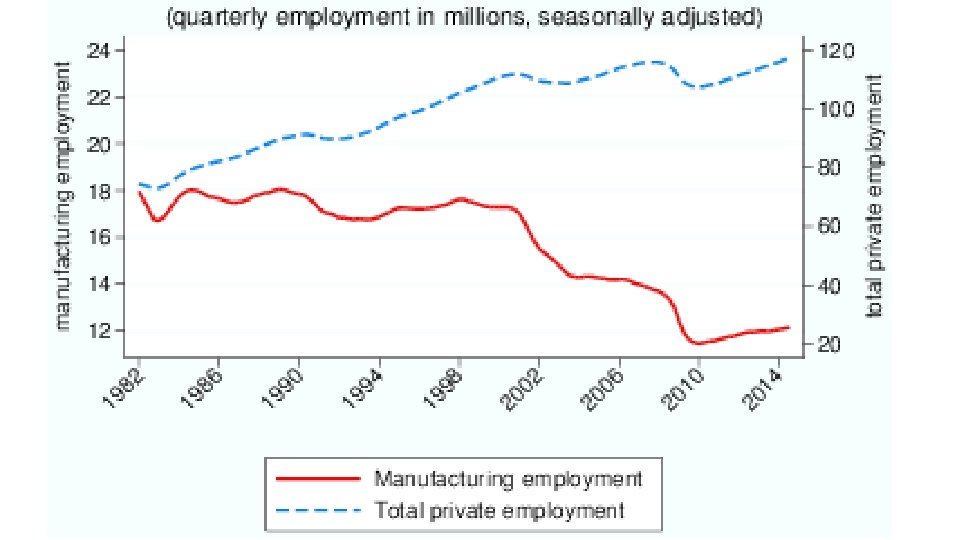
• Key ADH Result: Import growth from China caused 2. 4 million job losses in the US between 1999 -2011 • Corresponded with a steady decline during the same decade in US manufacturing employment • Contributes to an anti-China sentiment in the US and EU.
• 2. 4 million job losses seems significant but it is important to put this in some perspective • ADH themselves argue that their work only shows that some states and counties were affected notably by China trade, but … • Their work does not evaluate the overall effects of trade with China (should not be used to say trade with China was overall a bad thing)
• Feenstra and Sasahara (2017) estimate that US export growth during a similar period created 6. 6 million new jobs • While simultaneously causing about 2 million lost jobs due to imports • But, are the new jobs filled by workers who lost their jobs in other sectors. Surely, not always.
• Irwin (2016) points to a CBER study that estimated that 85% of job losses in manufacturing between 2000 -2010 was due to technology changes, not because of trade. • But two sectors, apparel and furniture, were hit hard. 40% of job losses were caused by trade • US apparel employment was 300, 000 in 2003, US furniture employment 550, 000 in 2005. • Note: US total employment in 2005 was about 135 million
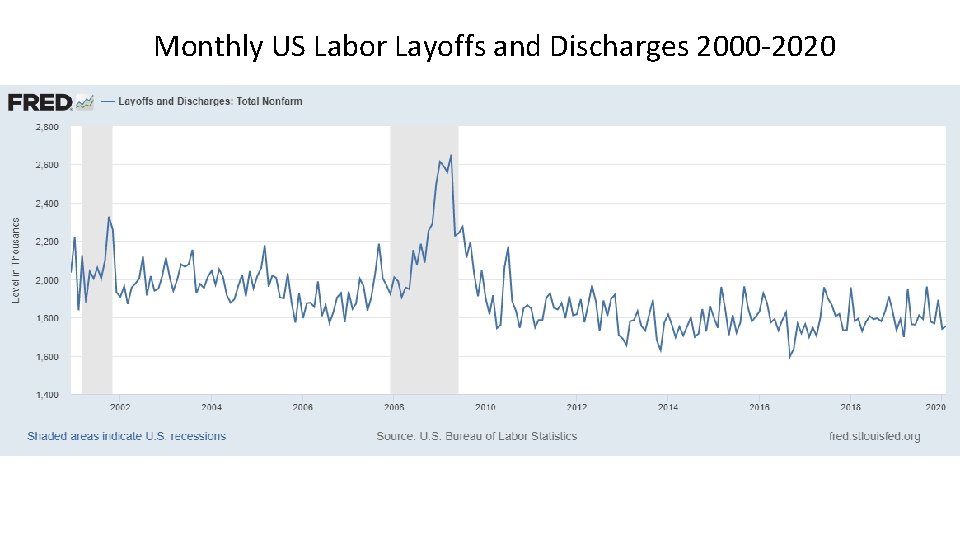
• 2. 4 million jobs lost between 1999 -2011 implies about 200, 000 jobs per year (0. 15% of all jobs) or almost 17, 000 jobs lost per month • Is this a lot or not? • Refer to JOLTs report to find out • JOLTS = Job Openings and Labor Turnover report; published monthly
Monthly US Labor Layoffs and Discharges 2000 -2020
• FRED diagrams shows that in 2005 there were approx. 2 million job losses EVERY MONTH in the US • Imports from China may have contributed 17, 000 job losses each month. . which is 0. 8% of total US layoffs every month • Question, Is that a big Shock? • To the 2. 4 million , yes • In the aggregate, no
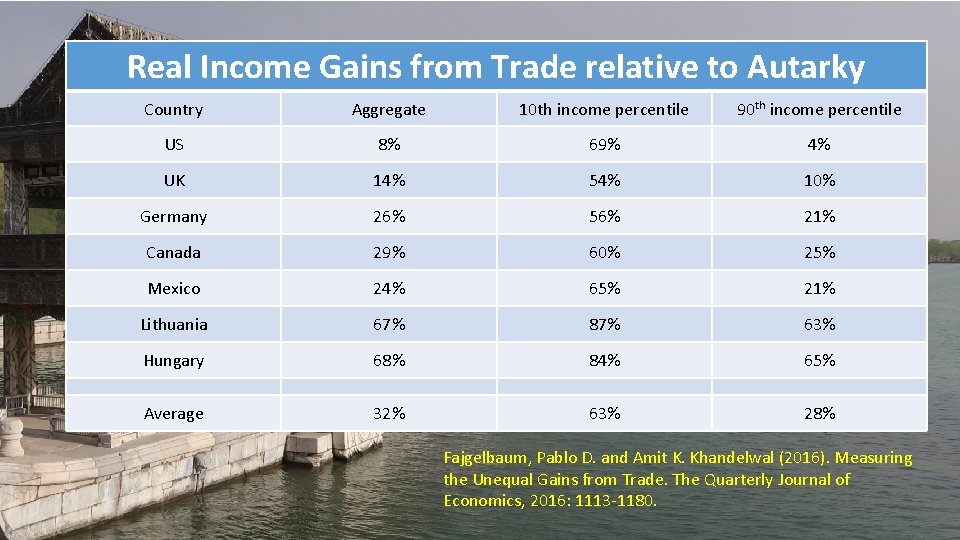
• Walmart effect – Imports from China mean prices at Walmart are lower than without the imports. • Trade theory suggests that the consumer benefits from lower prices will greatly outweigh the losses caused by job displacement. This is why a “country” does better with trade.
Real Income Gains from Trade relative to Autarky Country Aggregate 10 th income percentile 90 th income percentile US 8% 69% 4% UK 14% 54% 10% Germany 26% 56% 21% Canada 29% 60% 25% Mexico 24% 65% 21% Lithuania 67% 87% 63% Hungary 68% 84% 65% Average 32% 63% 28% Fajgelbaum, Pablo D. and Amit K. Khandelwal (2016). Measuring the Unequal Gains from Trade. The Quarterly Journal of Economics, 2016: 1113 -1180.
1. Was open trade with China a mistake? 2. Were the job losses large enough to be called a “shock” to the US economy? 3. Besides restricting trade, what other ways are there to mitigate the job loss damages? 4. Is it acceptable to give up the Walmart effect in order to save jobs in some sectors?