
The Chilling Effect of Parallelism Analysis and Allocation



- Slides: 14
The Chilling Effect of Parallelism: Analysis and Allocation of Parallel Real. Time Jobs for Peak System. Temperature Minimization Joël Goossens Université Libre de Bruxelles Nathan Fisher Wayne State University
Challenge: Thermal Management Heat is a by-product of computation. Processors must operate within thermal thresholds: • Reliability • Safety • Cooling Costs Dynamic Voltage/Frequency Scaling (DVFS) utilized to ensure no thresholds violations.
Current Research Trend: Thermal-Aware Real-Time Systems Common Objective: Minimize peak system temperature platform using DVFS cores while guaranteeing real-time constraints. Our Setting: Multicore Architectures with DVFS
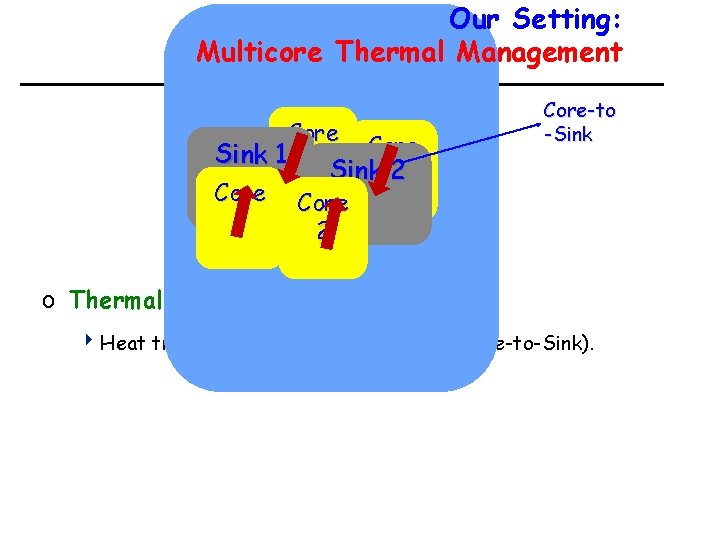
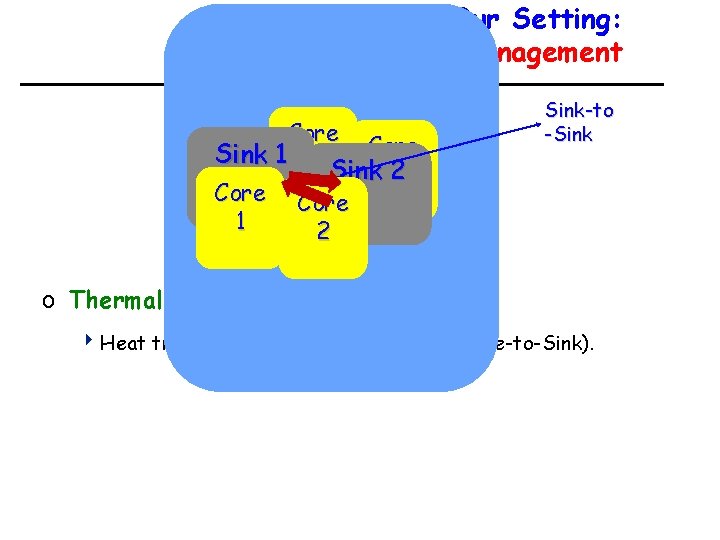
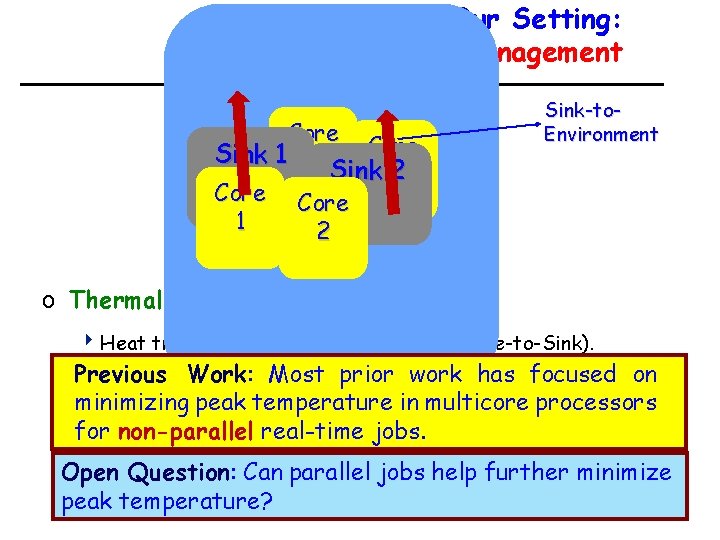
Our Setting: Multicore Thermal Management Core Sink 1 3 Sink 42 Core 1 2 Core-to -Sink o Thermal Challenges: 4 Heat transfer between elements (e. g. , Core-to-Sink).
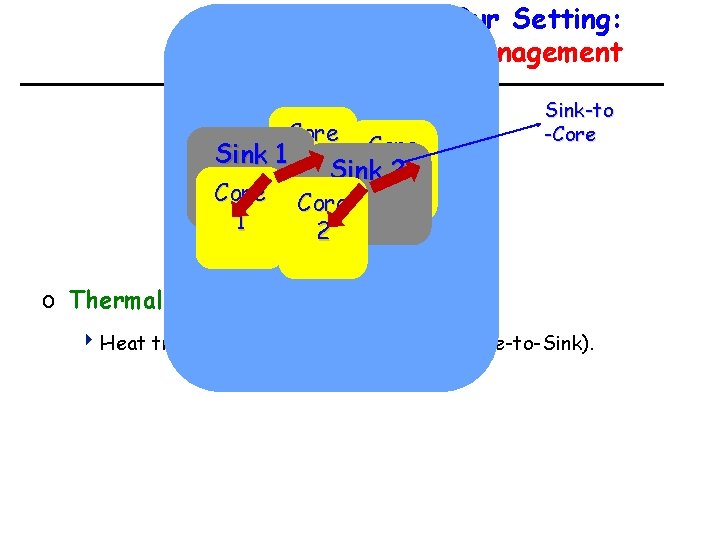
Our Setting: Multicore Thermal Management Core Sink 1 3 Sink 42 Core 1 2 Sink-to -Core o Thermal Challenges: 4 Heat transfer between elements (e. g. , Core-to-Sink).
Our Setting: Multicore Thermal Management Core Sink 1 3 Sink 42 Core 1 2 Sink-to -Sink o Thermal Challenges: 4 Heat transfer between elements (e. g. , Core-to-Sink).
Our Setting: Multicore Thermal Management Core Sink 1 3 Sink 42 Core 1 2 Core-to -Core o Thermal Challenges: 4 Heat transfer between elements (e. g. , Core-to-Sink).
Our Setting: Multicore Thermal Management Core Sink 1 3 Sink 42 Core 1 2 Sink-to. Environment o Thermal Challenges: 4 Heat transfer between elements (e. g. , Core-to-Sink). Previous Work: Most prior work has focused on minimizing peak temperature in multicore processors for non-parallel real-time jobs. Open Question: Can parallel jobs help further minimize peak temperature?
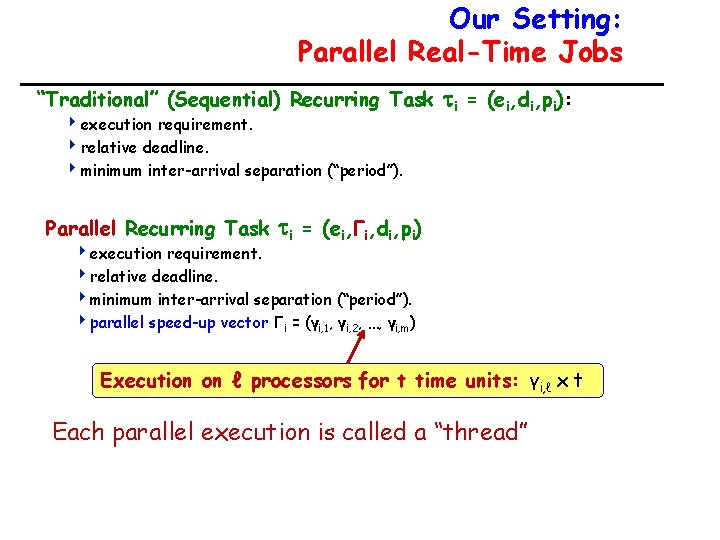
Our Setting: Parallel Real-Time Jobs “Traditional” (Sequential) Recurring Task 4 execution requirement. 4 relative deadline. 4 minimum inter-arrival separation (“period”). Parallel Recurring Task i = (ei, di, pi): i = (ei, Γi, di, pi) 4 execution requirement. 4 relative deadline. 4 minimum inter-arrival separation (“period”). 4 parallel speed-up vector Γi = (γi, 1, γi, 2, …, γi, m) Execution on ℓ processors for t time units: γi, ℓ x t Each parallel execution is called a “thread”
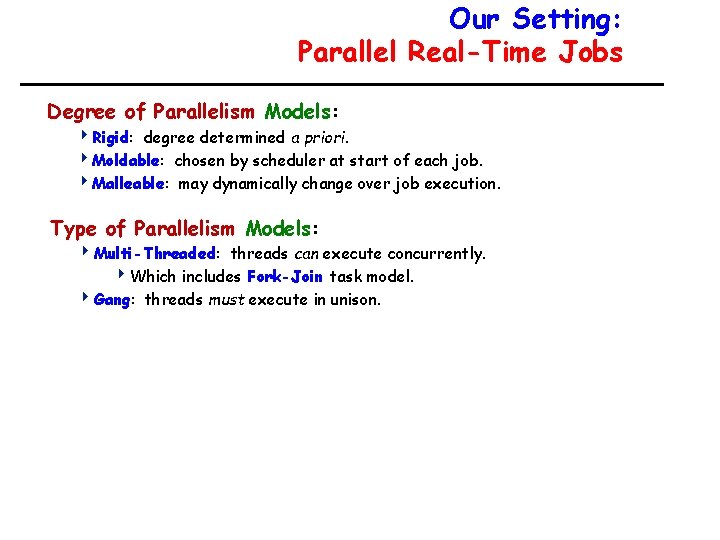
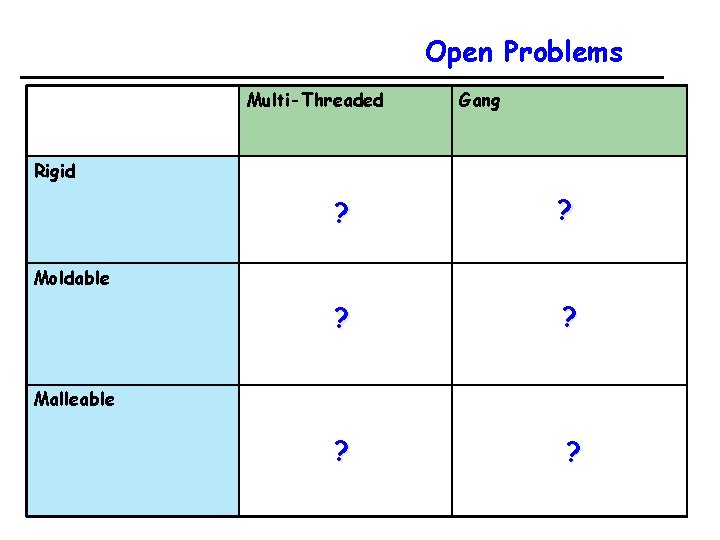
Our Setting: Parallel Real-Time Jobs Degree of Parallelism Models: 4 Rigid: degree determined a priori. 4 Moldable: chosen by scheduler at start of each job. 4 Malleable: may dynamically change over job execution. Type of Parallelism Models: 4 Multi-Threaded: threads can execute concurrently. 4 Which includes Fork-Join task model. 4 Gang: threads must execute in unison.
Motivating Example Consider two-core processor with one task: i = (ei, Γi, di, pi) = (1, [1, 2], 1, 1) Assume that processor speed is fixed at design-time. Option 1 (No Parallelism): One processor must execute at speed one. Option 2 (Degree-2 Parallelism): Each processor can execute at half-speed. Observation: Option 1 has greater peak temperature than Option 2 (even if some overhead is added for parallelism). Parallelism helps by spreading out heat generation!
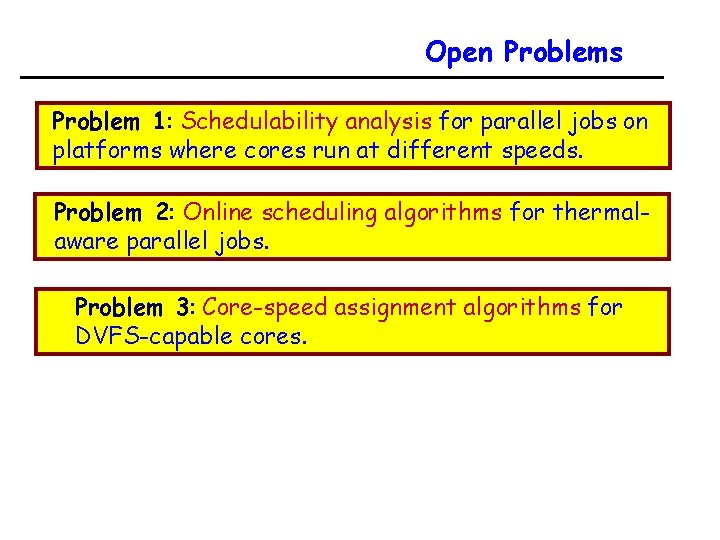
Open Problems Problem 1: Schedulability analysis for parallel jobs on platforms where cores run at different speeds. Problem 2: Online scheduling algorithms for thermalaware parallel jobs. Problem 3: Core-speed assignment algorithms for DVFS-capable cores.
Open Problems Multi-Threaded Gang Rigid ? ? ? Moldable Malleable
Thank You! Questions?