
The Children of Abraham The Holy Way of
The Children of Abraham The Holy Way of Life Palm Sunday, April 1, 2007 10 to 10: 50 am, in the Parlor. Everyone is welcome!

Primary References n n Three Faiths, One God: The Formative Faith and Practice of Judaism, Christianity, and Islam, Jacob Neusner, Bruce Chilton, William Graham. Brill Academic Publishers, 2002 The Sacred Paths: Understanding the Religions of the World, 3 rd Edition, Theodore M. Ludwig. Prentice Hall, 2000. ISBN: 013025682 X A History of the World's Religion, 10 th Edition. David S. Noss, John Boyer, Prentice Hall, 1999. ISBN: 0130105325 Religions of the World, 8 th Edition. Lewis M. Hopfe, Mark R. Woodward, Prentice Hall, 2000. ISBN: 0130282545
We gratefully thank You, for it is You Who are the LORD, our God and the God of our forefathers for all eternity; Rock of our lives, Shield of our salvation are You from generation to generation. We shall thank You and relate Your praise – for our lives, which are committed to Your power and for our souls that are entrusted to You; for Your miracles that are with us every day; and for Your wonders and favors in every season – evening, morning, and afternoon. The Beneficent One, for Your compassions were never exhausted, And the Compassionate One, for Your kindnesses never ended – Always have we put our hope in You Thanksgiving Prayer (Modim) for Pesach (Passover), Jewish Service Book (Siddur), translated by Rabbi Nosson Scherman, Art. Scroll Mesorah Series, p. 669
The Holy Way of Life Introduction
The Holy Way of Life Introduction n General note: n n Judaism and Islam are alike in that both tend to emphasize orthopraxy = “right practice” Christianity on the other hand, tends to emphasize orthodoxy = “right belief”
The Holy Way of Life Introduction n 1. The View of This Life. How does a Jew, Christian, or Muslim see this life as a manifestation of God’s purposes? 2. Determining How To Live. How does a Jew, Christian, or Muslim figure out what is the holy or correct way of living? 3. The Rhythms of A Holy Life. What are the “rhythms” – the rituals, traditions, the feast days – of holy living for a Jew, Christian, or Muslim?
The Holy Way of Life Judaism
Judaism 1. The View of This Life n n “You shall be holy, for I the Lord your God am Holy” (Leviticus 19: 2 NRSV) The purpose of life is to become God’s holy people by: n n accepting the kingship of God valuing all of God’s creatures
Judaism 1. The View of This Life n n Human beings are created in the “image of God, ” just “a little lower than God, ” and are partners with God in this life for the fulfillment of God’s will God created all things good, and therefore a holy life includes the obligation to enjoy and enhance life: n n good food, wealth, sexual pleasure all gifts of God to be enjoyed actions which degrade life are forbidden
Judaism 1. The View of This Life: Sin is averah = transgressing God’s will n “any act or attitude, whether of omission or commission, which nullifies God’s will, obscures His glory, profanes His name, opposed His kingdom, or transgresses the Mitzvot [commandments] of the Torah” (Milton Steinberg) n
Judaism 1. The View of This Life: Sin There is no such thing as “original sin” or “fallen humanity” in Judaism (that is exclusively a Christian idea) n Human beings have two basic inclinations: n good inclination (yetver hatov) n evil inclination (yetver hara) n
Judaism 1. The View of This Life: Sin The evil inclination (yetver hara) drives human beings to gratify their instincts and desires. Includes appetite for food, sexual drive n The evil inclination (yetver hara) is necessary and therefore good: “if it were not for the evil inclination, man would not build a house, or take a wife, or beget a child, or engage in business” (Gen. R. Bereshit, 9: 7) n
Judaism 1. The View of This Life: Sin Life is a continuing struggle to use the evil inclination (yetver hara) in a positive, lifeaffirming way n It was necessary for God to “wound” human beings by giving them the evil inclination (yetver hara), but God gives them Torah as the “antidote” n
Judaism 1. The View of This Life: Redemption and Sanctification n n God redeems by calling human beings to be what they were created to be We can distinguish three redemptive “movements” of God: n n 1. God intervenes in human history with mighty acts of salvation 2. God reveals Torah, including mitzvot and halakot, as “ways” to holiness n n n mitzva (pl. mitzvot): a law / commandment in the Hebrew Bible halaka (pl. halakot) : a law / commandment in the Oral Torah 3. God shows mercy and forgiveness when human beings repent
Judaism 1. The View of This Life: Redemption and Sanctification n n Repentance (teshuvah) is the highest virtue in Judaism It is a purely human act (no “grace” of God is involved). Requires: n n n 1. acknowledging wrongdoing 2. compensating for any injury done 3. resolving to not repeat sinful act Only after performing 1, 2, and 3 can a sinner ask for God’s forgiveness and receive God’s mercy Yom Kippur (Day of the Atonement), one of the most holy days of Judaism, is for repentance (teshuvah)
Judaism 1. The View of This Life: Redemption and Sanctification n n Sanctification: the process of becoming holy Path of sanctification (becoming holy) involves: n n 1. repentance of sins (= transgressions of God’s will) 2. following the laws and commandments: n n Mitzvot (singular: mitzva): laws / commandments in the Hebrew Bible Halakot (singular: halaka): laws / commandments in the oral Torah, derived from scripture or from tradition (“the Faith of the Fathers”) by rabbis
Judaism 1. The View of This Life: Estrangement of the Present Age In the present age, Israel (the Jews, the Chosen People of God) is estranged and alienated from God n Israel’s alienation from God will end when the hearts and deeds of the Chosen People conform to God’s will n
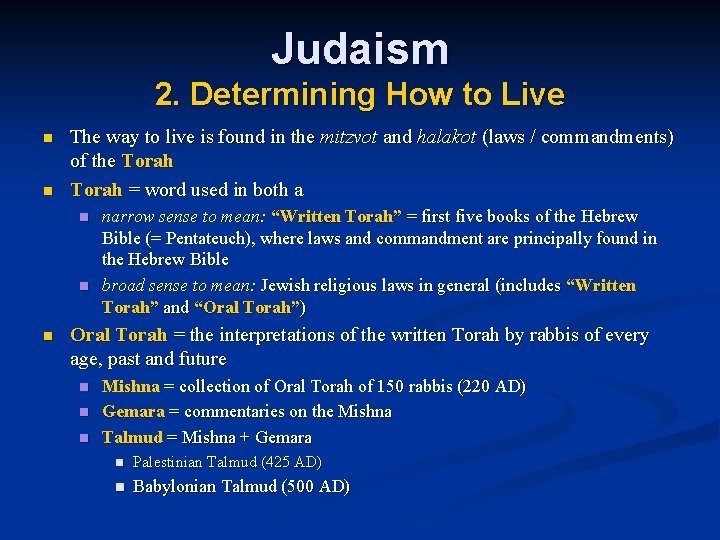
Judaism 2. Determining How to Live n n The way to live is found in the mitzvot and halakot (laws / commandments) of the Torah = word used in both a n narrow sense to mean: “Written Torah” = first five books of the Hebrew Bible (= Pentateuch), where laws and commandment are principally found in the Hebrew Bible broad sense to mean: Jewish religious laws in general (includes “Written Torah” and “Oral Torah”) Oral Torah = the interpretations of the written Torah by rabbis of every age, past and future n n n Mishna = collection of Oral Torah of 150 rabbis (220 AD) Gemara = commentaries on the Mishna Talmud = Mishna + Gemara n Palestinian Talmud (425 AD) n Babylonian Talmud (500 AD)
Judaism 2. Determining How to Live n Mitzvot (singular: mitzva): laws / commandments in the Hebrew Bible n There are 613 mitzvot or commandments in the Hebrew Bible n n n 365 negative commandments 248 positive commandments Halakot (singular: halaka): laws / commandments in the “Oral Torah, ” derived from scripture or from tradition (“the Faith of the Fathers”) by the rabbis
Judaism 2. Determining How to Live The mitzvot and halakot (Jewish religious laws / commandments) are a revelation of God. Their purpose is to create a kingdom of priests and a holy people n The mitzvot and halakot are considered a gift, a great joy, a sign of God’s love n
Judaism 2. Determining How to Live n n n As Christians, we tend to view religious commandments as a set of rules or standards by which our “goodness” or “holiness” is judged or assessed However, for Jews, the purpose of mitzvot and halakot (laws / commandments) is not to spell out the rules by which a person’s holiness is judged. Instead, laws and commandments are seen as the recipes or prescriptions for how a person can become holy (that is, sanctified) Following the mitzvot and halakot transforms a person inwardly, sanctifies them, makes them holy
Judaism 2. Determining How to Live n Abraham Heschel: “The true goal for man is to be what he does… A mitzva therefore, is not mere doing but an act that embraces both the doer and the deed. … It is a distortion to say that Judaism consists exclusively of performing ritual or moral deeds, and to forget that the goal of all performing is in transforming the soul. Even before Israel was told in the Ten Commandments what to do it was told what to be: a holy people. To perform deeds of holiness is to absorb the holiness of deeds… Man is not for the sake of good deeds; the good deeds are for the sake of man… The goal is not that a ceremony be performed; the goal is that man be transformed; to worship the Holy in order to be holy. The purpose of the mitzvot is to sanctify man”
Judaism 3. Rhythms of a Holy Life: The Year Judaic year follows the lunar calendar n The new moon marks the beginning of a new month n n n Period new moon to new moon: 29. 530588 days Two critical moments in the unfolding of a year (times of heightened celebration): first full moon after autumn begins n first full moon after spring begins n
Judaism 3. Rhythms of a Holy Life: The Year n Autumn Holy Days: n New moon marking beginning of the month of Tishre (in September) marks the New Year Rosh Hashanah and beginning of the ten Days of Awe or High Holy Days n n Rosh Hashanah: celebration of Creation and the first act of human repentance (= teshuvah) by Adam and Eve Days of Awe / High Holy Days: time to engage in cheshbon nefesh (=“soul searching”) to right our relationships to God and others 10 days later: Yom Kippur (Day of Atonement, the “Sabbath of Sabbaths”) 5 days later: the full moon and the beginning of the eight day Festival of Tabernacles or Booths (Sukkot) n n Antiquity: the central pilgrimage festival to Jerusalem to celebrate the harvest Festival ends with Shemini Asseret (solemn) and Simhat Torah (rejoicing in the Torah)
Judaism 3. Rhythms of a Holy Life: The Year n Spring Holy Days: n n First new moon after the vernal equinox begins the month of Nisan Next full moon: Passover (Pesach) n n 50 days after Passover: festival of Pentecost (Shavuot) n n n Lasts for 7 days Biblically: celebration of the harvest day for barley Rabbis: celebration of the “marriage” between God and the Jewish people when God gave them the Torah The 49 days between Pesach and Shavuot is the Omer n n Jews are commanded to count each day leading to Shavuot 12 th day of the Omer: “Day of Catastrophe and Heroism” or “Holocaust Memorial Day” (established 1951)
Judaism 3. Rhythms of a Holy Life: The Year n Some minor festivals: n Hanukkah (Feast of Lights) n n n Eight day holiday based on the Maccabean revolt against the Syrian Greeks from 168 to 165 BC, leading to a free Israel from 165 BC to 63 BC Celebrates the purity of living a lifestyle dedicated to God amidst the impurity of one’s culture (in Maccabean times: Hellenistic sexual and religious practices) Purim (Lots) n n Celebrates the turning of the tables on Haman (see book of Esther) Talmud: one should overindulge until one can no longer distinguish between cursed Haman and blessed Mordechai.
Judaism 3. Rhythms of a Holy Life: The Week n Sabbath (Saturday) marks the movement of time through the week n n n sanctification of the Sabbath is one of the Ten Commandments devoted to sacred activities: synagogue worship, Torah study, eating, drinking, enjoying oneself song for the Sabbath: Psalm 92: “ 1 A song; for the sabbath day. 2 It is good to praise the LORD, to sing hymns to Your name, O Most High, 3 To proclaim Your steadfast love at daybreak, Your faithfulness each night …” (JPS Tanahk)
Judaism 3. Rhythms of a Holy Life: Person’s Life n Rites of Passage: birth n puberty n marriage n death n
Judaism 3. Rhythms of a Holy Life: Person’s Life n Birth: Covenant of circumcision (brit milah): the covenant is engraved on the flesh of every male Jewish child n Takes place 8 days after birth n Requires quorum of 10 adult males n A chair is set aside for Elijah n Circumciser: mohel n
Judaism 3. Rhythms of a Holy Life: Person’s Life n Puberty: bar mitzvah or bat mitzvah (son/ daughter of the commandments) n Acceptance of the full responsibility of the Yoke of the Torah n Young person pronounces a benediction over a portion of the Torah; reads a prophetic passage n
Judaism 3. Rhythms of a Holy Life: Person’s Life n Death. The Confession before death: My God and God of my fathers, accept my prayer… Forgive me for all the sins which I have committed in my lifetime… Accept my pain and suffering as atonement and forgive my wrongdoing for against You alone have I sinned… I acknowledge that my life and recovery depend on You. May it be Your will to heal me. Yet if You have decreed that I shall die of this affliction, May my death atone for all sins and transgressions which I have committed before You.
Shelter me in the shadow of Your wings. Grant me a share in the world to come. Father of orphans and Guardian of widows, protect my beloved family… Into Your hand I commit my soul. You redeem me, O Lord God of truth. Hear O Israel, the Lord is our God, the Lord alone. The Lord He is God.
Judaism 3. Rhythms of a Holy Life: Person’s Life n n n burial the day of death or the following day broken pottery is laid on eyes and mouths as signs of vanity a handful of dirt from Land of Israel is laid under the head family recites Qaddish (prayer of sanctifications of God’s name that looks forward to the Messiah and the resurrection of the dead) mourners remains at home for 7 days, recite the Quaddish for 11 months
The Holy Way of Life Christianity
Christianity 1. The View of This Life n God created the world and all that is in it as good n n n matter, food, drink, play, bodily appetites, sex, are good Humans are made in the image and likeness of God and are the children of God Purpose of life is to love and serve God, to love all our brothers and sisters in Christ, and help fulfill God’s purposes for creation n which includes the fulfillment of all other humans.
Christianity 1. The View of This Life: Sin n Something happened however to God’s good creation and to human beings: n n the very nature of human beings fractured the tendency to sin became part of the nature of human beings, alienating them from God creation itself became broken, no longer a paradise, only a shadow of what God intended. Pain and suffering entered creation The “something” was “the Fall” (the rebellion of Adam and Eve) and “Original Sin, ” transmitted to every human being since
Christianity 1. The View of This Life: Sin n The sinfulness of the fallen human nature is so profound that (unlike in Judaism and Islam), it cannot be overcome by human will alone n human beings are literally enslaved to sin
Christianity 1. The View of This Life: Redemption and Sanctification n n Redemption cannot come from following the commandments, for human being are incapable of following the commandments The redemption of humanity required a new and sacrificial act of love from God: n “…God is love. God’s love was revealed among us in this way: God sent his only Son into the world so that we might live through him. … he loved us and sent his Son to be the atoning sacrifice for our sins. ” (1 John 4: 8 -10 NRSV)
Christianity 1. The View of This Life: Redemption and Sanctification n n We begin to live through Christ with hope of redemption through the grace (includes both the presence of God within us = uncreated grace, and a divine infusion or “medicine” = created grace) of the sacrament of baptism The coming of Christ also inaugurated a “new age” or “new creation” (2 Cor. 5: 17) which has not yet reached fulfillment n the Kingdom of God on this earth has begun, is Now, but also Not Yet
Christianity 2. Determining How To Live n When Jesus was asked by the Pharisees what was the greatest commandment, he answered (like a good Rabbi) by citing two (Matthew 22: 37 -40 NRSV): n ‘You shall love the Lord your God with all your heart, and with all your soul, and with all your mind. ’ This is the greatest and first commandment. And a second is like it: ‘You shall love your neighbor as yourself. ’ On these two commandments hang all the law and the prophets.
Christianity 2. Determining How To Live n n How does one love God and one’s neighbor? How do we put love in action? There is a tension in Christianity between the law and the freedom of love n n n we value the gift of written Torah (Old Testament) and its guidance on how to love God and neighbor But what about situations not covered by Torah and the Commandments? And does merely “obeying” the letter of a commandment fully satisfy God’s desire for us to love God and others?
Christianity 2. Determining How To Live n We also value the rightness of actions that spring from love. St. Augustine, 354 -430 AD wrote: “Love, and do what you will. . . Let love’s root be within you, and from that root nothing but good can spring. ”
Christianity 2. Determining How To Live n Paul: we need both law and love. God’s will for us to love means freedom from the literal form of law, but not from the “spirit” of the law, that is, God’s will for creation “…love is the fulfilling of the law” (Romans 13: 10, NRSV) n “For the whole law is summed up in a single commandment, ‘You shall love your neighbor as yourself. ’” (Galatians 5: 14, NRSV) n
Christianity 3. Rhythms of a Holy Life: The Week One of the earliest Christian practices was communal worship and sharing of Eucharist on Sunday (the day of Jesus’ Resurrection) n There is however no “divine law” for a particular worship practice (unlike Judaism and Islam), so there is wide variation: n “liturgical” versus “non liturgical” churches n “high” church versus “low” church n
Christianity 3. Rhythms of a Holy Life: Person’s Life n Seven Sacraments (means of grace) 1. Baptism n 2. Eucharist n 3. Confirmation n 4. Penance or Confession n 5. Marriage n 6. Holy Orders n 7. Anointing of the Sick / Extreme Unction n
Christianity 3. Rhythms of a Holy Life: The Year n Major Festivals and Holy Days: Lent and Easter n Advent, Christmas and Epiphany n Pentecost and the Season of the Church n
The Holy Way of Life Islam
Islam 1. The View of This Life: Role of Humans n God created everything to serve God, and the worth of creation lies in its servanthood to the Creator The whole of nature is “muslim, ” submitting to the laws of the Master, serving God by conforming to the laws of their being n muslim = one who submits n
Islam 1. The View of This Life: Role of Humans n n Human beings are God’s special creation, higher than the angels, and have the special role of exercising dominion over creation as the “caliphs” of God Goal of human beings is to submit to God (become perfect Muslims) Our bodies already largely submit to God by nature (breathing, heartbeat, genetics) Our task in life is to direct our reason, free will, and speech to follow God’s design (given in the Qur’an and God’s law = the Shari’a) and by so doing, completely and perfectly submit to God
Islam 1. The View of This Life: Sin n Human beings are “muslim” by nature (and not fundamentally sinful or fallen) But human beings tend to be “forgetful” and “negligent” of their true “muslim” nature. They “fall asleep, ” forgetting how they must fulfill their true nature through submission to God Because human beings are “muslim” by nature, it is possible to be perfect: God does not require what is beyond our capabilities
Islam 1. The View of This Life: Redemption and Sanctification n n Muslims do not speak of being “saved” or “redeemed, ” but rather of achieving a “life of felicity, ” which we are fully capable of by our nature The path of transformation to a “life of felicity, ” = a life of submission (= islam) to God’s design, is achieved through: n n iman: a belief in the truth of the Qur’an, achieved through free use of our intelligence molding our lives to God’s design through the practice of Shari’ah, the Way
Islam 1. The View of This Life: Redemption and Sanctification n n The path of transformation is a continuous struggle with the tendency to forget or neglect our true muslim nature -- to submit to God’s design Jihad: the struggle to establish God’s design in the world. May be: n n n an outer struggle, a holy war an inner struggle (the greater jihad) Life then is a continual jihad against unbelievers, evildoers, and in particular (the greater jihad) against our own forgetfulness and neglectfulness of our true muslim nature
Islam 2. Determining How to Live n Shari’ah n n literally: “watering place, way to water” = divinely revealed Islamic law n n God’s total design for human life. The divine law established by God for human life The way to salvation

Islam 2. Determining How to Live n Four methods accepted for determining Shari’ah: 1. the Qur’an n 2. the Sunna (the example or custom of the Prophet Muhammad, documented in the hadith) n 3. consensus of the faithful (ijma) n n in practice, the agreement of the majority of the ulama (those learned in Islam; analogous to Jewish rabbis) n 4. analogical reasoning (qiyas)
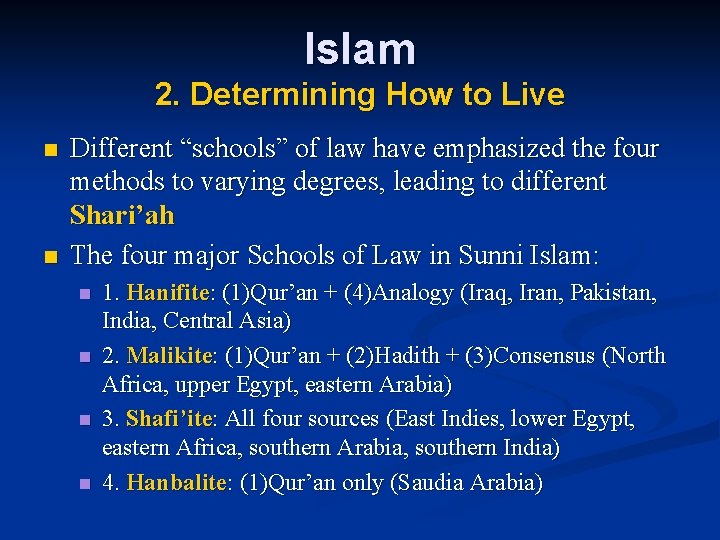
Islam 2. Determining How to Live n n Different “schools” of law have emphasized the four methods to varying degrees, leading to different Shari’ah The four major Schools of Law in Sunni Islam: n n 1. Hanifite: (1)Qur’an + (4)Analogy (Iraq, Iran, Pakistan, India, Central Asia) 2. Malikite: (1)Qur’an + (2)Hadith + (3)Consensus (North Africa, upper Egypt, eastern Arabia) 3. Shafi’ite: All four sources (East Indies, lower Egypt, eastern Africa, southern Arabia, southern India) 4. Hanbalite: (1)Qur’an only (Saudia Arabia)
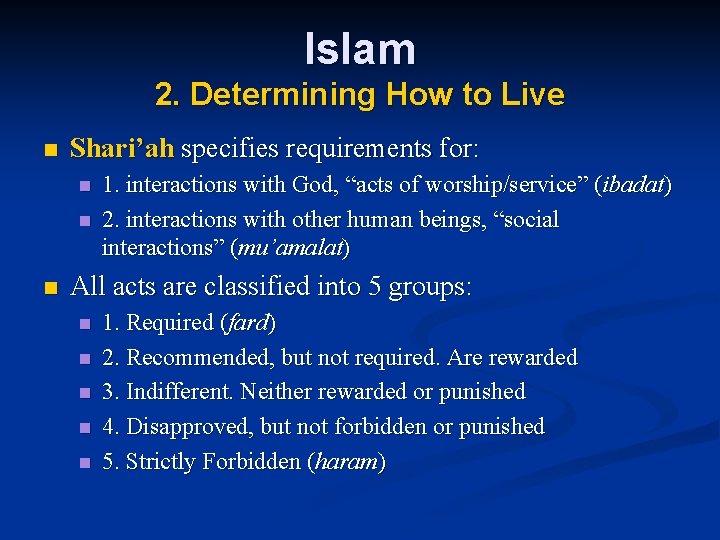
Islam 2. Determining How to Live n Shari’ah specifies requirements for: n n n 1. interactions with God, “acts of worship/service” (ibadat) 2. interactions with other human beings, “social interactions” (mu’amalat) All acts are classified into 5 groups: n n n 1. Required (fard) 2. Recommended, but not required. Are rewarded 3. Indifferent. Neither rewarded or punished 4. Disapproved, but not forbidden or punished 5. Strictly Forbidden (haram)
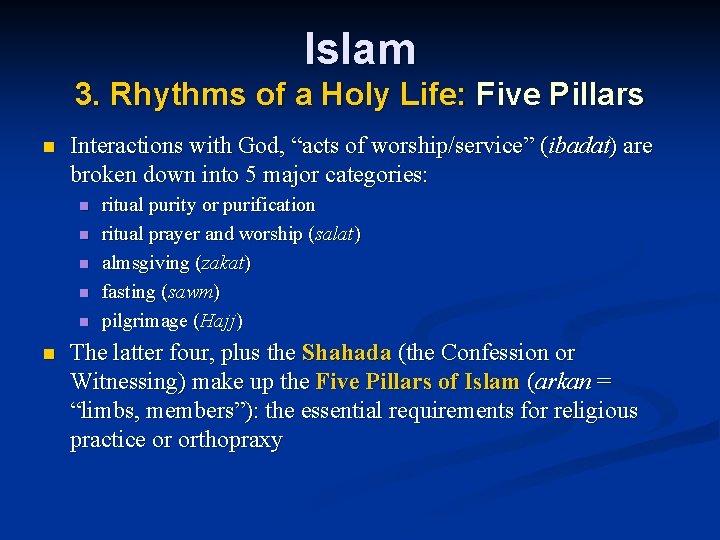
Islam 3. Rhythms of a Holy Life: Five Pillars n Interactions with God, “acts of worship/service” (ibadat) are broken down into 5 major categories: n n n ritual purity or purification ritual prayer and worship (salat) almsgiving (zakat) fasting (sawm) pilgrimage (Hajj) The latter four, plus the Shahada (the Confession or Witnessing) make up the Five Pillars of Islam (arkan = “limbs, members”): the essential requirements for religious practice or orthopraxy
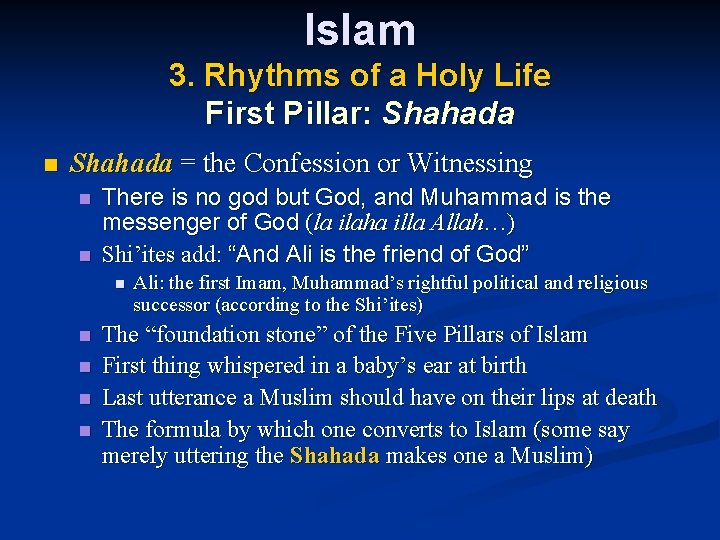
Islam 3. Rhythms of a Holy Life First Pillar: Shahada n Shahada = the Confession or Witnessing n n There is no god but God, and Muhammad is the messenger of God (la ilaha illa Allah…) Shi’ites add: “And Ali is the friend of God” n n n Ali: the first Imam, Muhammad’s rightful political and religious successor (according to the Shi’ites) The “foundation stone” of the Five Pillars of Islam First thing whispered in a baby’s ear at birth Last utterance a Muslim should have on their lips at death The formula by which one converts to Islam (some say merely uttering the Shahada makes one a Muslim)
Islam 3. Rhythms of a Holy Life Second Pillar: Salat n n n Salat (ritual prayer / worship) should be performed five times a day (dawn, noon, mid-afternoon, sunset, evening) Purity (which is both physical and symbolic) is essential for an act of salat to be valid “God loves those who seek to purify themselves” (Qur’an 9: 108) Hadith (accounts of the customs of Muhammad) defines: n n n how to hold one’s hands & body what and how to recite from the Qur’an how to dress when to do it acceptable modifications when traveling
Islam 3. Rhythms of a Holy Life Third Pillar: Zakat n Zakat (ritual almsgiving): formalized system of taxation of wealth for public welfare, payable once a year n n about 2. 5% of one’s capital assets over a defined minimum. Personal possessions such as cars, clothing, houses are excluded “Whatever you lend out in usury to gain value through other people’s wealth will not increase in God’s eyes, but whatever you give in charity (zakat), in your desire for God’s approval, will earn multiple rewards. ” (Qur’an 30: 39)
Islam 3. Rhythms of a Holy Life Third Pillar: Zakat n n n Zakat should be given to the poor, the needy, new converts, debtors, for ransom of slaves, those doing good works, travelers (Qur’an 9: 60) Should not be given to Christian or Jews; they should be given other aid Cannot be used for building Mosques or for burying the dead
Islam 3. Rhythms of a Holy Life Fourth Pillar: Sawm n Sawm (Fasting). Nothing can be taken into the body during the daylight hours during the entire lunar month of Ramadan (no eating, drinking, smoking, or sexual activity) n n n Fast broken at sunset: breakfast Note: Islam, like Judaism uses a lunar calendar. Unlike Judaism, Islam does not add a 13 th month every so often to keep pace with the solar calendar. Islamic months therefore shift 11 days each successive solar year “… fasting is prescribed for you, … so that you may be mindful of God. Fast for a specific number of days, but if one of you is ill, or on a journey, [then fast] on other days later. For those who can fast only with extreme difficulty, there is a way to compensate – feed a needy person. …” (Qur’an 2: 183 -5)
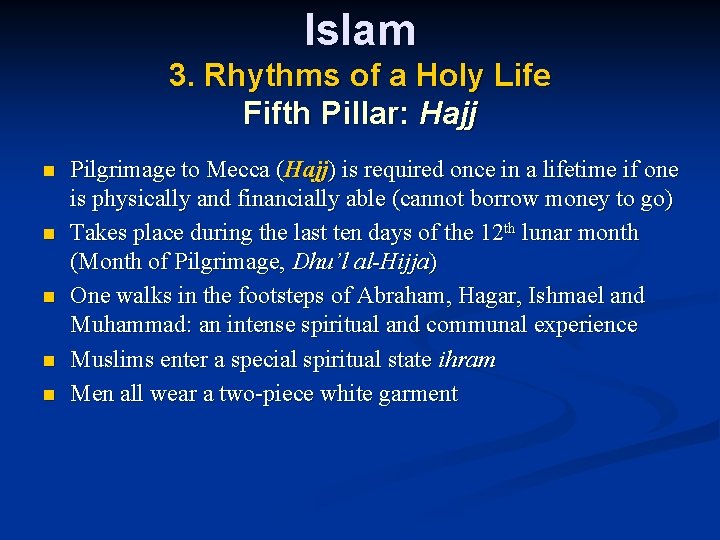
Islam 3. Rhythms of a Holy Life Fifth Pillar: Hajj n n n Pilgrimage to Mecca (Hajj) is required once in a lifetime if one is physically and financially able (cannot borrow money to go) Takes place during the last ten days of the 12 th lunar month (Month of Pilgrimage, Dhu’l al-Hijja) One walks in the footsteps of Abraham, Hagar, Ishmael and Muhammad: an intense spiritual and communal experience Muslims enter a special spiritual state ihram Men all wear a two-piece white garment
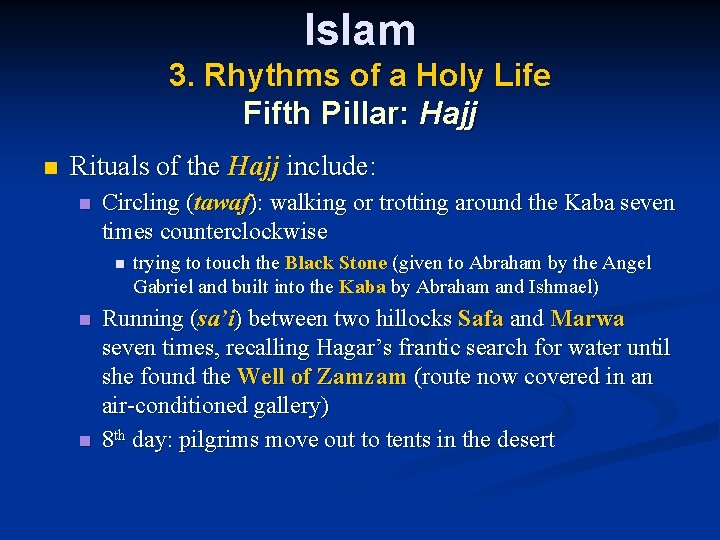
Islam 3. Rhythms of a Holy Life Fifth Pillar: Hajj n Rituals of the Hajj include: n Circling (tawaf): walking or trotting around the Kaba seven times counterclockwise n n n trying to touch the Black Stone (given to Abraham by the Angel Gabriel and built into the Kaba by Abraham and Ishmael) Running (sa’i) between two hillocks Safa and Marwa seven times, recalling Hagar’s frantic search for water until she found the Well of Zamzam (route now covered in an air-conditioned gallery) 8 th day: pilgrims move out to tents in the desert
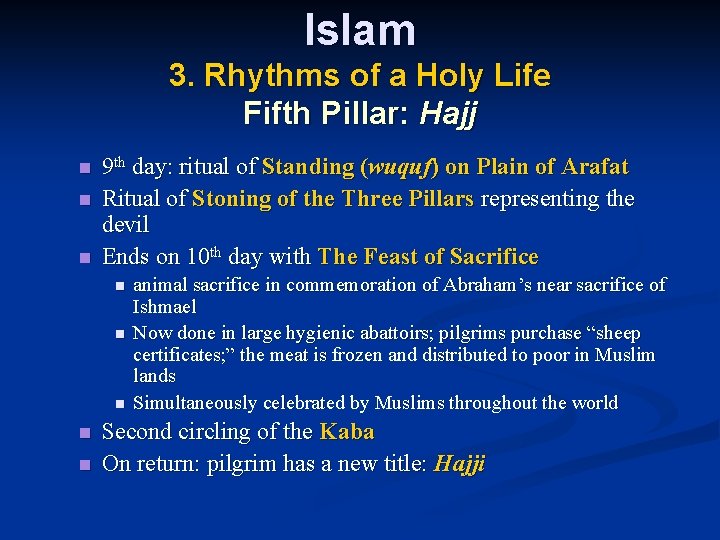
Islam 3. Rhythms of a Holy Life Fifth Pillar: Hajj n n n 9 th day: ritual of Standing (wuquf) on Plain of Arafat Ritual of Stoning of the Three Pillars representing the devil Ends on 10 th day with The Feast of Sacrifice n n n animal sacrifice in commemoration of Abraham’s near sacrifice of Ishmael Now done in large hygienic abattoirs; pilgrims purchase “sheep certificates; ” the meat is frozen and distributed to poor in Muslim lands Simultaneously celebrated by Muslims throughout the world Second circling of the Kaba On return: pilgrim has a new title: Hajji
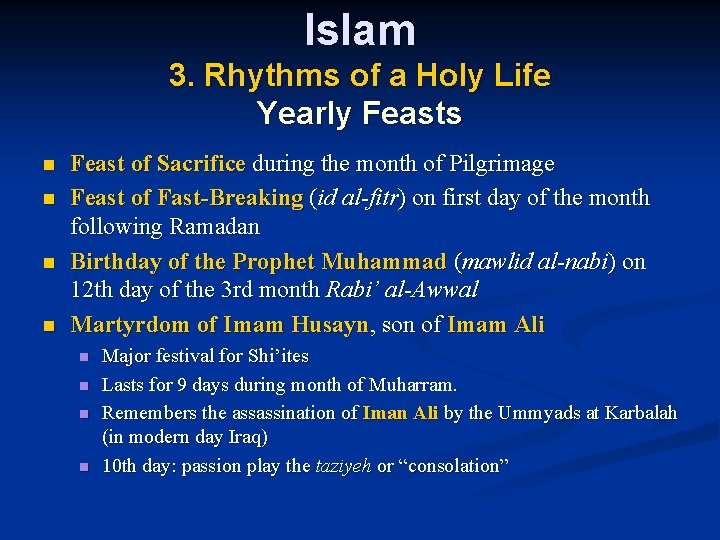
Islam 3. Rhythms of a Holy Life Yearly Feasts n n Feast of Sacrifice during the month of Pilgrimage Feast of Fast-Breaking (id al-fitr) on first day of the month following Ramadan Birthday of the Prophet Muhammad (mawlid al-nabi) on 12 th day of the 3 rd month Rabi’ al-Awwal Martyrdom of Imam Husayn, son of Imam Ali n n Major festival for Shi’ites Lasts for 9 days during month of Muharram. Remembers the assassination of Iman Ali by the Ummyads at Karbalah (in modern day Iraq) 10 th day: passion play the taziyeh or “consolation”
Primary References n n Three Faiths, One God: The Formative Faith and Practice of Judaism, Christianity, and Islam, Jacob Neusner, Bruce Chilton, William Graham. Brill Academic Publishers, 2002 The Sacred Paths: Understanding the Religions of the World, 3 rd Edition, Theodore M. Ludwig. Prentice Hall, 2000. ISBN: 013025682 X A History of the World's Religion, 10 th Edition. David S. Noss, John Boyer, Prentice Hall, 1999. ISBN: 0130105325 Religions of the World, 8 th Edition. Lewis M. Hopfe, Mark R. Woodward, Prentice Hall, 2000. ISBN: 0130282545
- Slides: 67