
The Chicano Experience A Historical Overview 1831 Map

- Slides: 29
The Chicano Experience A Historical Overview
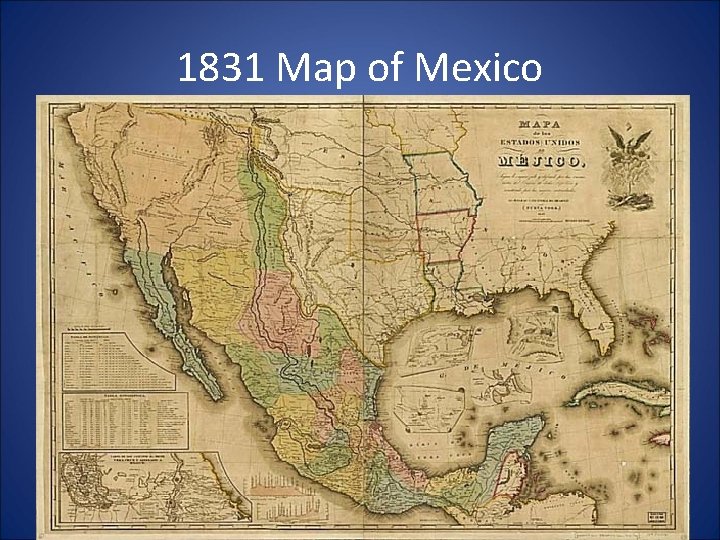
1831 Map of Mexico
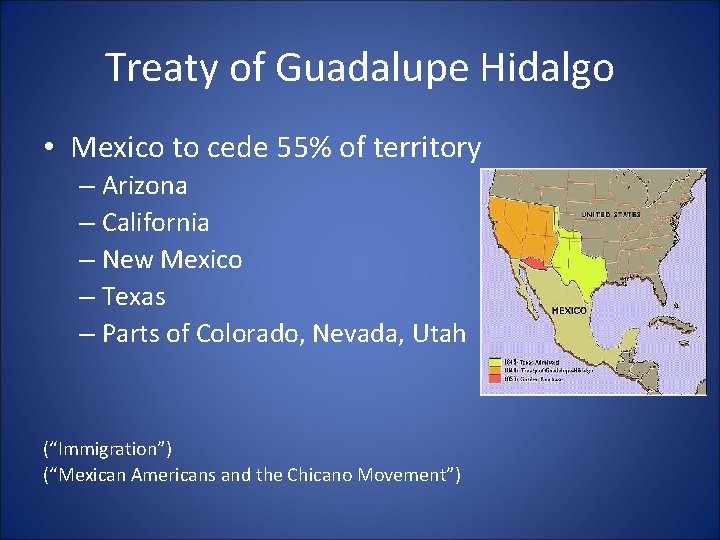
Treaty of Guadalupe Hidalgo • Mexico to cede 55% of territory – Arizona – California – New Mexico – Texas – Parts of Colorado, Nevada, Utah (“Immigration”) (“Mexican Americans and the Chicano Movement”)
Treaty of Guadalupe Hidalgo • Promised… – Mexicans could maintain current residence. – Retain property rights – Religious and cultural freedoms – Become US citizens, if desired (Perl, 24)
Three Great Surges • 1900 s • 1940 s • 1990 s to today
1900 s • • • Revolution in Mexico U. S. Economy El Paso, Texas Easy return to Mexico Population quadrupled (“Immigration”, Perl)
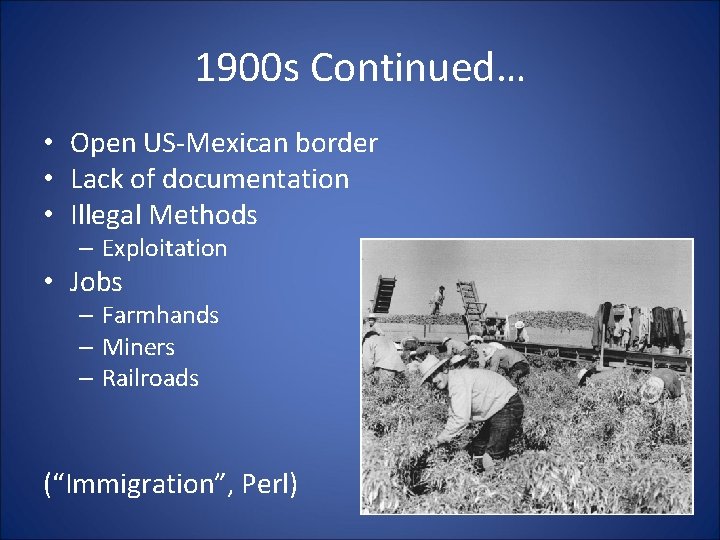
1900 s Continued… • Open US-Mexican border • Lack of documentation • Illegal Methods – Exploitation • Jobs – Farmhands – Miners – Railroads (“Immigration”, Perl)
World War I • 1917 • Mexicans move north • Mexican labor needed – Chicago—meatpacking – Detroit—auto factories – Steel mills – Paper factories – Chemical plants (Perl, 47)
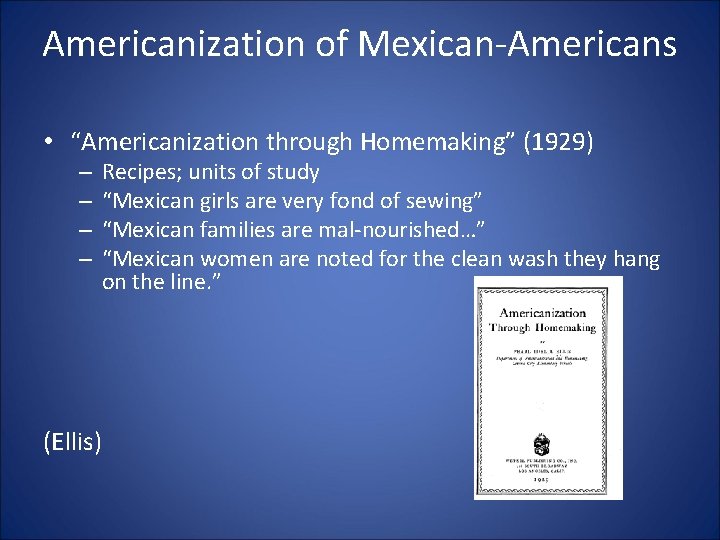
Americanization of Mexican-Americans • “Americanization through Homemaking” (1929) – – Recipes; units of study “Mexican girls are very fond of sewing” “Mexican families are mal-nourished…” “Mexican women are noted for the clean wash they hang on the line. ” (Ellis)
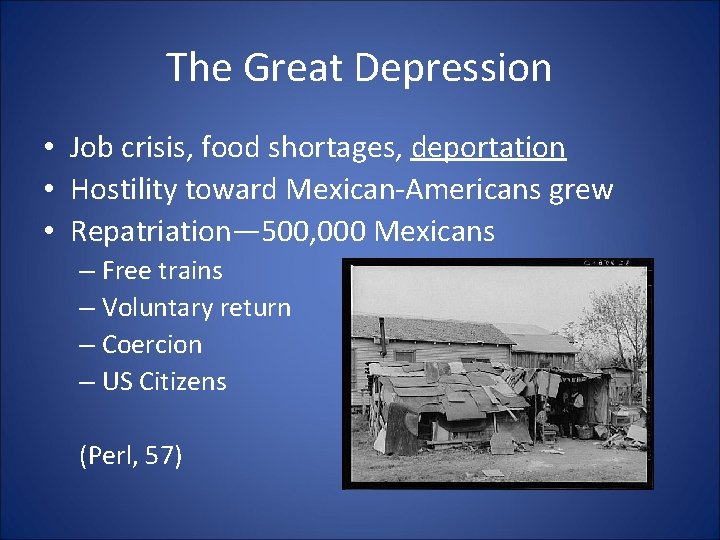
The Great Depression • Job crisis, food shortages, deportation • Hostility toward Mexican-Americans grew • Repatriation— 500, 000 Mexicans – Free trains – Voluntary return – Coercion – US Citizens (Perl, 57)
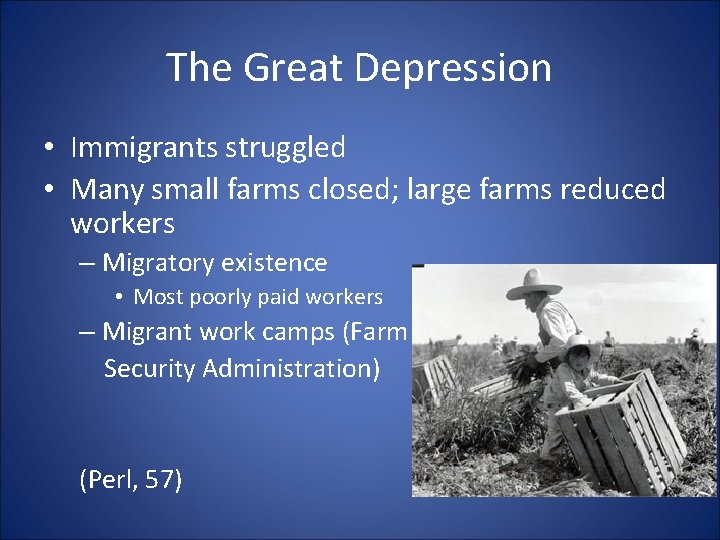
The Great Depression • Immigrants struggled • Many small farms closed; large farms reduced workers – Migratory existence • Most poorly paid workers – Migrant work camps (Farm Security Administration) (Perl, 57)
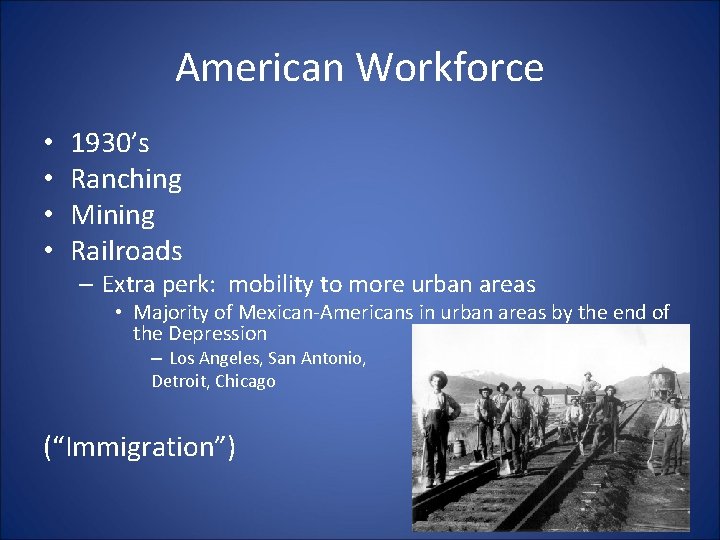
American Workforce • • 1930’s Ranching Mining Railroads – Extra perk: mobility to more urban areas • Majority of Mexican-Americans in urban areas by the end of the Depression – Los Angeles, San Antonio, Detroit, Chicago (“Immigration”)
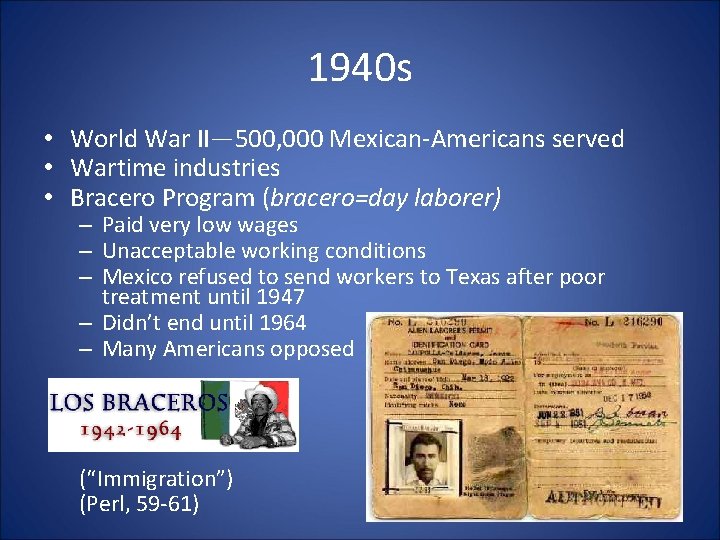
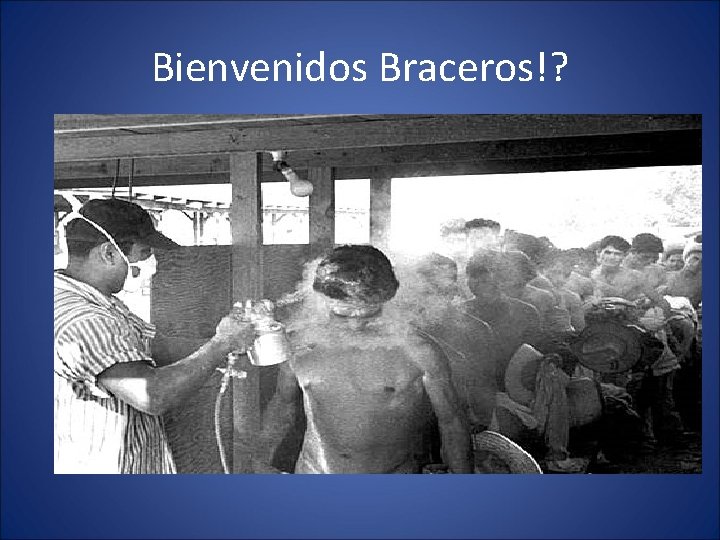
1940 s • World War II— 500, 000 Mexican-Americans served • Wartime industries • Bracero Program (bracero=day laborer) – Paid very low wages – Unacceptable working conditions – Mexico refused to send workers to Texas after poor treatment until 1947 – Didn’t end until 1964 – Many Americans opposed (“Immigration”) (Perl, 59 -61)
Bienvenidos Braceros!?
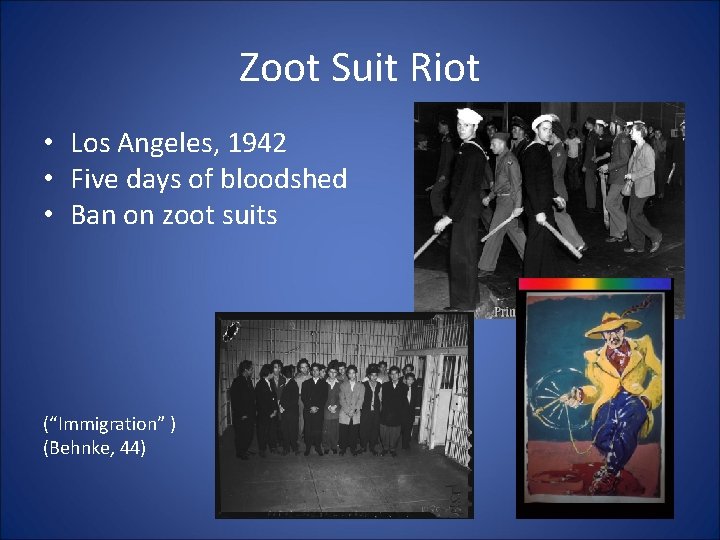
Zoot Suit Riot • Los Angeles, 1942 • Five days of bloodshed • Ban on zoot suits (“Immigration” ) (Behnke, 44)
1940 s • Deportation campaign after WWII • More than 4 million Mexican-Americans • Lasted into the 1950 s
Chicano • WWII— 250, 000 Mexican-Americans – New pride – New dedication to improving work conditions • Sprung from a La Raza Unida Conference – El Paso – 1967 • Portrayed a sense of pride and solidarity • Not accepted by all Mexican-American (Behnke, 45 -48)
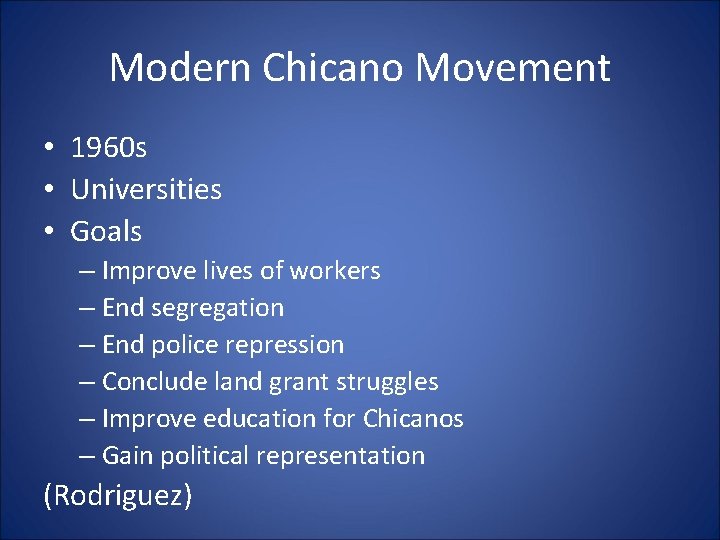
Modern Chicano Movement • 1960 s • Universities • Goals – Improve lives of workers – End segregation – End police repression – Conclude land grant struggles – Improve education for Chicanos – Gain political representation (Rodriguez)
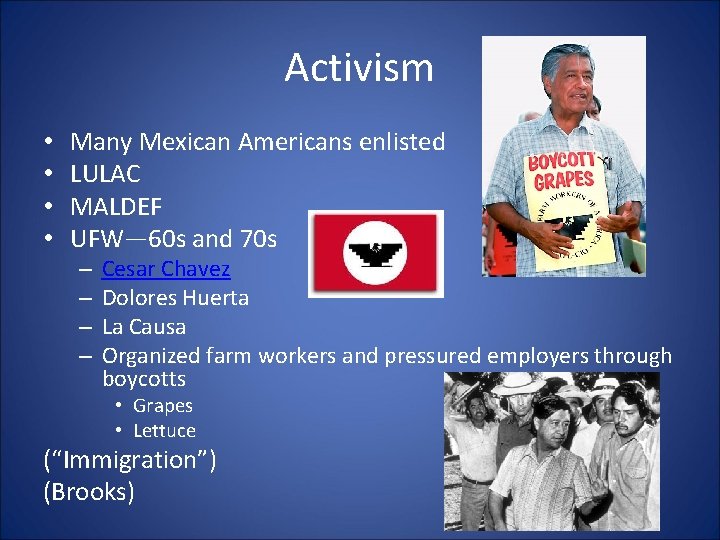
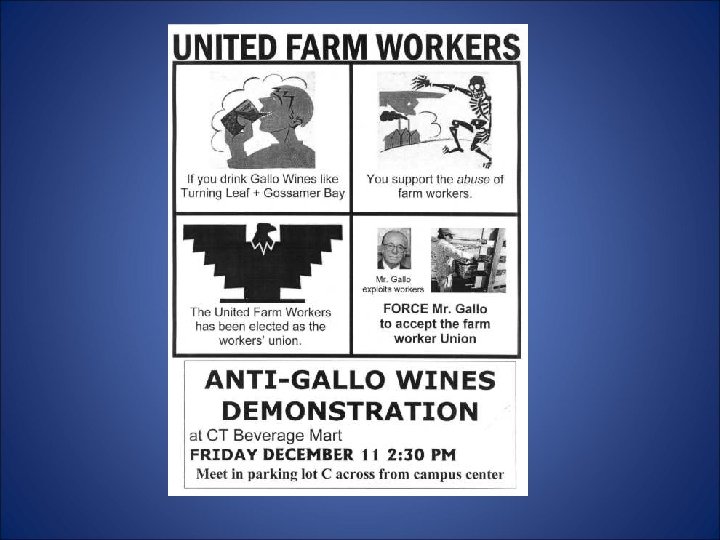
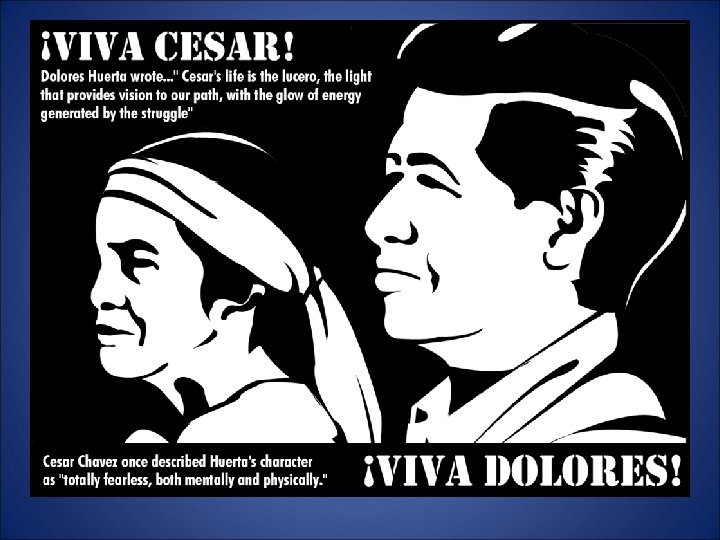
Activism • • Many Mexican Americans enlisted LULAC MALDEF UFW— 60 s and 70 s – – Cesar Chavez Dolores Huerta La Causa Organized farm workers and pressured employers through boycotts • Grapes • Lettuce (“Immigration”) (Brooks)
“I am Joaquin” (Perl, 73) I am Joaquin In a country that has wiped out all my history, And stifled my pride… My knees are caked with mud. My hands are calloused from the hoe. I have made the Anglo rich… Here I stand Poor in money Arrogant in pride.
Chicano Agenda • Bilingual Education • History of La Raza and chicano power struggle in schools – 1960 s • Texas, Colorado, New Mexico • Walkouts – 1968 • High schools in East LA – Multicultural education – Better facilities – More Latino faculty members • National Chicano Moratorium March (Perl, 74) (Rodriguez)
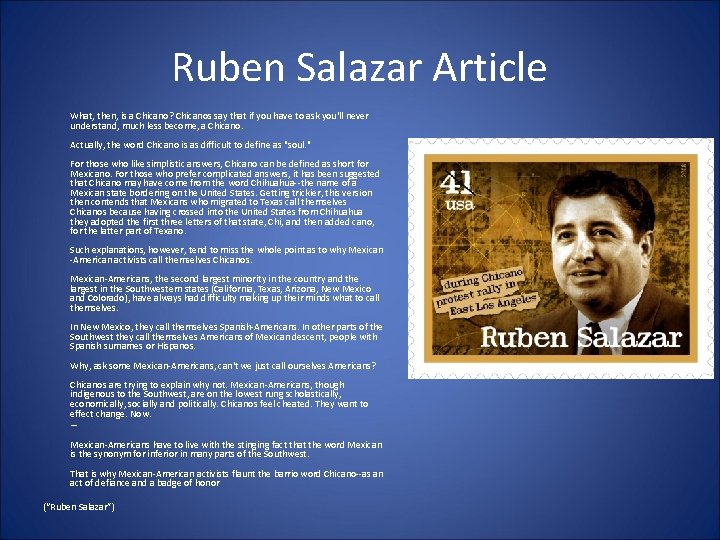
Ruben Salazar Article What, then, is a Chicano? Chicanos say that if you have to ask you'll never understand, much less become, a Chicano. Actually, the word Chicano is as difficult to define as "soul. " For those who like simplistic answers, Chicano can be defined as short for Mexicano. For those who prefer complicated answers, it has been suggested that Chicano may have come from the word Chihuahua--the name of a Mexican state bordering on the United States. Getting trickier, this version then contends that Mexicans who migrated to Texas call themselves Chicanos because having crossed into the United States from Chihuahua they adopted the first three letters of that state, Chi, and then added cano, for the latter part of Texano. Such explanations, however, tend to miss the whole point as to why Mexican -American activists call themselves Chicanos. Mexican-Americans, the second largest minority in the country and the largest in the Southwestern states (California, Texas, Arizona, New Mexico and Colorado), have always had difficulty making up their minds what to call themselves. In New Mexico, they call themselves Spanish-Americans. In other parts of the Southwest they call themselves Americans of Mexican descent, people with Spanish surnames or Hispanos. Why, ask some Mexican-Americans, can't we just call ourselves Americans? Chicanos are trying to explain why not. Mexican-Americans, though indigenous to the Southwest, are on the lowest rung scholastically, economically, socially and politically. Chicanos feel cheated. They want to effect change. Now. … Mexican-Americans have to live with the stinging fact that the word Mexican is the synonym for inferior in many parts of the Southwest. That is why Mexican-American activists flaunt the barrio word Chicano--as an act of defiance and a badge of honor (“Ruben Salazar”)
1990 s to Today • • • 20 million+ of Mexican origin 1990 s—more than all European countries combined Immigration more permanent Two generations— 25% of Mexican-American origin Los Angeles, Chicago, San Antonio, Houston, Phoenix (“Immigration”) (Behnke, 50 -51)
Which Racial Group? • Negroid--African Americans • Mongoloid/Asian-Asian/Native Americans • Caucasian-Euro/Anglo Americans
Latino Values • • Time: past-present, event-related: immediate short-range goals Personal Space: close social relationship Language: bilingual Communication Styles: – Verbal (Oral/Written): emphasis on oral tradition – Non-Verbal (Kinesics): important; gestures, posture, physical contact; limited eye contact with authority – Paralanguage: some silences, rhythmic and melodic speech; expressive • Environment: harmony with • Work: minimal importance for status: survival
Latino Values continued • Group/Individual: group centered, extended family • Achievement/Status and Power: various means of achievement • Age: elders and children important • Gender: male dominant • Competition/Cooperation: cooperation • Sacred/Secular: sacred important, little separation • Verbal/Emotional/Behavioral Expressiveness: expressiveness valued • Body-Mind Relationship: holistic • Preferred Mode of Activity: action oriented
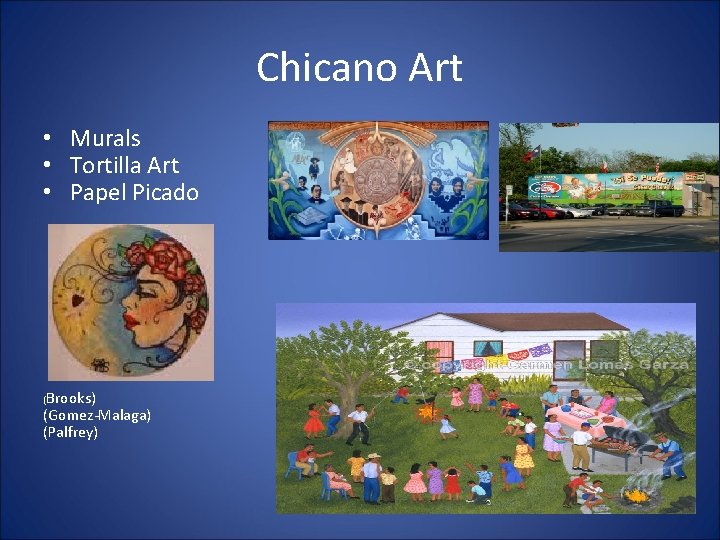
Chicano Art • Murals • Tortilla Art • Papel Picado Brooks) (Gomez-Malaga) (Palfrey) (