
The Chicago School The City Social Disorganization and

- Slides: 24
The Chicago School: The City, Social Disorganization, and Part III Crime
�Individualistic theories were dominant into the early 20 th century ◦ Ignored larger forces in society that could influence crime �The U. S. changed from a land of small stable communities to a land dominated by crowded cities ◦ Sociologists argued these changes and forces outside the individual influenced criminal behavior Movement from Biological to Sociological Theories
�In the early 1900 s, Chicago, like other cities, underwent rapid social change �Ernest Burgess theorized urban areas grow from their inner core toward outer areas ◦ Concentric zone theory ◦ Most important zone: Zone in Transition �Where the newcomers settle Social Disorganization in the City
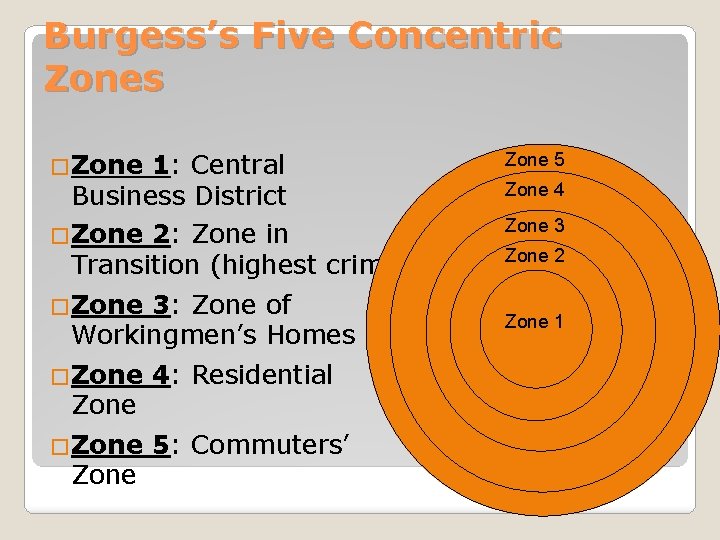
Burgess’s Five Concentric Zones �Zone 1: Central Business District �Zone 2: Zone in Transition (highest crime) �Zone 3: Zone of Workingmen’s Homes �Zone 4: Residential �Zone 5: Commuters’ Zone 5 Zone 4 Zone 3 Zone 2 Zone 1
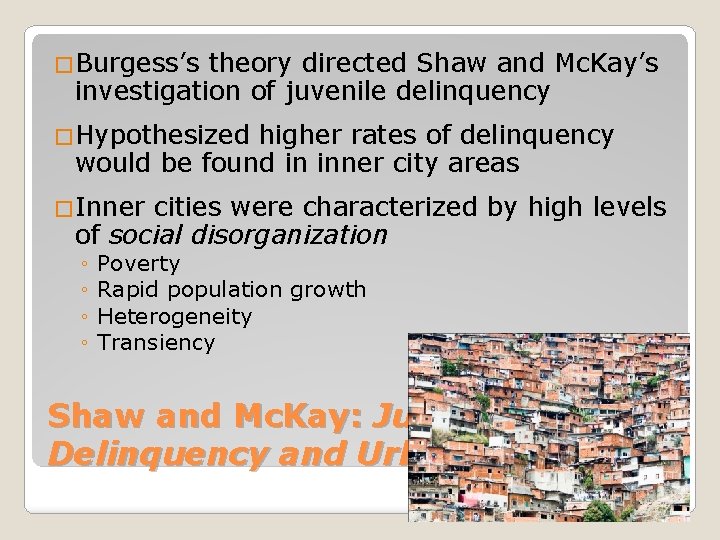
�Burgess’s theory directed Shaw and Mc. Kay’s investigation of juvenile delinquency �Hypothesized higher rates of delinquency would be found in inner city areas �Inner cities were characterized by high levels of social disorganization ◦ ◦ Poverty Rapid population growth Heterogeneity Transiency Shaw and Mc. Kay: Juvenile Delinquency and Urban Areas
�Tested this hypothesis by examining how measures of crime were distributed in the different zones of the city ◦ Mapped (by hand) the addresses of each delinquent �Found rates of crime by area remained similar regardless of the ethnic group that lived there �Thus, characteristics of the area, not the people, regulated levels of delinquency Shaw and Mc. Kay: Juvenile Delinquency and Urban Areas
�Areas most disadvantageous in relation to economic, social, and cultural values had the highest rates of delinquency �In high-rate delinquency areas, competing and conflicting moral values had developed ◦ In contrast, low-rate delinquency areas often had uniformity, consistency, and universality of conventional values Shaw and Mc. Kay: Juvenile Delinquency and Urban Areas
�Low-rate delinquency areas had constructive leisure activities, supervised children, and resisted behavior that threatened conventional values often absent in high-rate delinquency areas ◦ High-rate areas often had many adult criminals ◦ Many delinquents from these areas committed their offenses in groups ◦ High-rate areas allowed for youths to be in contact Shaw and Mc. Kay: Juvenile with criminal values and associates which facilitated the transmission of criminal values across Delinquency and Urban Areas generations
�Levels of officially recorded delinquency decreased as people moved away from the inner city �Found support that social disorganization was a major cause of delinquency Shaw and Mc. Kay: Juvenile Delinquency and Urban Areas
� Social disorganization is the breakdown of social institutions in a community � This fosters criminal behavior in that area because: ◦ Conventional institutions become weak, which results in lower supervision �Families disrupted, schools disordered, few organized activities ◦ A value system supportive of crime is nurtured and transmitted across generations Shaw and Mc. Kay: Juvenile Delinquency and Urban Areas
�Policy implications coming from Shaw and Mc. Kay’s work ◦ Chicago Area Project �Try to organize communities �Create recreational programs, revitalize the appearance of the neighborhood, help problem youth Shaw and Mc. Kay: Juvenile Delinquency and Urban Areas
�Shaw and Mc. Kay’s social disorganization work lost its appeal by the 1960 s �Revitalized in the 1980 s with a renewed interest in the ecology of crime and macrolevel criminology ◦ Macro-level criminology: how characteristics of geographical areas influence crime rates �Blau and Blau (1982) found violence was more pronounced in urban areas with Revitalization of especially Social inequality economic inequality, between whites and Theory blacks Disorganization
� The work of Robert Sampson was influential ◦ Sampson (1986) �Argued crime was higher in the inner city because residents lost the ability to exercise “informal social control” ◦ Cannot supervise youths ◦ Sampson and Groves (1989) �British Crime Survey �Measured social disorganization directly �Found structural conditions lead to social disorganization which leads to increased crime rates �Social disorganization mediated the relationship between structural conditions and crime rates Revitalization of Social Disorganization Theory
Extending Social Disorganization �Sampson and Crime, Wilson (1995) extended social Theory: Race, and Urban disorganization theory by placing it within the Inequality realities of contemporary America ◦ Structural social disorganization and cultural social isolation explained the high rate of inner city crime ◦ Argued variations in disorganization were linked to racial inequality ◦ Blacks were more likely to reside in areas where there is concentrated poverty due to macrostructural factors �Deindustrialization, departure of middle-class blacks, racial discrimination in housing, etc.
�Also argued that structural conditions influenced the culture in the community ◦ In these concentrated poverty areas, the people often live in social isolation and lack contact or interaction with individuals and institutions representing mainstream society �This results in restricted legitimate opportunities and impaired communication Sampson and Wilson: A Theory of Race, Crime, and Urban Inequality
� In socially isolated areas, cultural values often develop that view violence and crime as unavoidable given the situation ◦ Referred to as cultural disorganization—attenuation of societal cultural values ◦ Do not approve violence/crime, but tolerate it � Culture is the acquisition of “cognitive landscapes” ◦ Ecological structured norms regarding appropriate standards and expectations of conduct ◦ Because exposed to crime and have few opportunities, see crime/violence as a potential choice and possibly unavoidable �Have role models, possible access to weapons, etc. Sampson and Wilson: A Theory of Race, Crime, and Urban Inequality
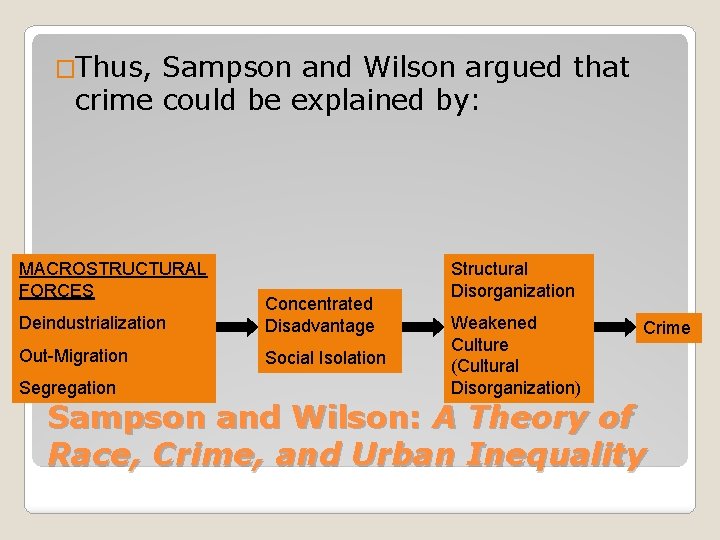
�Thus, Sampson and Wilson argued that crime could be explained by: MACROSTRUCTURAL FORCES Deindustrialization Concentrated Disadvantage Out-Migration Social Isolation Segregation Structural Disorganization Weakened Culture (Cultural Disorganization) Crime Sampson and Wilson: A Theory of Race, Crime, and Urban Inequality
�Sampson, Raudenbush, and Earls (1997) further elaborated social disorganization theory ◦ Wanted to understand the intervening variable between the structural characteristics of a community and crime ◦ Developed the concept of collective efficacy �Combination of both informal social control and social cohesion Extending Social Disorganization Theory: Collective Efficacy
� Collective efficacy is the willingness of community residents to (1) exercise informal social control and (2) trust and help one another � Enriched the social disorganization perspective in two ways: 1. Added the element that neighbors must mutually trust or support one another 2. Envisioned collective efficacy as a dynamic factor � A resource that can be mobilized/activated when the need arises Extending Social Disorganization Theory: Collective Efficacy
�Collective efficacy is the “process of activating or converting social ties to achieve desired outcomes” (Sampson et al. , 1999, p. 635) �Communities low in collective efficacy cannot mobilize as a group to solve problems and thus have high crime rates �Communities high in collective efficacy can mobilize and thus have lower crime rates Extending Social Disorganization Theory: Collective Efficacy
�To test their postulation, studied violence in 343 Chicago neighborhoods ◦ Project on Human Development in Chicago Neighborhoods ◦ Obtained both micro- and macro-level data in order to test for both compositional and contextual effects Sampson, Raudenbush, and Earls: Collective Efficacy and Crime
�Found: ◦ Concentrated disadvantage (poverty, race and age composition, and family disruption) was related to violence in a neighborhood ◦ Concentrated disadvantage, residential stability, and immigrant concentration explained 70% of the neighborhood variation in collective efficacy ◦ Collective efficacy was inversely related to crime ◦ The associations between concentrated disadvantage and residential stability with crime were largely mediated by collective efficacy ◦ The results held after controlling for compositional effects Sampson, Raudenbush, and Earls: Collective Efficacy and Crime
�Limitations of the study: ◦ The basic analysis was cross-sectional ◦ Informal social control and social cohesion were not observed directly ◦ Findings are limited to one city—Chicago ◦ May be other dimensions of neighborhood efficacy (e. g. , political ties) Sampson, Raudenbush, and Earls: Collective Efficacy and Crime
� As the U. S. began to become more urbanized, our thinking about crime changed ◦ Saw a move from micro-level theories to macro-level theories � Shaw and Mc. Kay put forth social disorganization theory � Social disorganization theory remained popular until the 1960 s; however, it was revitalized in the 1980 s and 1990 s ◦ � Especially by the work of Robert Sampson Social disorganization theory has now been extended in two major ways: 1. Takes into account racial inequality (Sampson and Wilson) 2. Examines the role of collective efficacy (Sampson, Raudenbush, Earls) Summary