
The Chernobyl Disaster Noah Quinlan HCOL 195 Background
The Chernobyl Disaster Noah Quinlan HCOL 195
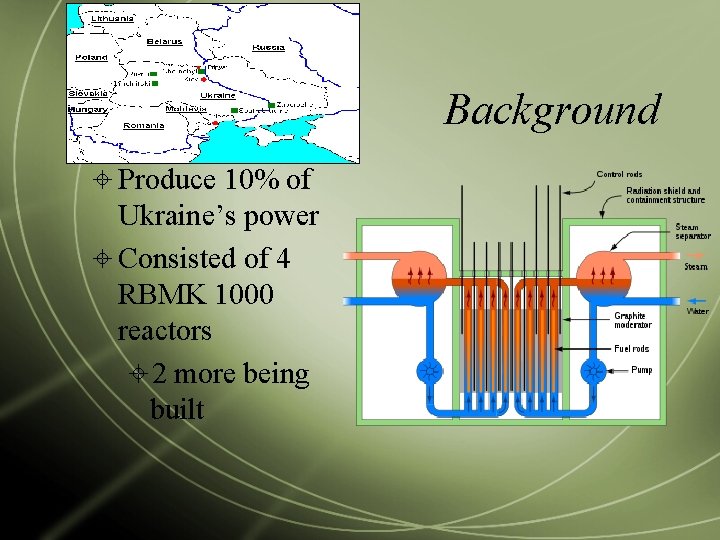
Background Produce 10% of Ukraine’s power Consisted of 4 RBMK 1000 reactors 2 more being built
The Accident Night of April 25 -26 1986 Experiment prior to shutdown for annual maintenance Test to see how long turbines could continue turning (produce electricity) after a sudden blackout Safety feature Not properly planned
The Accident Decreased power Went too low Emergency system temporarily disconnected to allow experiment Reactor became unstable as temperatures rose exponentially 1: 23 am - Two explosions within four seconds inside reactor 4
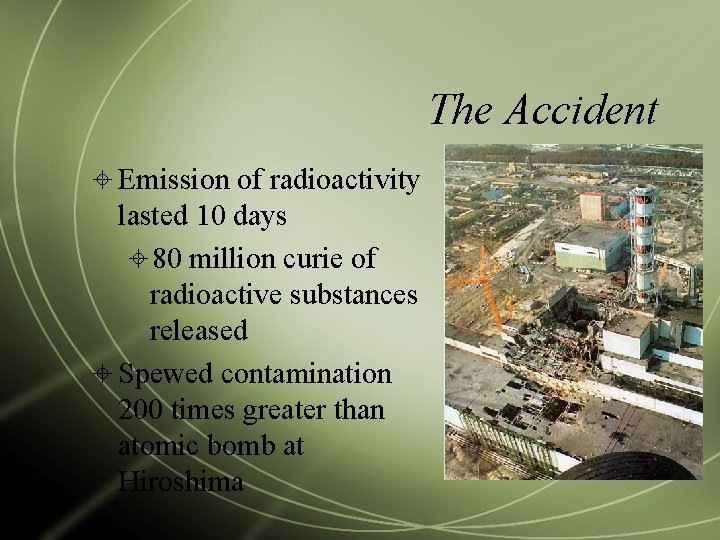
The Accident Emission of radioactivity lasted 10 days 80 million curie of radioactive substances released Spewed contamination 200 times greater than atomic bomb at Hiroshima
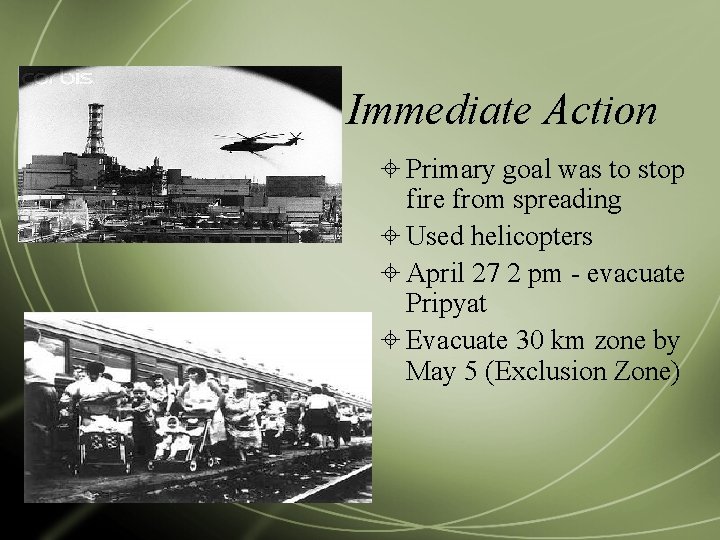
Immediate Action Primary goal was to stop fire from spreading Used helicopters April 27 2 pm - evacuate Pripyat Evacuate 30 km zone by May 5 (Exclusion Zone)
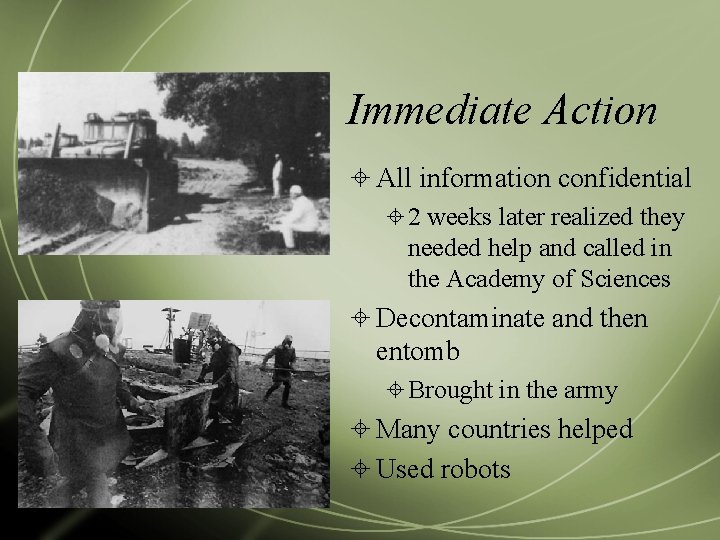
Immediate Action All information confidential 2 weeks later realized they needed help and called in the Academy of Sciences Decontaminate and then entomb Brought in the army Many countries helped Used robots
The Sarcophagus Hastily made to conceal radioactivity Best way to stop graphite fire was to cover the reactor shaft Built around (and supported by) reactor core that fused together Installed “The Needle” Complete by mid-November
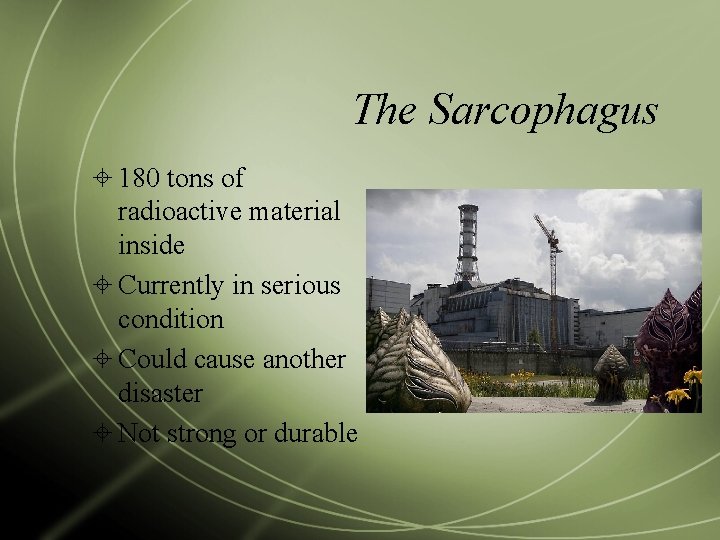
The Sarcophagus 180 tons of radioactive material inside Currently in serious condition Could cause another disaster Not strong or durable
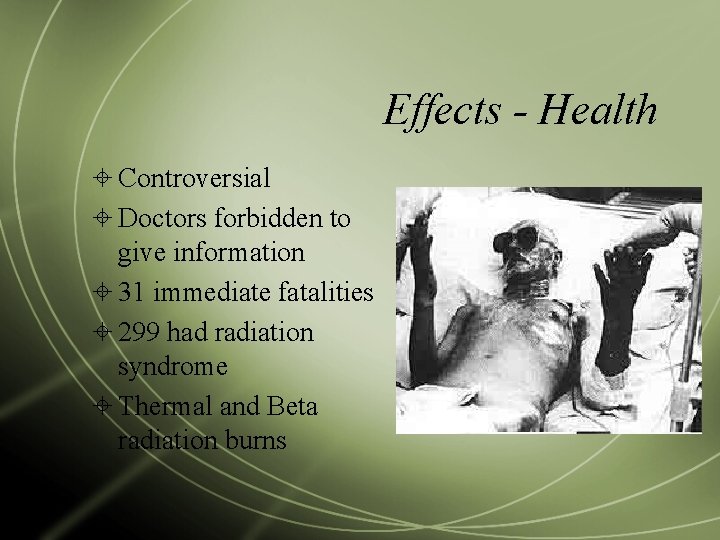
Effects - Health Controversial Doctors forbidden to give information 31 immediate fatalities 299 had radiation syndrome Thermal and Beta radiation burns
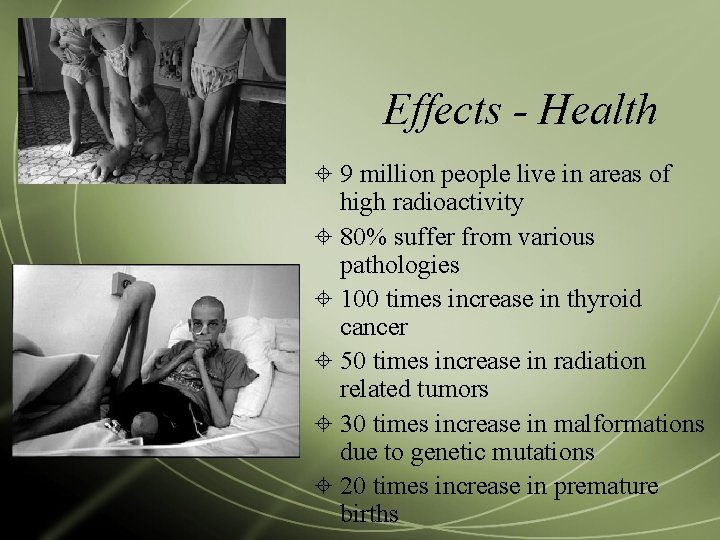
Effects - Health 9 million people live in areas of high radioactivity 80% suffer from various pathologies 100 times increase in thyroid cancer 50 times increase in radiation related tumors 30 times increase in malformations due to genetic mutations 20 times increase in premature births
Effects - Health Asthenia, anaemia, diabetes, gastrointestinal problems, neurological syndromes, headaches, epilepsy, thyroid pathology, bronchitis, pneumonia, asthma, hypertension, ischemia, myocardium infarction, cardiomyopathy, brain hemorrage, Down’s syndrome, hydrocephaly, microencephaly, mental retardation, infantile cerebral paralysis, disarthia, cleft lip and palate, aplasia of the limbs All children sick to one degree or another
Effects - Health Radionuclides are produced in fission Unstable Most dangerous from Chernobyl Strontium 90 (half life 28 years) Caesium 137 (half life 30 years) Iodine 131 (half life 8 days) Plutonium 239 (half life 24, 000 years) Uranium 235 (half life 700 million years)
Effects - Health Chernobyl Forum IAEA, WHO, governments “The legacy of Chernobyl: Health, Environmental and Socio-Economic Impact” 50 immediate deaths 200 cases of cancer from acute radiation 4, 000 cases of thyroid cancer (9 fatal) Number of deaths could reach 4, 000 Deny increase in other pathologies Radiophobia Radiation in environment is normal
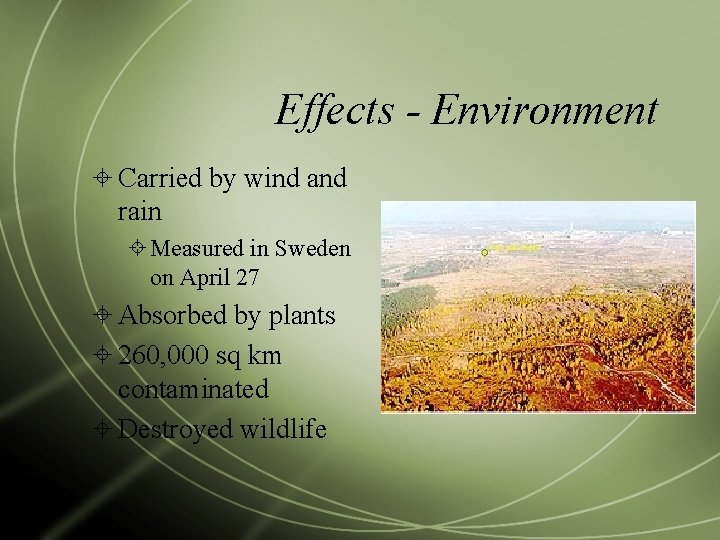
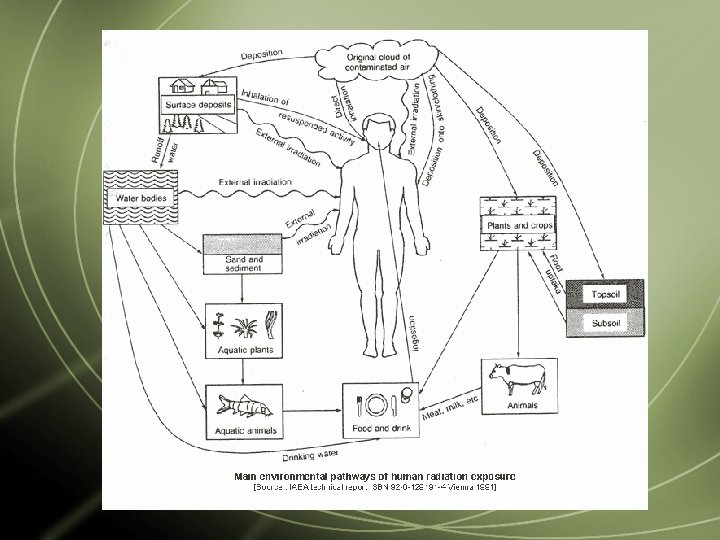
Effects - Environment Carried by wind and rain Measured in Sweden on April 27 Absorbed by plants 260, 000 sq km contaminated Destroyed wildlife
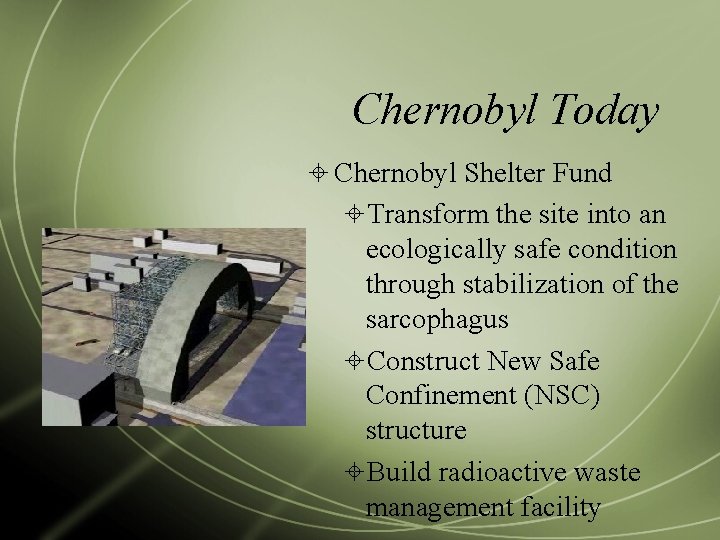
Chernobyl Today Chernobyl Shelter Fund Transform the site into an ecologically safe condition through stabilization of the sarcophagus Construct New Safe Confinement (NSC) structure Build radioactive waste management facility
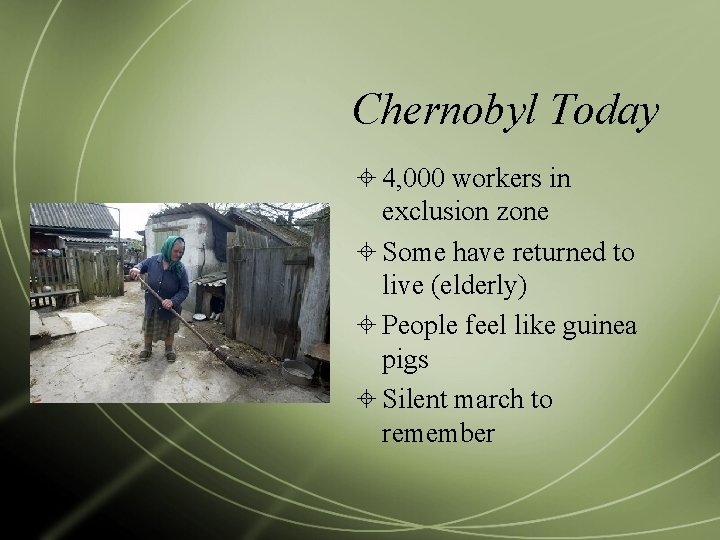
Chernobyl Today 4, 000 workers in exclusion zone Some have returned to live (elderly) People feel like guinea pigs Silent march to remember
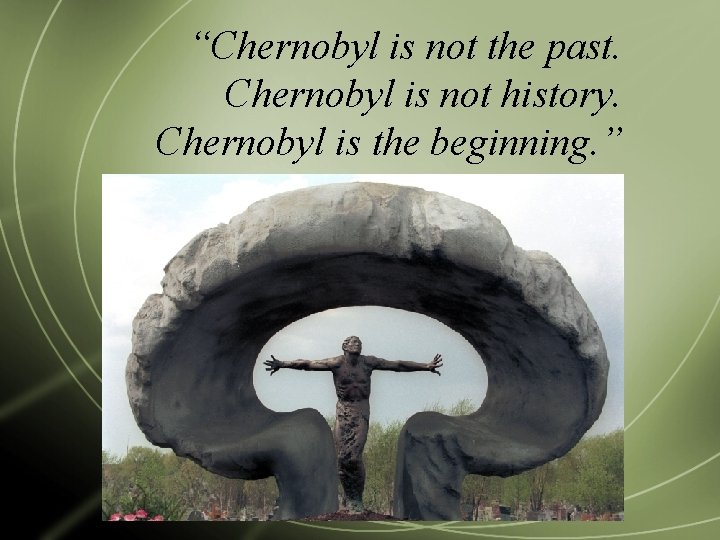
“Chernobyl is not the past. Chernobyl is not history. Chernobyl is the beginning. ”
Sources "Chernobyl Accident. " World Nuclear Association. May 2008. 15 Nov. 2008 <http: //www. worldnuclear. org/info/chernobyl/inf 07. html>. Living Under the Cloud. Dir. Teresa Metcalf. Prod. Bullfrog Films. Perf. Dr. Vladimir Chernousenko. VHS. 1994. Mittica, Pierpaolo. Chernobyl: The Hidden Legacy. Great Britain: Trolley Ltd. , 2007. Mould, Richard F. Chernobyl: The Real Story. Elmsford, NY: Pergamon P, 1988. Nadakavukaren, Anne. Our Global Environment: A Health Perspective. Sixth ed. Long Grove, IL: Waveland P, Inc. , 2006.
- Slides: 20