
The Chemistry of Life Macromolecules Macromolecules or organic
- Slides: 28
The Chemistry of Life Macromolecules • Macromolecules or organic compounds make up the body. • The backbone of these compounds is carbon; from here carbon-containing compounds. • have a core based around carbon • the core has attached groups of atoms called functional groups • the functional groups confer specific chemical properties on the organic molecules
Polymers Are Built of Monomers • There are four types of macromolecules: 1. 2. 3. 4. • Carbohydrates Lipids Proteins Nucleic acids Large macromolecules are actually assembled from many similar small components, called monomers § the assembled chain of monomers is known as a polymer
Carbohydrates • Carbohydrates are monomers that make up the structural framework of cells and play a critical role in energy storage § a carbohydrate is any molecule that contains the elements C, H, and O in a 1: 2: 1 ratio § Example: Sugar glucose C 6 H 1206 § the sizes of carbohydrates varies • simple carbohydrates – made up of one or two monomers • complex carbohydrates – made up of polymers
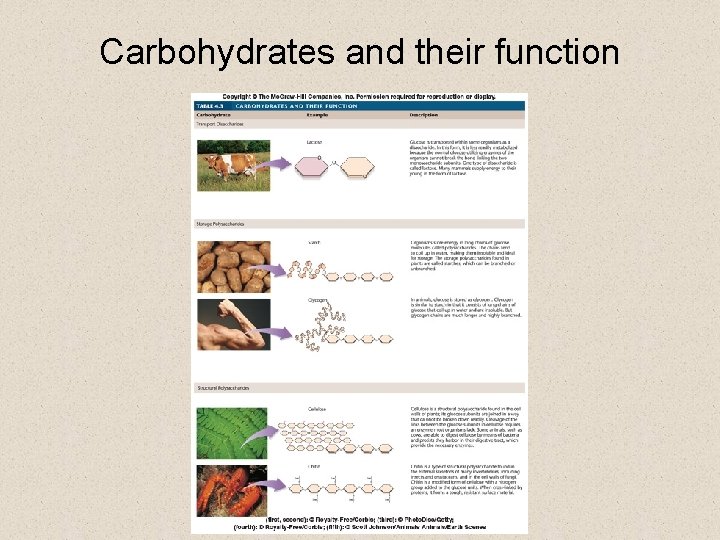
Carbohydrates • Simple carbohydrates are small § monosaccharides consist of only one monomer subunit • an example is the sugar glucose (C 6 H 12 O 6) § disaccharides consist of two monosaccharides • an example is the sugar sucrose, which is formed by joining together two monosaccharides, glucose and fructose
Carbohydrates • Complex carbohydrates are long polymer chain § the long chains are called polysaccharides • Plants and animals store energy in polysaccharide chains formed from glucose § plants form starch § animals form glycogen
Carbohydrates • Some polysaccharides are structural and resistant to digestion by enzymes § plants form cellulose cell walls § some animals form chitin for exoskeletons
Carbohydrates and their function
Lipids • Lipids – fats and other molecules that are not soluble in water § lipids are non-polar molecules § lipids have many different types • • • fats oils steroids rubber waxes pigments
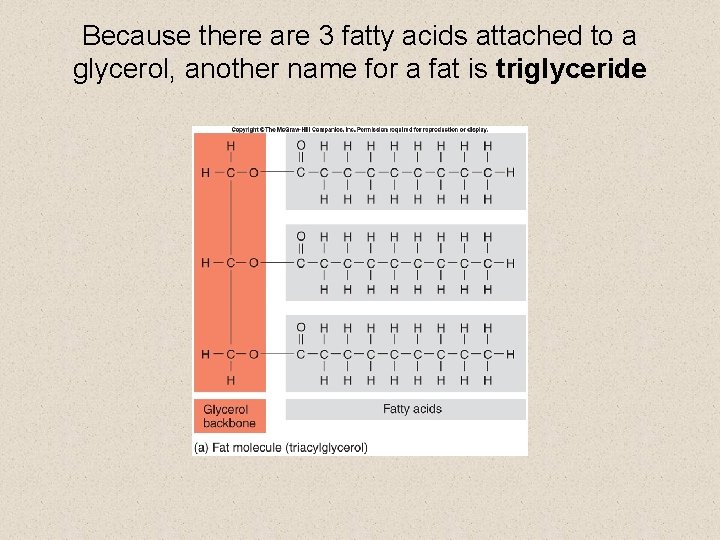
Lipids § fats have two subunits 1. fatty acids 2. glycerol § fatty acids are chains of C and H atoms, known as hydrocarbons • the chain ends in a carboxyl (-COOH) group
Because there are 3 fatty acids attached to a glycerol, another name for a fat is triglyceride
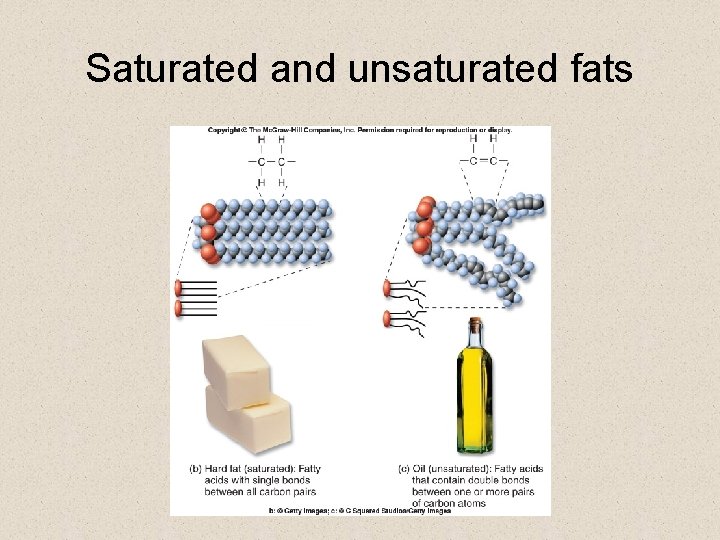
Saturated and unsaturated fats • Fatty acids have different chemical properties due to the number of hydrogens that are attached to the non-carboxyl carbons § if the maximum number of hydrogens are attached, then the fat is said to be saturated § Fat is solid at room temperature § if there are fewer than the maximum attached, then the fat is said to be unsaturated § Oil is liquid at room temperature.
Saturated and unsaturated fats
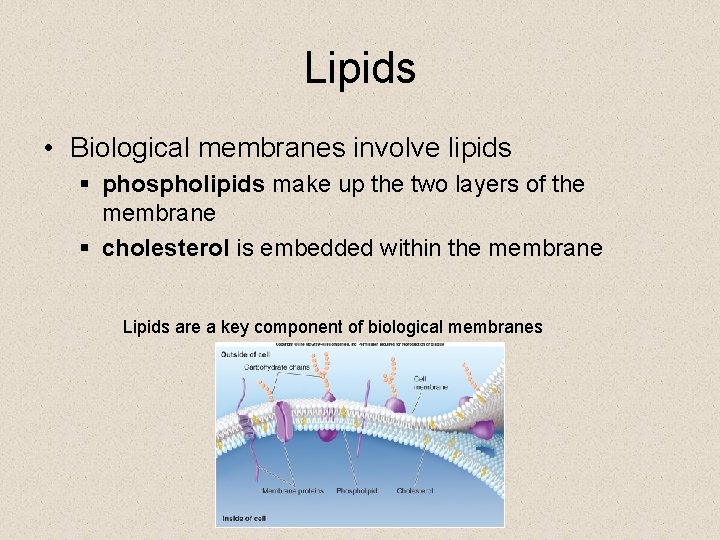
Lipids • Biological membranes involve lipids § phospholipids make up the two layers of the membrane § cholesterol is embedded within the membrane Lipids are a key component of biological membranes
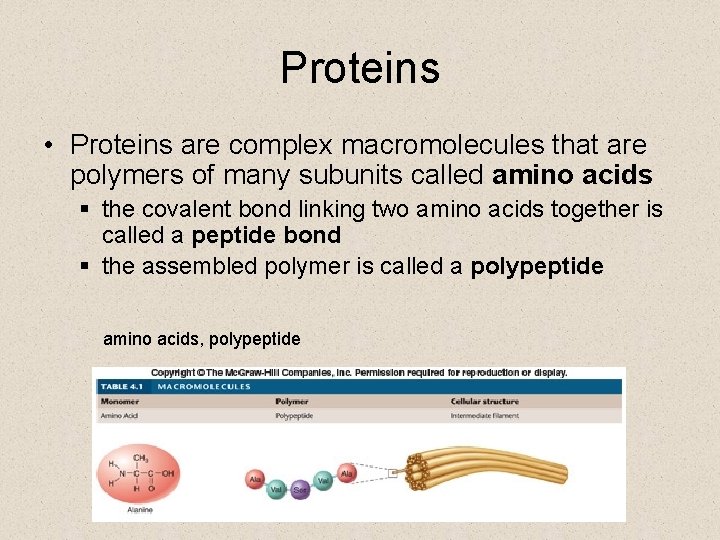
Proteins • Proteins are complex macromolecules that are polymers of many subunits called amino acids § the covalent bond linking two amino acids together is called a peptide bond § the assembled polymer is called a polypeptide amino acids, polypeptide
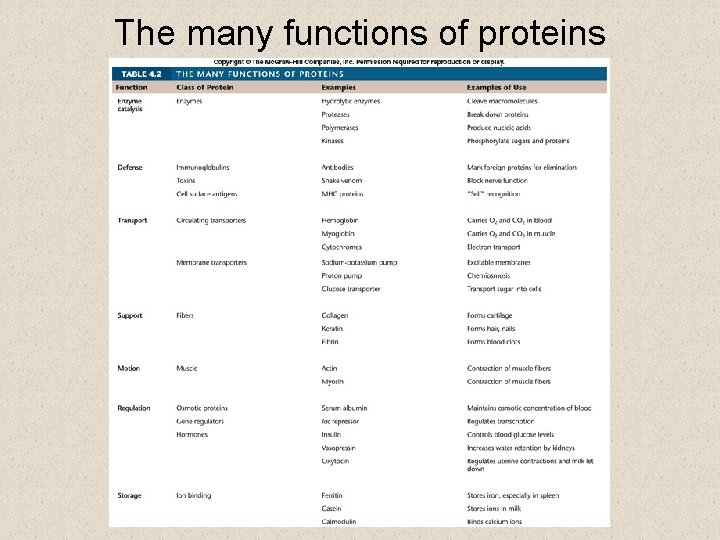
The many functions of proteins
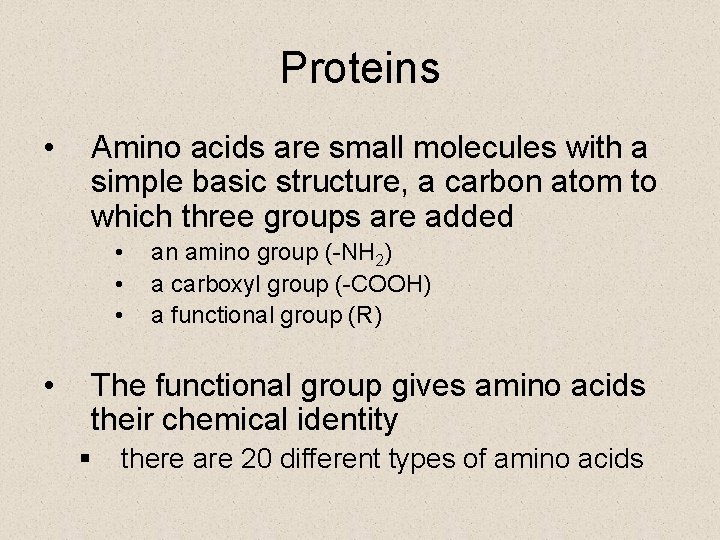
Proteins • Amino acids are small molecules with a simple basic structure, a carbon atom to which three groups are added • • an amino group (-NH 2) a carboxyl group (-COOH) a functional group (R) The functional group gives amino acids their chemical identity § there are 20 different types of amino acids
Proteins • Protein structure is complex § the order of the amino acids that form the polypeptide is important • the sequence of the amino acids affects how the protein folds together § the way that a polypeptide folds to form the protein determines the protein’s function • some proteins are comprised of more than one polypeptide
Proteins • There are four general levels to protein structure 1. Primary 2. Secondary 3. Tertiary 4. Quaternary
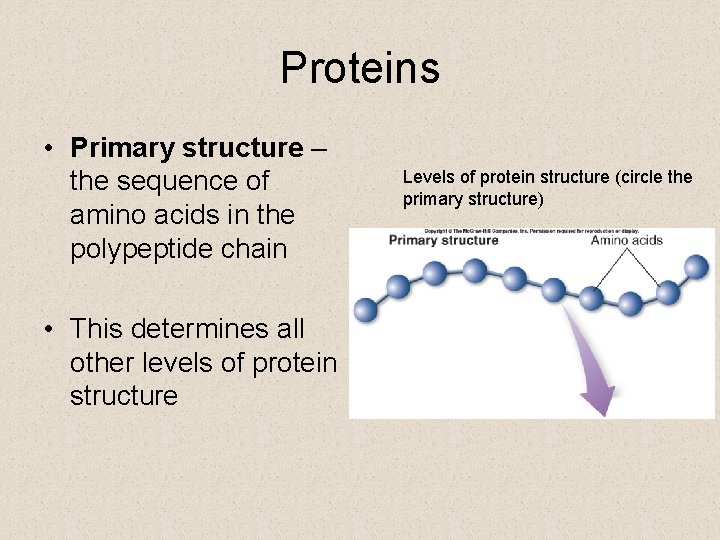
Proteins • Primary structure – the sequence of amino acids in the polypeptide chain • This determines all other levels of protein structure Levels of protein structure (circle the primary structure)
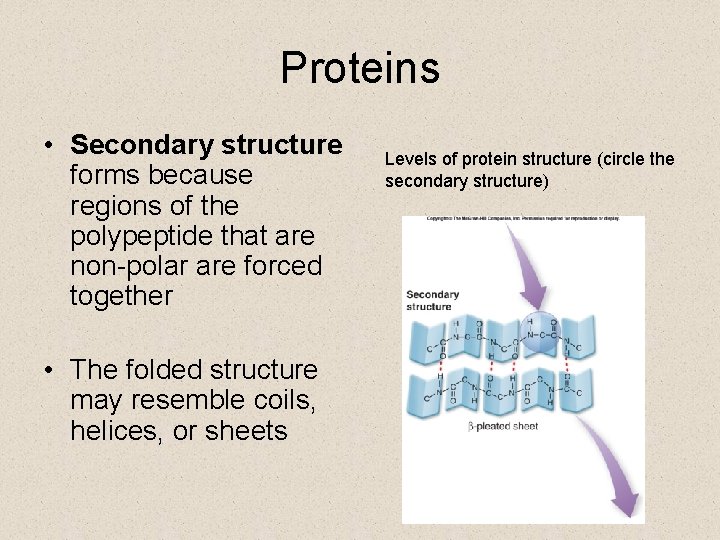
Proteins • Secondary structure forms because regions of the polypeptide that are non-polar are forced together • The folded structure may resemble coils, helices, or sheets Levels of protein structure (circle the secondary structure)
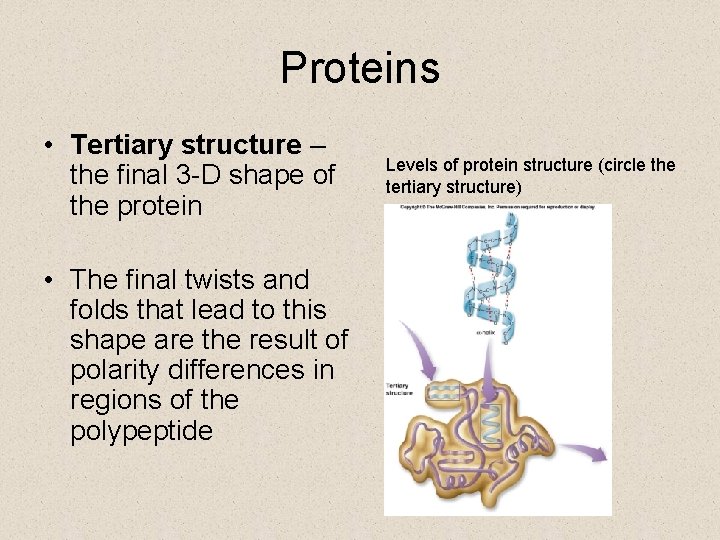
Proteins • Tertiary structure – the final 3 -D shape of the protein • The final twists and folds that lead to this shape are the result of polarity differences in regions of the polypeptide Levels of protein structure (circle the tertiary structure)
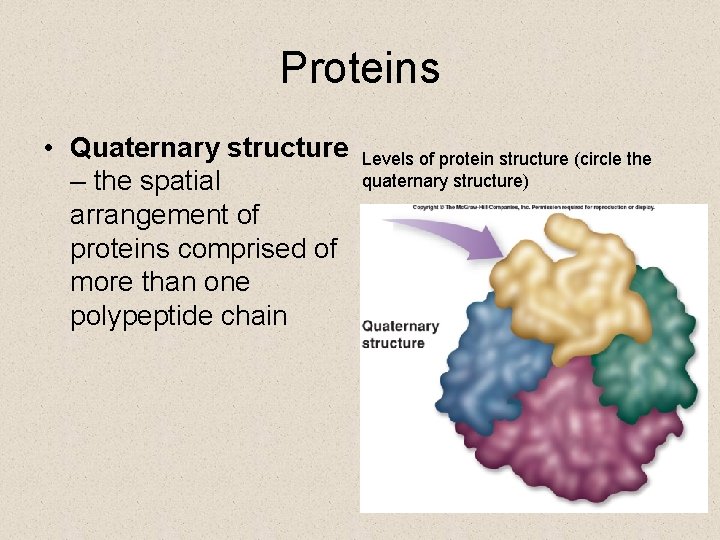
Proteins • Quaternary structure – the spatial arrangement of proteins comprised of more than one polypeptide chain Levels of protein structure (circle the quaternary structure)
Protein • The shape of a protein affects its function § changes to the environment of the protein may cause it to unfold or denature • increased temperature or lower p. H affects hydrogen bonding, which is involved in the folding process § a denatured protein is inactive
Nucleic Acids • Nucleic acids are very long polymers that store information § comprised of monomers called nucleotides • each nucleotide has 3 parts 1. a five-carbon sugar 2. a phosphate group 3. an organic nitrogen-containing base § there are five different types of nucleotides • information is encoded in the nucleic acid by different sequences of these nucleotides
Nucleic Acids • There are two types of nucleic acids § Deoxyribonucleic acid (DNA) § Ribonucleic acid (RNA) • RNA is similar to DNA except that § it uses uracil instead of thymine § it is comprised of just one strand § it has a ribose sugar
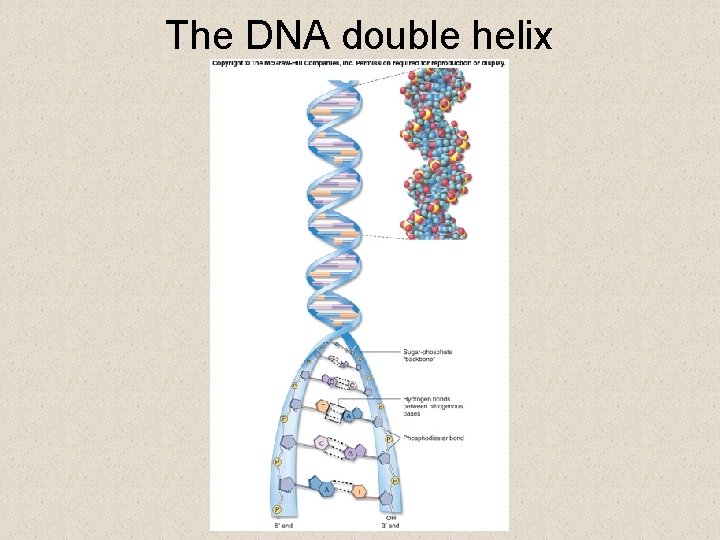
Nucleic Acids • The structure of DNA is a double helix because § there are only two base pairs possible • Adenosine (A) pairs with thymine (T) • Cytosine (C) pairs with Guanine (G) § the bond holding together a base pair is hydrogen bond § a sugar-phosphate backbone comprised of phosphodiester bonds gives support
The DNA double helix
Nucleic Acids • The structure of DNA helps it to function (information storage) § the hydrogen bonds of the base pairs can be easily broken to unzip the DNA so that information can be copied • each strand of DNA is a mirror image so the DNA contains two copies of the information § having two copies means that the information can be accurately copied and passed to the next generation