
The Chemistry of Life CHEMISTRY OF LIFE Summary
- Slides: 51
The Chemistry of Life
CHEMISTRY OF LIFE Summary layout Minerals Inorganic compounds
ELEMENTS � Remember all compounds are made up of elements. � Elements are pure substances. � Elements come together to form compounds. � There are two types of compounds. � These are organic and inorganic compounds.
INORGANIC COMPOUNDS � These are compounds that do not contain the element carbon 12. � Examples of inorganic compounds are water and carbon dioxide.
ORGANIC COMPOUNDS � These are compounds that contain the element carbon 12. � Examples are carbohydrates, proteins and fats.
MINERALS � Minerals are inorganic substances that are required by living organisms. � They are required by both plants and animals. � Minerals can be put into two groups depending on the organisms needs. � These two groups are: a) Micro-elements b) Macro-elements
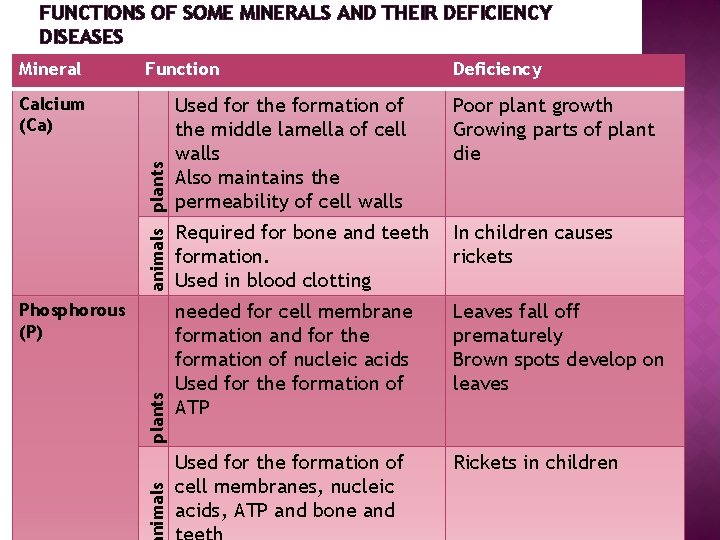
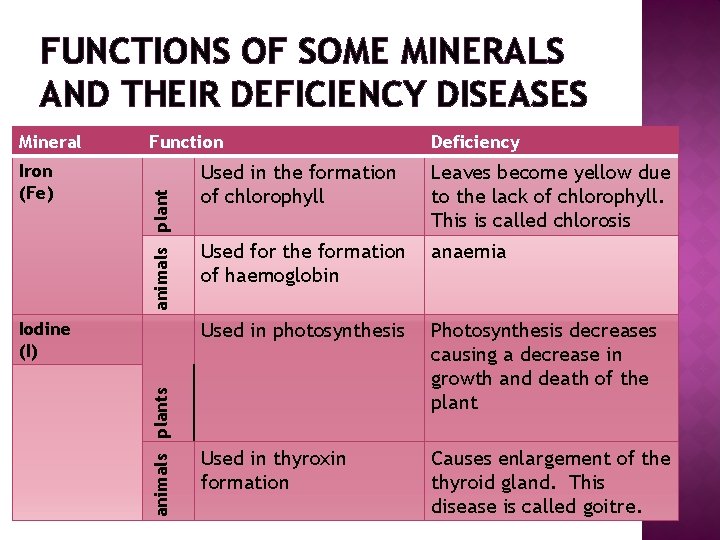
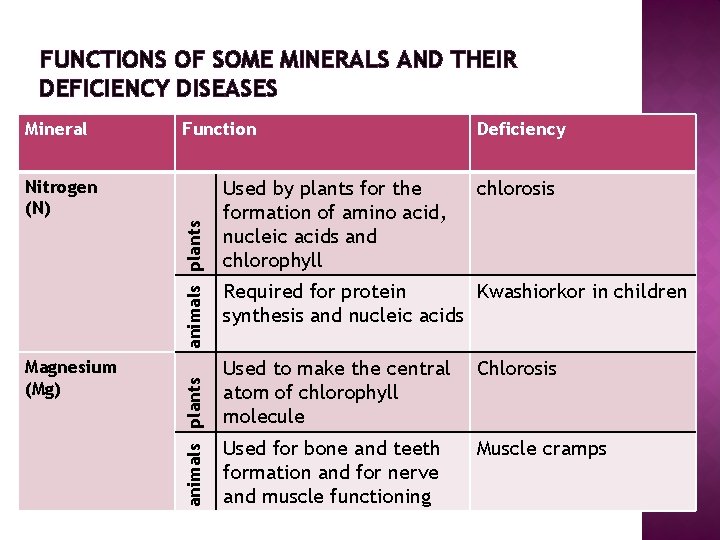
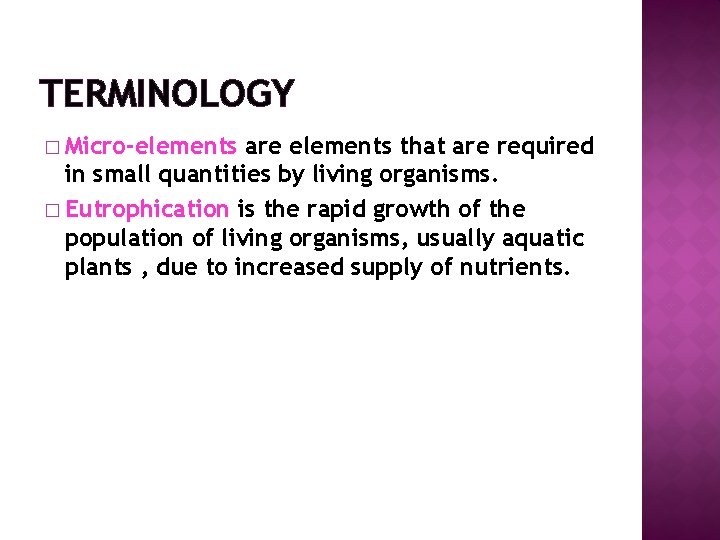
MACRO- AND MICRO-ELEMENTS � Macro-elements are elements that are required in large quantities by living organisms. � Micro-elements are elements that are required in small quantities by living organisms. � A mineral maybe either a macro- or microelement depending on the organisms needs. � The table on the next slides discusses some of these minerals.
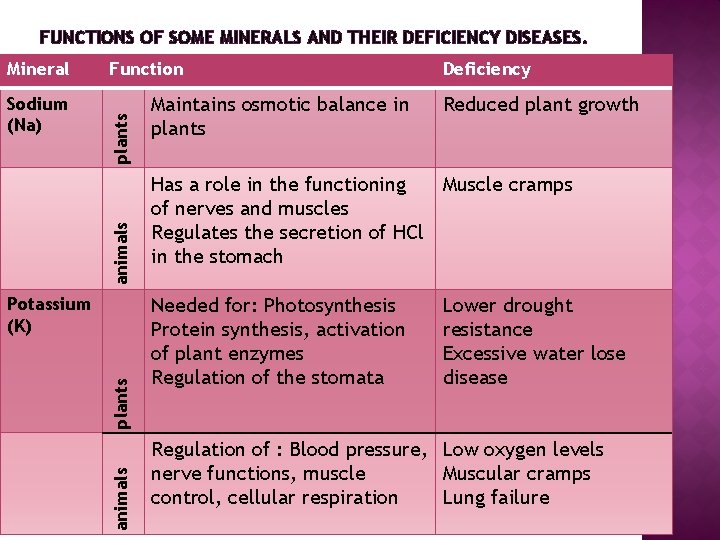
FUNCTIONS OF SOME MINERALS AND THEIR DEFICIENCY DISEASES. animals Sodium (Na) Function plants Mineral animals plants Potassium (K) Maintains osmotic balance in plants Deficiency Reduced plant growth Has a role in the functioning Muscle cramps of nerves and muscles Regulates the secretion of HCl in the stomach Needed for: Photosynthesis Protein synthesis, activation of plant enzymes Regulation of the stomata Lower drought resistance Excessive water lose disease Regulation of : Blood pressure, Low oxygen levels nerve functions, muscle Muscular cramps control, cellular respiration Lung failure
FUNCTIONS OF SOME MINERALS AND THEIR DEFICIENCY DISEASES Mineral Function animals plants Calcium (Ca) nimals plants Phosphorous (P) Deficiency Used for the formation of the middle lamella of cell walls Also maintains the permeability of cell walls Poor plant growth Growing parts of plant die Required for bone and teeth formation. Used in blood clotting In children causes rickets needed for cell membrane formation and for the formation of nucleic acids Used for the formation of ATP Leaves fall off prematurely Brown spots develop on leaves Used for the formation of cell membranes, nucleic acids, ATP and bone and Rickets in children
FUNCTIONS OF SOME MINERALS AND THEIR DEFICIENCY DISEASES Iron (Fe) Function animals plant Mineral animals plants Iodine (I) Deficiency Used in the formation of chlorophyll Leaves become yellow due to the lack of chlorophyll. This is called chlorosis Used for the formation of haemoglobin anaemia Used in photosynthesis Photosynthesis decreases causing a decrease in growth and death of the plant Used in thyroxin formation Causes enlargement of the thyroid gland. This disease is called goitre.
FUNCTIONS OF SOME MINERALS AND THEIR DEFICIENCY DISEASES Mineral Function Magnesium (Mg) animals plants Nitrogen (N) Used by plants for the formation of amino acid, nucleic acids and chlorophyll Deficiency chlorosis Required for protein Kwashiorkor in children synthesis and nucleic acids Used to make the central atom of chlorophyll molecule Chlorosis Used for bone and teeth formation and for nerve and muscle functioning Muscle cramps
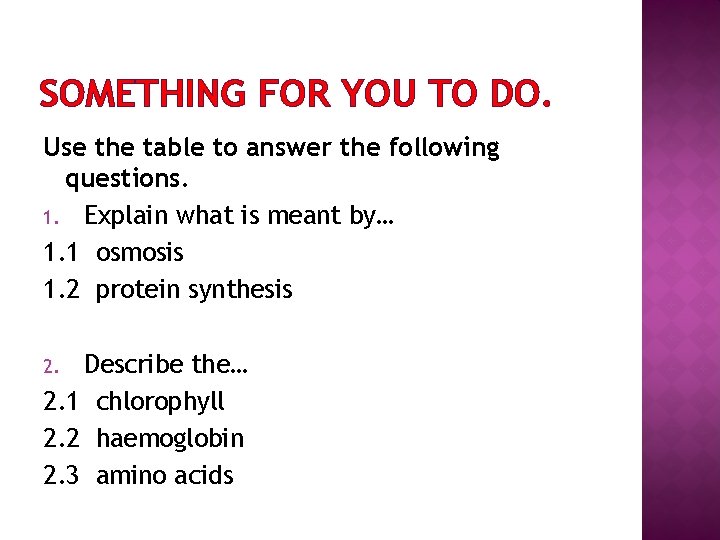
SOMETHING FOR YOU TO DO. Use the table to answer the following questions. 1. Explain what is meant by… 1. 1 osmosis 1. 2 protein synthesis Describe the… 2. 1 chlorophyll 2. 2 haemoglobin 2. 3 amino acids 2.
SOMETHING FOR YOU TO DO. 3. 4. Explain why chlorosis occurs when there is an iron and nitrogen deficiency. Name the gland that secretes thyroxin.
SOLUTION 1. 1 osmosis is the movement of water from a region of high concentration to a region of low concentration across a differentially permeable membrane. 1. 2 protein synthesis is the process during which proteins are made. 2. 1 chlorophyll is a green pigment found in plants and is used to give plants the green colour and trap sunlight. 2. 2 haemoglobin is a red pigment found in the red blood cell, its function is to give blood the red color and to transport gases.
SOLUTION: 2. 3 amino acids are the building blocks of proteins. 3. Both iron and iodine is used to make chlorophyll, if these minerals are deficient then the plant cannot make enough chlorophyll and the leaves will lose their green colour. 4. Thyroid gland
THE NEED FOR FERTILIZER IN OVER USED SOIL � In order for plants to grow they need nutrients. � These nutrients come from both the soil and air. � Nutrients enter the soil when dead plants and animals decay. � In order to achieve this richness of soil, decomposition should be encouraged. � Farmers can achieve this in two ways.
THE NEED FOR FERTILIZER IN OVER USED SOIL � These a. b. two ways are… To leave the soil fallow To plough back dead plants into the soil. Can you explain what is meant by fallow? � � If the land is used constantly there is no time for the land to be left fallow or for natural nutrient recycling to occur. Therefore the soil may become very infertile.
THE NEED FOR FERTILIZER IN OVER USED SOIL � So the farmer may use synthetic fertilizers to replace the lost nutrients. � These fertilizers may contain phosphates and nitrates. � When it rains these fertilizers may be washed out into to the rivers. � The nutrient content of the river increases. � This increased nutrient content causes a rapid growth of plant and algae in the water. � This is called eutrophication.
THE NEED FOR FERTILIZER IN OVER USED SOIL � The increased plant growth especially the algae covers the surface of the water, preventing sunlight from reaching the plants lower down in the water. � These plants will die and the aquatic organisms that depend on these plants will also die. � The dead plant and animal matter begin to rot and attract bacteria to the water. Can you explain why the bacteria are attracted to the area?
THE NEED FOR FERTILIZER IN OVER USED SOIL � The increased bacteria uses more oxygen and this decreases the oxygen content of the water. � This results in more plants and animals dying.
SOLUTION: Fallow means that the farm lands should be left without planting crops. Bacteria are attracted to the area because the area has a high concentration of dead organic matter, which the bacteria will decompose.
INORGANIC COMPOUNDS � The main inorganic compounds required by living organisms are salts. water and mineral
MINERAL SALTS � Many minerals that are required by living organisms occur in the form of salts. � These minerals are therefore referred to as mineral salts and not just minerals � Some examples of such salts are sodium chloride, nitrates and phosphates. � The nitrates contain nitrogen and the phosphates contain phosphorous.
WATER � Water can exist naturally in three states, solid, liquid and gas. � It is the only substance like this on Earth. � In its solid state it exists as ice found in the polar ice caps, as a liquid it is called water and is found in the rivers, lakes and oceans and finally as a gas it is called water vapour and occurs in the atmosphere.
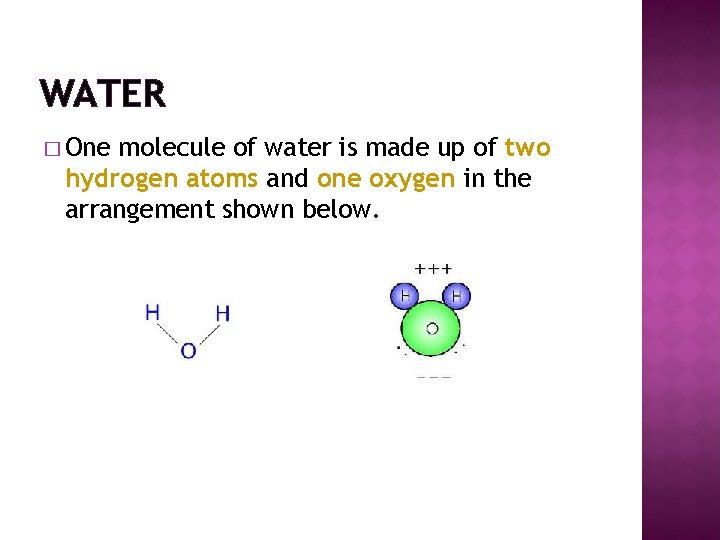
WATER � One molecule of water is made up of two hydrogen atoms and one oxygen in the arrangement shown below.
IMPORTANCE OF WATER � The human body is made up of 60 -75% water. � 70 -95% � Water of the cell is made up of water. makes life on Earth possible.
FUNCTIONS OF WATER 1. 2. 3. 4. It is used during digestion to break down large insoluble substances into smaller soluble substances. It is a medium for all chemical reactions in the cell. It is used to transport food along the alimentary canal and mineral salts in plants. Dissolve the waste substance in the body to form urine and sweat.
TERMINOLOGY � Elements are pure substances. � Compounds are made up of two or more elements. � Inorganic compounds are compounds that do not contain the element carbon 12. � Organic compounds are compounds that contain the element carbon 12. � Minerals are inorganic substances that are required by living organisms. � Macro-elements are elements that are required in large quantities by living organisms.
TERMINOLOGY � Micro-elements are elements that are required in small quantities by living organisms. � Eutrophication is the rapid growth of the population of living organisms, usually aquatic plants , due to increased supply of nutrients.
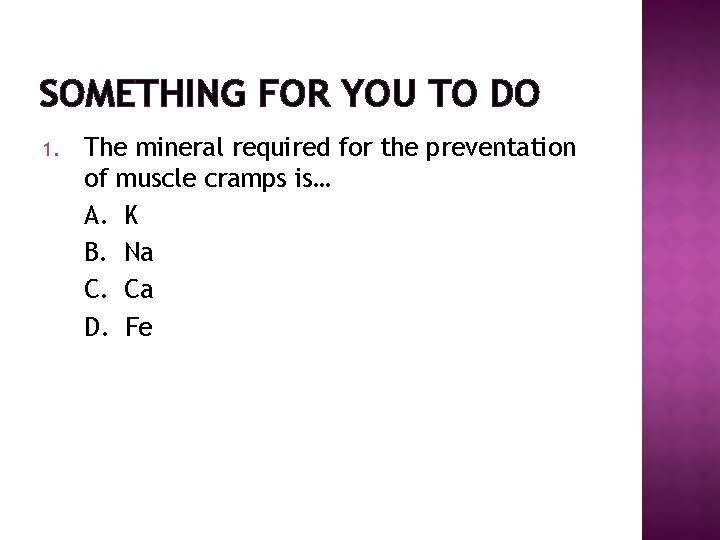
SOMETHING FOR YOU TO DO 1. The mineral required for the preventation of muscle cramps is… A. K B. Na C. Ca D. Fe
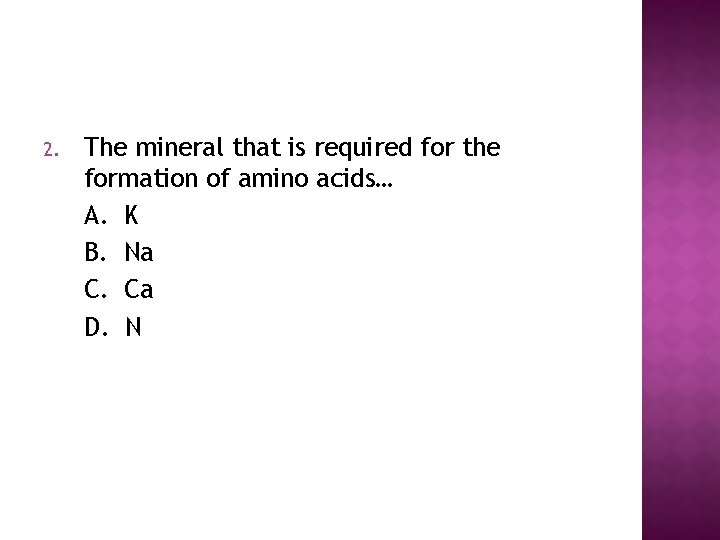
2. The mineral that is required for the formation of amino acids… A. K B. Na C. Ca D. N
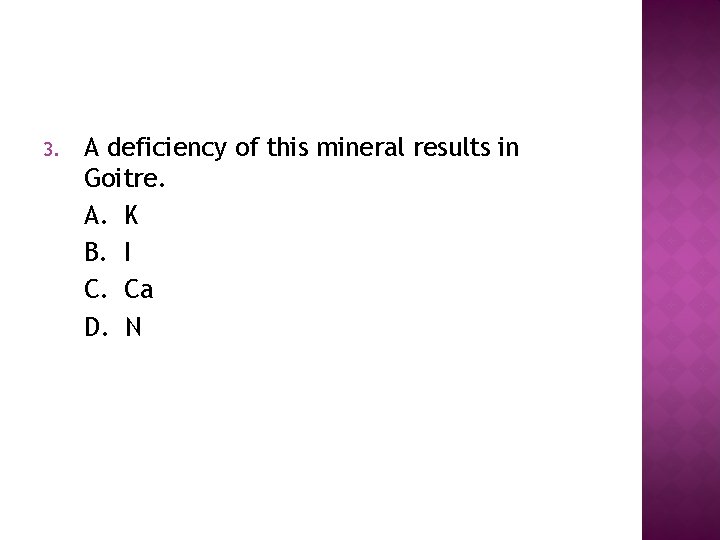
3. A deficiency of this mineral results in Goitre. A. K B. I C. Ca D. N
4. Lack of iron results in a deficiency disease in plants called… A. Kwashiorkor B. Goitre C. Anaemia D. chlorosis
5. A lack of this mineral results in lower drought resistance. A. K B. I C. Ca D. N
6. The mineral that is used formation of nucleic acids and the chlorophyll molecule is called… A. K B. I C. Ca D. N
7. In order for a child to have good strong bones and teeth, his/her diet must be rich in the following minerals A. Ca and P B. N and I C. Fe and K D. Na and Mg
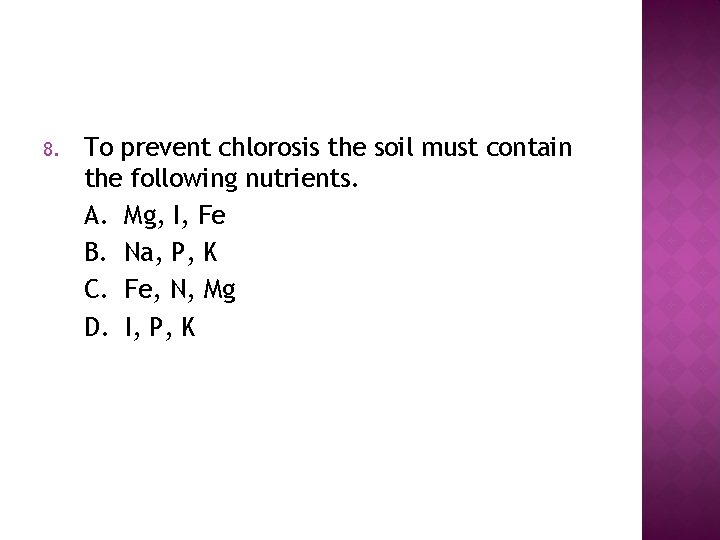
8. To prevent chlorosis the soil must contain the following nutrients. A. Mg, I, Fe B. Na, P, K C. Fe, N, Mg D. I, P, K
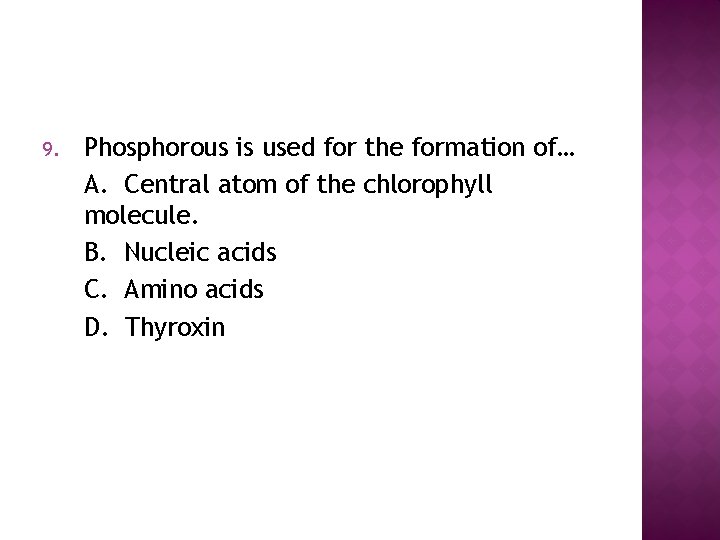
9. Phosphorous is used for the formation of… A. Central atom of the chlorophyll molecule. B. Nucleic acids C. Amino acids D. Thyroxin
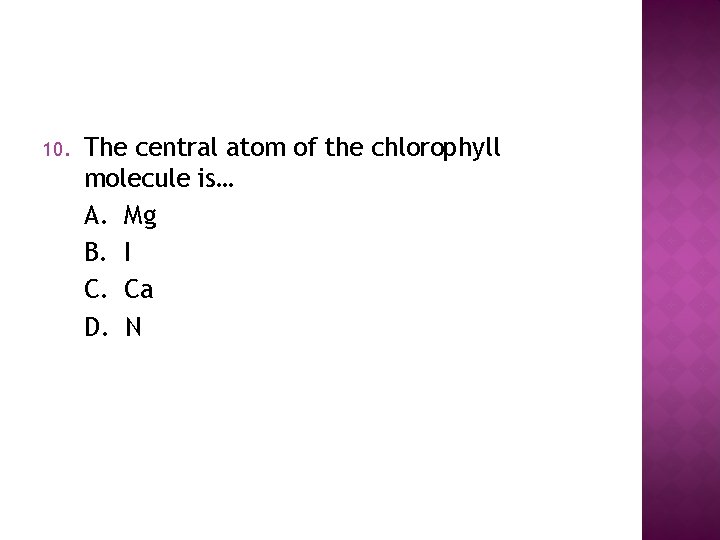
10. The central atom of the chlorophyll molecule is… A. Mg B. I C. Ca D. N
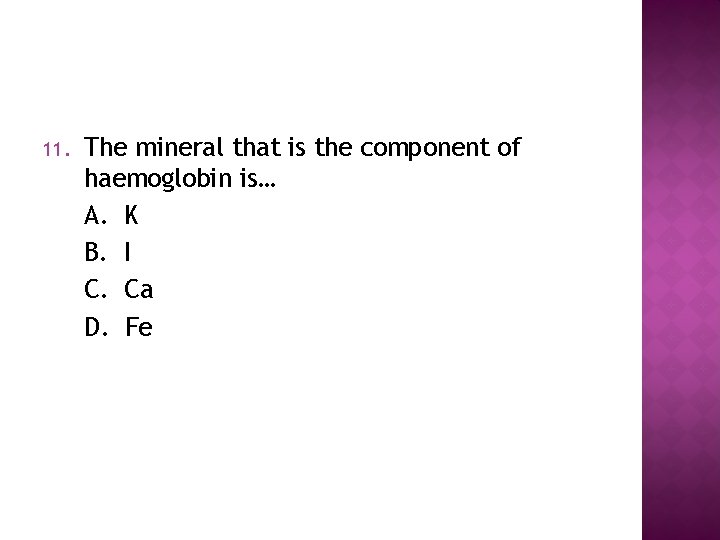
11. The mineral that is the component of haemoglobin is… A. K B. I C. Ca D. Fe
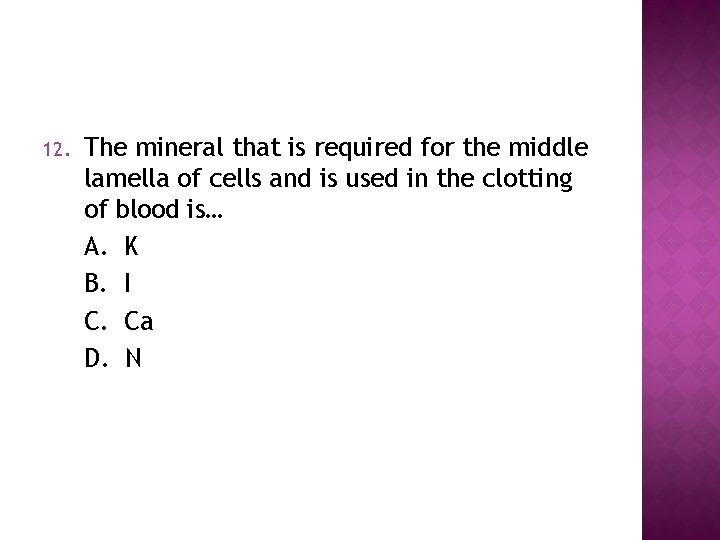
12. The mineral that is required for the middle lamella of cells and is used in the clotting of blood is… A. K B. I C. Ca D. N
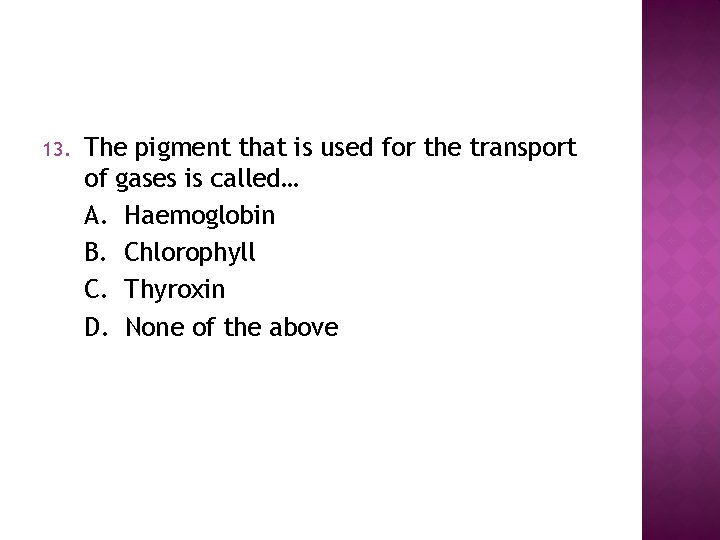
13. The pigment that is used for the transport of gases is called… A. Haemoglobin B. Chlorophyll C. Thyroxin D. None of the above
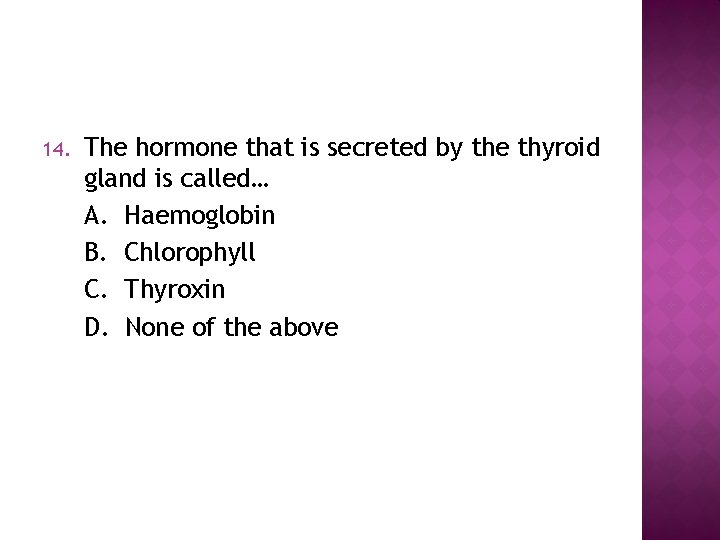
14. The hormone that is secreted by the thyroid gland is called… A. Haemoglobin B. Chlorophyll C. Thyroxin D. None of the above
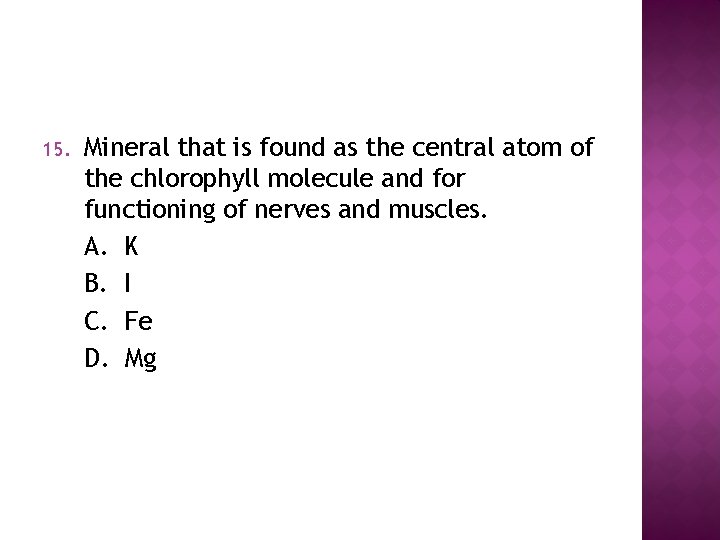
15. Mineral that is found as the central atom of the chlorophyll molecule and for functioning of nerves and muscles. A. K B. I C. Fe D. Mg
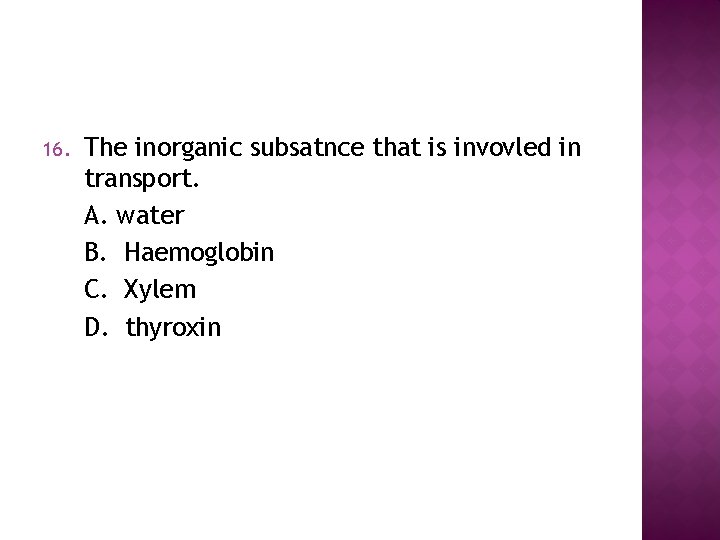
16. The inorganic subsatnce that is invovled in transport. A. water B. Haemoglobin C. Xylem D. thyroxin
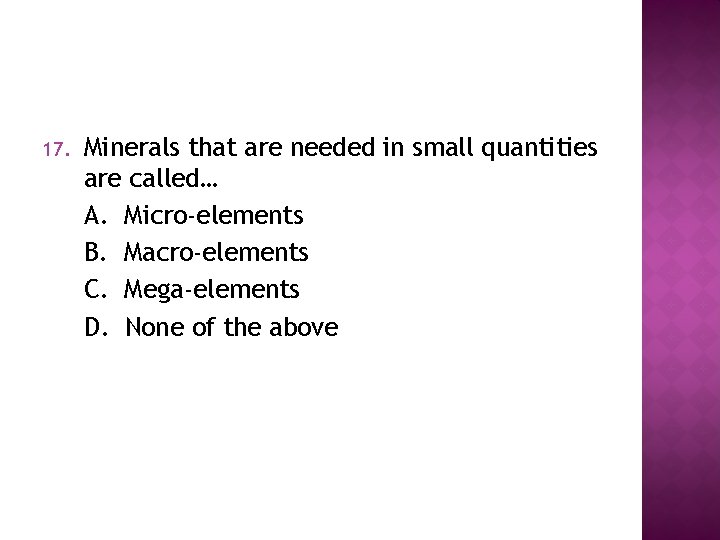
17. Minerals that are needed in small quantities are called… A. Micro-elements B. Macro-elements C. Mega-elements D. None of the above
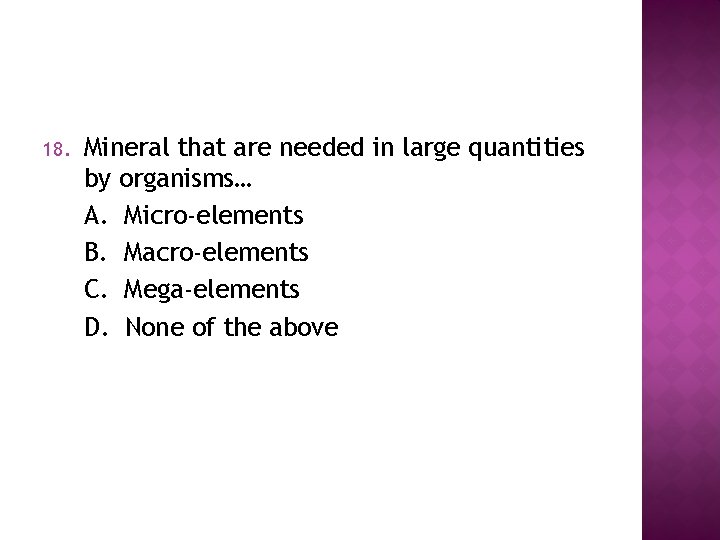
18. Mineral that are needed in large quantities by organisms… A. Micro-elements B. Macro-elements C. Mega-elements D. None of the above
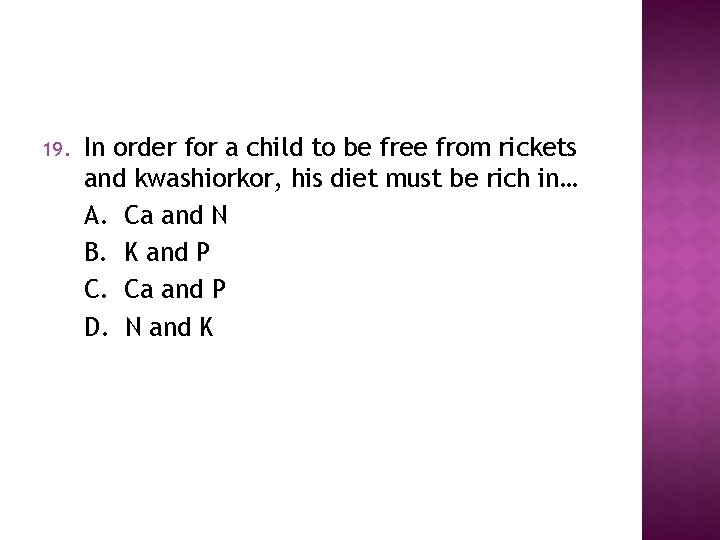
19. In order for a child to be free from rickets and kwashiorkor, his diet must be rich in… A. Ca and N B. K and P C. Ca and P D. N and K
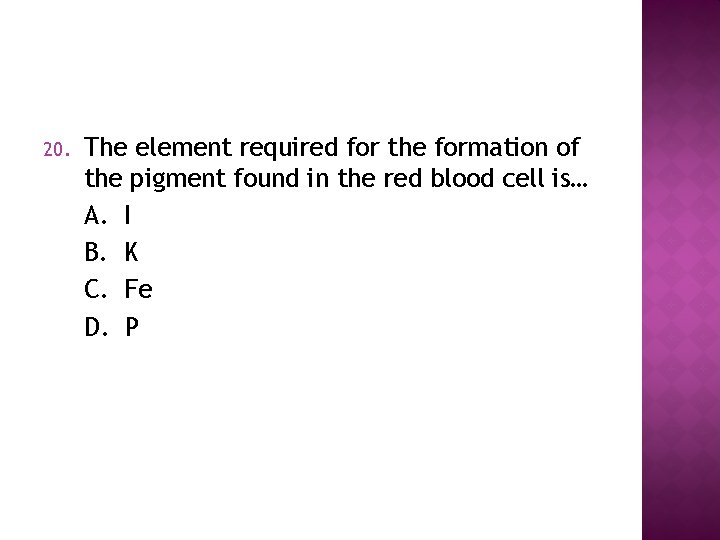
20. The element required for the formation of the pigment found in the red blood cell is… A. I B. K C. Fe D. P
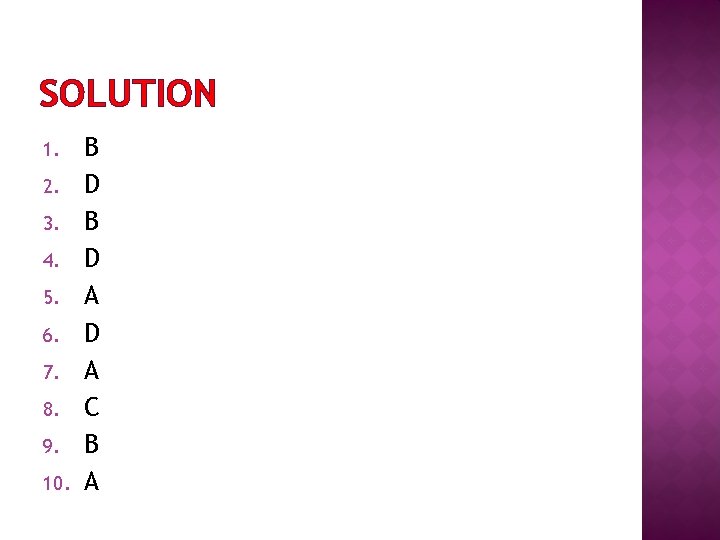
SOLUTION 1. 2. 3. 4. 5. 6. 7. 8. 9. 10. B D A D A C B A
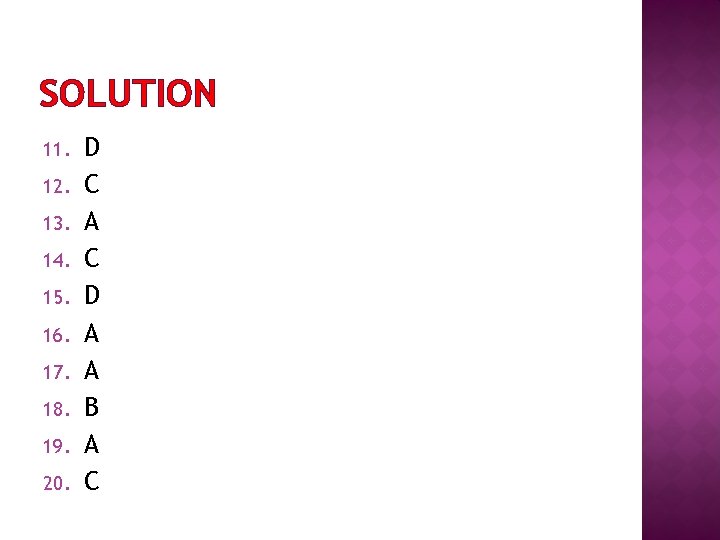
SOLUTION 11. 12. 13. 14. 15. 16. 17. 18. 19. 20. D C A C D A A B A C