
THE CHEMISTRY OF ANTIBIOTICS Lecture Six The Chemistry


THE CHEMISTRY OF ANTIBIOTICS
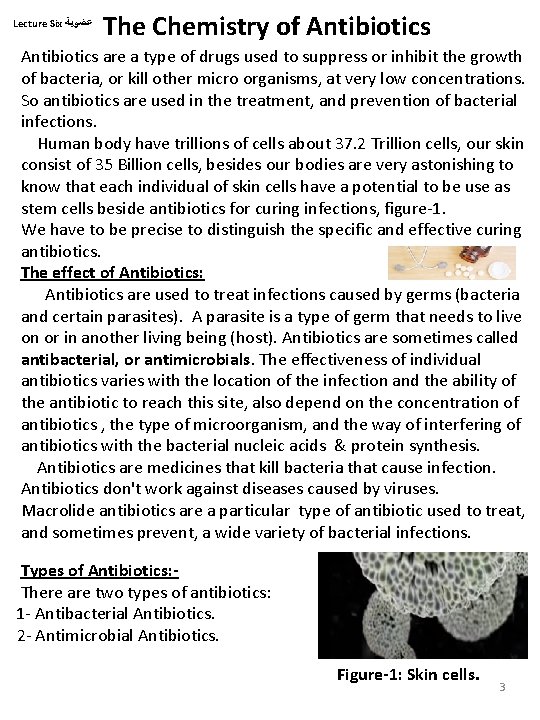
Lecture Six ﻋﻀﻮﻳﺔ The Chemistry of Antibiotics are a type of drugs used to suppress or inhibit the growth of bacteria, or kill other micro organisms, at very low concentrations. So antibiotics are used in the treatment, and prevention of bacterial infections. Human body have trillions of cells about 37. 2 Trillion cells, our skin consist of 35 Billion cells, besides our bodies are very astonishing to know that each individual of skin cells have a potential to be use as stem cells beside antibiotics for curing infections, figure-1. We have to be precise to distinguish the specific and effective curing antibiotics. The effect of Antibiotics: Antibiotics are used to treat infections caused by germs (bacteria and certain parasites). A parasite is a type of germ that needs to live on or in another living being (host). Antibiotics are sometimes called antibacterial, or antimicrobials. The effectiveness of individual antibiotics varies with the location of the infection and the ability of the antibiotic to reach this site, also depend on the concentration of antibiotics , the type of microorganism, and the way of interfering of antibiotics with the bacterial nucleic acids & protein synthesis. Antibiotics are medicines that kill bacteria that cause infection. Antibiotics don't work against diseases caused by viruses. Macrolide antibiotics are a particular type of antibiotic used to treat, and sometimes prevent, a wide variety of bacterial infections. Types of Antibiotics: There are two types of antibiotics: 1 - Antibacterial Antibiotics. 2 - Antimicrobial Antibiotics. Figure-1: Skin cells. 3
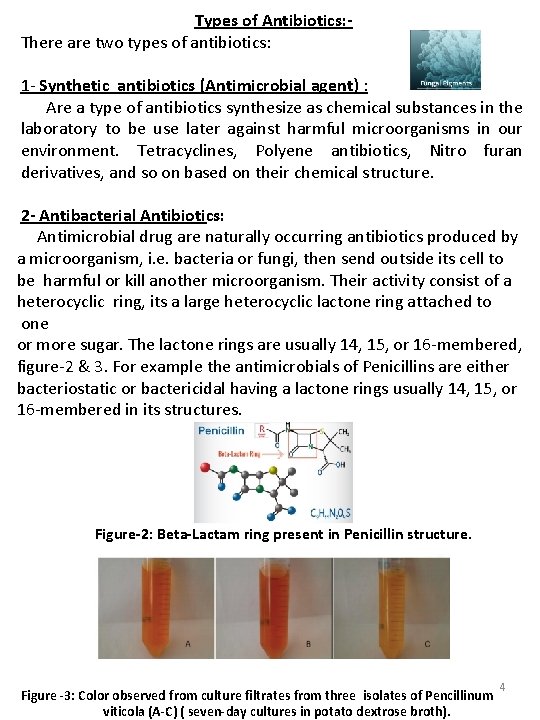
Types of Antibiotics: There are two types of antibiotics: 1 - Synthetic antibiotics (Antimicrobial agent) : Are a type of antibiotics synthesize as chemical substances in the laboratory to be use later against harmful microorganisms in our environment. Tetracyclines, Polyene antibiotics, Nitro furan derivatives, and so on based on their chemical structure. 2 - Antibacterial Antibiotics: Antimicrobial drug are naturally occurring antibiotics produced by a microorganism, i. e. bacteria or fungi, then send outside its cell to be harmful or kill another microorganism. Their activity consist of a heterocyclic ring, its a large heterocyclic lactone ring attached to one or more sugar. The lactone rings are usually 14, 15, or 16 -membered, figure-2 & 3. For example the antimicrobials of Penicillins are either bacteriostatic or bactericidal having a lactone rings usually 14, 15, or 16 -membered in its structures. Figure-2: Beta-Lactam ring present in Penicillin structure. 4 Figure -3: Color observed from culture filtrates from three isolates of Pencillinum viticola (A-C) ( seven-day cultures in potato dextrose broth).
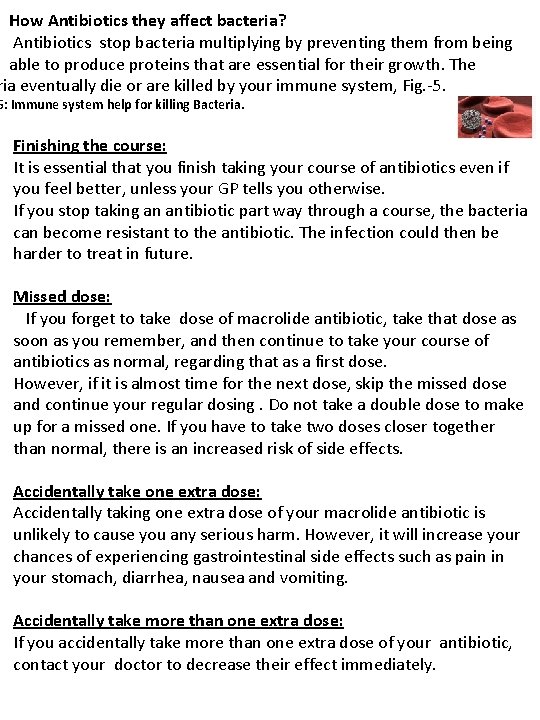
How Antibiotics they affect bacteria? Antibiotics stop bacteria multiplying by preventing them from being able to produce proteins that are essential for their growth. The ria eventually die or are killed by your immune system, Fig. -5. 5: Immune system help for killing Bacteria. Finishing the course: It is essential that you finish taking your course of antibiotics even if you feel better, unless your GP tells you otherwise. If you stop taking an antibiotic part way through a course, the bacteria can become resistant to the antibiotic. The infection could then be harder to treat in future. Missed dose: If you forget to take dose of macrolide antibiotic, take that dose as soon as you remember, and then continue to take your course of antibiotics as normal, regarding that as a first dose. However, if it is almost time for the next dose, skip the missed dose and continue your regular dosing. Do not take a double dose to make up for a missed one. If you have to take two doses closer together than normal, there is an increased risk of side effects. Accidentally take one extra dose: Accidentally taking one extra dose of your macrolide antibiotic is unlikely to cause you any serious harm. However, it will increase your chances of experiencing gastrointestinal side effects such as pain in your stomach, diarrhea, nausea and vomiting. Accidentally take more than one extra dose: If you accidentally take more than one extra dose of your antibiotic, contact your doctor to decrease their effect immediately.
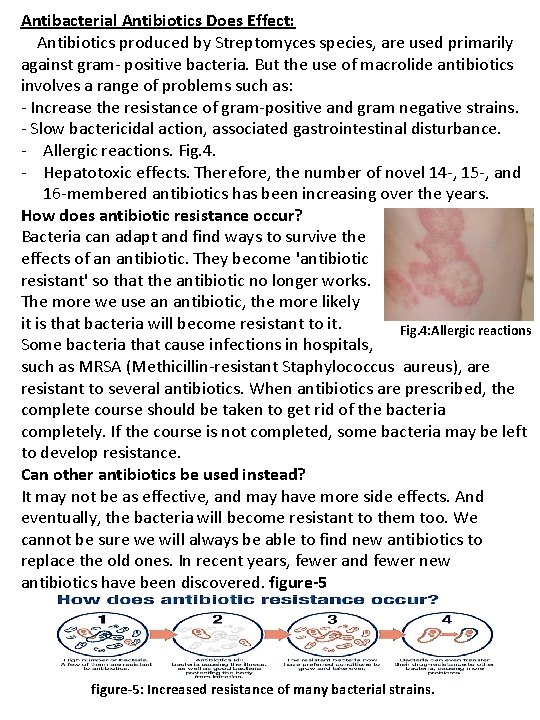
Antibacterial Antibiotics Does Effect: Antibiotics produced by Streptomyces species, are used primarily against gram- positive bacteria. But the use of macrolide antibiotics involves a range of problems such as: - Increase the resistance of gram-positive and gram negative strains. - Slow bactericidal action, associated gastrointestinal disturbance. - Allergic reactions. Fig. 4. - Hepatotoxic effects. Therefore, the number of novel 14 -, 15 -, and 16 -membered antibiotics has been increasing over the years. How does antibiotic resistance occur? Bacteria can adapt and find ways to survive the effects of an antibiotic. They become 'antibiotic resistant' so that the antibiotic no longer works. The more we use an antibiotic, the more likely it is that bacteria will become resistant to it. Fig. 4: Allergic reactions Some bacteria that cause infections in hospitals, such as MRSA (Methicillin-resistant Staphylococcus aureus), are resistant to several antibiotics. When antibiotics are prescribed, the complete course should be taken to get rid of the bacteria completely. If the course is not completed, some bacteria may be left to develop resistance. Can other antibiotics be used instead? It may not be as effective, and may have more side effects. And eventually, the bacteria will become resistant to them too. We cannot be sure we will always be able to find new antibiotics to replace the old ones. In recent years, fewer and fewer new antibiotics have been discovered. figure-5: Increased resistance of many bacterial strains.
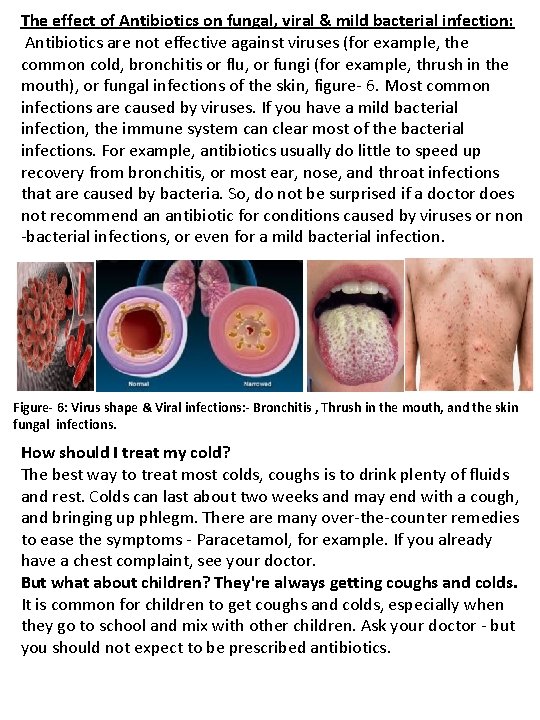
The effect of Antibiotics on fungal, viral & mild bacterial infection: Antibiotics are not effective against viruses (for example, the common cold, bronchitis or flu, or fungi (for example, thrush in the mouth), or fungal infections of the skin, figure- 6. Most common infections are caused by viruses. If you have a mild bacterial infection, the immune system can clear most of the bacterial infections. For example, antibiotics usually do little to speed up recovery from bronchitis, or most ear, nose, and throat infections that are caused by bacteria. So, do not be surprised if a doctor does not recommend an antibiotic for conditions caused by viruses or non -bacterial infections, or even for a mild bacterial infection. Figure- 6: Virus shape & Viral infections: - Bronchitis , Thrush in the mouth, and the skin fungal infections. How should I treat my cold? The best way to treat most colds, coughs is to drink plenty of fluids and rest. Colds can last about two weeks and may end with a cough, and bringing up phlegm. There are many over-the-counter remedies to ease the symptoms - Paracetamol, for example. If you already have a chest complaint, see your doctor. But what about children? They're always getting coughs and colds. It is common for children to get coughs and colds, especially when they go to school and mix with other children. Ask your doctor - but you should not expect to be prescribed antibiotics.
So when will I be prescribed antibiotics? The doctor will only prescribe antibiotics when you need them; for example, for a kidney infection or pneumonia. Antibiotics may be lifesaving for infections such as meningitis. By only using them when necessary, they are more likely to work when we need them in future. Treatment: Antibiotics are only effective in treating bacterial infections associated with the following conditions: Ear, nose and throat infections: Otitis media (infection of the middle ear). Sinusitis (infection of the sinuses). Tonsillitis (infection of the tonsils) Laryngitis (infection of the voice box). Chest infections: Pneumonia (infection of the lining of the lung). Bronchitis (infection of the airways of the lung). Whooping cough. Skin infections - such as eczema, Psoriasis, Acne that has become infected. When to avoid them or Using them with caution Pregnancy and breastfeeding If you are pregnant or are breastfeeding, the only type of macrolide antibiotic you can take is erythromycin. Erythromycin can be used at the usual doses throughout your pregnancy, or while you are breastfeeding.
Combined oral contraceptive pill There is a small risk that macrolide antibiotics can reduce the effectiveness of the combined oral contraceptive pill. Common side effects Up to one in 10 people may experience the following: pain in the stomach or intestines, diarrhoea, nausea, and vomiting. These side effects are less severe if you are taking azithromycin (Zithromax) or clarithromycin (Klacid). Erythromycin is available in enteric-coated tablets, slow-release capsules, oral suspensions, ophthalmic solutions, ointments, gels, and injections. Less common side effects Up to one in 100 people may experience the following: dizziness, stomach irritation, indigestion (dyspepsia), and skin rash. Rare and very rare side effects Between one in 1, 000 and one in 10, 000 people may experience the following: jaundice, heart arrhythmias (disorders that affect the way the heart beats), Stevens-Johnson syndrome (a very severe allergic reaction), and tinnitus - this usually disappears once you stop taking the macrolide antibiotics.
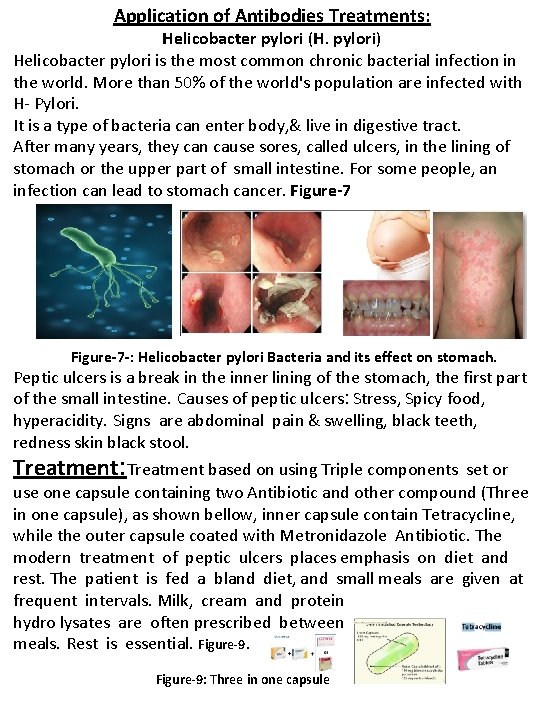
Application of Antibodies Treatments: Helicobacter pylori (H. pylori) Helicobacter pylori is the most common chronic bacterial infection in the world. More than 50% of the world's population are infected with H- Pylori. It is a type of bacteria can enter body, & live in digestive tract. After many years, they can cause sores, called ulcers, in the lining of stomach or the upper part of small intestine. For some people, an infection can lead to stomach cancer. Figure-7 Figure-7 -: Helicobacter pylori Bacteria and its effect on stomach. Peptic ulcers is a break in the inner lining of the stomach, the first part of the small intestine. Causes of peptic ulcers: Stress, Spicy food, hyperacidity. Signs are abdominal pain & swelling, black teeth, redness skin black stool. Treatment: Treatment based on using Triple components set or use one capsule containing two Antibiotic and other compound (Three in one capsule), as shown bellow, inner capsule contain Tetracycline, while the outer capsule coated with Metronidazole Antibiotic. The modern treatment of peptic ulcers places emphasis on diet and rest. The patient is fed a bland diet, and small meals are given at frequent intervals. Milk, cream and protein hydro lysates are often prescribed between meals. Rest is essential. Figure-9. Figure-9: Three in one capsule
REFERENCE Application of Different Analytical Techniques and Microbiological Assays for the Analysis of Macrolide Antibiotics from Pharmaceutical Dosage Forms and Biological Matrices Lantider Kassaye Bekele 1 and Getachew Genete Gebeyehu Content provided by NHS Choices www. nhs. uk and adapted for Ireland by the Health A-Z: sinusitis , Health A-Z: laryngitis, Health A-Z: bronchitis, www. medicines. ie H. pylori Bacteria Infection: Symptoms, Diagnosis, . . . www. webmd. com › digestive-disorders › h-pylori-helicobacter-pylori International Scholarly Research Notices / 2012 / Article / Fig 1 Review Article Application of Different Analytical Techniques and Microbiological Assays for the Analysis of Macrolide Antibiotics from Pharmaceutical Dosage Forms and Biological Matrices
- Slides: 11