
The Chemistry of Acids and Bases Learning Objectives
The Chemistry of Acids and Bases
Learning Objectives Acids and bases Learners be able to calculate and understand 1) Arrhenius and Bronsted-Lowry theories. 2) p. H as -log 10[H+], and be able to convert p. H to concentration for a strong acid or base. 3) know that water is weakly dissociated 4) know the ionic product of water, Kw and that Kw = [H+] [OH-]
A/B Intro 5 min Fuse School https: //www. youtube. com/watch? v=wmh. Ottro. Irw
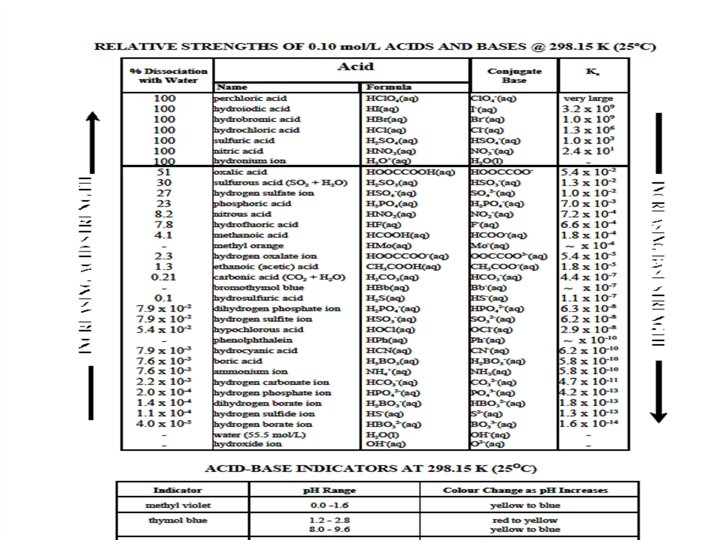
Strong Acids…. MEMORIZE RIGHT NOW, or don’t…. • HCl - hydrochloric acid • HNO 3 - nitric acid • H 2 SO 4 - sulfuric acid (HSO 4 - is a weak acid) • HBr - hydrobromic acid • HI - hydroiodic acid • HCl. O 4 - perchloric acid H 2 SO 4 (aq) → 2 H+(aq) + SO 42 - (aq) HCl(aq) → H+ (aq) + Cl-(aq) HNO 3 (aq) → H+ (aq) + NO 3 -(aq)

STRONG BASES Li. OH lithium hydroxide Na. OH sodium hydroxide KOH potassium hydroxide Rb. OH rubidium hydroxide Cs. OH cesium hydroxide *Ca(OH)2 calcium hydroxide *Sr(OH)2 strontium hydroxide *Ba(OH)2 barium hydroxide
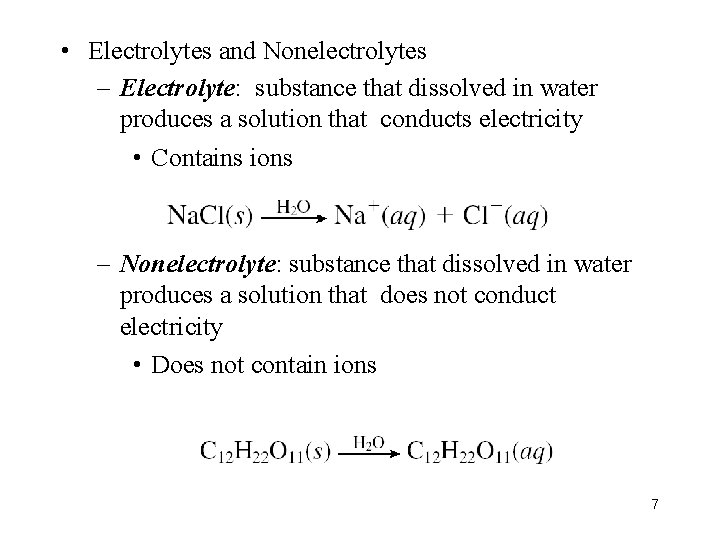
• Electrolytes and Nonelectrolytes – Electrolyte: substance that dissolved in water produces a solution that conducts electricity • Contains ions – Nonelectrolyte: substance that dissolved in water produces a solution that does not conduct electricity • Does not contain ions 7
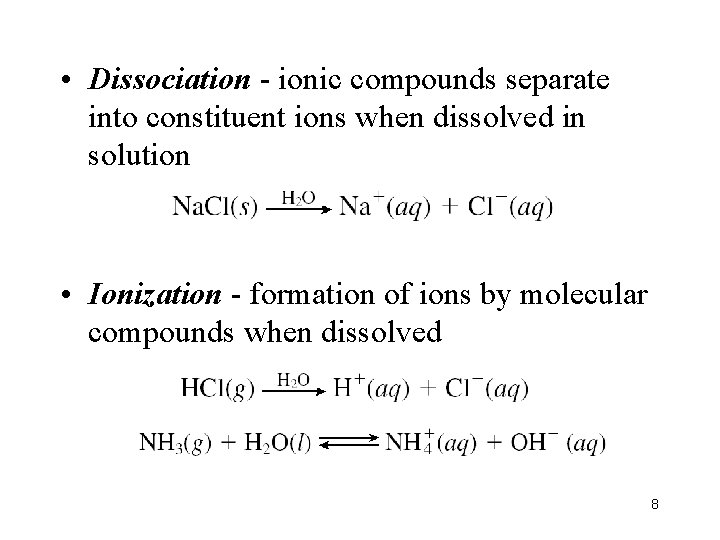
• Dissociation - ionic compounds separate into constituent ions when dissolved in solution • Ionization - formation of ions by molecular compounds when dissolved 8
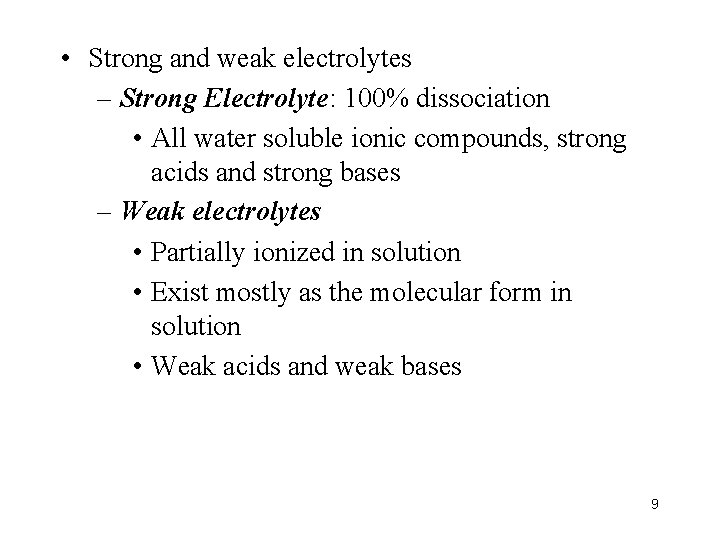
• Strong and weak electrolytes – Strong Electrolyte: 100% dissociation • All water soluble ionic compounds, strong acids and strong bases – Weak electrolytes • Partially ionized in solution • Exist mostly as the molecular form in solution • Weak acids and weak bases 9
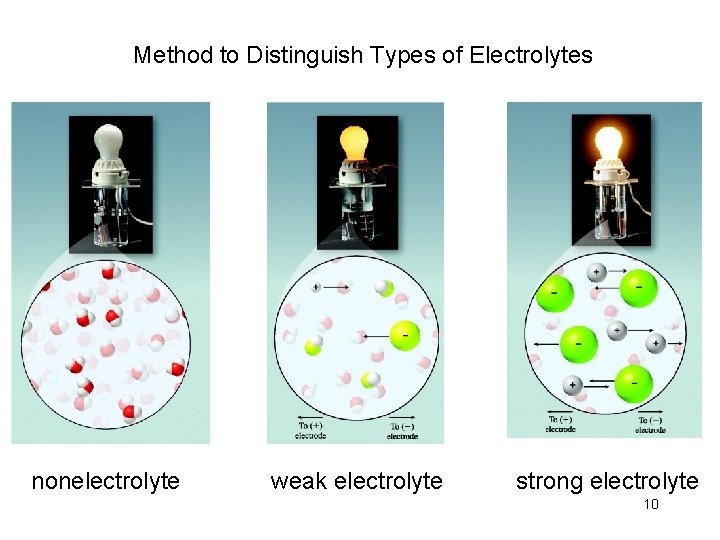
Method to Distinguish Types of Electrolytes nonelectrolyte weak electrolyte strong electrolyte 10
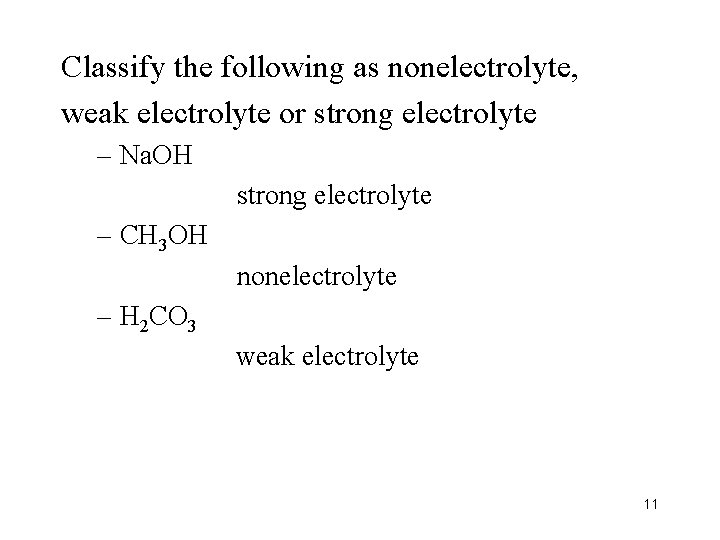
Classify the following as nonelectrolyte, weak electrolyte or strong electrolyte – Na. OH strong electrolyte – CH 3 OH nonelectrolyte – H 2 CO 3 weak electrolyte 11
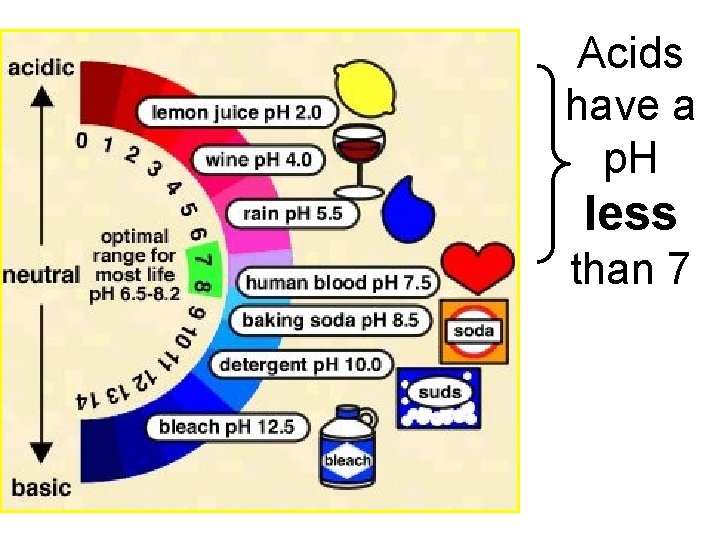
Acids have a p. H less than 7
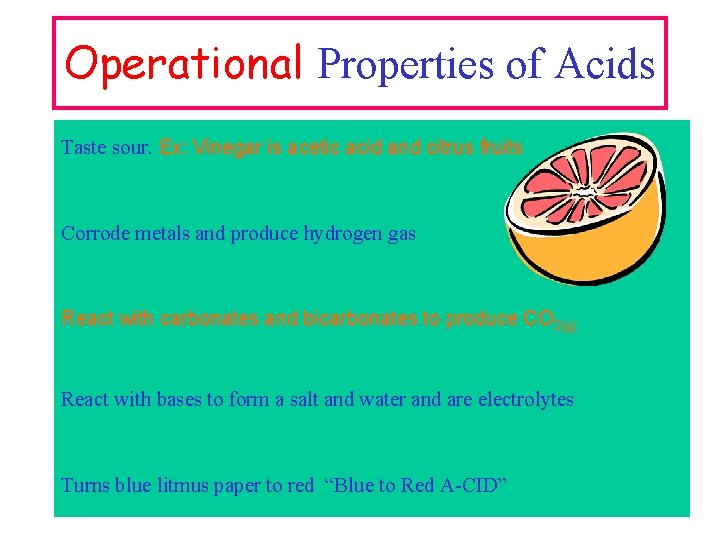
Operational Properties of Acids Taste sour. Ex: Vinegar is acetic acid and citrus fruits Corrode metals and produce hydrogen gas React with carbonates and bicarbonates to produce CO 2(g) React with bases to form a salt and water and are electrolytes Turns blue litmus paper to red “Blue to Red A-CID”
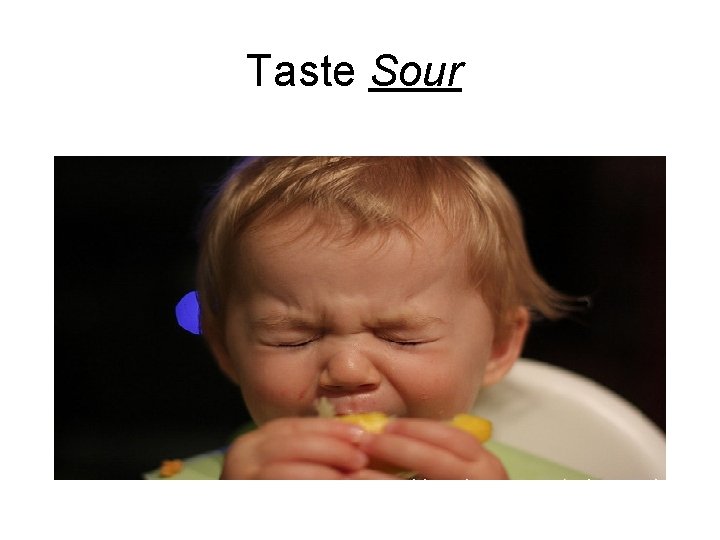
Taste Sour
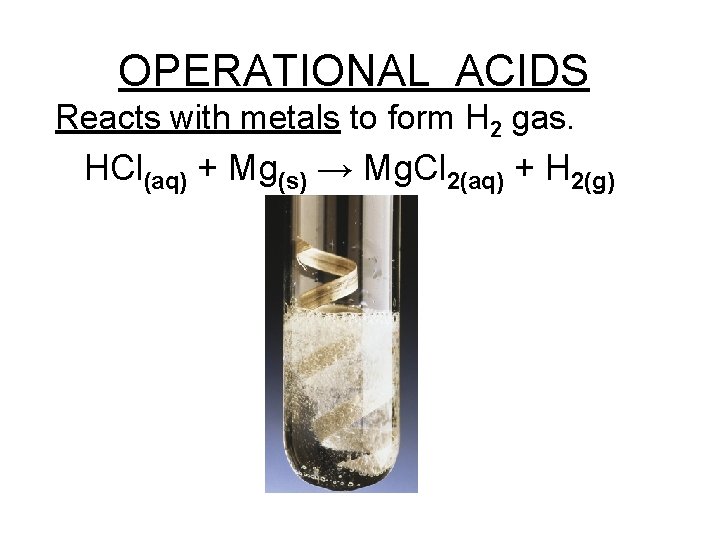
OPERATIONAL ACIDS Reacts with metals to form H 2 gas. HCl(aq) + Mg(s) → Mg. Cl 2(aq) + H 2(g)
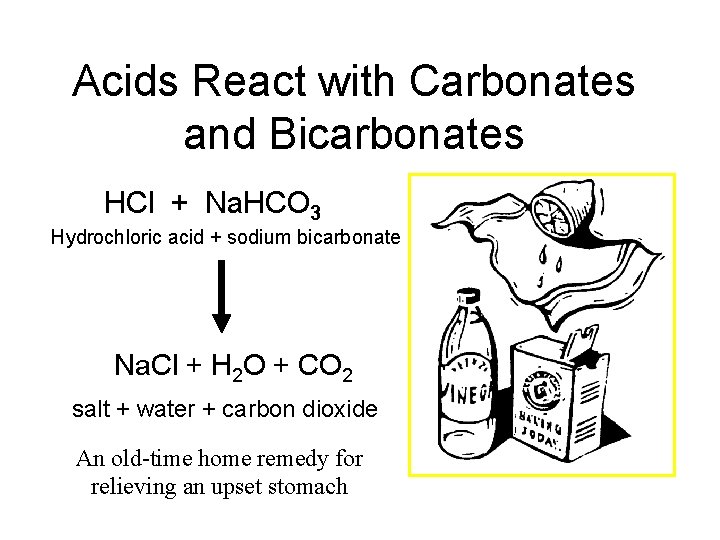
Acids React with Carbonates and Bicarbonates HCl + Na. HCO 3 Hydrochloric acid + sodium bicarbonate Na. Cl + H 2 O + CO 2 salt + water + carbon dioxide An old-time home remedy for relieving an upset stomach
Conducts electricity.
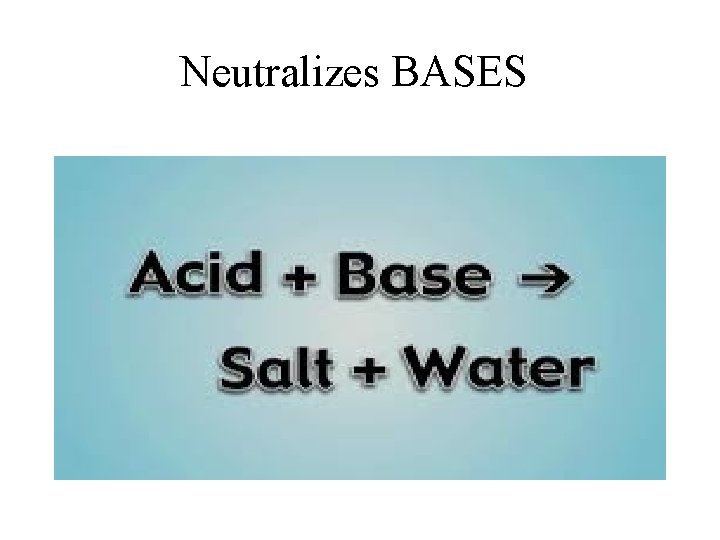
Neutralizes BASES
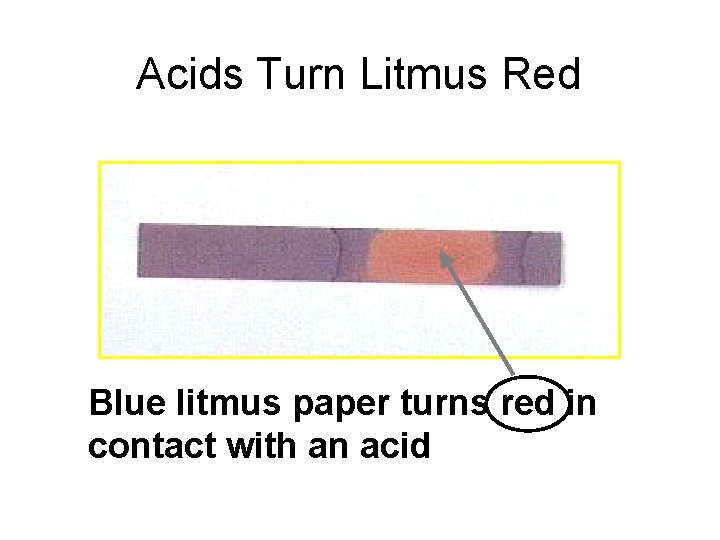
Acids Turn Litmus Red Blue litmus paper turns red in contact with an acid
B/L Theory and Arrhenius https: //www. youtube. com/watch? time_contin ue=1&v=Ziokq. P 0 a. Z 1 E
BASES
OPERATIONAL BASES
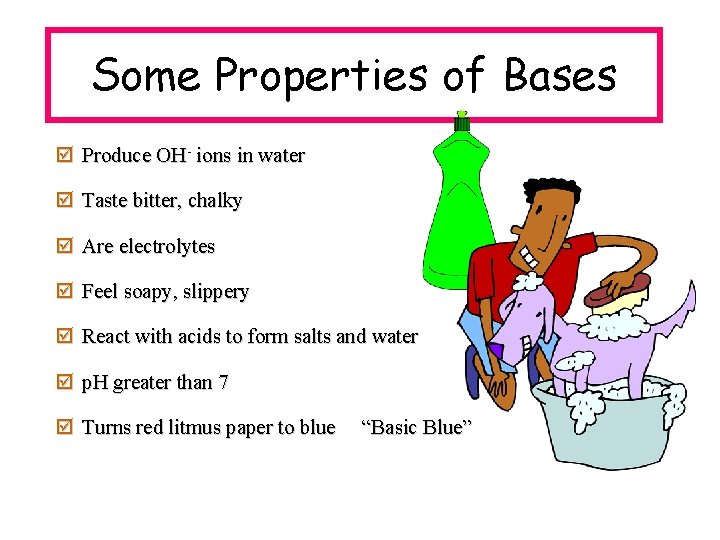
Some Properties of Bases þ Produce OH- ions in water þ Taste bitter, chalky þ Are electrolytes þ Feel soapy, slippery þ React with acids to form salts and water þ p. H greater than 7 þ Turns red litmus paper to blue “Basic Blue”
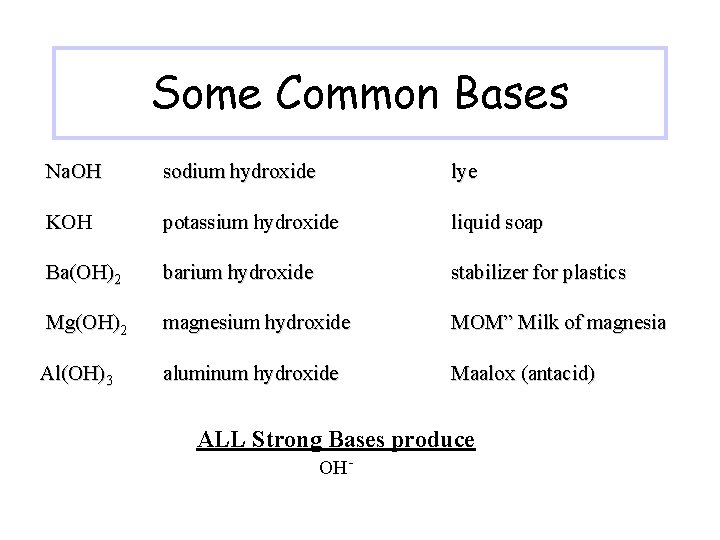
Some Common Bases Na. OH sodium hydroxide lye KOH potassium hydroxide liquid soap Ba(OH)2 barium hydroxide stabilizer for plastics Mg(OH)2 magnesium hydroxide MOM” Milk of magnesia Al(OH)3 aluminum hydroxide Maalox (antacid) ALL Strong Bases produce OH-
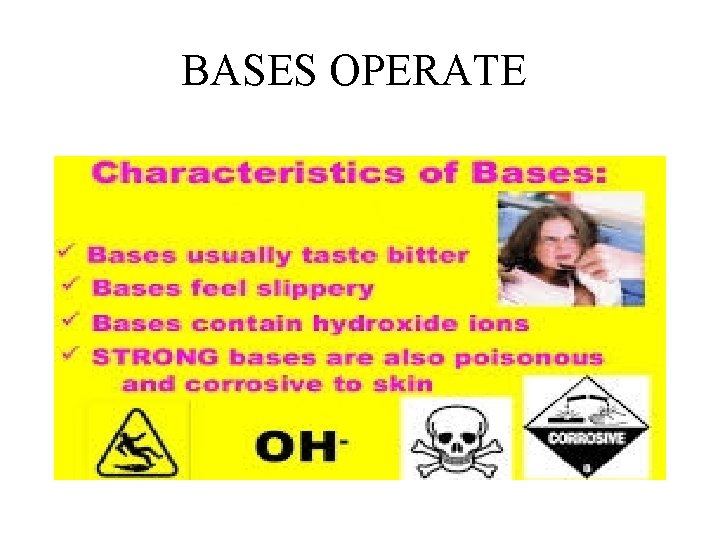
BASES OPERATE
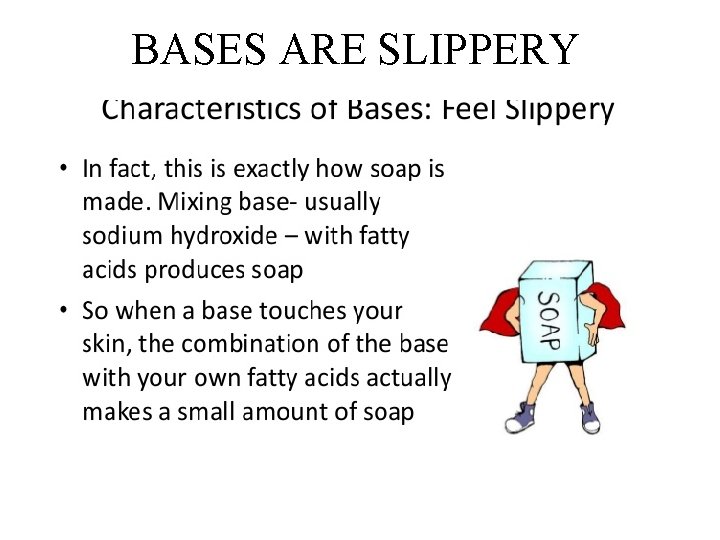
BASES ARE SLIPPERY
BASES are Corrosive
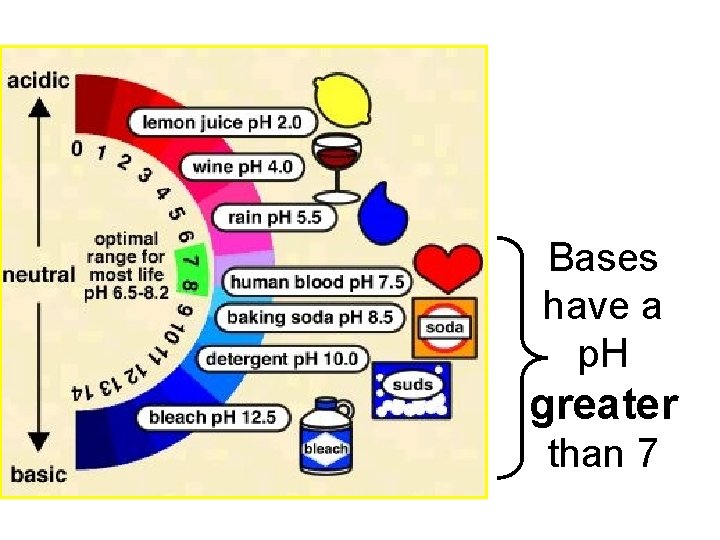
Bases have a p. H greater than 7
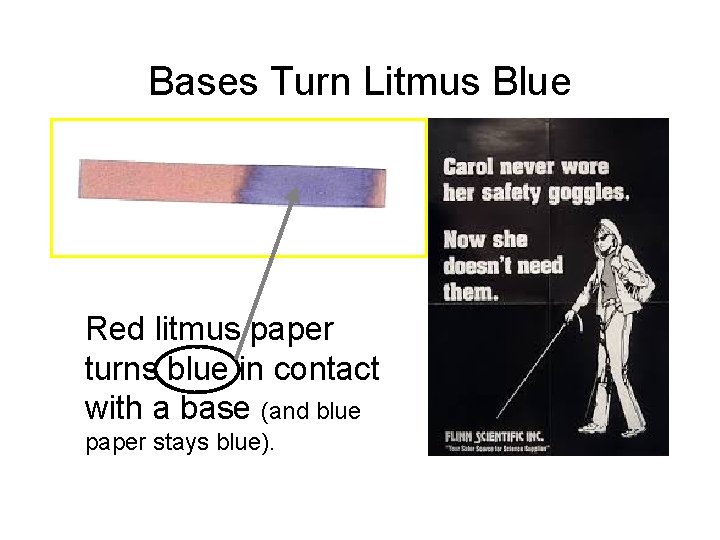
Bases Turn Litmus Blue Red litmus paper turns blue in contact with a base (and blue paper stays blue).
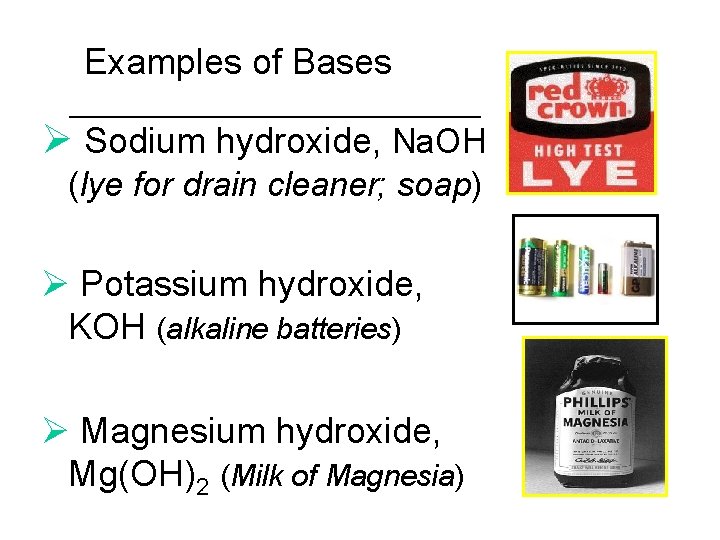
Examples of Bases Ø Sodium hydroxide, Na. OH (lye for drain cleaner; soap) Ø Potassium hydroxide, KOH (alkaline batteries) Ø Magnesium hydroxide, Mg(OH)2 (Milk of Magnesia)
Review Properties of Bases (metallic hydroxides, Na. OH) • • React with acids forms water and salt. Taste bitter & feel slippery Electrolytes in aqueous Change the color of indicators (bases go Blue, with litmus).
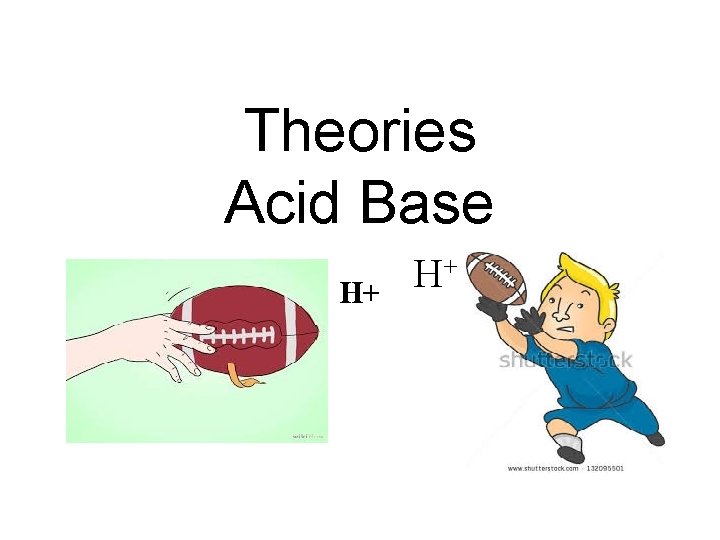
Theories Acid Base H+ H+
Acid-Base Theories • a) Arrhenius, • b) Brønsted-Lowry • c) Lewis (not covered).
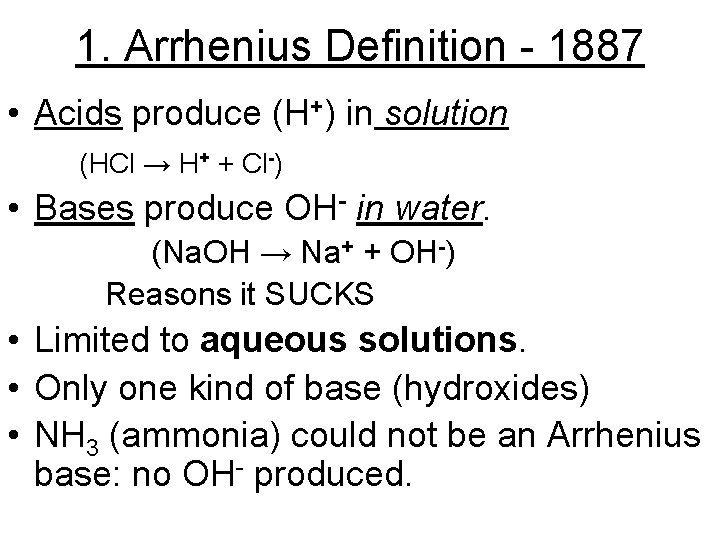
1. Arrhenius Definition - 1887 • Acids produce (H+) in solution (HCl → H+ + Cl-) • Bases produce OH- in water. (Na. OH → Na+ + OH-) Reasons it SUCKS • Limited to aqueous solutions. • Only one kind of base (hydroxides) • NH 3 (ammonia) could not be an Arrhenius base: no OH- produced.
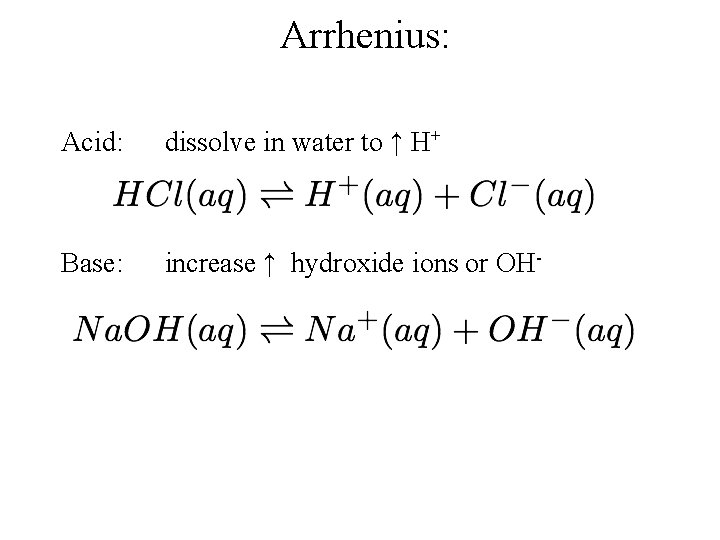
Arrhenius: Acid: dissolve in water to ↑ H+ Base: increase ↑ hydroxide ions or OH-
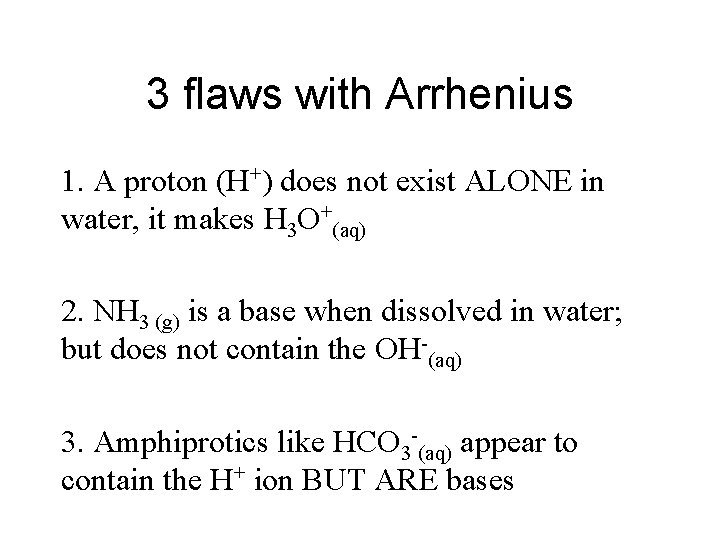
3 flaws with Arrhenius 1. A proton (H+) does not exist ALONE in water, it makes H 3 O+(aq) 2. NH 3 (g) is a base when dissolved in water; but does not contain the OH-(aq) 3. Amphiprotics like HCO 3 -(aq) appear to contain the H+ ion BUT ARE bases
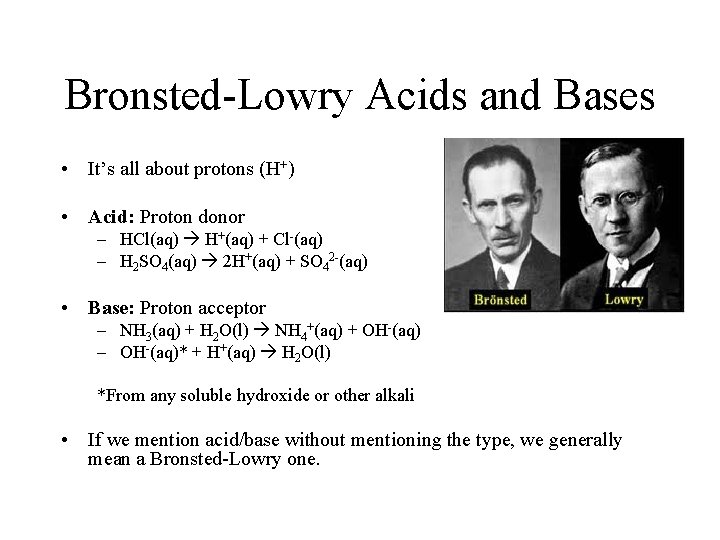
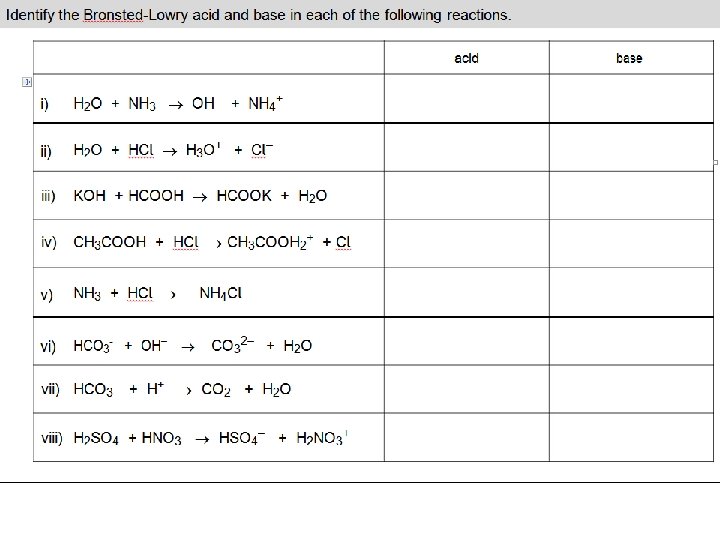
Bronsted-Lowry Acids and Bases • It’s all about protons (H+) • Acid: Proton donor – HCl(aq) H+(aq) + Cl-(aq) – H 2 SO 4(aq) 2 H+(aq) + SO 42 -(aq) • Base: Proton acceptor – NH 3(aq) + H 2 O(l) NH 4+(aq) + OH-(aq) – OH-(aq)* + H+(aq) H 2 O(l) *From any soluble hydroxide or other alkali • If we mention acid/base without mentioning the type, we generally mean a Bronsted-Lowry one.
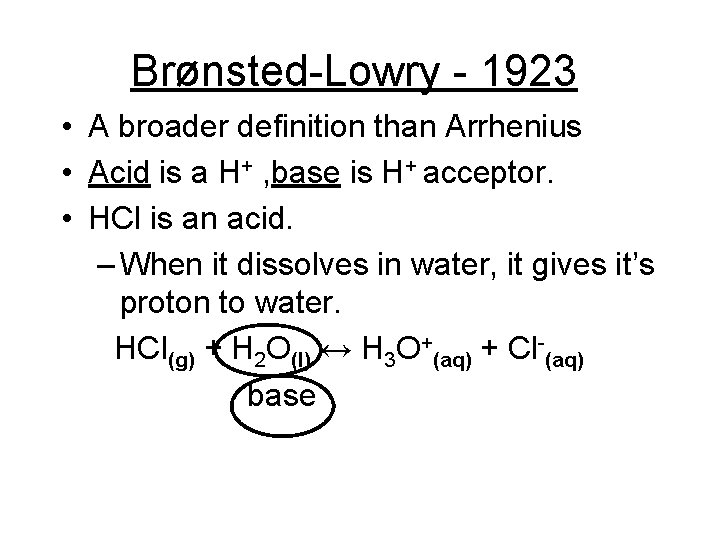
Brønsted-Lowry - 1923 • A broader definition than Arrhenius • Acid is a H+ , base is H+ acceptor. • HCl is an acid. – When it dissolves in water, it gives it’s proton to water. HCl(g) + H 2 O(l) ↔ H 3 O+(aq) + Cl-(aq) base
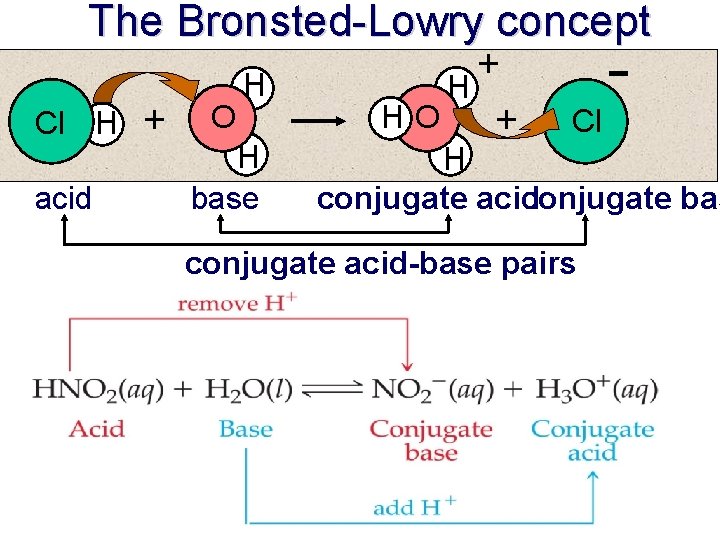
The Bronsted-Lowry concept Cl H acid + O H H base + H HO + Cl H conjugate acid conjugate bas conjugate acid-base pairs
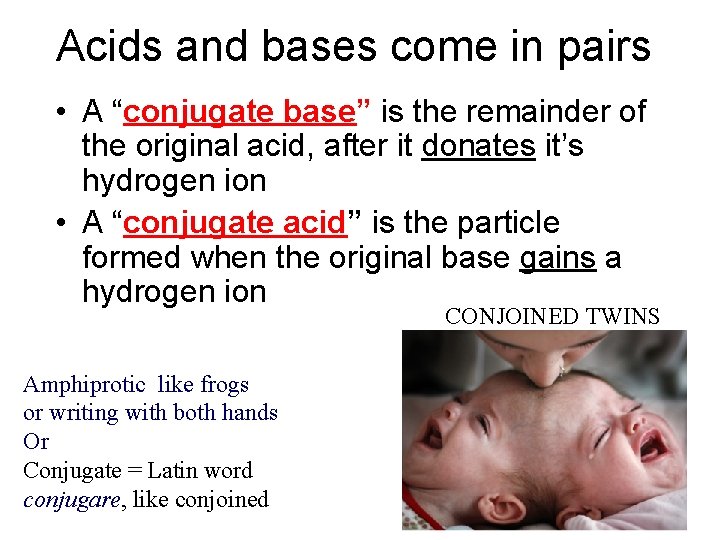
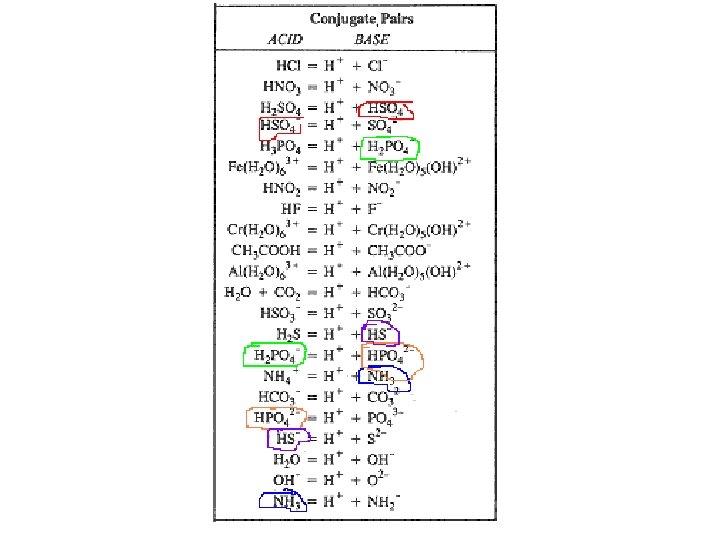
Acids and bases come in pairs • A “conjugate base” is the remainder of the original acid, after it donates it’s hydrogen ion • A “conjugate acid” is the particle formed when the original base gains a hydrogen ion CONJOINED TWINS Amphiprotic like frogs or writing with both hands Or Conjugate = Latin word conjugare, like conjoined
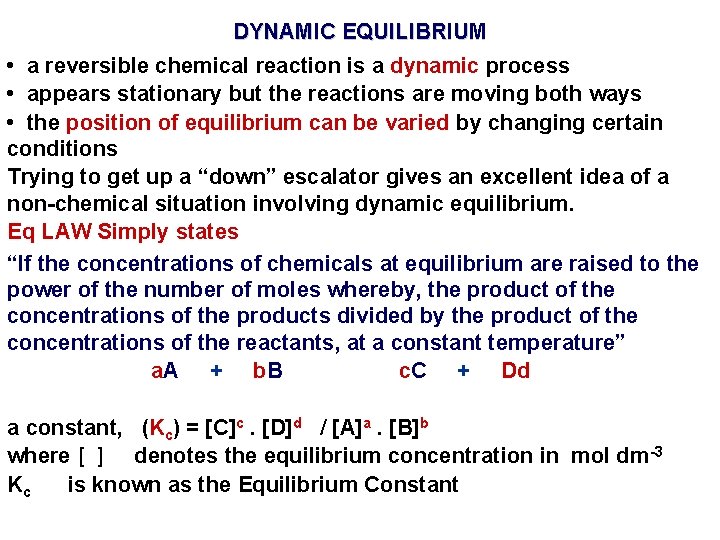
DYNAMIC EQUILIBRIUM • a reversible chemical reaction is a dynamic process • appears stationary but the reactions are moving both ways • the position of equilibrium can be varied by changing certain conditions Trying to get up a “down” escalator gives an excellent idea of a non-chemical situation involving dynamic equilibrium. Eq LAW Simply states “If the concentrations of chemicals at equilibrium are raised to the power of the number of moles whereby, the product of the concentrations of the products divided by the product of the concentrations of the reactants, at a constant temperature” a. A + b. B c. C + Dd a constant, (Kc) = [C]c. [D]d / [A]a. [B]b where [ ] denotes the equilibrium concentration in mol dm-3 Kc is known as the Equilibrium Constant
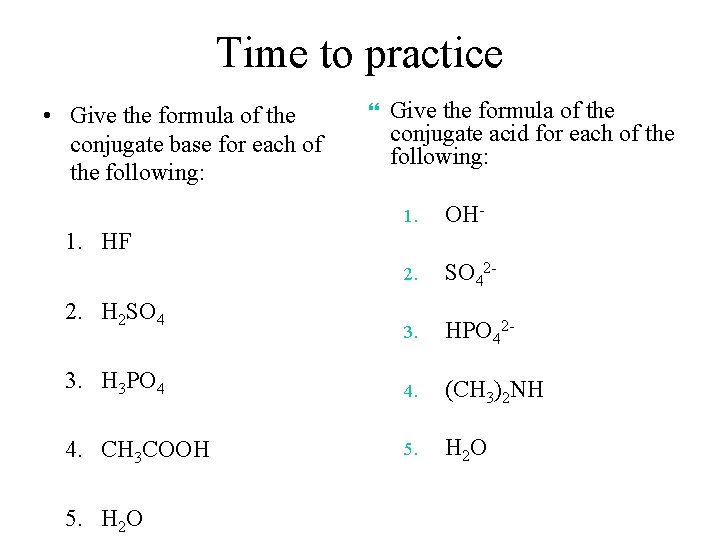
Time to practice • Give the formula of the conjugate base for each of the following: Give the formula of the conjugate acid for each of the following: 1. OH- 2. SO 42 - 3. HPO 42 - 3. H 3 PO 4 4. (CH 3)2 NH 4. CH 3 COOH 5. H 2 O 1. HF 2. H 2 SO 4 5. H 2 O
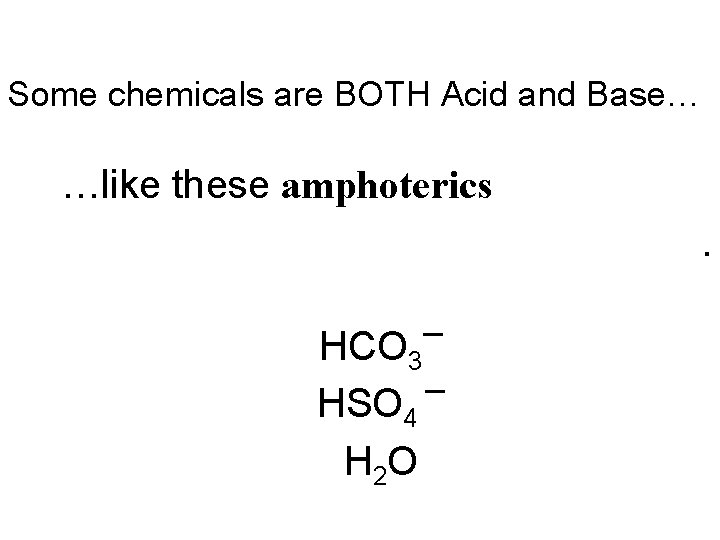
Some chemicals are BOTH Acid and Base… …like these amphoterics amphiprotic. – HCO 3 – HSO 4 H 2 O
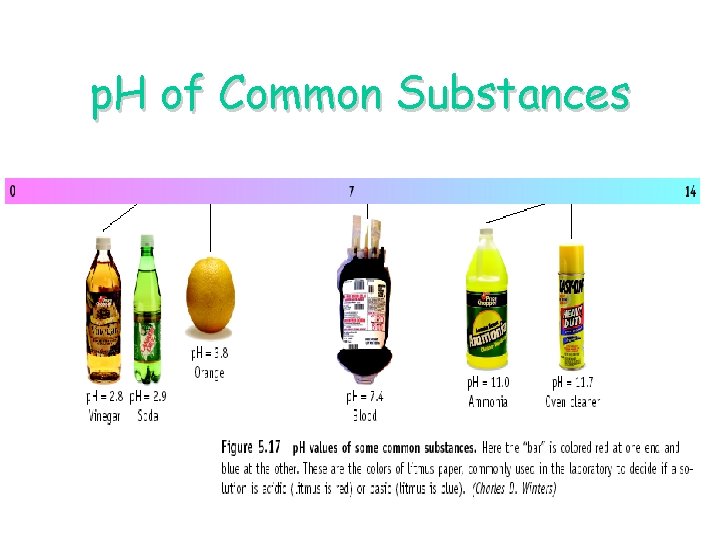
p. H of Common Substances
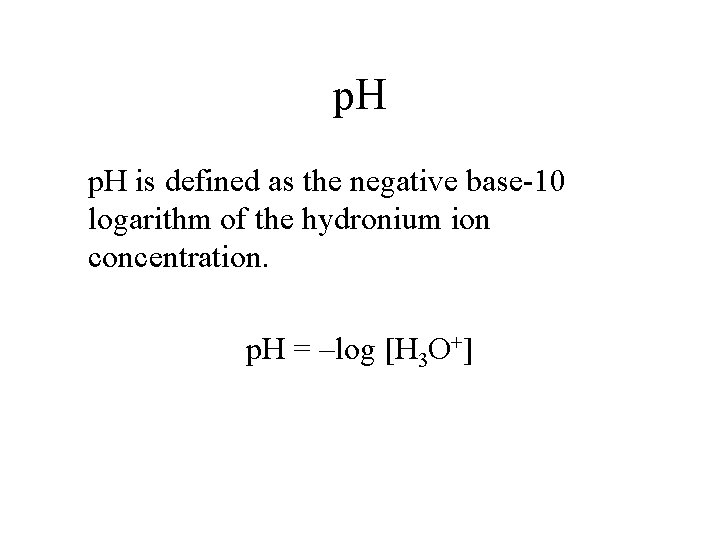
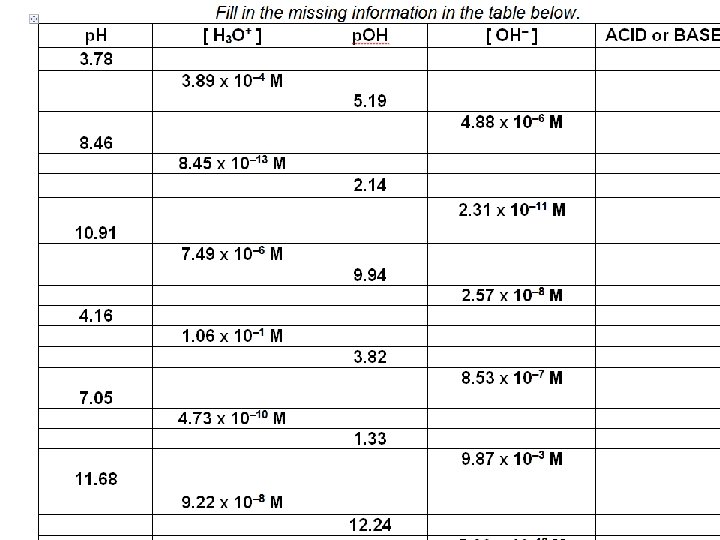
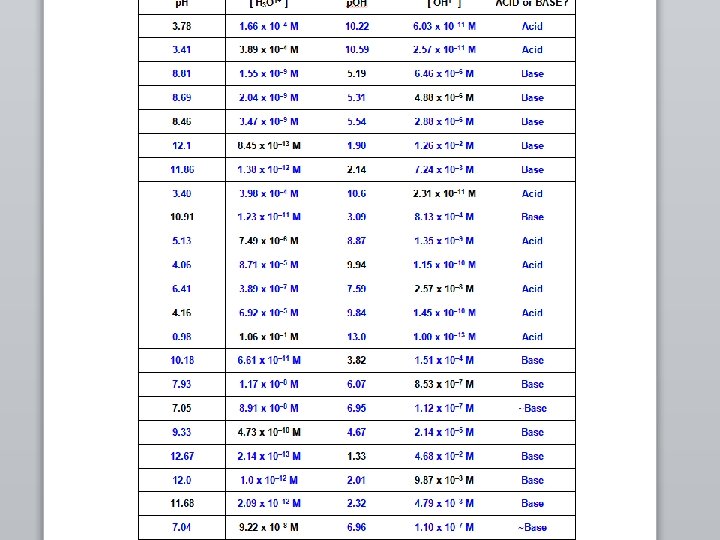
p. H is defined as the negative base-10 logarithm of the hydronium ion concentration. p. H = –log [H 3 O+]
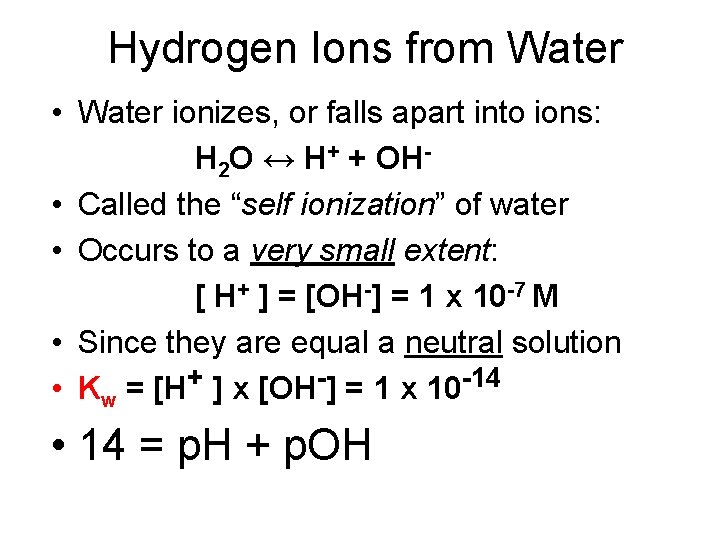
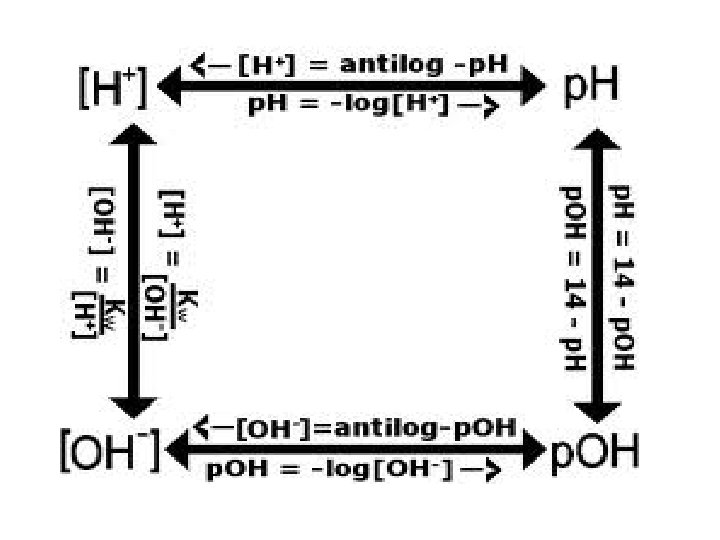
Hydrogen Ions from Water • Water ionizes, or falls apart into ions: H 2 O ↔ H+ + OH • Called the “self ionization” of water • Occurs to a very small extent: [ H+ ] = [OH-] = 1 x 10 -7 M • Since they are equal a neutral solution • Kw = [H+ ] x [OH-] = 1 x 10 -14 • 14 = p. H + p. OH
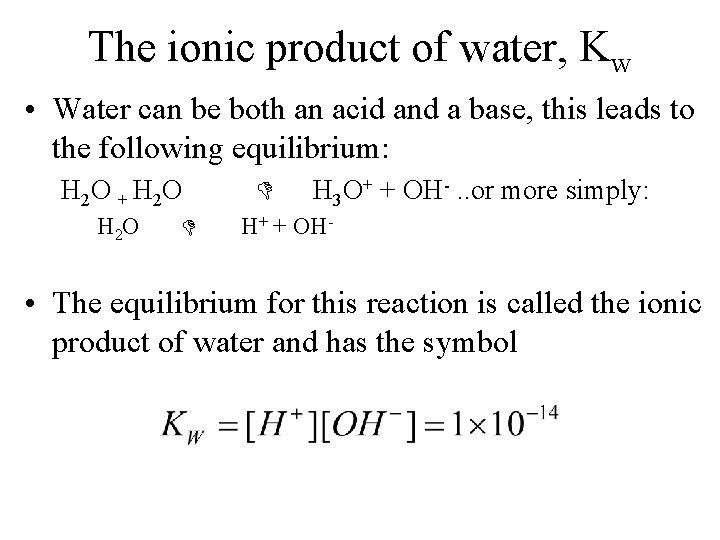
The ionic product of water, Kw • Water can be both an acid and a base, this leads to the following equilibrium: H 2 O + H 2 O H 3 O+ + OH-. . or more simply: H+ + OH- • The equilibrium for this reaction is called the ionic product of water and has the symbol
![Calculating [H+] and [OH-] of pure water: • Kw = [H+][OH-] = 1. 00](http://slidetodoc.com/presentation_image_h2/6106684385675505ebf4c4fc4a7754a5/image-51.jpg "Calculating [H+] and [OH-] of pure water: • Kw = [H+][OH-] = 1. 00")
Calculating [H+] and [OH-] of pure water: • Kw = [H+][OH-] = 1. 00 x 10 -14 mol 2 dm-6 • Since when pure, [H+] = [OH-] – [H+]2 = 1. 00 x 10 -14 – [H+] = √ 1. 00 x 10 -14 = 1. 00 x 10 -7 mol dm-3 • Kw varies with temperature: – At 273 K, Kw = 1. 14 x 10 -15, calculate [H+] – At 373 K, Kw = 5. 13 x 10 -13, calculate [OH-] – Do these changes mean the self-dissociation of water is endothermic or exothermic? Justify your answer.
![If you know one, you know them all: [OH-] 14 -1 -] H [O](http://slidetodoc.com/presentation_image_h2/6106684385675505ebf4c4fc4a7754a5/image-53.jpg "If you know one, you know them all: [OH-] 14 -1 -] H [O")
If you know one, you know them all: [OH-] 14 -1 -] H [O og -L 10 x +] 0 1. [H OH -p 10 10 x -] 0 H. 1 O [ [H+] p. OH H -p 10 +] [H og -L 14 p. H - H p. O 14 H p -
![p. H and Significant Figures • [H+] = 0. 0010 M = 1. 0](http://slidetodoc.com/presentation_image_h2/6106684385675505ebf4c4fc4a7754a5/image-54.jpg "p. H and Significant Figures • [H+] = 0. 0010 M = 1. 0")
p. H and Significant Figures • [H+] = 0. 0010 M = 1. 0 x 10 -3 M 0. 0010 has 2 sig figs • the p. H = 3. 00, with the two numbers to the right of the decimal corresponding to the 2 sig figs

![Calculating the p. H = - log [H+] (Remember that the [ ] mean](http://slidetodoc.com/presentation_image_h2/6106684385675505ebf4c4fc4a7754a5/image-56.jpg "Calculating the p. H = - log [H+] (Remember that the [ ] mean")
Calculating the p. H = - log [H+] (Remember that the [ ] mean Molarity, or mol/L) Example: If [H+] = 1 X 10 -10 p. H = - log 1 X 10 -10 p. H = - (- 10) p. H = 10 Example: If [H+] = 1. 0 X 10 -5 p. H = - log 1. 0 X 10 -5 p. H = - (- 5) p. H = 5
![A p. H Number lines. [H+] =10 -15 p. H = 15 [OH -]](http://slidetodoc.com/presentation_image_h2/6106684385675505ebf4c4fc4a7754a5/image-57.jpg "A p. H Number lines. [H+] =10 -15 p. H = 15 [OH -]")
A p. H Number lines. [H+] =10 -15 p. H = 15 [OH -] = 101 basic [H+] < [OH -] basic p. H = 12 [H+] =10 -12 [OH -] = 10 -2 p. H = 7 [H+] = 10 -7 [OH -] = 10 -7 [H+] = [OH -] neutral p. H = 2 [H+] = 10 -2 [OH -] = 10 -12 [H+] > [OH -] acidic [H+] < [OH -] basic
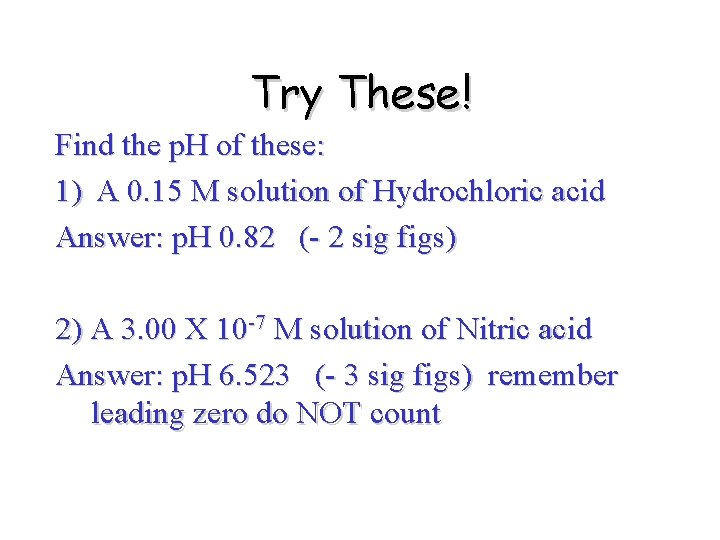
Try These! Find the p. H of these: 1) A 0. 15 M solution of Hydrochloric acid Answer: p. H 0. 82 (- 2 sig figs) 2) A 3. 00 X 10 -7 M solution of Nitric acid Answer: p. H 6. 523 (- 3 sig figs) remember leading zero do NOT count
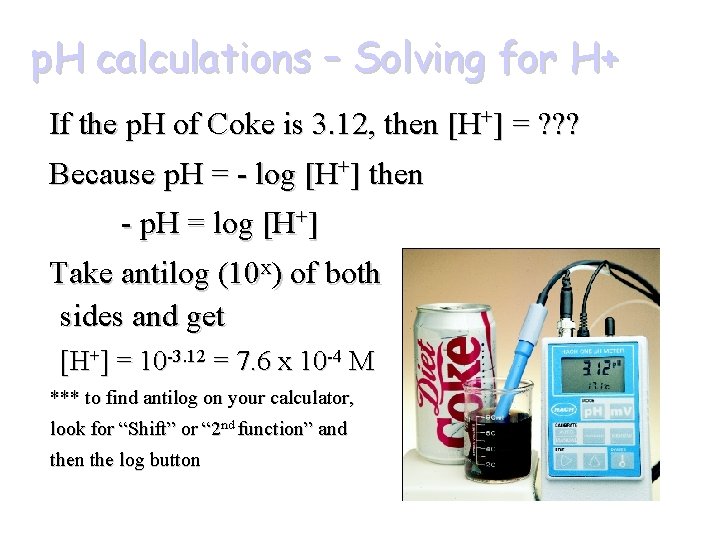
p. H calculations – Solving for H+ If the p. H of Coke is 3. 12, then [H+] = ? ? ? Because p. H = - log [H+] then - p. H = log [H+] Take antilog (10 x) of both sides and get [H+] = 10 -3. 12 = 7. 6 x 10 -4 M *** to find antilog on your calculator, look for “Shift” or “ 2 nd function” and then the log button
![[H 3 O+], [OH-] and p. H What is the p. H of the](http://slidetodoc.com/presentation_image_h2/6106684385675505ebf4c4fc4a7754a5/image-60.jpg "[H 3 O+], [OH-] and p. H What is the p. H of the")
[H 3 O+], [OH-] and p. H What is the p. H of the 0. 0010 M Na. OH solution? [OH-] = 0. 0010 (or 1. 0 X 10 -3 M) p. OH = - log 0. 0010 p. OH = 3 p. H = 14 – 3 = 11 OR Kw = [H 3 O+] [OH-] [H 3 O+] = 1. 0 x 10 -11 M p. H = - log (1. 0 x 10 -11) = 11. 00
![Calculating [H 3 O+], p. H, [OH-], and p. OH Problem 1: A chemist](http://slidetodoc.com/presentation_image_h2/6106684385675505ebf4c4fc4a7754a5/image-61.jpg "Calculating [H 3 O+], p. H, [OH-], and p. OH Problem 1: A chemist")
Calculating [H 3 O+], p. H, [OH-], and p. OH Problem 1: A chemist dilutes concentrated HCl to 0. 0024 M. Calculate the [H 3 O+], p. H, [OH-], and p. OH ANSWERS: p. H=2. 62, p. OH = 11. 38, 4. 2 x 10 -12 Problem 2: What is the [H 3 O+], [OH-], and p. OH of a solution with a p. H = 3. 67? Is this an acid, base, or neutral? ANSWERS : An acid. [H 3 O+], 0. 00021 M, [OH-], 4. 7 x 10 -11 p. OH = 10. 33
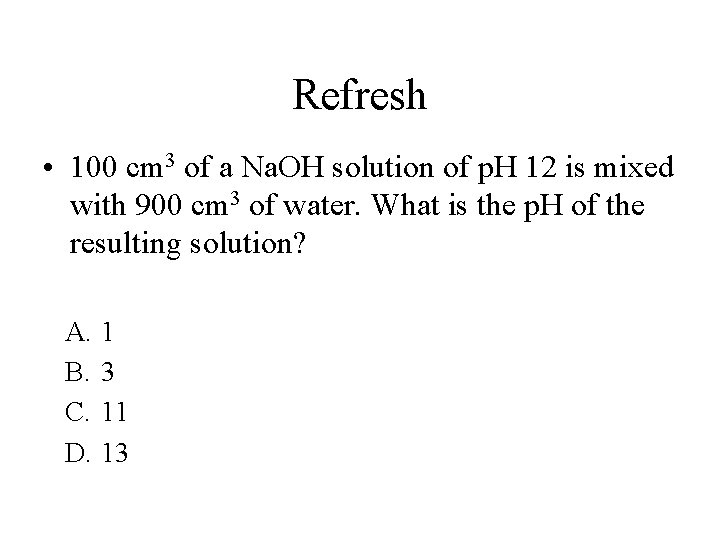
Refresh • 100 cm 3 of a Na. OH solution of p. H 12 is mixed with 900 cm 3 of water. What is the p. H of the resulting solution? A. 1 B. 3 C. 11 D. 13
STRONG V WEAK
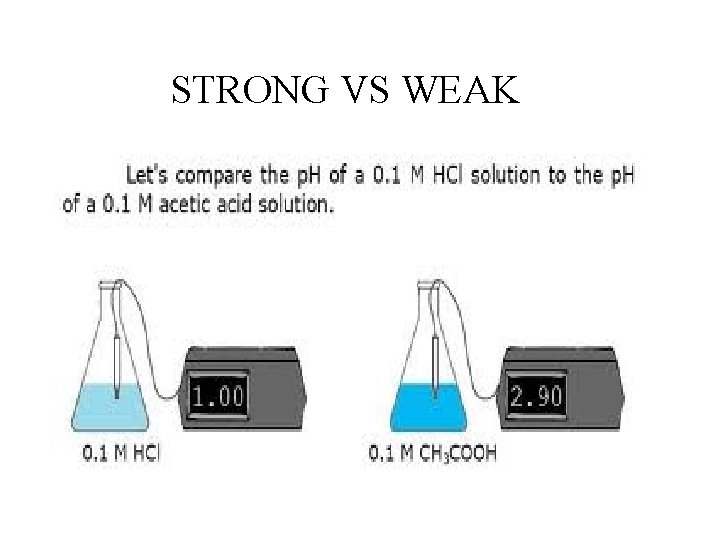
STRONG VS WEAK
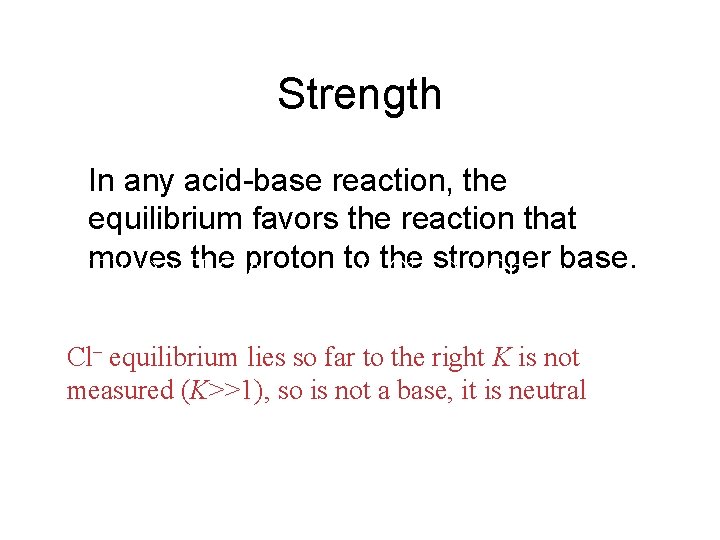
Strength In any acid-base reaction, the equilibrium favors the reaction that moves the proton stronger HCl (aq) + H O(l) to. H the O+(aq) + Cl–(aq)base. 2 3 Cl– equilibrium lies so far to the right K is not measured (K>>1), so is not a base, it is neutral
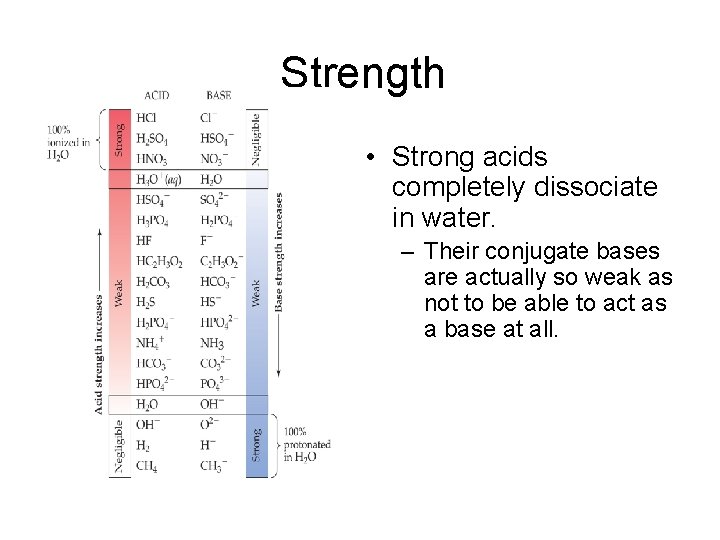
Strength • Strong acids completely dissociate in water. – Their conjugate bases are actually so weak as not to be able to act as a base at all.
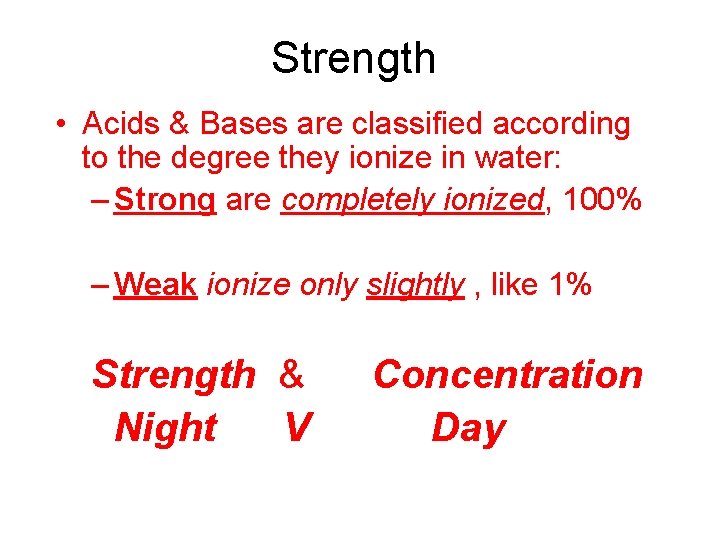
Strength • Acids & Bases are classified according to the degree they ionize in water: – Strong are completely ionized, 100% – Weak ionize only slightly , like 1% Strength & Night V Concentration Day
• Compared with strong acids of the same concentration, weak acids: – Have lower electrical conductivity – React more slowly – p. H is higher (less acid) – Change p. H more slowly when diluted – However, they neutralise the same volume of alkali • Weak bases follow a similar pattern
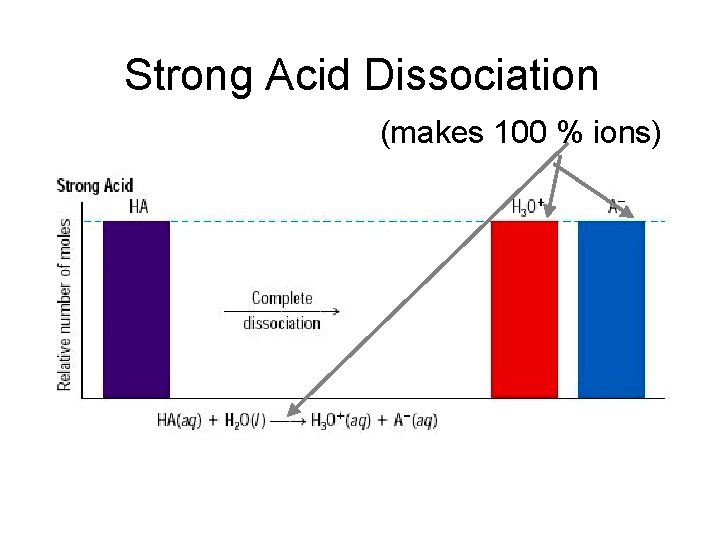
Strong Acid Dissociation (makes 100 % ions)
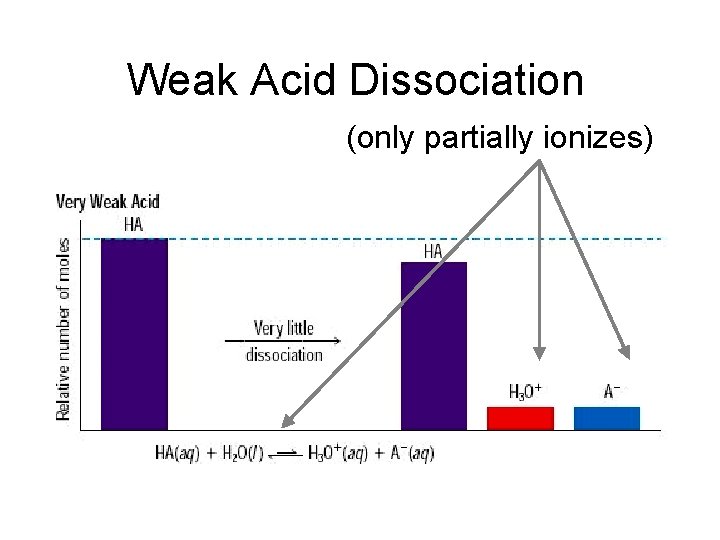
Weak Acid Dissociation (only partially ionizes)
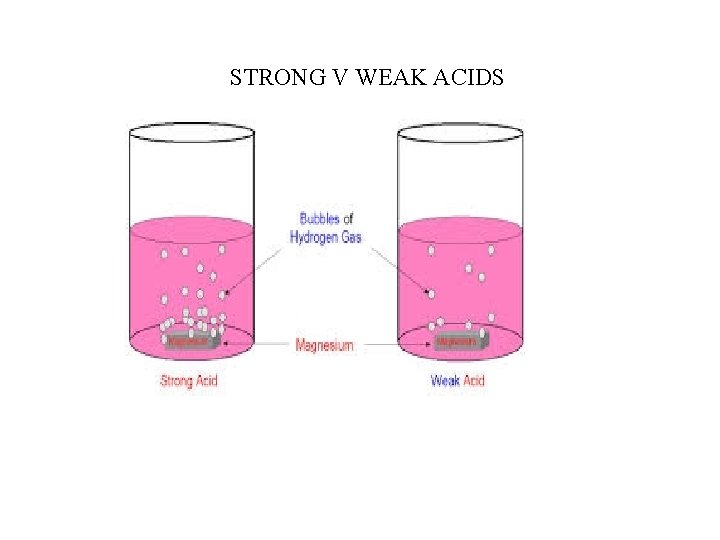
STRONG V WEAK ACIDS
LOL
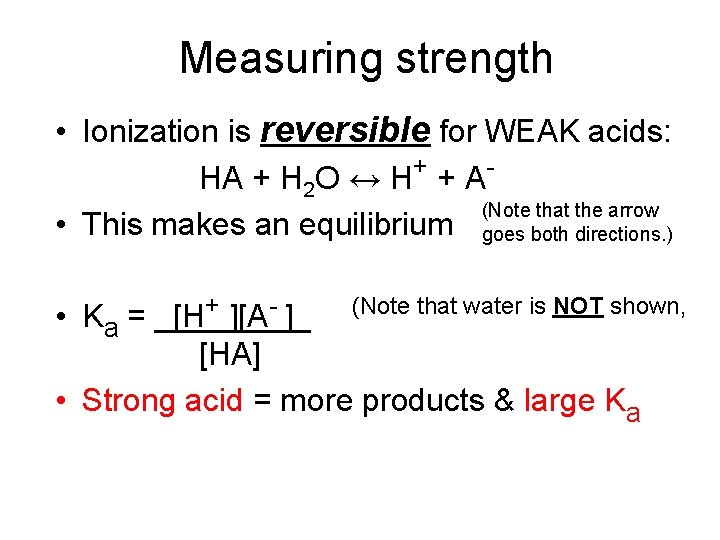
Measuring strength • Ionization is reversible for WEAK acids: HA + H 2 O ↔ H+ + A(Note that the arrow • This makes an equilibrium goes both directions. ) (Note that water is NOT shown, • Ka = [H+ ][A- ] [HA] • Strong acid = more products & large Ka
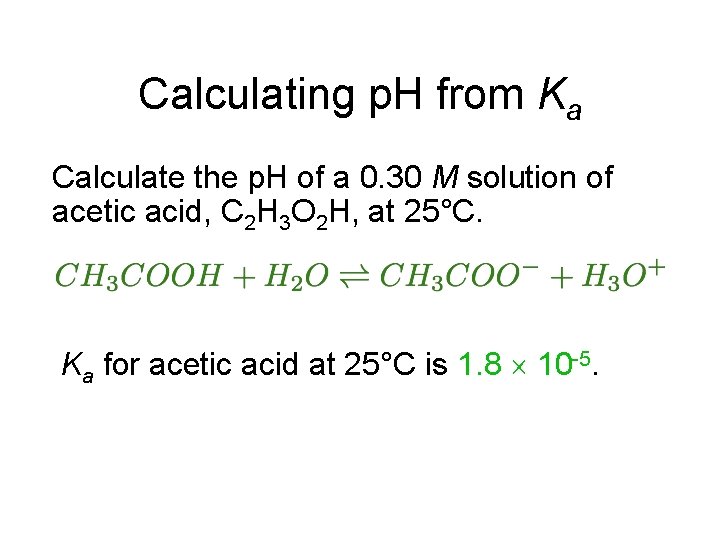
Calculating p. H from Ka Calculate the p. H of a 0. 30 M solution of acetic acid, C 2 H 3 O 2 H, at 25°C. Ka for acetic acid at 25°C is 1. 8 10 -5.
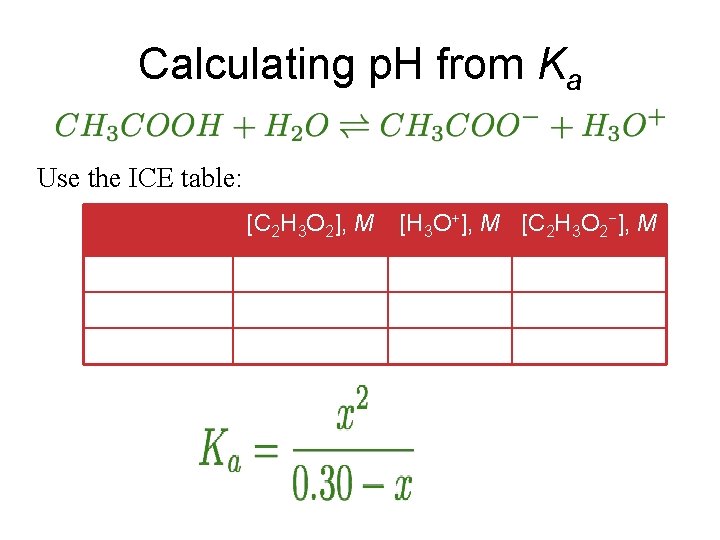
Calculating p. H from Ka Use the ICE table: [C 2 H 3 O 2], M Initial Change Equilibrium 0. 30 –x 0. 30 – x [H 3 O+], M [C 2 H 3 O 2−], M 0 +x x
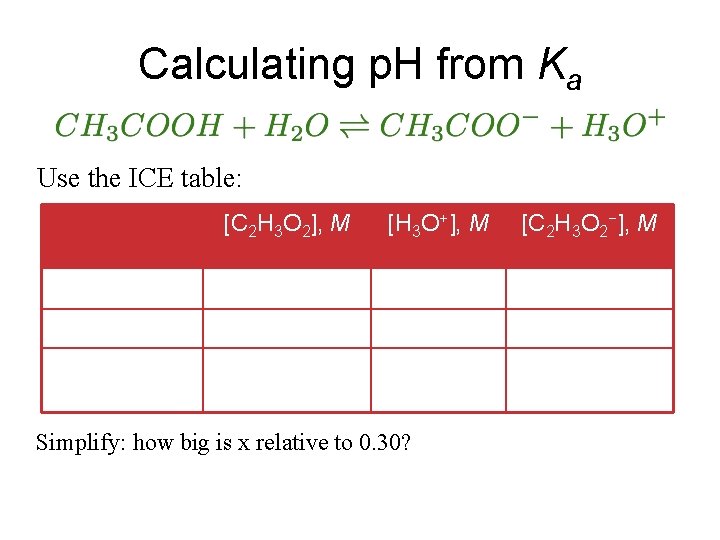
Calculating p. H from Ka Use the ICE table: Initial Change Equilibrium [C 2 H 3 O 2], M [H 3 O+], M [C 2 H 3 O 2−], M 0. 30 0 0 –x +x +x 0. 30 – x ≈ 0. 30 x x Simplify: how big is x relative to 0. 30?
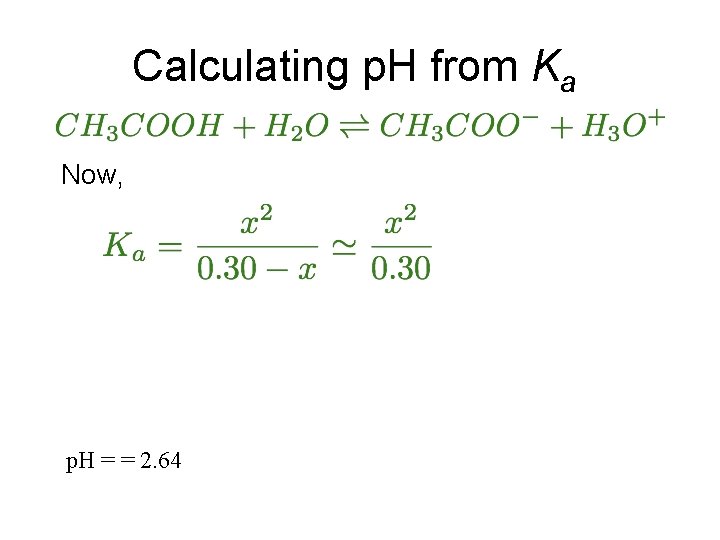
Calculating p. H from Ka Now, (1. 8 10 -5) (0. 30) = x 2 5. 4 10 -6 = x 2 2. 3 10 -3 = x p. H = = 2. 64
Another Ka problem with % ionization found at the end
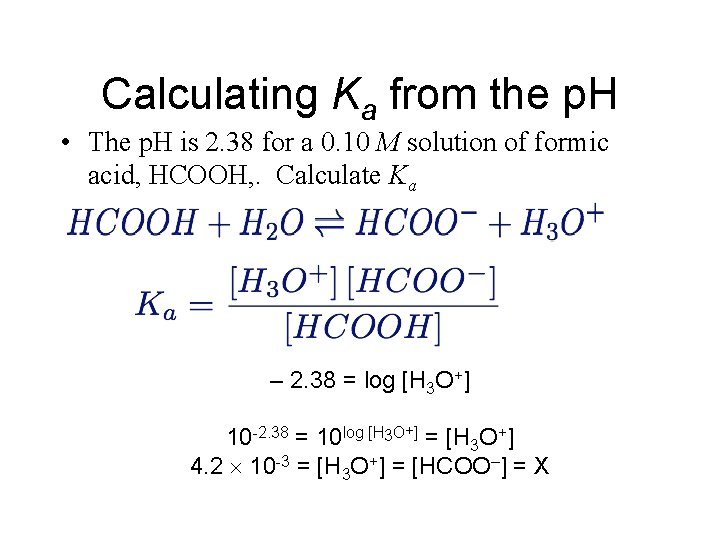
Calculating Ka from the p. H • The p. H is 2. 38 for a 0. 10 M solution of formic acid, HCOOH, . Calculate Ka – 2. 38 = log [H 3 O+] 10 -2. 38 = 10 log [H 3 O+] = [H 3 O+] 4. 2 10 -3 = [H 3 O+] = [HCOO–] = X
![Calculating Ka from p. H All values In Mol/L Initially [HCOOH] [H 3 O+]](http://slidetodoc.com/presentation_image_h2/6106684385675505ebf4c4fc4a7754a5/image-82.jpg "Calculating Ka from p. H All values In Mol/L Initially [HCOOH] [H 3 O+]")
Calculating Ka from p. H All values In Mol/L Initially [HCOOH] [H 3 O+] [HCOO−] 0. 10 0 0 Change – 4. 2 10 -3 Equilibrium 0. 10 – 4. 2 10 -3 = 0. 0958 = 0. 10 +4. 2 10 -3 4. 2 10 - 3
![Calculating Ka from p. H Ka = [4. 2 10 -3] [0. 10] =](http://slidetodoc.com/presentation_image_h2/6106684385675505ebf4c4fc4a7754a5/image-83.jpg "Calculating Ka from p. H Ka = [4. 2 10 -3] [0. 10] =")
Calculating Ka from p. H Ka = [4. 2 10 -3] [0. 10] = 1. 8 10 -4
![Calculating Percent Ionization [A-]eq = [H 3 O+]eq = 4. 2 10 -3 M](http://slidetodoc.com/presentation_image_h2/6106684385675505ebf4c4fc4a7754a5/image-84.jpg "Calculating Percent Ionization [A-]eq = [H 3 O+]eq = 4. 2 10 -3 M")
Calculating Percent Ionization [A-]eq = [H 3 O+]eq = 4. 2 10 -3 M [A-]eq + [HCOOH]eq = [HCOOH]initial= 0. 10 M %rx = [4. 2 10 -3 / 0. 10] (x 100) = 4. 2%
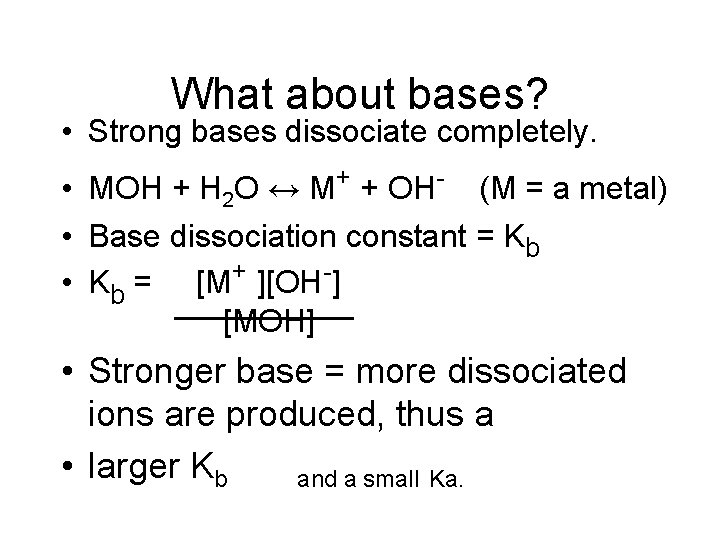
What about bases? • Strong bases dissociate completely. • MOH + H 2 O ↔ M+ + OH- (M = a metal) • Base dissociation constant = Kb • Kb = [M+ ][OH-] [MOH] • Stronger base = more dissociated ions are produced, thus a • larger Kb and a small Ka.
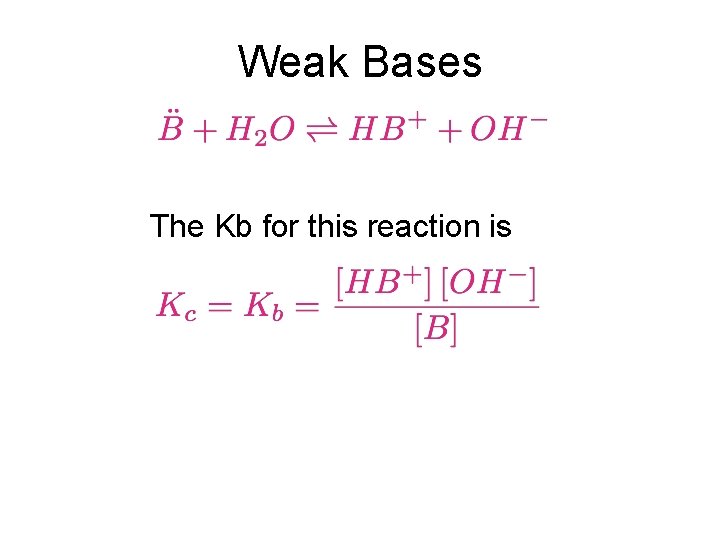
Weak Bases The Kb for this reaction is
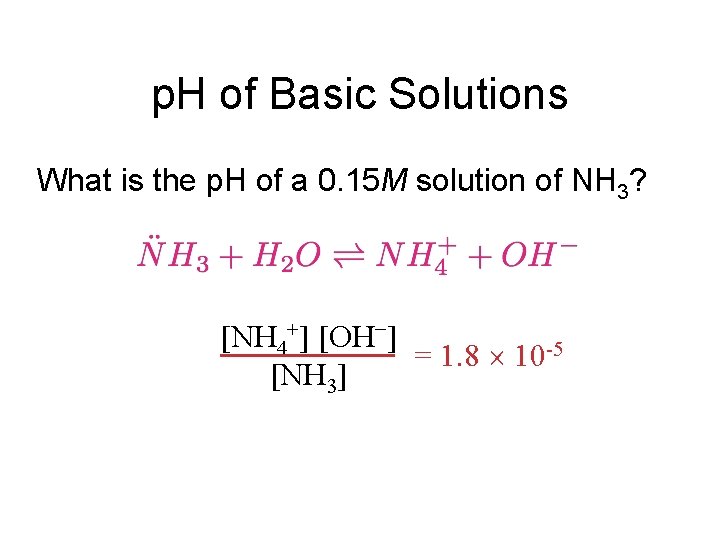
p. H of Basic Solutions What is the p. H of a 0. 15 M solution of NH 3? [NH 4+] [OH−] Kb = = 1. 8 10 -5 [NH 3]
![p. H of Basic Solutions [NH 3] [NH 4+] [OH−] Initial 0. 15 0](http://slidetodoc.com/presentation_image_h2/6106684385675505ebf4c4fc4a7754a5/image-88.jpg "p. H of Basic Solutions [NH 3] [NH 4+] [OH−] Initial 0. 15 0")
p. H of Basic Solutions [NH 3] [NH 4+] [OH−] Initial 0. 15 0 0 Equil 0. 15 - x 0. 15 x x
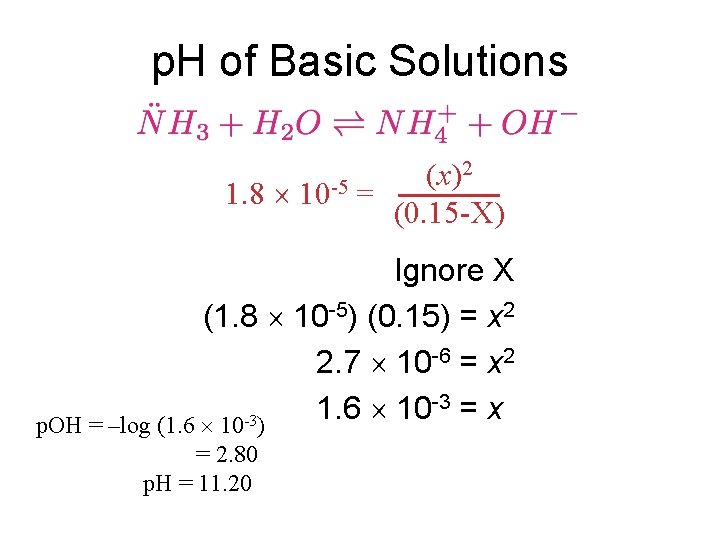
p. H of Basic Solutions 2 (x) 1. 8 10 -5 = (0. 15 -X) Ignore X (1. 8 10 -5) (0. 15) = x 2 2. 7 10 -6 = x 2 -3 = x 2 1. 6 10 p. OH = –log (1. 6 10 -3) p. OH = 2. 80 p. H = 11. 20
![Example 1: Calculation of [OH-] • What is the concentration of OH- ions in](http://slidetodoc.com/presentation_image_h2/6106684385675505ebf4c4fc4a7754a5/image-90.jpg "Example 1: Calculation of [OH-] • What is the concentration of OH- ions in")
Example 1: Calculation of [OH-] • What is the concentration of OH- ions in a 0. 500 mol dm-3 solution of ammonia (Kb = 1. 8 x 10 -5)? What % of the NH 3 molecules have dissociated? Since it is a weak base and the equilibrium is to the right we assume that at equilibrium, [NH 3] is the same as stated in the question. So: Kb 1. 8 x 10 -5 • = [NH 4+][OH-]/[NH 3] Sub all known values into equation = [NH 4+][OH-]/ 0. 500 Looks like there are 2 unknowns However, since [NH 4+] = [OH-]: – 1. 8 x 10 -5 = [OH-]2 / 0. 500 – [OH-] = √(1. 8 x 10 -5 x 0. 500) – [OH-] = 0. 0030 mol dm-3 • Rearrange to make [OH-] the subject Perform calculation % Dissociation = 0. 0030 / 0. 500 x 100 = 0. 60%
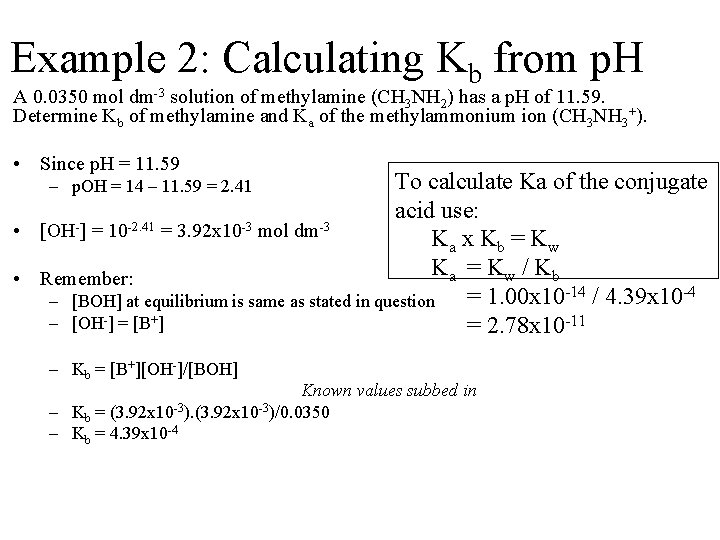
Example 2: Calculating Kb from p. H A 0. 0350 mol dm-3 solution of methylamine (CH 3 NH 2) has a p. H of 11. 59. Determine Kb of methylamine and Ka of the methylammonium ion (CH 3 NH 3+). • Since p. H = 11. 59 To calculate Ka of the conjugate acid use: -2. 41 -3 -3 • [OH ] = 10 = 3. 92 x 10 mol dm Ka x Kb = K w Ka = K w / K b • Remember: = 1. 00 x 10 -14 / 4. 39 x 10 -4 – [BOH] at equilibrium is same as stated in question – [OH-] = [B+] = 2. 78 x 10 -11 – p. OH = 14 – 11. 59 = 2. 41 – Kb = [B+][OH-]/[BOH] Known values subbed in – Kb = (3. 92 x 10 -3)/0. 0350 – Kb = 4. 39 x 10 -4
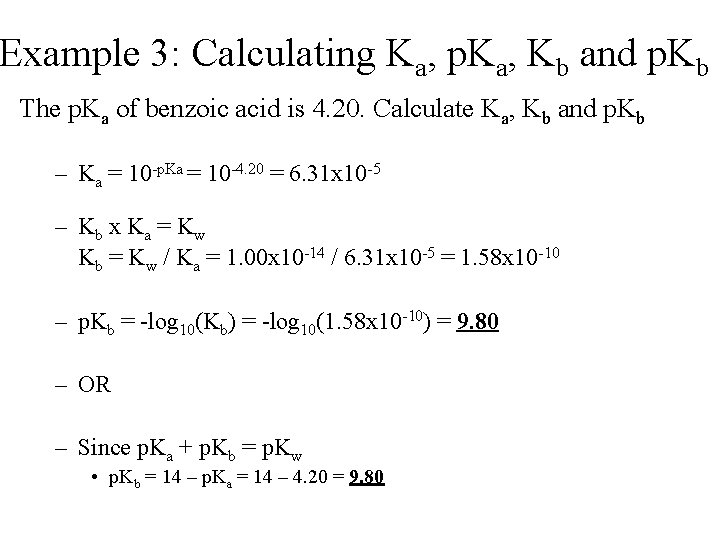
Example 3: Calculating Ka, p. Ka, Kb and p. Kb The p. Ka of benzoic acid is 4. 20. Calculate Ka, Kb and p. Kb – Ka = 10 -p. Ka = 10 -4. 20 = 6. 31 x 10 -5 – Kb x Ka = K w Kb = Kw / Ka = 1. 00 x 10 -14 / 6. 31 x 10 -5 = 1. 58 x 10 -10 – p. Kb = -log 10(Kb) = -log 10(1. 58 x 10 -10) = 9. 80 – OR – Since p. Ka + p. Kb = p. Kw • p. Kb = 14 – p. Ka = 14 – 4. 20 = 9. 80
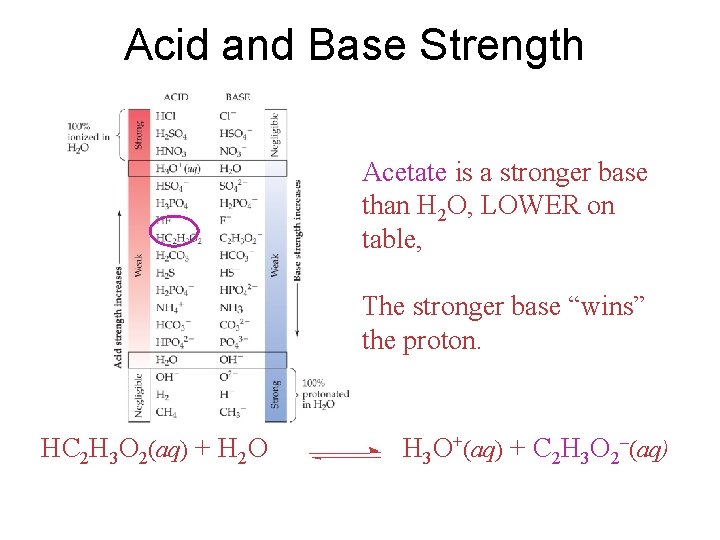
Acid and Base Strength Acetate is a stronger base than H 2 O, LOWER on table, The stronger base “wins” the proton. HC 2 H 3 O 2(aq) + H 2 O H 3 O+(aq) + C 2 H 3 O 2–(aq)
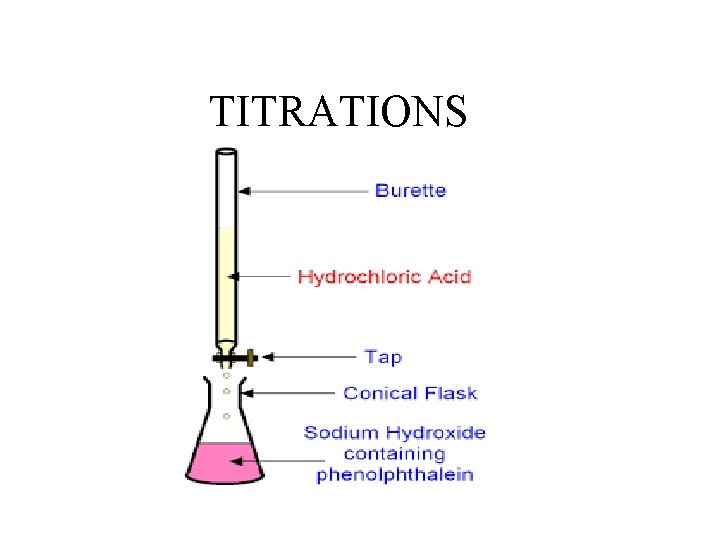
TITRATIONS
Titration • Titration is the process of adding a known amount of solution of known concentration to determine the concentration of another solution • The equivalence point is when the moles of hydrogen ions is equal to the moles of hydroxide ions (= neutralized!)
Titration Lab Demo Fuse school sample calc https: //www. youtube. com/watch? v=ovx. Sro 4 NXM Fuse school Indicators https: //www. youtube. com/watch? v=6 ojb. Qak WI 8 A
Titration n The concentration of acid (or base) in solution can be determined by performing a neutralization reaction – An indicator is used to show when neutralization has occurred – Often we use phenolphthaleinbecause it is colorless in neutral and acid; turns pink in base
Easy Titration Problem • Example #1: If 20. 00 m. L of 0. 100 M aqueous HCl is required to titrate into 20. 00 m. L of an aqueous solution of Na. OH to the equivalence point, what is the molarity of the Na. OH solution?
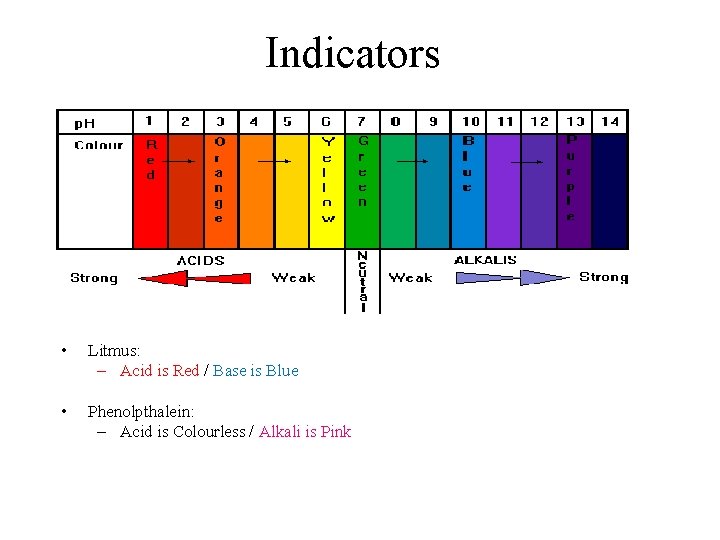
Indicators • Universal (actually a mixture of indicators) • Litmus: – Acid is Red / Base is Blue • Phenolpthalein: – Acid is Colourless / Alkali is Pink
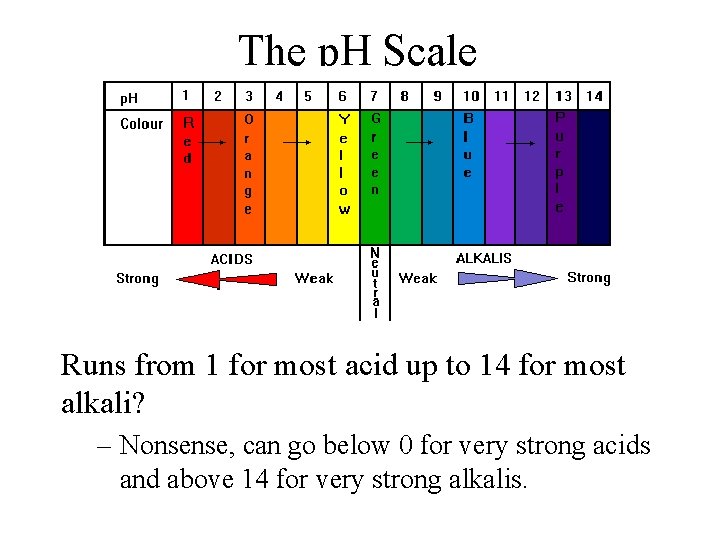
The p. H Scale Runs from 1 for most acid up to 14 for most alkali? – Nonsense, can go below 0 for very strong acids and above 14 for very strong alkalis.
Steps - Neutralization reaction #1. A measured volume of acid of unknown concentration is added to a flask #2. Several drops of indicator added #3. A base of known concentration is slowly added, until the indicator changes color; measure the volume
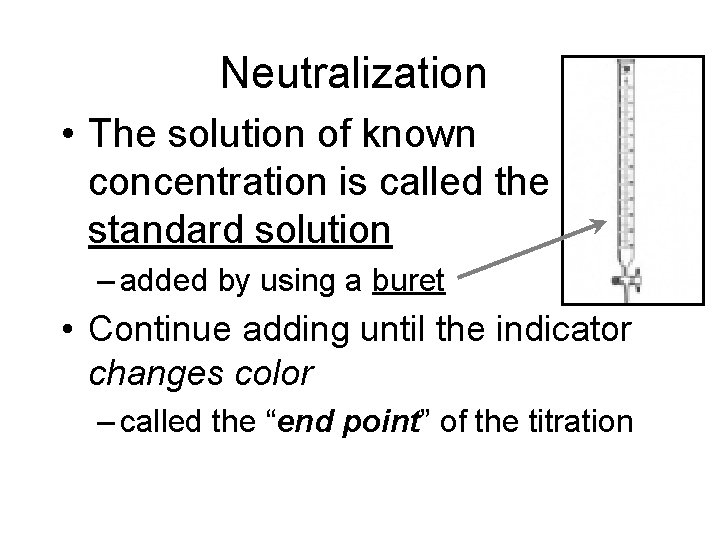
Neutralization • The solution of known concentration is called the standard solution – added by using a buret • Continue adding until the indicator changes color – called the “end point” of the titration
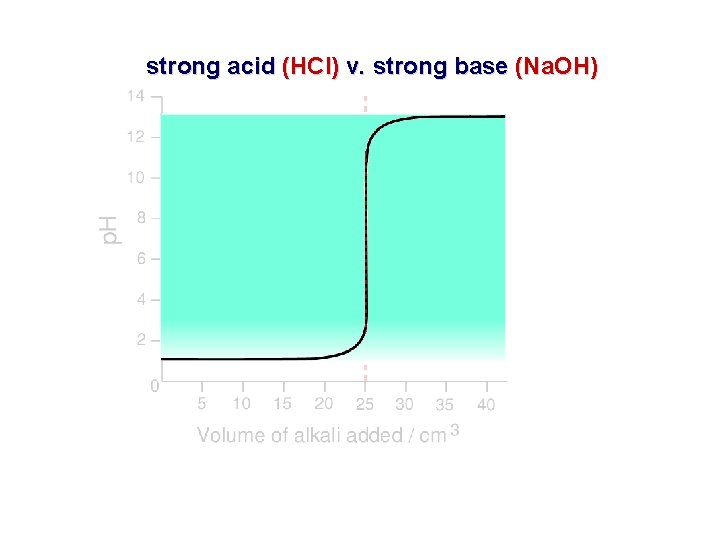
strong acid (HCl) v. strong base (Na. OH)
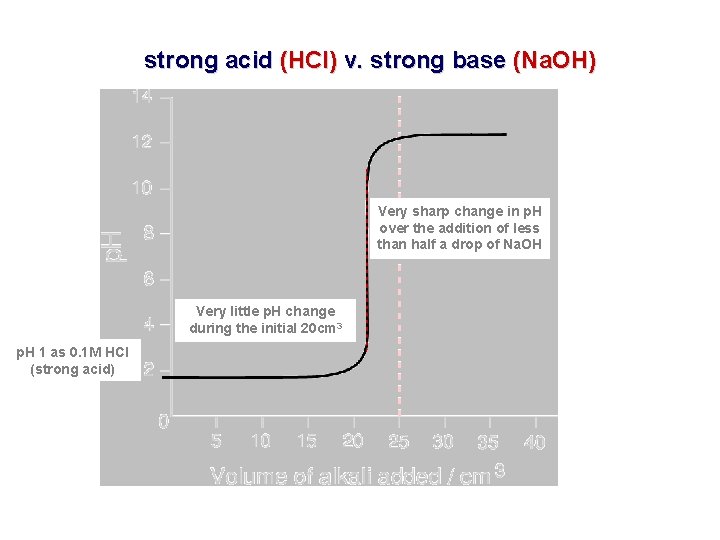
strong acid (HCl) v. strong base (Na. OH) Very sharp change in p. H over the addition of less than half a drop of Na. OH Very little p. H change during the initial 20 cm 3 p. H 1 as 0. 1 M HCl (strong acid)
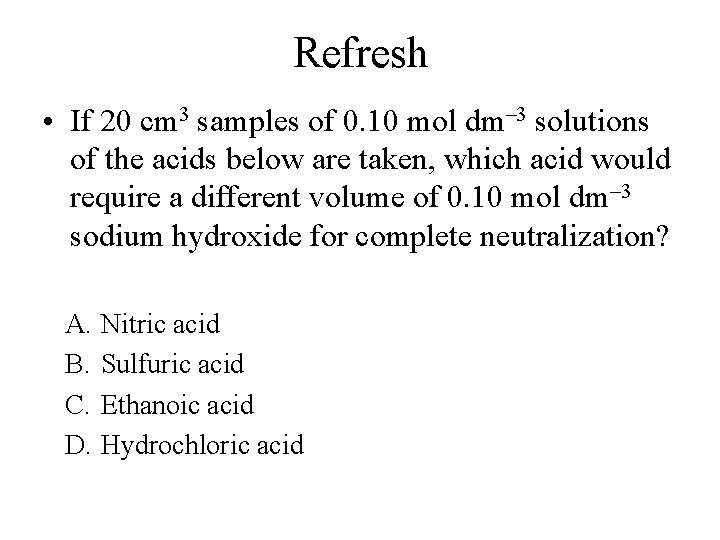
Refresh • If 20 cm 3 samples of 0. 10 mol dm– 3 solutions of the acids below are taken, which acid would require a different volume of 0. 10 mol dm– 3 sodium hydroxide for complete neutralization? A. Nitric acid B. Sulfuric acid C. Ethanoic acid D. Hydrochloric acid
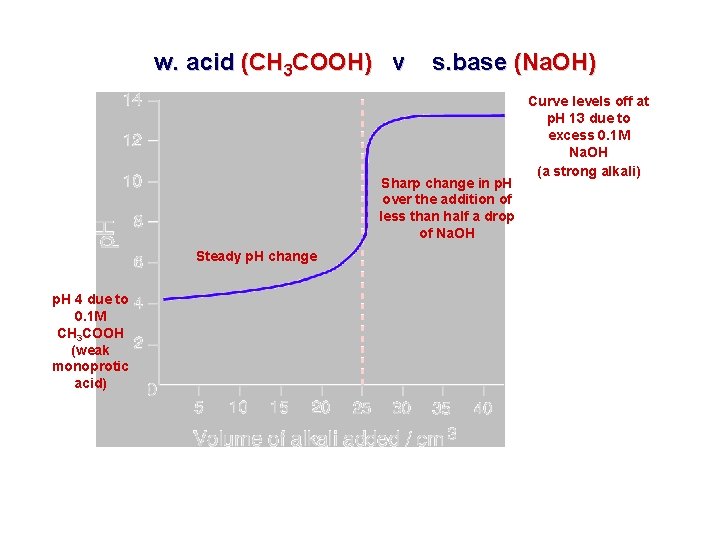
w. acid (CH 3 COOH) v s. base (Na. OH) Sharp change in p. H over the addition of less than half a drop of Na. OH Steady p. H change p. H 4 due to 0. 1 M CH 3 COOH (weak monoprotic acid) Curve levels off at p. H 13 due to excess 0. 1 M Na. OH (a strong alkali)
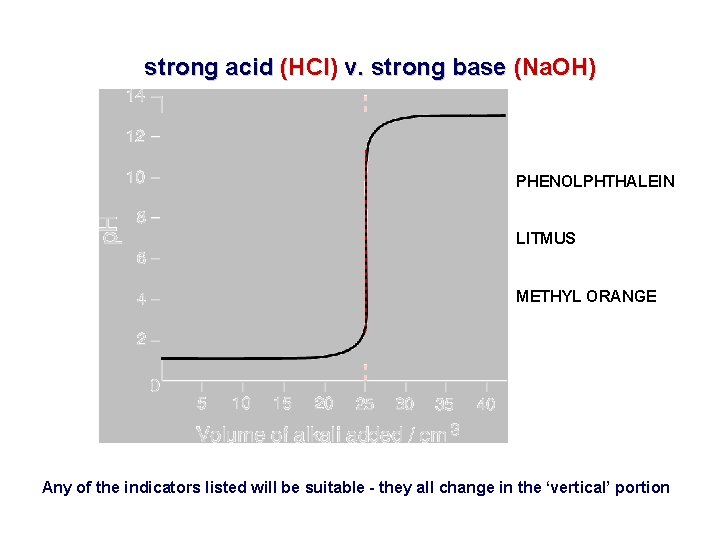
strong acid (HCl) v. strong base (Na. OH) PHENOLPHTHALEIN LITMUS METHYL ORANGE Any of the indicators listed will be suitable - they all change in the ‘vertical’ portion
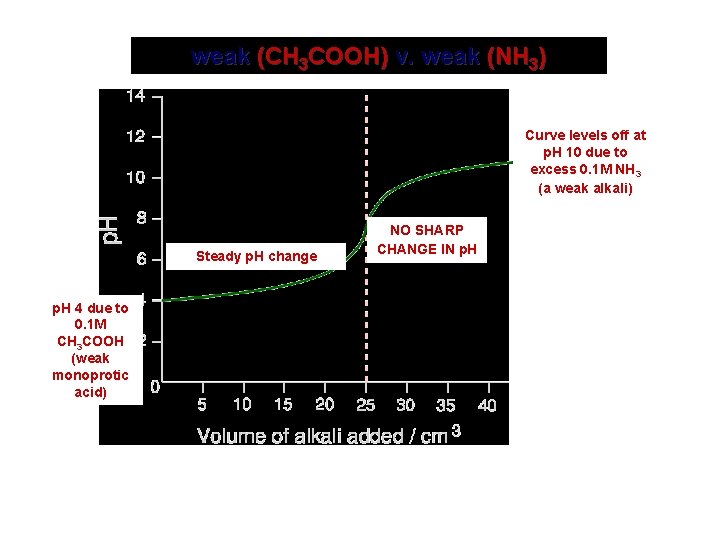
weak (CH 3 COOH) v. weak (NH 3) Curve levels off at p. H 10 due to excess 0. 1 M NH 3 (a weak alkali) Steady p. H change p. H 4 due to 0. 1 M CH 3 COOH (weak monoprotic acid) NO SHARP CHANGE IN p. H
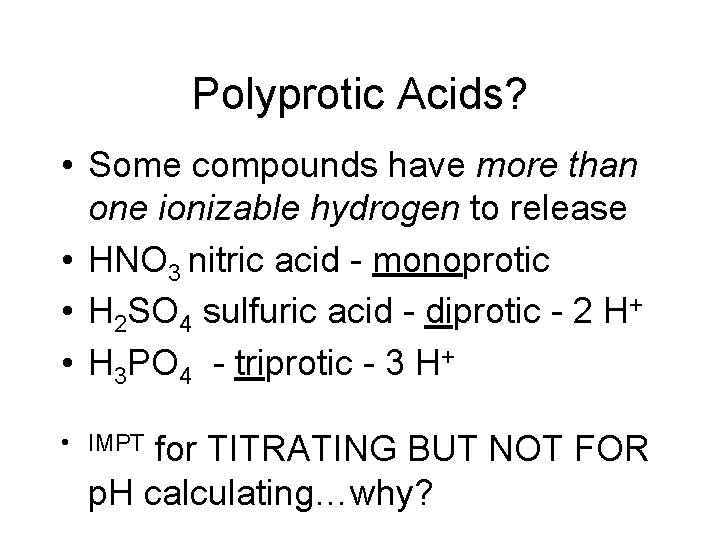
Polyprotic Acids? • Some compounds have more than one ionizable hydrogen to release • HNO 3 nitric acid - monoprotic • H 2 SO 4 sulfuric acid - diprotic - 2 H+ • H 3 PO 4 - triprotic - 3 H+ • IMPT for TITRATING BUT NOT FOR p. H calculating…why?
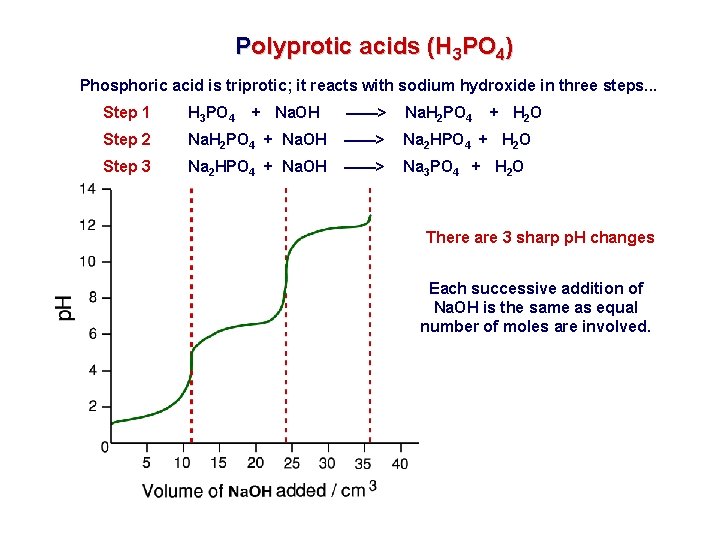
Polyprotic acids (H 3 PO 4) Phosphoric acid is triprotic; it reacts with sodium hydroxide in three steps. . . Step 1 H 3 PO 4 Step 2 Step 3 + Na. OH ——> Na. H 2 PO 4 + H 2 O Na. H 2 PO 4 + Na. OH ——> Na 2 HPO 4 + H 2 O Na 2 HPO 4 + Na. OH ——> Na 3 PO 4 + H 2 O There are 3 sharp p. H changes Each successive addition of Na. OH is the same as equal number of moles are involved.
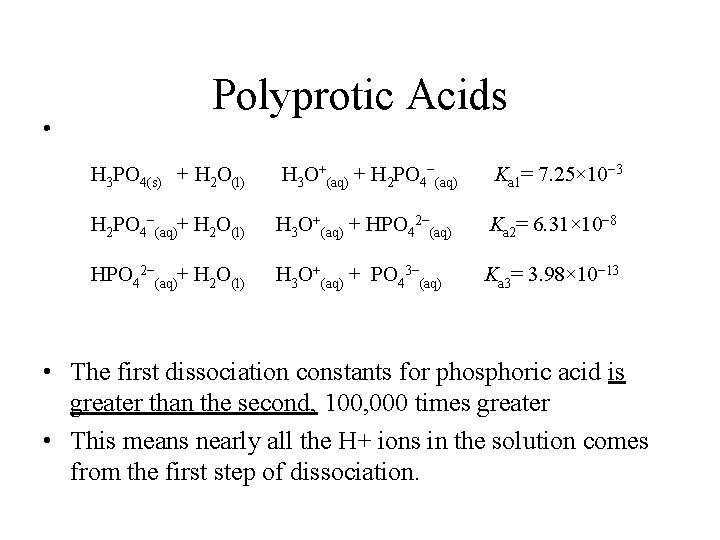
• Polyprotic Acids H 3 PO 4(s) + H 2 O(l) H 3 O+(aq) + H 2 PO 4−(aq) Ka 1= 7. 25× 10− 3 H 2 PO 4−(aq)+ H 2 O(l) H 3 O+(aq) + HPO 42−(aq) Ka 2= 6. 31× 10− 8 HPO 42−(aq)+ H 2 O(l) H 3 O+(aq) + PO 43−(aq) Ka 3= 3. 98× 10− 13 • The first dissociation constants for phosphoric acid is greater than the second, 100, 000 times greater • This means nearly all the H+ ions in the solution comes from the first step of dissociation.
Salt Hydrolysis • A salt is an ionic compound that: – formed in a neutralization reaction – some neutral; others acidic or basic
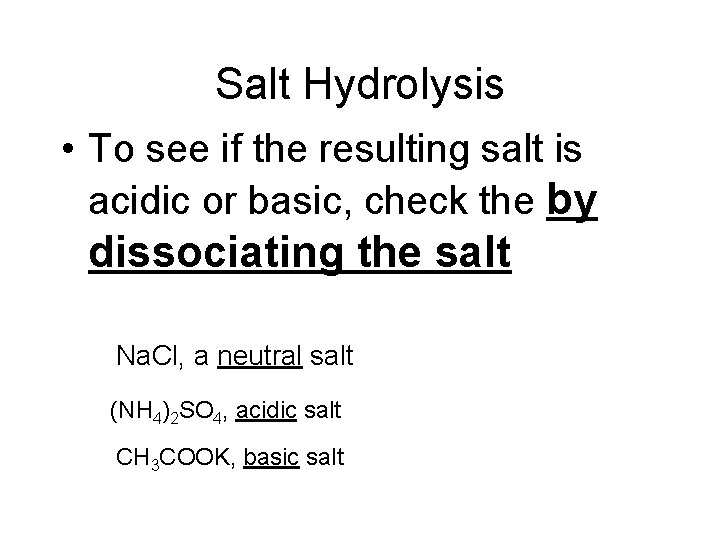
Salt Hydrolysis • To see if the resulting salt is acidic or basic, check the by dissociating the salt Na. Cl, a neutral salt (NH 4)2 SO 4, acidic salt CH 3 COOK, basic salt
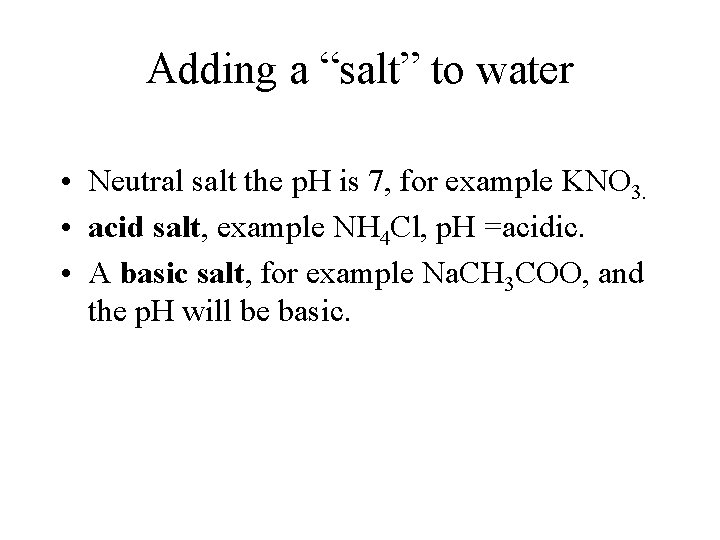
Adding a “salt” to water • Neutral salt the p. H is 7, for example KNO 3. • acid salt, example NH 4 Cl, p. H =acidic. • A basic salt, for example Na. CH 3 COO, and the p. H will be basic.
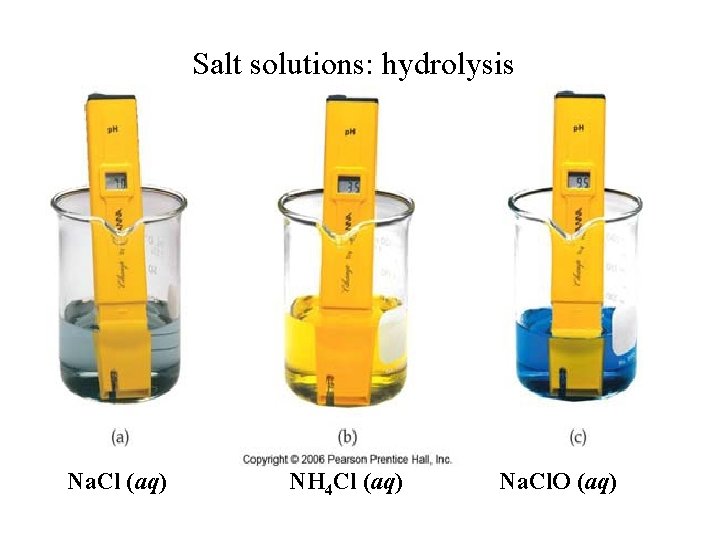
Salt solutions: hydrolysis Na. Cl (aq) NH 4 Cl (aq) Na. Cl. O (aq)
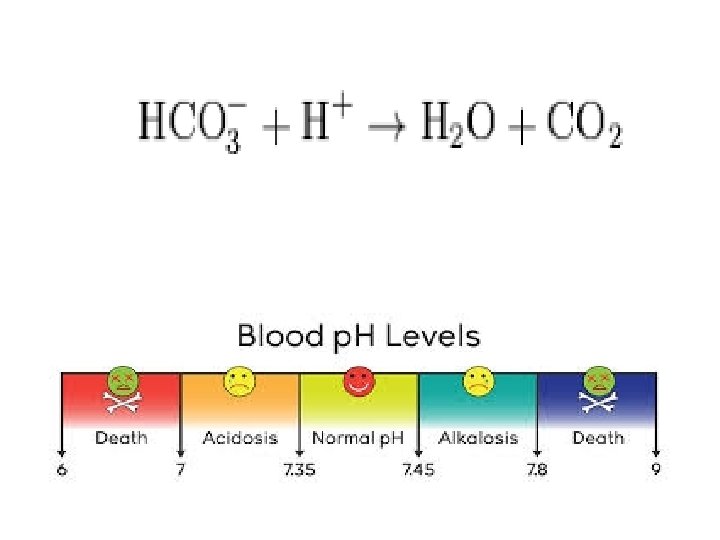
Buffers • Buffers are solutions in which the p. H remains relatively constant, even when small amounts of acid or base are added –made from a pair of chemicals: a weak acid and one of it’s salts; or a weak base and one of it’s salts
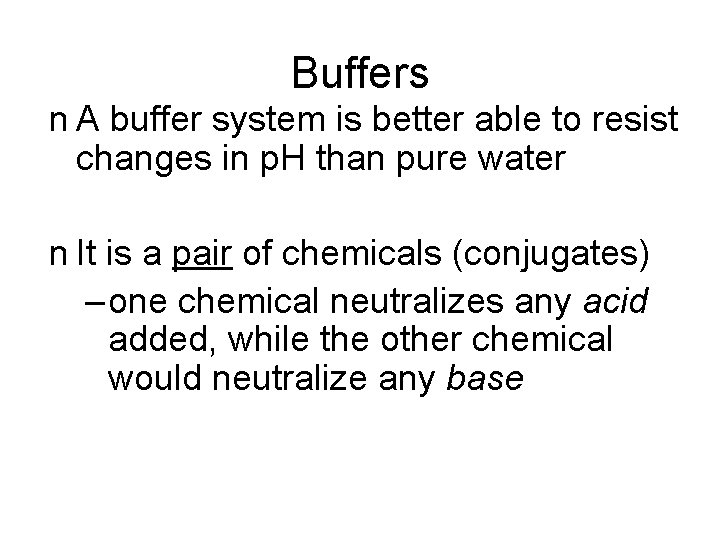
Buffers n A buffer system is better able to resist changes in p. H than pure water n It is a pair of chemicals (conjugates) – one chemical neutralizes any acid added, while the other chemical would neutralize any base
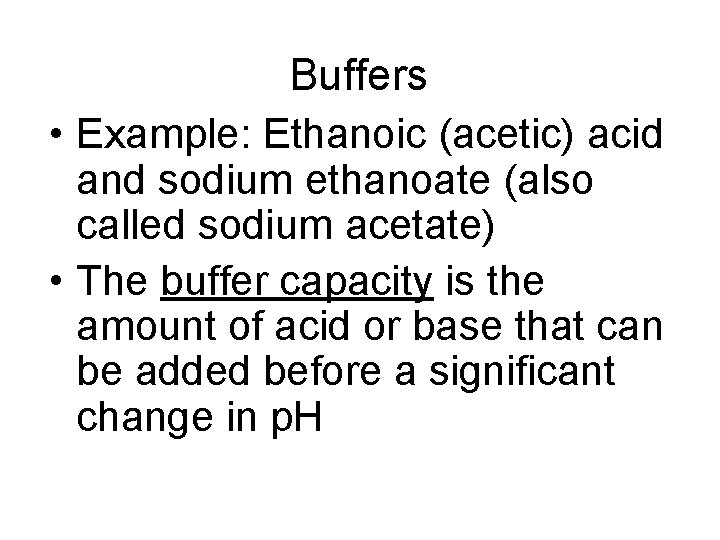
Buffers • Example: Ethanoic (acetic) acid and sodium ethanoate (also called sodium acetate) • The buffer capacity is the amount of acid or base that can be added before a significant change in p. H
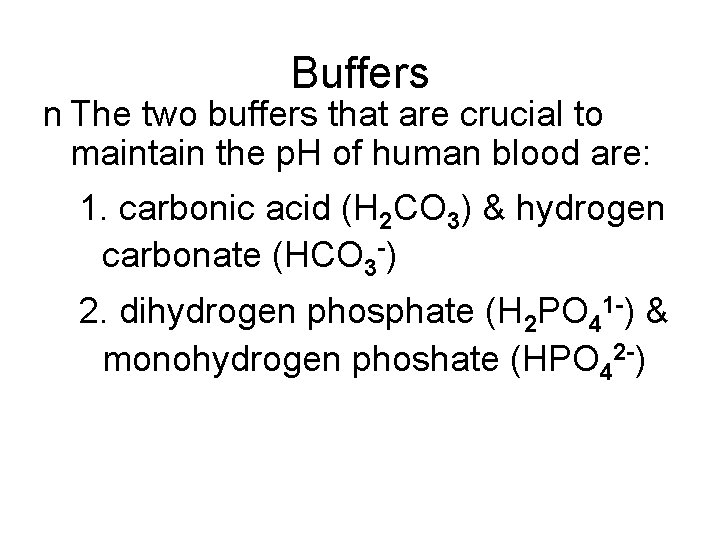
Buffers n The two buffers that are crucial to maintain the p. H of human blood are: 1. carbonic acid (H 2 CO 3) & hydrogen carbonate (HCO 3 -) 2. dihydrogen phosphate (H 2 PO 41 -) & monohydrogen phoshate (HPO 42 -)
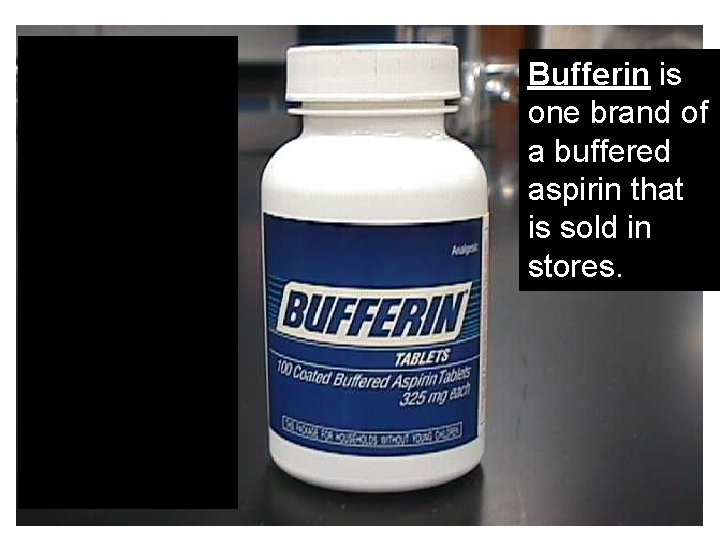
Aspirin (which is a type of acid) sometimes causes stomach upset; thus by adding a “buffer”, it does not cause the acid irritation. Bufferin is one brand of a buffered aspirin that is sold in stores.
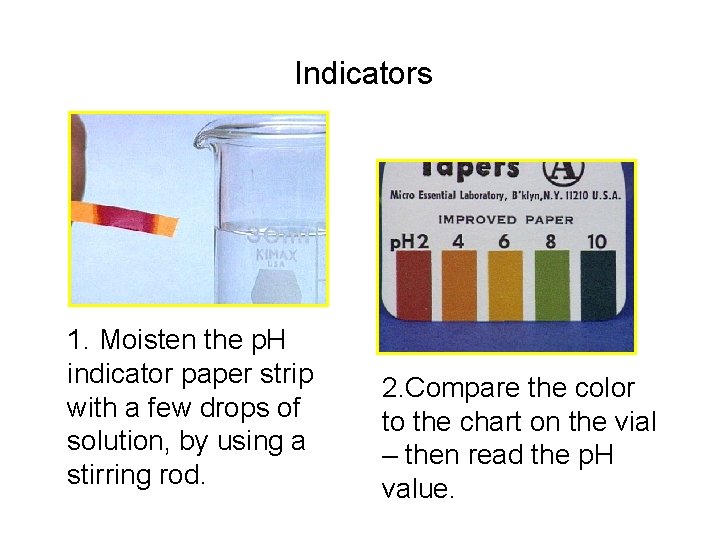
Indicators 1. Moisten the p. H indicator paper strip with a few drops of solution, by using a stirring rod. 2. Compare the color to the chart on the vial – then read the p. H value.
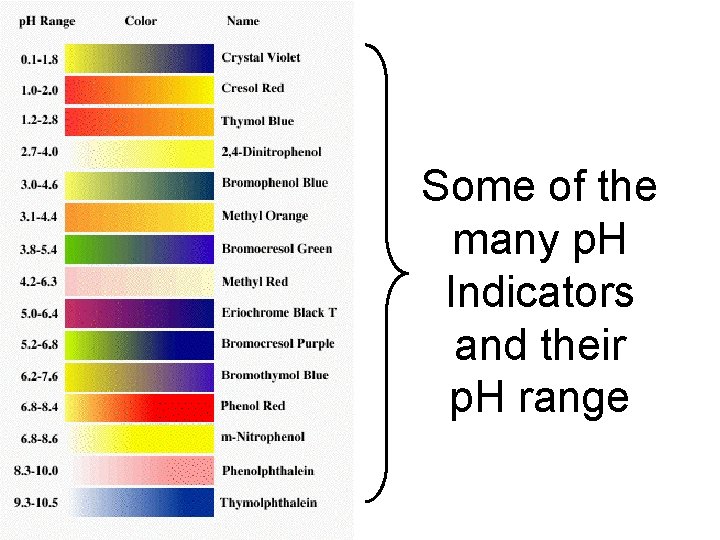
Some of the many p. H Indicators and their p. H range
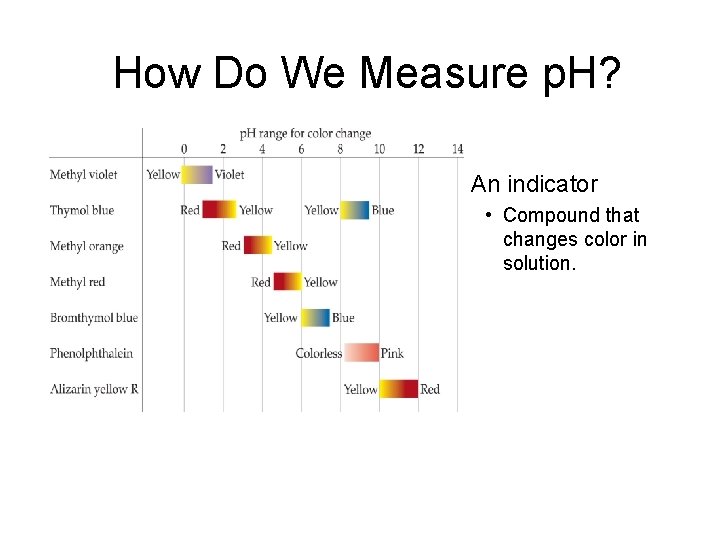
How Do We Measure p. H? – An indicator • Compound that changes color in solution.
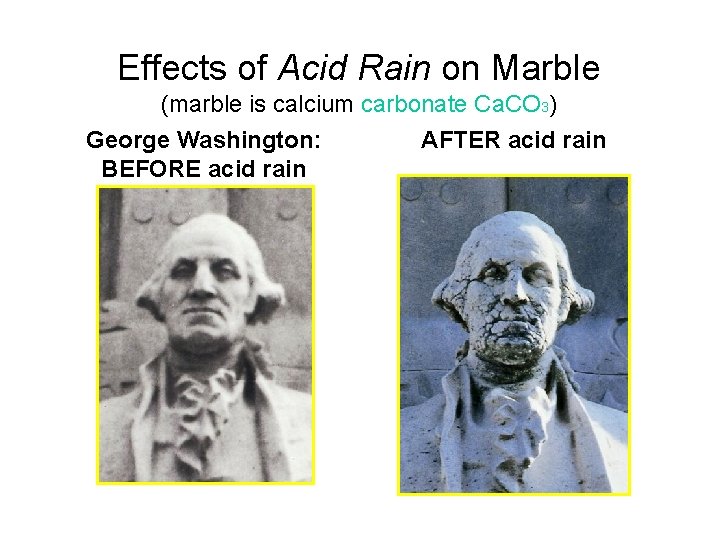
Effects of Acid Rain on Marble (marble is calcium carbonate Ca. CO 3) George Washington: BEFORE acid rain AFTER acid rain

- Slides: 128