
The chemically peculiar stars of the upper main
- Slides: 45
The chemically peculiar stars of the upper main sequence Don Kurtz Jeremiah Horrocks Institute University of Central Lancashire IAC WS 2010 – Lecture 1 9/17/2020
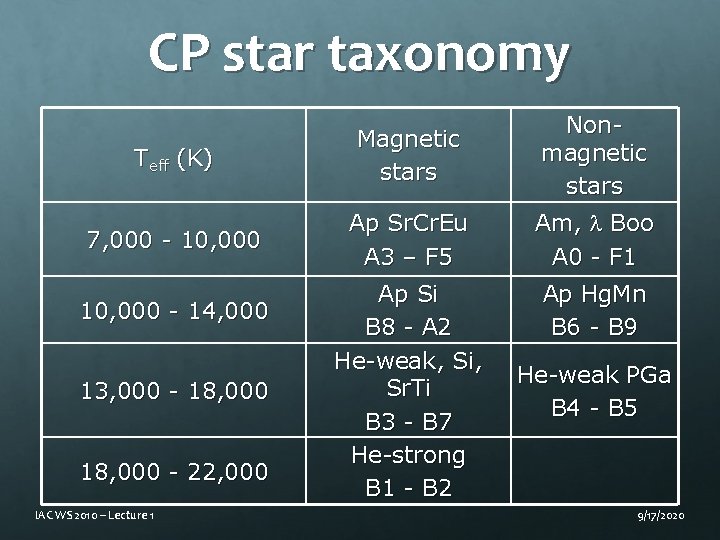
CP star taxonomy Teff (K) Magnetic stars Nonmagnetic stars 7, 000 - 10, 000 Ap Sr. Cr. Eu A 3 – F 5 Am, Boo A 0 - F 1 Ap Si B 8 - A 2 He-weak, Si, Sr. Ti B 3 - B 7 He-strong B 1 - B 2 Ap Hg. Mn B 6 - B 9 10, 000 - 14, 000 13, 000 - 18, 000 - 22, 000 IAC WS 2010 – Lecture 1 He-weak PGa B 4 - B 5 9/17/2020
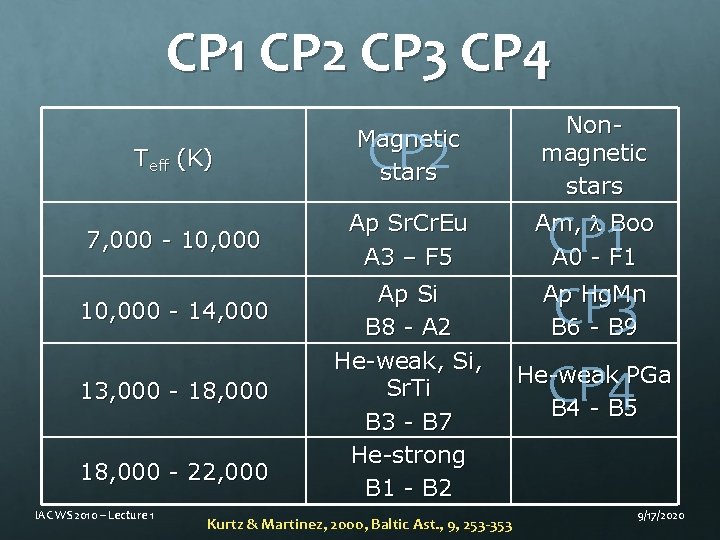
CP 1 CP 2 CP 3 CP 4 Teff (K) Magnetic stars CP 2 Nonmagnetic stars 7, 000 - 10, 000 Ap Sr. Cr. Eu A 3 – F 5 CP 1 Ap Hg. Mn CP 3 B 6 - B 9 He-weak PGa CP 4 B 4 - B 5 10, 000 - 14, 000 13, 000 - 18, 000 - 22, 000 IAC WS 2010 – Lecture 1 Ap Si B 8 - A 2 He-weak, Si, Sr. Ti B 3 - B 7 He-strong B 1 - B 2 Kurtz & Martinez, 2000, Baltic Ast. , 9, 253 -353 Am, Boo A 0 - F 1 9/17/2020
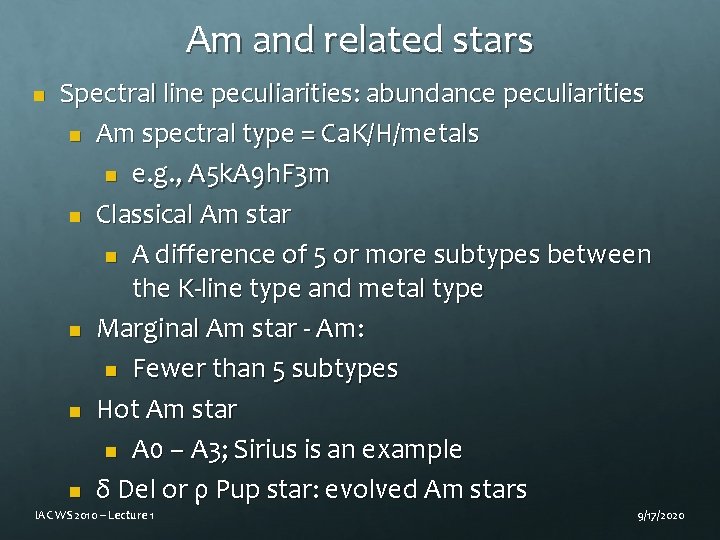
Am and related stars n Spectral line peculiarities: abundance peculiarities n Am spectral type = Ca. K/H/metals n e. g. , A 5 k. A 9 h. F 3 m n Classical Am star n A difference of 5 or more subtypes between the K-line type and metal type n Marginal Am star - Am: n Fewer than 5 subtypes n Hot Am star n A 0 – A 3; Sirius is an example n δ Del or ρ Pup star: evolved Am stars IAC WS 2010 – Lecture 1 9/17/2020
λ Boo stars n λ Boo stars: n A 0 – F 0 H line type n A 0 Ca K line type n Weak metal lines – metal deficient particularly Mg II 4481 Å n Lighter elements normal IAC WS 2010 – Lecture 1 9/17/2020
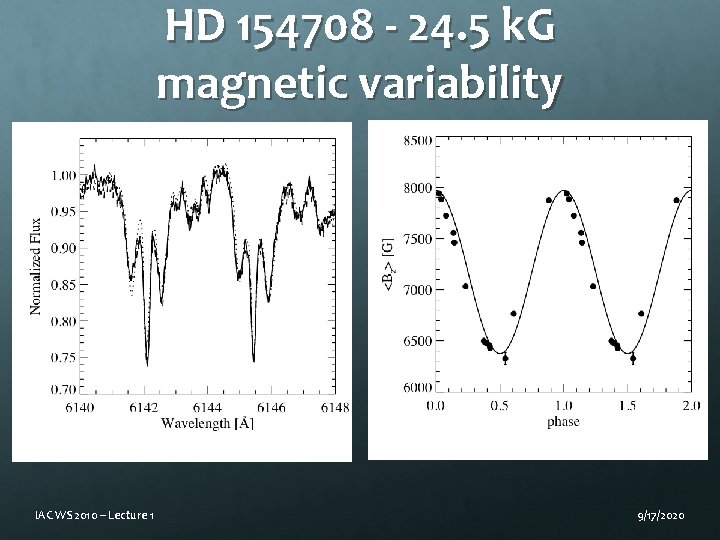
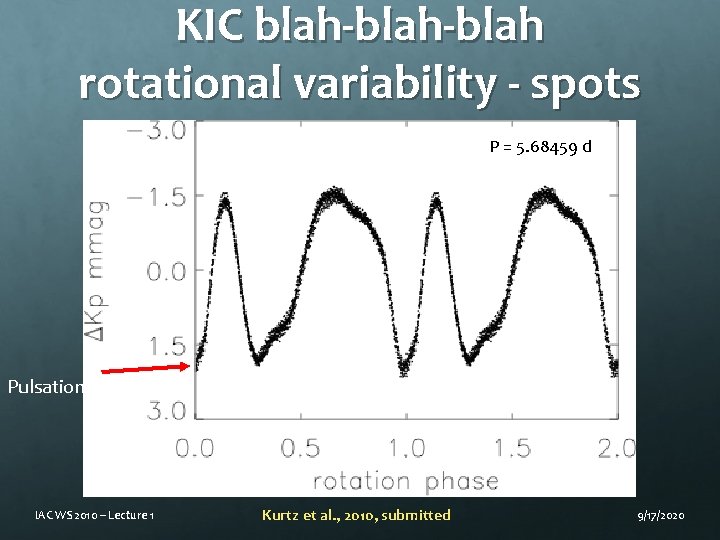
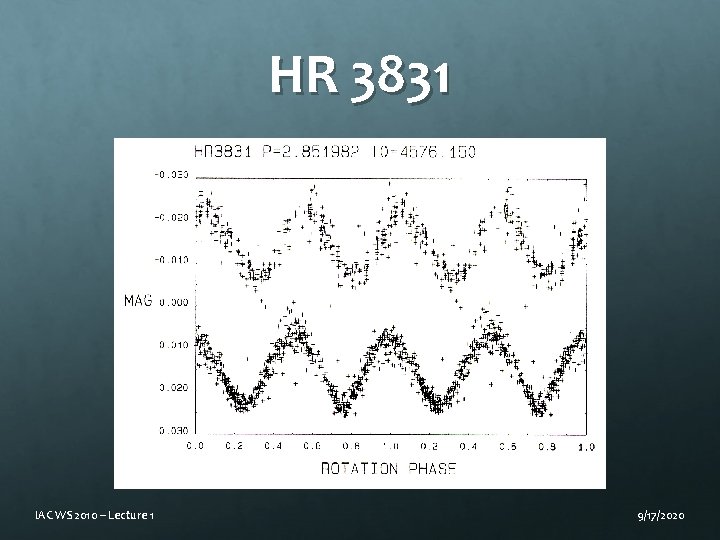
Observed properties of the Am and Ap stars n n n Slow rotation vsini < 100 km s-1 • Nearly 100% close binary (Am) • Magnetic braking (Ap) (very few close binaries) Strong global magnetic fields in CP 2 Ap stars show: n magnetic variability n spectrum variability n light variability (not pulsation) all with the same period α 2 CVn stars = upper main sequence spotted magnetic stars, hence rotational variables IAC WS 2010 – Lecture 1 9/17/2020
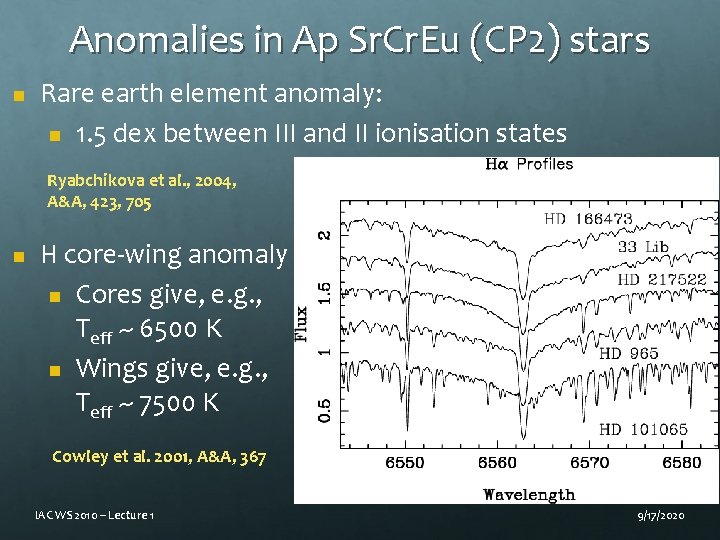
Anomalies in Ap Sr. Cr. Eu (CP 2) stars n Rare earth element anomaly: n 1. 5 dex between III and II ionisation states Ryabchikova et al. , 2004, A&A, 423, 705 n H core-wing anomaly n Cores give, e. g. , Teff ~ 6500 K n Wings give, e. g. , Teff ~ 7500 K Cowley et al. 2001, A&A, 367 IAC WS 2010 – Lecture 1 9/17/2020
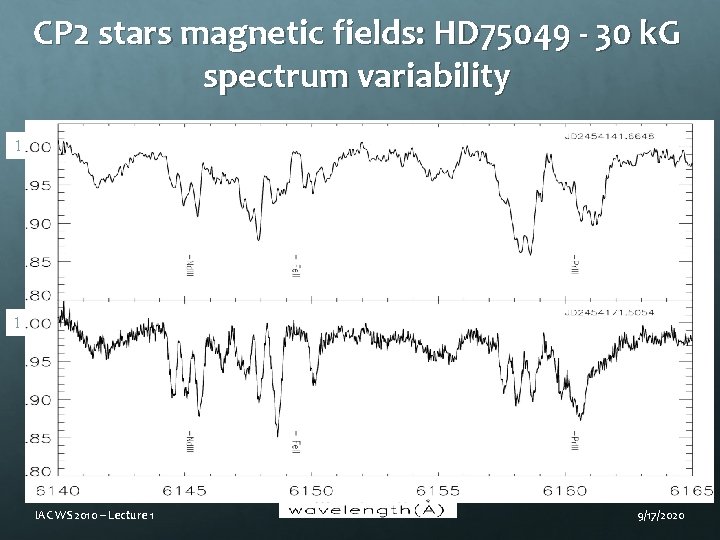
CP 2 stars magnetic fields: HD 75049 - 30 k. G spectrum variability 1 1 IAC WS 2010 – Lecture 1 9/17/2020
HD 154708 - 24. 5 k. G magnetic variability IAC WS 2010 – Lecture 1 9/17/2020
KIC blah-blah rotational variability - spots P = 5. 68459 d Pulsation maximum IAC WS 2010 – Lecture 1 Kurtz et al. , 2010, submitted 9/17/2020
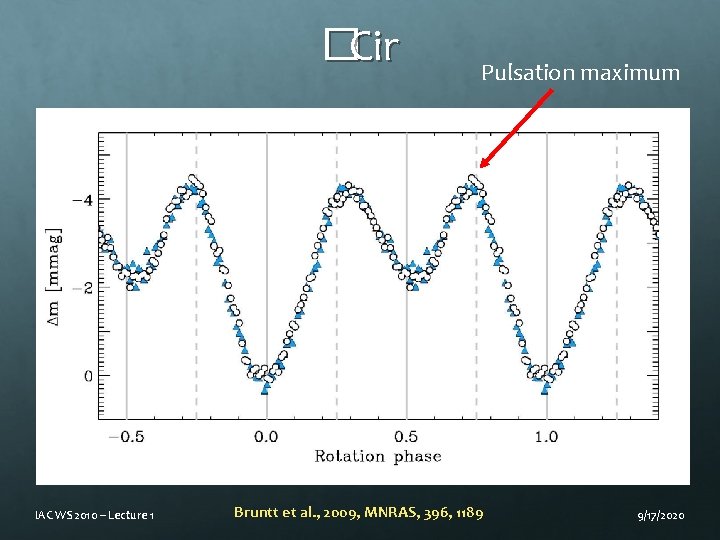
� Cir IAC WS 2010 – Lecture 1 Pulsation maximum Bruntt et al. , 2009, MNRAS, 396, 1189 9/17/2020
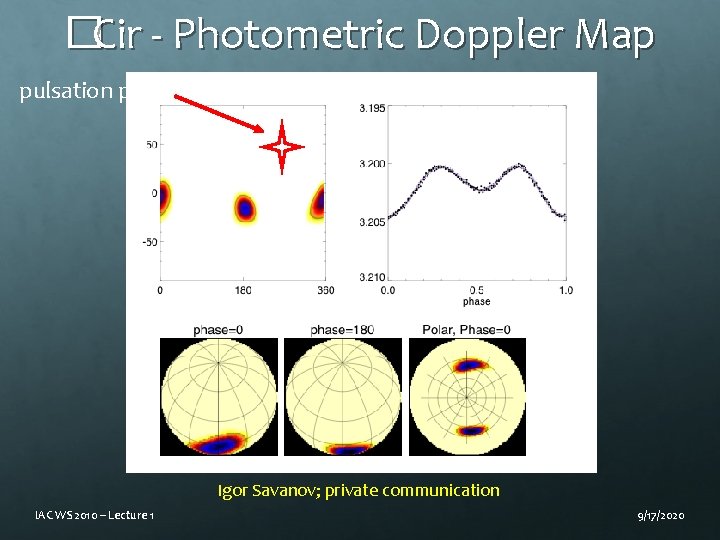
� Cir - Photometric Doppler Map pulsation pole Igor Savanov; private communication IAC WS 2010 – Lecture 1 9/17/2020
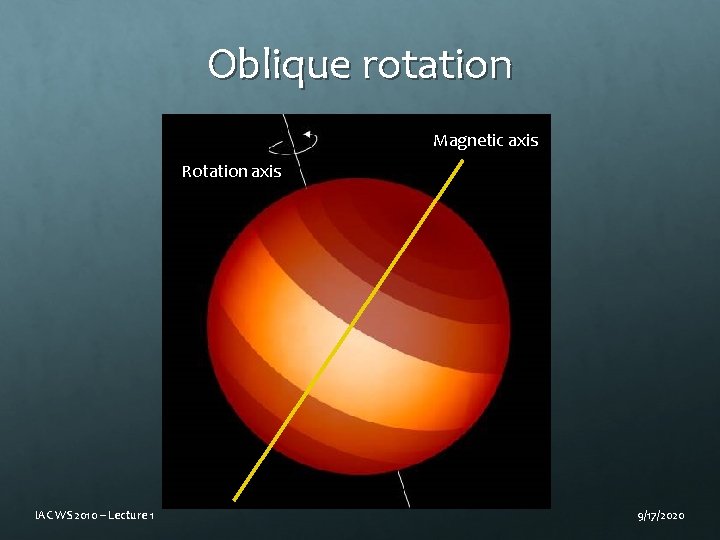
Oblique rotation Magnetic axis Rotation axis IAC WS 2010 – Lecture 1 9/17/2020
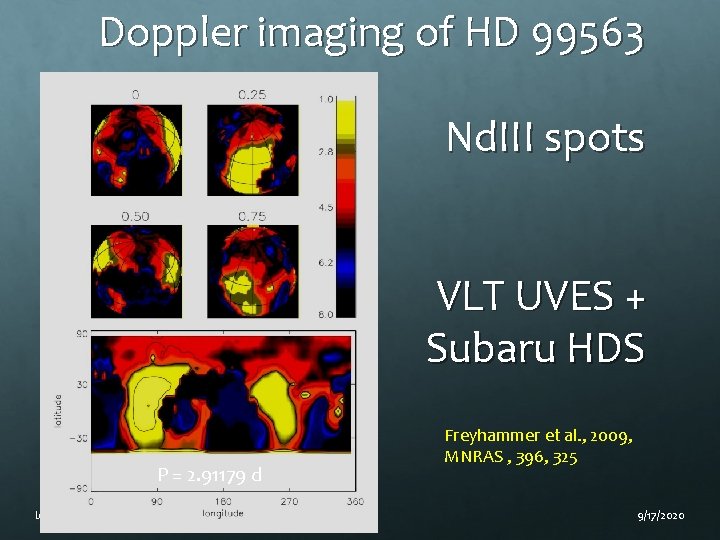
Doppler imaging of HD 99563 Nd. III spots VLT UVES + Subaru HDS P = 2. 91179 d IAC WS 2010 – Lecture 1 Freyhammer et al. , 2009, MNRAS , 396, 325 9/17/2020
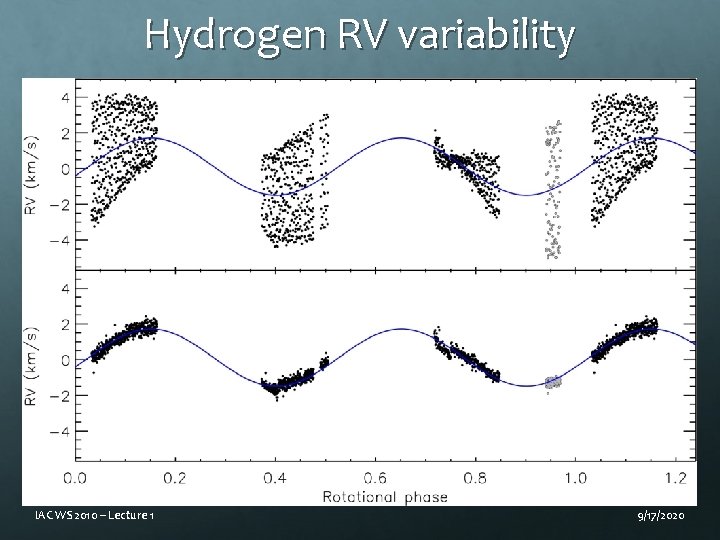
Hydrogen RV variability P = 2. 91179 d IAC WS 2010 – Lecture 1 9/17/2020
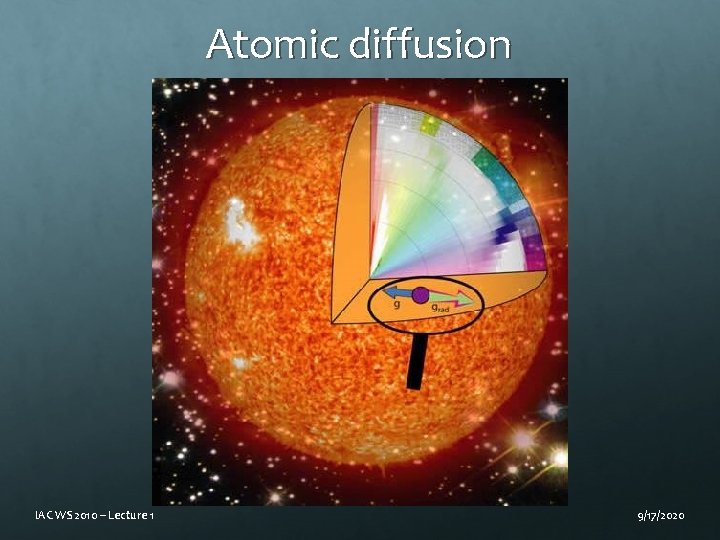
Atomic diffusion IAC WS 2010 – Lecture 1 9/17/2020
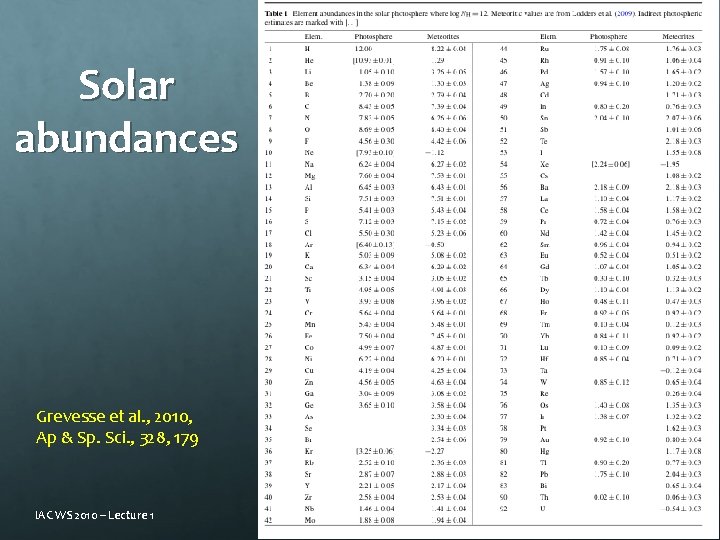
Solar abundances Grevesse et al. , 2010, Ap & Sp. Sci. , 328, 179 IAC WS 2010 – Lecture 1 9/17/2020
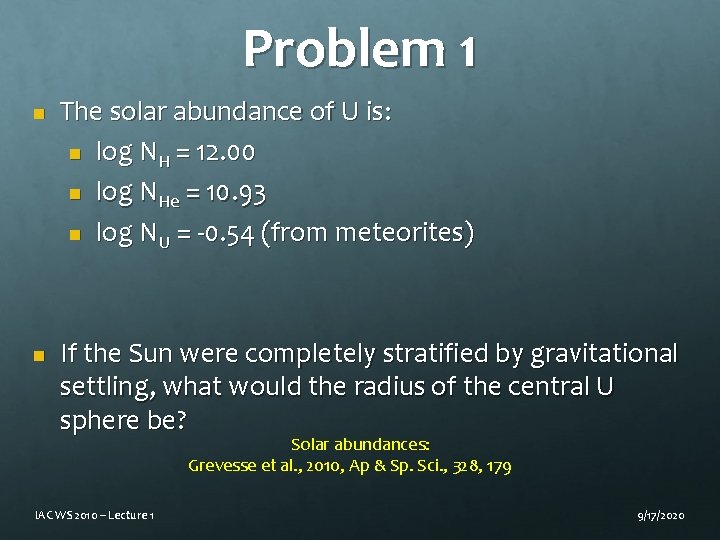
Problem 1 n n The solar abundance of U is: n log NH = 12. 00 n log NHe = 10. 93 n log NU = -0. 54 (from meteorites) If the Sun were completely stratified by gravitational settling, what would the radius of the central U sphere be? Solar abundances: Grevesse et al. , 2010, Ap & Sp. Sci. , 328, 179 IAC WS 2010 – Lecture 1 9/17/2020
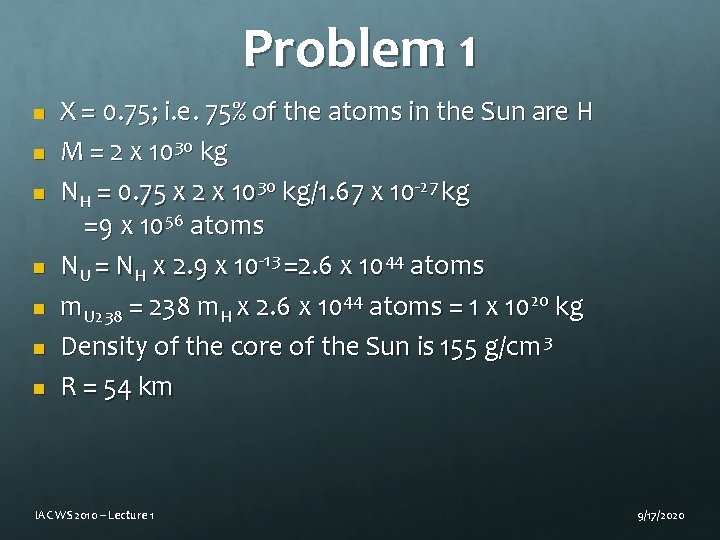
Problem 1 n n n n X = 0. 75; i. e. 75% of the atoms in the Sun are H M = 2 x 1030 kg NH = 0. 75 x 2 x 1030 kg/1. 67 x 10 -27 kg =9 x 1056 atoms NU = NH x 2. 9 x 10 -13 =2. 6 x 1044 atoms m. U 238 = 238 m. H x 2. 6 x 1044 atoms = 1 x 10²⁰ kg Density of the core of the Sun is 155 g/cm 3 R = 54 km IAC WS 2010 – Lecture 1 9/17/2020
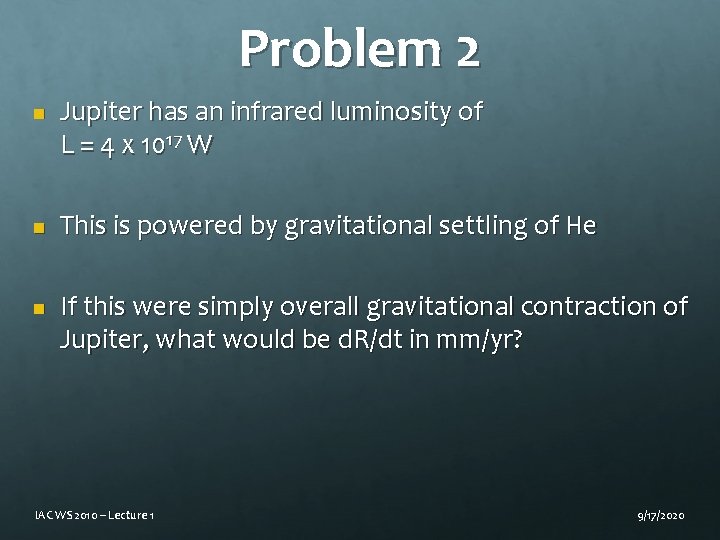
Problem 2 n n n Jupiter has an infrared luminosity of L = 4 x 10¹⁷ W This is powered by gravitational settling of He If this were simply overall gravitational contraction of Jupiter, what would be d. R/dt in mm/yr? IAC WS 2010 – Lecture 1 9/17/2020
Problem 2 IAC WS 2010 – Lecture 1 9/17/2020
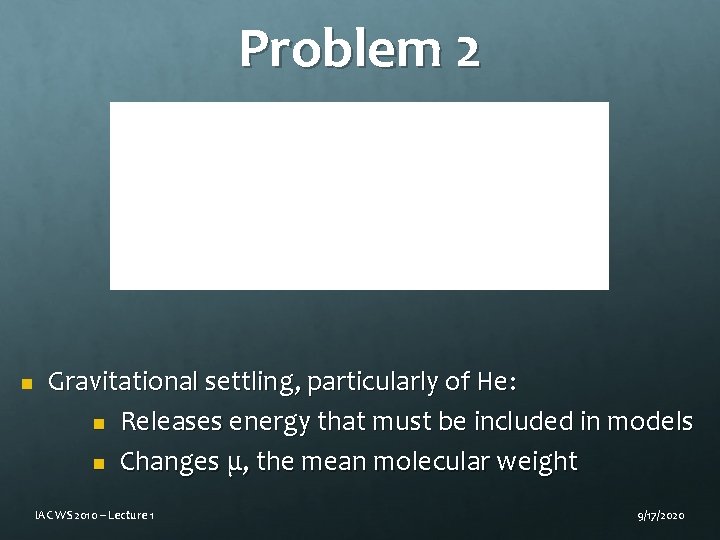
Problem 2 n Gravitational settling, particularly of He: n Releases energy that must be included in models n Changes μ, the mean molecular weight IAC WS 2010 – Lecture 1 9/17/2020
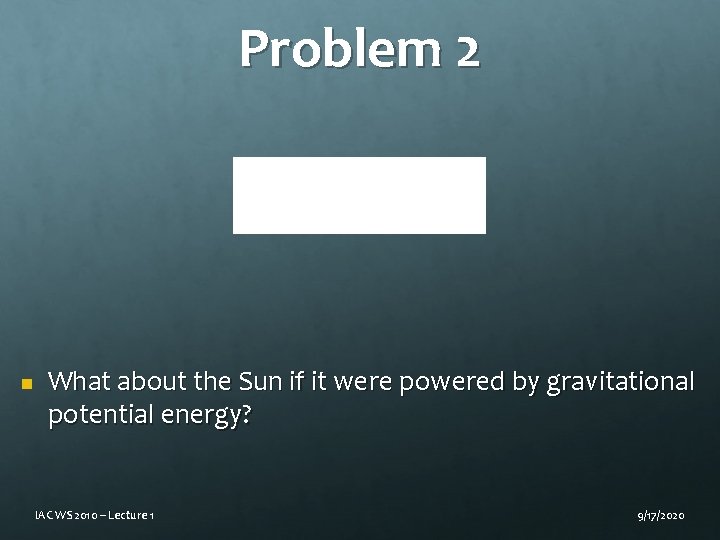
Problem 2 n What about the Sun if it were powered by gravitational potential energy? IAC WS 2010 – Lecture 1 9/17/2020
Sun and cluster ages n n He settling is included in the Standard Solar Model He settling reduces ages for clusters determined from isochrones n ε(3α) ~ T 30 n Globular cluster ages come down by 1 -2 Gyr Chaboyer et al. , 1996, Science, 271, 957 -961 IAC WS 2010 – Lecture 1 9/17/2020
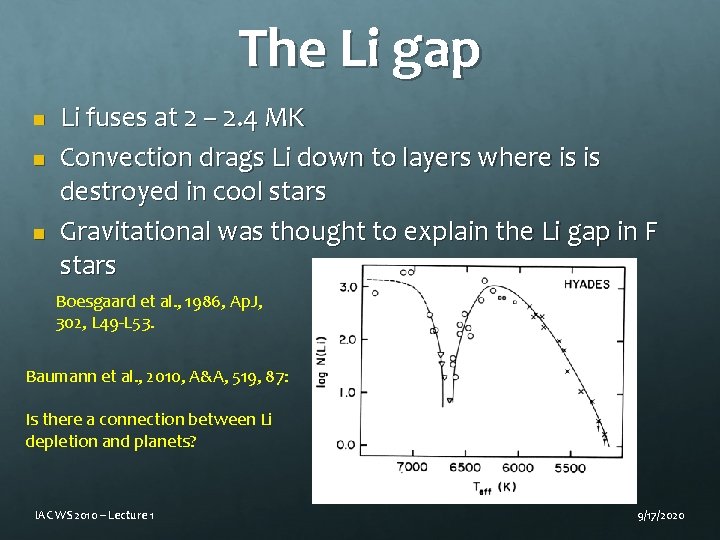
The Li gap n n n Li fuses at 2 – 2. 4 MK Convection drags Li down to layers where is is destroyed in cool stars Gravitational was thought to explain the Li gap in F stars Boesgaard et al. , 1986, Ap. J, 302, L 49 -L 53. Baumann et al. , 2010, A&A, 519, 87: Is there a connection between Li depletion and planets? IAC WS 2010 – Lecture 1 9/17/2020
White dwarfs n n n White dwarfs are stratified Some of this is the result of core and then shell burning In the strong gravitational field of white dwarfs settling and stratification are quick Typically: n C-O core n He layer n H layer Studies of g modes in white dwarfs measure the atmospheric layer masses IAC WS 2010 – Lecture 1 PG 1159: Costa et al. , 2008, … 9/17/2020
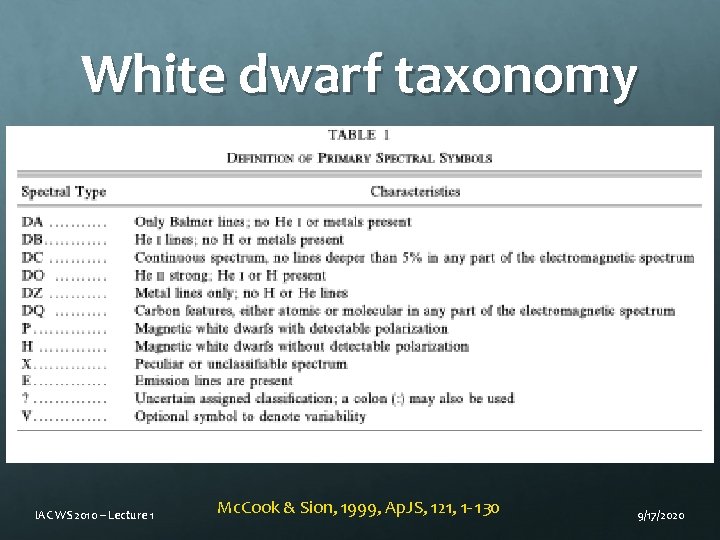
White dwarf taxonomy IAC WS 2010 – Lecture 1 Mc. Cook & Sion, 1999, Ap. JS, 121, 1 - 130 9/17/2020
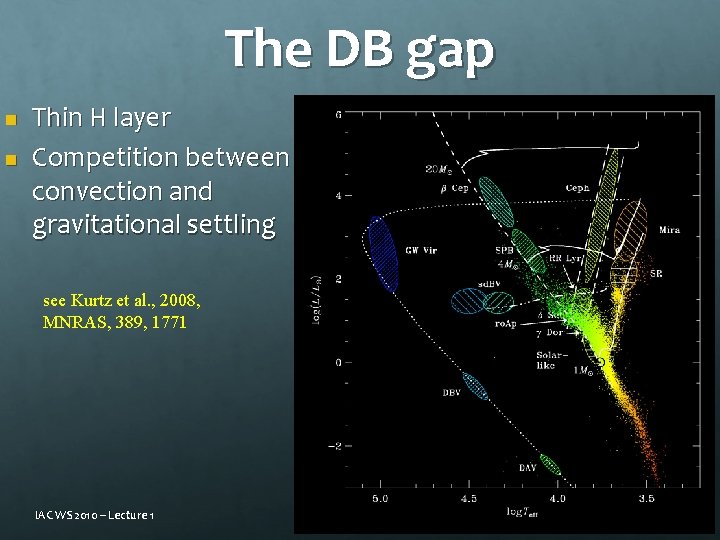
The DB gap n n Thin H layer Competition between convection and gravitational settling see Kurtz et al. , 2008, MNRAS, 389, 1771 IAC WS 2010 – Lecture 1 9/17/2020
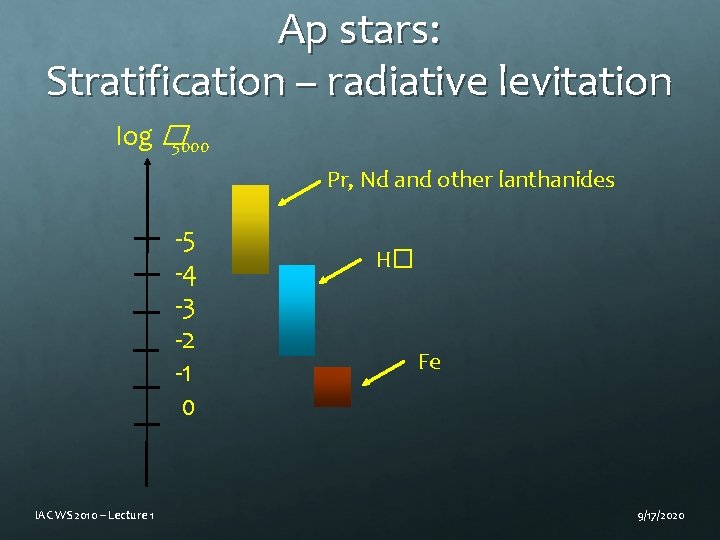
Ap stars: Stratification – radiative levitation log � 5000 Pr, Nd and other lanthanides -5 -4 -3 -2 -1 0 IAC WS 2010 – Lecture 1 H� Fe 9/17/2020
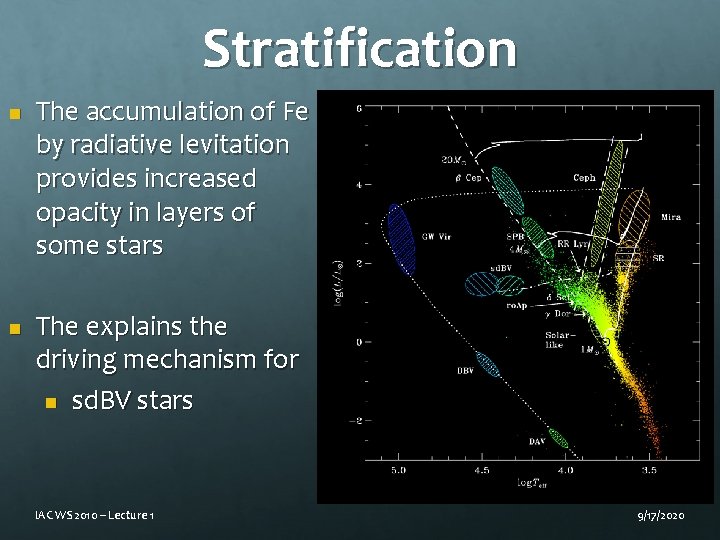
Stratification n n The accumulation of Fe by radiative levitation provides increased opacity in layers of some stars The explains the driving mechanism for n sd. BV stars IAC WS 2010 – Lecture 1 9/17/2020
3 4 He /He in moon rocks n n n The He 3/He 4 ratio in moon rocks is higher than in the Sun He 3 is preferentially driven of the Sun the solar wind compared to He 4 This is a consequence of abundance and opacity: The typical He 3 gets to see more photons than the more abundant isotope He 4 This explain the abundance anomlaies and isotope ratios of the Hg. Mn stars n CP 3; nonmagnetic; late B stars IAC WS 2010 – Lecture 1 9/17/2020
Atomic diffusion in the CP stars accounts for or is consistent with: n n n Overabundances of the Fe-peak and rare earth elements Underabundances of Ca, Sc, C, He in Am stars n Noble gas electronic configuration Ages of Cp stars n Anomalies disappear in red giants with Cp precursors Slow rotation in Am and Ap stars n Binary fraction of Am stars n Magnetic braking in Ap stars Spots in Ap stars IAC WS 2010 – Lecture 1 9/17/2020
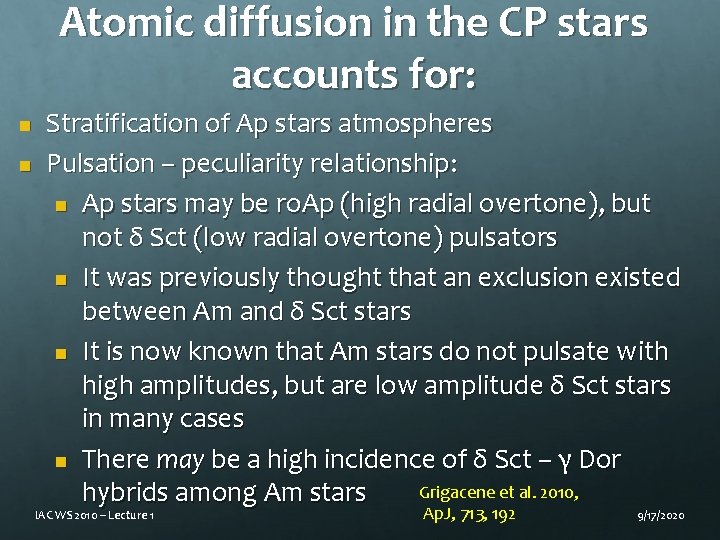
Atomic diffusion in the CP stars accounts for: n n Stratification of Ap stars atmospheres Pulsation – peculiarity relationship: n Ap stars may be ro. Ap (high radial overtone), but not δ Sct (low radial overtone) pulsators n It was previously thought that an exclusion existed between Am and δ Sct stars n It is now known that Am stars do not pulsate with high amplitudes, but are low amplitude δ Sct stars in many cases n There may be a high incidence of δ Sct – γ Dor hybrids among Am stars Grigacene et al. 2010, IAC WS 2010 – Lecture 1 Ap. J, 713, 192 9/17/2020
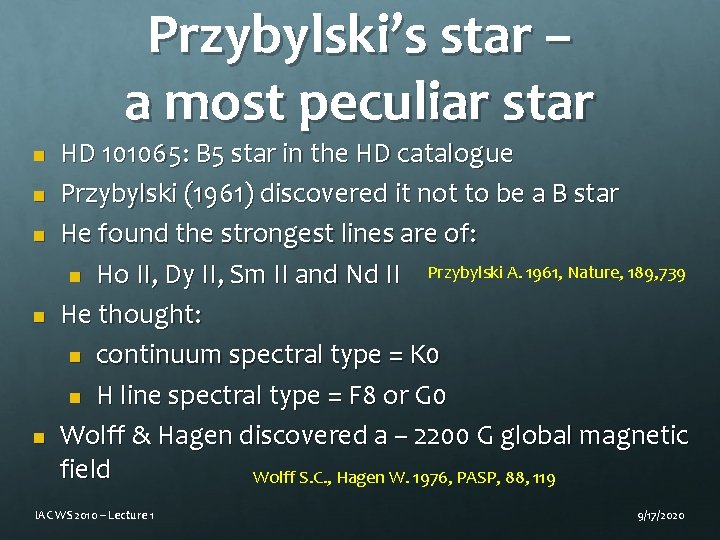
Przybylski’s star – a most peculiar star n n n HD 101065: B 5 star in the HD catalogue Przybylski (1961) discovered it not to be a B star He found the strongest lines are of: Przybylski A. 1961, Nature, 189, 739 n Ho II, Dy II, Sm II and Nd II He thought: n continuum spectral type = K 0 n H line spectral type = F 8 or G 0 Wolff & Hagen discovered a – 2200 G global magnetic field Wolff S. C. , Hagen W. 1976, PASP, 88, 119 IAC WS 2010 – Lecture 1 9/17/2020
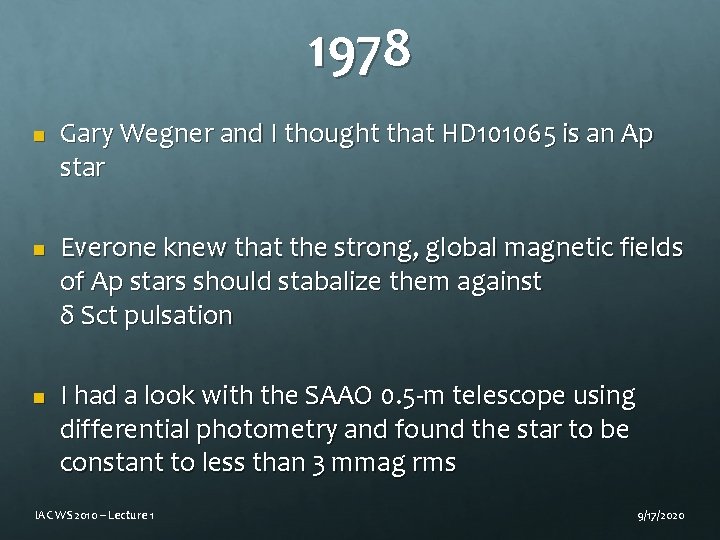
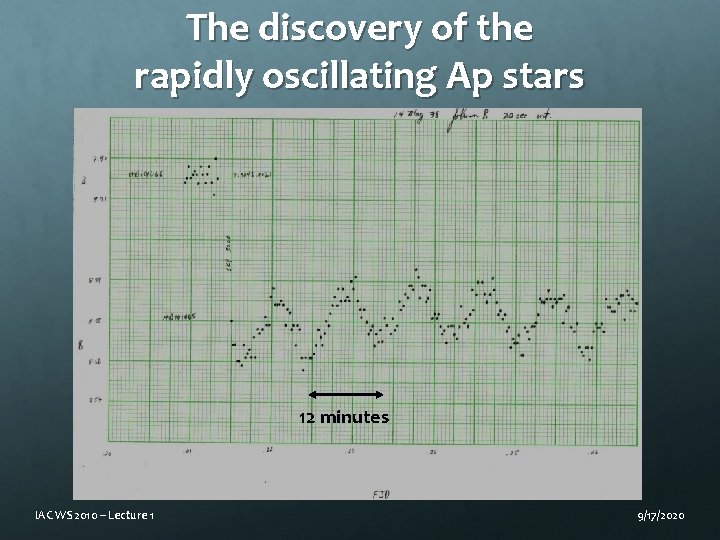
1978 n n n Gary Wegner and I thought that HD 101065 is an Ap star Everone knew that the strong, global magnetic fields of Ap stars should stabalize them against δ Sct pulsation I had a look with the SAAO 0. 5 -m telescope using differential photometry and found the star to be constant to less than 3 mmag rms IAC WS 2010 – Lecture 1 9/17/2020
The discovery of the rapidly oscillating Ap stars 12 minutes IAC WS 2010 – Lecture 1 9/17/2020
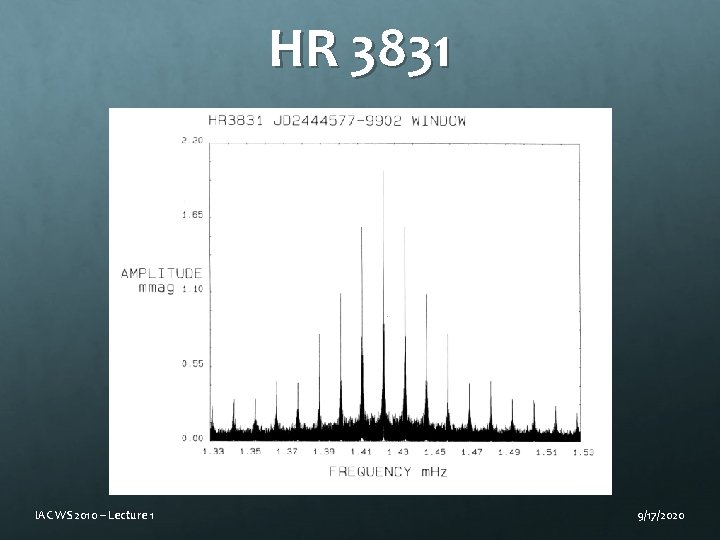
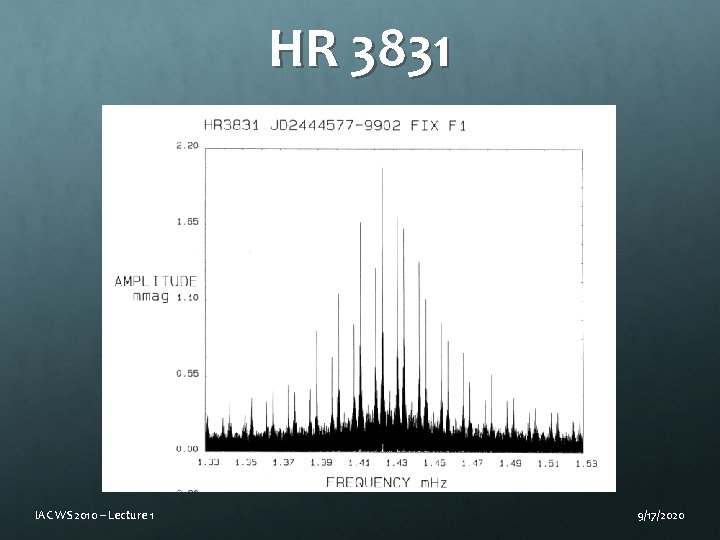
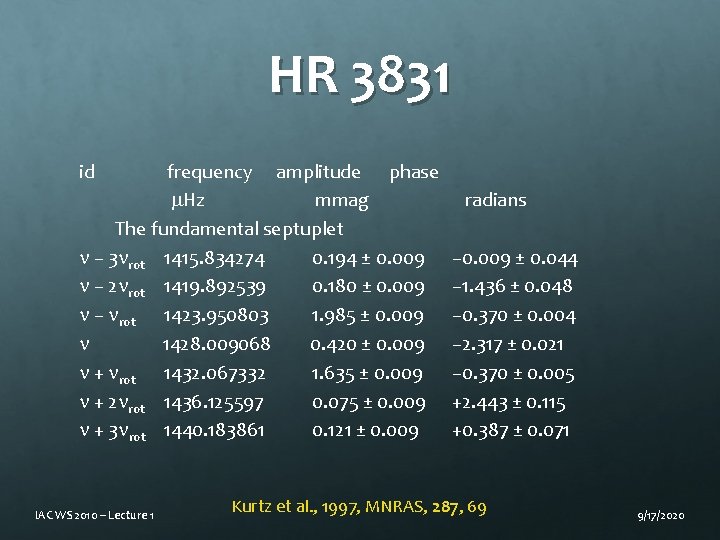
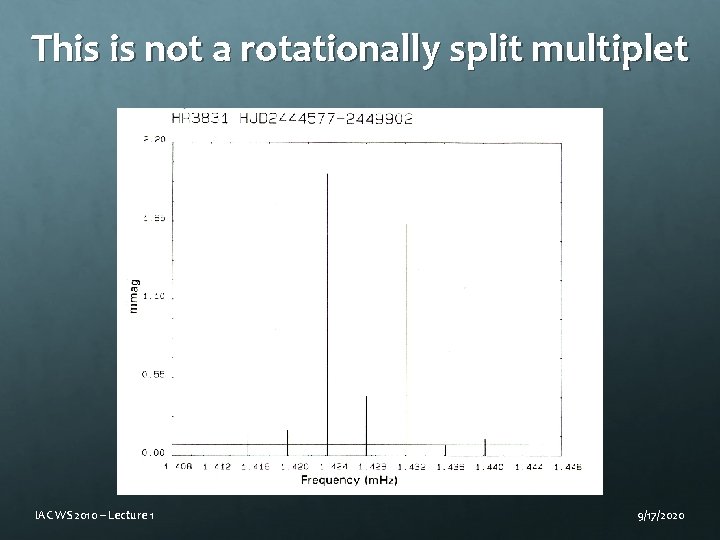
HR 3831 n n This is the third ro. Ap star discovered Let’s look at some multi-site data obtained over a time span of 17 days Find the three highest amplitude frequencies in this data set and determine their pattern Data set = 2448303 -2448320 bzl 40 n n n The bzl 40 means: b means Johnson B filter z means zero in the mean l means high pass filter (low frequencies removed) 40 means 40 -s integrations IAC WS 2010 – Lecture 1 9/17/2020
HR 3831 IAC WS 2010 – Lecture 1 9/17/2020
HR 3831 IAC WS 2010 – Lecture 1 9/17/2020
HR 3831 IAC WS 2010 – Lecture 1 9/17/2020
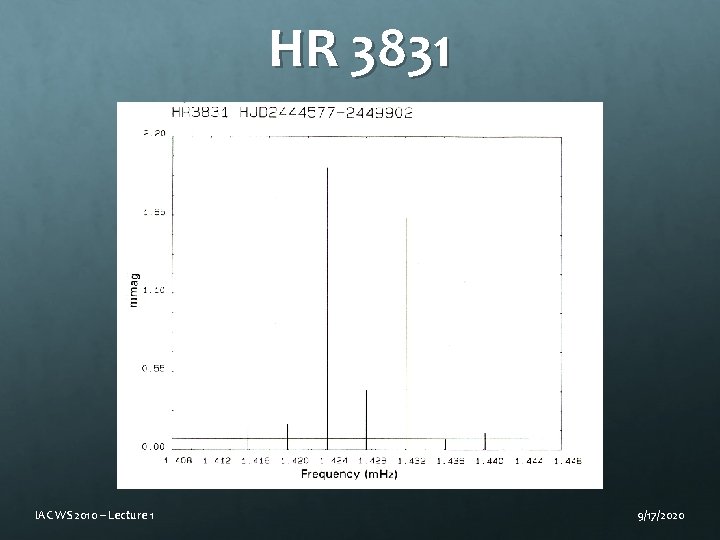
HR 3831 id frequency amplitude phase Hz mmag radians The fundamental septuplet – 3 rot 1415. 834274 0. 194 ± 0. 009 – 0. 009 ± 0. 044 – 2 rot 1419. 892539 0. 180 ± 0. 009 – 1. 436 ± 0. 048 – rot 1423. 950803 1. 985 ± 0. 009 – 0. 370 ± 0. 004 1428. 009068 0. 420 ± 0. 009 – 2. 317 ± 0. 021 + rot 1432. 067332 1. 635 ± 0. 009 – 0. 370 ± 0. 005 + 2 rot 1436. 125597 0. 075 ± 0. 009 +2. 443 ± 0. 115 + 3 rot 1440. 183861 0. 121 ± 0. 009 +0. 387 ± 0. 071 IAC WS 2010 – Lecture 1 Kurtz et al. , 1997, MNRAS, 287, 69 9/17/2020
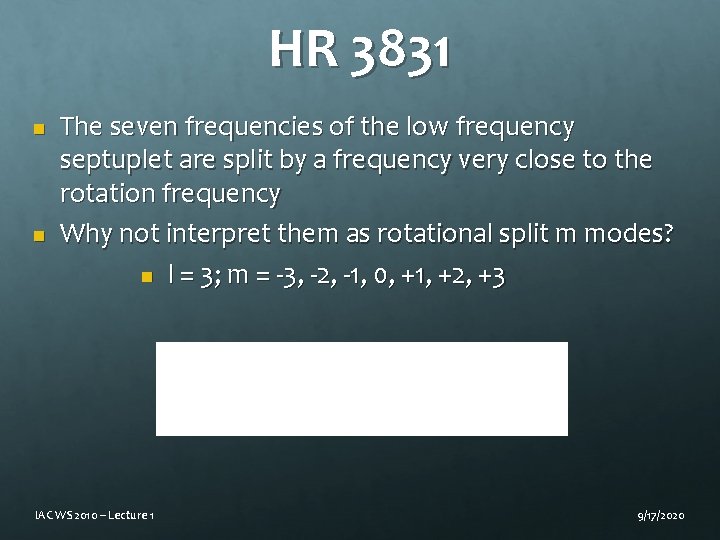
HR 3831 n n The seven frequencies of the low frequency septuplet are split by a frequency very close to the rotation frequency Why not interpret them as rotational split m modes? n l = 3; m = -3, -2, -1, 0, +1, +2, +3 IAC WS 2010 – Lecture 1 9/17/2020
HR 3831 IAC WS 2010 – Lecture 1 9/17/2020
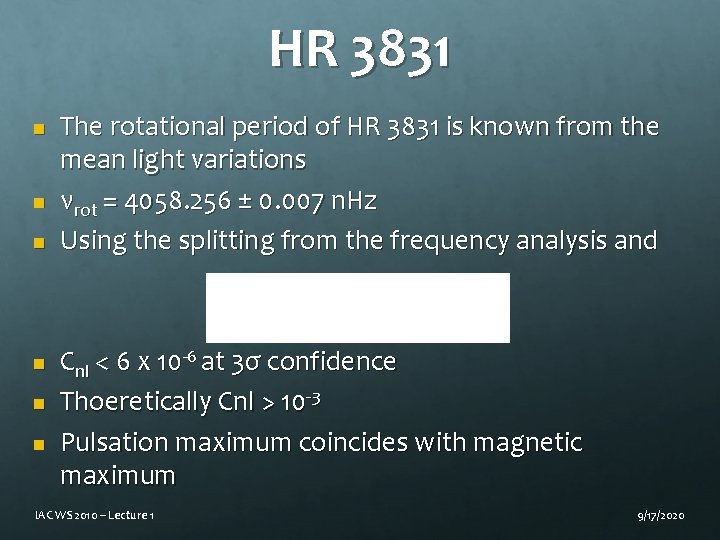
HR 3831 n n n The rotational period of HR 3831 is known from the mean light variations νrot = 4058. 256 ± 0. 007 n. Hz Using the splitting from the frequency analysis and Cnl < 6 x 10 -6 at 3σ confidence Thoeretically Cnl > 10 -3 Pulsation maximum coincides with magnetic maximum IAC WS 2010 – Lecture 1 9/17/2020
This is not a rotationally split multiplet IAC WS 2010 – Lecture 1 9/17/2020