
The Chemical Context of Life AP Biology 2011
The Chemical Context of Life AP Biology 2011 -2012
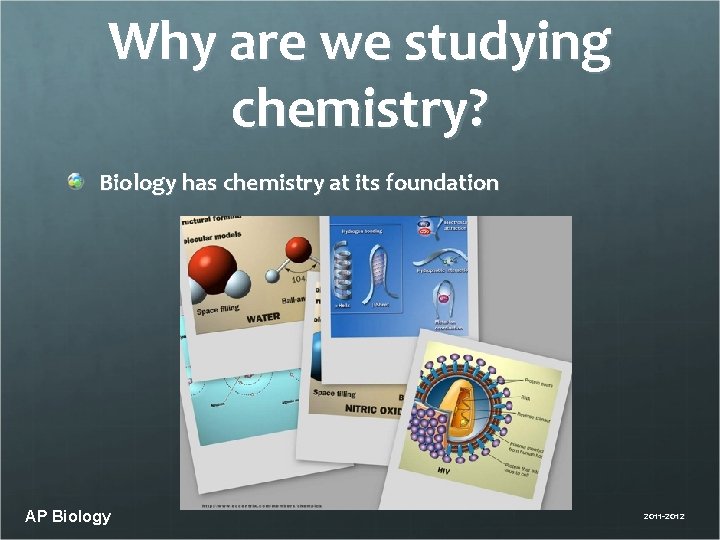
Why are we studying chemistry? Biology has chemistry at its foundation AP Biology 2011 -2012
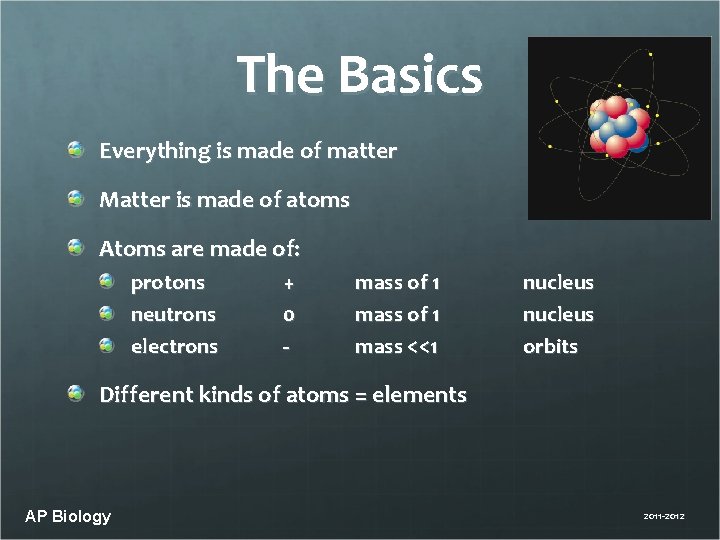
The Basics Everything is made of matter Matter is made of atoms Atoms are made of: protons neutrons electrons + 0 - mass of 1 mass <<1 nucleus orbits Different kinds of atoms = elements AP Biology 2011 -2012
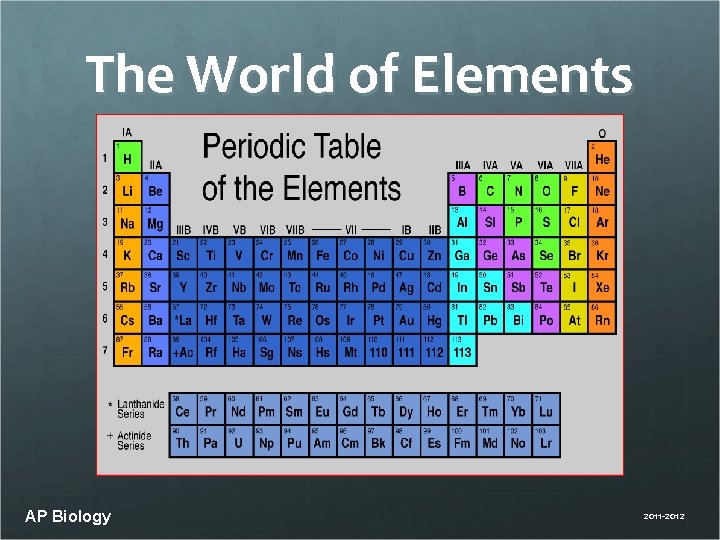
The World of Elements AP Biology 2011 -2012
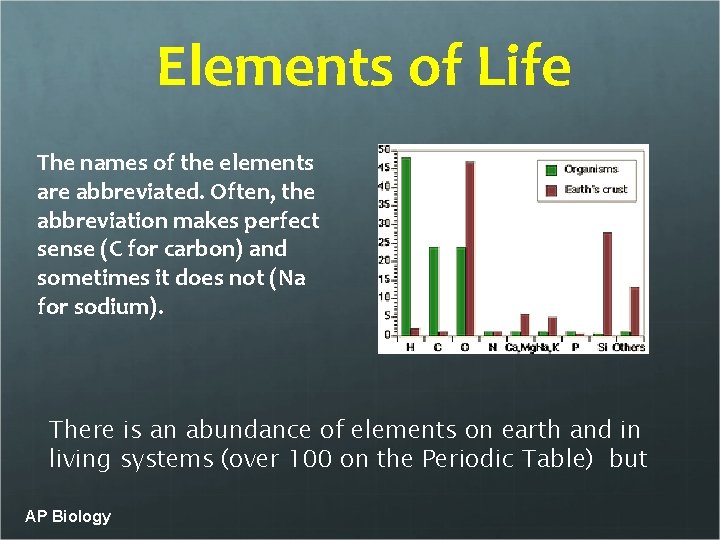
Elements of Life The names of the elements are abbreviated. Often, the abbreviation makes perfect sense (C for carbon) and sometimes it does not (Na for sodium). There is an abundance of elements on earth and in living systems (over 100 on the Periodic Table) but AP Biology
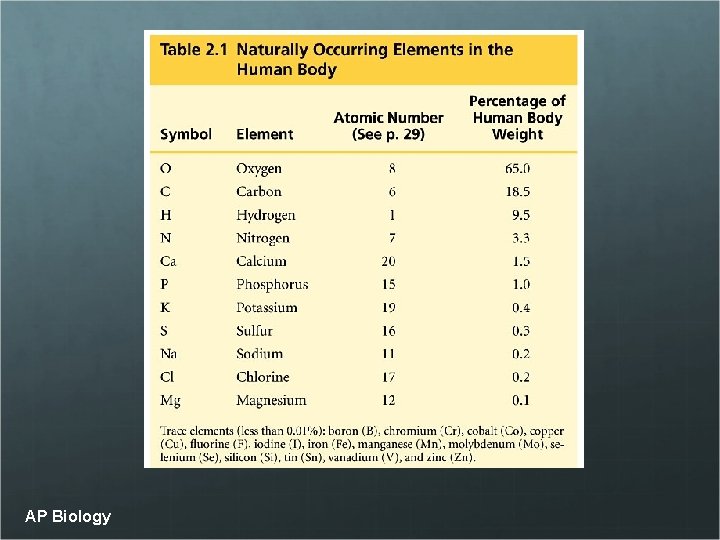
Life requires ~25 chemical elements About 25 elements are essential for life Four elements make up 96% of living matter: • carbon (C) • oxygen (O) • hydrogen (H) • nitrogen (N) Four elements make up most of remaining 4%: • phosphorus (P) • sulfur (S) AP Biology • calcium (Ca) • potassium (K) 2011 -2012
AP Biology
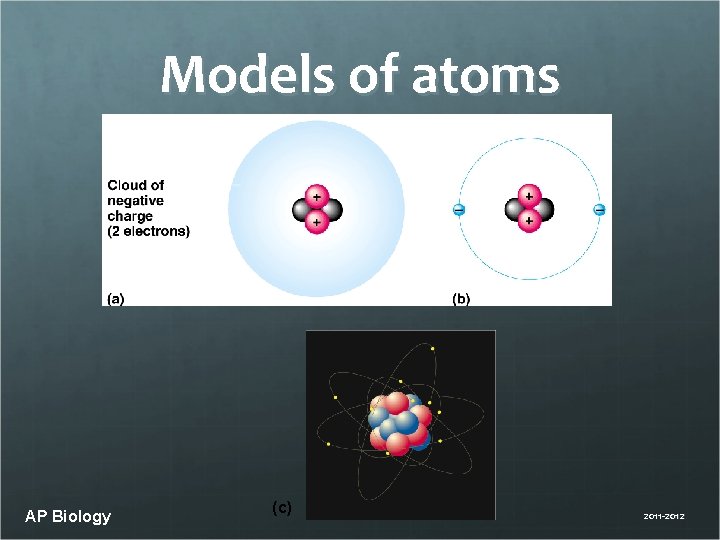
Models of atoms AP Biology (c) 2011 -2012
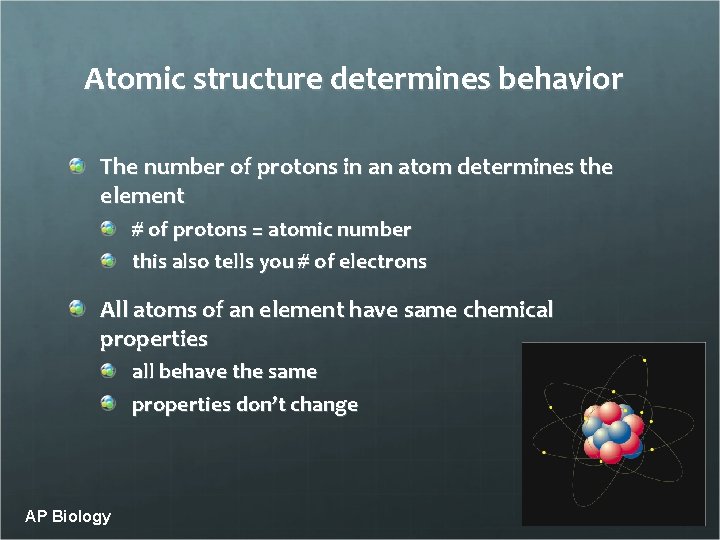
Atomic structure determines behavior The number of protons in an atom determines the element # of protons = atomic number this also tells you # of electrons All atoms of an element have same chemical properties all behave the same properties don’t change AP Biology 2005 -2006
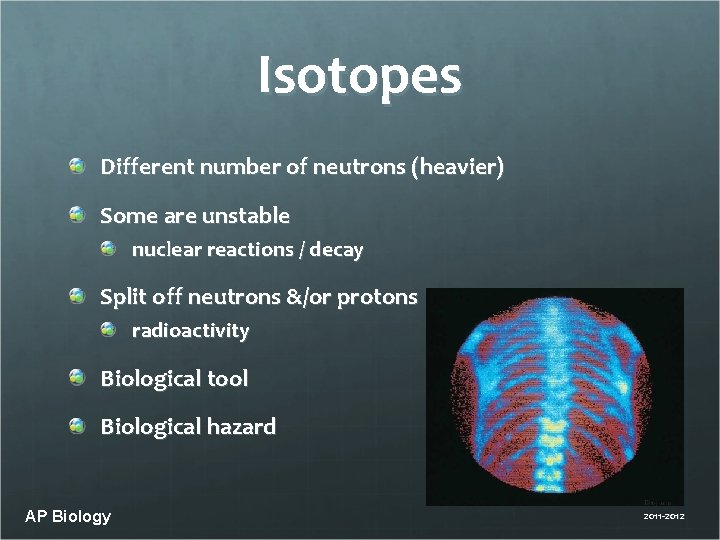
Isotopes Different number of neutrons (heavier) Some are unstable nuclear reactions / decay Split off neutrons &/or protons radioactivity Biological tool Biological hazard AP Biology 2011 -2012
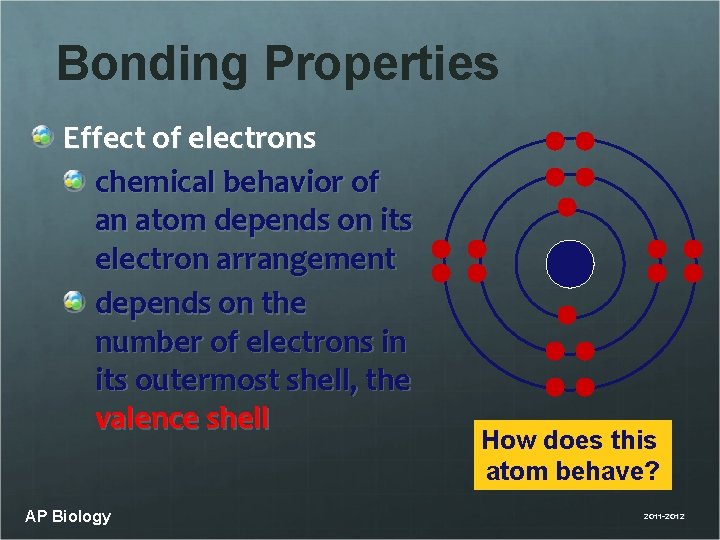
Bonding Properties Effect of electrons chemical behavior of an atom depends on its electron arrangement depends on the number of electrons in its outermost shell, the valence shell AP Biology How does this atom behave? 2011 -2012
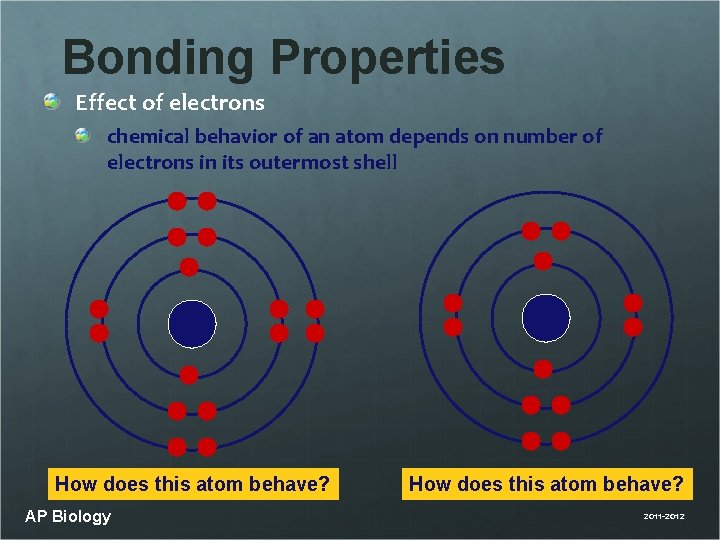
Bonding Properties Effect of electrons chemical behavior of an atom depends on number of electrons in its outermost shell How does this atom behave? AP Biology How does this atom behave? 2011 -2012
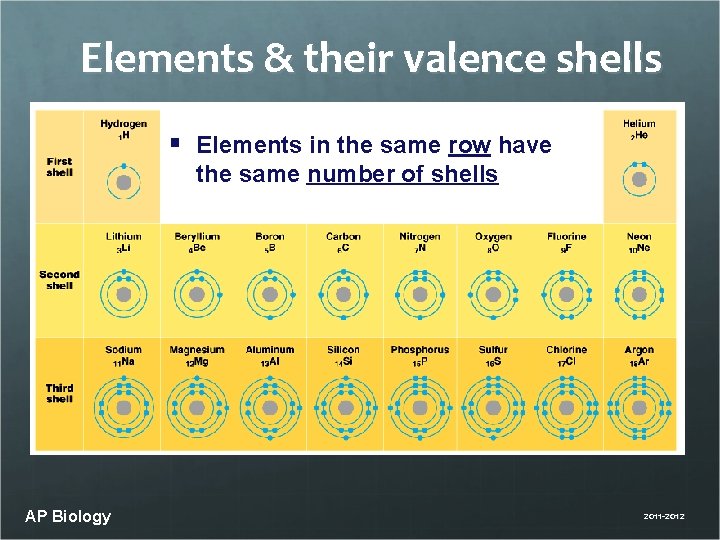
Elements & their valence shells § Elements in the same row have the same number of shells AP Biology 2011 -2012
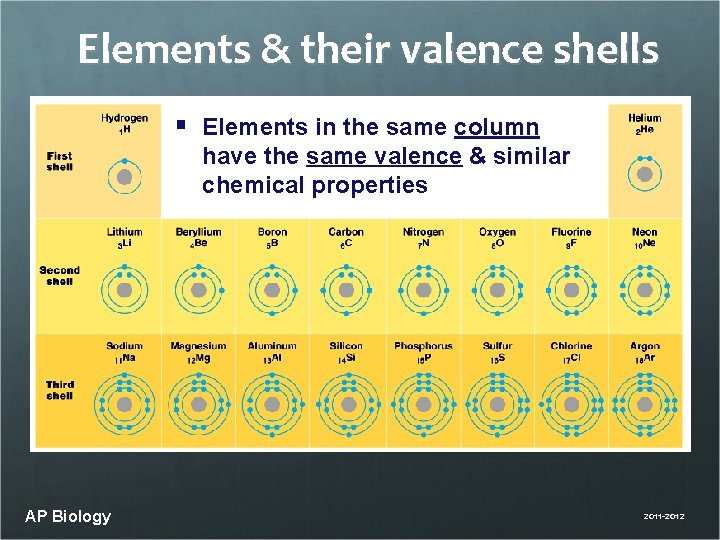
Elements & their valence shells § Elements in the same column have the same valence & similar chemical properties AP Biology 2011 -2012
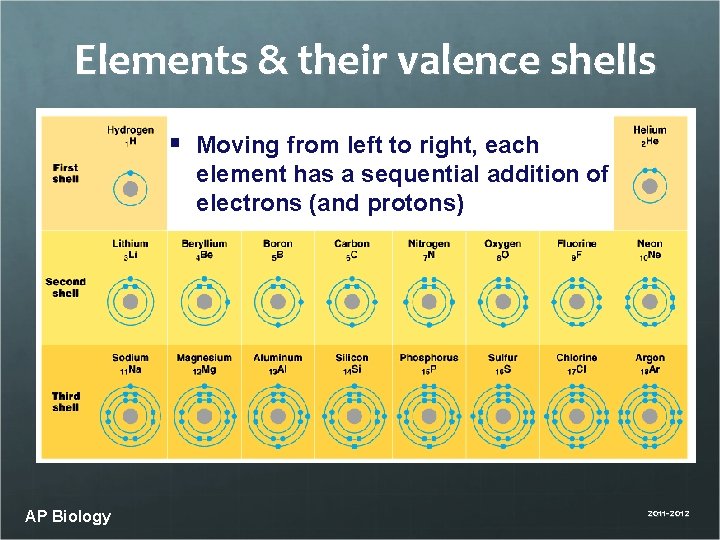
Elements & their valence shells § Moving from left to right, each element has a sequential addition of electrons (and protons) AP Biology 2011 -2012
Chemical reactivity Atoms tend to Complete a partially filled outer (valence) electron shell or Empty a partially filled outer (valence) electron shell This tendency drives chemical reactions AP Biology 2011 -2012
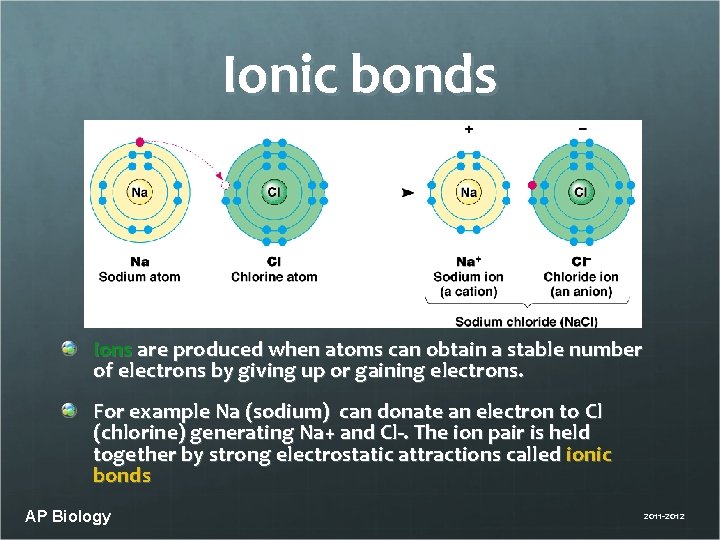
Ionic bonds Ions are produced when atoms can obtain a stable number of electrons by giving up or gaining electrons. For example Na (sodium) can donate an electron to Cl (chlorine) generating Na+ and Cl-. The ion pair is held together by strong electrostatic attractions called ionic bonds AP Biology 2011 -2012
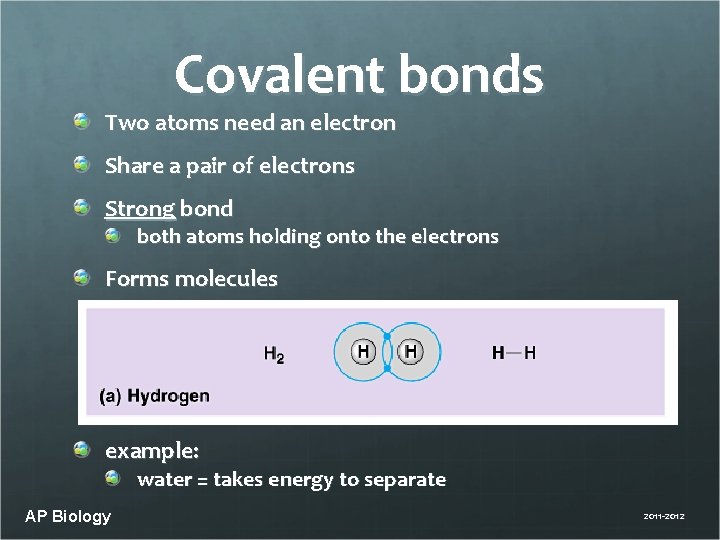
Covalent bonds Two atoms need an electron Share a pair of electrons Strong bond both atoms holding onto the electrons Forms molecules example: water = takes energy to separate AP Biology 2011 -2012
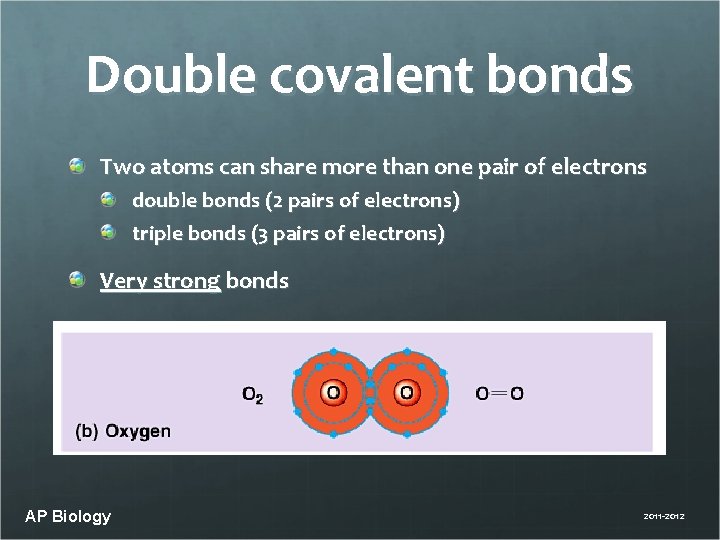
Double covalent bonds Two atoms can share more than one pair of electrons double bonds (2 pairs of electrons) triple bonds (3 pairs of electrons) Very strong bonds AP Biology 2011 -2012
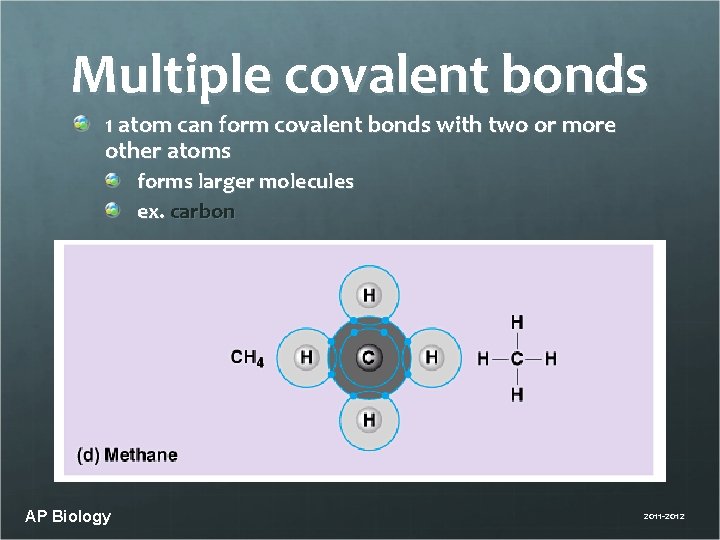
Multiple covalent bonds 1 atom can form covalent bonds with two or more other atoms forms larger molecules ex. carbon AP Biology 2011 -2012
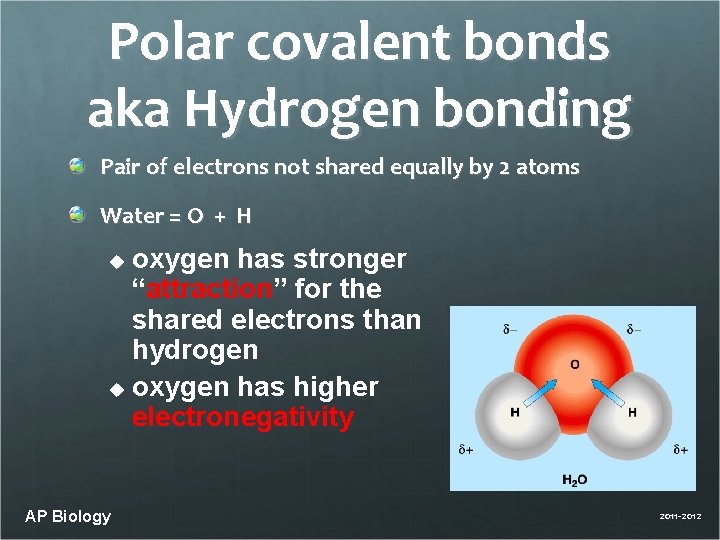
Polar covalent bonds aka Hydrogen bonding Pair of electrons not shared equally by 2 atoms Water = O + H oxygen has stronger “attraction” for the shared electrons than hydrogen u oxygen has higher electronegativity u AP Biology 2011 -2012
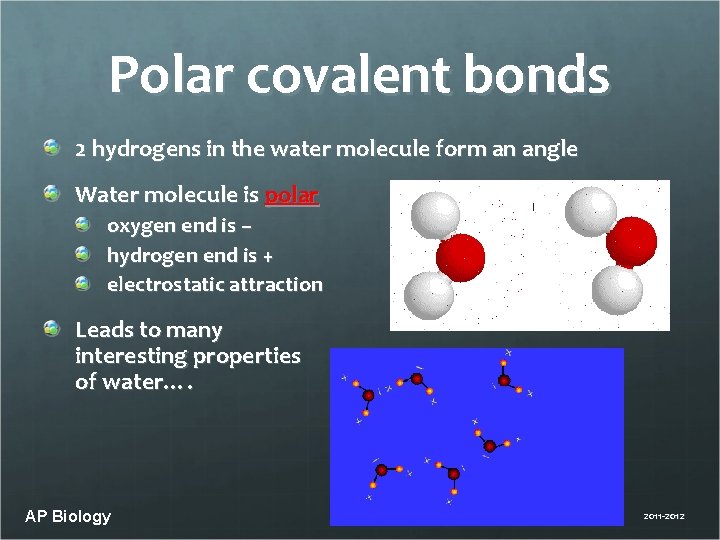
Polar covalent bonds 2 hydrogens in the water molecule form an angle Water molecule is polar oxygen end is – hydrogen end is + electrostatic attraction Leads to many interesting properties of water…. AP Biology 2011 -2012
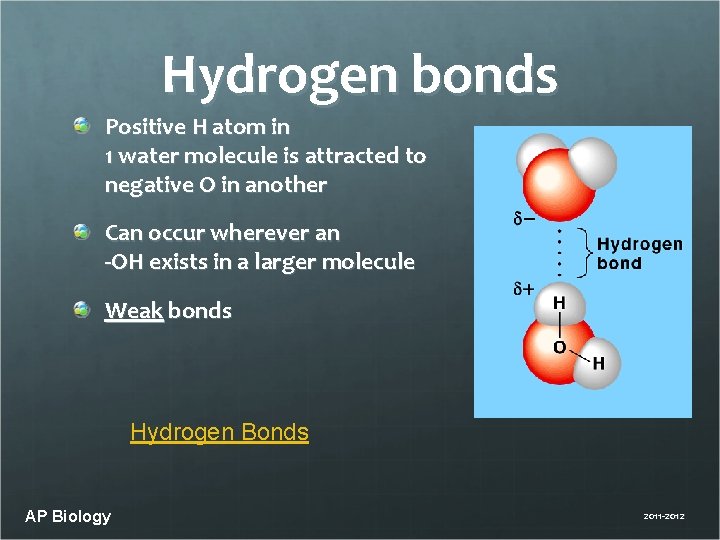
Hydrogen bonds Positive H atom in 1 water molecule is attracted to negative O in another Can occur wherever an -OH exists in a larger molecule Weak bonds Hydrogen Bonds AP Biology 2011 -2012
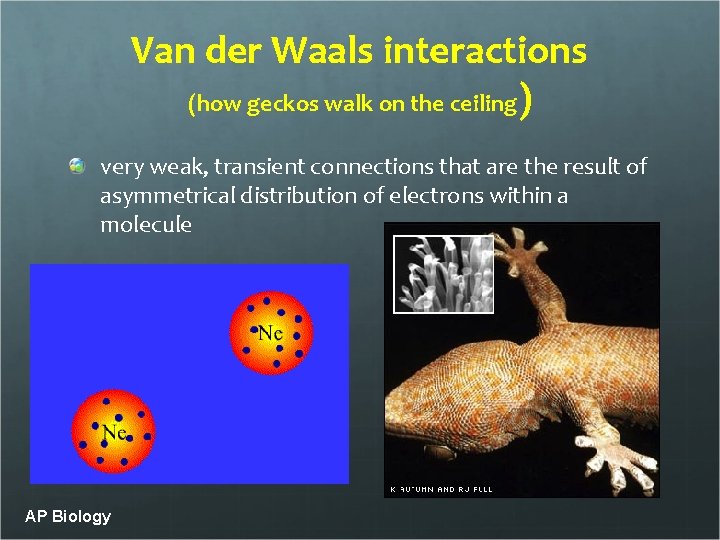
Van der Waals interactions (how geckos walk on the ceiling) very weak, transient connections that are the result of asymmetrical distribution of electrons within a molecule AP Biology

AP Biology
Bonding by Analogy: Dog - Bone Bonds AP Biology
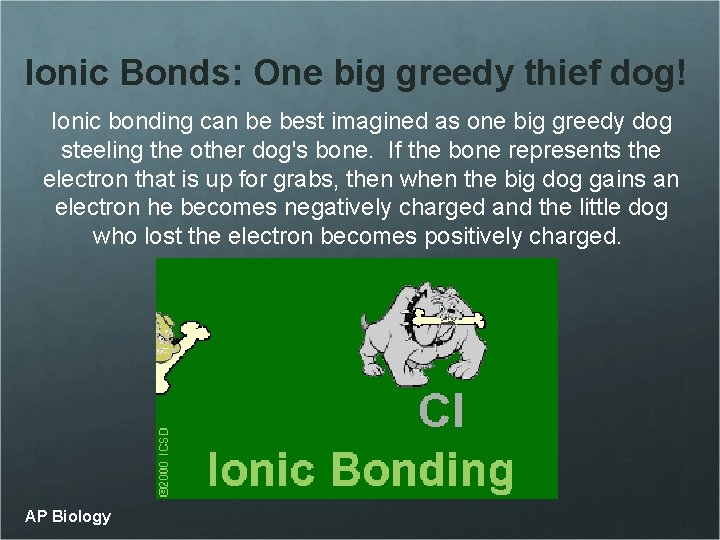
Ionic Bonds: One big greedy thief dog! Ionic bonding can be best imagined as one big greedy dog steeling the other dog's bone. If the bone represents the electron that is up for grabs, then when the big dog gains an electron he becomes negatively charged and the little dog who lost the electron becomes positively charged. AP Biology
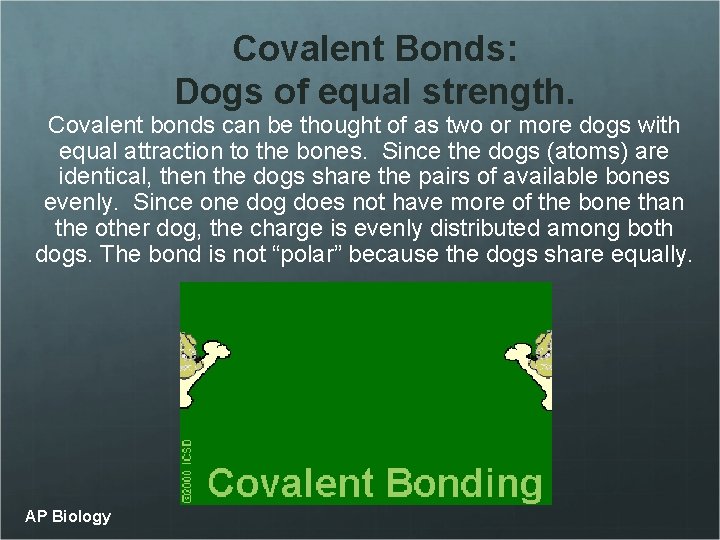
Covalent Bonds: Dogs of equal strength. Covalent bonds can be thought of as two or more dogs with equal attraction to the bones. Since the dogs (atoms) are identical, then the dogs share the pairs of available bones evenly. Since one dog does not have more of the bone than the other dog, the charge is evenly distributed among both dogs. The bond is not “polar” because the dogs share equally. AP Biology
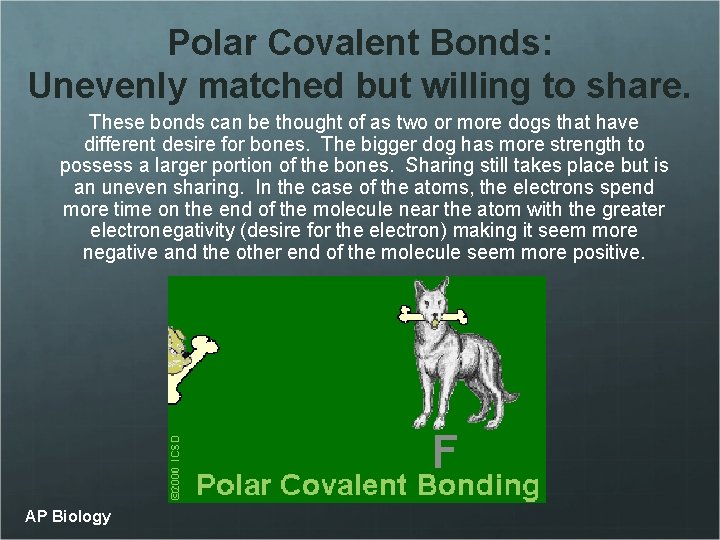
Polar Covalent Bonds: Unevenly matched but willing to share. These bonds can be thought of as two or more dogs that have different desire for bones. The bigger dog has more strength to possess a larger portion of the bones. Sharing still takes place but is an uneven sharing. In the case of the atoms, the electrons spend more time on the end of the molecule near the atom with the greater electronegativity (desire for the electron) making it seem more negative and the other end of the molecule seem more positive. AP Biology
Reductionist view of biology Matter is made of atoms Life requires ~25 chemical elements Atomic structure determines behavior of an element Atoms combine by chemical bonding to form molecules Weak chemical bonds play important roles in chemistry of life A molecule’s biological function is related to its shape Chemical reactions make & break chemical bonds AP Biology 2011 -2012
Any Questions? ? AP Biology 2011 -2012
- Slides: 31