
The Chemical Components of Cells In this lab
The Chemical Components of Cells
In this lab we will • Test for STARCH • Test for SUGARS • Test for PROTEIN

Starch • Plants store glucose as the polysaccharide starch. • The cereal grains (wheat, rice, corn, oats, barley) as well as tubers such as potatoes are rich in starch. • Starch can be separated into two fractions --amylose and amylopectin. Natural starches are mixtures of amylose (1020%) and amylopectin (80 -90%).
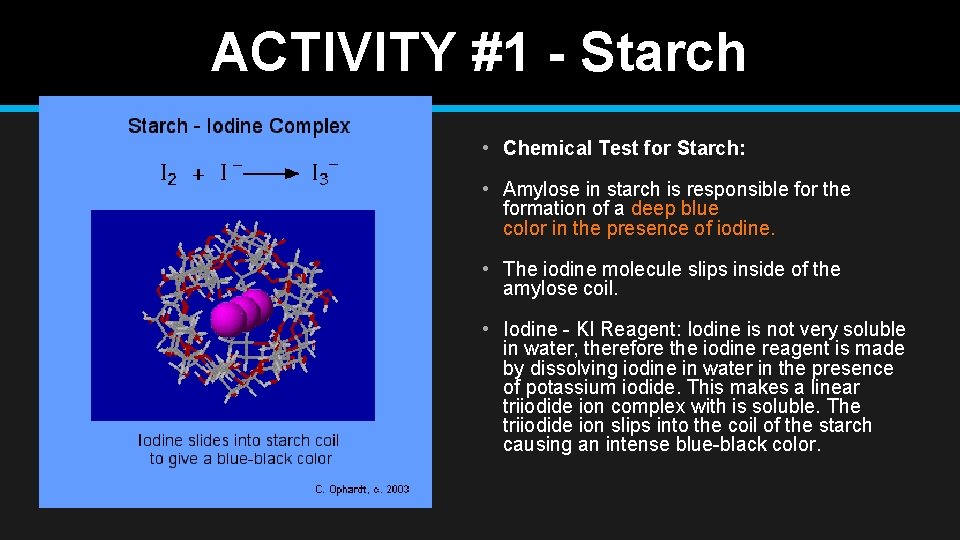
ACTIVITY #1 - Starch • Chemical Test for Starch: • Amylose in starch is responsible for the formation of a deep blue color in the presence of iodine. • The iodine molecule slips inside of the amylose coil. • Iodine - KI Reagent: Iodine is not very soluble in water, therefore the iodine reagent is made by dissolving iodine in water in the presence of potassium iodide. This makes a linear triiodide ion complex with is soluble. The triiodide ion slips into the coil of the starch causing an intense blue-black color.
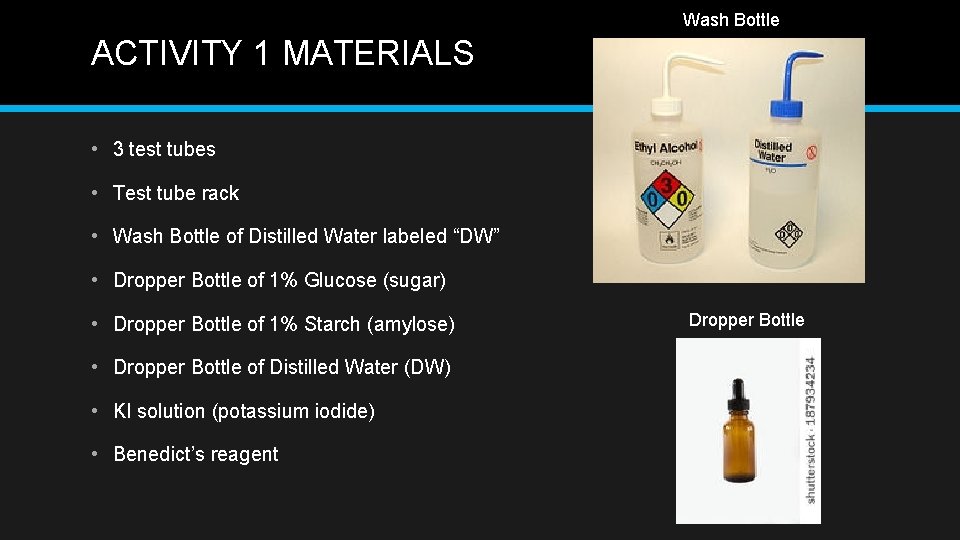
Wash Bottle ACTIVITY 1 MATERIALS • 3 test tubes • Test tube rack • Wash Bottle of Distilled Water labeled “DW” • Dropper Bottle of 1% Glucose (sugar) • Dropper Bottle of 1% Starch (amylose) • Dropper Bottle of Distilled Water (DW) • KI solution (potassium iodide) • Benedict’s reagent Dropper Bottle
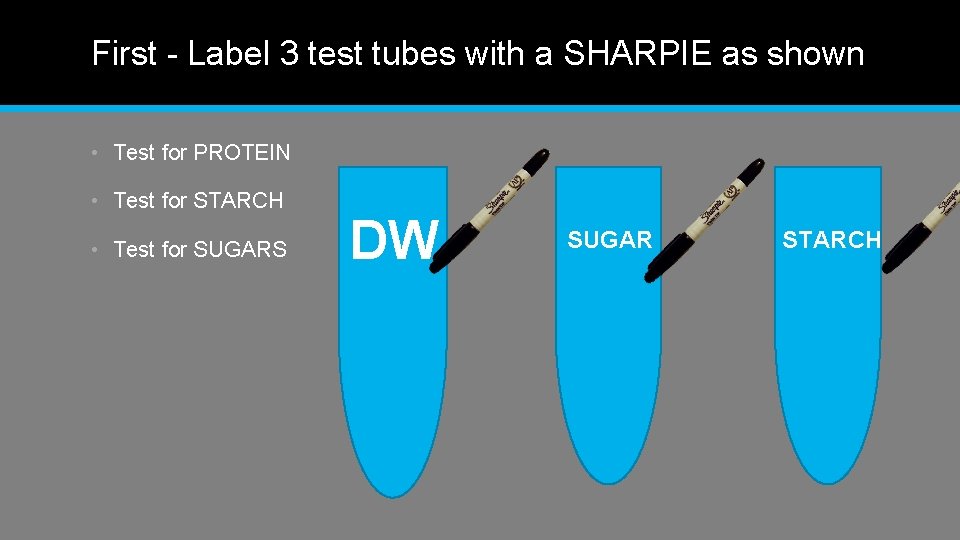
First - Label 3 test tubes with a SHARPIE as shown • Test for PROTEIN • Test for STARCH • Test for SUGARS DW SUGAR STARCH
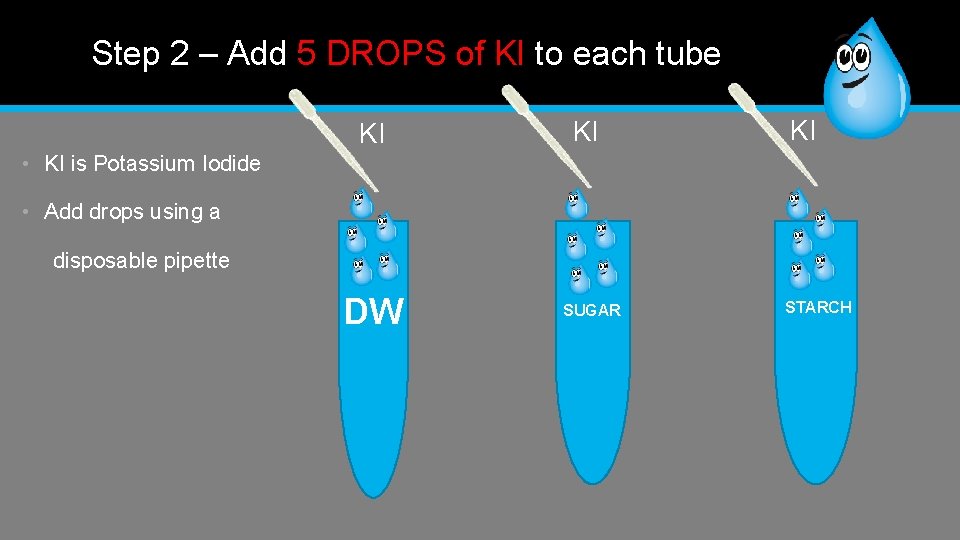
Step 2 – Add 5 DROPS of KI to each tube KI KI KI • KI is Potassium Iodide • Add drops using a disposable pipette DW SUGAR STARCH
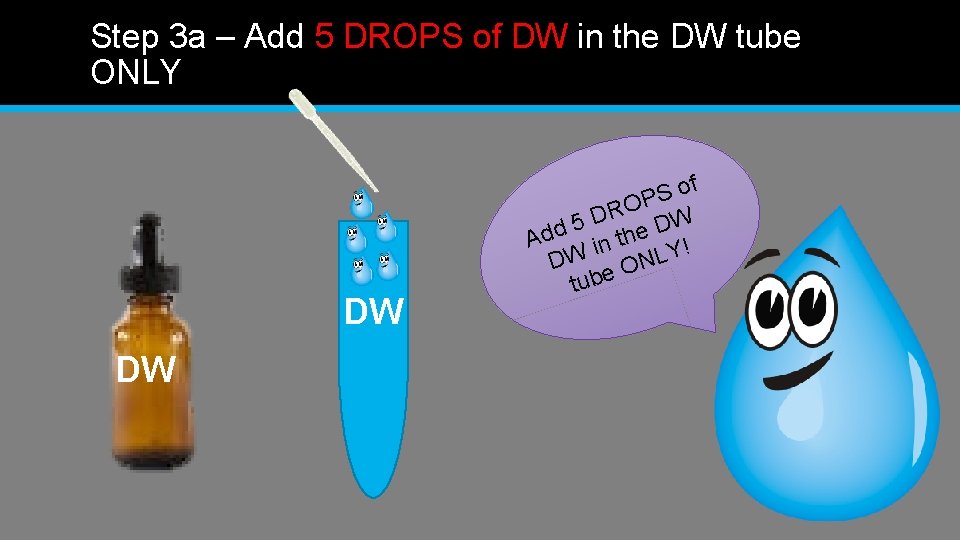
Step 3 a – Add 5 DROPS of DW in the DW tube ONLY DW DW of S P O R D W 5 D Add in the ! DW ONLY tube
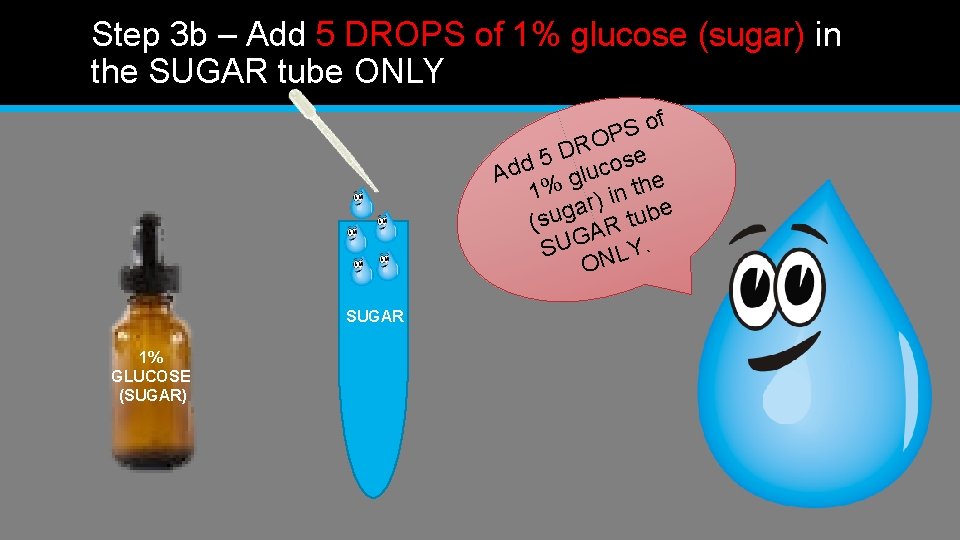
Step 3 b – Add 5 DROPS of 1% glucose (sugar) in the SUGAR tube ONLY of S P O R D ose 5 d Ad luc he g 1% r) in t a e g b u u t (s R A SUG NLY. O SUGAR 1% GLUCOSE (SUGAR)
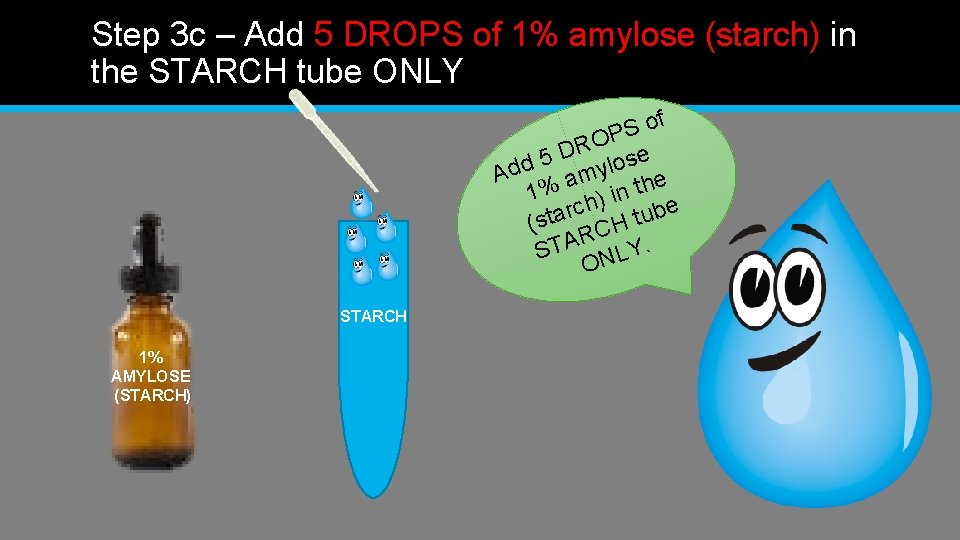
Step 3 c – Add 5 DROPS of 1% amylose (starch) in the STARCH tube ONLY of S P O R D e 5 s Add amylo he 1% h) in t e c r b a u t (st H C R STA NLY. O STARCH 1% AMYLOSE (STARCH)
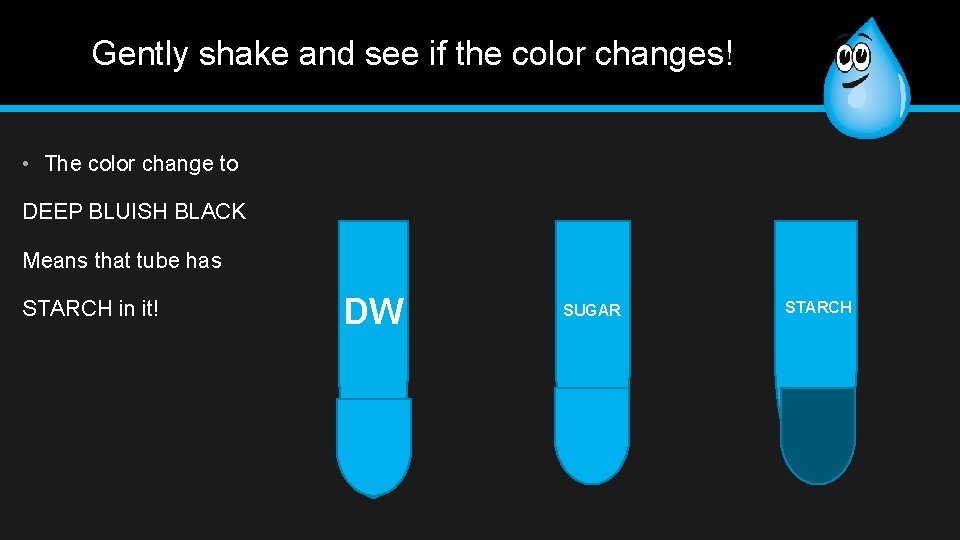
Gently shake and see if the color changes! • The color change to DEEP BLUISH BLACK Means that tube has STARCH in it! DW SUGAR STARCH
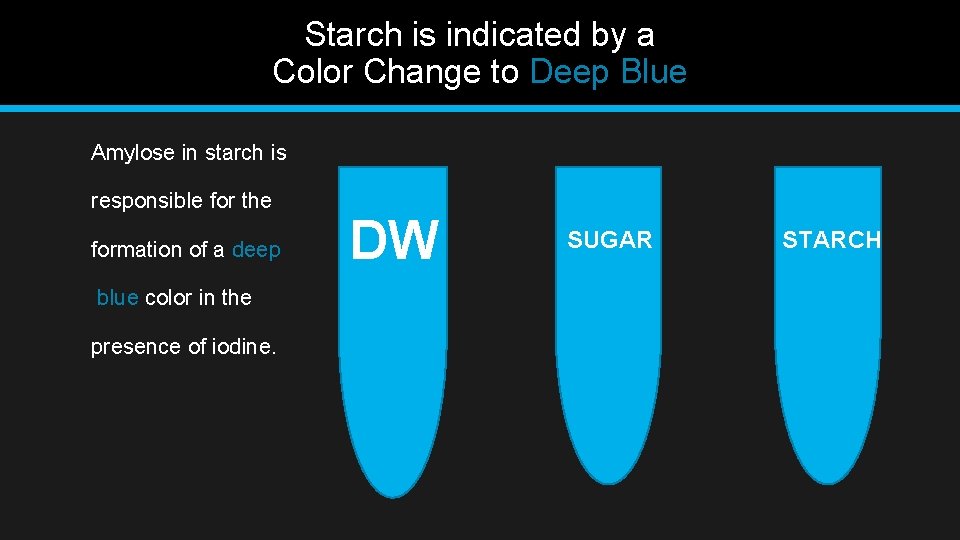
Starch is indicated by a Color Change to Deep Blue Amylose in starch is responsible for the formation of a deep blue color in the presence of iodine. DW SUGAR STARCH

ACTIVITY #2 – TEST FOR SUGAR
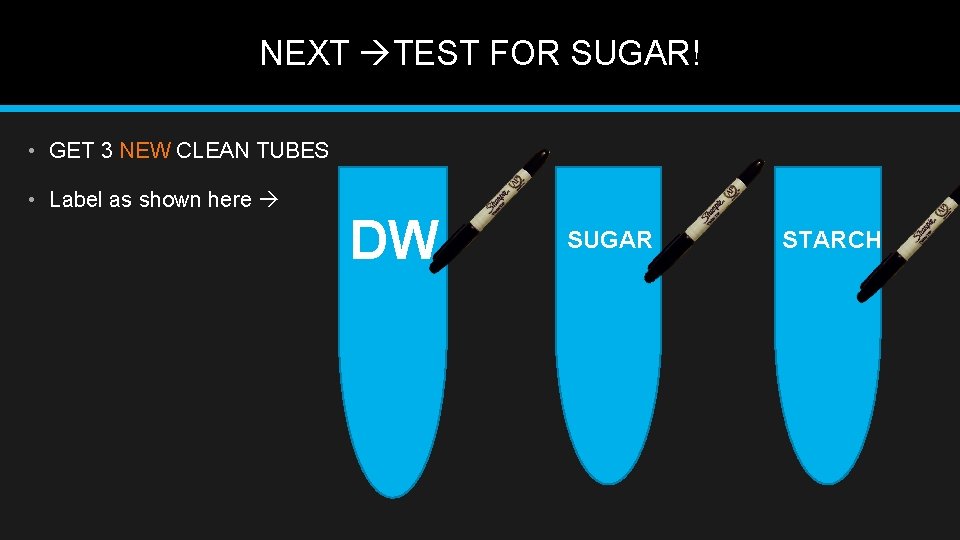
NEXT TEST FOR SUGAR! • GET 3 NEW CLEAN TUBES • Label as shown here DW SUGAR STARCH
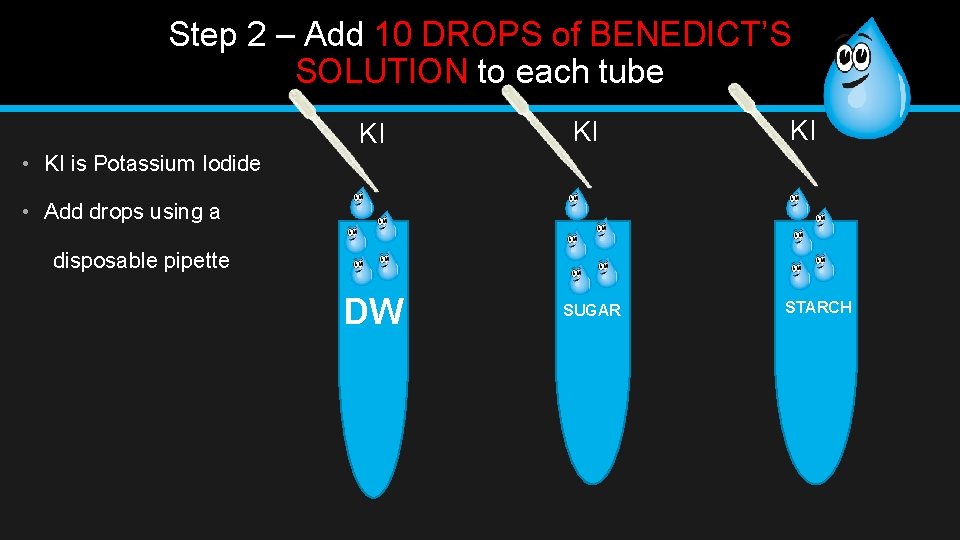
Step 2 – Add 10 DROPS of BENEDICT’S SOLUTION to each tube KI KI KI • KI is Potassium Iodide • Add drops using a disposable pipette DW SUGAR STARCH
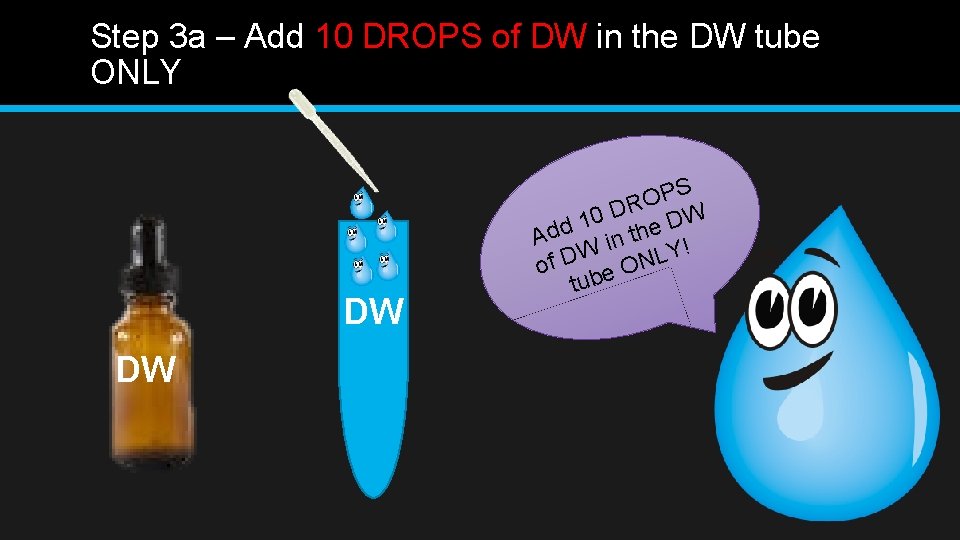
Step 3 a – Add 10 DROPS of DW in the DW tube ONLY DW DW S P O R D W 0 1 D Add in the ! Y W of D e ONL tub
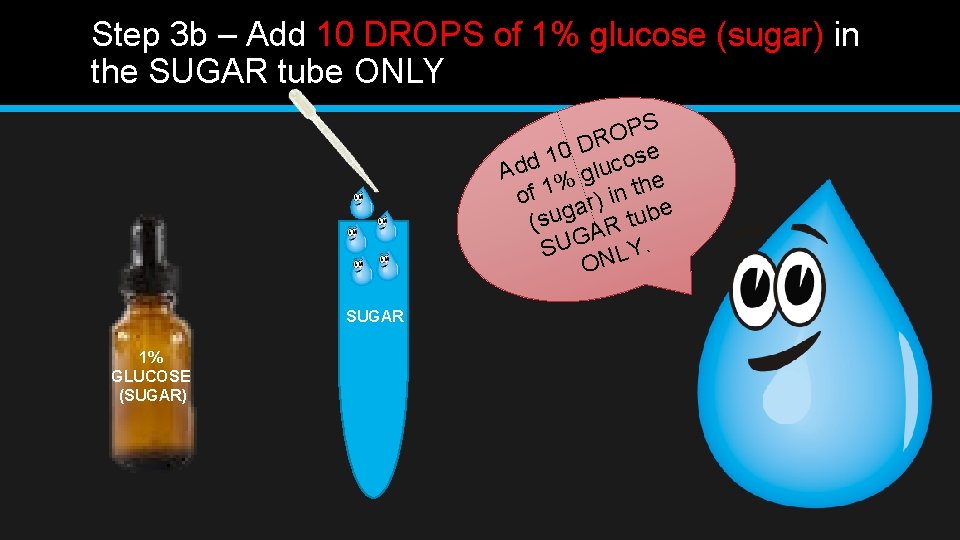
Step 3 b – Add 10 DROPS of 1% glucose (sugar) in the SUGAR tube ONLY S P O R D 0 e 1 s o d Ad % gluc e of 1 ar) in th e (sug AR tub SUG NLY. O SUGAR 1% GLUCOSE (SUGAR)
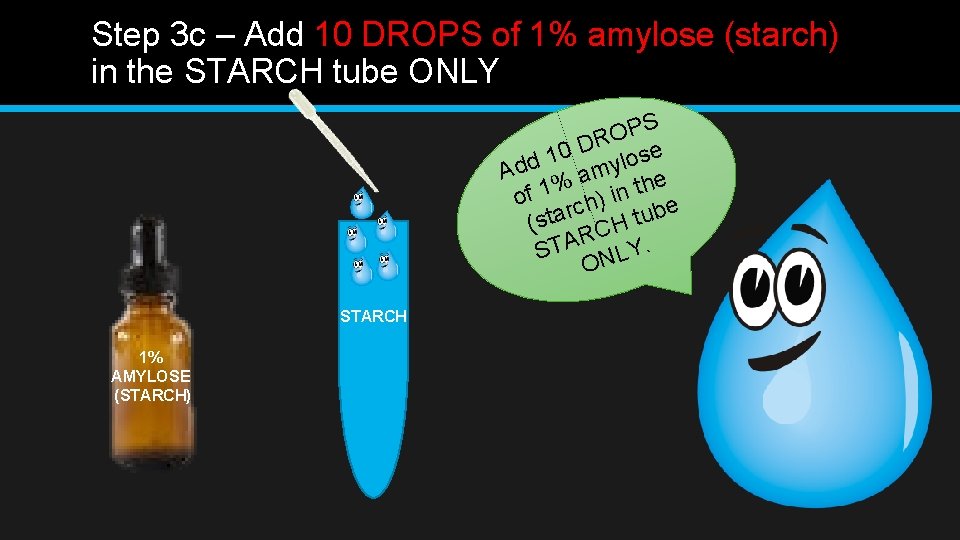
Step 3 c – Add 10 DROPS of 1% amylose (starch) in the STARCH tube ONLY S P O R D e 0 s 1 o Add amyl e h % of 1 ch) in t e r b (sta CH tu R STA NLY. O STARCH 1% AMYLOSE (STARCH)
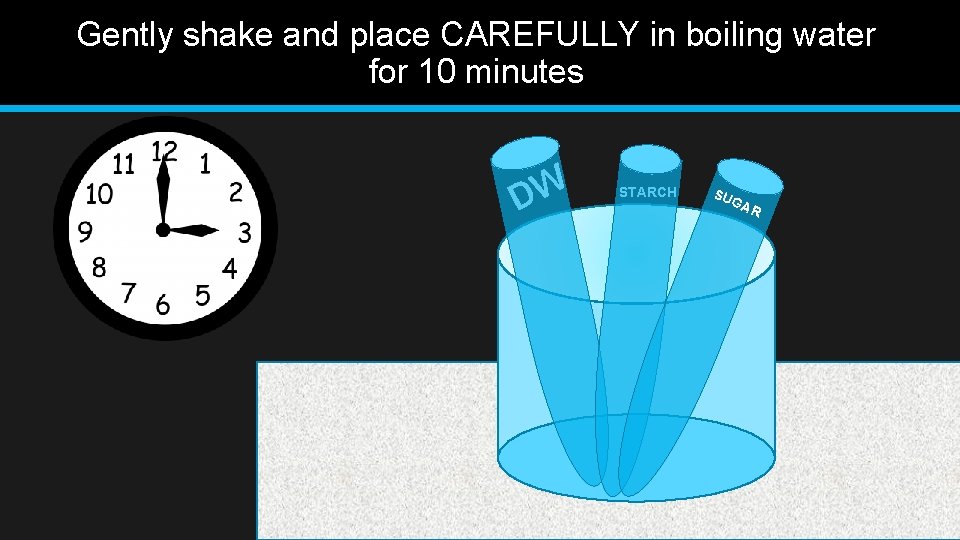
Gently shake and place CAREFULLY in boiling water for 10 minutes DW STARCH SUGAR SU GA R

If the solution changes from bluish (the color of the Benedict’s Solution) to GREEN, RED, YELLOW or ORANGE, that sample has SUGAR! Benedict's test will detect the presence of aldehydes, and alpha-hydroxy-ketones. Thus, although the ketose fructose is not strictly a reducing sugar, it is an alpha-hydroxy-ketone, and gives a positive test because it is converted to the aldoses glucose and mannose by the base in the reagent. DW STARCH SUGAR SU GA R
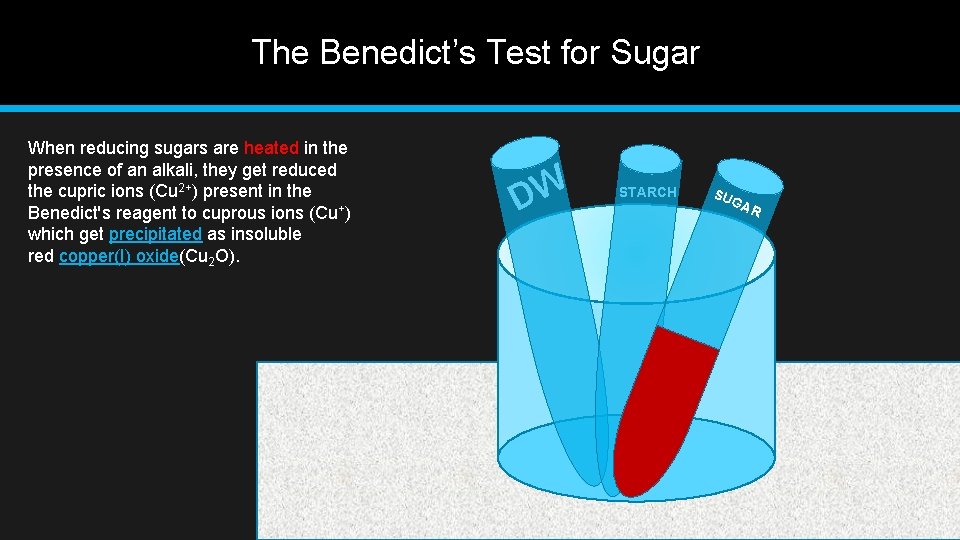
The Benedict’s Test for Sugar When reducing sugars are heated in the presence of an alkali, they get reduced the cupric ions (Cu 2+) present in the Benedict's reagent to cuprous ions (Cu+) which get precipitated as insoluble red copper(I) oxide(Cu 2 O). DW STARCH SUGAR SU GA R
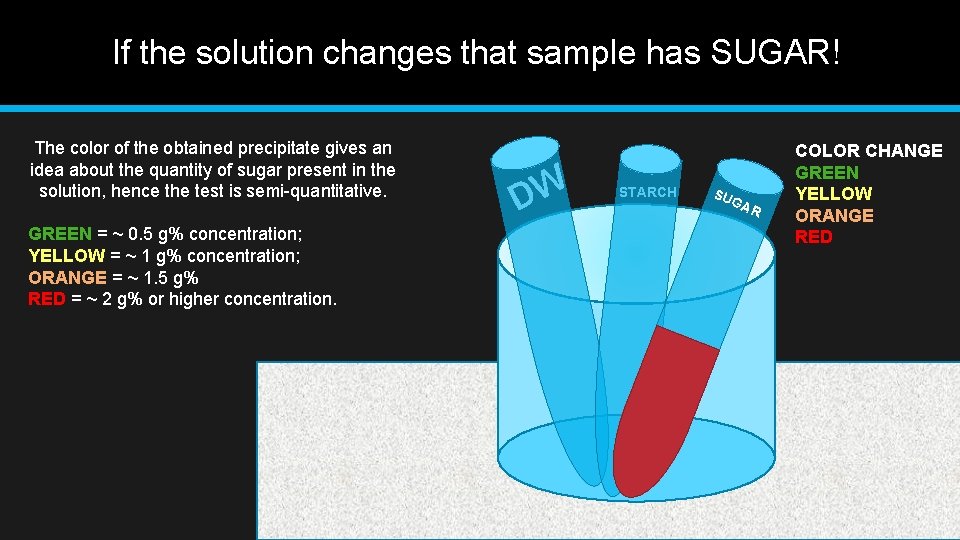
If the solution changes that sample has SUGAR! The color of the obtained precipitate gives an idea about the quantity of sugar present in the solution, hence the test is semi-quantitative. GREEN = ~ 0. 5 g% concentration; YELLOW = ~ 1 g% concentration; ORANGE = ~ 1. 5 g% RED = ~ 2 g% or higher concentration. DW STARCH SUGAR SU GA R COLOR CHANGE GREEN YELLOW ORANGE RED
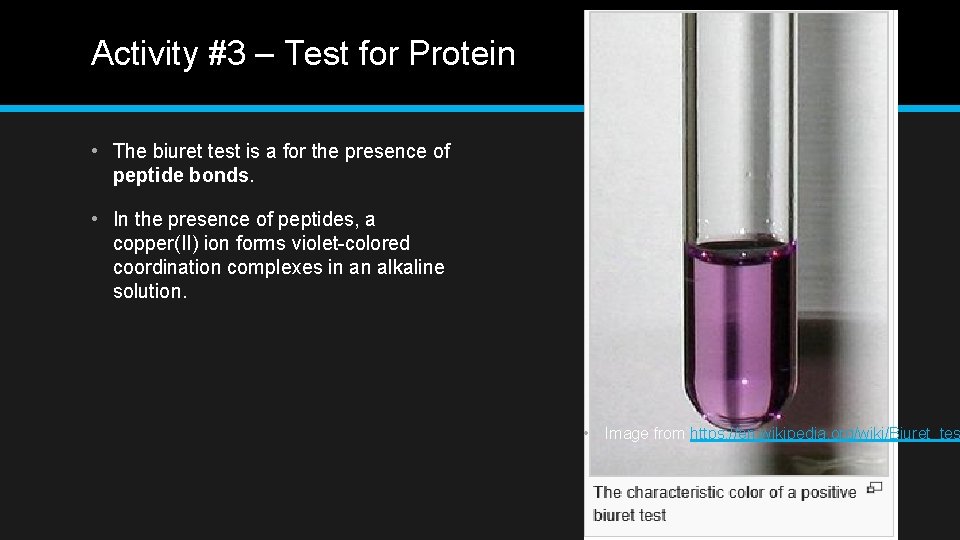
Activity #3 – Test for Protein • The biuret test is a for the presence of peptide bonds. • In the presence of peptides, a copper(II) ion forms violet-colored coordination complexes in an alkaline solution. • Image from https: //en. wikipedia. org/wiki/Biuret_tes
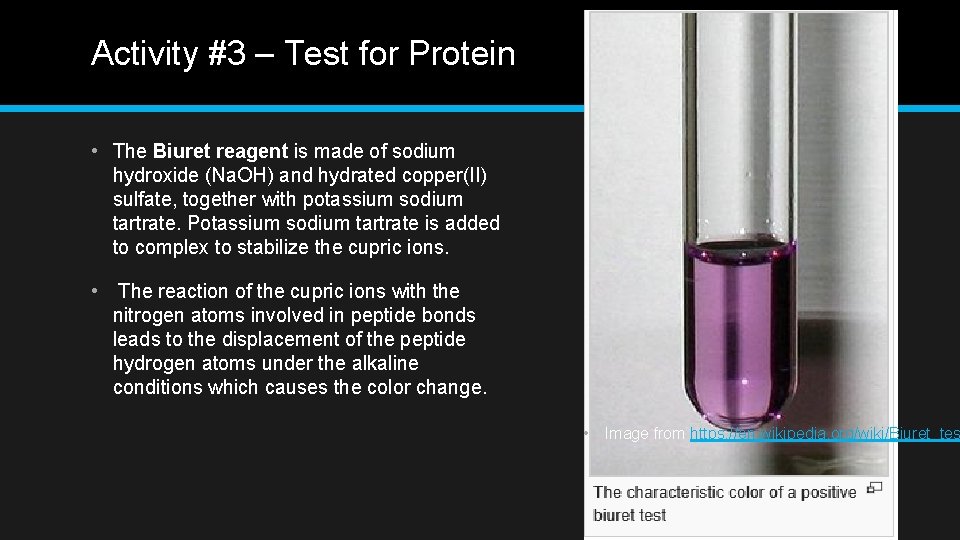
Activity #3 – Test for Protein • The Biuret reagent is made of sodium hydroxide (Na. OH) and hydrated copper(II) sulfate, together with potassium sodium tartrate. Potassium sodium tartrate is added to complex to stabilize the cupric ions. • The reaction of the cupric ions with the nitrogen atoms involved in peptide bonds leads to the displacement of the peptide hydrogen atoms under the alkaline conditions which causes the color change. • Image from https: //en. wikipedia. org/wiki/Biuret_tes
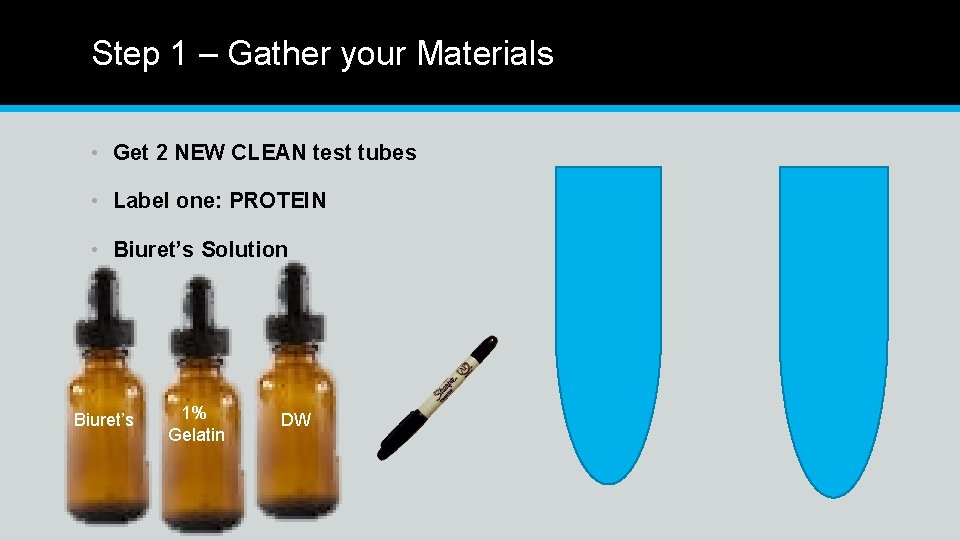
Step 1 – Gather your Materials • Get 2 NEW CLEAN test tubes • Label one: PROTEIN • Biuret’s Solution Biuret’s 1% Gelatin DW
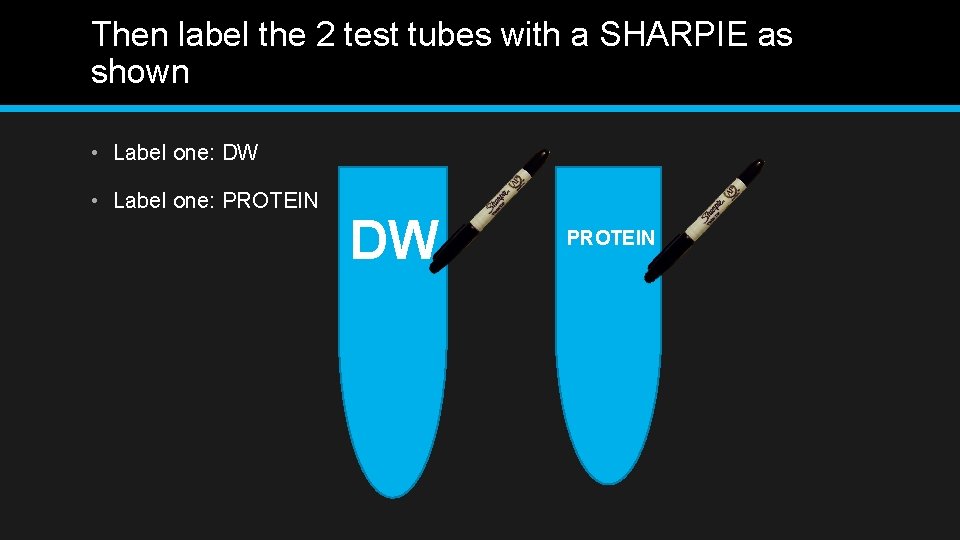
Then label the 2 test tubes with a SHARPIE as shown • Label one: DW • Label one: PROTEIN DW PROTEIN
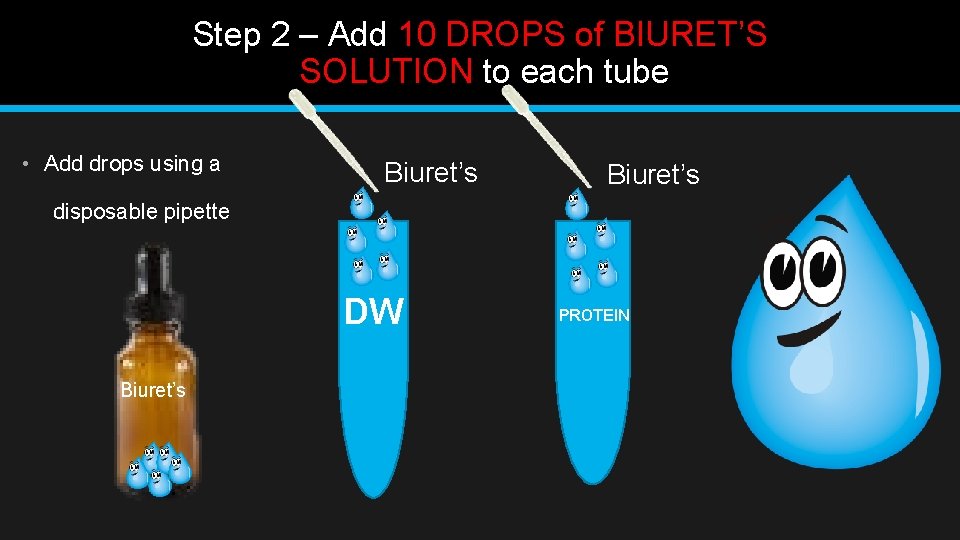
Step 2 – Add 10 DROPS of BIURET’S SOLUTION to each tube • Add drops using a Biuret’s disposable pipette DW Biuret’s PROTEIN
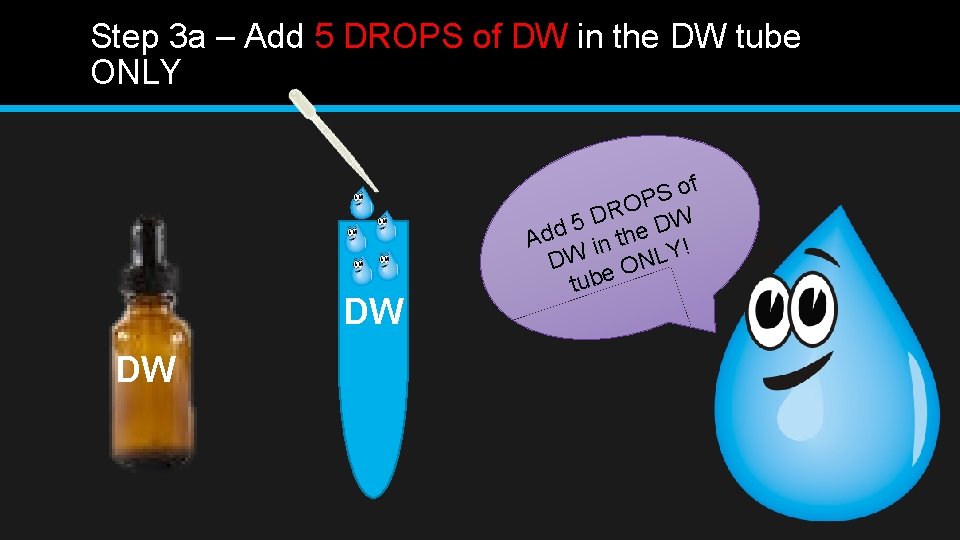
Step 3 a – Add 5 DROPS of DW in the DW tube ONLY DW DW of S P O R D W 5 D Add in the ! DW ONLY tube
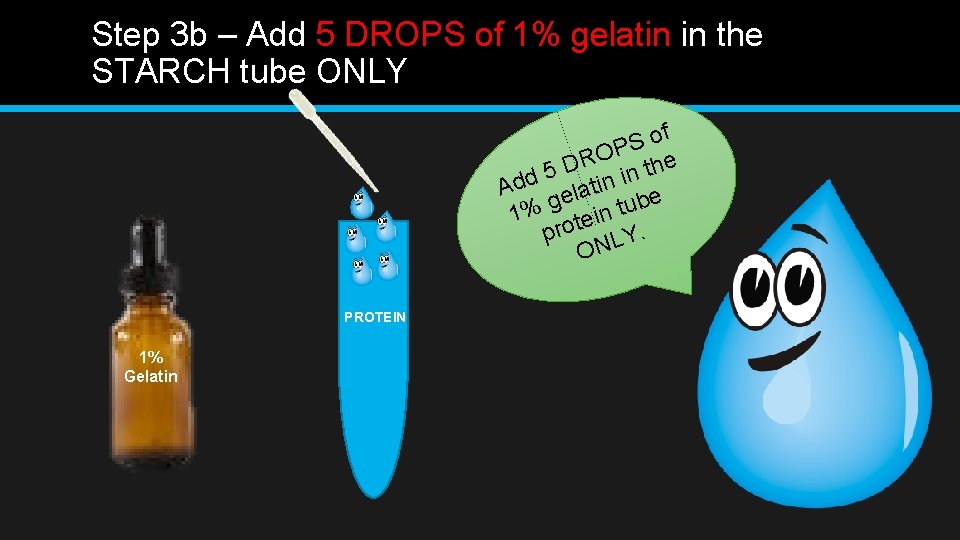
Step 3 b – Add 5 DROPS of 1% gelatin in the STARCH tube ONLY of S P O R e D h t 5 n i d d n i t A ela tube g 1% tein . pro Y L ON PROTEIN 1% Gelatin
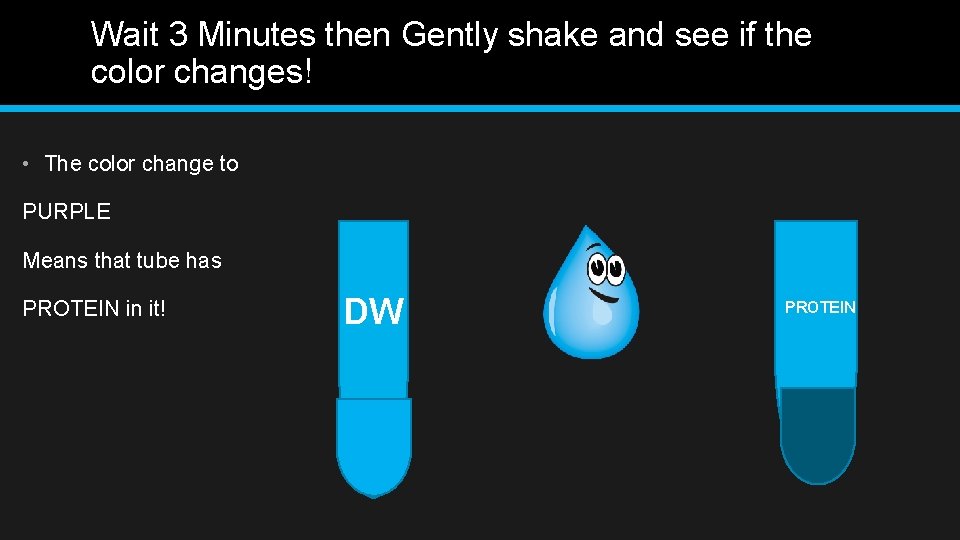
Wait 3 Minutes then Gently shake and see if the color changes! • The color change to PURPLE Means that tube has PROTEIN in it! DW PROTEIN
- Slides: 30