
The Chemical Basis of Life Key Words and
The Chemical Basis of Life
Key Words and Concepts • • • Element Atom Compounds Molecule Ions Acid and base Polar molecule p. H Diffusion and osmosis
Review: Basic Chemistry • Matter • anything that has a mass and takes up a space. • Matter is composed of one or more elements • • Element • is a substance that can not be broken down into simpler substances. Example: oxygen (O), hydrogen (H), carbon (C). • • Each element has a set of properties that distinguish it from other elements. Example: copper is a bronze colored solid that conducts heat; oxygen is odorless/colorless at room temperature.
Review: Basic Chemistry • Atom – is the smallest particle of an element that retains the characteristics of that element. • Example: all atoms of copper have the properties of copper • – The center of each atom contains a nucleus composed of 2 different particles- protons (+ charge) and neutron (with no charge). Moving in regions outside the nucleus is a particle- electron (- charge)
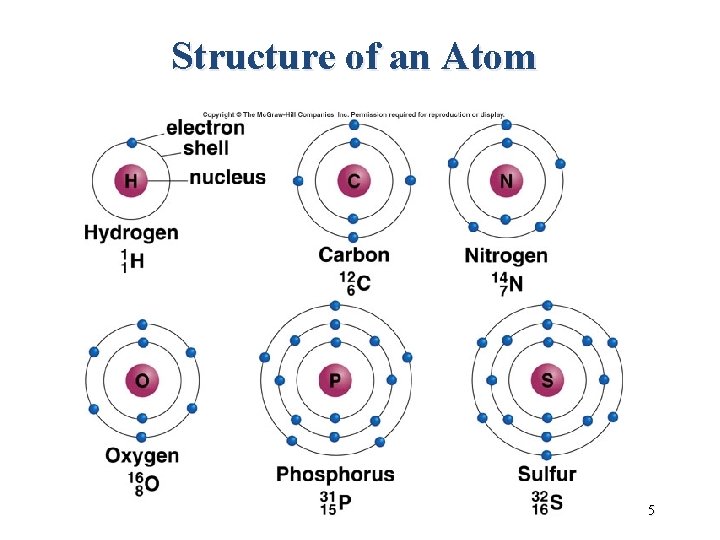
Structure of an Atom 5
Review: Basic Chemistry • Atom – Every atom in an element has an equal number of protons and electrons, and is electrically balanced, or neutral. – Every atom has energy, or the ability to do work. – – This energy (called chemical energy), comes from electrons in the atom. Electrons are in motion and occupy certain regions in space depending on their energy. Electron closest to the nucleus have less energy than those farthest from the nucleus
Review: Basic Chemistry • Compounds – Substance made from elements are called compounds. A chemical formula shows the kinds of and proportions of of atoms in a compound (H 2 O). – • Molecules – Are the smallest units of a compound that still have the properties of that compound. (in H 2 O, the ratio of H and O is 2: 1, so the formula is H 2 O) – Molecules are generally NEUTRAL. – • Ions – Electrically charged (+ 0 r -) molecules (atoms or groups of atoms) are called IONS.
Review: Basic Chemistry • Ions and Ionic bonding • In some kind of compounds, atoms may lose or gain electrons (no longer is electrically neutral). Example: Chlorine Atom 17 p+ 17 e 0 charge Symbol: Cl- Sodium Ion 17 p+ 18 e-1 charge Atom 11 p+ 11 e 0 charge Symbol: Na+ Ion 11 p+ 10 e+1 charge The negative chloride ion and the positive sodium ion are attracted to each other. This attraction between oppositely charged ions is called an IONIC BOND.
Review: Basic Chemistry • Polar Molecules – Molecules with uneven distribution of electrical charges. That is, positive and negative charges within the molecule tend to congregate separately from one another. – – A POLAR MOLECULE is any molecule with unbalanced charge distribution. – – This unbalanced charge distribution makes water a polar molecule. –
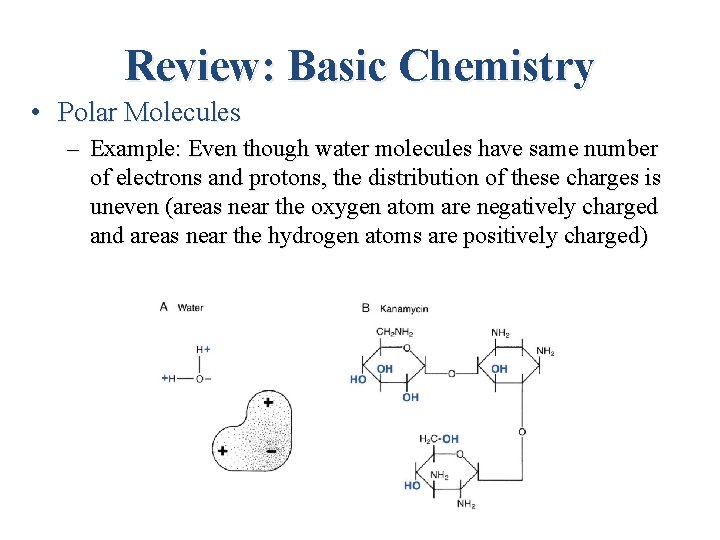
Review: Basic Chemistry • Polar Molecules – Example: Even though water molecules have same number of electrons and protons, the distribution of these charges is uneven (areas near the oxygen atom are negatively charged and areas near the hydrogen atoms are positively charged)
Review: Basic Chemistry • Acids and Bases • Two common groups of compounds that react in water are ACIDS and BASES. • Acid is any substance that releases hydrogen ions (proton) when mixed with water (PROTON DONOR) • Example: CH 3 COOH --–H 20– H+ + CH 3 COO– • • Base is a substance that separates in water, forming ions that react with hydrogen ions (PROTON ACCEPTOR) • Example: Na. OH + CH 3 COOH --– H 20 + CH 3 COONa
Review: Basic Chemistry • p. H • The strength of an acid or base is measured by the p. H scale (0 -14, 7 being neutral: water) • p. H of acid solution: 0 -7; of basic solution 7 -14 • The p. H scale is based on powers of 10. Thus Cola with a p. H of 3 is 10 times more acidic than Tomato juice with a p. H of 4. • Living cells are very sensitive to p. H of their environment. Our cells are bathed in a fluid that has a p. H of 7. 2 (if the p. H changes by only 2/10 th of a point in either direction, cells may die).
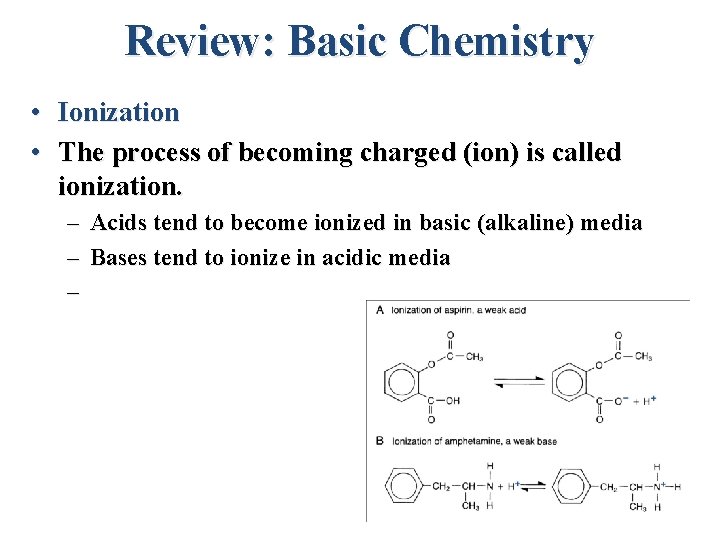
Review: Basic Chemistry • Ionization • The process of becoming charged (ion) is called ionization. – Acids tend to become ionized in basic (alkaline) media – Bases tend to ionize in acidic media –
Review: Basic Chemistry • p. H Dependant Ionization • – Example: Aspirin is an acidic molecule- in the stomach (acid environment) it remains nonionized and can pass into the blood; once it moves to the intestine where it is basic, the aspirin becomes ionized and cannot cross the membranes into the blood
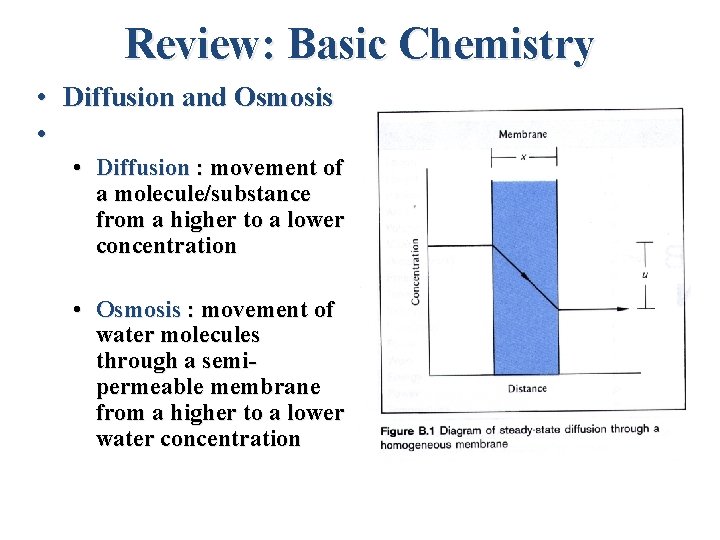
Review: Basic Chemistry • Diffusion and Osmosis • • Diffusion : movement of a molecule/substance from a higher to a lower concentration • Osmosis : movement of water molecules through a semipermeable membrane from a higher to a lower water concentration
- Slides: 15