
The Character of Cassio in Othello by William
The Character of Cassio in ‘Othello’ by William Shakespeare
Key Adjectives: • Chivalrous • Noble • Loyal • Sincere • Malleable • Pliable
• Cassio is renowned for his refined, gentlemanly behaviour, being particularly courteous towards women. Chivalrous • He greets Emelia with a kiss when she arrives in Cyprus and kisses Desdemona’s hand as a sign of his respect for her. He also generally treats his mistress politely and with respect: “How is it with you, m most fair Bianca? In faith, sweet love, I was coming to your house. ” • While Cassio’s gallantry may sometimes seem to be exaggerated, he is essentially an open, sincere character.
• Cassio’s nobility is very evident in his attitude towards and treatment of Desdemona. A Noble Character • Cassio has a reverential attitude towards Othello’s wife, describing her as “the divine Desdemona. ”. His high regard for her is clear from the moment she arrives in Cyprus, “Ye men of Cyprus, let her have your knees. Hail to thee lady!”
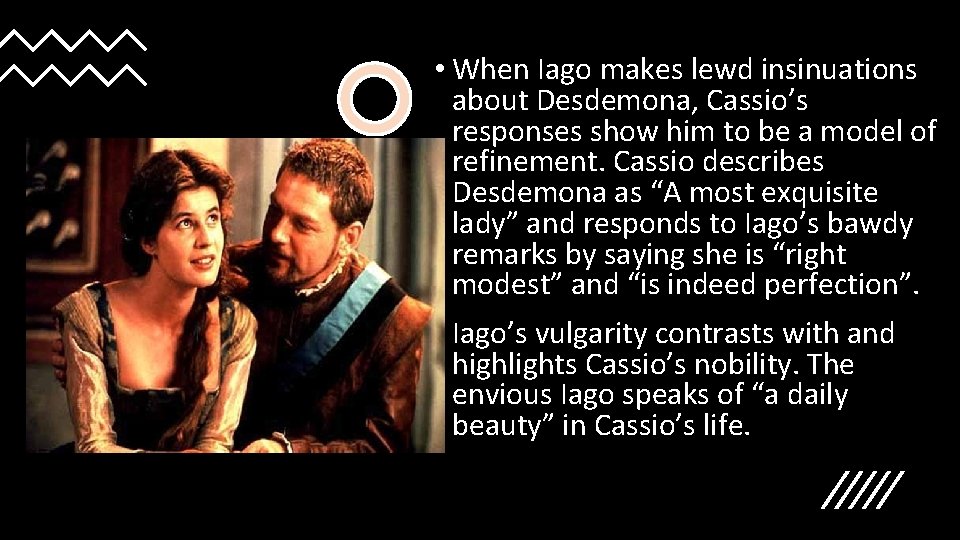
• When Iago makes lewd insinuations about Desdemona, Cassio’s responses show him to be a model of refinement. Cassio describes Desdemona as “A most exquisite lady” and responds to Iago’s bawdy remarks by saying she is “right modest” and “is indeed perfection”. • Iago’s vulgarity contrasts with and highlights Cassio’s nobility. The envious Iago speaks of “a daily beauty” in Cassio’s life.
• Cassio expresses genuine concern for Othello’s safety when he is still at sea in the violent storm, “let the heavens give him defence against the elements. ” Respectful and Loyal • He looks forward to Othello’s arrival rejuvenating their “extincted spirits” and bringing “all Cyprus comfort. ” • After the drunken brawl Cassio is filled with guilt at having betrayed Othello’s trust in him. Cassio’s love for and loyalty to Othello is severely tested as Iago’s poison destroys the Moor’s faith in his lieutenant and drives him to order his death.
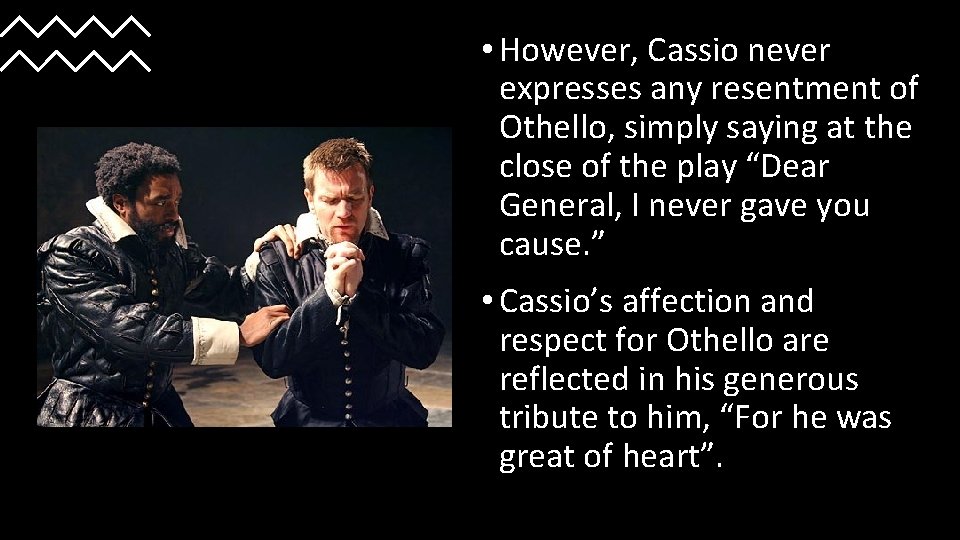
• However, Cassio never expresses any resentment of Othello, simply saying at the close of the play “Dear General, I never gave you cause. ” • Cassio’s affection and respect for Othello are reflected in his generous tribute to him, “For he was great of heart”.
• Cassio’s chief importance in the play lies in his unwitting facilitation of Iago’s malicious scheming. Cassio Has Human Weakness Which Contributes to Iago’s Success. • His reputation as a ladies’ man makes him credible as Desdemona’s supposed lover. Also, while Cassio is a pleasant companion, his desire to please others is a weakness that Iago ruthlessly exploits. • Cassio goes against his own better judgement when he allows Iago to persuade him to drink more than he should. He knows that he has “poor and unhappy brains for drinking”, but is still inveigled into having some more wine, “I’ll do it, but it dislikes me”.
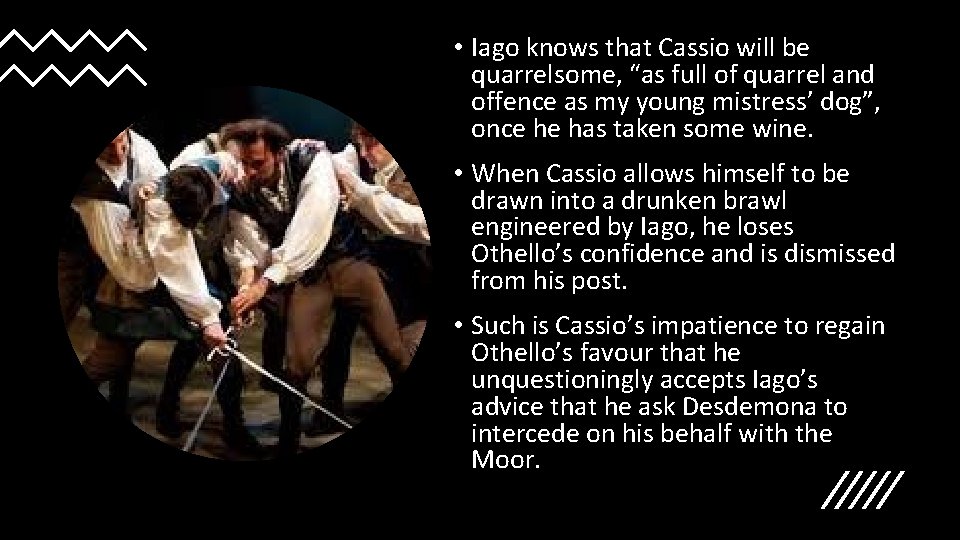
• Iago knows that Cassio will be quarrelsome, “as full of quarrel and offence as my young mistress’ dog”, once he has taken some wine. • When Cassio allows himself to be drawn into a drunken brawl engineered by Iago, he loses Othello’s confidence and is dismissed from his post. • Such is Cassio’s impatience to regain Othello’s favour that he unquestioningly accepts Iago’s advice that he ask Desdemona to intercede on his behalf with the Moor.
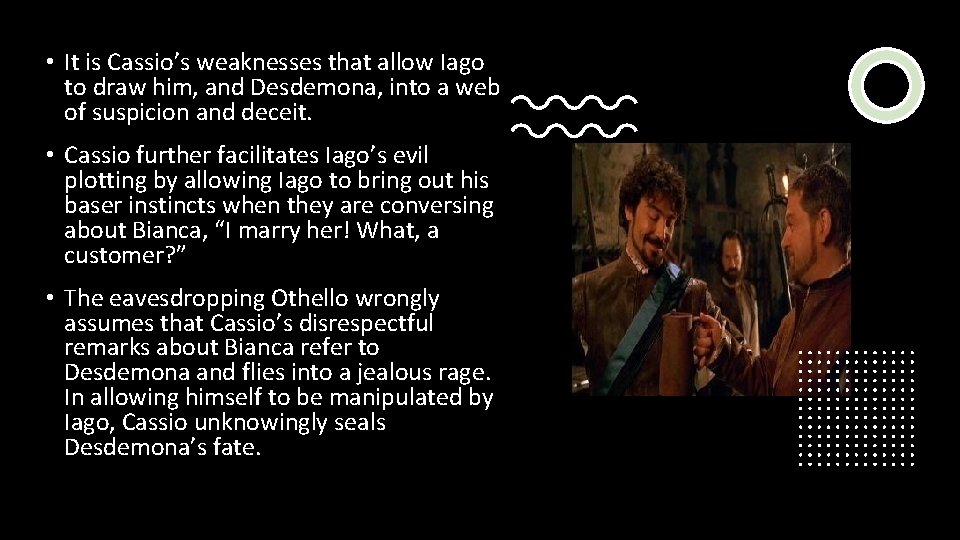
• It is Cassio’s weaknesses that allow Iago to draw him, and Desdemona, into a web of suspicion and deceit. • Cassio further facilitates Iago’s evil plotting by allowing Iago to bring out his baser instincts when they are conversing about Bianca, “I marry her! What, a customer? ” • The eavesdropping Othello wrongly assumes that Cassio’s disrespectful remarks about Bianca refer to Desdemona and flies into a jealous rage. In allowing himself to be manipulated by Iago, Cassio unknowingly seals Desdemona’s fate.
Our Final Impression of Cassio Is Positive • At the close of the play the Venetian senate recognises Cassio’s ability and nobility when they appoint him as the Governor of Cyprus (ironically replacing Othello).
- Slides: 11