
The Changing Culture of Embryo Culture Advances in
The Changing Culture of Embryo Culture: Advances in Embryo Culture Platforms Jason E. Swain, Ph. D, HCLD University of Michigan
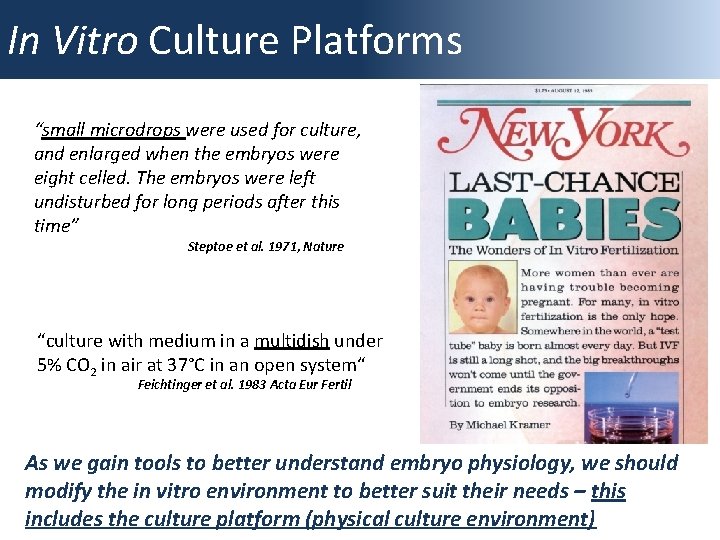
In Vitro Culture Platforms “small microdrops were used for culture, and enlarged when the embryos were eight celled. The embryos were left undisturbed for long periods after this time” Steptoe et al. 1971, Nature “culture with medium in a multidish under 5% CO 2 in air at 37°C in an open system“ Feichtinger et al. 1983 Acta Eur Fertil As we gain tools to better understand embryo physiology, we should modify the in vitro environment to better suit their needs – this includes the culture platform (physical culture environment)
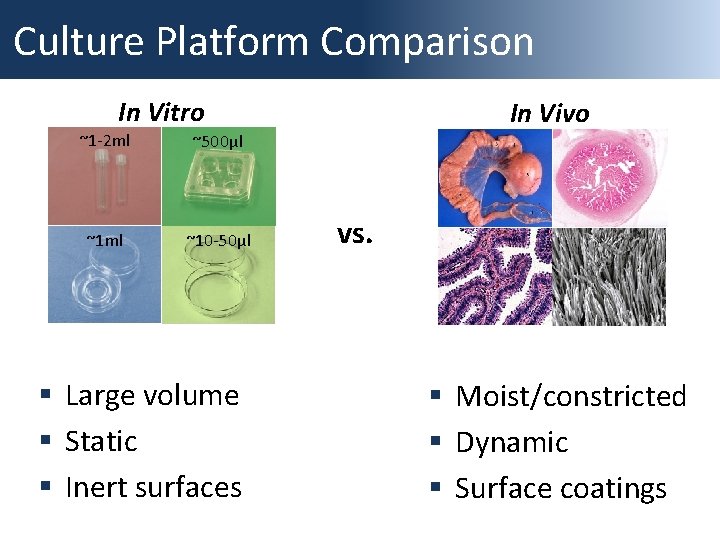
Culture Platform Comparison In Vitro ~1 -2 ml ~500µl ~1 ml ~10 -50µl § Large volume § Static § Inert surfaces In Vivo vs. § Moist/constricted § Dynamic § Surface coatings
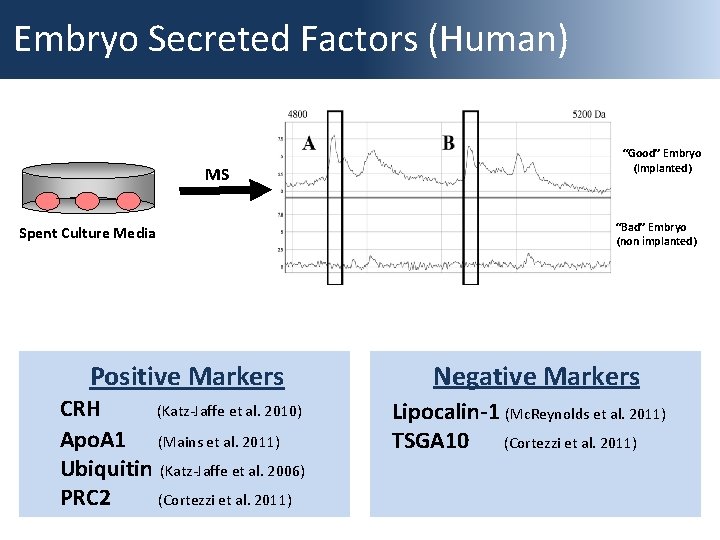
Embryo Secreted Factors (Human) MS Spent Culture Media Positive Markers CRH (Katz-Jaffe et al. 2010) Apo. A 1 (Mains et al. 2011) Ubiquitin (Katz-Jaffe et al. 2006) PRC 2 (Cortezzi et al. 2011) “Good” Embryo (Implanted) “Bad” Embryo (non implanted) Negative Markers Lipocalin-1 (Mc. Reynolds et al. 2011) TSGA 10 (Cortezzi et al. 2011)
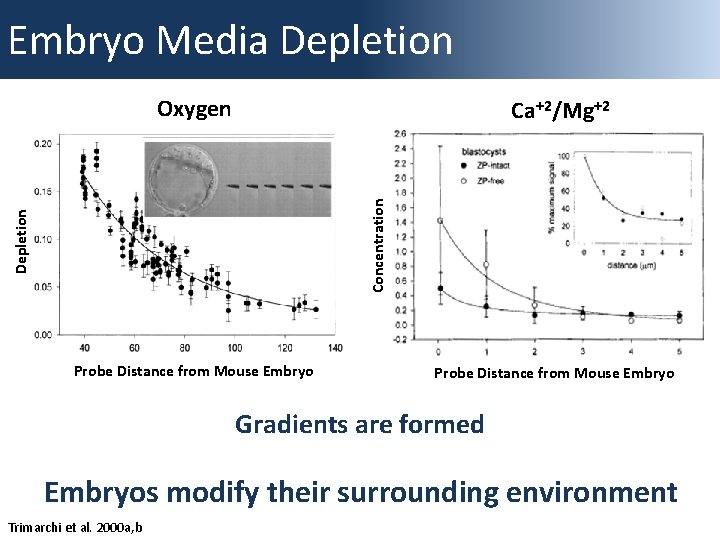
Embryo Media Depletion Oxygen Depletion Concentration Calcium Concentration Ca+2/Mg+2 Probe Distance from Mouse Embryo Gradients are formed Embryos modify their surrounding environment Trimarchi et al. 2000 a, b
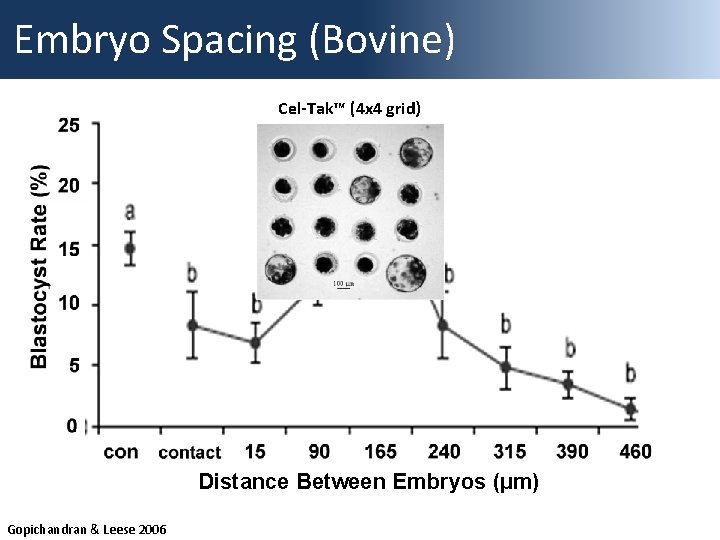
Embryo Spacing (Bovine) Cel-Tak™ (4 x 4 grid) Distance Between Embryos (µm) Gopichandran & Leese 2006
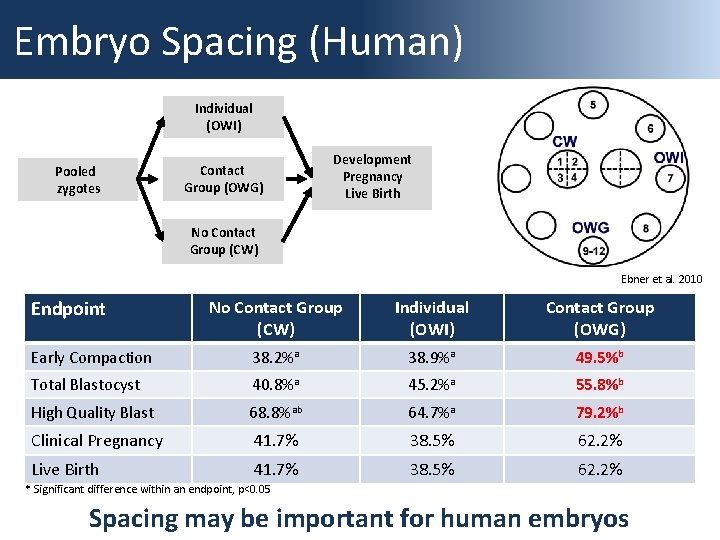
Embryo Spacing (Human) Individual (OWI) Pooled zygotes Contact Group (OWG) Development Pregnancy Live Birth No Contact Group (CW) Ebner et al. 2010 Endpoint No Contact Group (CW) Individual (OWI) Contact Group (OWG) Early Compaction 38. 2%a 38. 9%a 49. 5%b Total Blastocyst 40. 8%a 45. 2%a 55. 8%b High Quality Blast 68. 8%ab 64. 7%a 79. 2%b Clinical Pregnancy 41. 7% 38. 5% 62. 2% Live Birth 41. 7% 38. 5% 62. 2% * Significant difference within an endpoint, p<0. 05 Spacing may be important for human embryos
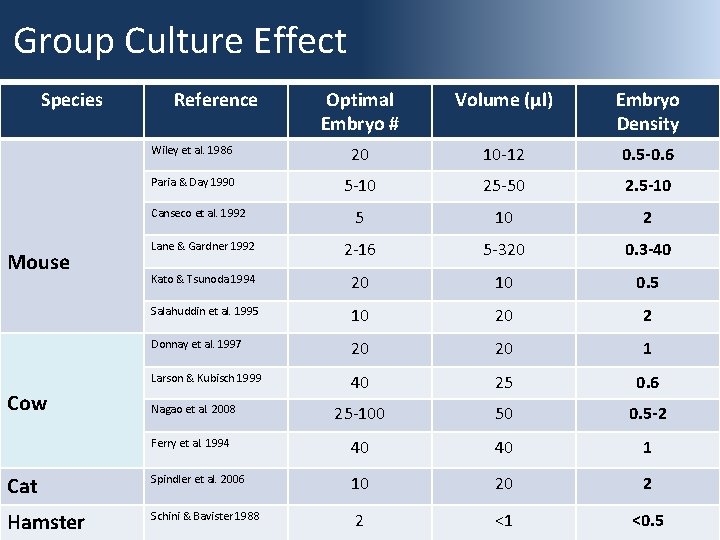
Group Culture Effect Species Reference Optimal Embryo # Volume (µl) Embryo Density Wiley et al. 1986 20 10 -12 0. 5 -0. 6 Paria & Day 1990 5 -10 25 -50 2. 5 -10 5 10 2 Lane & Gardner 1992 2 -16 5 -320 0. 3 -40 Kato & Tsunoda 1994 20 10 0. 5 Salahuddin et al. 1995 10 20 2 Donnay et al. 1997 20 20 1 Larson & Kubisch 1999 40 25 0. 6 Nagao et al. 2008 25 -100 50 0. 5 -2 Ferry et al. 1994 40 40 1 Cat Spindler et al. 2006 10 20 2 Hamster Schini & Bavister 1988 2 <1 <0. 5 Canseco et al. 1992 Mouse Cow
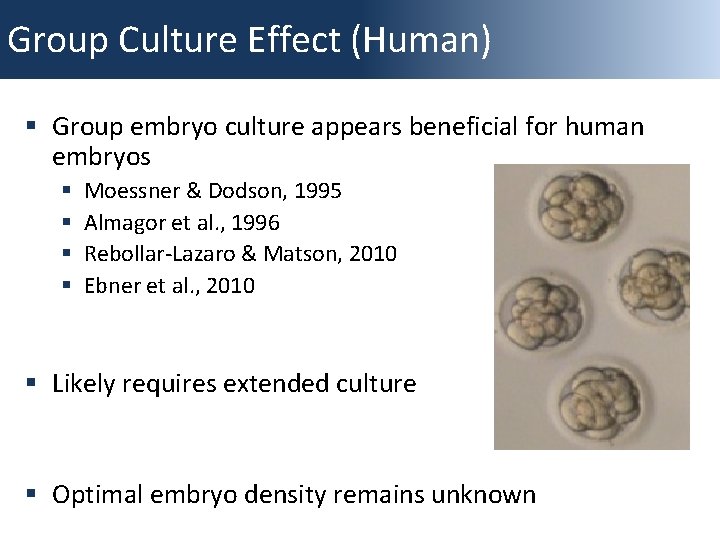
Group Culture Effect (Human) § Group embryo culture appears beneficial for human embryos § § Moessner & Dodson, 1995 Almagor et al. , 1996 Rebollar-Lazaro & Matson, 2010 Ebner et al. , 2010 § Likely requires extended culture § Optimal embryo density remains unknown
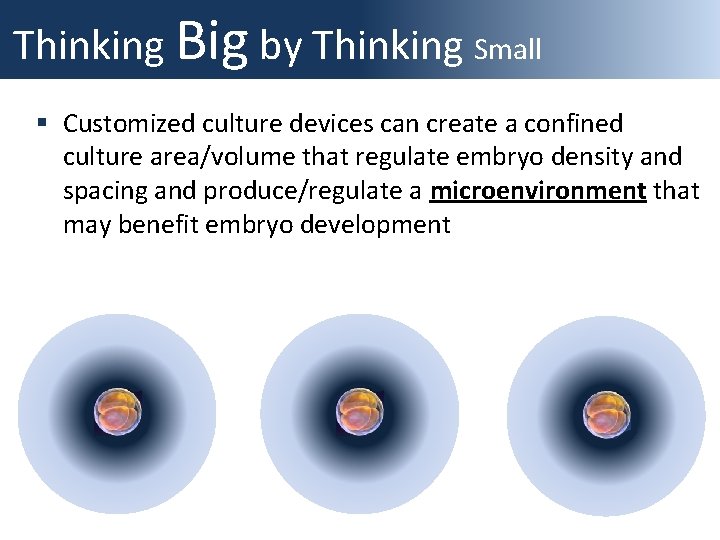
Thinking Big by Thinking Small § Customized culture devices can create a confined culture area/volume that regulate embryo density and spacing and produce/regulate a microenvironment that may benefit embryo development
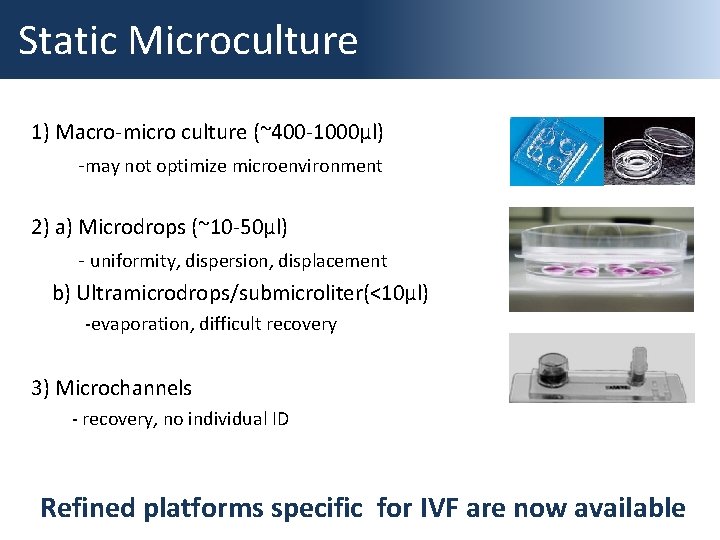
Static Microculture 1) Macro-micro culture (~400 -1000µl) -may not optimize microenvironment 2) a) Microdrops (~10 -50µl) - uniformity, dispersion, displacement b) Ultramicrodrops/submicroliter(<10µl) -evaporation, difficult recovery 3) Microchannels - recovery, no individual ID Refined platforms specific for IVF are now available
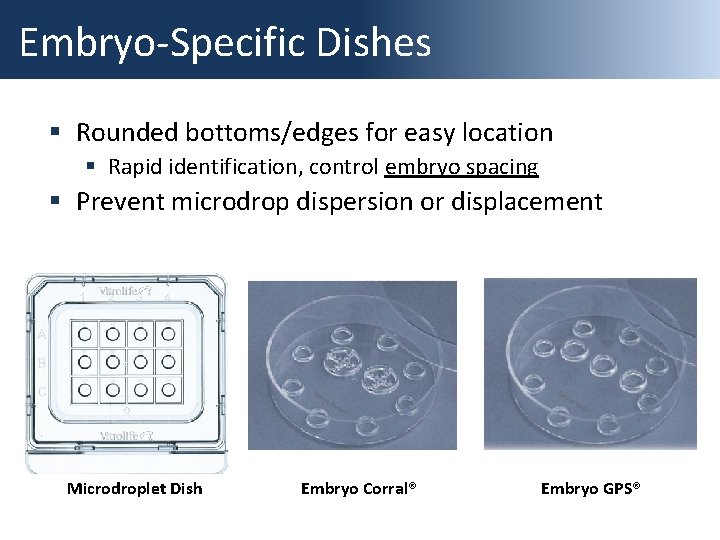
Embryo-Specific Dishes § Rounded bottoms/edges for easy location § Rapid identification, control embryo spacing § Prevent microdrop dispersion or displacement Microdroplet Dish Embryo Corral® Embryo GPS®
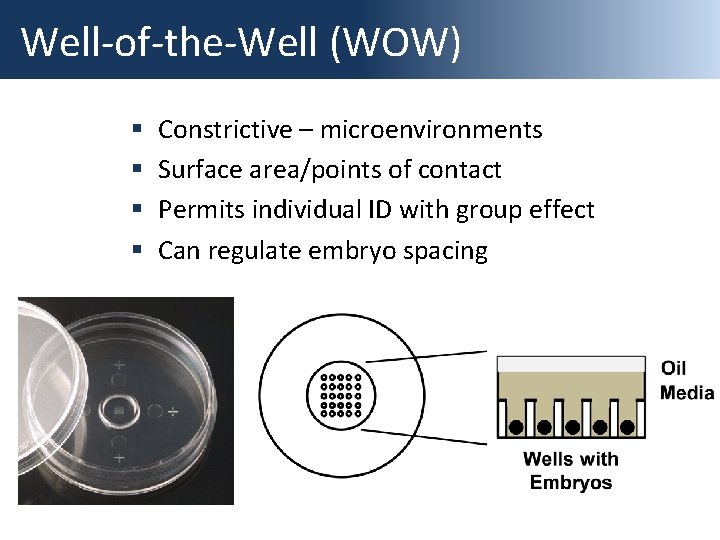
Well-of-the-Well (WOW) § § Constrictive – microenvironments Surface area/points of contact Permits individual ID with group effect Can regulate embryo spacing
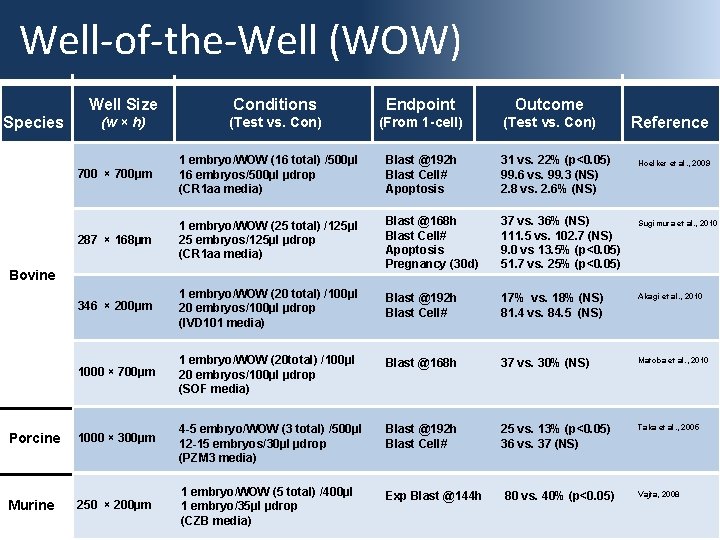
Well-of-the-Well (WOW) Species Well Size Conditions Endpoint Outcome (w × h) (Test vs. Con) (From 1 -cell) (Test vs. Con) 700 × 700µm 1 embryo/WOW (16 total) /500µl 16 embryos/500µl µdrop (CR 1 aa media) Blast @192 h Blast Cell# Apoptosis 31 vs. 22% (p<0. 05) 99. 6 vs. 99. 3 (NS) 2. 8 vs. 2. 6% (NS) 287 × 168µm 1 embryo/WOW (25 total) /125µl 25 embryos/125µl µdrop (CR 1 aa media) Blast @168 h Blast Cell# Apoptosis Pregnancy (30 d) 37 vs. 36% (NS) 111. 5 vs. 102. 7 (NS) 9. 0 vs 13. 5% (p<0. 05) 51. 7 vs. 25% (p<0. 05) 346 × 200µm 1 embryo/WOW (20 total) /100µl 20 embryos/100µl µdrop (IVD 101 media) Blast @192 h Blast Cell# 17% vs. 18% (NS) 81. 4 vs. 84. 5 (NS) Akagi et al. , 2010 1000 × 700µm 1 embryo/WOW (20 total) /100µl 20 embryos/100µl µdrop (SOF media) Blast @168 h 37 vs. 30% (NS) Matoba et al. , 2010 4 -5 embryo/WOW (3 total) /500µl 12 -15 embryos/30µl µdrop (PZM 3 media) Blast @192 h Blast Cell# 25 vs. 13% (p<0. 05) 36 vs. 37 (NS) Taka et al. , 2005 1 embryo/WOW (5 total) /400µl 1 embryo/35µl µdrop (CZB media) Exp Blast @144 h Bovine Porcine Murine Reference 1000 × 300µm 250 × 200µm 80 vs. 40% (p<0. 05) Hoelker et al. , 2009 Sugimura et al. , 2010 Vajta, 2008
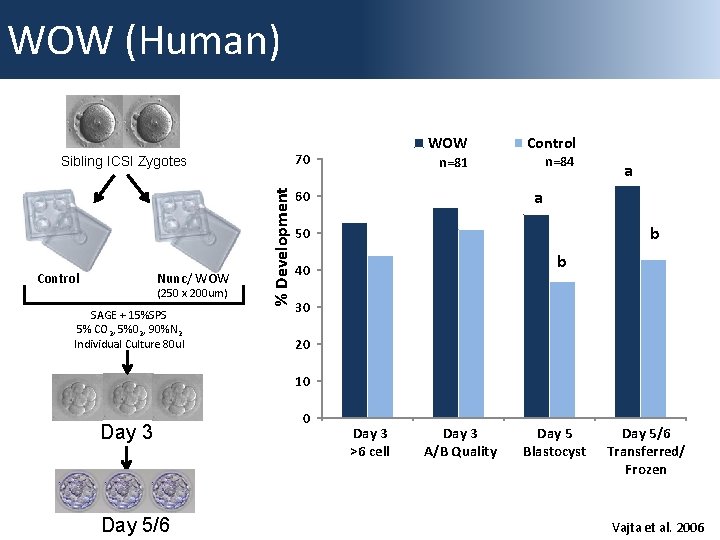
WOW (Human) 70 Control Nunc/ WOW (250 x 200 um) SAGE + 15%SPS 5% CO 2, 5%02, 90%N 2 Individual Culture 80 ul % Development Sibling ICSI Zygotes WOW Control n=81 n=84 a a 60 b 50 b 40 30 20 10 Day 3 Day 5/6 0 Day 3 >6 cell 3 >6 cell Day 3 Day A+B 3 Quality A/B Quality Day 5 Day Blastocyst 5 Blastocyst Day 5/6 Transferred/Frozen Transferred/ Frozen Vajta et al. 2006
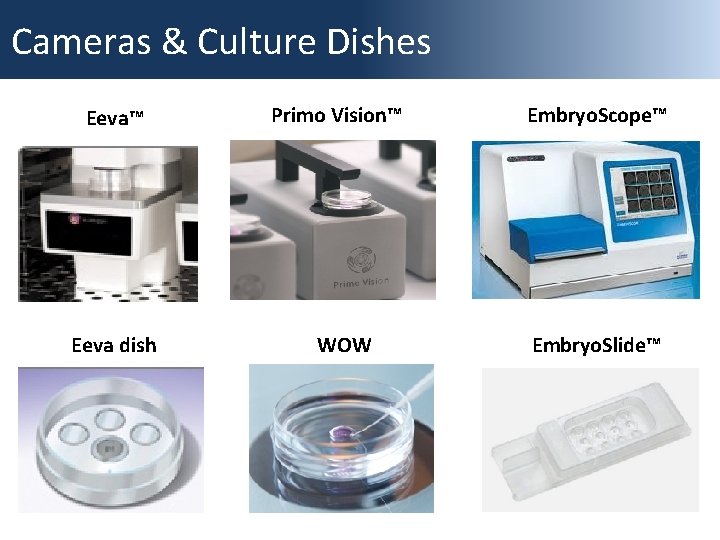
Cameras & Culture Dishes Eeva™ Eeva dish Primo Vision™ WOW Embryo. Scope™ Embryo. Slide™
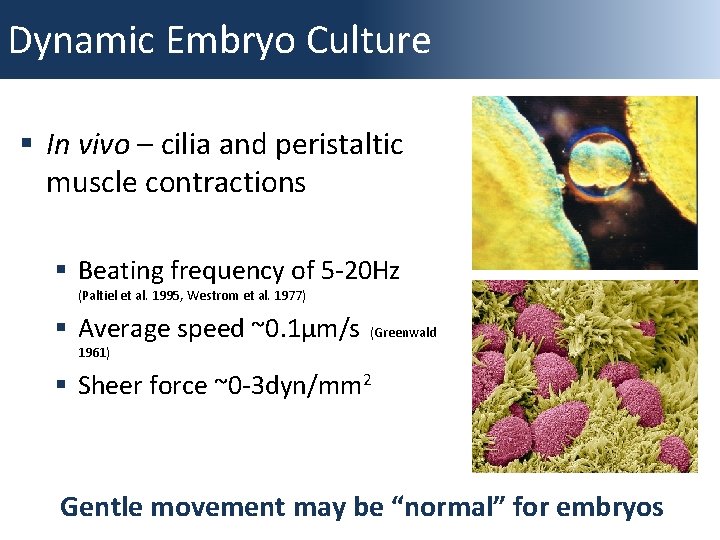
Dynamic Embryo Culture § In vivo – cilia and peristaltic muscle contractions § Beating frequency of 5 -20 Hz (Paltiel et al. 1995, Westrom et al. 1977) § Average speed ~0. 1µm/s (Greenwald 1961) § Sheer force ~0 -3 dyn/mm 2 Gentle movement may be “normal” for embryos
“Rock-a-Bye-Baby” Possible Benefits of Dynamic Culture 1) Disruption of gradients § Substrate renewal? § Removal of harmful byproducts? Not that simple What about benefit of static micro-culture? 2) Mechanical stimulation § Sensory mechanotransduction (Synthichaki & Tavernarakis 2003) § Cell ability to respond to physical stimuli § Influences ion channels, etc § Embryos can “sense” sheer stress (Xie et al. 2006, 2007) § Possible activation of trophic signaling pathways
Active Embryo Hypothesis § Excessive movement and resulting sheer forces can be detrimental to embryo development, activating signaling pathways that lead to apoptosis. Less vigorous or periodic movement or other physical stimuli, such as surface interactions, vibrations or gentle media flow, can be embryo-trophic.
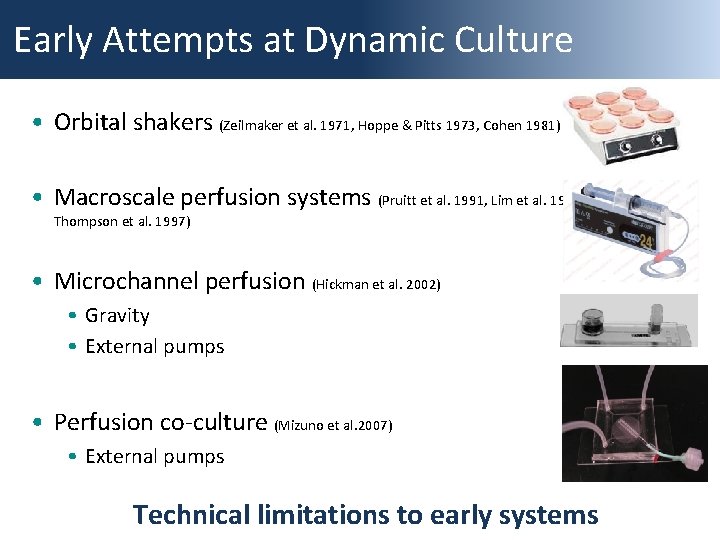
Early Attempts at Dynamic Culture • Orbital shakers (Zeilmaker et al. 1971, Hoppe & Pitts 1973, Cohen 1981) • Macroscale perfusion systems (Pruitt et al. 1991, Lim et al. 1996, Thompson et al. 1997) • Microchannel perfusion (Hickman et al. 2002) • Gravity • External pumps • Perfusion co-culture (Mizuno et al. 2007) • External pumps Technical limitations to early systems
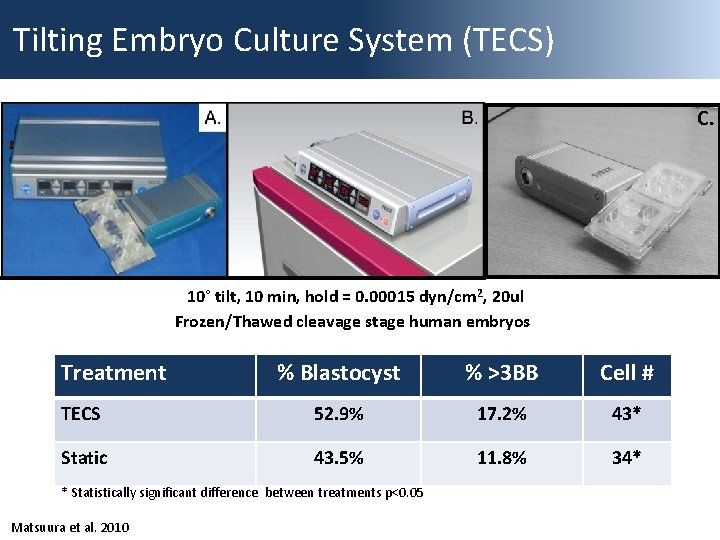
Tilting Embryo Culture System (TECS) C. 10° tilt, 10 min, hold = 0. 00015 dyn/cm 2, 20 ul Frozen/Thawed cleavage stage human embryos Treatment % Blastocyst % >3 BB Cell # TECS 52. 9% 17. 2% 43* Static 43. 5% 11. 8% 34* * Statistically significant difference between treatments p<0. 05 Matsuura et al. 2010
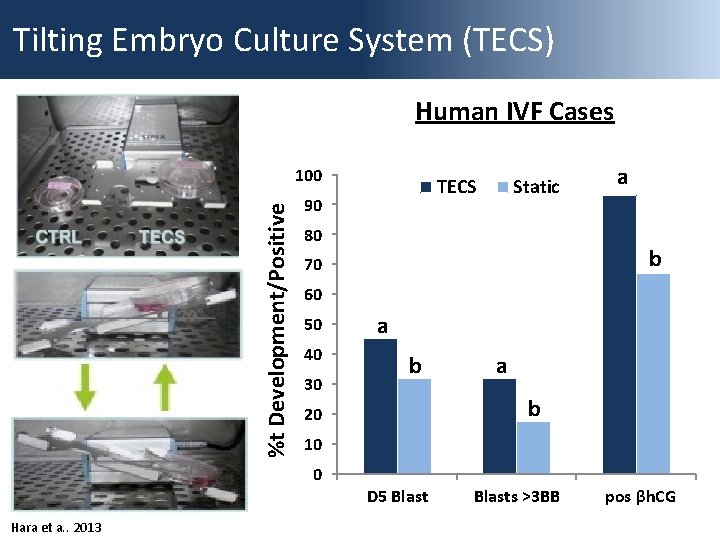
Tilting Embryo Culture System (TECS) Human IVF Cases %t Development/Positive 100 90 Static 80 a b 70 60 50 40 30 a b 20 10 0 Hara et a. . 2013 TECS D 5 Blasts >3 BB pos βh. CG
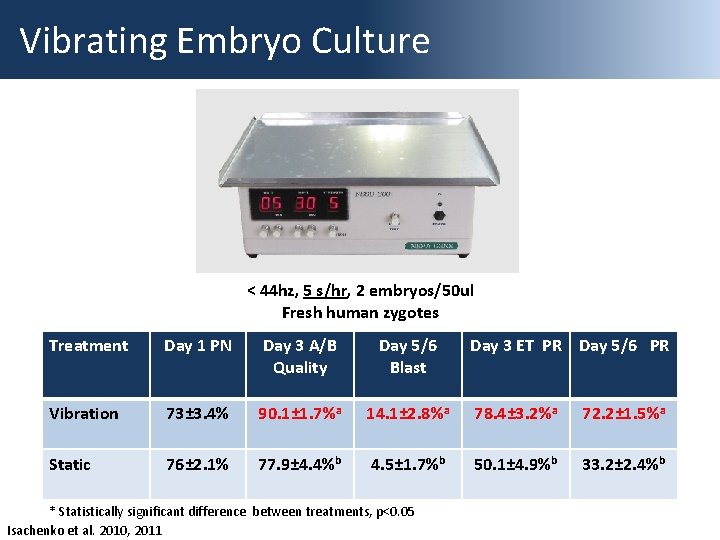
Vibrating Embryo Culture < 44 hz, 5 s/hr, 2 embryos/50 ul Fresh human zygotes Treatment Day 1 PN Day 3 A/B Quality Day 5/6 Blast Vibration 73± 3. 4% 90. 1± 1. 7%a 14. 1± 2. 8%a 78. 4± 3. 2%a 72. 2± 1. 5%a Static 76± 2. 1% 77. 9± 4. 4%b 4. 5± 1. 7%b 50. 1± 4. 9%b 33. 2± 2. 4%b * Statistically significant difference between treatments, p<0. 05 Isachenko et al. 2010, 2011 Day 3 ET PR Day 5/6 PR
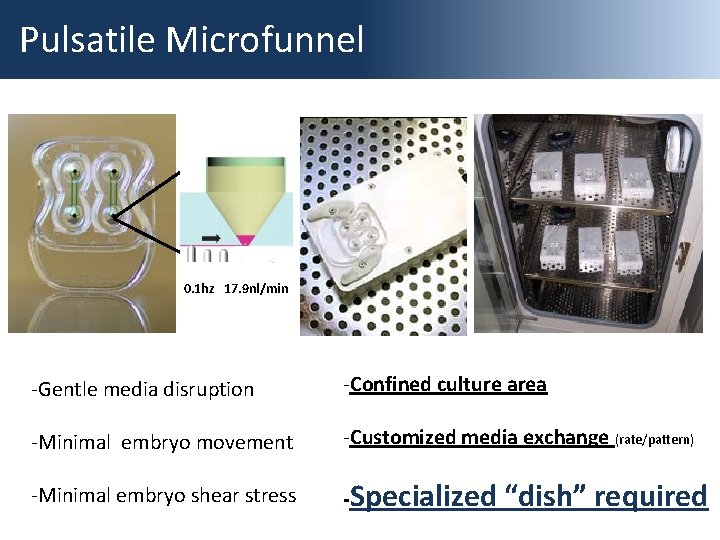
Pulsatile Microfunnel 0. 1 hz 17. 9 nl/min -Gentle media disruption -Confined culture area -Minimal embryo movement -Customized media exchange (rate/pattern) -Minimal embryo shear stress -Specialized “dish” required
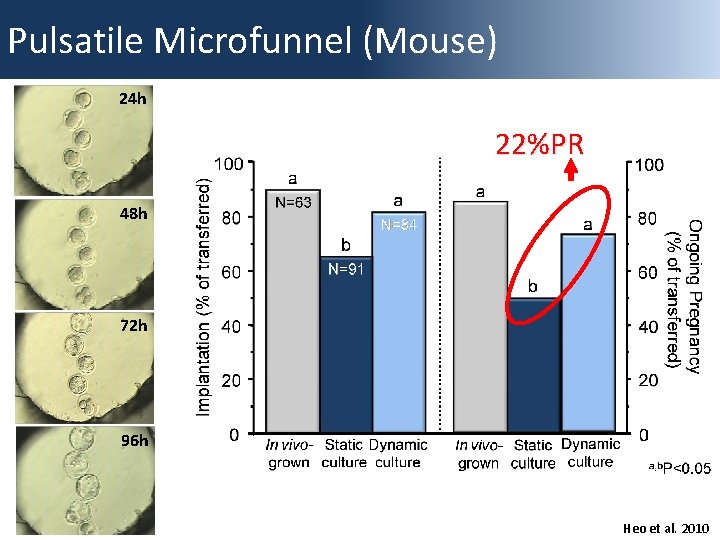
Pulsatile Microfunnel (Mouse) 24 h 22%PR 48 h 72 h 96 h Heo et al. 2010
Culture Surfaces § Polystyrene may compromise growth of adherent cells (Summer et al. 2012) § Alters microenvironment – p. H, ROS § Matrigel coating may be beneficial or detrimental for embryo development (Carnegie et al. 1995, Dawson et al. 1997, Lazzaroni et al. 1999) § Surface stiffness may impact embryo development (PDMS polymer) (Kholani et al. 2012) § Is this really a factor for embryos? – consider the zona pelludica barrier Need to consider media and molecule absorption
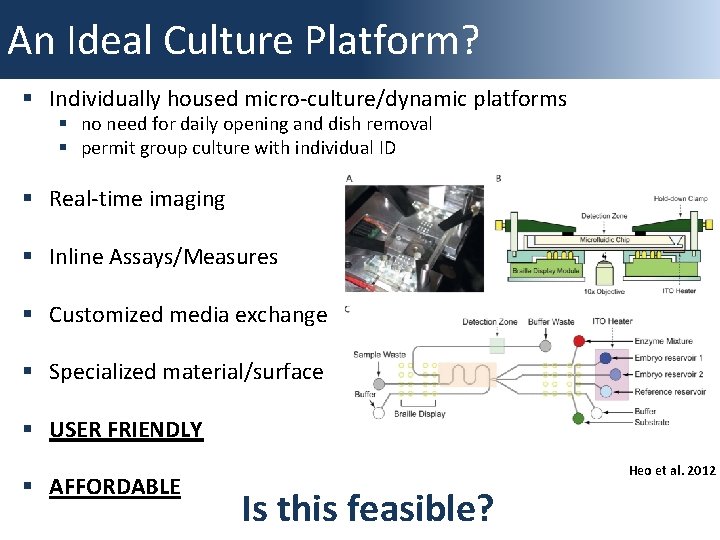
An Ideal Culture Platform? § Individually housed micro-culture/dynamic platforms § no need for daily opening and dish removal § permit group culture with individual ID § Real-time imaging § Inline Assays/Measures § Customized media exchange § Specialized material/surface § USER FRIENDLY § AFFORDABLE Heo et al. 2012 Is this feasible?
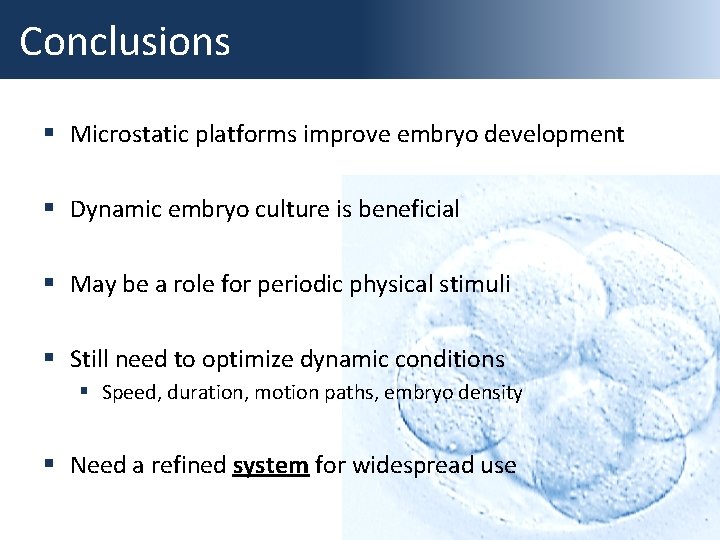
Conclusions § Microstatic platforms improve embryo development § Dynamic embryo culture is beneficial § May be a role for periodic physical stimuli § Still need to optimize dynamic conditions § Speed, duration, motion paths, embryo density § Need a refined system for widespread use
Acknowledgements Center for Reproductive Medicine Colleagues IVF Lab Staff § Melissa Hiner, TS § Laura Keller, GS § Lisa Gerisch § § Rusty Pool, Ph. D, HCLD Gary D. Smith, Ph. D, HCLD Mike Reed, Ph. D, HCLD Charles Bormann, Ph. D, HCLD
- Slides: 30