
THE CHANGE IN THE CONCEPT OF TIME A
- Slides: 13
THE CHANGE IN THE CONCEPT OF TIME A comparison between the concept of time in Modern Age and in classical societies Barzellato Roberta, 5°A A. S. 2012 -2013
Reasons for choosing the path § The concept of time fascinates me because of the importance people give to it. § To better understand the innovations in Modern society § To improve my skills in making intertextuality and connections between different subjects Questions to start § Why is time so important? § Why did the concept of time change in Modern Age? § What is the main differences between classical people’s idea of time and modernists’ one?
The Importance Of Time In Classical society Ita fac, mi Lucilii: vindica te tibi, et tempus quod adhuc aut auferebatur, aut subriepiebatur aut excidebat collige et serva. […] Remember to act thus, my dear Lucilius: set your- self free for your own sake ; gather and save your time. which till lately has been forced from you, or tilched away, or has merely slipped from your hands. […] In hoc enim fallimur, quod mortem prospicimus: magna pars eius iam praeterît; quid aetatis retro est mors tenet. We are mistaken when we look forward to death ; the major portion of death has already passed. Whatever years lie behind us are in death's hands. Fac ergo, mi Lucili, quod facere te scribis, omnes horas complectere Therefore, Lucilius, do as you write me that you are doing: hold every hour in vour grasp. Omnia, Lucilii, aliena sunt, tempus tantum nostrum est. Nothing, Lucilius, is ours, except time. [Epistulae ad Lucilium, I - Seneca] § Time was considered precious § People thought they could dominate it § Past, present and future are different «cathegories» § The importance of the present: the only moment to realize the self-improvement
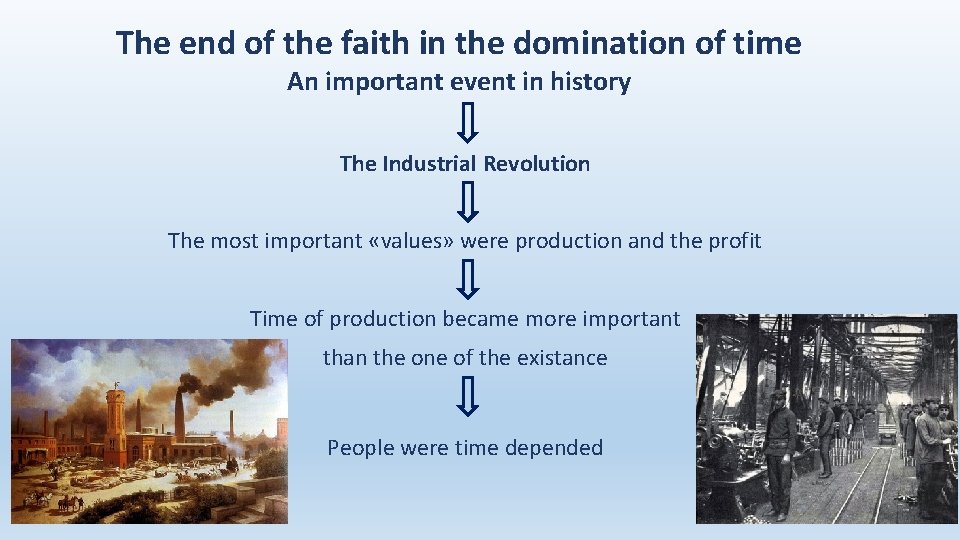
The end of the faith in the domination of time An important event in history The Industrial Revolution The most important «values» were production and the profit Time of production became more important than the one of the existance People were time depended
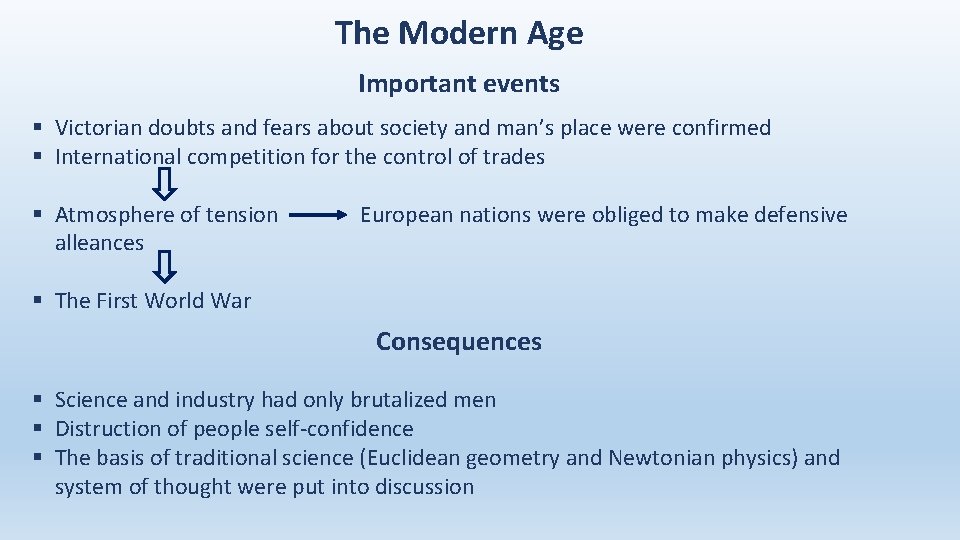
The Modern Age Important events § Victorian doubts and fears about society and man’s place were confirmed § International competition for the control of trades § Atmosphere of tension alleances European nations were obliged to make defensive § The First World War Consequences § Science and industry had only brutalized men § Distruction of people self-confidence § The basis of traditional science (Euclidean geometry and Newtonian physics) and system of thought were put into discussion
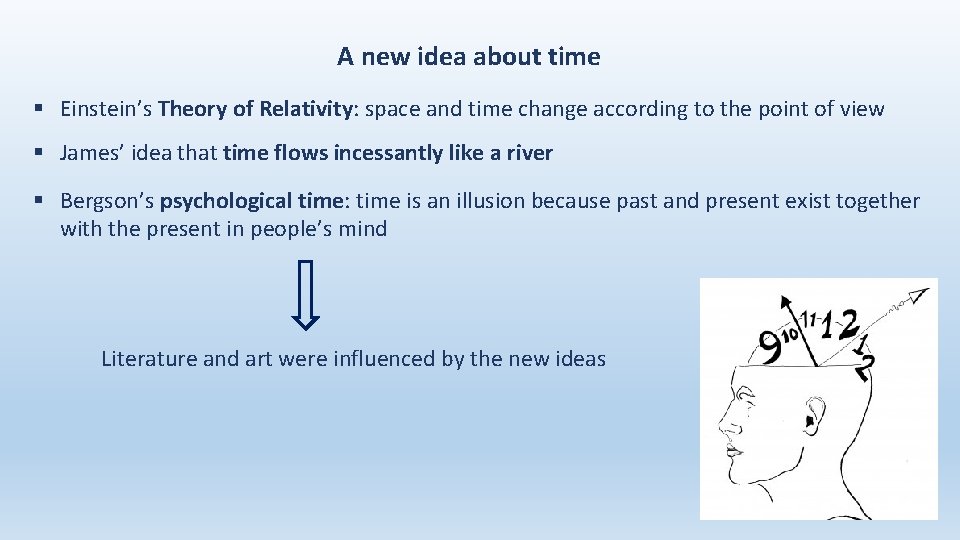
A new idea about time § Einstein’s Theory of Relativity: space and time change according to the point of view § James’ idea that time flows incessantly like a river § Bergson’s psychological time: time is an illusion because past and present exist together with the present in people’s mind Literature and art were influenced by the new ideas
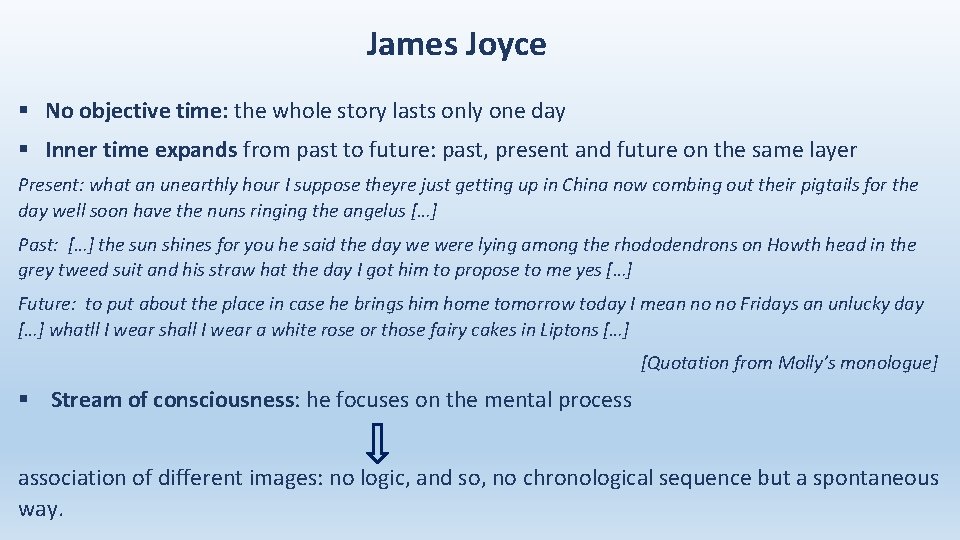
James Joyce § No objective time: the whole story lasts only one day § Inner time expands from past to future: past, present and future on the same layer Present: what an unearthly hour I suppose theyre just getting up in China now combing out their pigtails for the day well soon have the nuns ringing the angelus […] Past: […] the sun shines for you he said the day we were lying among the rhododendrons on Howth head in the grey tweed suit and his straw hat the day I got him to propose to me yes […] Future: to put about the place in case he brings him home tomorrow today I mean no no Fridays an unlucky day […] whatll I wear shall I wear a white rose or those fairy cakes in Liptons […] [Quotation from Molly’s monologue] § Stream of consciousness: he focuses on the mental process association of different images: no logic, and so, no chronological sequence but a spontaneous way.
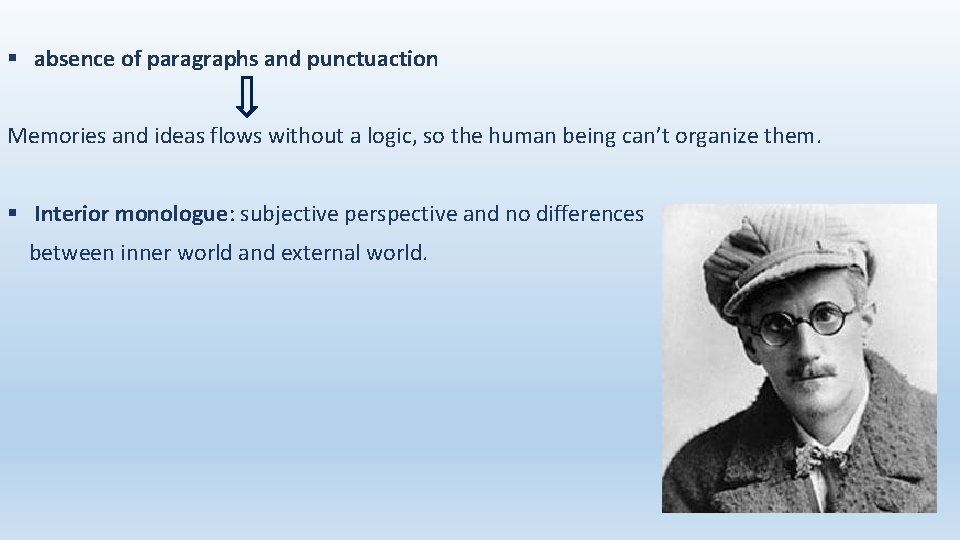
§ absence of paragraphs and punctuaction Memories and ideas flows without a logic, so the human being can’t organize them. § Interior monologue: subjective perspective and no differences between inner world and external world.
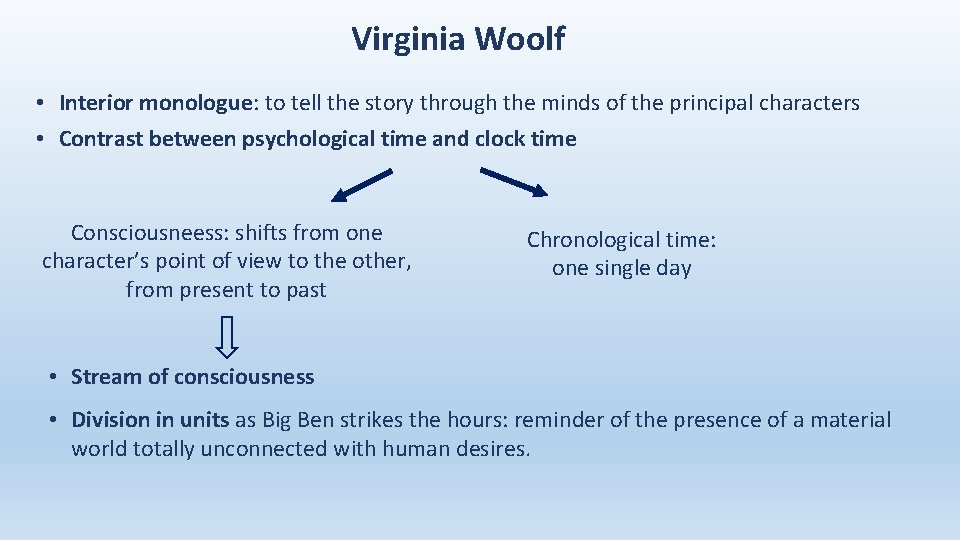
Virginia Woolf • Interior monologue: to tell the story through the minds of the principal characters • Contrast between psychological time and clock time Consciousneess: shifts from one character’s point of view to the other, from present to past Chronological time: one single day • Stream of consciousness • Division in units as Big Ben strikes the hours: reminder of the presence of a material world totally unconnected with human desires.
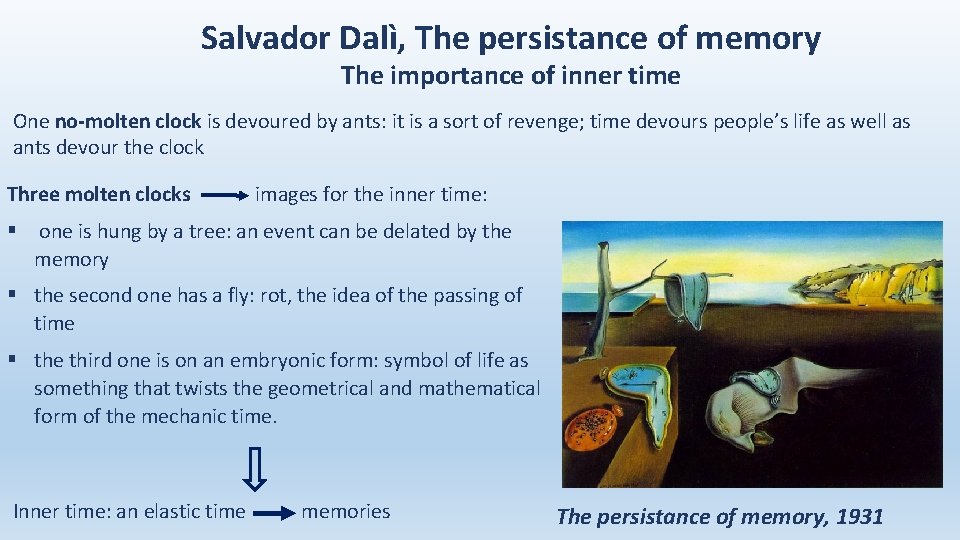
Salvador Dalì, The persistance of memory The importance of inner time One no-molten clock is devoured by ants: it is a sort of revenge; time devours people’s life as well as ants devour the clock Three molten clocks images for the inner time: § one is hung by a tree: an event can be delated by the memory § the second one has a fly: rot, the idea of the passing of time § the third one is on an embryonic form: symbol of life as something that twists the geometrical and mathematical form of the mechanic time. Inner time: an elastic time memories The persistance of memory, 1931
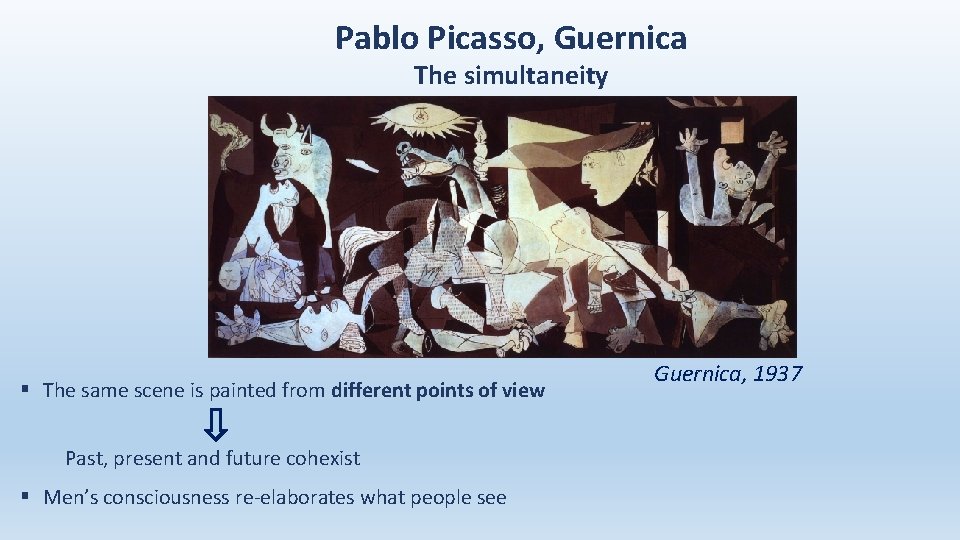
Pablo Picasso, Guernica The simultaneity § The same scene is painted from different points of view Past, present and future cohexist § Men’s consciousness re-elaborates what people see Guernica, 1937
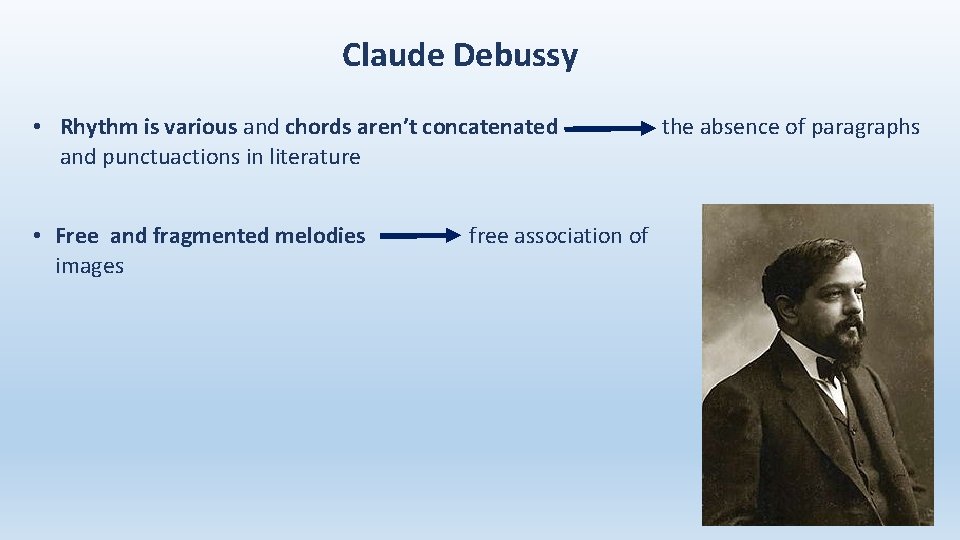
Claude Debussy • Rhythm is various and chords aren’t concatenated and punctuactions in literature • Free and fragmented melodies images free association of the absence of paragraphs
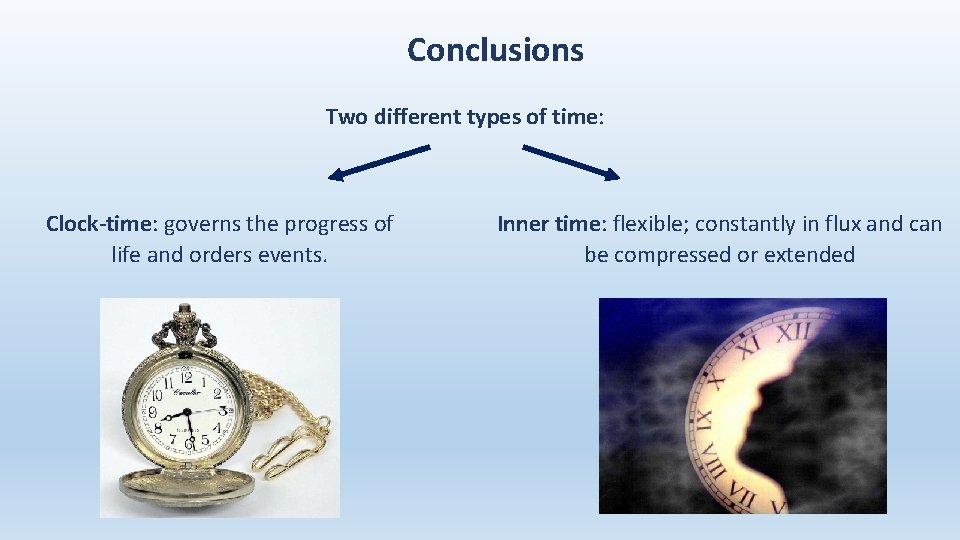
Conclusions Two different types of time: Clock-time: governs the progress of life and orders events. Inner time: flexible; constantly in flux and can be compressed or extended