
THE CHANGE EQUATION Building your Capability for Change
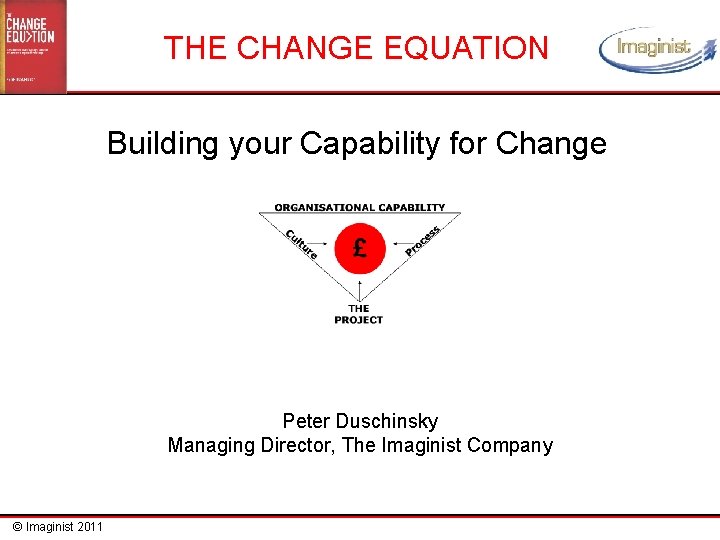
THE CHANGE EQUATION Building your Capability for Change Peter Duschinsky Managing Director, The Imaginist Company © Imaginist 2011
The Purpose of this Presentation To: § Examine what makes an organisation good at managing change § Introduce the key models and tools in the Change Equation methodology § Develop the concepts of: Change Readiness and Capability for Change § Show the Change Equation can be incorporated into your standard practices: • at project level - to deliver consistently improved project outcomes • at programme level – to deliver Capability for Change into the organisation as a key outcome © Imaginist 2011 2
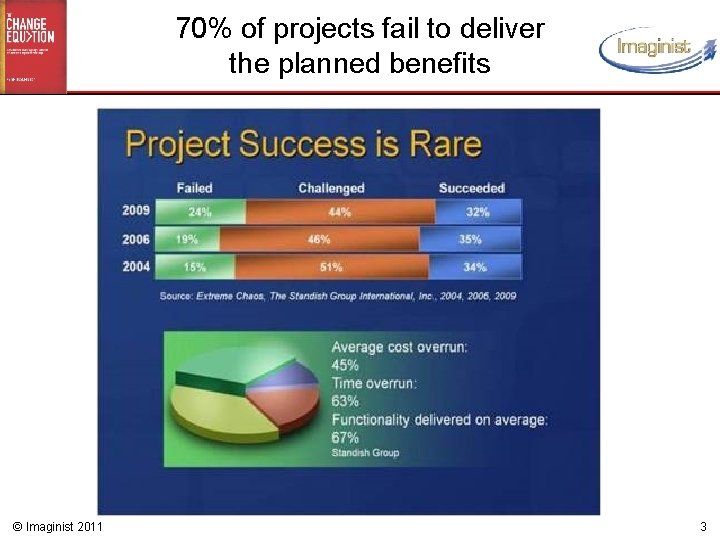
70% of projects fail to deliver the planned benefits © Imaginist 2011 3
Internal Change Programmes fare no better § The Harvard Business School tracked the impact of change efforts among the Fortune 100 and found that only 30% produced a positive bottom-line improvement… § A survey of change programmes in 400 European organisations quoted by Prof. John Oakland, Emeritus Professor, Leeds University Business School found that: • 90% of change programmes faced major implementation problems • Only 30% delivered measurable business improvements § A CIPD survey of 800 executives found that reorganisations failed to deliver real improvement in performance in 40% of cases © Imaginist 2011 4
What makes an organisation good at managing change? § Are there characteristics we can look out for? • Strong, visible, empowering, leadership • Clearly articulated and shared vision • Attention paid to supporting core values • High level of trust between managers and staff – decision-making devolved wherever possible • People able to give priority to new initiatives – overload issue managed well • Innovation encouraged and well managed • Good communication between departments • Collaboration with customers and suppliers • Adherence to standard ways of doing things • HR benefits and rewards aligned to business objectives © Imaginist 2011 5
What makes an organisation good at managing change? § Does your organisation have these characteristics? § Then you are likely to have: • High level of involvement and commitment • Low resistance to change • Resilience in the face of challenges • Able to bring in changes rapidly and effectively in response to need ² Capability for Change © Imaginist 2011 6
Capability for Change “Stock of capability” (Rebecca Henderson, Harvard Business School) § “Attention and resources focused on people and processes, developing the organisation’s capability and resilience” • Crucial if you want to respond to the accelerating pace of change and rising levels of business complexity • But erodes through natural entropy and neglect, so requires continual investment and maintenance § Any Change / Transformation Programme needs this to be part of its core deliverables, but many don’t § The Change Equation provides the tools you need © Imaginist 2011 7
The Principles behind the Change Equation The Change Equation is based on 3 key contentions: 1. Projects fail when the complexity of the project exceeds the capability of the organisation to cope 2. The changes needed in a complex project cannot be achieved within its lifecycle 3. A conventional ’command & control’ approach to management of complex change projects will not achieve consistently successful outcomes Let’s apply these… © Imaginist 2011 8
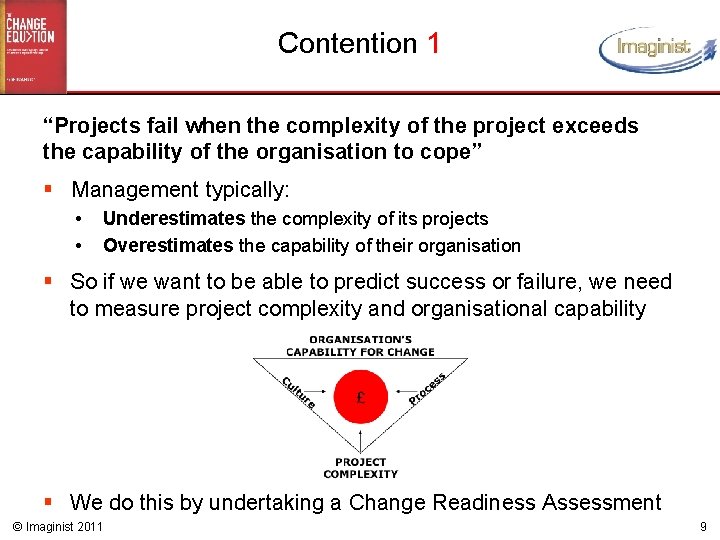
Contention 1 “Projects fail when the complexity of the project exceeds the capability of the organisation to cope” § Management typically: • • Underestimates the complexity of its projects Overestimates the capability of their organisation § So if we want to be able to predict success or failure, we need to measure project complexity and organisational capability § We do this by undertaking a Change Readiness Assessment © Imaginist 2011 9
Change Readiness Assessment § The Change Readiness Assessment (CRA) comprises: • Stakeholder interviews, review of project documentation, analysis, senior management team workshop, report & recommendations § It allows us to: • • identify the underlying causes of low and negative ROI on projects quantify the barriers to success predict the success or failure of projects deliver a Route Map and Action Plan to help clients gain ownership of the risks and improve performance § Undertaking a CRA at the planning stage will improve a project’s outcomes § Integrating CRA into your standard project planning process will deliver consistently improved project outcomes © Imaginist 2011 10
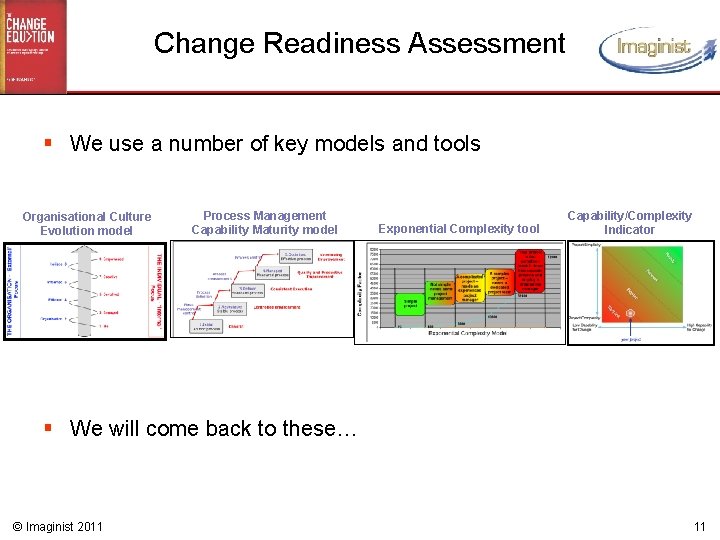
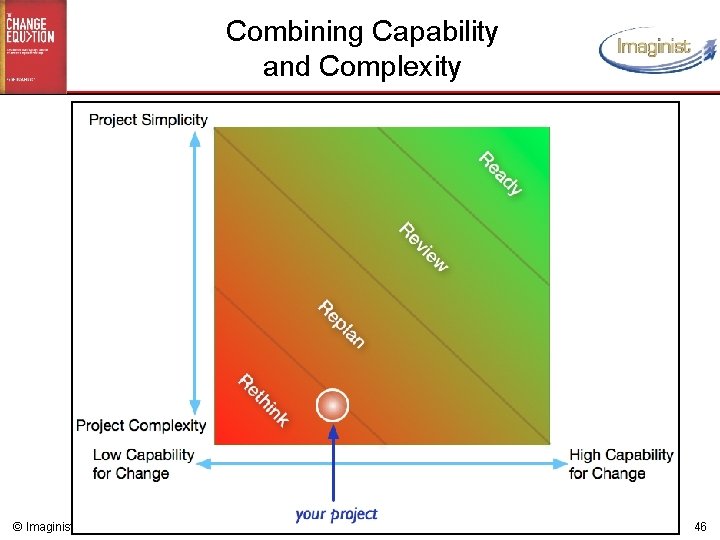
Change Readiness Assessment § We use a number of key models and tools Organisational Culture Evolution model Process Management Capability Maturity model Exponential Complexity tool Capability/Complexity Indicator § We will come back to these… © Imaginist 2011 11
Contention 2 “The changes needed in a complex project cannot be achieved within its lifecycle” § The actions needed to achieve and embed behaviour change usually have to be linked to a wider programme § Building these into a Change (or Transformation) Programme will enable the development of an organisation’s Capability for Change § The Change Equation principles provide the framework § The CRA Route Maps and Action Plans provide the content © Imaginist 2011 12
Contention 3 “A conventional ’command & control’ approach to management of complex change projects will not achieve consistently successful outcomes” § Conventional change management interventions attempt to impose change…so people give up, fall back on ‘what’s in it for me’ and the change project fails § In a complex project, newly emergent ways of working and new forms of organisation need to be recognised, nurtured and embedded § You need to employ project and programme managers with the right skill-sets to achieve this © Imaginist 2011 13
Integrating the Change Equation into standard practice 1. Audit • Undertake CRAs on selected projects • Stakeholder face-to-face interviews 2. Analyse • • Identify and quantify key common barriers Adapt methodology, terminology 3. Integrate • • CRA into standard project management practice Change Equation principles into programme architecture 4. Implement • Employ project and programme managers with right skill-sets Ø Consistent improvement in project outcomes Ø Capability for Change © Imaginist 2011 14
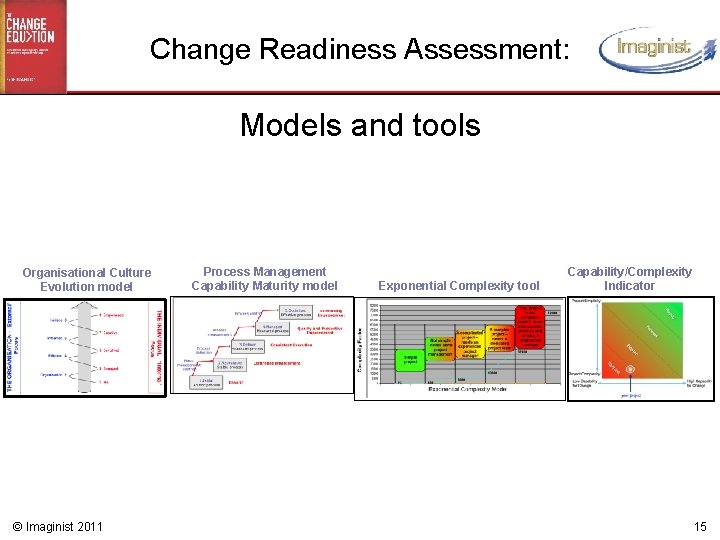
Change Readiness Assessment: Models and tools Organisational Culture Evolution model © Imaginist 2011 Process Management Capability Maturity model Exponential Complexity tool Capability/Complexity Indicator 15
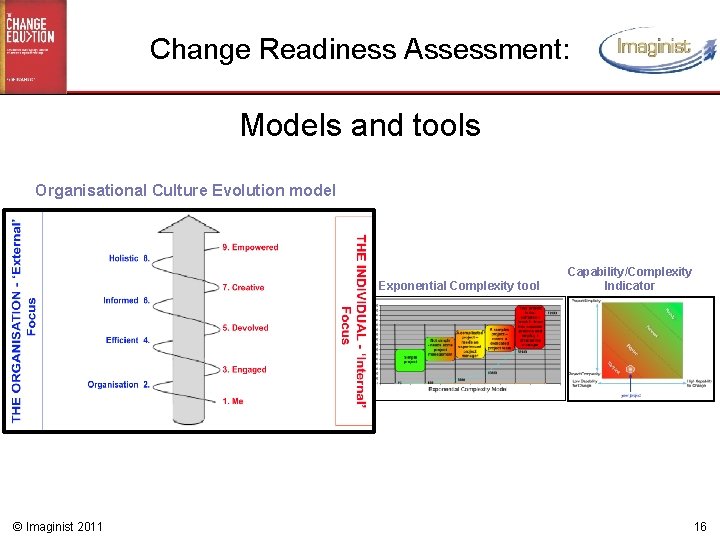
Change Readiness Assessment: Models and tools Organisational Culture Evolution model Process Management Capability Maturity model © Imaginist 2011 Exponential Complexity tool Capability/Complexity Indicator 16
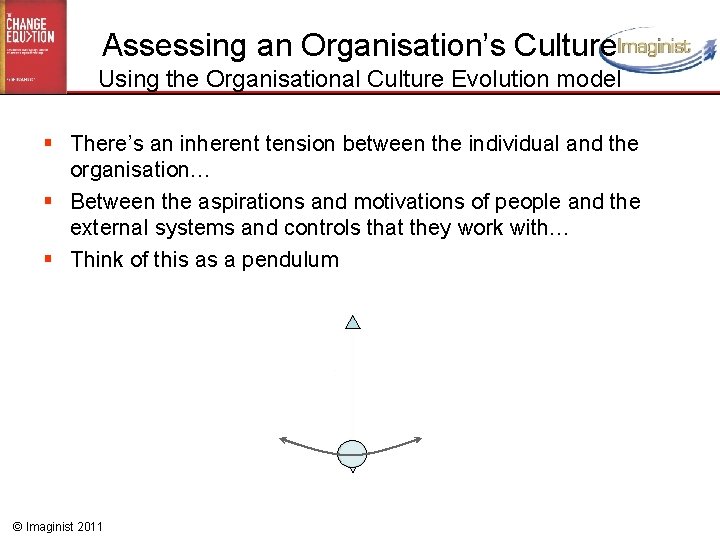
Assessing an Organisation’s Culture Using the Organisational Culture Evolution model § There’s an inherent tension between the individual and the organisation… § Between the aspirations and motivations of people and the external systems and controls that they work with… § Think of this as a pendulum © Imaginist 2011
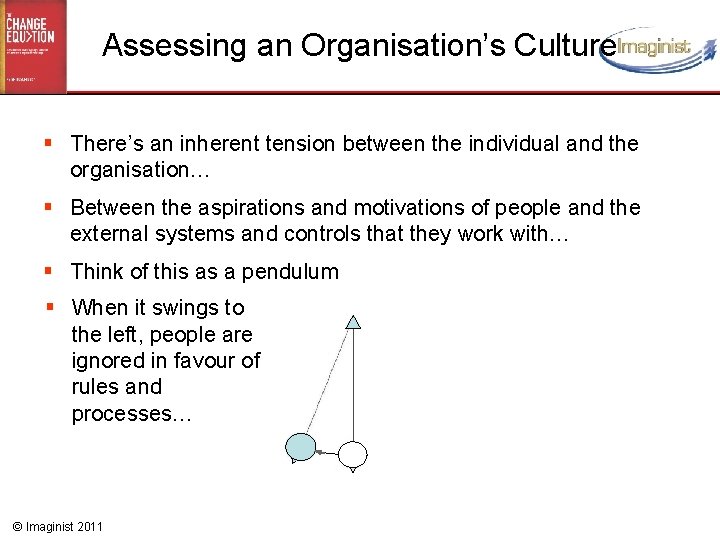
Assessing an Organisation’s Culture § There’s an inherent tension between the individual and the organisation… § Between the aspirations and motivations of people and the external systems and controls that they work with… § Think of this as a pendulum § When it swings to the left, people are ignored in favour of rules and processes… © Imaginist 2011
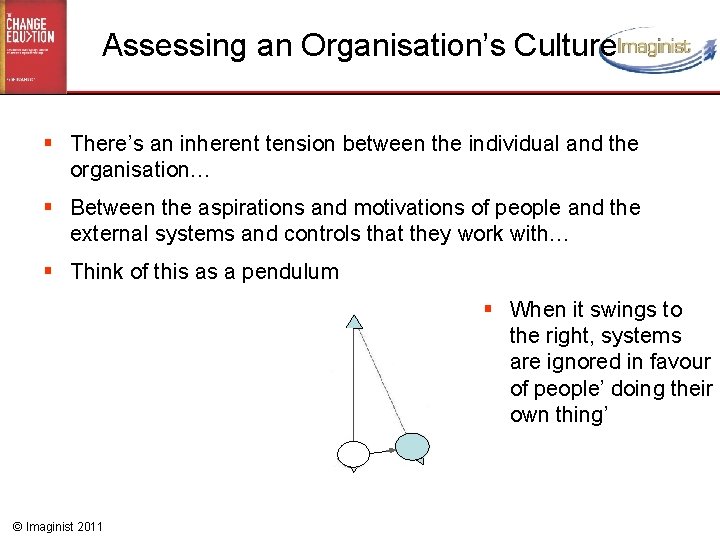
Assessing an Organisation’s Culture § There’s an inherent tension between the individual and the organisation… § Between the aspirations and motivations of people and the external systems and controls that they work with… § Think of this as a pendulum § When it swings to the right, systems are ignored in favour of people’ doing their own thing’ © Imaginist 2011
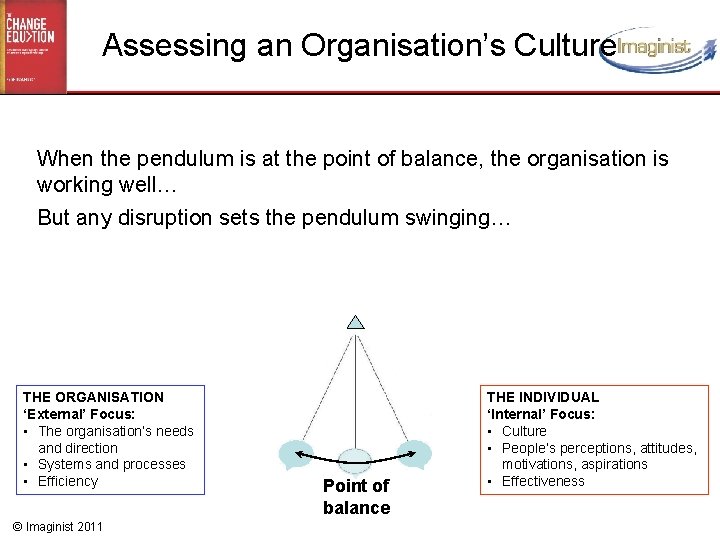
Assessing an Organisation’s Culture When the pendulum is at the point of balance, the organisation is working well… But any disruption sets the pendulum swinging… THE ORGANISATION ‘External’ Focus: • The organisation’s needs and direction • Systems and processes • Efficiency © Imaginist 2011 Point of balance THE INDIVIDUAL ‘Internal’ Focus: • Culture • People’s perceptions, attitudes, motivations, aspirations • Effectiveness
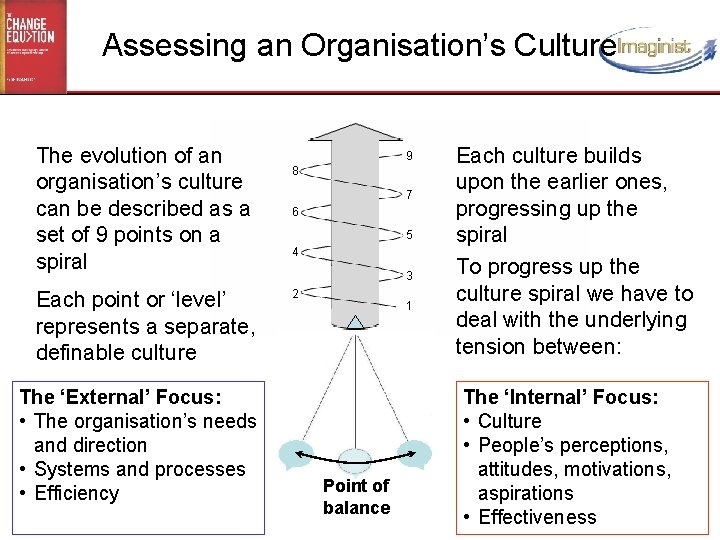
Assessing an Organisation’s Culture The evolution of an organisation’s culture can be described as a set of 9 points on a spiral Each point or ‘level’ represents a separate, definable culture THE ORGANISATION The ‘External’ Focus: • • The organisation’s needs and direction Systems and processes • • • Systems and processes Efficiency • Efficiency © Imaginist 2011 9 8 7 6 5 4 3 2 1 Point of balance Each culture builds upon the earlier ones, progressing up the spiral To progress up the culture spiral we have to deal with the underlying tension between: THE INDIVIDUALFocus: The ‘Internal’ Focus: • Culture • People’s perceptions, attitudes, motivations, aspirations attitudes, motivations, • Effectiveness aspirations • Effectiveness
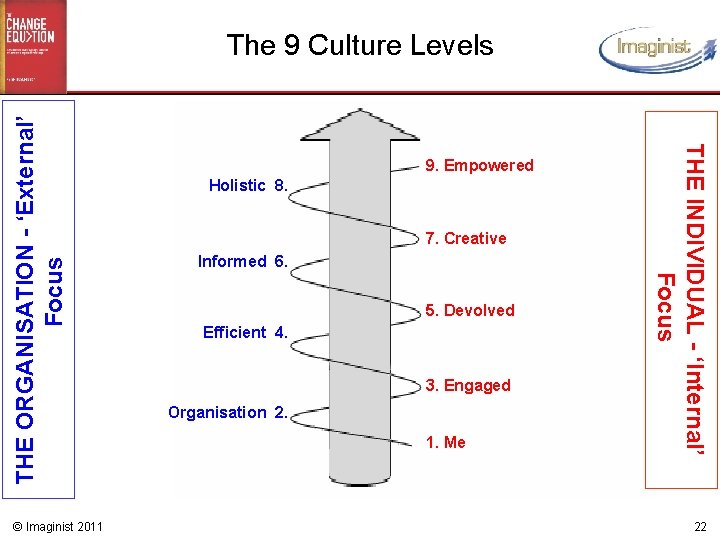
© Imaginist 2011 9. Empowered Holistic 8. 7. Creative Informed 6. 5. Devolved Efficient 4. 3. Engaged Organisation 2. 1. Me THE INDIVIDUAL - ‘Internal’ Focus THE ORGANISATION - ‘External’ Focus The 9 Culture Levels 22
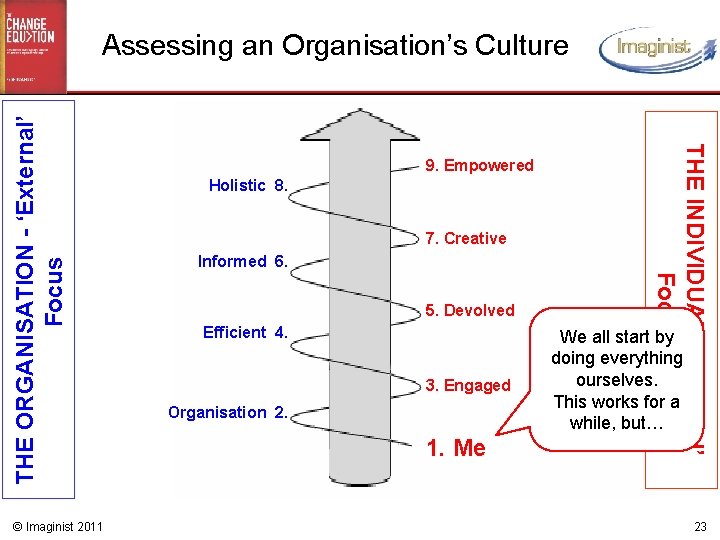
© Imaginist 2011 9. Empowered Holistic 8. 7. Creative Informed 6. 5. Devolved Efficient 4. 3. Engaged Organisation 2. 1. Me THE INDIVIDUAL - ‘Internal’ Focus THE ORGANISATION - ‘External’ Focus Assessing an Organisation’s Culture We all start by doing everything ourselves. This works for a while, but… 23
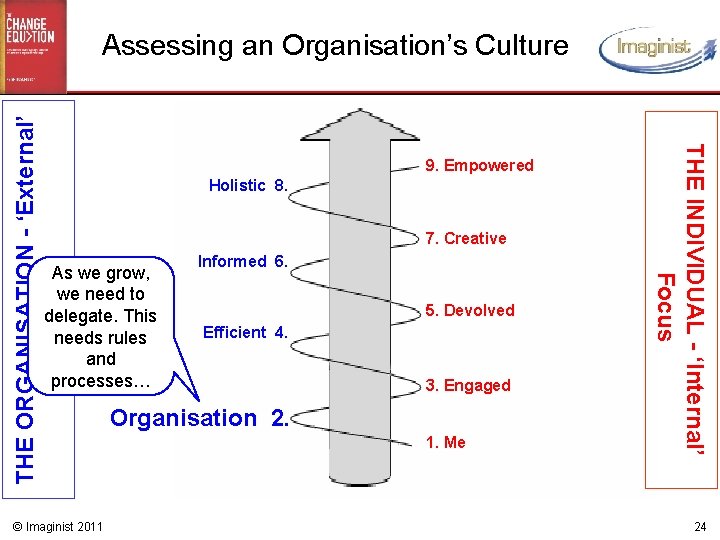
9. Empowered Holistic 8. 7. Creative As we grow, we need to delegate. This needs rules and processes… © Imaginist 2011 Informed 6. 5. Devolved Efficient 4. 3. Engaged Organisation 2. 1. Me THE INDIVIDUAL - ‘Internal’ Focus THE ORGANISATION - ‘External’ Focus Assessing an Organisation’s Culture 24
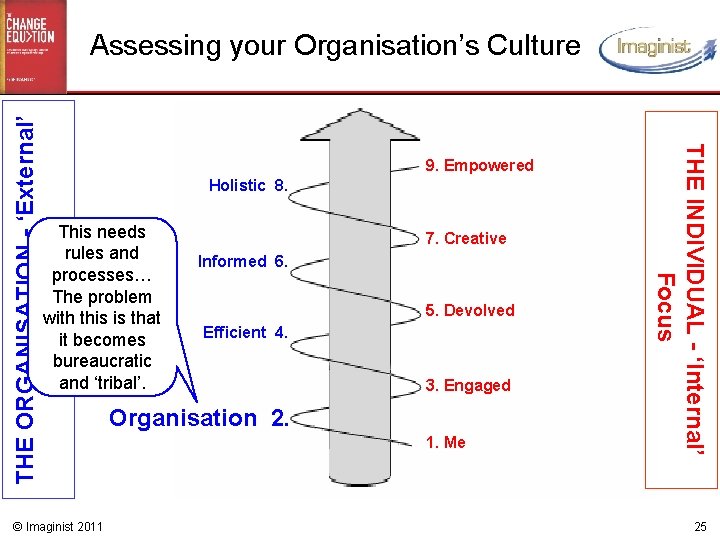
9. Empowered Holistic 8. This needs rules and processes… The problem with this is that it becomes bureaucratic and ‘tribal’. © Imaginist 2011 7. Creative Informed 6. 5. Devolved Efficient 4. 3. Engaged Organisation 2. 1. Me THE INDIVIDUAL - ‘Internal’ Focus THE ORGANISATION - ‘External’ Focus Assessing your Organisation’s Culture 25
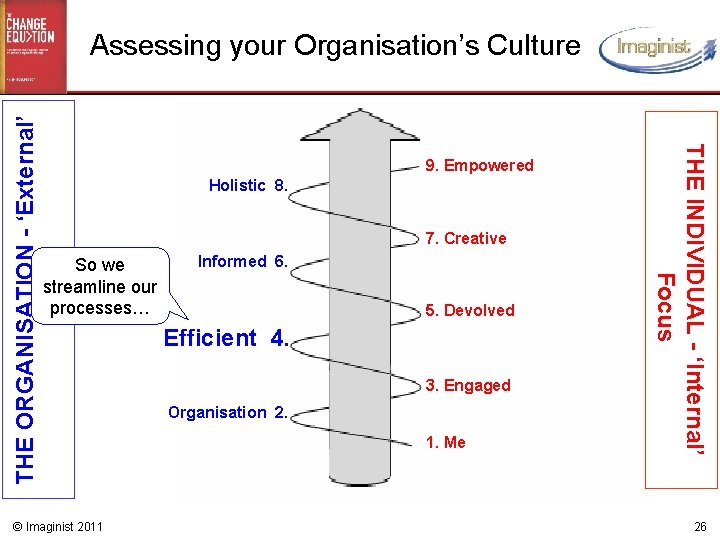
So we streamline our processes… © Imaginist 2011 9. Empowered Holistic 8. 7. Creative Informed 6. 5. Devolved Efficient 4. 3. Engaged Organisation 2. 1. Me THE INDIVIDUAL - ‘Internal’ Focus THE ORGANISATION - ‘External’ Focus Assessing your Organisation’s Culture 26
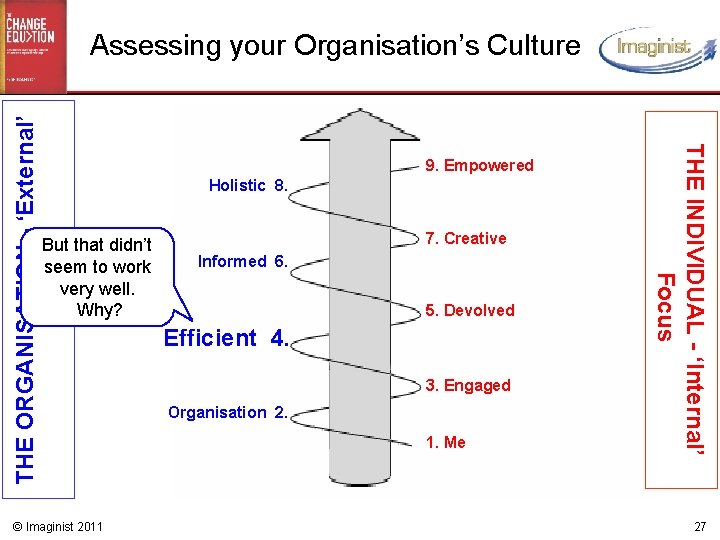
But that didn’t seem to work very well. Why? © Imaginist 2011 9. Empowered Holistic 8. 7. Creative Informed 6. 5. Devolved Efficient 4. 3. Engaged Organisation 2. 1. Me THE INDIVIDUAL - ‘Internal’ Focus THE ORGANISATION - ‘External’ Focus Assessing your Organisation’s Culture 27
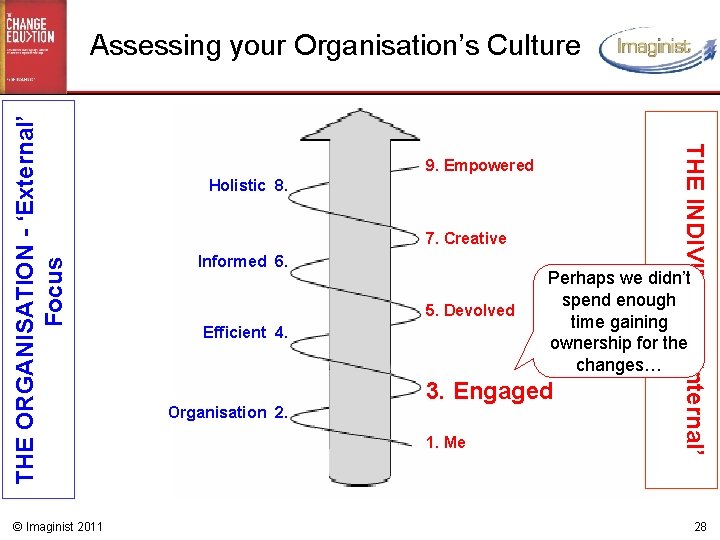
© Imaginist 2011 9. Empowered Holistic 8. 7. Creative Informed 6. 5. Devolved Efficient 4. Organisation 2. Perhaps we didn’t spend enough time gaining ownership for the changes… 3. Engaged 1. Me THE INDIVIDUAL - ‘Internal’ Focus THE ORGANISATION - ‘External’ Focus Assessing your Organisation’s Culture 28
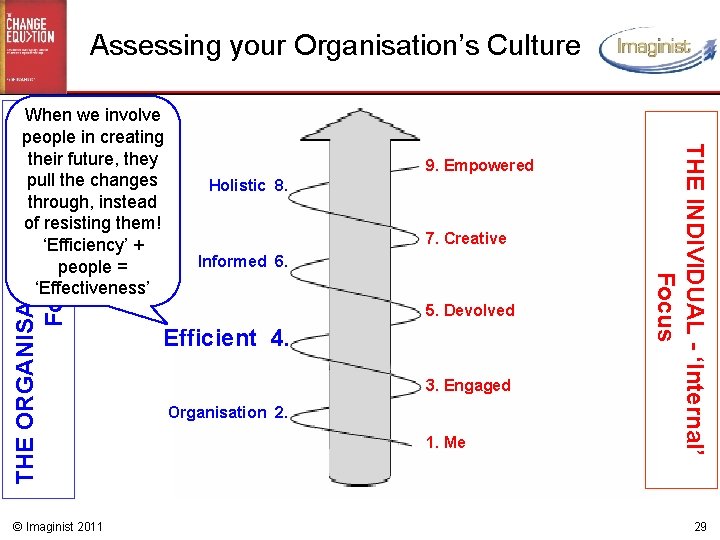
Assessing your Organisation’s Culture THE ORGANISATION - ‘External’ Focus © Imaginist 2011 9. Empowered Holistic 8. 7. Creative Informed 6. 5. Devolved Efficient 4. 3. Engaged Organisation 2. 1. Me THE INDIVIDUAL - ‘Internal’ Focus When we involve people in creating their future, they pull the changes through, instead of resisting them! ‘Efficiency’ + people = ‘Effectiveness’ 29
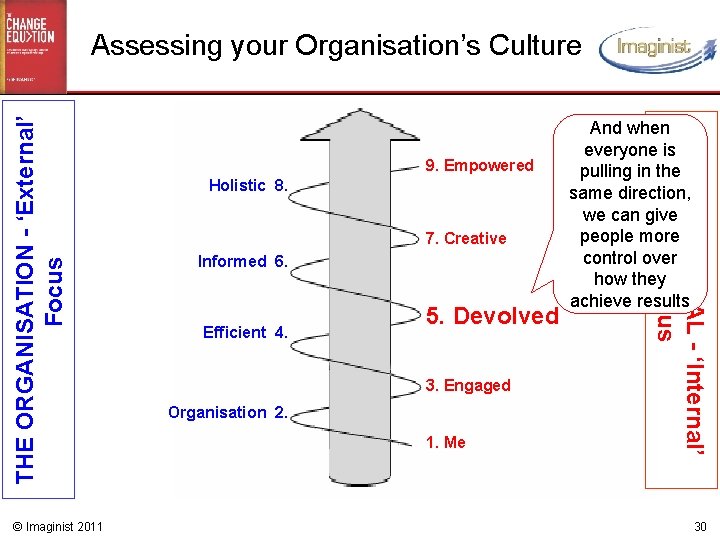
© Imaginist 2011 9. Empowered Holistic 8. 7. Creative Informed 6. Efficient 4. 5. Devolved 3. Engaged Organisation 2. 1. Me And when everyone is pulling in the same direction, we can give people more control over how they achieve results THE INDIVIDUAL - ‘Internal’ Focus THE ORGANISATION - ‘External’ Focus Assessing your Organisation’s Culture 30
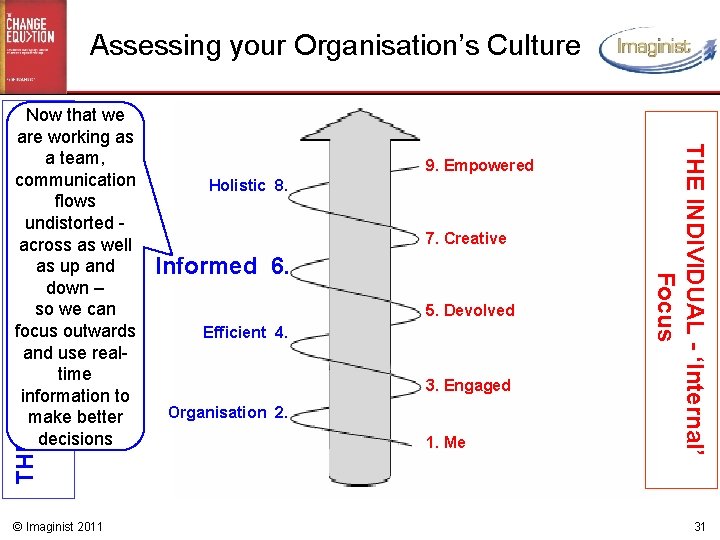
Assessing your Organisation’s Culture THE ORGANISATION - ‘External’ Focus © Imaginist 2011 9. Empowered Holistic 8. 7. Creative Informed 6. 5. Devolved Efficient 4. 3. Engaged Organisation 2. 1. Me THE INDIVIDUAL - ‘Internal’ Focus Now that we are working as a team, communication flows undistorted across as well as up and down – so we can focus outwards and use realtime information to make better decisions 31
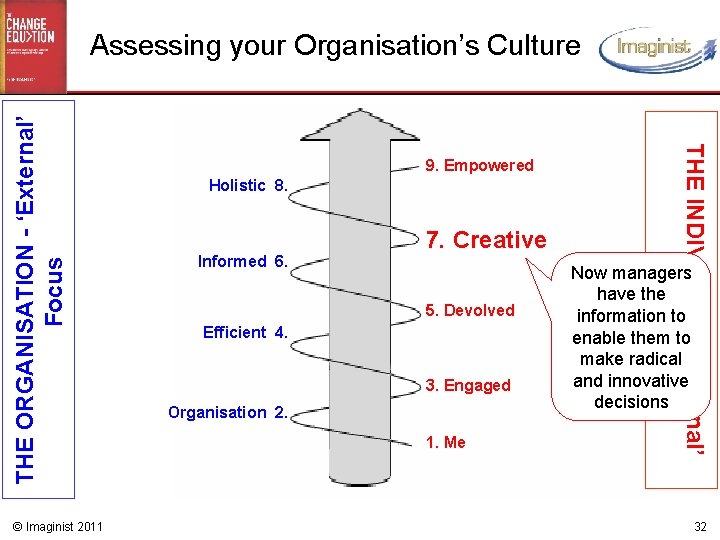
© Imaginist 2011 9. Empowered Holistic 8. Informed 6. 7. Creative 5. Devolved Efficient 4. 3. Engaged Organisation 2. 1. Me THE INDIVIDUAL - ‘Internal’ Focus THE ORGANISATION - ‘External’ Focus Assessing your Organisation’s Culture Now managers have the information to enable them to make radical and innovative decisions 32
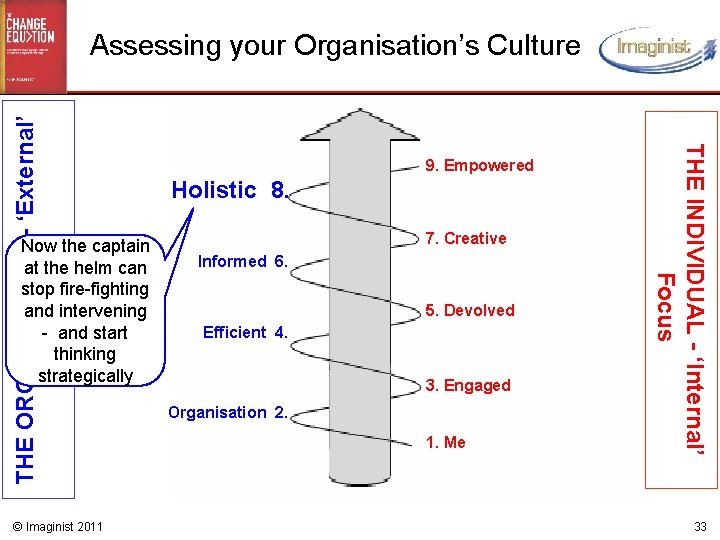
Now the captain at the helm can stop fire-fighting and intervening - and start thinking strategically © Imaginist 2011 9. Empowered Holistic 8. 7. Creative Informed 6. 5. Devolved Efficient 4. 3. Engaged Organisation 2. 1. Me THE INDIVIDUAL - ‘Internal’ Focus THE ORGANISATION - ‘External’ Focus Assessing your Organisation’s Culture 33
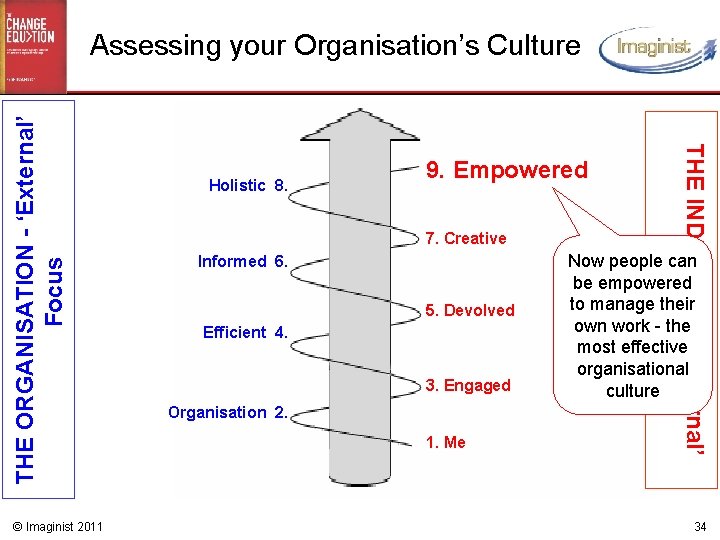
© Imaginist 2011 Holistic 8. 9. Empowered 7. Creative Informed 6. 5. Devolved Efficient 4. 3. Engaged Organisation 2. 1. Me THE INDIVIDUAL - ‘Internal’ Focus THE ORGANISATION - ‘External’ Focus Assessing your Organisation’s Culture Now people can be empowered to manage their own work - the most effective organisational culture 34
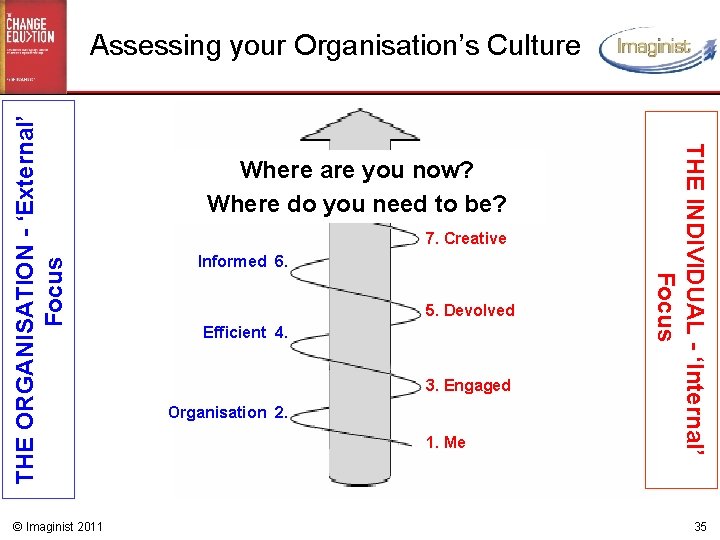
© Imaginist 2011 9. Empowered Where are you now? Holistic 8. Where do you need to be? 7. Creative Informed 6. 5. Devolved Efficient 4. 3. Engaged Organisation 2. 1. Me THE INDIVIDUAL - ‘Internal’ Focus THE ORGANISATION - ‘External’ Focus Assessing your Organisation’s Culture 35
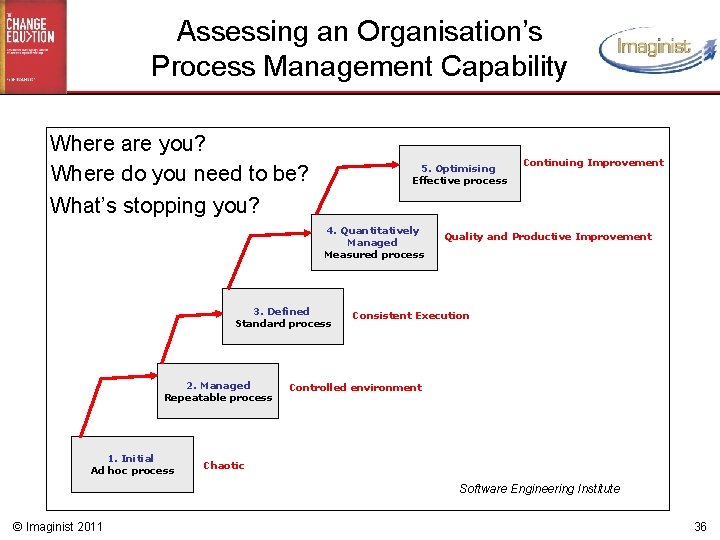
Assessing an Organisation’s Process Management Capability Where are you? Where do you need to be? What’s stopping you? 5. Optimising Effective process 4. Quantitatively Managed Measured process 3. Defined Standard process 2. Managed Repeatable process 1. Initial Ad hoc process Continuing Improvement Quality and Productive Improvement Consistent Execution Controlled environment Chaotic Software Engineering Institute © Imaginist 2011 36
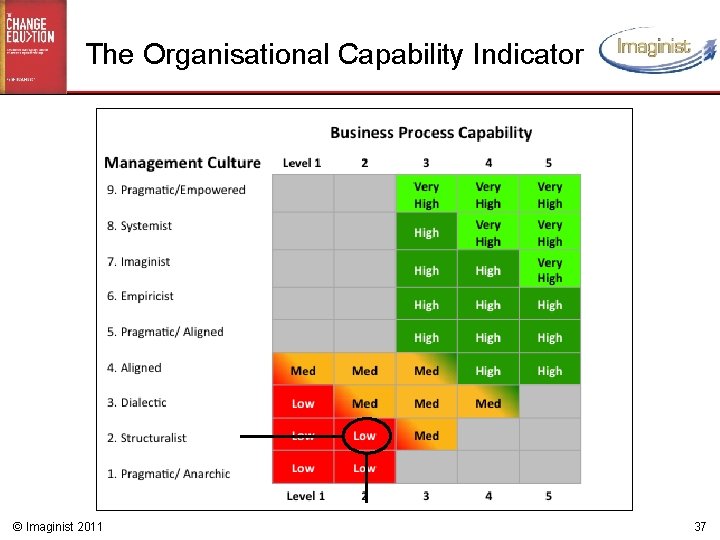
The Organisational Capability Indicator © Imaginist 2011 37
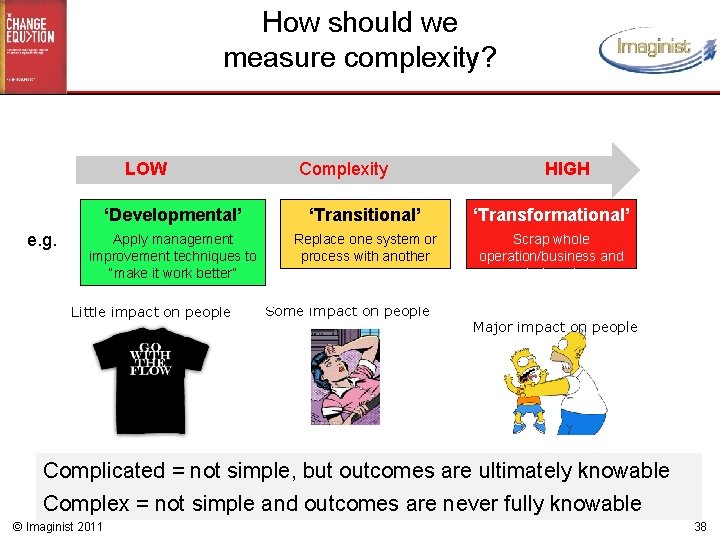
How should we measure complexity? LOW ‘Developmental’ e. g. Complexity ‘Transitional’ Replace oneone system oror Apply management Replace system with another improvement techniques to process with another techniques “make ittowork better” Little impact on people Some impact on people HIGH ‘Transformational’ Scrap whole Scrap operation/business and start again Major impact on people Complicated = not simple, but outcomes are ultimately knowable Complex = not simple and outcomes are never fully knowable © Imaginist 2011 38
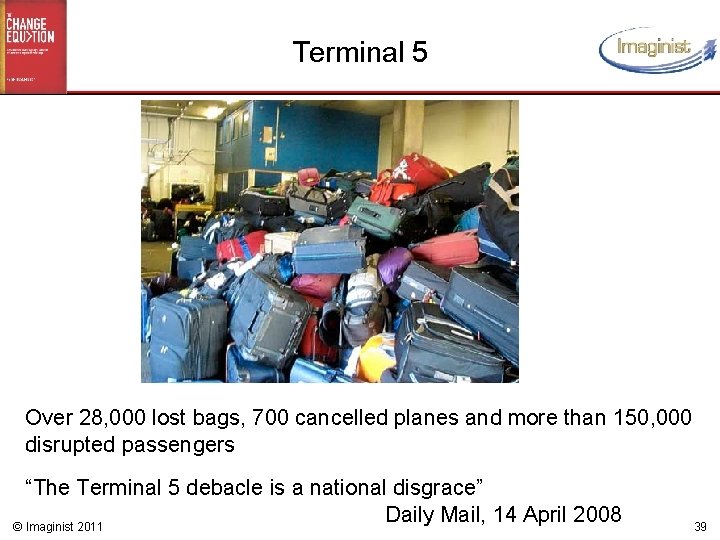
Terminal 5 Over 28, 000 lost bags, 700 cancelled planes and more than 150, 000 disrupted passengers “The Terminal 5 debacle is a national disgrace” Daily Mail, 14 April 2008 © Imaginist 2011 39
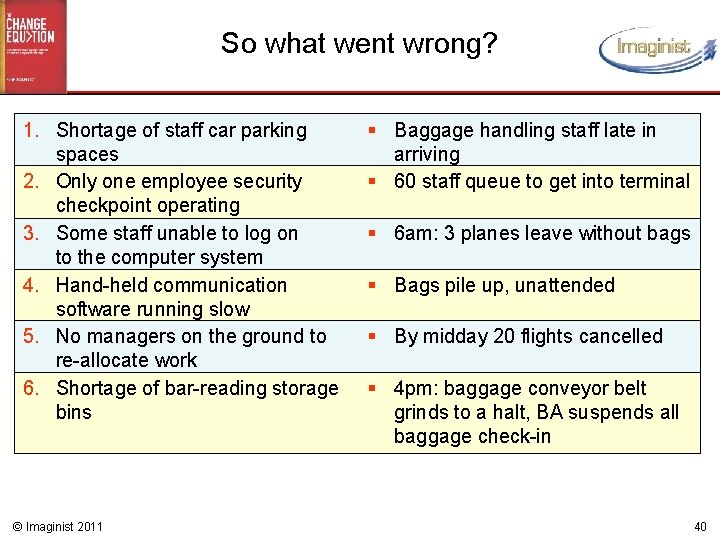
So what went wrong? 1. Shortage of staff car parking spaces 2. Only one employee security checkpoint operating 3. Some staff unable to log on to the computer system 4. Hand-held communication software running slow 5. No managers on the ground to re-allocate work 6. Shortage of bar-reading storage bins © Imaginist 2011 § Baggage handling staff late in arriving § 60 staff queue to get into terminal § 6 am: 3 planes leave without bags § Bags pile up, unattended § By midday 20 flights cancelled § 4 pm: baggage conveyor belt grinds to a halt, BA suspends all baggage check-in 40
“The Perfect Storm” § In 2004, HP's project managers knew all of the things that could go wrong with their ERP centralisation programme. But they just didn't plan for so many of them to happen at once. § The project eventually cost HP $160 million in order backlogs and lost revenue—more than five times the project's estimated cost. § Gilles Bouchard, then-CIO of HP's global operations, says: "We had a series of small problems, none of which individually would have been too much to handle. But together they created the perfect storm. ” § Complexity is exponential! © Imaginist 2011 41
Complexity is Exponential ”We live in a world that can change exponentially – but we have brains that are hardwired to plot things out linearly - the software in our brains compels us to think about progressions as being simple arithmetic ones So as a species, and a society, we deal poorly with uncertainty in non-linear domains. ” Prof Albert Bartlett, University of Colorado § That’s one good reason why management typically underestimates the complexity of projects! © Imaginist 2011 42
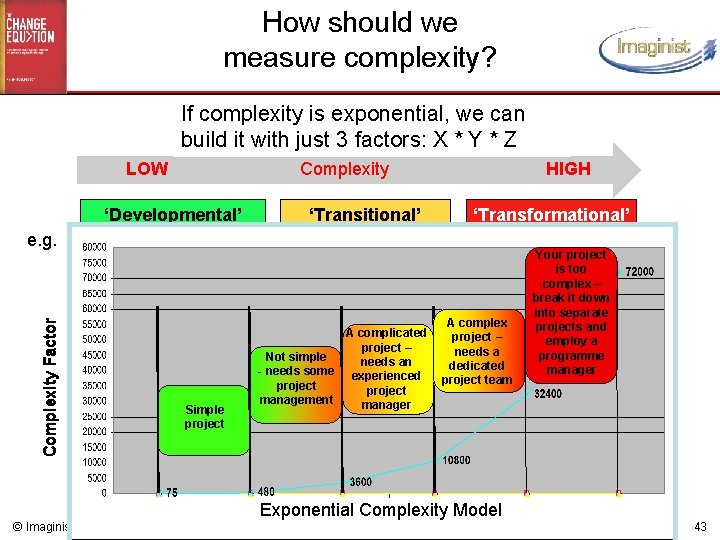
How should we measure complexity? If complexity is exponential, we can build it with just 3 factors: X * Y * Z LOW Complexity ‘Developmental’ Complexity Factor e. g. ‘Transitional’ Replace oneone system oror Apply management Replace system with another improvement techniques to process with another techniques “make ittowork better” Little impact on people © Imaginist 2011 Simple project HIGH ‘Transformational’ Scrapwhole Scrap Your project operation/business and is too start again complex – break it down Some impact on people into separate A complex projects Major impact onand people A complicated project – employ a project – needs a programme Not simple needs an dedicated manager - needs some experienced project team project management manager Exponential Complexity Model Exponential 43
The Exponential Complexity Tool § Which 3 factors? They must be: • Common to all projects • Quantifiable by stakeholders • Good predictors of the complexity of a project § The Exponential Complexity Tool uses the following 3 factors: 1. Number of people or Stakeholders involved (More people = more complex = higher risk) 2. Number of business activities or Processes affected (More ambitious = more complex = higher risk) 3. Elapsed Time to implement (in months) (Longer to implement = more complex = higher risk) © Imaginist 2011 44
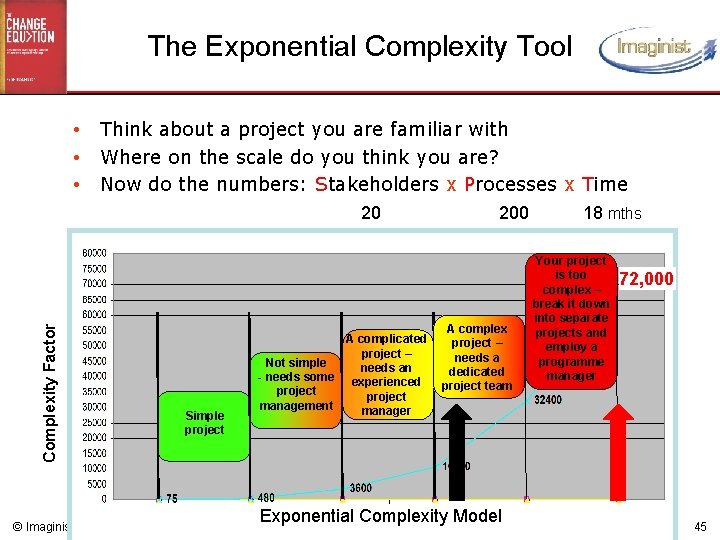
The Exponential Complexity Tool • • • Think about a project you are familiar with Where on the scale do you think you are? Now do the numbers: Stakeholders x Processes x Time Complexity Factor 20 © Imaginist 2011 Simple project A complicated project – Not simple needs an - needs some experienced project management manager 200 A complex project – needs a dedicated project team Exponential Complexity Model 18 mths Your project is too complex – break it down into separate projects and employ a programme manager 72, 000 45
Combining Capability and Complexity © Imaginist 2011 46
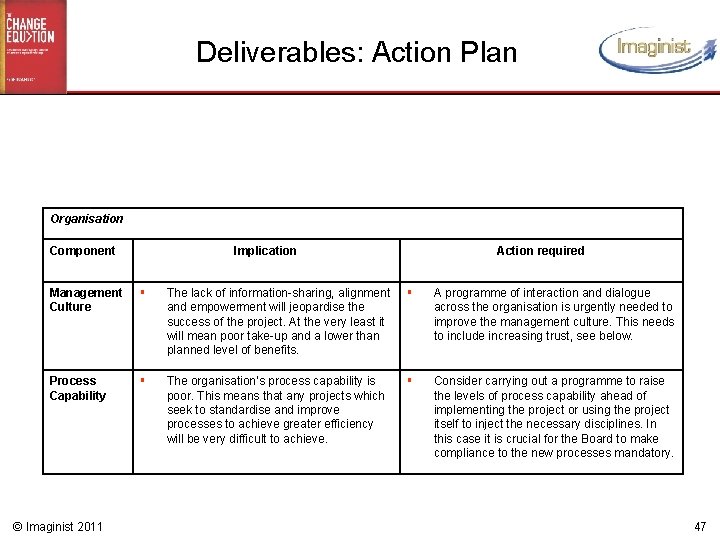
Deliverables: Action Plan Organisation Component Implication Action required Management Culture § The lack of information-sharing, alignment and empowerment will jeopardise the success of the project. At the very least it will mean poor take-up and a lower than planned level of benefits. § A programme of interaction and dialogue across the organisation is urgently needed to improve the management culture. This needs to include increasing trust, see below. Process Capability § The organisation’s process capability is poor. This means that any projects which seek to standardise and improve processes to achieve greater efficiency will be very difficult to achieve. § Consider carrying out a programme to raise the levels of process capability ahead of implementing the project or using the project itself to inject the necessary disciplines. In this case it is crucial for the Board to make compliance to the new processes mandatory. © Imaginist 2011 47
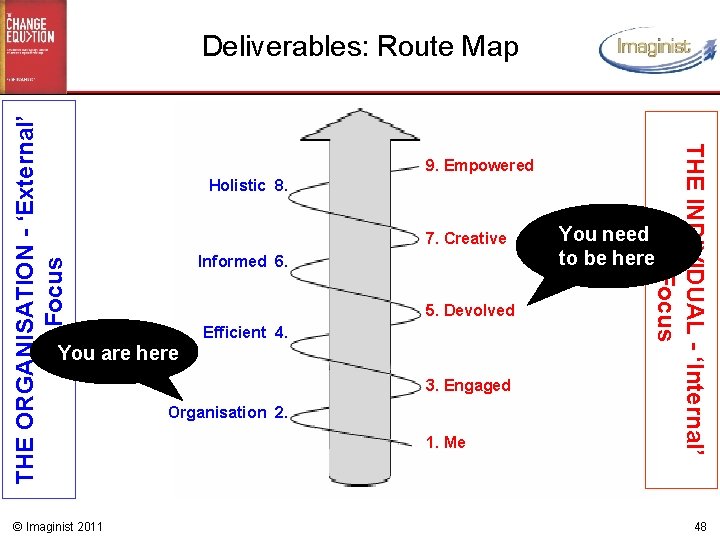
9. Empowered Holistic 8. 7. Creative Informed 6. 5. Devolved Efficient 4. You are here © Imaginist 2011 3. Engaged Organisation 2. 1. Me THE INDIVIDUAL - ‘Internal’ Focus THE ORGANISATION - ‘External’ Focus Deliverables: Route Map You need to be here 48
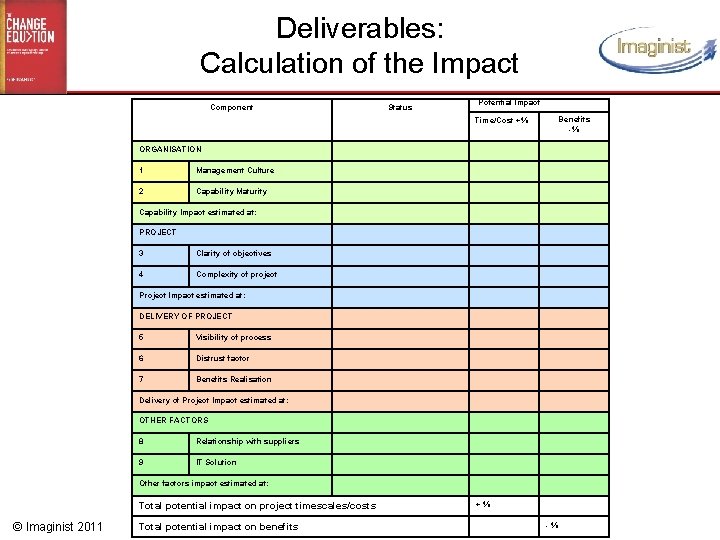
Deliverables: Calculation of the Impact Component Status Potential Impact Benefits -% Time/Cost +% ORGANISATION 1 Management Culture 2 Capability Maturity Capability Impact estimated at: PROJECT 3 Clarity of objectives 4 Complexity of project Project Impact estimated at: DELIVERY OF PROJECT 5 Visibility of process 6 Distrust factor 7 Benefits Realisation Delivery of Project Impact estimated at: OTHER FACTORS 8 Relationship with suppliers 9 IT Solution Other factors impact estimated at: Total potential impact on project timescales/costs © Imaginist 2011 Total potential impact on benefits +% -%
Summary § The Change Equation methodology is designed to be integrated into standard practice: • at Project level – CRA ensures Change Readiness and deliver consistent improvement in change project outcomes • at Programme level – Change Equation principles, Route Maps and Action Plans provides framework and content to deliver organisational Capability for Change as a key outcome § If you think this approach might be of value to your organisation, please contact us © Imaginist 2011 50
Can you afford not to find out more? Peter Duschinsky Managing Director The Imaginist Company ‘The Change Equation’ is available from Amazon. co. uk © Imaginist 2011 Email: peterd@imaginist. co. uk Tel: 020 8201 1478 Mob: 07801 802 571 Web: http: //www. imaginist. co. uk 51
- Slides: 51