
The Chandra Source Catalog and related activities 101430

- Slides: 17
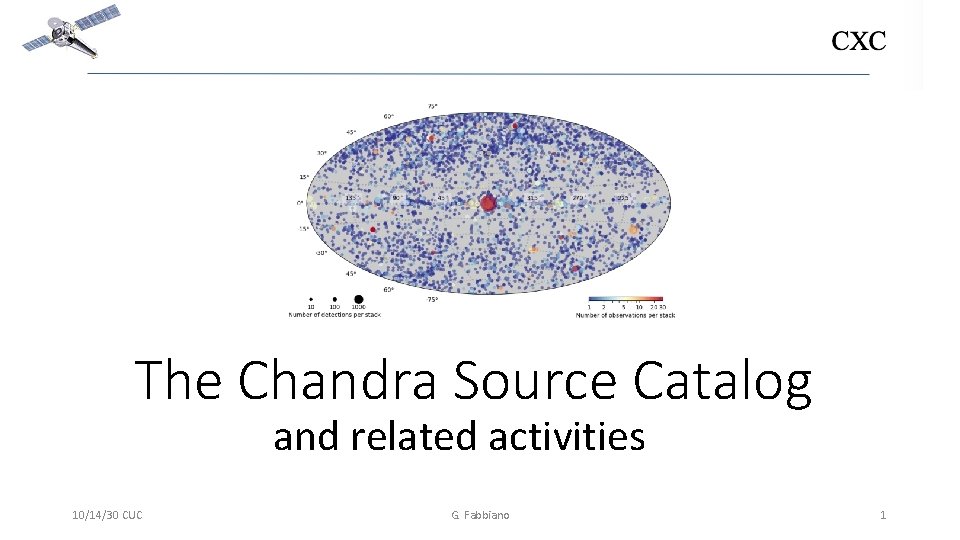
The Chandra Source Catalog and related activities 10/14/30 CUC G. Fabbiano 1
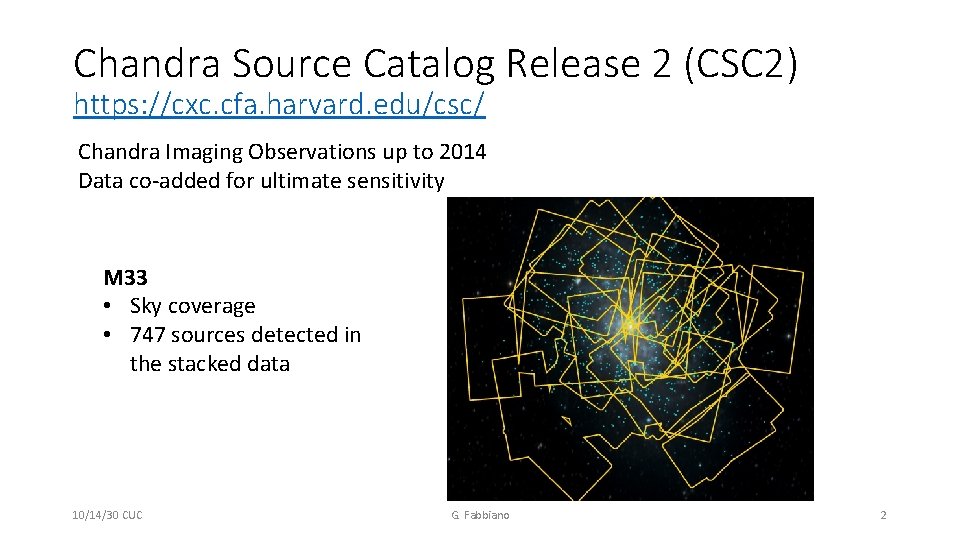
Chandra Source Catalog Release 2 (CSC 2) https: //cxc. cfa. harvard. edu/csc/ Chandra Imaging Observations up to 2014 Data co-added for ultimate sensitivity M 33 • Sky coverage • 747 sources detected in the stacked data 10/14/30 CUC G. Fabbiano 2
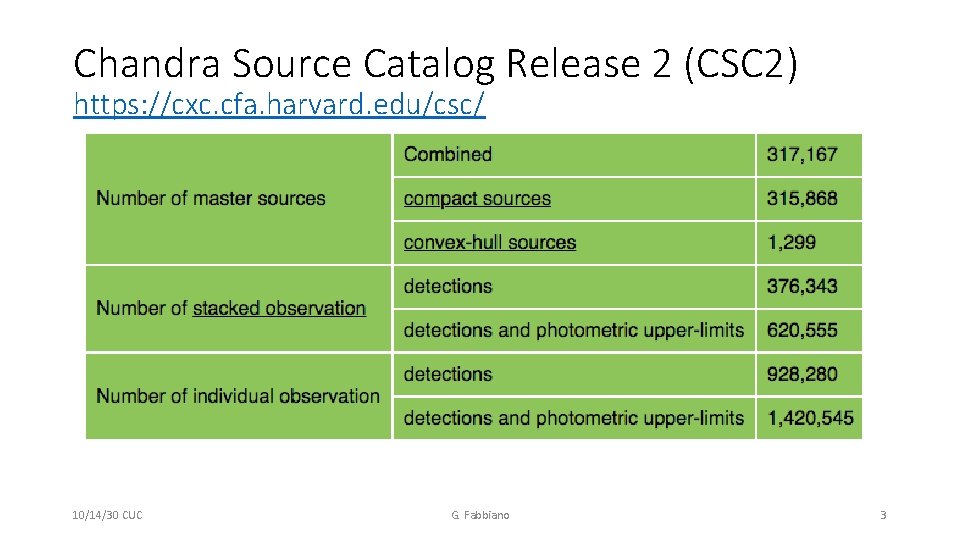
Chandra Source Catalog Release 2 (CSC 2) https: //cxc. cfa. harvard. edu/csc/ 10/14/30 CUC G. Fabbiano 3
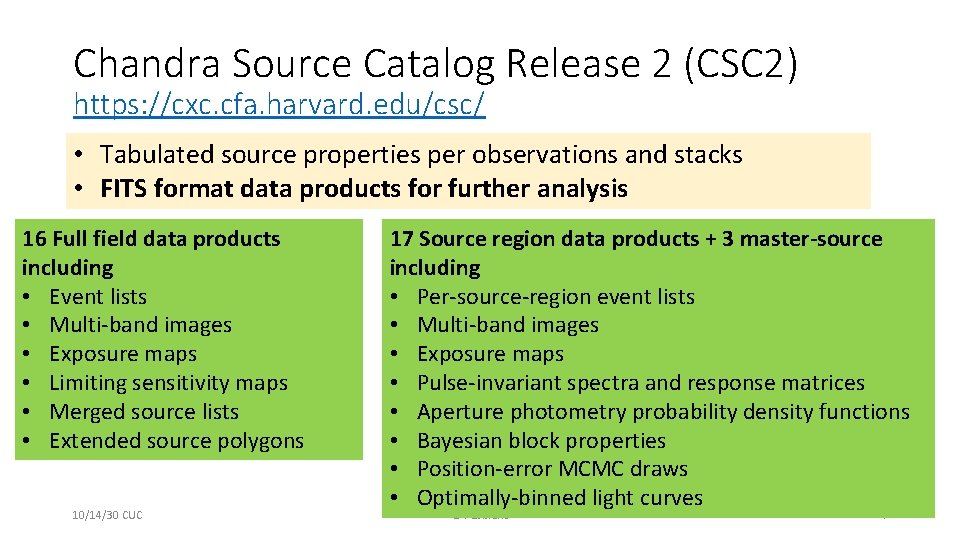
Chandra Source Catalog Release 2 (CSC 2) https: //cxc. cfa. harvard. edu/csc/ • Tabulated source properties per observations and stacks • FITS format data products for further analysis 16 Full field data products including • Event lists • Multi-band images • Exposure maps • Limiting sensitivity maps • Merged source lists • Extended source polygons 10/14/30 CUC 17 Source region data products + 3 master-source including • Per-source-region event lists • Multi-band images • Exposure maps • Pulse-invariant spectra and response matrices • Aperture photometry probability density functions • Bayesian block properties • Position-error MCMC draws • Optimally-binned light curves G. Fabbiano 4
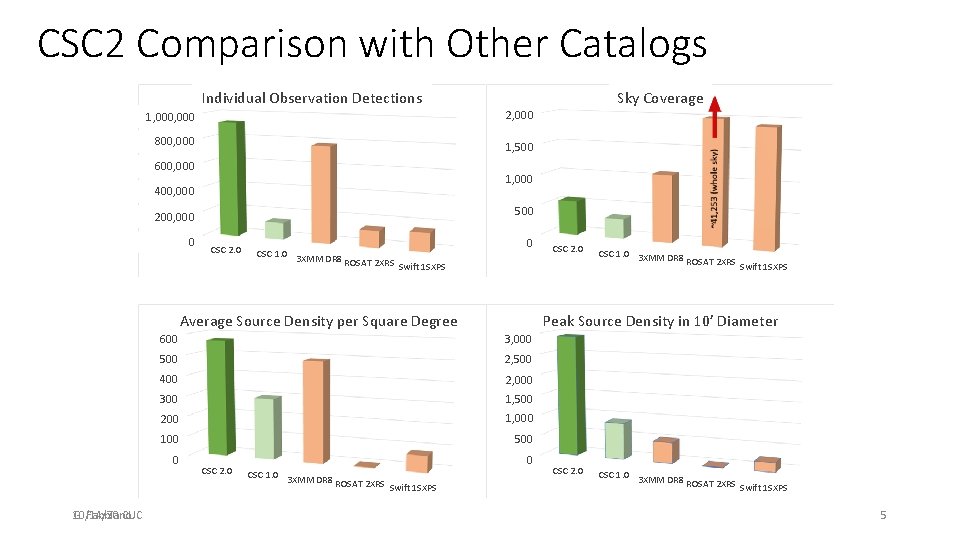
CSC 2 Comparison with Other Catalogs Individual Observation Detections 1, 000 2, 000 800, 000 1, 500 600, 000 1, 000 400, 000 500 200, 000 0 CSC 2. 0 CSC 1. 0 3 XMM DR 8 ROSAT 2 XRS 0 3, 000 500 2, 500 400 2, 000 300 1, 500 200 1, 000 100 500 G. Fabbiano 10/14/30 CUC 0 CSC 1. 0 3 XMM DR 8 ROSAT 2 XRS Swift 1 SXPS Peak Source Density in 10’ Diameter 600 CSC 2. 0 Swift 1 SXPS Average Source Density per Square Degree 0 Sky Coverage CSC 2. 0 CSC 1. 0 3 XMM DR 8 ROSAT 2 XRS Swift 1 SXPS 5
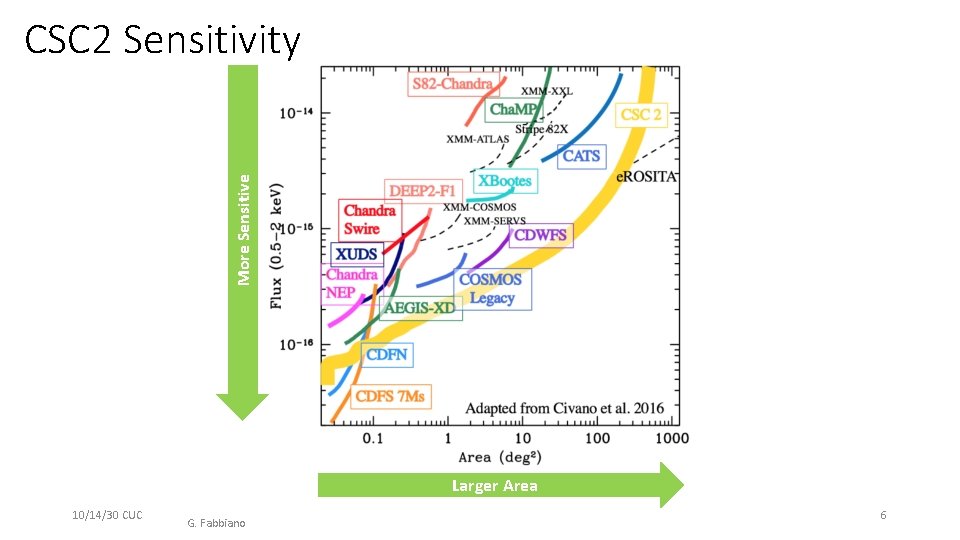
More Sensitive CSC 2 Sensitivity Larger Area 10/14/30 CUC G. Fabbiano 6
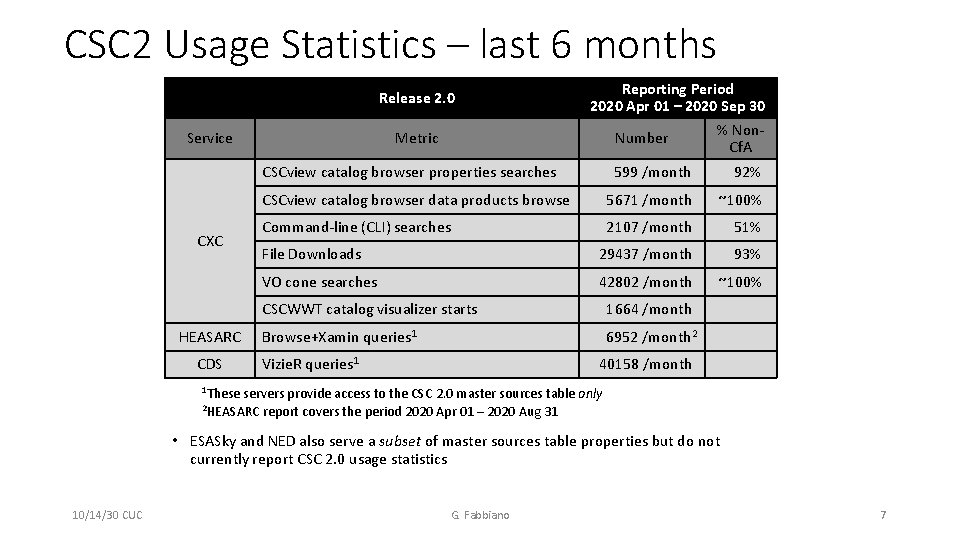
CSC 2 Usage Statistics – last 6 months Release 2. 0 Service Metric Reporting Period 2020 Apr 01 – 2020 Sep 30 % Non. Number Cf. A CSCview catalog browser properties searches CXC HEASARC CDS 1 These 599 /month 92% CSCview catalog browser data products browse 5671 /month ~100% Command-line (CLI) searches 2107 /month 51% File Downloads 29437 /month 93% VO cone searches 42802 /month ~100% CSCWWT catalog visualizer starts 1664 /month Browse+Xamin queries 1 6952 /month 2 Vizie. R queries 1 40158 /month servers provide access to the CSC 2. 0 master sources table only report covers the period 2020 Apr 01 – 2020 Aug 31 2 HEASARC • ESASky and NED also serve a subset of master sources table properties but do not currently report CSC 2. 0 usage statistics 10/14/30 CUC G. Fabbiano 7
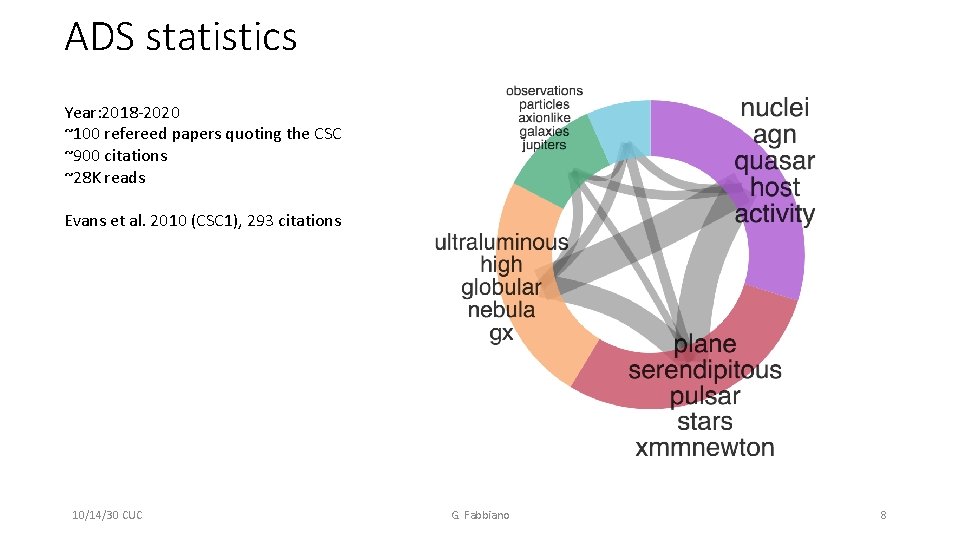
ADS statistics Year: 2018 -2020 ~100 refereed papers quoting the CSC ~900 citations ~28 K reads Evans et al. 2010 (CSC 1), 293 citations 10/14/30 CUC G. Fabbiano 8
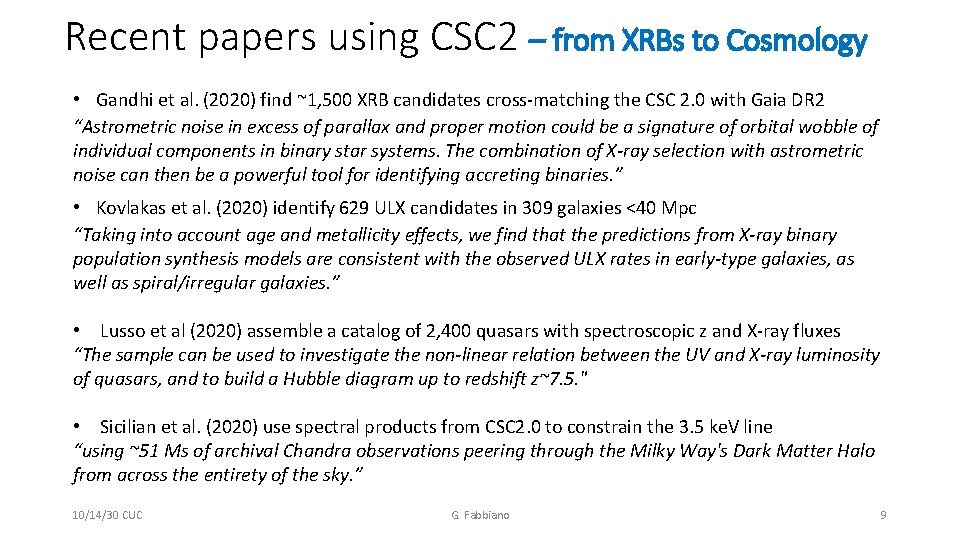
Recent papers using CSC 2 – from XRBs to Cosmology • Gandhi et al. (2020) find ~1, 500 XRB candidates cross-matching the CSC 2. 0 with Gaia DR 2 “Astrometric noise in excess of parallax and proper motion could be a signature of orbital wobble of individual components in binary star systems. The combination of X-ray selection with astrometric noise can then be a powerful tool for identifying accreting binaries. ” • Kovlakas et al. (2020) identify 629 ULX candidates in 309 galaxies <40 Mpc “Taking into account age and metallicity effects, we find that the predictions from X-ray binary population synthesis models are consistent with the observed ULX rates in early-type galaxies, as well as spiral/irregular galaxies. ” • Lusso et al (2020) assemble a catalog of 2, 400 quasars with spectroscopic z and X-ray fluxes “The sample can be used to investigate the non-linear relation between the UV and X-ray luminosity of quasars, and to build a Hubble diagram up to redshift z~7. 5. " • Sicilian et al. (2020) use spectral products from CSC 2. 0 to constrain the 3. 5 ke. V line “using ~51 Ms of archival Chandra observations peering through the Milky Way's Dark Matter Halo from across the entirety of the sky. ” 10/14/30 CUC G. Fabbiano 9
CSC 2 Status, Activities & Projections 10/14/30 CUC G. Fabbiano 10
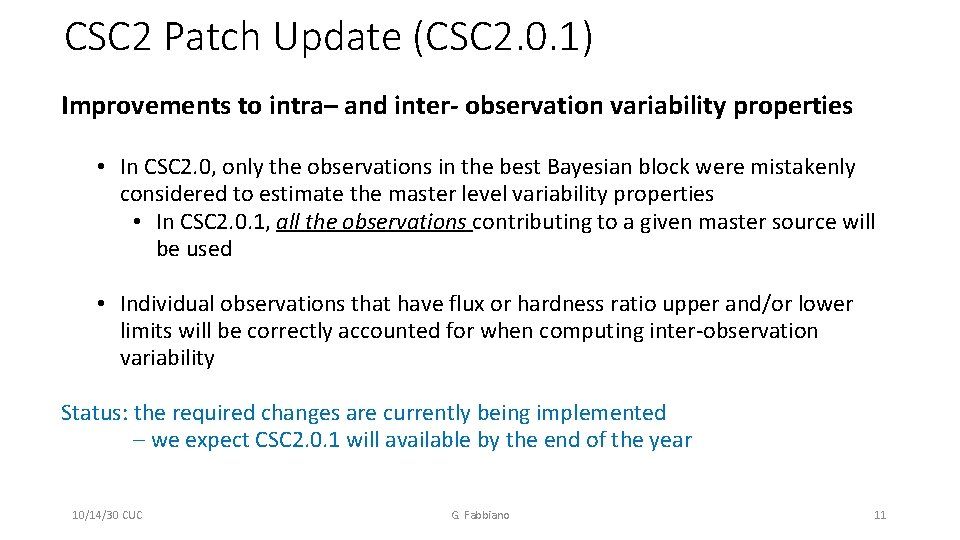
CSC 2 Patch Update (CSC 2. 0. 1) Improvements to intra– and inter- observation variability properties • In CSC 2. 0, only the observations in the best Bayesian block were mistakenly considered to estimate the master level variability properties • In CSC 2. 0. 1, all the observations contributing to a given master source will be used • Individual observations that have flux or hardness ratio upper and/or lower limits will be correctly accounted for when computing inter-observation variability Status: the required changes are currently being implemented – we expect CSC 2. 0. 1 will available by the end of the year 10/14/30 CUC G. Fabbiano 11
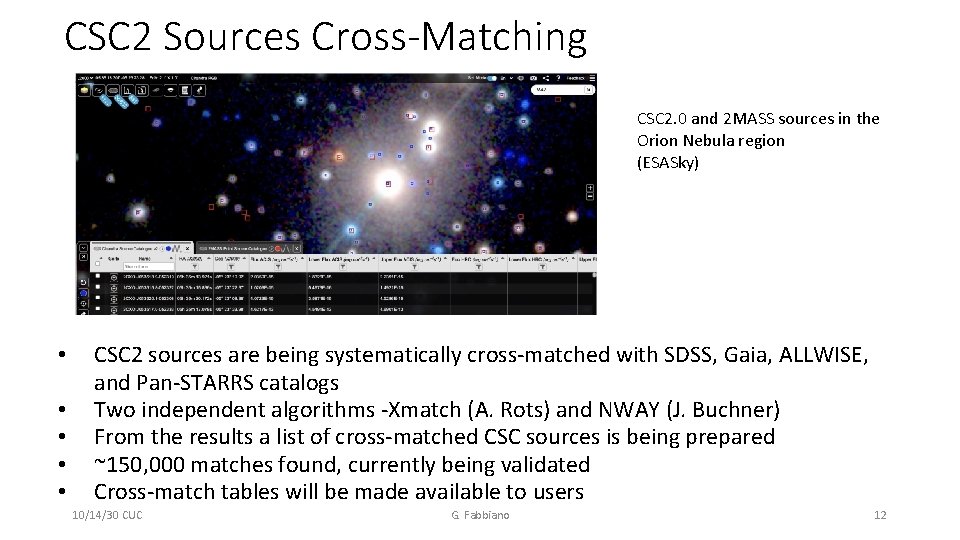
CSC 2 Sources Cross-Matching CSC 2. 0 and 2 MASS sources in the Orion Nebula region (ESASky) • • • CSC 2 sources are being systematically cross-matched with SDSS, Gaia, ALLWISE, and Pan-STARRS catalogs Two independent algorithms -Xmatch (A. Rots) and NWAY (J. Buchner) From the results a list of cross-matched CSC sources is being prepared ~150, 000 matches found, currently being validated Cross-match tables will be made available to users 10/14/30 CUC G. Fabbiano 12
CSC 2 – SDSS-V Observations • The Cf. A and the CXC have joined the SDSS consortium • The list of CSC sources matched with optical counterparts will be used for SDSS-V observations as part of the spectroscopic timedomain survey • A sub-set of these cross-matched CSC sources will be observed by SDSS-V • The CXC will support a local public repository of SDSS-V optical spectra for CSC sources 10/14/30 CUC G. Fabbiano 13
CSC 2 Release Update (CSC 2. 1) Add 2015 - 2021 public observations • Same property list and data products as in CSC 2. 0 • Some stack-level and master-level properties will change, due to adding new observations to existing stacks Improved algorithms • Fine stack astrometry: stack astrometry will be tied to the Gaia reference frame • Aperture photometry: improved optimization and MCMC sampling techniques using state-of-the -art tools such as pymc 3 • Maximum Likelihood algorithm: improved to reduce ‘manual’ Quality Assurance verification of source positions and position errors • Specfit: resolve a small fraction of glitches in the current spectral fits and possibly add APEC models Changes are tested against CSC 2. 0 in order to assure consistency 10/14/30 CUC G. Fabbiano 14
CSC 2. 1 Activities Timeline Expected processing start at the end of 2021 • After completion of the ongoing reprocessing of the entire CXC data set (REPRO-V) Expected processing time ~1 year • New data will be made available via the CSCview Current Database view as processing proceeds • Processing of observation fields that do not overlap existing stacks will be prioritized In preparation: • Developing and implementing improved algorithms - Fine stack astrometry, aperture astrometry, MLE, Specfit • Upgraded processing and infrastructure to new cluster (felix) • Implementing the operational procedures for the DSOps group • Developing a clean set of reprocessing infrastructure and procedures - The CSC 2 release has shown that reprocessing is important • Perform end-to-end testing and integration of all of the CSC 2 pipelines - to make them robust for processing run by DSOps 10/14/30 CUC G. Fabbiano 15
Repro V • Apply uniformly the latest set of calibrations, including new clock correlation files • Improve the aspect software, to obtain improved estimates of the optical axis position, and of the Aspect Camera Assembly (ACA) plate scale - Needed to avoid deteriorations of source photometry and position • Implement a polynomial fit for a new Charge Transfer Inefficiency (CTI) correction as ACIS is operating at warmer temperatures • Include additional columns in the HRC Level 2 event list, and add a new HRC degapping algorithm to improve calculation of chip coordinates near the edges of the chip • Include RMF/ARF for gratings to the Primary data product package • Clean-up of bad target names for archival observations taken through the end of 2016 • Enhance the Chandra legacy by replacing with (mostly) resolvable target names • Improve discoverability of archival observations • Produce and add standard unique data identifiers to data products - Digital Object Identifiers (DOIs) 10/14/30 CUC G. Fabbiano 16
Summary • The CSC 2. 0 release provides the most sensitive view of the X-ray sky to date, excelling in deep exposure and crowded source regions • The CSC 2 is actively used by the community • Refereed papers using the CSC 2 cover research areas from stars to cosmology • CSC 2. 0. 1 patch update will correct some timing issues – available by the end of this year • CSC 2. 1 release update in preparation - Add to the CSC years 2015 -2021 o Same property list and data products as in CSC 2. 0 o Some stack-level and master-level properties will change, due to adding new observations to existing stacks - Improved algorithms - Processing infrastructure will allow processing by the Ops group - Will include latest reprocessed data (Repro V) 10/14/30 CUC G. Fabbiano 17