
The challenges of protecting the superconducting magnets and
![LHC cycle and stored beam energy 7000 Energy [Ge. V/c] 6000 energy ramp 25](https://slidetodoc.com/presentation_image_h2/1f30a80fef4adca22eb8a37fdb586805/image-6.jpg "LHC cycle and stored beam energy 7000 Energy [Ge. V/c] 6000 energy ramp 25")
![LHC cycle and stored magnet energy (main dipoles) 12000 10000 Current [k. A] current](https://slidetodoc.com/presentation_image_h2/1f30a80fef4adca22eb8a37fdb586805/image-7.jpg "LHC cycle and stored magnet energy (main dipoles) 12000 10000 Current [k. A] current")
![Operational margin of a superconducting magnet Applied Magnetic Field [T] Bc critical field Bc](https://slidetodoc.com/presentation_image_h2/1f30a80fef4adca22eb8a37fdb586805/image-19.jpg "Operational margin of a superconducting magnet Applied Magnetic Field [T] Bc critical field Bc")
![Fast Power Abort from 5500 A (PNO. C 2) time [s] Academic Training May](https://slidetodoc.com/presentation_image_h2/1f30a80fef4adca22eb8a37fdb586805/image-43.jpg "Fast Power Abort from 5500 A (PNO. C 2) time [s] Academic Training May")
![Quench - detail time [s] Academic Training May 2008 45](https://slidetodoc.com/presentation_image_h2/1f30a80fef4adca22eb8a37fdb586805/image-45.jpg "Quench - detail time [s] Academic Training May 2008 45")
- Slides: 49
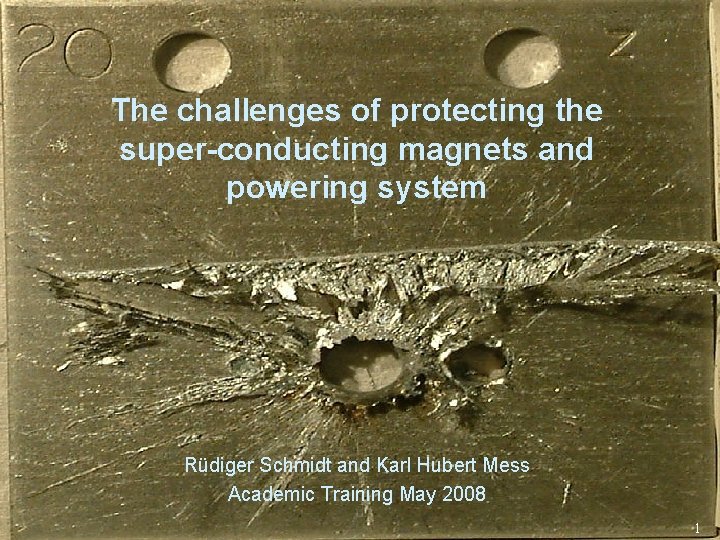
The challenges of protecting the super-conducting magnets and powering system Rüdiger Schmidt and Karl Hubert Mess Academic Training May 2008 1
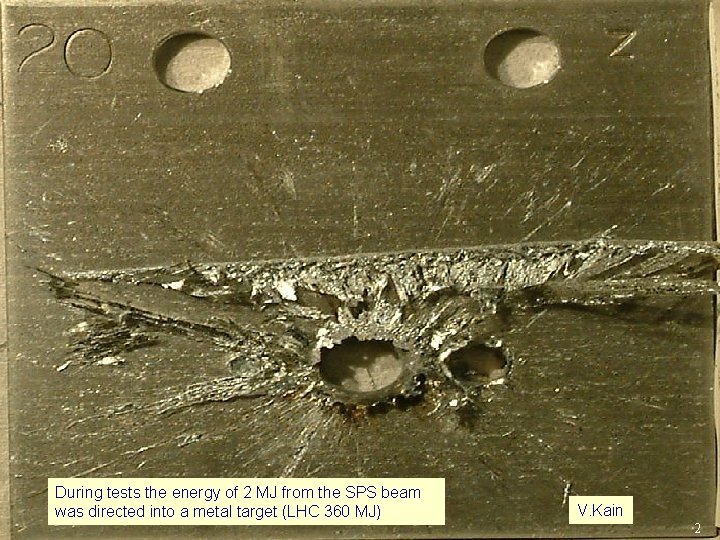
During tests the energy of 2 MJ from the SPS beam was directed into a metal target (LHC 360 MJ) V. Kain 2
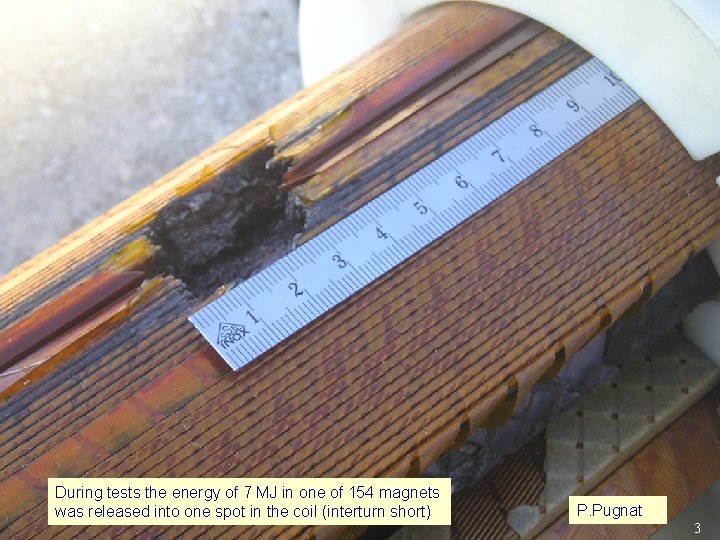
During tests the energy of 7 MJ in one of 154 magnets was released into one spot in the coil (interturn short) P. Pugnat 3
Overview • Energy in beams and magnets …. and their controlled discharge • Beam and powering interlock systems • Quenches in superconducting magnets • LHC powering architecture • Powering system: magnet types and electrical circuit types • Protection for the electrical circuits • Procedure for commissioning of (the protection systems) an electrical circuit and recent experience • Interlocks systems during beam operation Academic Training May 2008 4
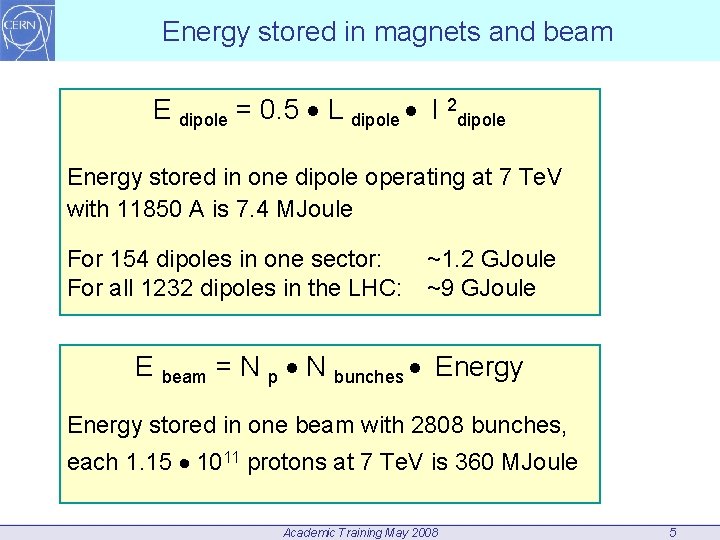
Energy stored in magnets and beam E dipole = 0. 5 L dipole I 2 dipole Energy stored in one dipole operating at 7 Te. V with 11850 A is 7. 4 MJoule For 154 dipoles in one sector: For all 1232 dipoles in the LHC: ~1. 2 GJoule ~9 GJoule E beam = N p N bunches Energy stored in one beam with 2808 bunches, each 1. 15 1011 protons at 7 Te. V is 360 MJoule Academic Training May 2008 5
LHC cycle and stored beam energy 7000 Energy [Ge. V/c] 6000 energy ramp 25 5000 MJ 360 MJ circulating beam 2808 bunches 4000 360 MJ circulating beam 3000 2000 1000 coast beam dump injection phase 3 MJ 25 MJ beam transfer circulating beam discharge of energy into beam dump block 0 -4000 12 batches from the SPS (every-2000 20 sec)0 2000 one batch 216 / 288 bunches 4000 time from start of injection (s) 3 MJ per batch Academic Training May 2008 6
LHC cycle and stored magnet energy (main dipoles) 12000 10000 Current [k. A] current ramp 36 MJ 9 GJ for 1232 dipole magnets 8000 9 GJ 6000 4000 2000 1 coast in case of quench injection current 760 A 0. 53 T discharge of energy into resistors 0 -4000 -2000 0 2000 4000 time from start of injection (s) Academic Training May 2008 7
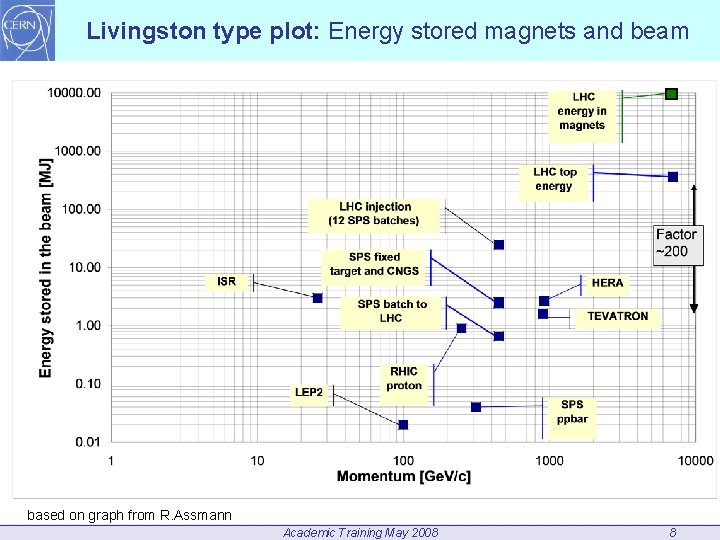
Livingston type plot: Energy stored magnets and beam based on graph from R. Assmann Academic Training May 2008 8
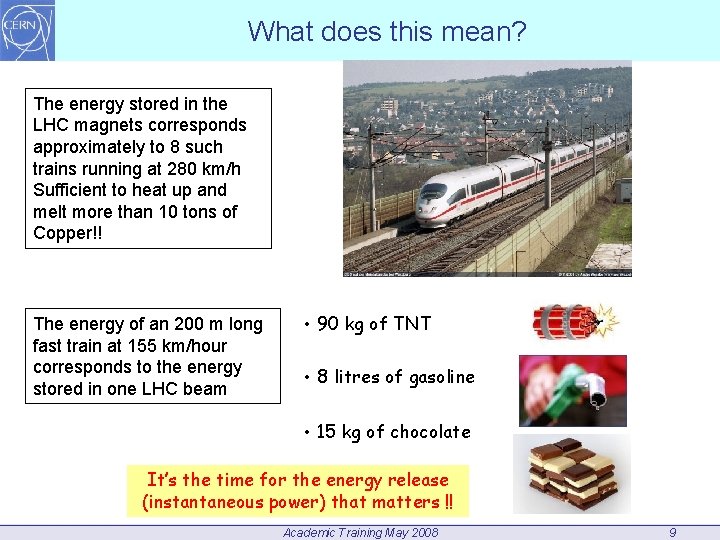
What does this mean? The energy stored in the LHC magnets corresponds approximately to 8 such trains running at 280 km/h Sufficient to heat up and melt more than 10 tons of Copper!! The energy of an 200 m long fast train at 155 km/hour corresponds to the energy stored in one LHC beam • 90 kg of TNT • 8 litres of gasoline • 15 kg of chocolate It’s the time for the energy release (instantaneous power) that matters !! Academic Training May 2008 9
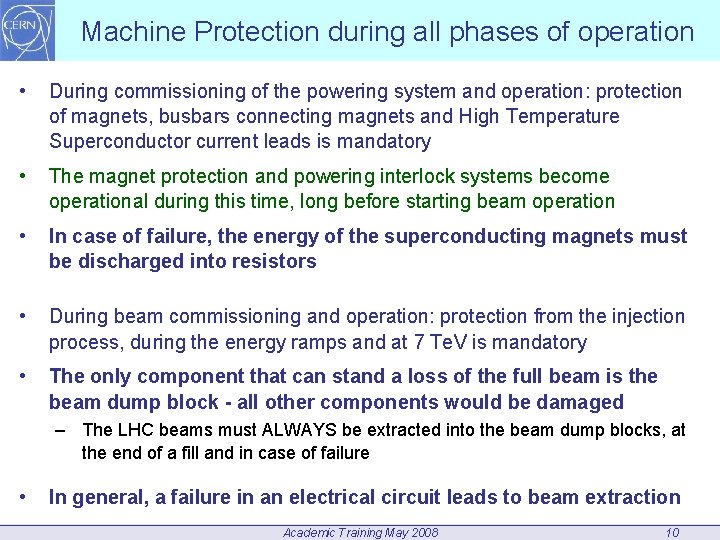
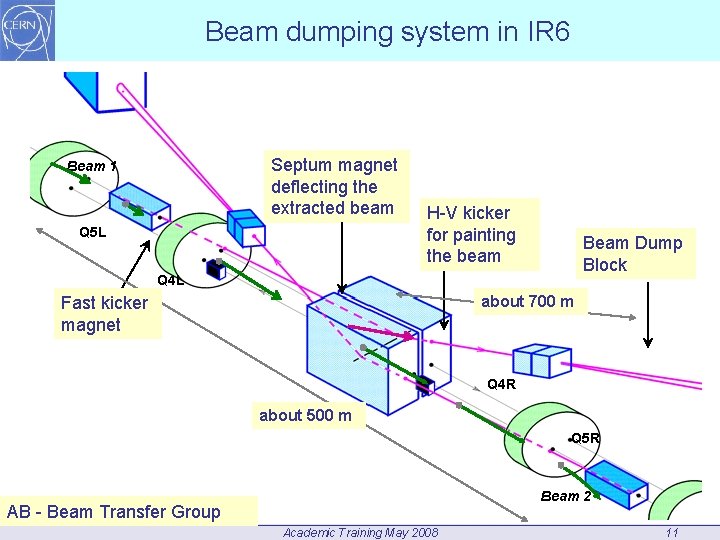
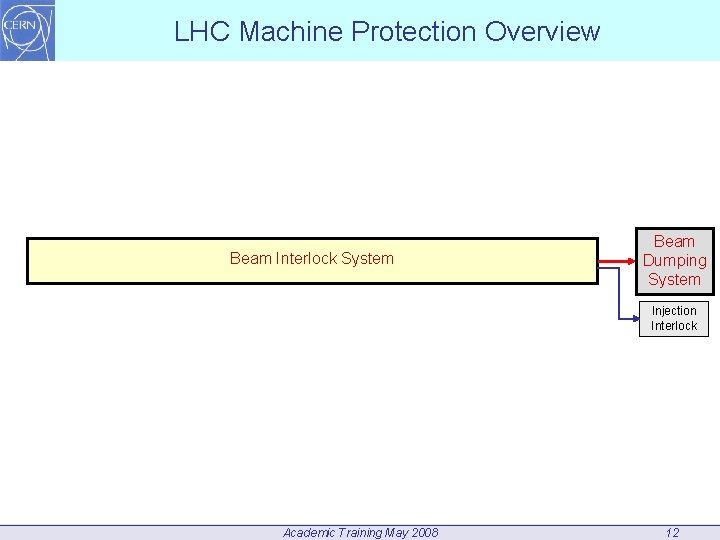
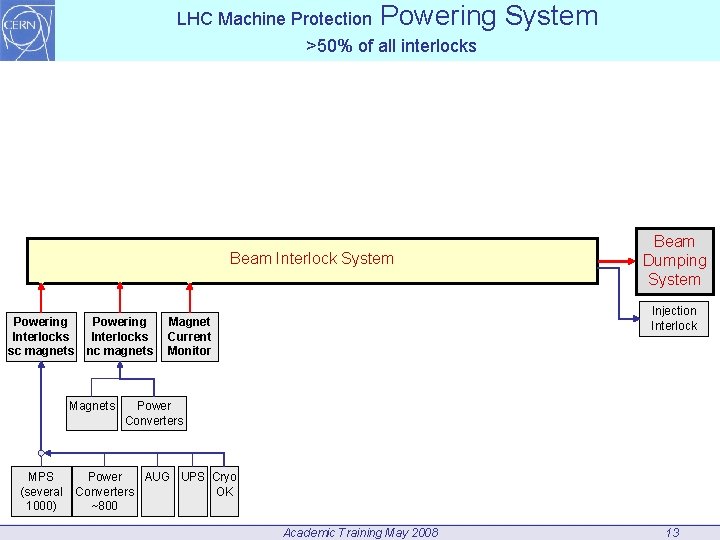
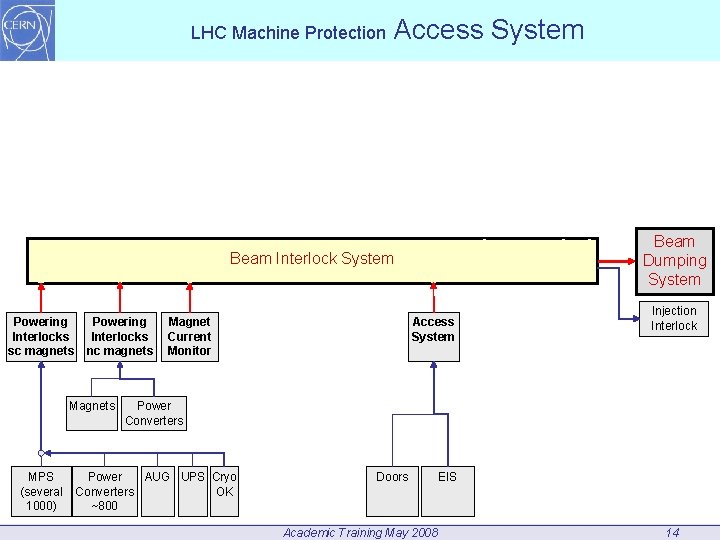
Machine Protection during all phases of operation • During commissioning of the powering system and operation: protection of magnets, busbars connecting magnets and High Temperature Superconductor current leads is mandatory • The magnet protection and powering interlock systems become operational during this time, long before starting beam operation • In case of failure, the energy of the superconducting magnets must be discharged into resistors • During beam commissioning and operation: protection from the injection process, during the energy ramps and at 7 Te. V is mandatory • The only component that can stand a loss of the full beam is the beam dump block - all other components would be damaged – The LHC beams must ALWAYS be extracted into the beam dump blocks, at the end of a fill and in case of failure • In general, a failure in an electrical circuit leads to beam extraction Academic Training May 2008 10
Beam dumping system in IR 6 Septum magnet deflecting the extracted beam Beam 1 Q 5 L H-V kicker for painting the beam Beam Dump Block Q 4 L about 700 m Fast kicker magnet Q 4 R about 500 m Q 5 R Beam 2 AB - Beam Transfer Group Academic Training May 2008 11
LHC Machine Protection Overview Beam Interlock System Beam Dumping System Injection Interlock Academic Training May 2008 12
LHC Machine Protection Powering >50% of all interlocks Beam Interlock System Powering Interlocks sc magnets Powering Interlocks nc magnets MPS (several 1000) System Beam Dumping System Injection Interlock Magnet Current Monitor Power Converters Power AUG UPS Cryo Converters OK ~800 Academic Training May 2008 13
LHC Machine Protection Access System Beam Dumping System Beam Interlock System Powering Interlocks sc magnets Powering Interlocks nc magnets MPS (several 1000) Magnet Current Monitor Access System Injection Interlock Power Converters Power AUG UPS Cryo Converters OK ~800 Doors Academic Training May 2008 EIS 14
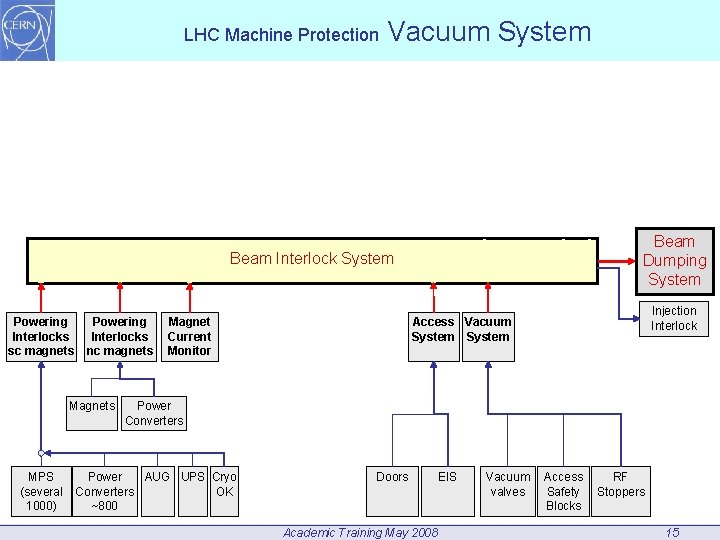
LHC Machine Protection Vacuum System Beam Dumping System Beam Interlock System Powering Interlocks sc magnets Powering Interlocks nc magnets MPS (several 1000) Magnet Current Monitor Injection Interlock Access Vacuum System Power Converters Power AUG UPS Cryo Converters OK ~800 Doors Academic Training May 2008 EIS Vacuum valves Access Safety Blocks RF Stoppers 15
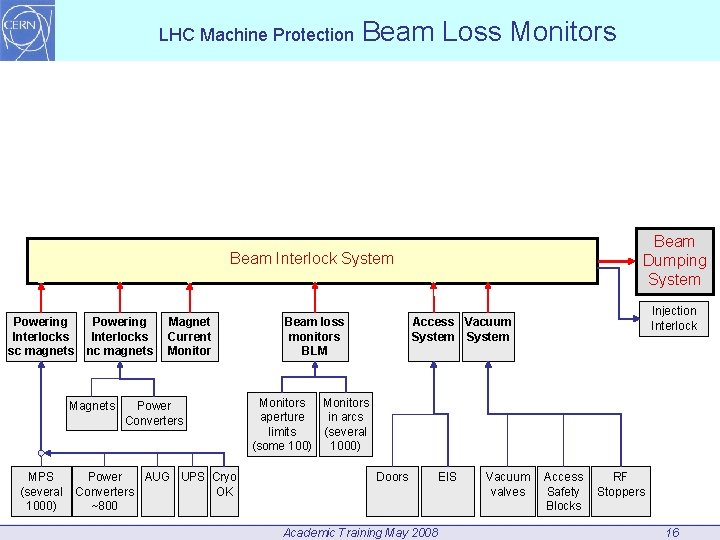
LHC Machine Protection Beam Loss Monitors Beam Dumping System Beam Interlock System Powering Interlocks sc magnets Powering Interlocks nc magnets MPS (several 1000) Magnet Current Monitor Power Converters Power AUG UPS Cryo Converters OK ~800 Beam loss monitors BLM Injection Interlock Access Vacuum System Monitors aperture in arcs limits (several (some 100) 1000) Doors Academic Training May 2008 EIS Vacuum valves Access Safety Blocks RF Stoppers 16
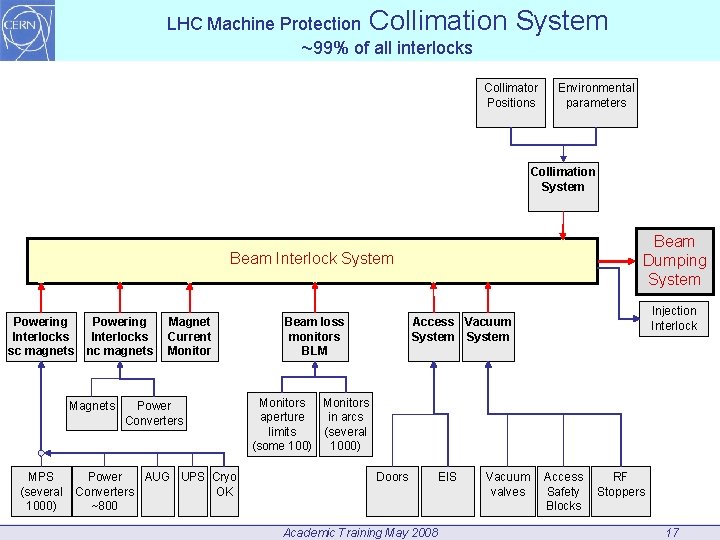
LHC Machine Protection Collimation ~99% of all interlocks System Collimator Positions Environmental parameters Collimation System Beam Dumping System Beam Interlock System Powering Interlocks sc magnets Powering Interlocks nc magnets MPS (several 1000) Magnet Current Monitor Power Converters Power AUG UPS Cryo Converters OK ~800 Beam loss monitors BLM Injection Interlock Access Vacuum System Monitors aperture in arcs limits (several (some 100) 1000) Doors Academic Training May 2008 EIS Vacuum valves Access Safety Blocks RF Stoppers 17
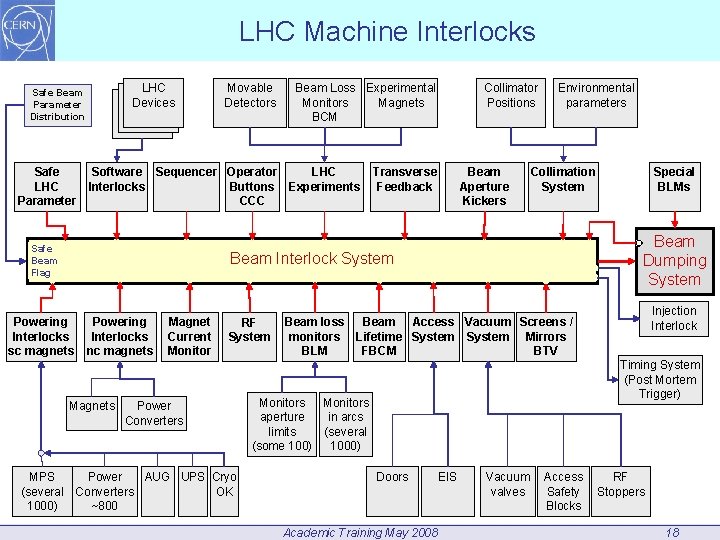
LHC Machine Interlocks LHC LHC Devices Safe Beam Parameter Distribution Safe LHC Parameter Movable Detectors Beam Loss Experimental Monitors Magnets BCM Software Sequencer Operator LHC Interlocks Buttons Experiments CCC Safe Beam Flag Collimator Positions Transverse Feedback Beam Aperture Kickers Environmental parameters Collimation System Beam Dumping System Beam Interlock System Powering Interlocks sc magnets Powering Interlocks nc magnets Magnet Current Monitor RF System Power Converters MPS Power AUG UPS Cryo (several Converters OK 1000) ~800 Special BLMs Injection Interlock Beam loss Beam Access Vacuum Screens / monitors Lifetime System Mirrors BLM FBCM BTV Timing System (Post Mortem Trigger) Monitors aperture in arcs limits (several (some 100) 1000) Doors Academic Training May 2008 EIS Vacuum valves Access Safety Blocks RF Stoppers 18
Operational margin of a superconducting magnet Applied Magnetic Field [T] Bc critical field Bc 8. 3 T quench with fast local loss of ~5 · 106 protons QUENCH Tc critical quench with fast local loss of ~5 · 109 protons 0. 54 T 1. 9 K Temperature [K] Academic Training May 2008 temperature 9 K 19
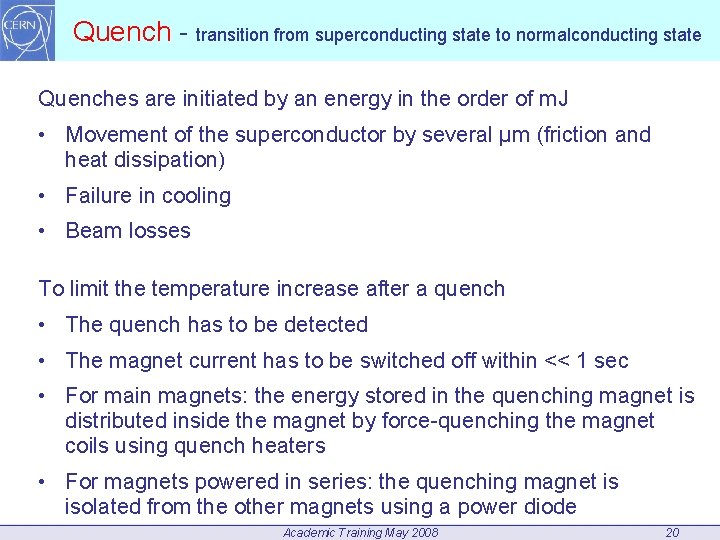
Quench - transition from superconducting state to normalconducting state Quenches are initiated by an energy in the order of m. J • Movement of the superconductor by several µm (friction and heat dissipation) • Failure in cooling • Beam losses To limit the temperature increase after a quench • The quench has to be detected • The magnet current has to be switched off within << 1 sec • For main magnets: the energy stored in the quenching magnet is distributed inside the magnet by force-quenching the magnet coils using quench heaters • For magnets powered in series: the quenching magnet is isolated from the other magnets using a power diode Academic Training May 2008 20
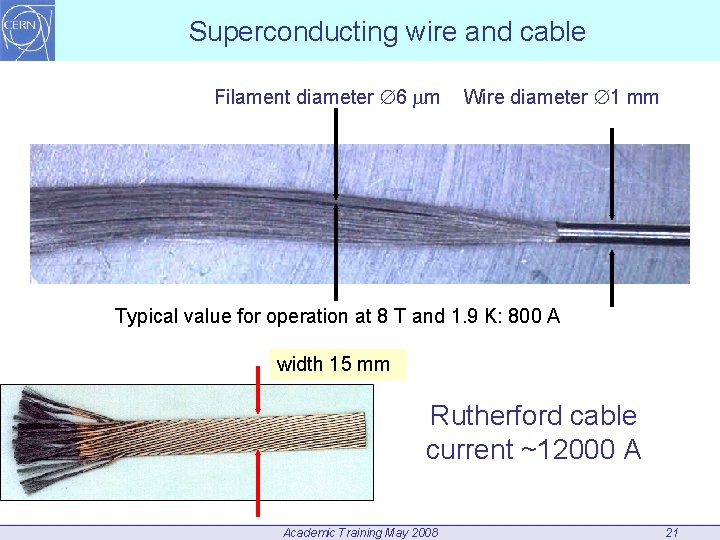
Superconducting wire and cable Filament diameter 6 m Wire diameter 1 mm Typical value for operation at 8 T and 1. 9 K: 800 A width 15 mm Rutherford cable current ~12000 A Academic Training May 2008 21
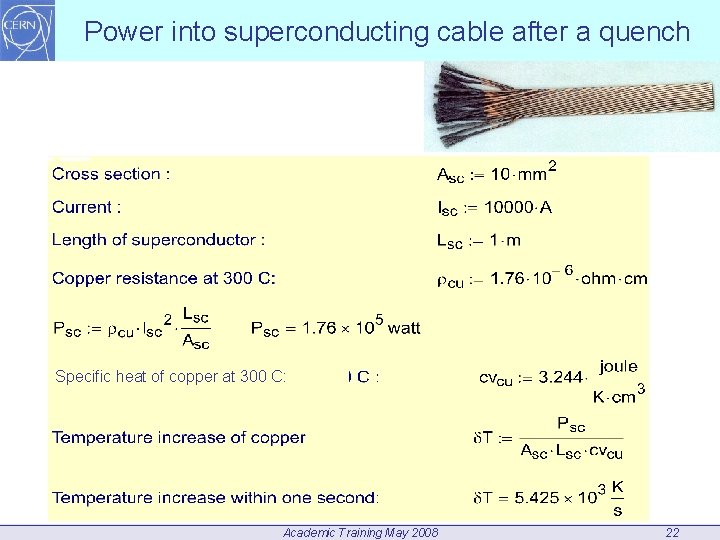
Power into superconducting cable after a quench Specific heat of copper at 300 C: Academic Training May 2008 22
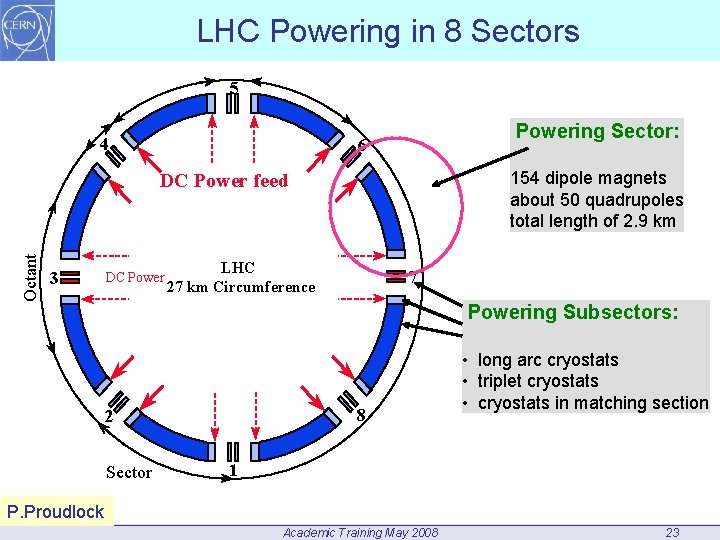
LHC Powering in 8 Sectors 5 4 Powering Sector: 6 154 dipole magnets about 50 quadrupoles total length of 2. 9 km Octant DC Power feed 3 DC Power LHC 27 km Circumference 7 Powering Subsectors: 8 2 Sector • long arc cryostats • triplet cryostats • cryostats in matching section 1 P. Proudlock Academic Training May 2008 23
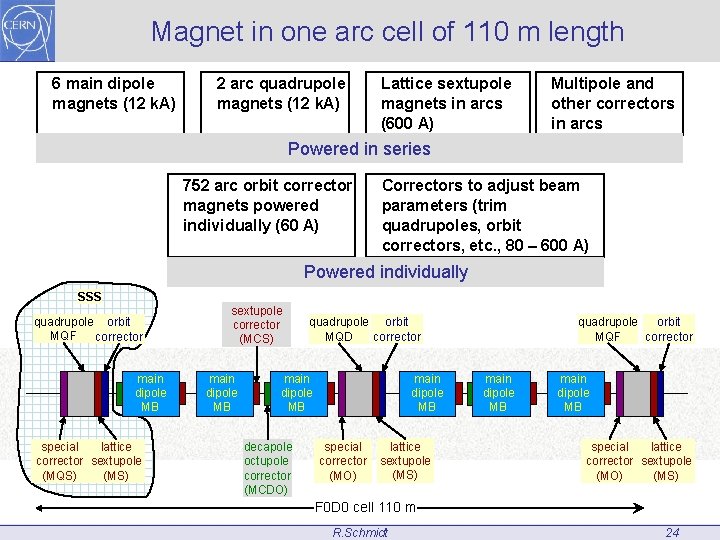
Magnet in one arc cell of 110 m length 6 main dipole magnets (12 k. A) 2 arc quadrupole magnets (12 k. A) Lattice sextupole magnets in arcs (600 A) Multipole and other correctors in arcs Powered in series 752 arc orbit corrector magnets powered individually (60 A) Correctors to adjust beam parameters (trim quadrupoles, orbit correctors, etc. , 80 – 600 A) Powered individually SSS quadrupole orbit MQF corrector main dipole MB special lattice corrector sextupole (MQS) (MS) sextupole corrector (MCS) main dipole MB quadrupole orbit MQD corrector main dipole MB decapole octupole corrector (MCDO) main dipole MB special corrector (MO) lattice sextupole (MS) quadrupole orbit MQF corrector main dipole MB special lattice corrector sextupole (MO) (MS) F 0 D 0 cell 110 m R. Schmidt 24
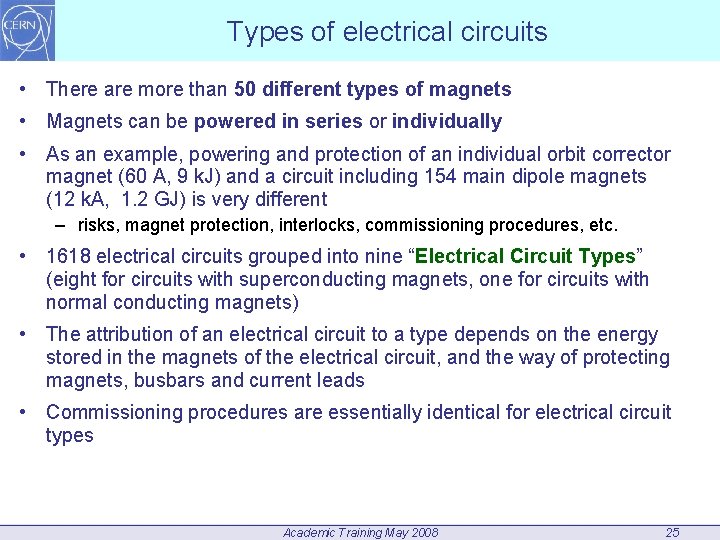
Types of electrical circuits • There are more than 50 different types of magnets • Magnets can be powered in series or individually • As an example, powering and protection of an individual orbit corrector magnet (60 A, 9 k. J) and a circuit including 154 main dipole magnets (12 k. A, 1. 2 GJ) is very different – risks, magnet protection, interlocks, commissioning procedures, etc. • 1618 electrical circuits grouped into nine “Electrical Circuit Types” (eight for circuits with superconducting magnets, one for circuits with normal conducting magnets) • The attribution of an electrical circuit to a type depends on the energy stored in the magnets of the electrical circuit, and the way of protecting magnets, busbars and current leads • Commissioning procedures are essentially identical for electrical circuit types Academic Training May 2008 25
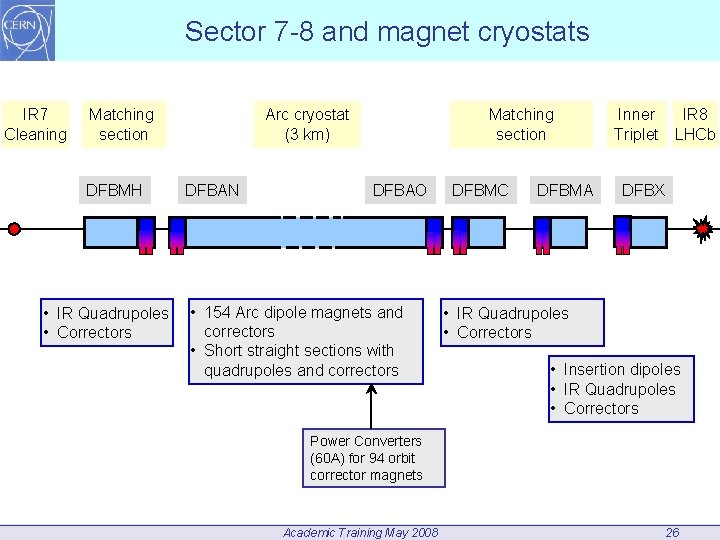
Sector 7 -8 and magnet cryostats IR 7 Cleaning Matching section DFBMH • IR Quadrupoles • Correctors Arc cryostat (3 km) DFBAN Matching section DFBAO • 154 Arc dipole magnets and correctors • Short straight sections with quadrupoles and correctors DFBMC DFBMA Inner Triplet IR 8 LHCb DFBX • IR Quadrupoles • Correctors • Insertion dipoles • IR Quadrupoles • Correctors Power Converters (60 A) for 94 orbit corrector magnets Academic Training May 2008 26
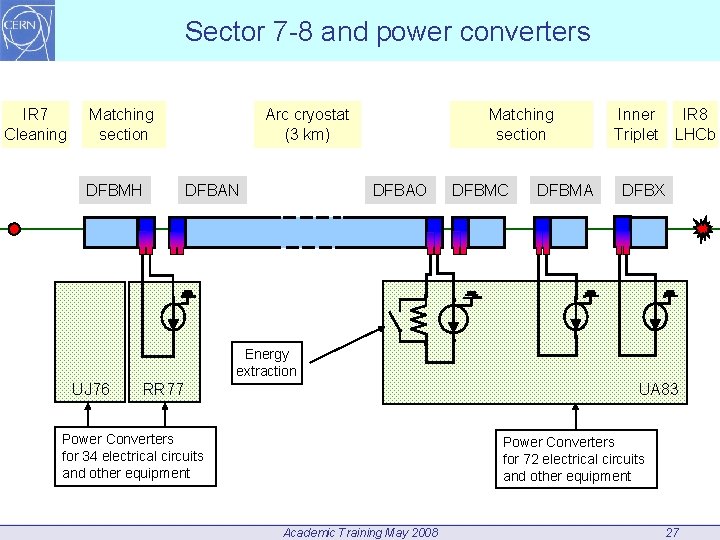
Sector 7 -8 and power converters IR 7 Cleaning Matching section DFBMH Arc cryostat (3 km) DFBAN Matching section DFBAO DFBMC DFBMA Inner Triplet IR 8 LHCb DFBX Energy extraction UJ 76 RR 77 UA 83 Power Converters for 34 electrical circuits and other equipment Power Converters for 72 electrical circuits and other equipment Academic Training May 2008 27
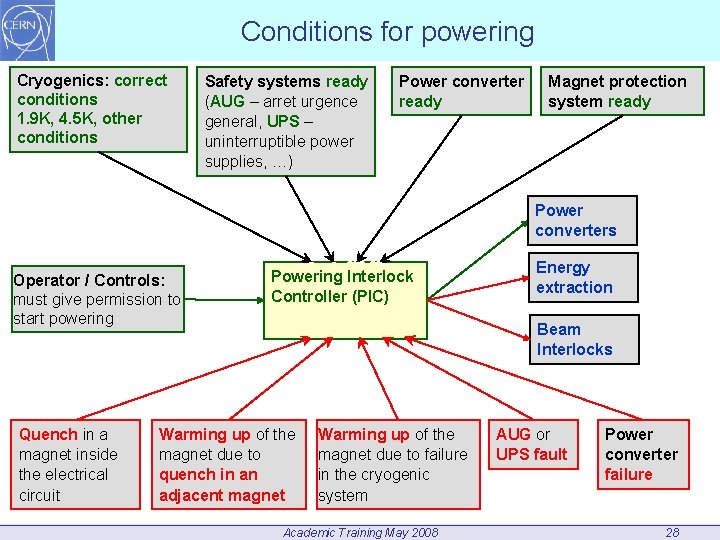
Conditions for powering Cryogenics: correct conditions 1. 9 K, 4. 5 K, other conditions Safety systems ready (AUG – arret urgence general, UPS – uninterruptible power supplies, …) Power converter ready Magnet protection system ready Power converters Operator / Controls: must give permission to start powering Quench in a magnet inside the electrical circuit Powering Interlock Controller (PIC) Energy extraction Beam Interlocks Warming up of the magnet due to quench in an adjacent magnet Warming up of the magnet due to failure in the cryogenic system Academic Training May 2008 AUG or UPS fault Power converter failure 28
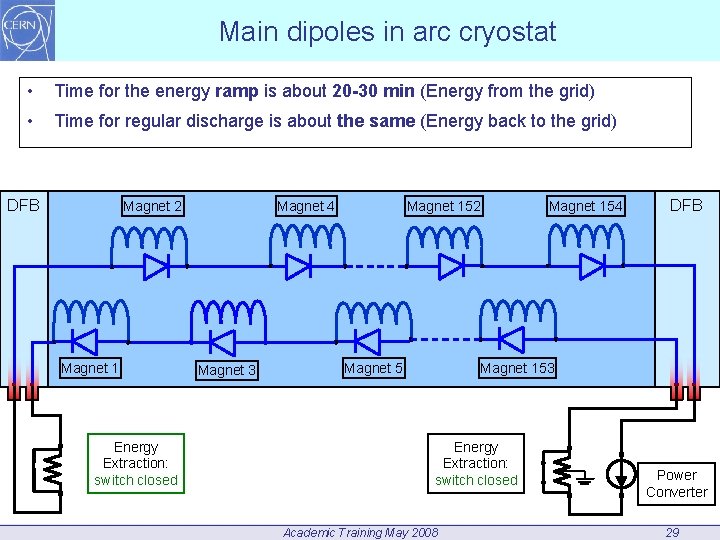
Main dipoles in arc cryostat • Time for the energy ramp is about 20 -30 min (Energy from the grid) • Time for regular discharge is about the same (Energy back to the grid) DFB Magnet 2 Magnet 1 Energy Extraction: switch closed Magnet 4 Magnet 3 Magnet 152 Magnet 5 Magnet 154 DFB Magnet 153 Energy Extraction: switch closed Academic Training May 2008 Power Converter 29
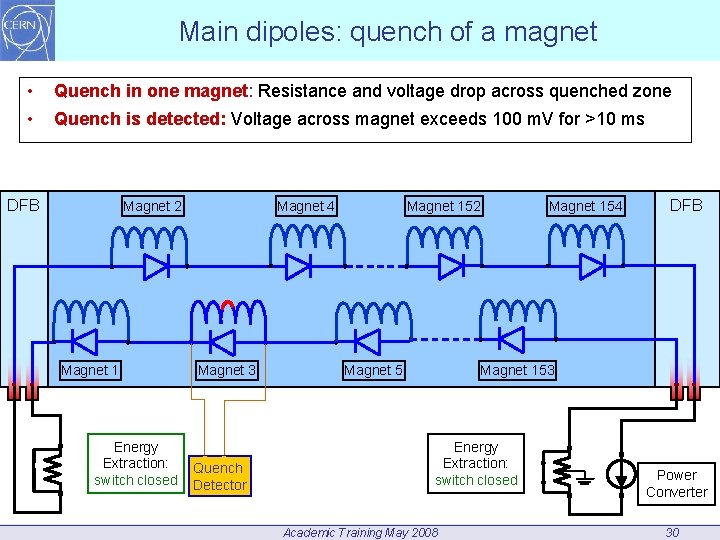
Main dipoles: quench of a magnet • Quench in one magnet: Resistance and voltage drop across quenched zone • Quench is detected: Voltage across magnet exceeds 100 m. V for >10 ms DFB Magnet 2 Magnet 1 Energy Extraction: switch closed Magnet 4 Magnet 3 Quench Detector Magnet 152 Magnet 5 Magnet 154 DFB Magnet 153 Energy Extraction: switch closed Academic Training May 2008 Power Converter 30
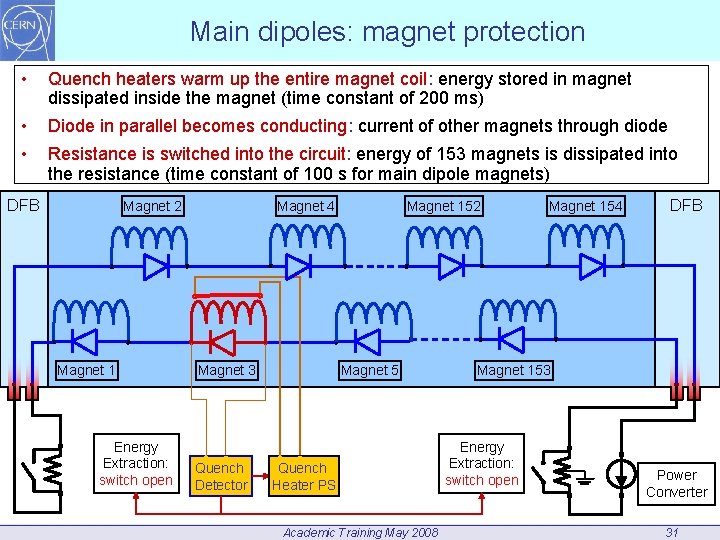
Main dipoles: magnet protection • Quench heaters warm up the entire magnet coil: energy stored in magnet dissipated inside the magnet (time constant of 200 ms) • Diode in parallel becomes conducting: current of other magnets through diode • Resistance is switched into the circuit: energy of 153 magnets is dissipated into the resistance (time constant of 100 s for main dipole magnets) DFB Magnet 2 Magnet 1 Energy Extraction: switch open Magnet 4 Magnet 3 Quench Detector Magnet 152 Magnet 5 Quench Heater PS Academic Training May 2008 Magnet 154 DFB Magnet 153 Energy Extraction: switch open Power Converter 31
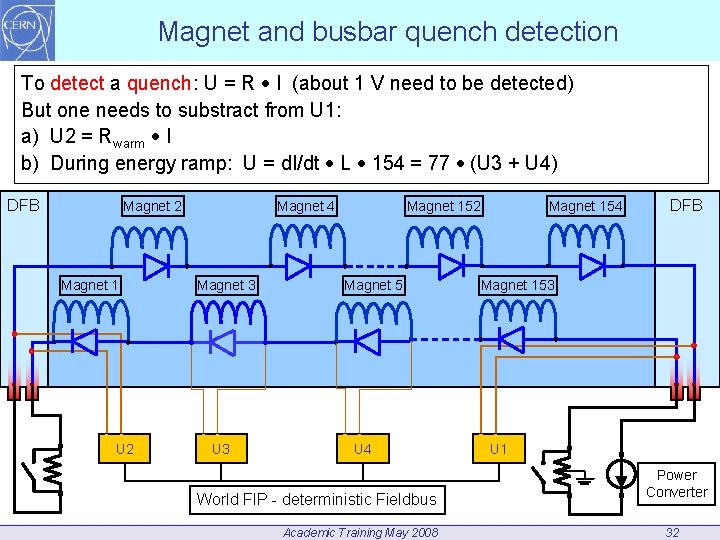
Magnet and busbar quench detection To detect a quench: U = R I (about 1 V need to be detected) But one needs to substract from U 1: a) U 2 = Rwarm I b) During energy ramp: U = d. I/dt L 154 = 77 (U 3 + U 4) DFB Magnet 2 Magnet 1 U 2 Magnet 4 Magnet 3 U 3 Magnet 152 Magnet 5 U 4 World FIP - deterministic Fieldbus Academic Training May 2008 Magnet 154 DFB Magnet 153 U 1 Power Converter 32
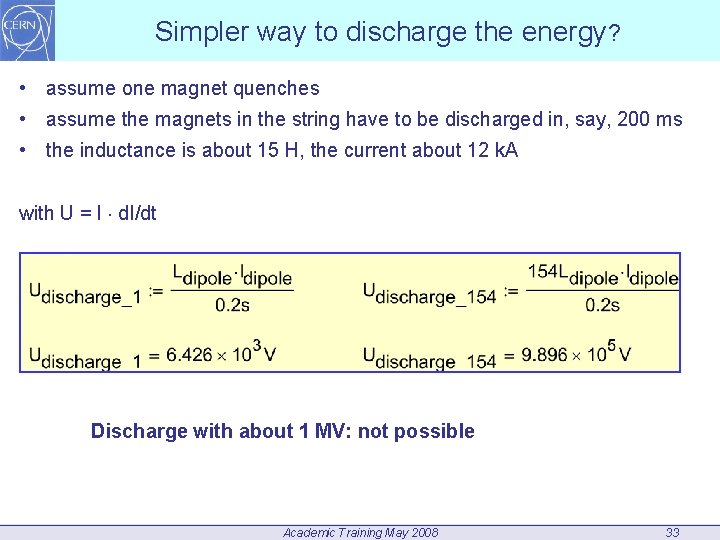
Simpler way to discharge the energy? • assume one magnet quenches • assume the magnets in the string have to be discharged in, say, 200 ms • the inductance is about 15 H, the current about 12 k. A with U = l d. I/dt Discharge with about 1 MV: not possible Academic Training May 2008 33
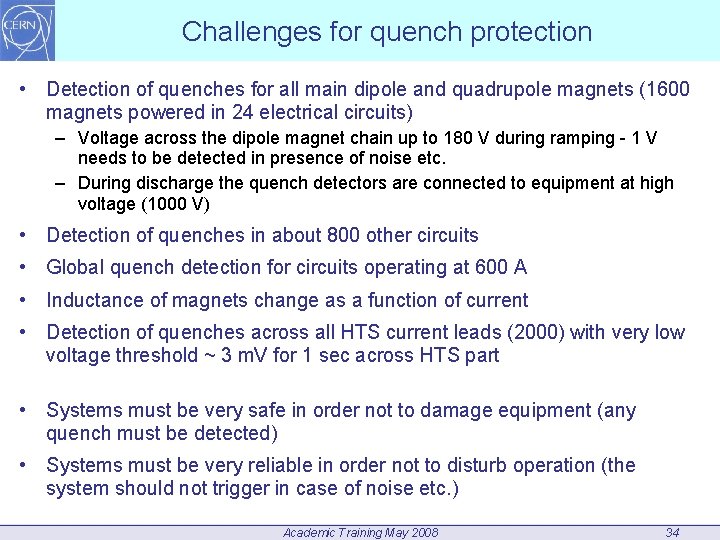
Challenges for quench protection • Detection of quenches for all main dipole and quadrupole magnets (1600 magnets powered in 24 electrical circuits) – Voltage across the dipole magnet chain up to 180 V during ramping - 1 V needs to be detected in presence of noise etc. – During discharge the quench detectors are connected to equipment at high voltage (1000 V) • Detection of quenches in about 800 other circuits • Global quench detection for circuits operating at 600 A • Inductance of magnets change as a function of current • Detection of quenches across all HTS current leads (2000) with very low voltage threshold ~ 3 m. V for 1 sec across HTS part • Systems must be very safe in order not to damage equipment (any quench must be detected) • Systems must be very reliable in order not to disturb operation (the system should not trigger in case of noise etc. ) Academic Training May 2008 34
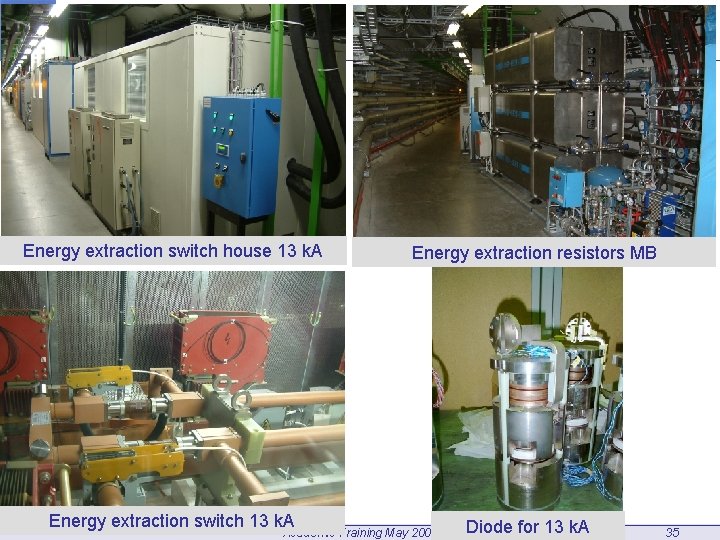
Energy extraction switch house 13 k. A Energy extraction switch 13 k. A Energy extraction resistors MB Academic Training May 2008 Diode for 13 k. A 35
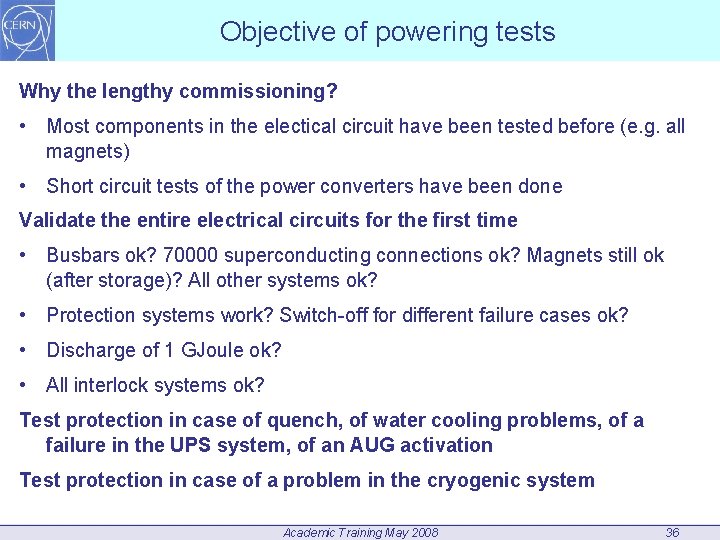
Objective of powering tests Why the lengthy commissioning? • Most components in the electical circuit have been tested before (e. g. all magnets) • Short circuit tests of the power converters have been done Validate the entire electrical circuits for the first time • Busbars ok? 70000 superconducting connections ok? Magnets still ok (after storage)? All other systems ok? • Protection systems work? Switch-off for different failure cases ok? • Discharge of 1 GJoule ok? • All interlock systems ok? Test protection in case of quench, of water cooling problems, of a failure in the UPS system, of an AUG activation Test protection in case of a problem in the cryogenic system Academic Training May 2008 36
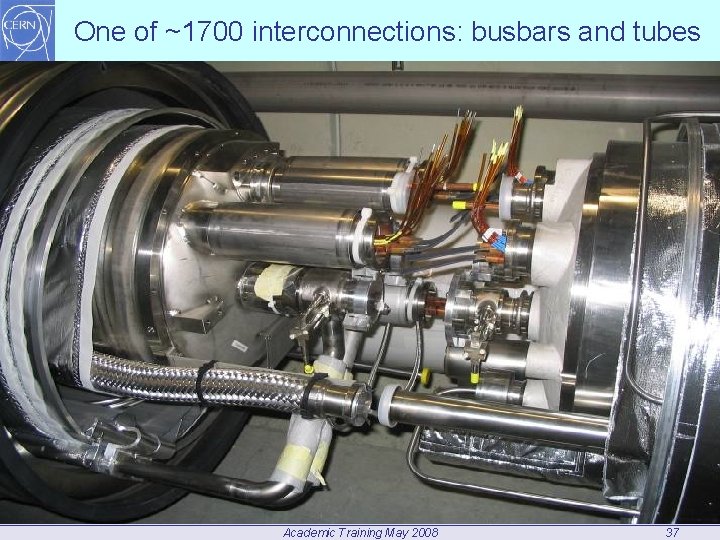
One of ~1700 interconnections: busbars and tubes Academic Training May 2008 37
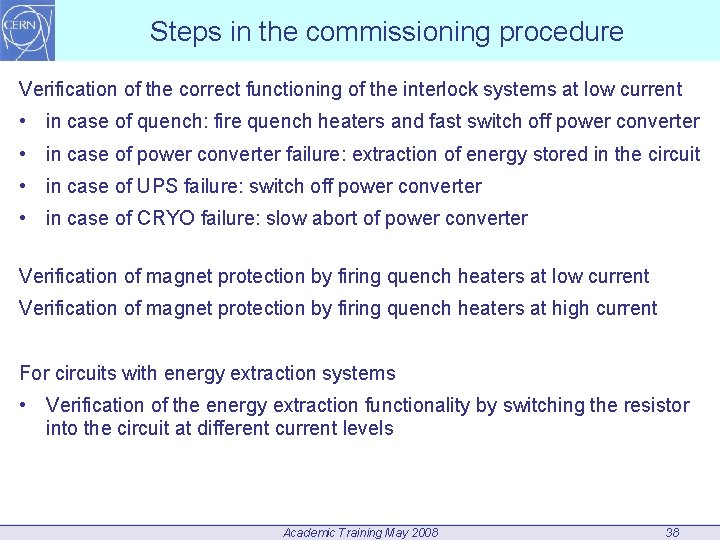
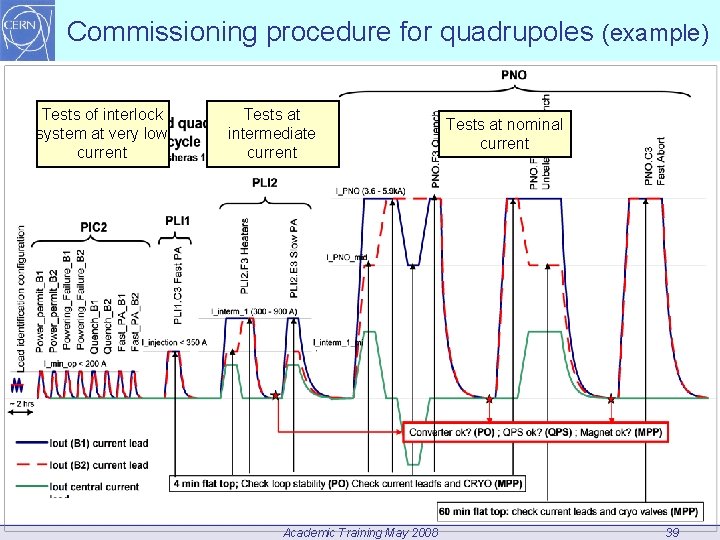
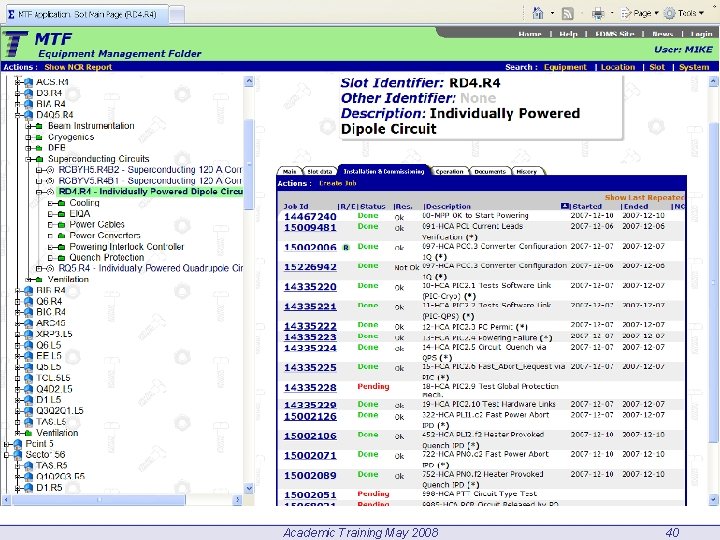
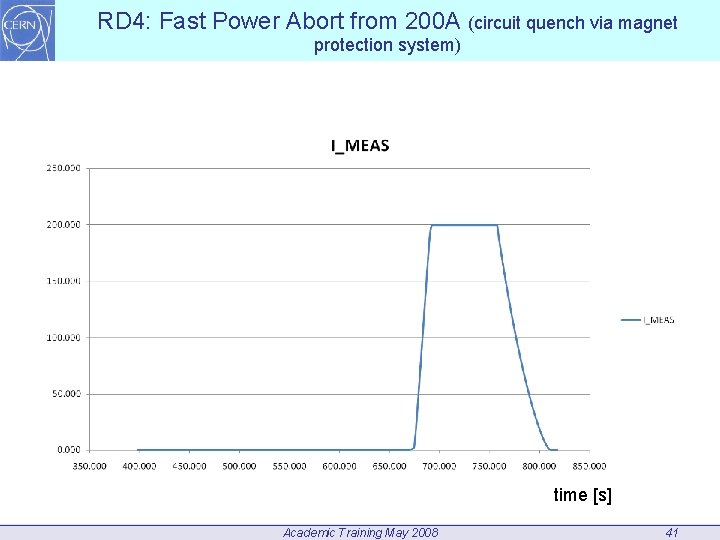
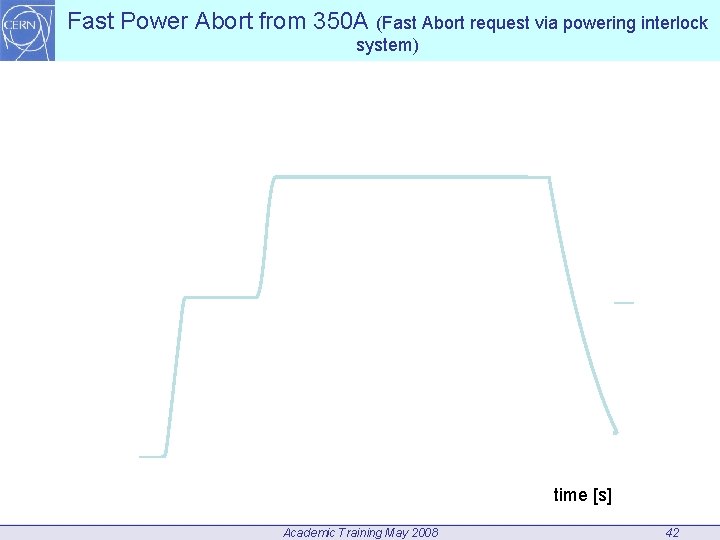
Steps in the commissioning procedure Verification of the correct functioning of the interlock systems at low current • in case of quench: fire quench heaters and fast switch off power converter • in case of power converter failure: extraction of energy stored in the circuit • in case of UPS failure: switch off power converter • in case of CRYO failure: slow abort of power converter Verification of magnet protection by firing quench heaters at low current Verification of magnet protection by firing quench heaters at high current For circuits with energy extraction systems • Verification of the energy extraction functionality by switching the resistor into the circuit at different current levels Academic Training May 2008 38
Commissioning procedure for quadrupoles (example) Tests of interlock system at very low current Tests at intermediate current Academic Training May 2008 Tests at nominal current 39
Academic Training May 2008 40
RD 4: Fast Power Abort from 200 A (circuit quench via magnet protection system) time [s] Academic Training May 2008 41
Fast Power Abort from 350 A (Fast Abort request via powering interlock system) 400, 000 I_MEAS 350, 000 300, 000 250, 000 200, 000 I_MEAS 150, 000 100, 000 50, 000 350, 000 450, 000 550, 000 650, 000 750, 000 850, 000 time [s] Academic Training May 2008 42
Fast Power Abort from 5500 A (PNO. C 2) time [s] Academic Training May 2008 43
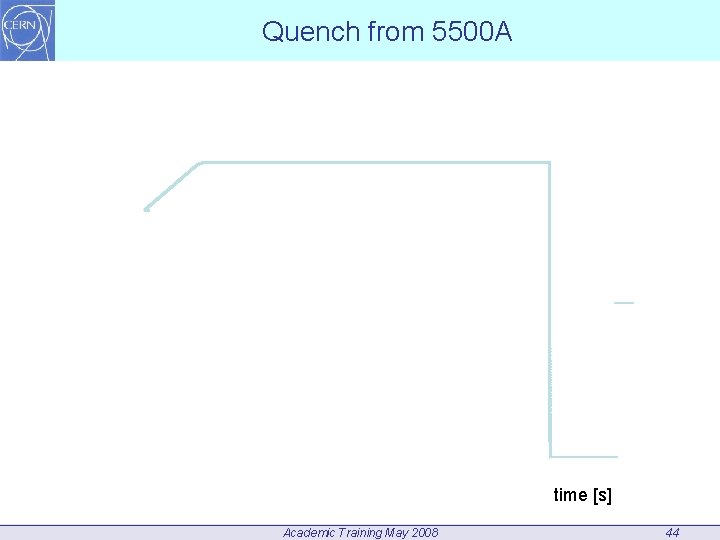
Quench from 5500 A 6000, 000 I_MEAS 5000, 000 4000, 000 3000, 000 I_MEAS 2000, 000 1000, 000 350, 000 450, 000 550, 000 650, 000 750, 000 850, 000 time [s] Academic Training May 2008 44
Quench - detail time [s] Academic Training May 2008 45
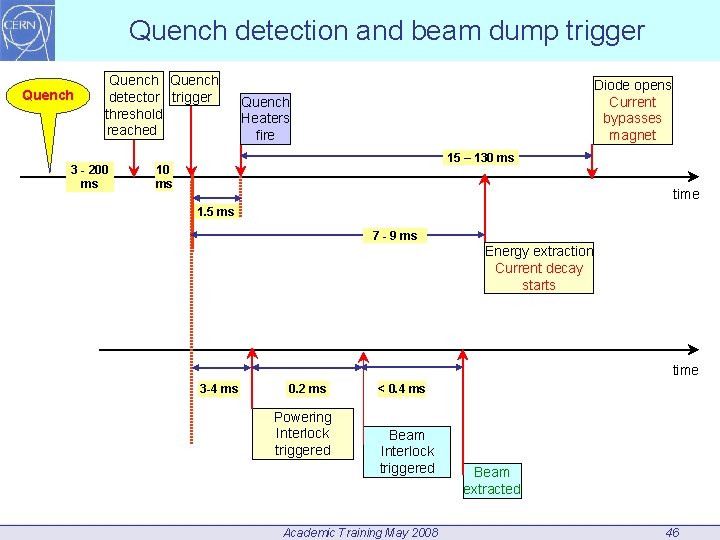
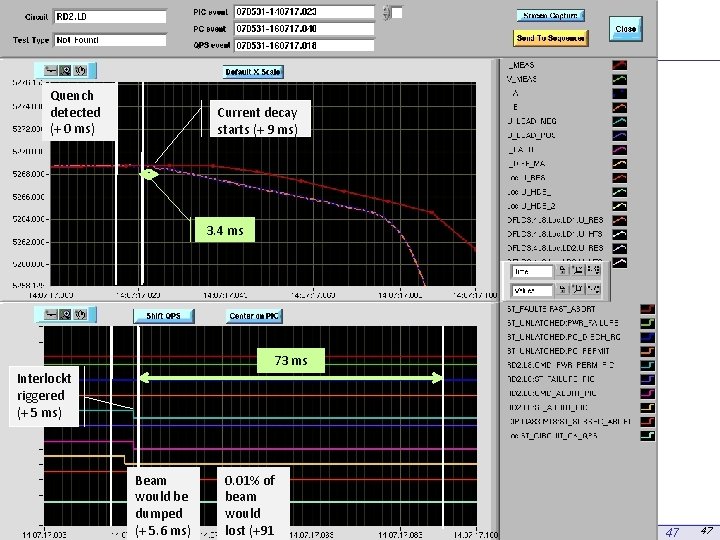
Quench detection and beam dump trigger Quench detector trigger threshold reached 3 - 200 ms Diode opens Current bypasses magnet Quench Heaters fire 15 – 130 ms 10 ms time 1. 5 ms 7 - 9 ms Energy extraction Current decay starts time 3 -4 ms 0. 2 ms Powering Interlock triggered < 0. 4 ms Beam Interlock triggered Academic Training May 2008 Beam extracted 46
Response to Quenches Quench detected (+ 0 ms) Current decay starts (+ 9 ms) 3. 4 ms 73 ms Interlockt riggered (+ 5 ms) 12/21/2021 Beam would be dumped (+ 5. 6 ms) 0. 01% of beam would andres. gomez. alonso@cern. ch lost (+91 Academic Training May 2008 47 47
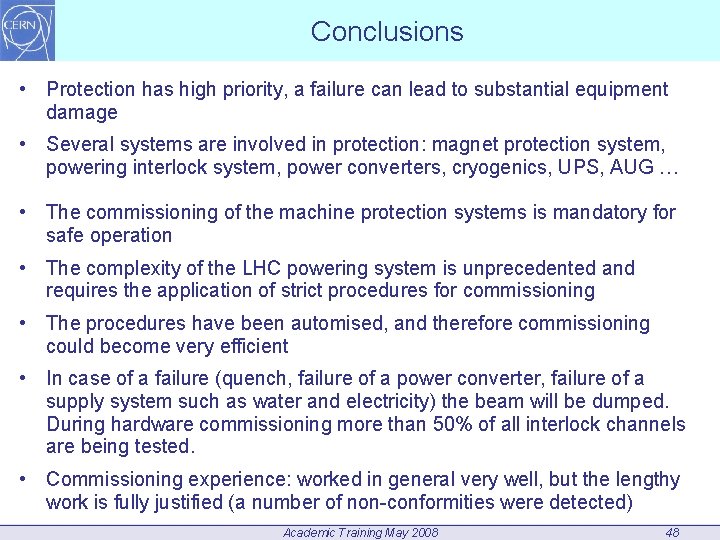
Conclusions • Protection has high priority, a failure can lead to substantial equipment damage • Several systems are involved in protection: magnet protection system, powering interlock system, power converters, cryogenics, UPS, AUG … • The commissioning of the machine protection systems is mandatory for safe operation • The complexity of the LHC powering system is unprecedented and requires the application of strict procedures for commissioning • The procedures have been automised, and therefore commissioning could become very efficient • In case of a failure (quench, failure of a power converter, failure of a supply system such as water and electricity) the beam will be dumped. During hardware commissioning more than 50% of all interlock channels are being tested. • Commissioning experience: worked in general very well, but the lengthy work is fully justified (a number of non-conformities were detected) Academic Training May 2008 48
Acknowledgement Many colleagues have been involved in the work that is presented here, as CERN staff, as project associates and as industrial support. It is not possible to list all the names, but I very much appreciate the enthusiastic work of all them. Teams responsible for protection systems: – Magnet Protection, Powering Interlocks, Beam Dumping System, Beam Loss Monitors, Collimation System Teams responsible for systems involved in powering: – Power Converters, Vacuum, Cryogenics, (cold) Electrical Engineering Teams responsible for service systems: – Water cooling, Ventilation, Access System, AC and DC distribution Other teams: – Controls and Networking, Operation, Magnet “Owners” – Collaborators from abroad (US, Japan), Project Engineers Academic Training May 2008 49