
THE CHALLENGES OF LEADERSHIP How do I grow



- Slides: 25
THE CHALLENGES OF LEADERSHIP • How do I grow myself? • How do I grow my team members? • What we do today does not equal what we do tomorrow • Can we know who will adapt and scale? 1 1
CONSTRUCTIVE DEVELOPMENTAL THEORY • How do we know what we know? • We have a lens • Our lenses change to become more complex as we grow • Life is a journey with many points of development - called leader levels Note: This is NOT Collins. It is Jean Piaget, Robert Kegan, Lawrence Kohlberg 2 2
PERSONALITY TESTS • Myers Briggs • Hogan • DISC, etc. These are useful to understand your style and the style of others. They are your vehicle on the journey. BUT: Your personality/style does not predict how you will, or have, grown and adapted to life’s challenges. 3 3
HOW IMPORTANT ARE SMARTS? • IQ is a factor • Technical skills are a factor • Personality and style are a factor • But as you move up—it is the combination of IQ, Personality, and Leader Level that matters 4 4
WHY IS THIS IMPORTANT? The next 2 slides will address the complexity and challenges of: • A senior executive role (the CIO in our example) • Aligning a new leader within an organization 5 5
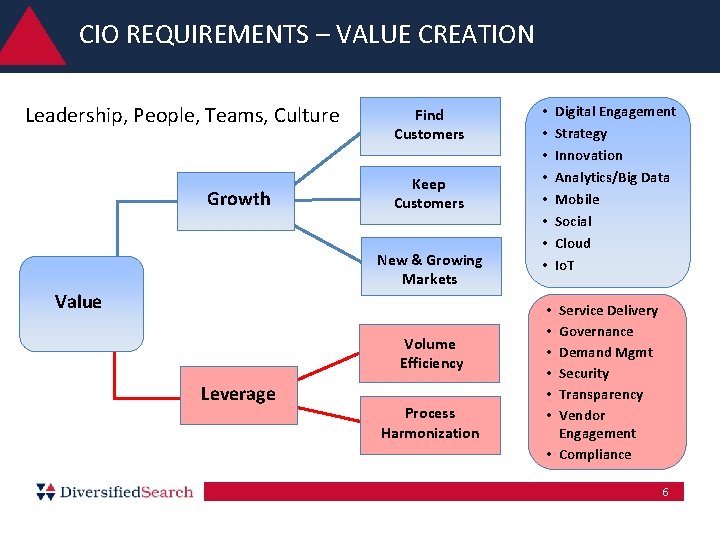
CIO REQUIREMENTS – VALUE CREATION Leadership, People, Teams, Culture 98% Growth • • Find Customers Keep Customers New & Growing Markets Value Service Delivery Governance Demand Mgmt Security Transparency Vendor Engagement • Compliance • • • Volume Efficiency Leverage Digital Engagement Strategy Innovation Analytics/Big Data Mobile 75% Social Cloud Io. T Process Harmonization 6 6
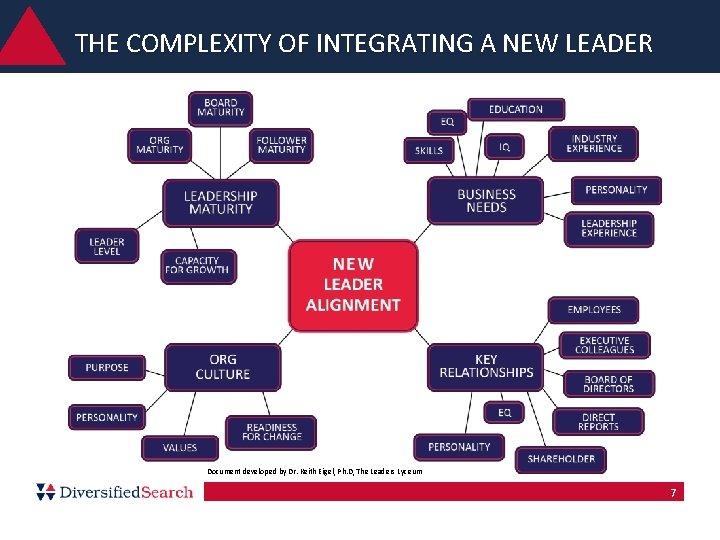
THE COMPLEXITY OF INTEGRATING A NEW LEADER Document developed by Dr. Keith Eigel, Ph. D, The Leaders Lyceum 7 7
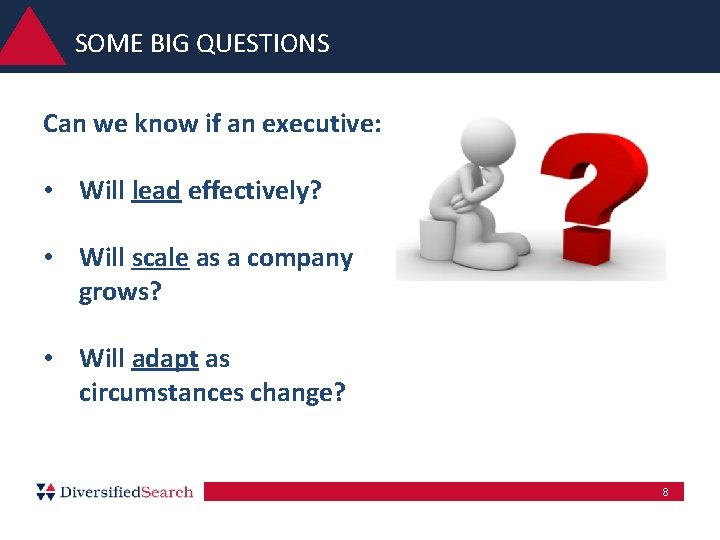
SOME BIG QUESTIONS Can we know if an executive: • Will lead effectively? • Will scale as a company grows? • Will adapt as circumstances change? 8 8
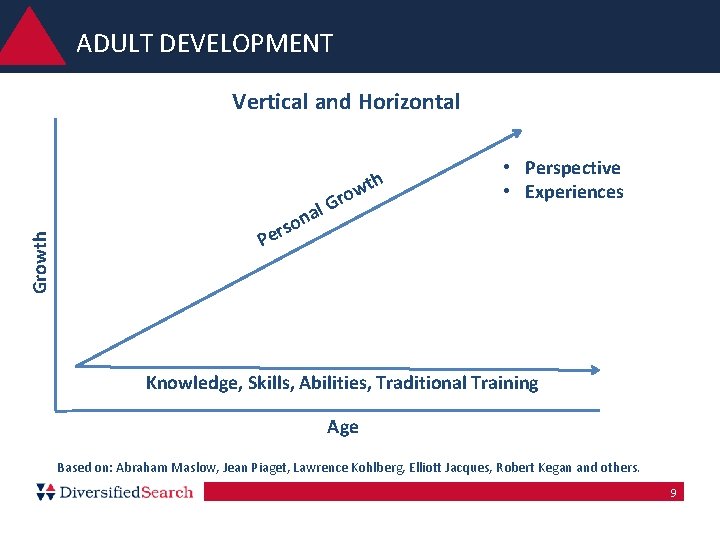
ADULT DEVELOPMENT Vertical and Horizontal Growth th w ro G l a n • Perspective • Experiences o s Per Knowledge, Skills, Abilities, Traditional Training Age Based on: Abraham Maslow, Jean Piaget, Lawrence Kohlberg, Elliott Jacques, Robert Kegan and others. 9 9
REMEMBERING YOUR JOURNEY • How do you know what you know? • When did you learn the most? • What were the hardest lessons? • Reflecting • Understanding your impact • What enabled success at one stage may derail you later 10 10
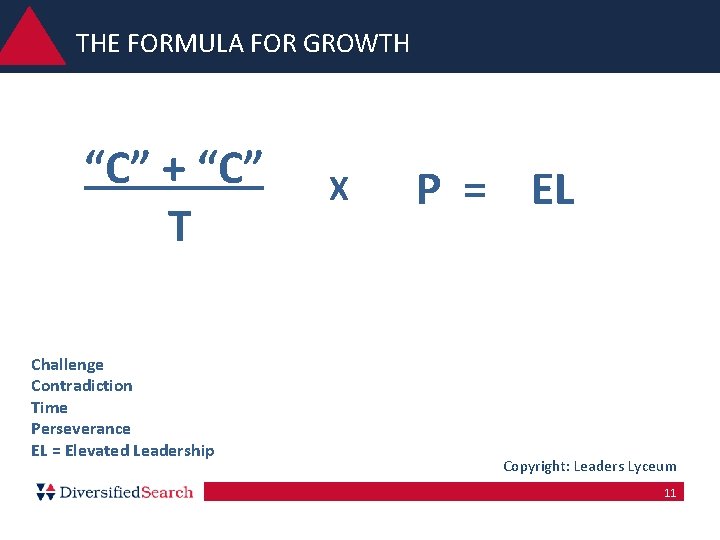
THE FORMULA FOR GROWTH “C” + “C” T Challenge Contradiction Time Perseverance EL = Elevated Leadership X P = EL Copyright: Leaders Lyceum 11 11
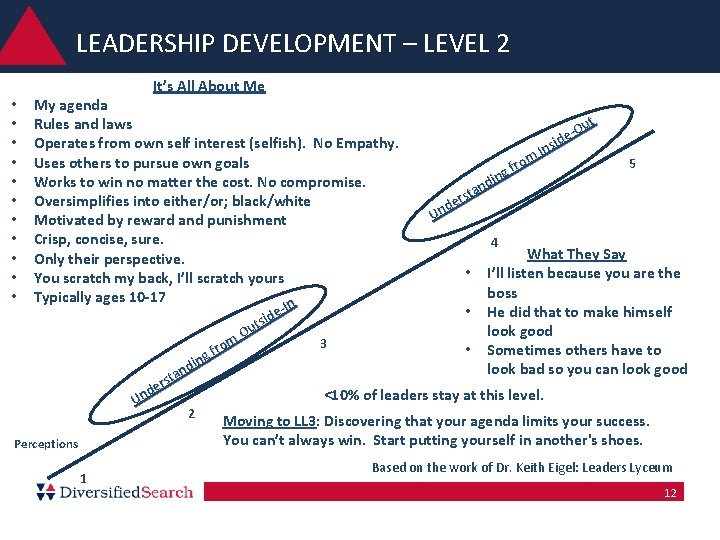
LEADERSHIP DEVELOPMENT – LEVEL 2 • • • It’s All About Me My agenda Rules and laws Operates from own self interest (selfish). No Empathy. Uses others to pursue own goals Works to win no matter the cost. No compromise. Oversimplifies into either/or; black/white Motivated by reward and punishment Crisp, concise, sure. Only their perspective. You scratch my back, I’ll scratch yours Typically ages 10 -17 n rom f g din n a rst e d Un 2 Perceptions 1 e-I d i ts Ou 3 rom f g din n a rst e d Un ut O ide Ins 5 4 • • • What They Say I’ll listen because you are the boss He did that to make himself look good Sometimes others have to look bad so you can look good <10% of leaders stay at this level. Moving to LL 3: Discovering that your agenda limits your success. You can’t always win. Start putting yourself in another's shoes. Based on the work of Dr. Keith Eigel: Leaders Lyceum 12 12
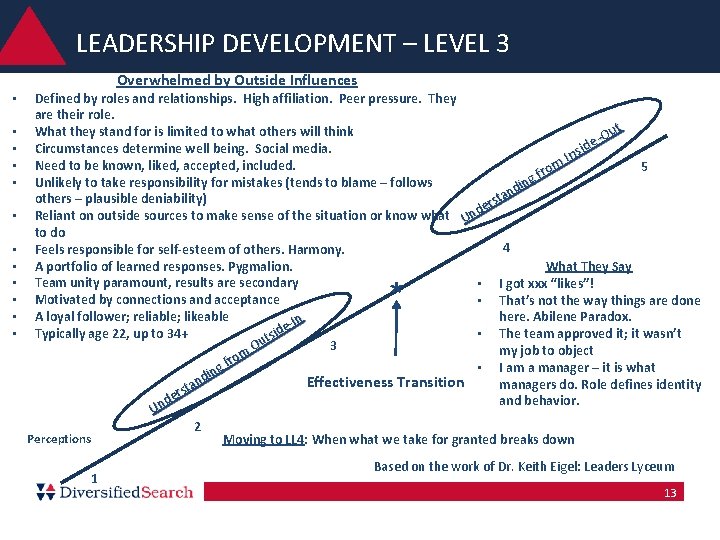
LEADERSHIP DEVELOPMENT – LEVEL 3 • • • Overwhelmed by Outside Influences Defined by roles and relationships. High affiliation. Peer pressure. They are their role. ut What they stand for is limited to what others will think O ide Circumstances determine well being. Social media. s n I m Need to be known, liked, accepted, included. 5 o fr g Unlikely to take responsibility for mistakes (tends to blame – follows din n ta others – plausible deniability) ers d Reliant on outside sources to make sense of the situation or know what Un to do 4 Feels responsible for self-esteem of others. Harmony. A portfolio of learned responses. Pygmalion. What They Say Team unity paramount, results are secondary • I got xxx “likes”! Motivated by connections and acceptance • That’s not the way things are done A loyal follower; reliable; likeable here. Abilene Paradox. -In e d Typically age 22, up to 34+ • The team approved it; it wasn’t tsi 3 Ou my job to object rom f • I am a manager – it is what ing d Effectiveness Transition managers do. Role defines identity tan s r e d and behavior. Un 2 Perceptions Moving to LL 4: When what we take for granted breaks down * 1 Based on the work of Dr. Keith Eigel: Leaders Lyceum 13 13
LEVEL 3 MANAGERS – SUPPLEMENTAL NOTES • They are their role. E. g. I am a Director of Infrastructure (L 3) – I am a person who leads Infrastructure at…. (L 4) • They are a portfolio of outside viewpoints. They don’t “own” those inputs. They need those outside sources to make sense of the situation and to know what to do. (Novel circumstances can cause confusion). Don’t rock the boat! The Pygmalion effect – Lisa Doolittle just did what Henry Higgins said – he determined her reality. • Reflecting on who and what a L 3 leader stands for is limited to what s/he believes others will think about who s/he is, and what s/he stands for. Classic example: If I did that… “what would my friends say” (L 3) vs “I couldn’t look at myself in the mirror” (L 4) • Relational harmony is paramount therefore a silly little argument can totally disrupt. (Remember in your 20’s when a little dispute with your significant other was all consuming) • Often believe they are doing the right thing by “lying” so as not to hurt another’s feelings. You can only speak helpful truths to those who need it when you are compassionate and secure. • They are endearing and likeable – know everyone, want subs to feel heard, they walk the talk, and total fit and identify with the company values. • All energy taken up in pleasing the boss, ensuring subs are happy, putting things back together. • Want to have others feel good about themselves. • Their identities are largely shaped by their position and formal power in the organization – which can make them arrogant and defensive. • Hard for them to take responsibility for their own decisions/mistakes – mostly blame others. Think through situations to make themselves bullet proof. Plausible deniability to protect a cherished role. Have the team vote, and go with that. • They do not like conflict – which often leads to better decisions. They consequently smooth over challenges to make them go away – rather than embracing them. Based on the work of Dr. Keith Eigel: Leaders Lyceum 14 14
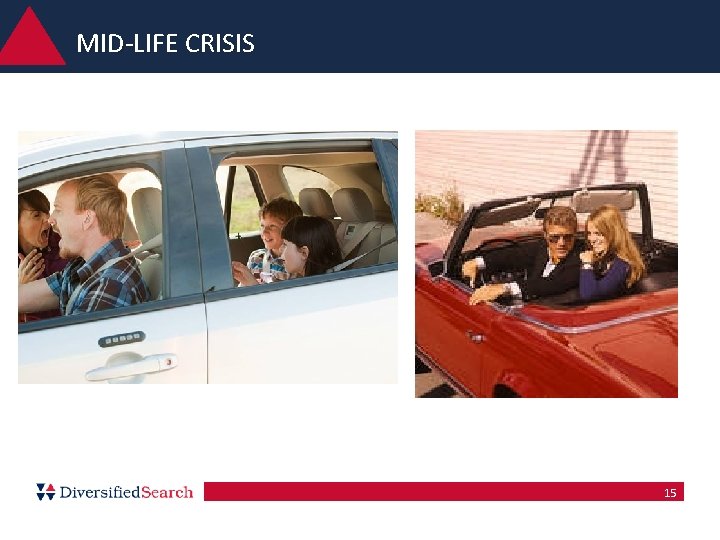
MID-LIFE CRISIS 15 15
MID-LIFE CRISIS • A mid-life crisis can come between L 3 and L 4 • Instead of pushing through and finding meaning as you move into L 4, a mid-life crisis often seeks a new external validation system. 16 16 16
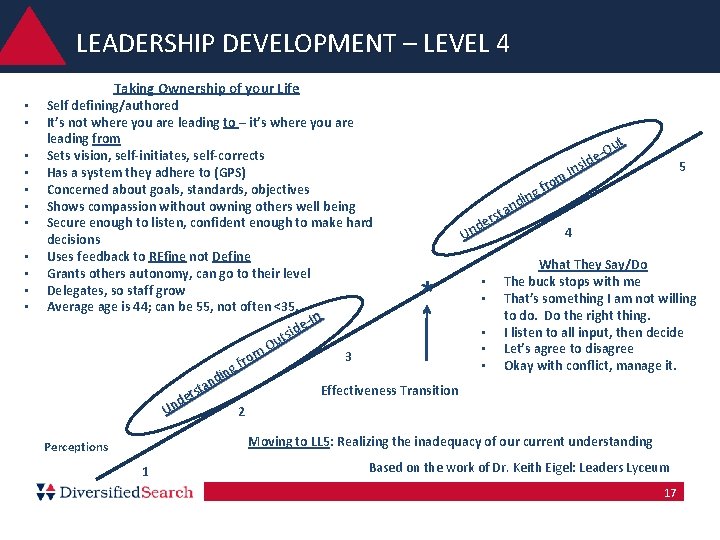
LEADERSHIP DEVELOPMENT – LEVEL 4 • • • Taking Ownership of your Life Self defining/authored It’s not where you are leading to – it’s where you are leading from Sets vision, self-initiates, self-corrects Has a system they adhere to (GPS) Concerned about goals, standards, objectives Shows compassion without owning others well being Secure enough to listen, confident enough to make hard decisions Uses feedback to REfine not Define Grants others autonomy, can go to their level Delegates, so staff grow Average is 44; can be 55, not often <35. rom f g din n a t ers d Un 2 n e-I d i ts Ou ut O ide s n I m 5 ro g fr n i nd a t rs de n 4 U * • • • 3 What They Say/Do The buck stops with me That’s something I am not willing to do. Do the right thing. I listen to all input, then decide Let’s agree to disagree Okay with conflict, manage it. Effectiveness Transition Moving to LL 5: Realizing the inadequacy of our current understanding Perceptions 1 Based on the work of Dr. Keith Eigel: Leaders Lyceum 17 17
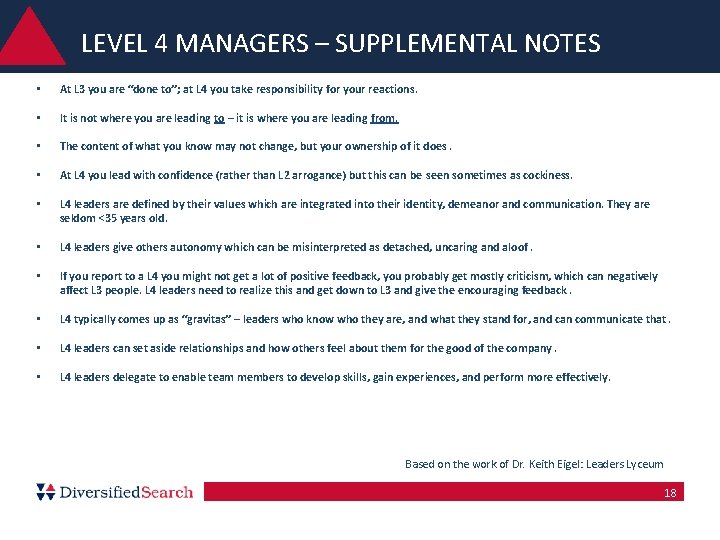
LEVEL 4 MANAGERS – SUPPLEMENTAL NOTES • At L 3 you are “done to”; at L 4 you take responsibility for your reactions. • It is not where you are leading to – it is where you are leading from. • The content of what you know may not change, but your ownership of it does. • At L 4 you lead with confidence (rather than L 2 arrogance) but this can be seen sometimes as cockiness. • L 4 leaders are defined by their values which are integrated into their identity, demeanor and communication. They are seldom <35 years old. • L 4 leaders give others autonomy which can be misinterpreted as detached, uncaring and aloof. • If you report to a L 4 you might not get a lot of positive feedback, you probably get mostly criticism, which can negatively affect L 3 people. L 4 leaders need to realize this and get down to L 3 and give the encouraging feedback. • L 4 typically comes up as “gravitas” – leaders who know who they are, and what they stand for, and can communicate that. • L 4 leaders can set aside relationships and how others feel about them for the good of the company. • L 4 leaders delegate to enable team members to develop skills, gain experiences, and perform more effectively. Based on the work of Dr. Keith Eigel: Leaders Lyceum 18 18
LEADERSHIP DEVELOPMENT – LEVEL 5 • • The Ability to Rise Above Yourself (<15% of population) Open – take an objective view of themselves, compare their paradigms to those of others Grounded in, and leads through higher order values Self-aware , self-reflecting, authentic, rigorously honest Can be hard to get to L 5. You get comfortable and can insulate yourself. Others valued as co-contributors and co-learners. Differences are appreciated. Intentionally focused on developing and growing others (not their own welfare) Capacity to see oneself objectively. Humbly. Typically mid to late 50’s rom f g din n a t ers d Un 2 Perceptions 1 n e-I d i ts Ou 3 g din n ta ers d Un 4 • • m fro ut O ide Ins 5 Characteristics They seem wise Open – don’t have a set system. Our way may not be the best way. Define success as achieving a valued outcome Value and learn from conflict Do the right thing for the right reason It’s not us (company), it’s all of us (world) Asks: What am I missing? What’s new? How can I be more inclusive? Based on the work of Dr. Keith Eigel: Leaders Lyceum 19 19
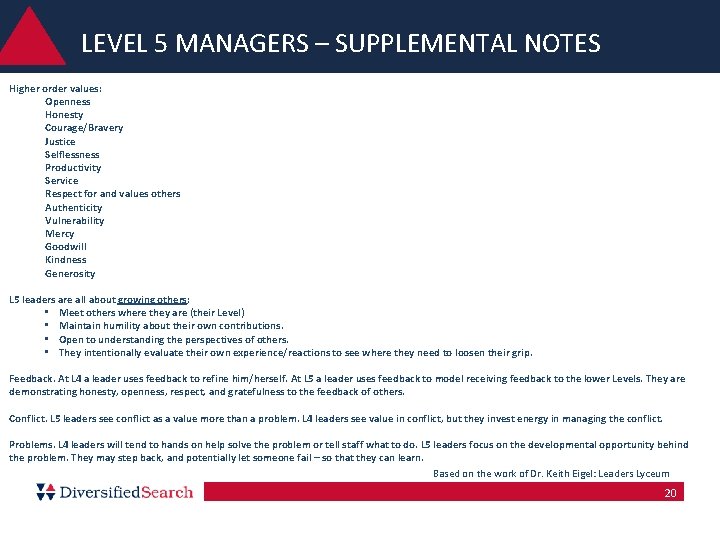
LEVEL 5 MANAGERS – SUPPLEMENTAL NOTES Higher order values: Openness Honesty Courage/Bravery Justice Selflessness Productivity Service Respect for and values others Authenticity Vulnerability Mercy Goodwill Kindness Generosity L 5 leaders are all about growing others; • Meet others where they are (their Level) • Maintain humility about their own contributions. • Open to understanding the perspectives of others. • They intentionally evaluate their own experience/reactions to see where they need to loosen their grip. Feedback. At L 4 a leader uses feedback to refine him/herself. At L 5 a leader uses feedback to model receiving feedback to the lower Levels. They are demonstrating honesty, openness, respect, and gratefulness to the feedback of others. Conflict. L 5 leaders see conflict as a value more than a problem. L 4 leaders see value in conflict, but they invest energy in managing the conflict. Problems. L 4 leaders will tend to hands on help solve the problem or tell staff what to do. L 5 leaders focus on the developmental opportunity behind the problem. They may step back, and potentially let someone fail – so that they can learn. Based on the work of Dr. Keith Eigel: Leaders Lyceum 20 20
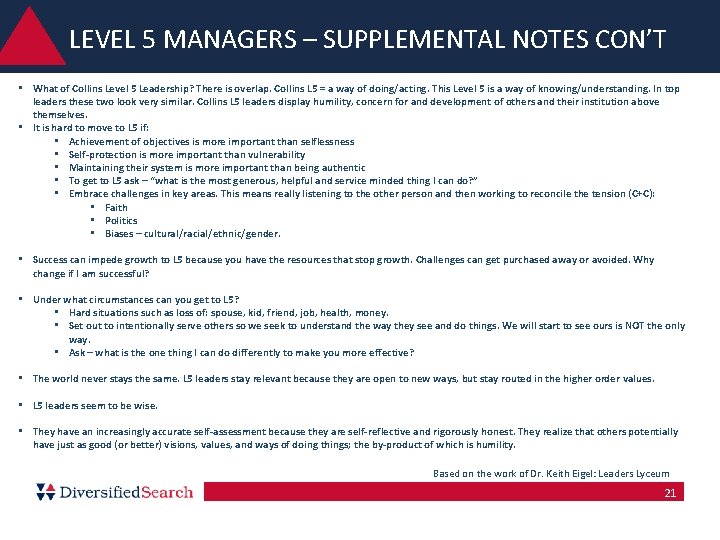
LEVEL 5 MANAGERS – SUPPLEMENTAL NOTES CON’T • What of Collins Level 5 Leadership? There is overlap. Collins L 5 = a way of doing/acting. This Level 5 is a way of knowing/understanding. In top leaders these two look very similar. Collins L 5 leaders display humility, concern for and development of others and their institution above themselves. • It is hard to move to L 5 if: • Achievement of objectives is more important than selflessness • Self-protection is more important than vulnerability • Maintaining their system is more important than being authentic • To get to L 5 ask – “what is the most generous, helpful and service minded thing I can do? ” • Embrace challenges in key areas. This means really listening to the other person and then working to reconcile the tension (C+C): • Faith • Politics • Biases – cultural/racial/ethnic/gender. • Success can impede growth to L 5 because you have the resources that stop growth. Challenges can get purchased away or avoided. Why change if I am successful? • Under what circumstances can you get to L 5? • Hard situations such as loss of: spouse, kid, friend, job, health, money. • Set out to intentionally serve others so we seek to understand the way they see and do things. We will start to see ours is NOT the only way. • Ask – what is the one thing I can do differently to make you more effective? • The world never stays the same. L 5 leaders stay relevant because they are open to new ways, but stay routed in the higher order values. • L 5 leaders seem to be wise. • They have an increasingly accurate self-assessment because they are self-reflective and rigorously honest. They realize that others potentially have just as good (or better) visions, values, and ways of doing things; the by-product of which is humility. Based on the work of Dr. Keith Eigel: Leaders Lyceum 21 21
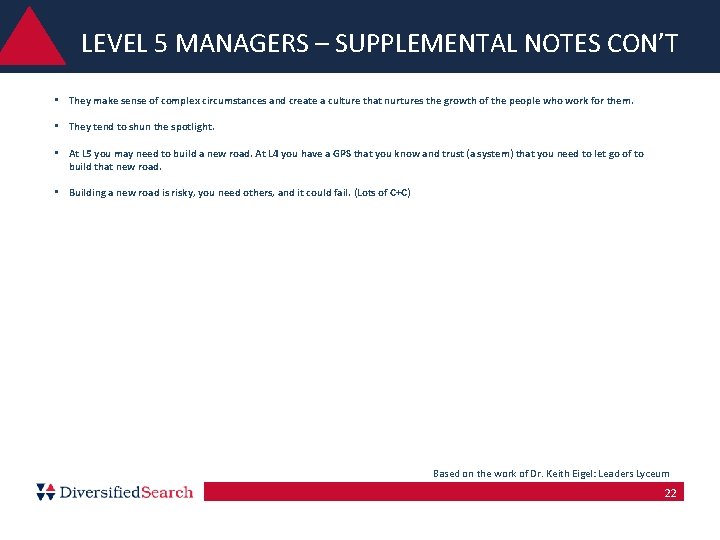
LEVEL 5 MANAGERS – SUPPLEMENTAL NOTES CON’T • They make sense of complex circumstances and create a culture that nurtures the growth of the people who work for them. • They tend to shun the spotlight. • At L 5 you may need to build a new road. At L 4 you have a GPS that you know and trust (a system) that you need to let go of to build that new road. • Building a new road is risky, you need others, and it could fail. (Lots of C+C) Based on the work of Dr. Keith Eigel: Leaders Lyceum 22 22
LEARNING FROM LIFE The experiences in our life that are most developmental are the hardest. • They usually involve loss of: • Relationships • Finances • Health • They have the most collateral damage • They are hard to sweep under the rug • They can’t be imitated in a training environment BUT: They are not the only path to growth. 23 23
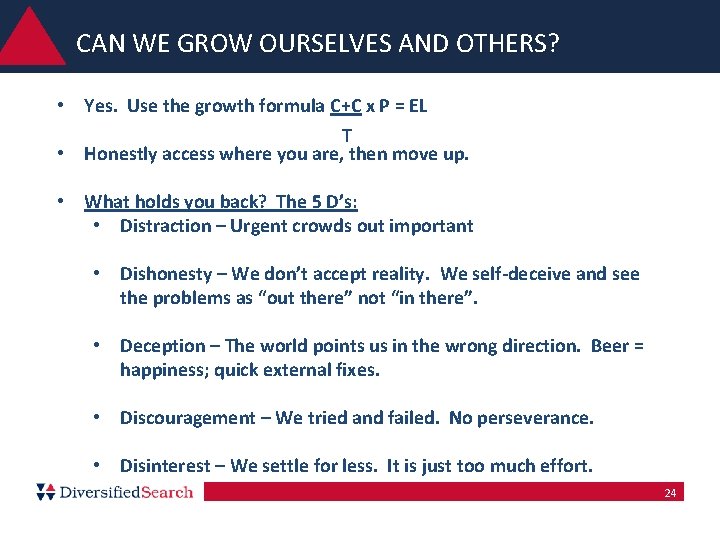
CAN WE GROW OURSELVES AND OTHERS? • Yes. Use the growth formula C+C x P = EL T • Honestly access where you are, then move up. • What holds you back? The 5 D’s: • Distraction – Urgent crowds out important • Dishonesty – We don’t accept reality. We self-deceive and see the problems as “out there” not “in there”. • Deception – The world points us in the wrong direction. Beer = happiness; quick external fixes. • Discouragement – We tried and failed. No perseverance. • Disinterest – We settle for less. It is just too much effort. 24 24
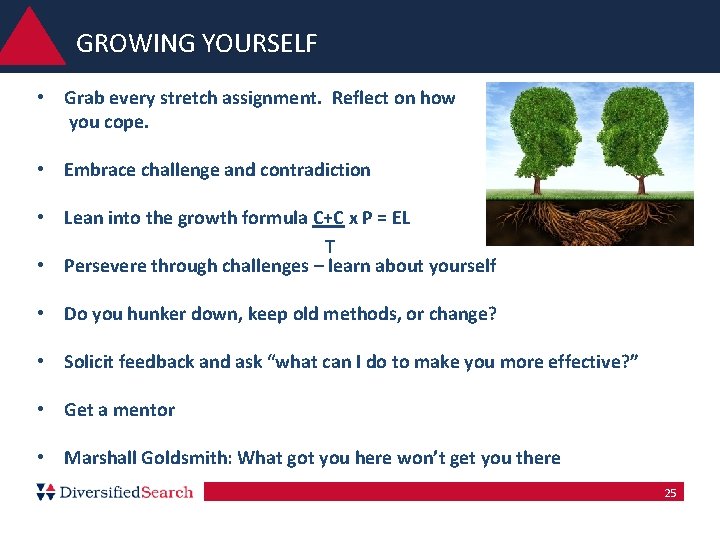
GROWING YOURSELF • Grab every stretch assignment. Reflect on how you cope. • Embrace challenge and contradiction • Lean into the growth formula C+C x P = EL T • Persevere through challenges – learn about yourself • Do you hunker down, keep old methods, or change? • Solicit feedback and ask “what can I do to make you more effective? ” • Get a mentor • Marshall Goldsmith: What got you here won’t get you there 25 25