
The challenges of evidence implementation in the global
The challenges of evidence implementation in the global healthcare arena-its all about the context Dr Judith Carrier Reader Primary Care/Public Health Nursing, Director Wales Centre for Evidence Based Care-a Joanna Briggs Institute Centre of Excellence

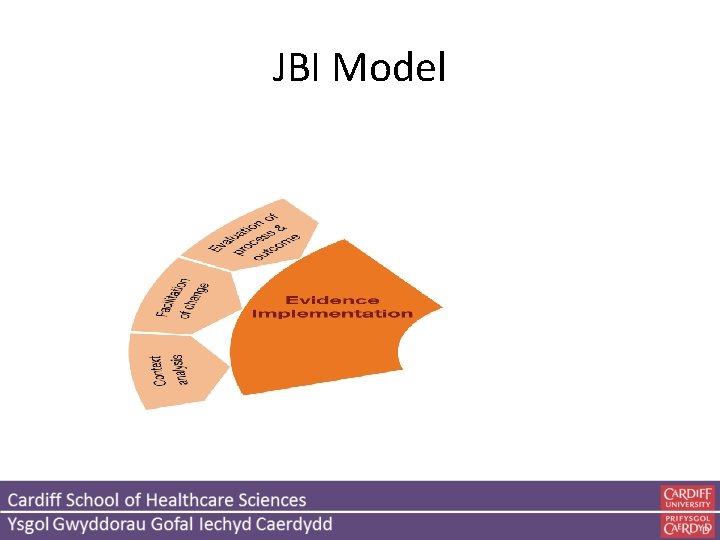
JBI Model
EBHC “The conscientious, explicit and judicious use of current best evidence in making decisions about the care of the individual patient. It means integrating individual clinical expertise with the best available external clinical evidence from systematic research. ” (Sackett et al, 1996 p. 72 ) Decision-making that considers the feasibility, appropriateness, meaningfulness and effectiveness of healthcare practices. The best available evidence, the context in which care is delivered, the individual patient and the professional judgement and expertise of the health professional inform this process. ’ (Jordan et al, 2016)
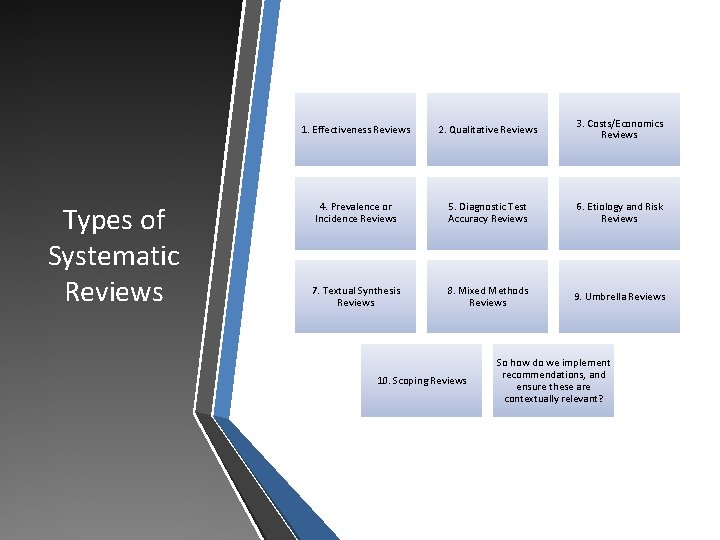
Types of Systematic Reviews 1. Effectiveness Reviews 2. Qualitative Reviews 3. Costs/Economics Reviews 4. Prevalence or Incidence Reviews 5. Diagnostic Test Accuracy Reviews 6. Etiology and Risk Reviews 7. Textual Synthesis Reviews 8. Mixed Methods Reviews 9. Umbrella Reviews 10. Scoping Reviews So how do we implement recommendations, and ensure these are contextually relevant?
![What do we mean by Context? context noun [ C ] (CAUSE OF EVENT)](http://slidetodoc.com/presentation_image_h2/7cb4e50c4f2bbcff9666da9a116a4d6b/image-6.jpg "What do we mean by Context? context noun [ C ] (CAUSE OF EVENT)")
What do we mean by Context? context noun [ C ] (CAUSE OF EVENT) the situation within which something exists or happens, and that can help explain it (Definition of “context” from the Cambridge Advanced Learner's Dictionary & Thesaurus © Cambridge University Press)
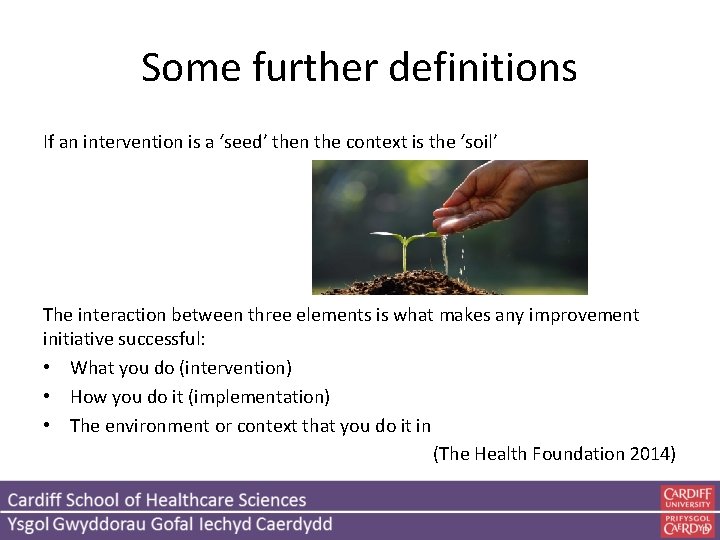
Some further definitions If an intervention is a ‘seed’ then the context is the ‘soil’ The interaction between three elements is what makes any improvement initiative successful: • What you do (intervention) • How you do it (implementation) • The environment or context that you do it in (The Health Foundation 2014)
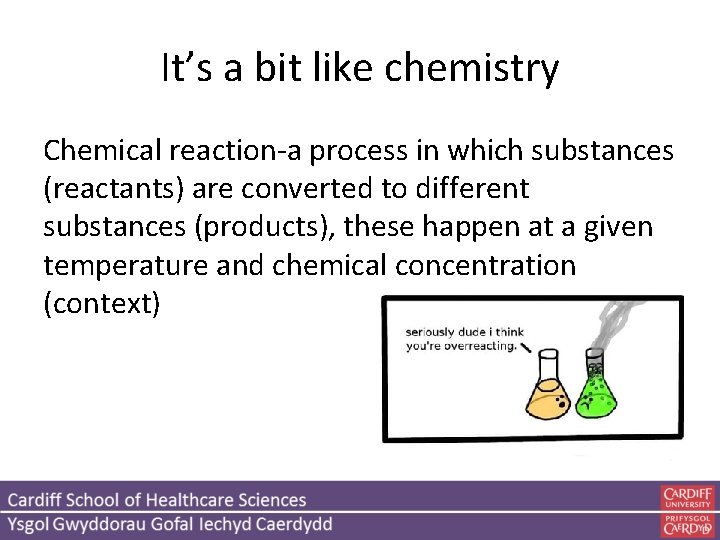
It’s a bit like chemistry Chemical reaction-a process in which substances (reactants) are converted to different substances (products), these happen at a given temperature and chemical concentration (context)
But a bit more complex! Recognised weak relationship between strength of evidence base and behaviour change (Dopson et al 2002, Rycroft-Malone et al 2002) To understand context you need to understand external and internal influences
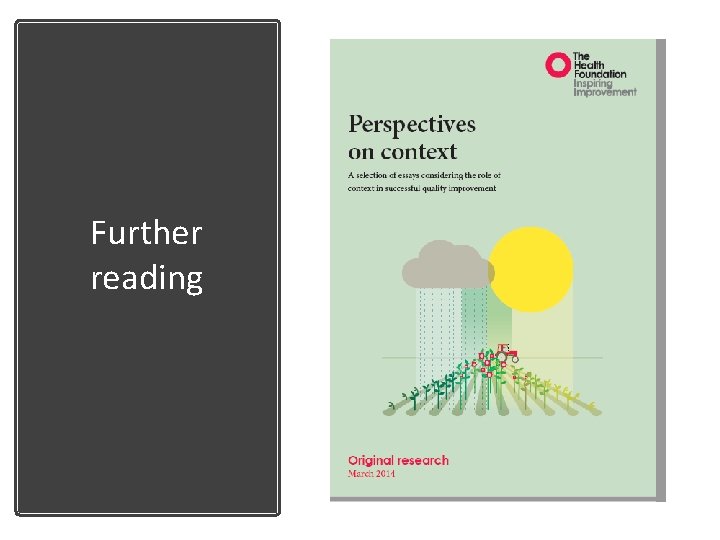
Further reading
‘…the notion of context as it is used in the social sciences is not a strictly theoretical concept, but rather a more or less fuzzy notion denoting a situational, historical, geographical, social or cultural environment of a phenomenon being studied. ’ (Teun van Dijk in Bale 2014 Health Foundation )
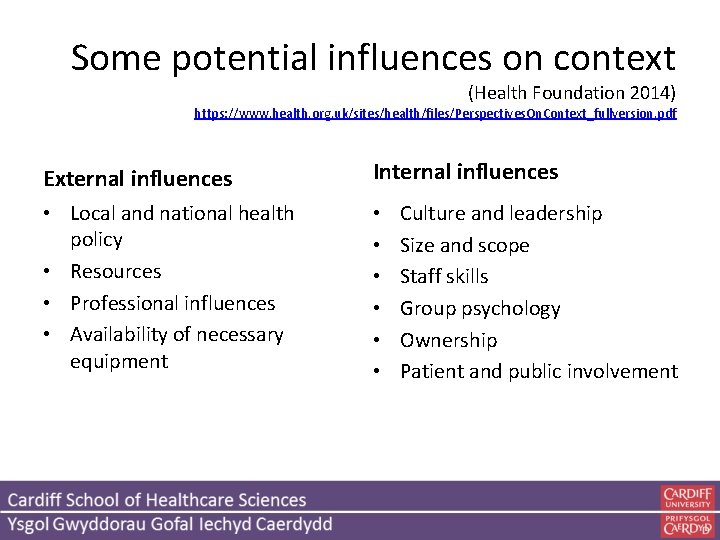
Some potential influences on context (Health Foundation 2014) https: //www. health. org. uk/sites/health/files/Perspectives. On. Context_fullversion. pdf External influences Internal influences • Local and national health policy • Resources • Professional influences • Availability of necessary equipment • • • Culture and leadership Size and scope Staff skills Group psychology Ownership Patient and public involvement

Many consider context e. g. PARi. HS (Promoting Action on Research Implementation) SI = f (E, C, F) Implementation frameworks where SI=successful implementation, E=evidence, C=context, F=facilitation and f=function of. However these frameworks have proved difficult to test
EBHC Surely evidence isn’t it? Or is it? Let’s think of some scenarios
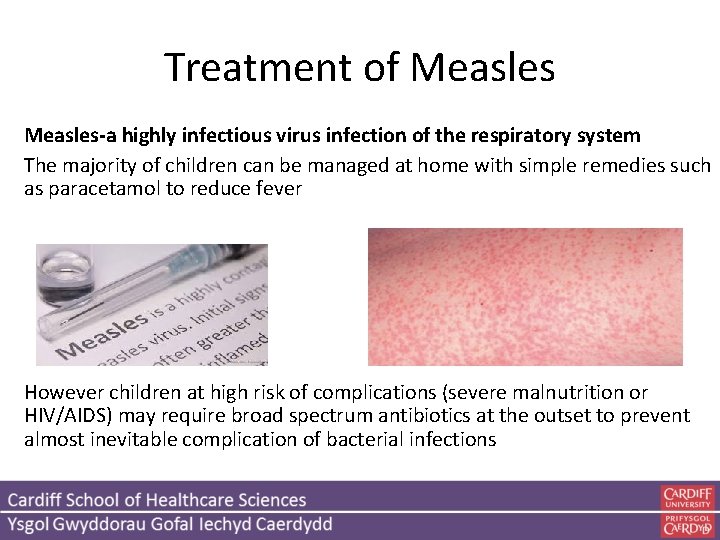
Treatment of Measles-a highly infectious virus infection of the respiratory system The majority of children can be managed at home with simple remedies such as paracetamol to reduce fever However children at high risk of complications (severe malnutrition or HIV/AIDS) may require broad spectrum antibiotics at the outset to prevent almost inevitable complication of bacterial infections
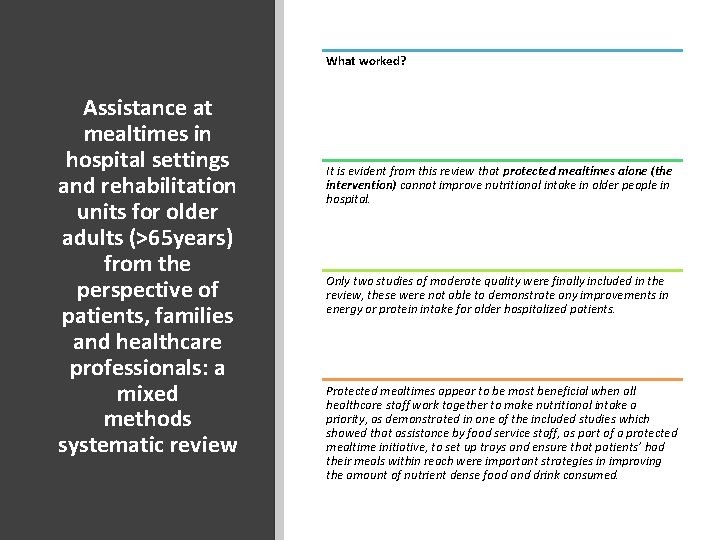
What worked? Assistance at mealtimes in hospital settings and rehabilitation units for older adults (>65 years) from the perspective of patients, families and healthcare professionals: a mixed methods systematic review It is evident from this review that protected mealtimes alone (the intervention) cannot improve nutritional intake in older people in hospital. Only two studies of moderate quality were finally included in the review, these were not able to demonstrate any improvements in energy or protein intake for older hospitalized patients. Protected mealtimes appear to be most beneficial when all healthcare staff work together to make nutritional intake a priority, as demonstrated in one of the included studies which showed that assistance by food service staff, as part of a protected mealtime initiative, to set up trays and ensure that patients’ had their meals within reach were important strategies in improving the amount of nutrient dense food and drink consumed.
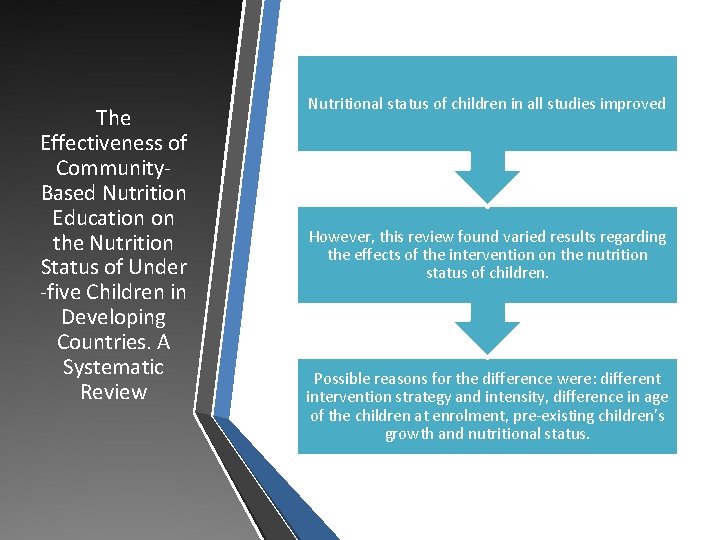
The Effectiveness of Community. Based Nutrition Education on the Nutrition Status of Under -five Children in Developing Countries. A Systematic Review Nutritional status of children in all studies improved However, this review found varied results regarding the effects of the intervention on the nutrition status of children. Possible reasons for the difference were: different intervention strategy and intensity, difference in age of the children at enrolment, pre-existing children’s growth and nutritional status.
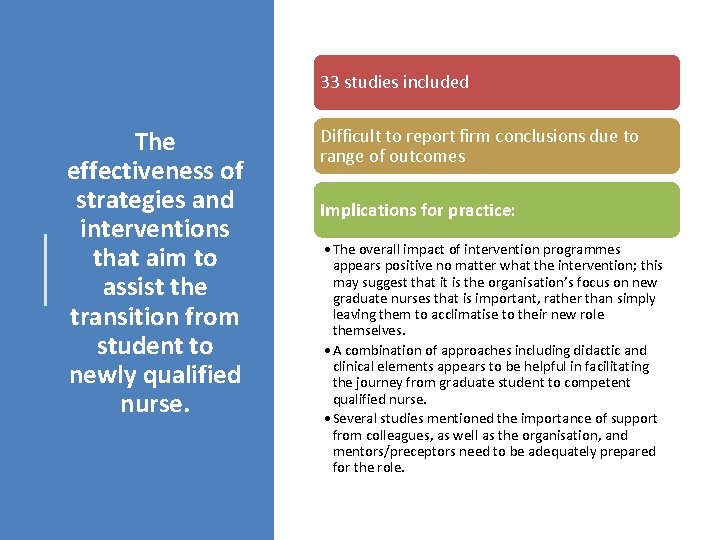
33 studies included The effectiveness of strategies and interventions that aim to assist the transition from student to newly qualified nurse. Difficult to report firm conclusions due to range of outcomes Implications for practice: • The overall impact of intervention programmes appears positive no matter what the intervention; this may suggest that it is the organisation’s focus on new graduate nurses that is important, rather than simply leaving them to acclimatise to their new role themselves. • A combination of approaches including didactic and clinical elements appears to be helpful in facilitating the journey from graduate student to competent qualified nurse. • Several studies mentioned the importance of support from colleagues, as well as the organisation, and mentors/preceptors need to be adequately prepared for the role.
The influence of context Context is influential in a number of ways: Culturally Financially Politically Individually
Mindlines: making sense of evidence in practice • • Mindlines, knowledge-inpractice-in-context, collective sensemaking, communities of practice, contextual adroitness, and knowledge transformation may all play an inescapable role in developing good clinical care. Rather than consider barriers, need to consider what works and use education and training to facilitate this (Gabbay and le May 2004, 2016)
The Way Forward? REALIST METHODOLOGY (REALIST EVALUATION AND REALIST SYNTHESIS) UNDERPINNED BY THE PHILOSOPHY OF CRITICAL REALISM “WHAT WORKS, FOR WHOM, IN WHAT RESPECTS, TO WHAT EXTENT, IN WHAT CONTEXTS, AND HOW? (PAWSON AND TILLEY 1997)

Let’s Discuss?
- Slides: 23