
The Challenge of DEVELOPING LEAN MANAGEMENT By Mike
The Challenge of DEVELOPING LEAN MANAGEMENT By Mike Rother May 2015 v 5. 0 © Mike Rother Toyota Kata
You can use these slides You may use any slides from this presentation, which are copyrighted under a Creative Commons Attribution license. The only requirement is to note the source on each slide you use, for instance by including “By Mike Rother” somewhere on the slide. © Mike Rother Toyota Kata 2
ADOPTING NEW WAYS • Hoping to create different behavior by explaining or trying to convince people generally doesn't work. • We don't behave a certain way because we lack information. We behave one way or another because it's a habit. • What can work is deliberately practicing a different routine, which over time changes how you think. • But don't try to run 20 miles in your first workout! Begin with some starter practice routines, which help you learn fundamentals and build some initial confidence in the new pattern you are trying to learn. © Mike Rother Toyota Kata 3
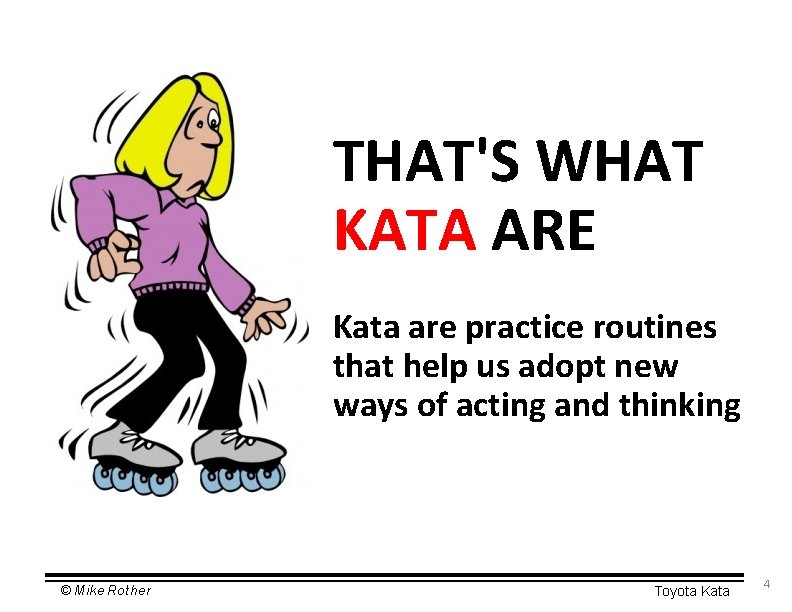
THAT'S WHAT KATA ARE Kata are practice routines that help us adopt new ways of acting and thinking © Mike Rother Toyota Kata 4
WHAT THE IMPROVEMENT KATA AND COACHING KATA ARE ABOUT Scientific Thinking Pattern + Deliberate Practice (Kata) Making Scientific Thinking a Skill that Can be Learned by Anyone © Mike Rother Toyota Kata 5
THE TOYOTA KATA RESEARCH 2004 - 2009 Guided by these two research questions: 1. What are the unseen managerial routines and thinking that lie behind Toyota’s success with continuous improvement and adaptation? 2. How can other companies develop similar routines and thinking in their organizations? Let's start with Question 1: If you study Toyota’s management system enough, a common pattern of thinking and acting emerges, at all levels in the company. © Mike Rother Toyota Kata 6
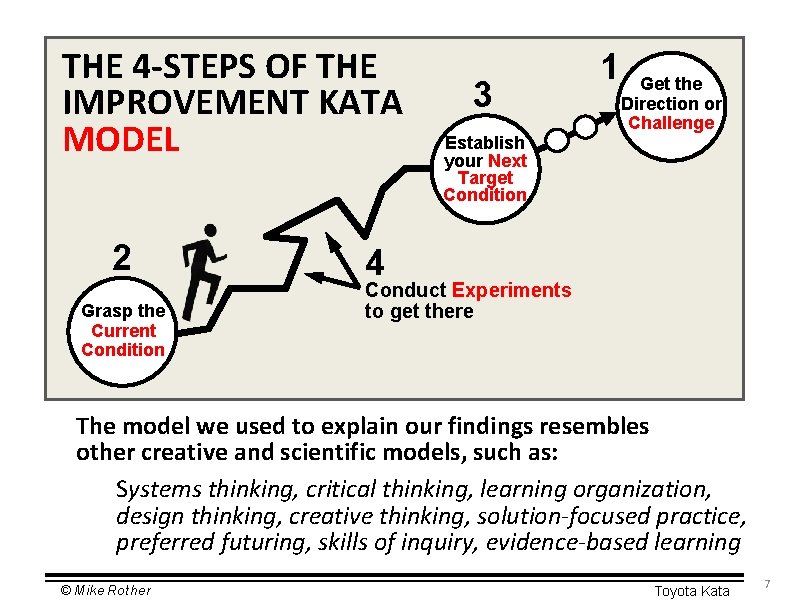
THE 4 -STEPS OF THE IMPROVEMENT KATA MODEL 2 Grasp the Current Condition 3 1 Get the Direction or Challenge Establish your Next Target Condition 4 Conduct Experiments to get there The model we used to explain our findings resembles other creative and scientific models, such as: Systems thinking, critical thinking, learning organization, design thinking, creative thinking, solution-focused practice, preferred futuring, skills of inquiry, evidence-based learning © Mike Rother Toyota Kata 7
CREATING CAPABILITY TO THINK AND WORK SCIENTIFICALLY Finding commonality between Toyota's management approach and models of human creative endeavor makes sense In their daily work, Toyota managers have people practice a universal pattern for improving, adapting and innovating along uncharted paths. Toyota's management approach involves teaching everyone in the organization a scientific mindset, which can be applied to an infinite number of challenges and objectives. Toyota managers are teaching a deliberate, effective, shared way of working throughout the organization. © Mike Rother Toyota Kata 8
Scientific Thinking Pattern + Deliberate Practice (Kata) Making Scientific Thinking a Skill that Can be Learned by Anyone © Mike Rother Toyota Kata 9
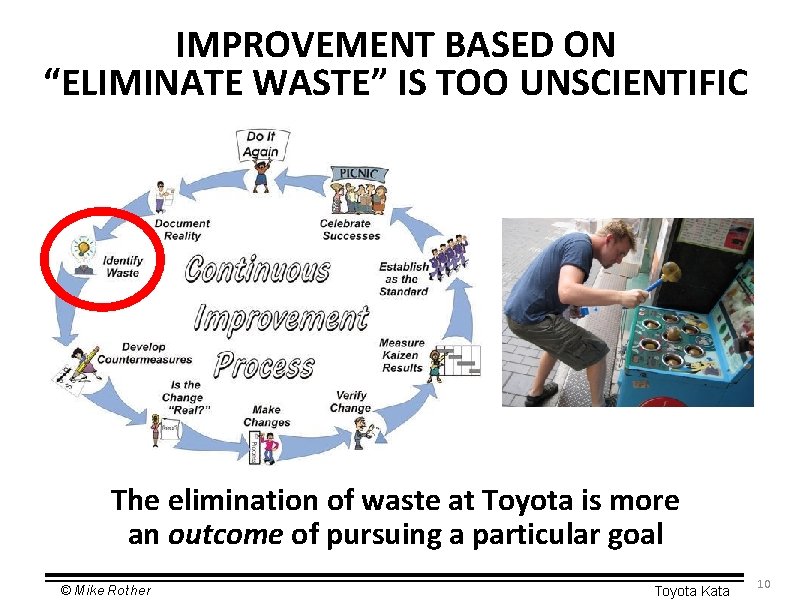
IMPROVEMENT BASED ON “ELIMINATE WASTE” IS TOO UNSCIENTIFIC The elimination of waste at Toyota is more an outcome of pursuing a particular goal © Mike Rother Toyota Kata 10
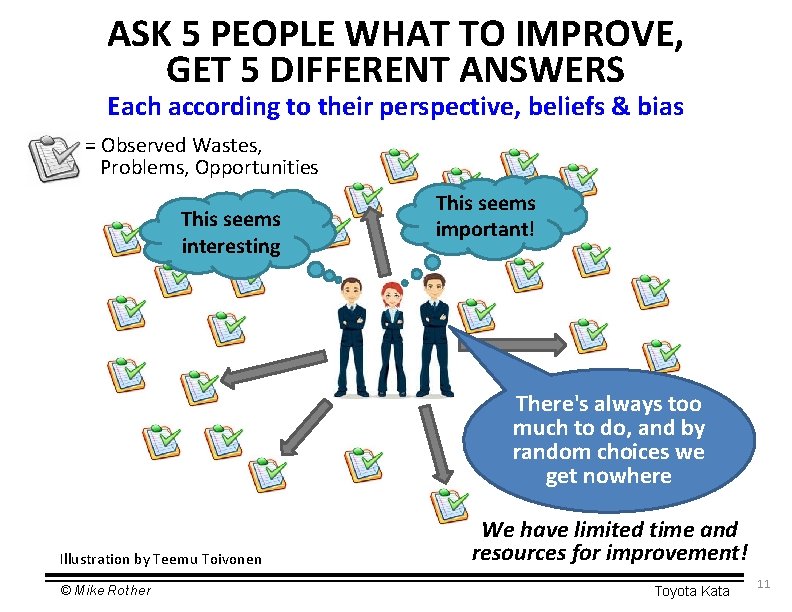
ASK 5 PEOPLE WHAT TO IMPROVE, GET 5 DIFFERENT ANSWERS Each according to their perspective, beliefs & bias = Observed Wastes, Problems, Opportunities This seems interesting This seems important! There's always too much to do, and by random choices we get nowhere Illustration by Teemu Toivonen © Mike Rother We have limited time and resources for improvement! Toyota Kata 11
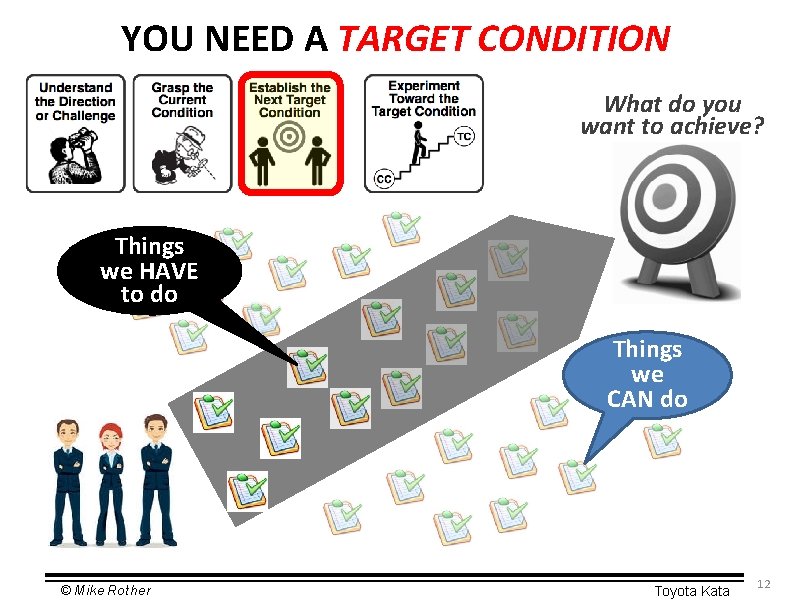
YOU NEED A TARGET CONDITION What do you want to achieve? Things we HAVE to do Things we CAN do © Mike Rother Toyota Kata 12
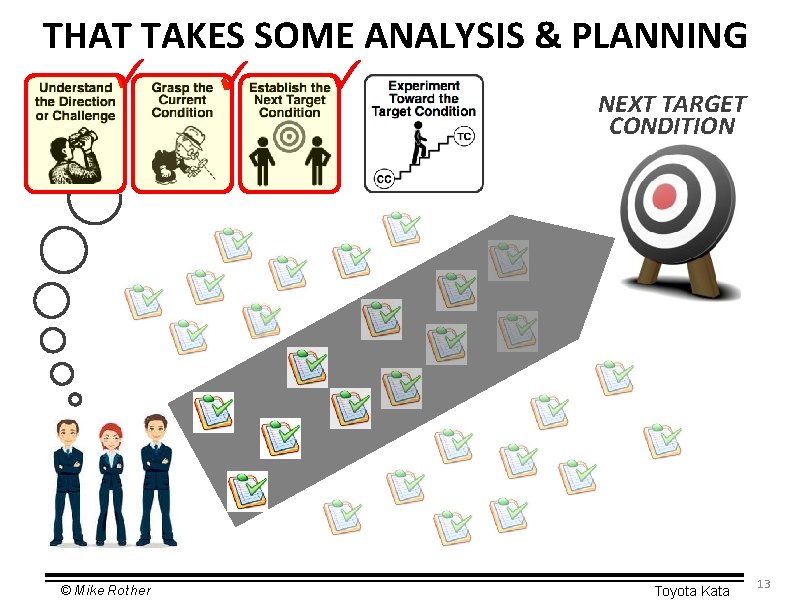
THAT TAKES SOME ANALYSIS & PLANNING ✓ ✓ ✓ NEXT TARGET CONDITION © Mike Rother Toyota Kata 13
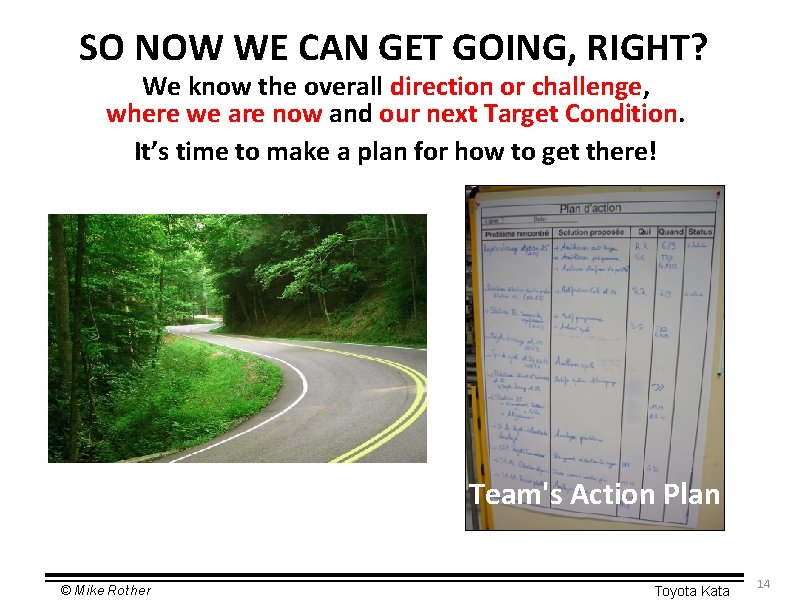
SO NOW WE CAN GET GOING, RIGHT? We know the overall direction or challenge, where we are now and our next Target Condition. It’s time to make a plan for how to get there! Team's Action Plan © Mike Rother Toyota Kata 14
SO NOW WE CAN GET GOING, RIGHT? We know the overall direction or challenge, where we are now and our next Target Condition. It’s time to make a plan for how to get there! Well, not quite. . . Team's Action Plan © Mike Rother Toyota Kata 15
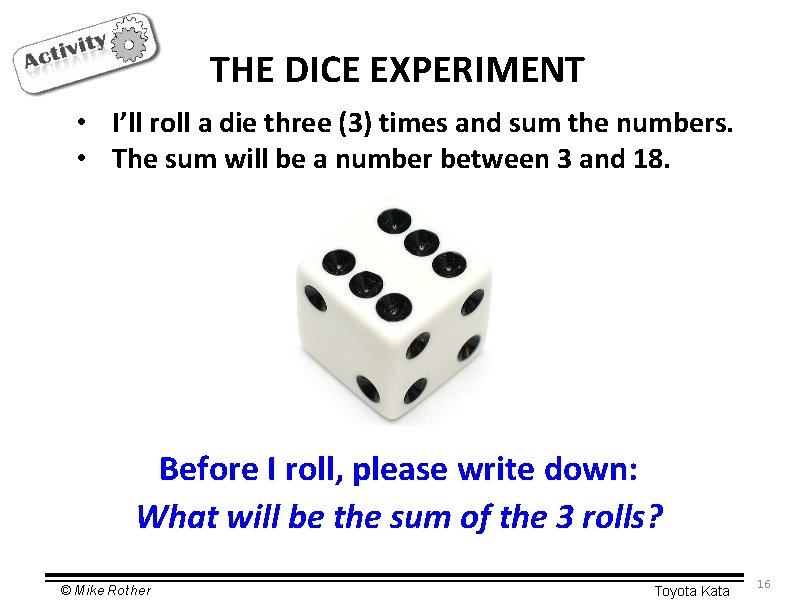
THE DICE EXPERIMENT • I’ll roll a die three (3) times and sum the numbers. • The sum will be a number between 3 and 18. Before I roll, please write down: What will be the sum of the 3 rolls? © Mike Rother Toyota Kata 16
Those of you who wrote down the incorrect sum. . . How do you feel? © Mike Rother Toyota Kata 17
Not so bad, it’s just chance © Mike Rother Toyota Kata 18
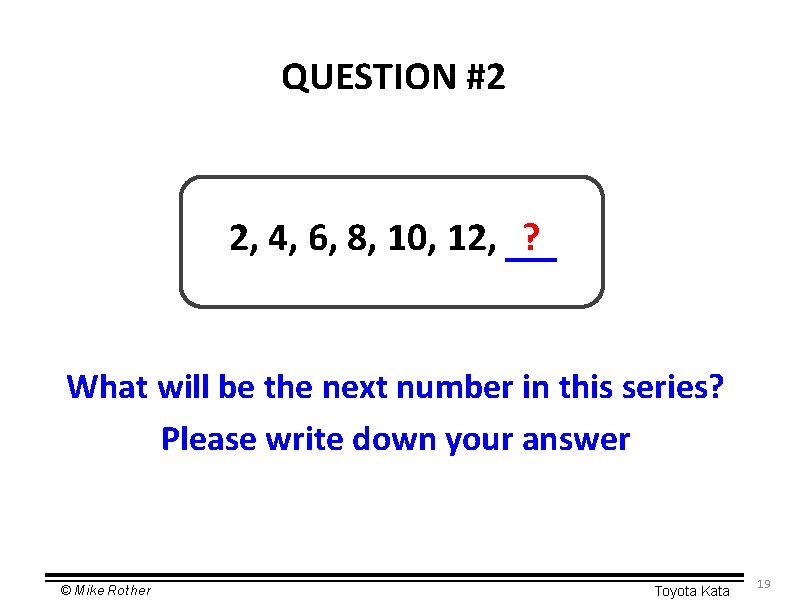
QUESTION #2 2, 4, 6, 8, 10, 12, ? What will be the next number in this series? Please write down your answer © Mike Rother Toyota Kata 19
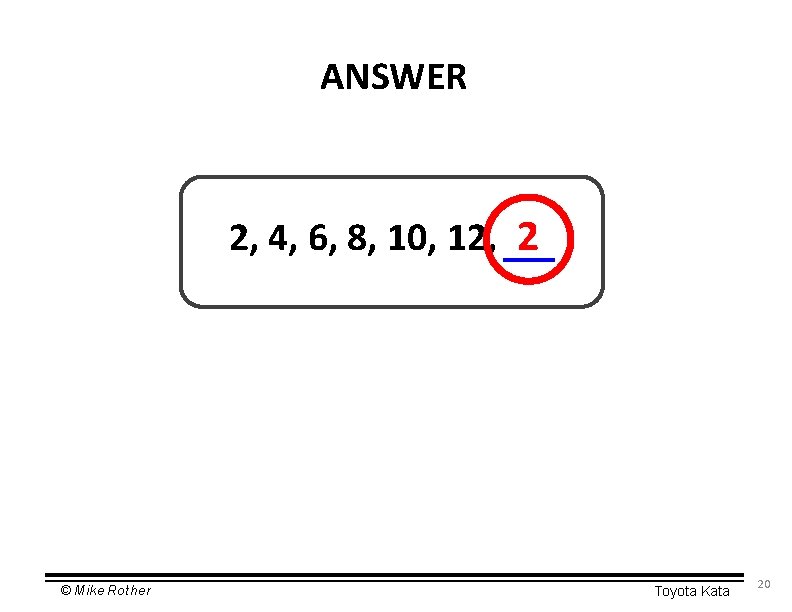
ANSWER 2, 4, 6, 8, 10, 12, 2 © Mike Rother Toyota Kata 20
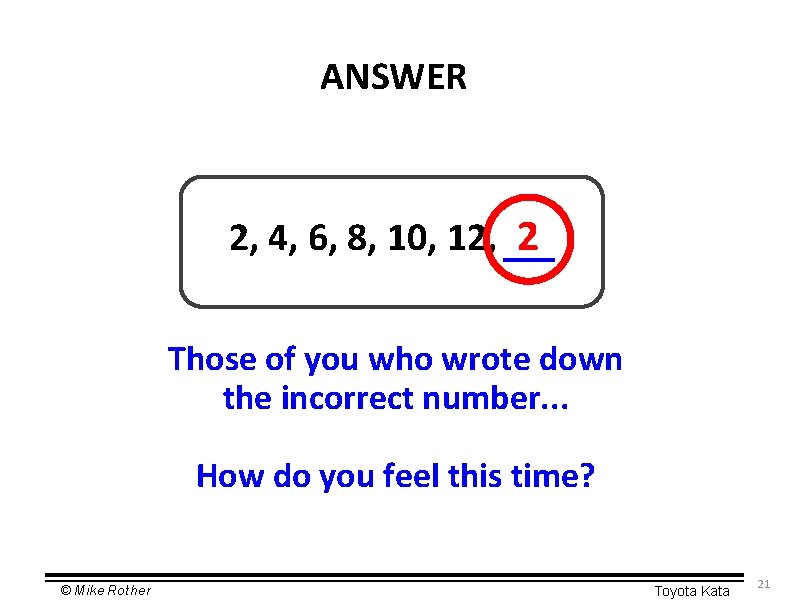
ANSWER 2, 4, 6, 8, 10, 12, 2 Those of you who wrote down the incorrect number. . . How do you feel this time? © Mike Rother Toyota Kata 21
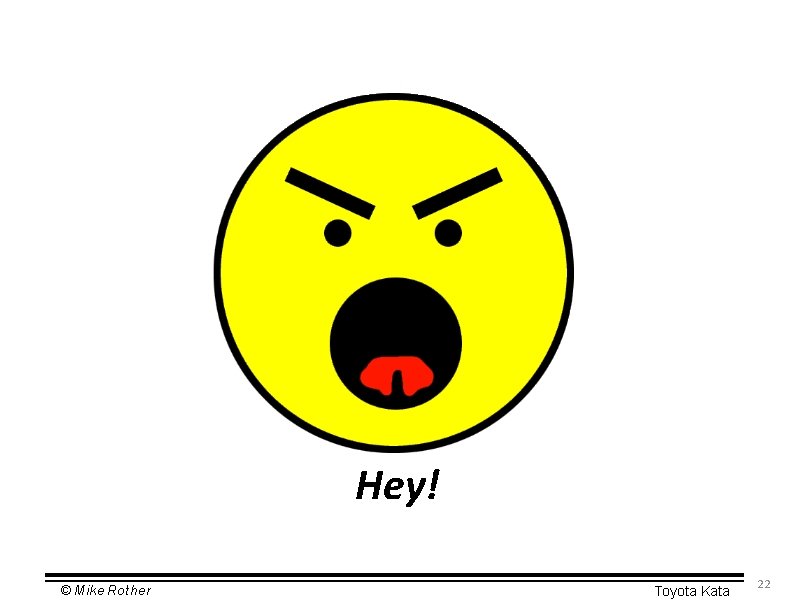
Hey! © Mike Rother Toyota Kata 22
What was different about these two scenarios? © Mike Rother Toyota Kata 23
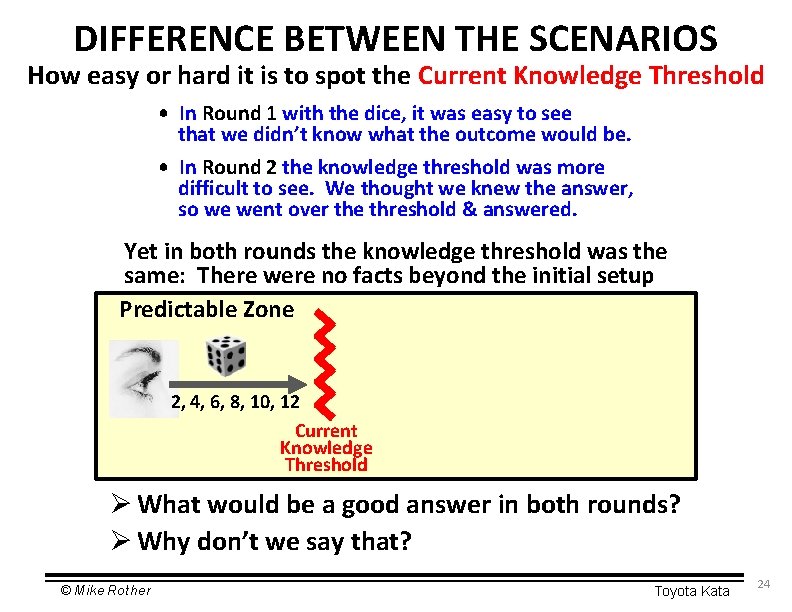
DIFFERENCE BETWEEN THE SCENARIOS How easy or hard it is to spot the Current Knowledge Threshold • In Round 1 with the dice, it was easy to see that we didn’t know what the outcome would be. • In Round 2 the knowledge threshold was more difficult to see. We thought we knew the answer, so we went over the threshold & answered. Yet in both rounds the knowledge threshold was the same: There were no facts beyond the initial setup Predictable Zone 2, 4, 6, 8, 10, 12 Current Knowledge Threshold Ø What would be a good answer in both rounds? Ø Why don’t we say that? © Mike Rother Toyota Kata 24
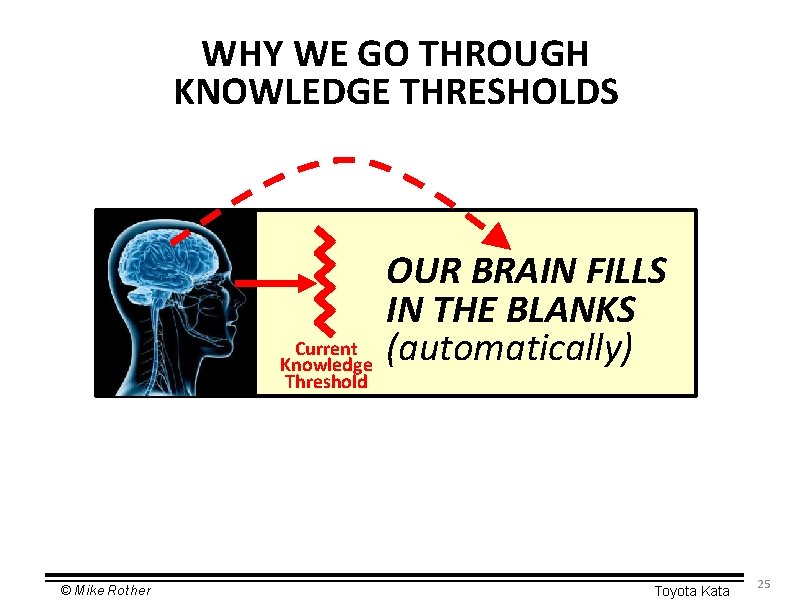
WHY WE GO THROUGH KNOWLEDGE THRESHOLDS Current Knowledge Threshold © Mike Rother OUR BRAIN FILLS IN THE BLANKS (automatically) Toyota Kata 25
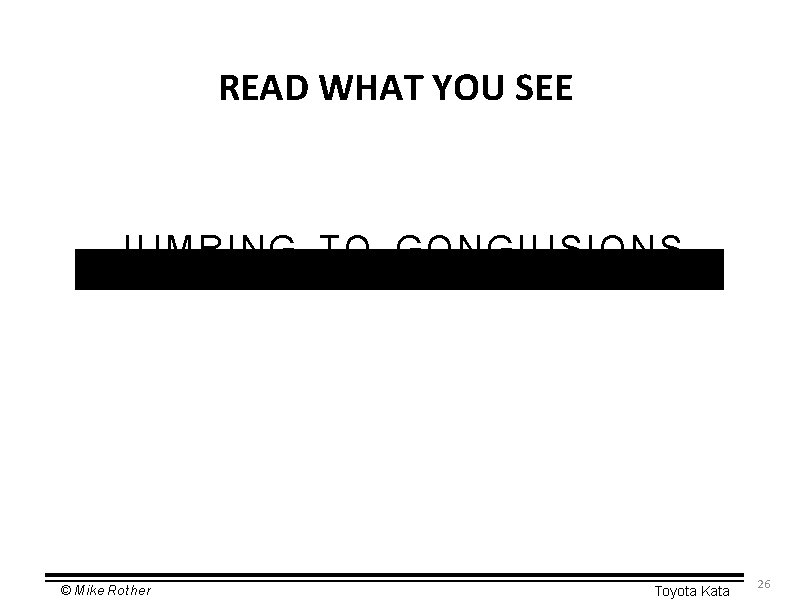
READ WHAT YOU SEE IUMRING TQ GQNGIUSIQNS © Mike Rother Toyota Kata 26
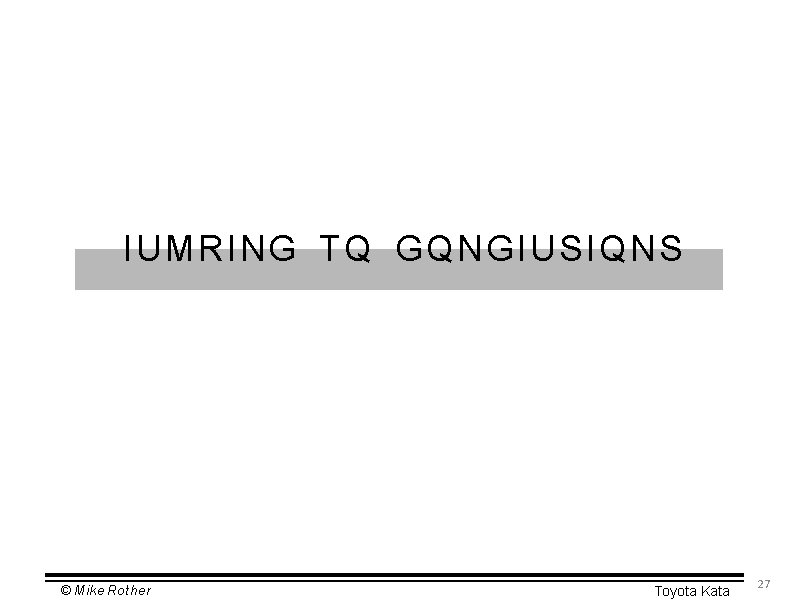
IUMRING TQ GQNGIUSIQNS © Mike Rother Toyota Kata 27
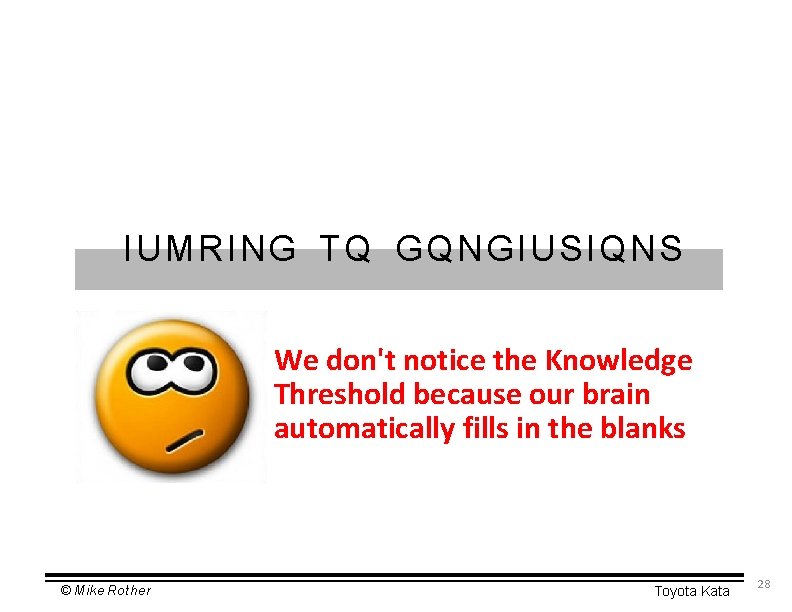
IUMRING TQ GQNGIUSIQNS We don't notice the Knowledge Threshold because our brain automatically fills in the blanks © Mike Rother Toyota Kata 28
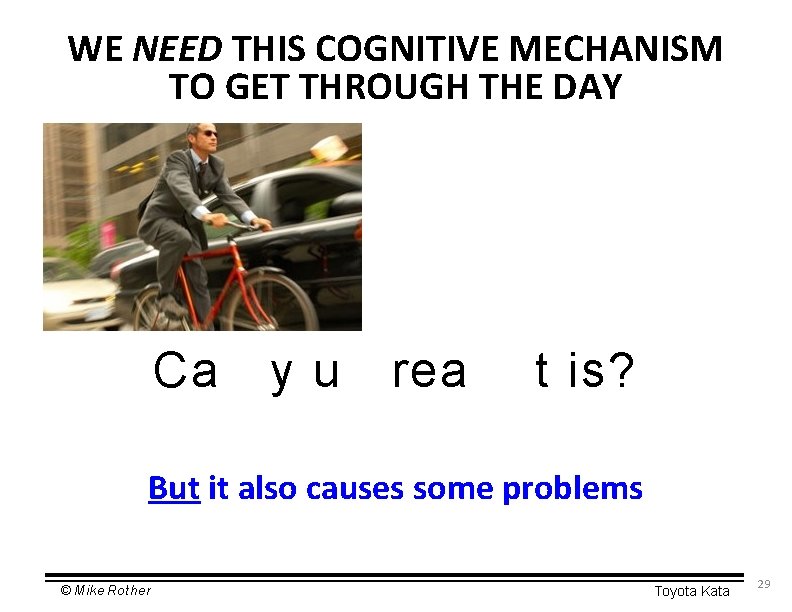
WE NEED THIS COGNITIVE MECHANISM TO GET THROUGH THE DAY Ca y u rea t is? But it also causes some problems © Mike Rother Toyota Kata 29
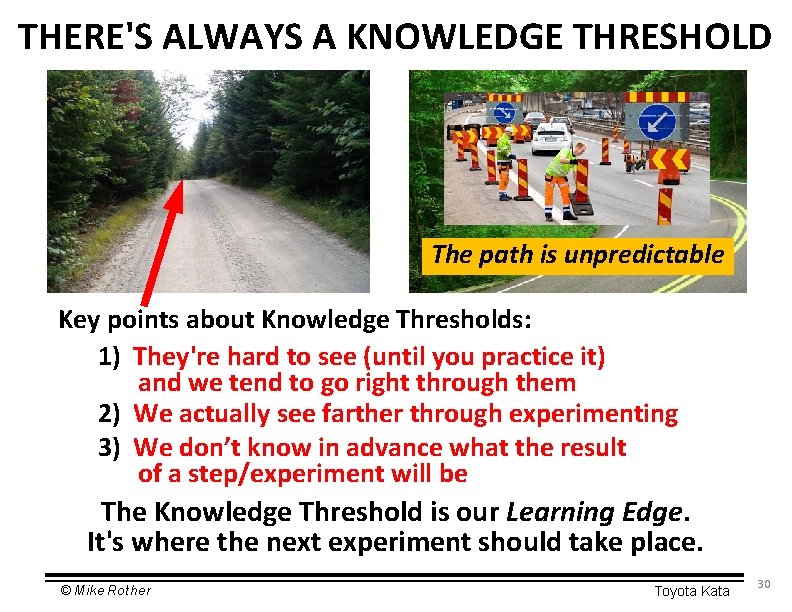
THERE'S ALWAYS A KNOWLEDGE THRESHOLD The path is unpredictable Key points about Knowledge Thresholds: 1) They're hard to see (until you practice it) and we tend to go right through them 2) We actually see farther through experimenting 3) We don’t know in advance what the result of a step/experiment will be The Knowledge Threshold is our Learning Edge. It's where the next experiment should take place. © Mike Rother Toyota Kata 30
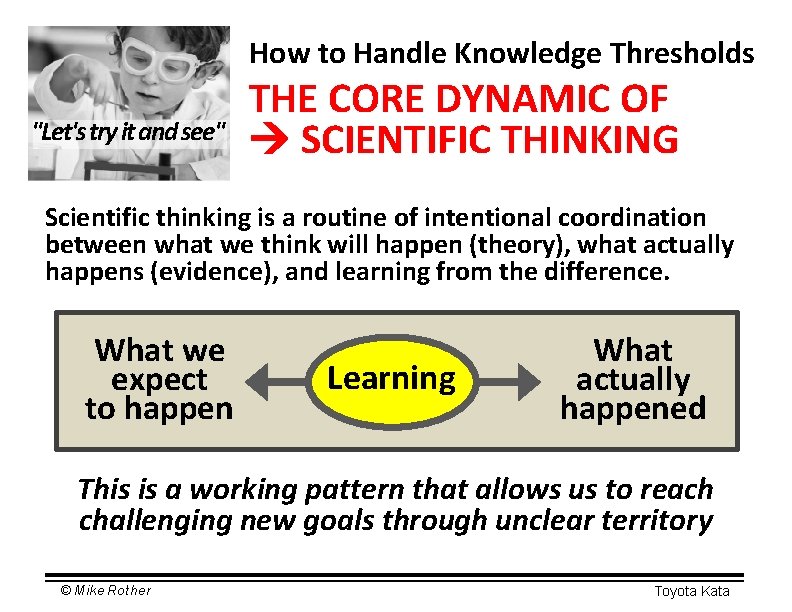
How to Handle Knowledge Thresholds "Let's try it and see" THE CORE DYNAMIC OF SCIENTIFIC THINKING Scientific thinking is a routine of intentional coordination between what we think will happen (theory), what actually happens (evidence), and learning from the difference. What we expect to happen Learning What actually happened This is a working pattern that allows us to reach challenging new goals through unclear territory © Mike Rother Toyota Kata
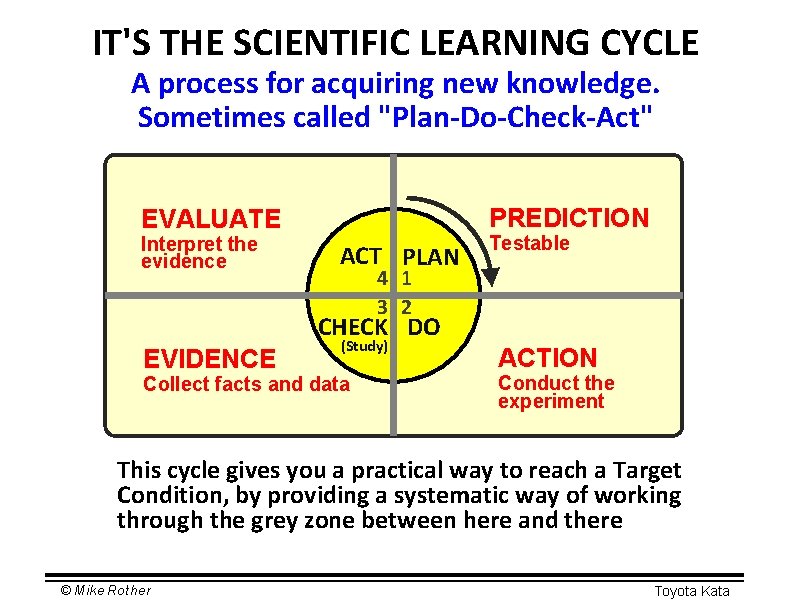
IT'S THE SCIENTIFIC LEARNING CYCLE A process for acquiring new knowledge. Sometimes called "Plan-Do-Check-Act" PREDICTION EVALUATE Interpret the evidence ACT PLAN Testable 4 1 3 2 CHECK DO EVIDENCE (Study) Collect facts and data ACTION Conduct the experiment This cycle gives you a practical way to reach a Target Condition, by providing a systematic way of working through the grey zone between here and there © Mike Rother Toyota Kata
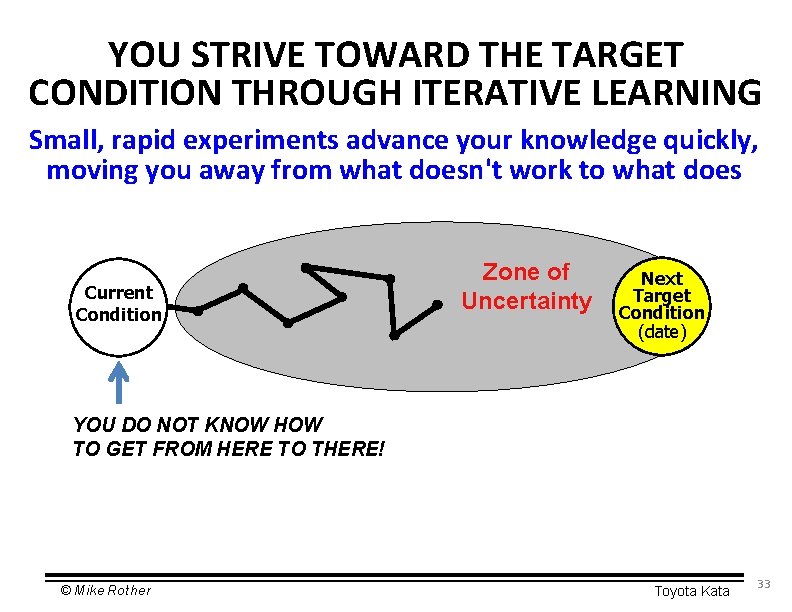
YOU STRIVE TOWARD THE TARGET CONDITION THROUGH ITERATIVE LEARNING Small, rapid experiments advance your knowledge quickly, moving you away from what doesn't work to what does Current Condition Zone of Uncertainty Next Target Condition (date) YOU DO NOT KNOW HOW TO GET FROM HERE TO THERE! © Mike Rother Toyota Kata 33
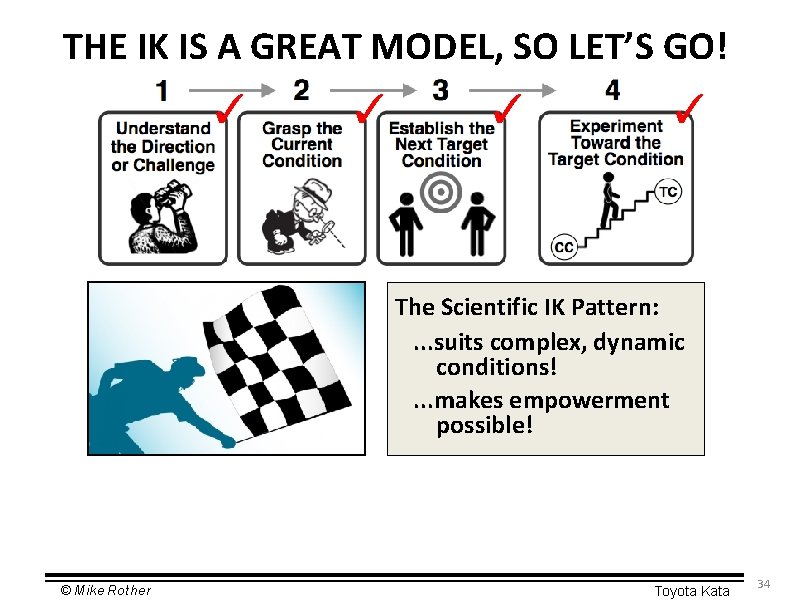
THE IK IS A GREAT MODEL, SO LET’S GO! ✓ ✓ The Scientific IK Pattern: . . . suits complex, dynamic conditions!. . . makes empowerment possible! © Mike Rother Toyota Kata 34
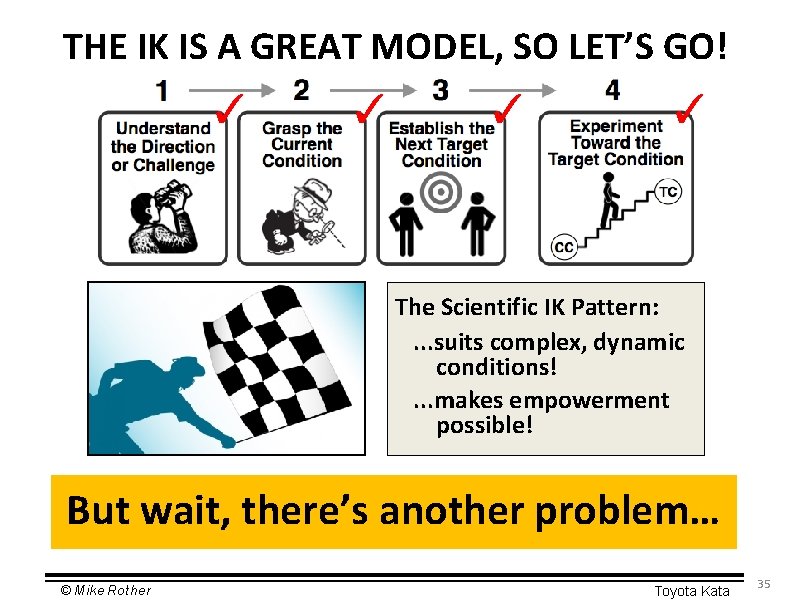
THE IK IS A GREAT MODEL, SO LET’S GO! ✓ ✓ The Scientific IK Pattern: . . . suits complex, dynamic conditions!. . . makes empowerment possible! But wait, there’s another problem… © Mike Rother Toyota Kata 35
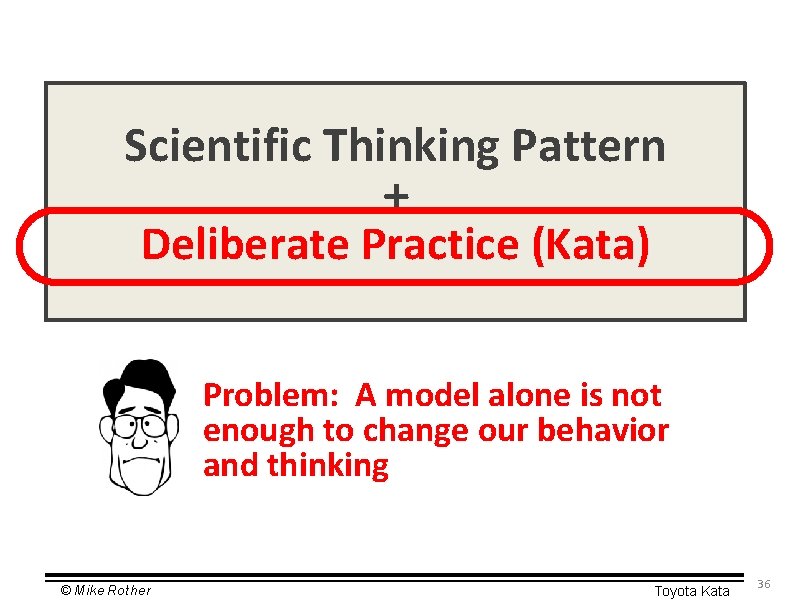
Scientific Thinking Pattern + Deliberate Practice (Kata) Problem: A model alone is not enough to change our behavior and thinking © Mike Rother Toyota Kata 36
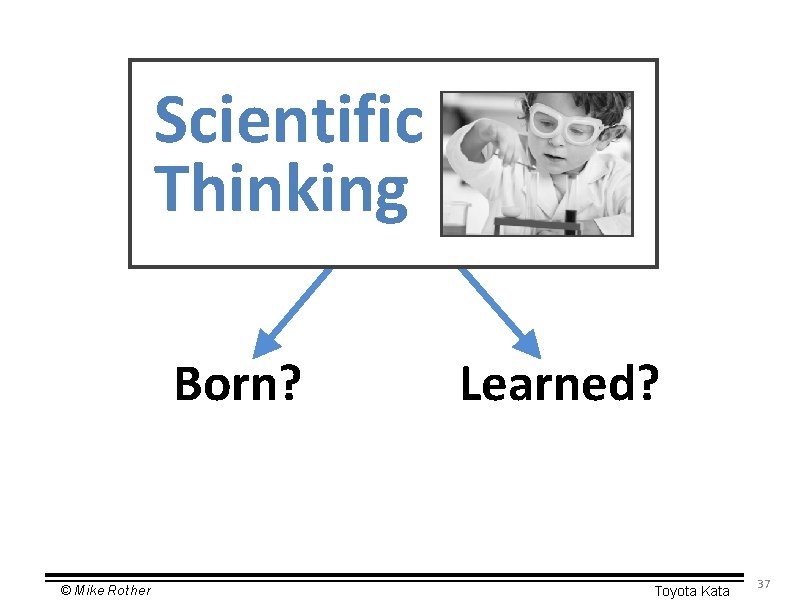
Scientific Thinking Born? © Mike Rother Learned? Toyota Kata 37
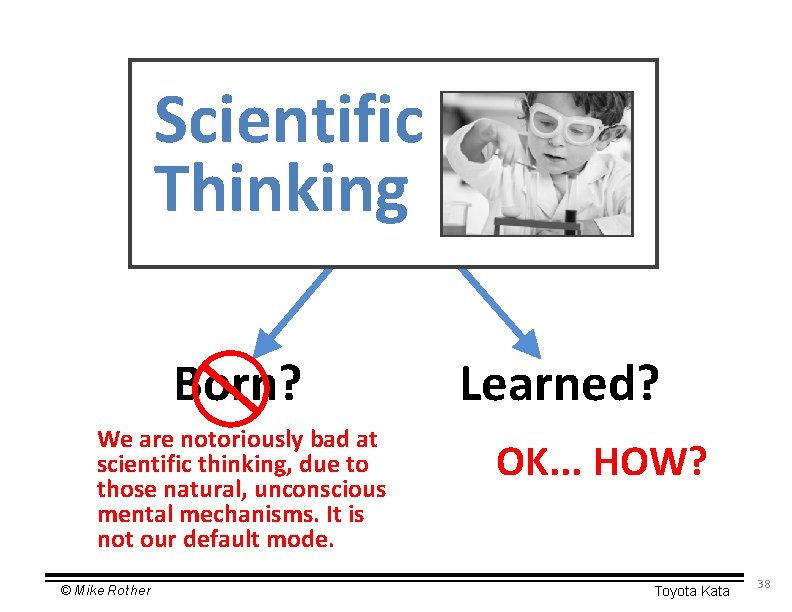
Scientific Thinking Born? We are notoriously bad at scientific thinking, due to those natural, unconscious mental mechanisms. It is not our default mode. © Mike Rother Learned? OK. . . HOW? Toyota Kata 38
REMEMBER QUESTION 2? How can other companies develop similar routines and thinking in their organizations? Interestingly, we face a different challenge than does Toyota: • Toyota is trying to maintain an existing culture as it grows worldwide. • We are trying to change our culture. © Mike Rother Toyota Kata 39
WHAT DOES IT TAKE TO CHANGE OUR THINKING? • • © Mike Rother Get a piece of paper and a pen Start when I say “go” Sign your name 5 times normally When you are finished raise your hand Toyota Kata 40
REMEMBER QUESTION 2? How can other companies develop similar routines and thinking in their organizations? Interestingly, we face a different challenge than does Toyota: • Toyota is trying to maintain an existing culture as it grows worldwide. • We are trying to change our culture. © Mike Rother Toyota Kata 41
LET’S TRY JUST ONE CHANGE, MUCH SMALLER THAN CHANGING ORG CULTURE • • © Mike Rother Change hands, to non-dominant Start when I say “go” Sign your name 5 times again Raise your hand when you are finished Toyota Kata 42
HOW DID IT FEEL THE SECOND TIME COMPARED TO THE FIRST? © Mike Rother Toyota Kata 43
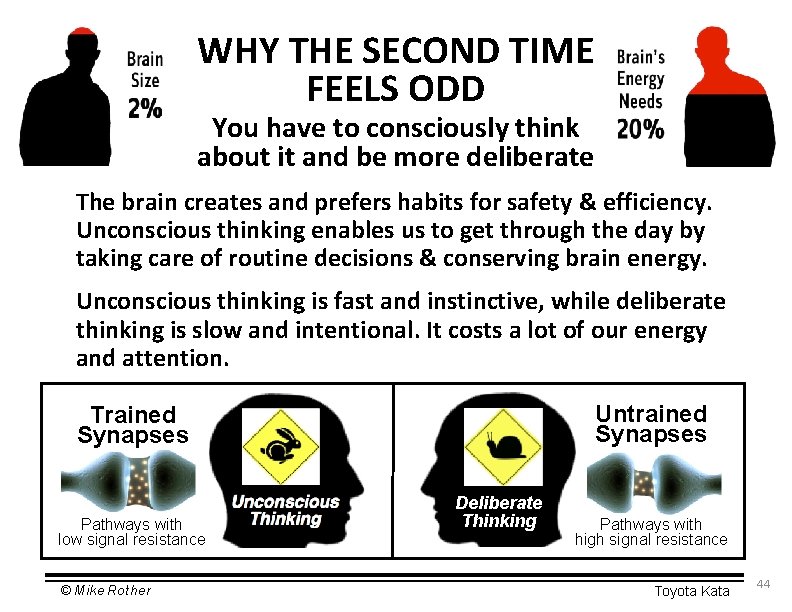
WHY THE SECOND TIME FEELS ODD You have to consciously think about it and be more deliberate The brain creates and prefers habits for safety & efficiency. Unconscious thinking enables us to get through the day by taking care of routine decisions & conserving brain energy. Unconscious thinking is fast and instinctive, while deliberate thinking is slow and intentional. It costs a lot of our energy and attention. Untrained Synapses Trained Synapses Pathways with low signal resistance © Mike Rother Deliberate Thinking Pathways with high signal resistance Toyota Kata 44
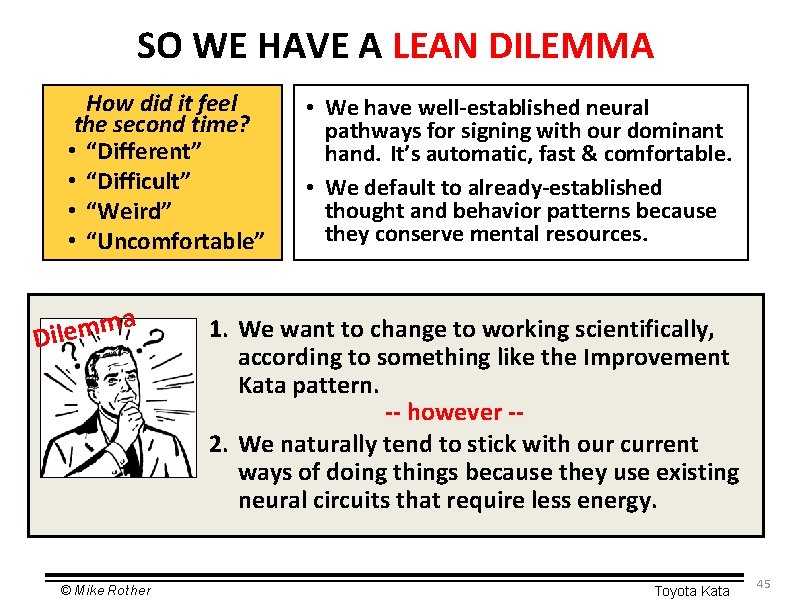
SO WE HAVE A LEAN DILEMMA How did it feel the second time? • “Different” • “Difficult” • “Weird” • “Uncomfortable” a m Dilem © Mike Rother • We have well-established neural pathways for signing with our dominant hand. It’s automatic, fast & comfortable. • We default to already-established thought and behavior patterns because they conserve mental resources. 1. We want to change to working scientifically, according to something like the Improvement Kata pattern. -- however -2. We naturally tend to stick with our current ways of doing things because they use existing neural circuits that require less energy. Toyota Kata 45
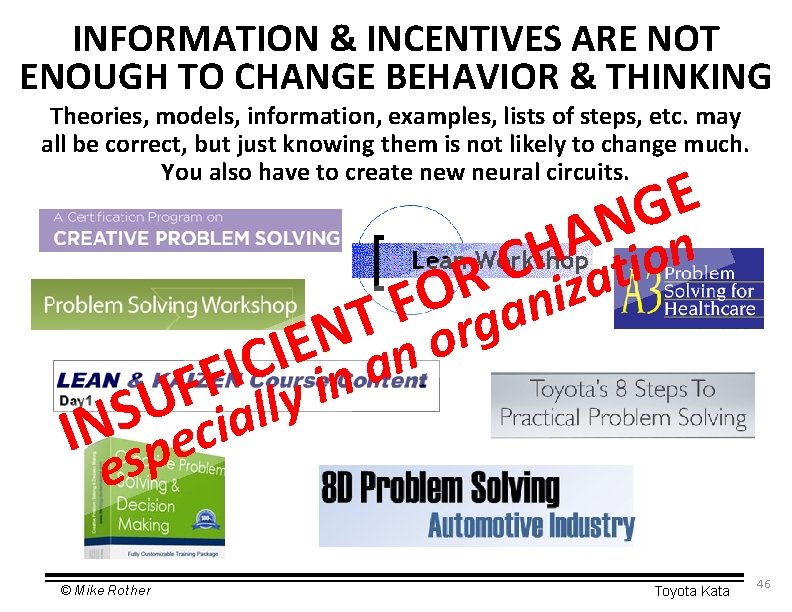
INFORMATION & INCENTIVES ARE NOT ENOUGH TO CHANGE BEHAVIOR & THINKING Theories, models, information, examples, lists of steps, etc. may all be correct, but just knowing them is not likely to change much. You also have to create new neural circuits. E G N A n H o i C t a R z i O n F a T g r N o E I n C a I F in F y U l l S a i N c I spe e © Mike Rother Toyota Kata 46
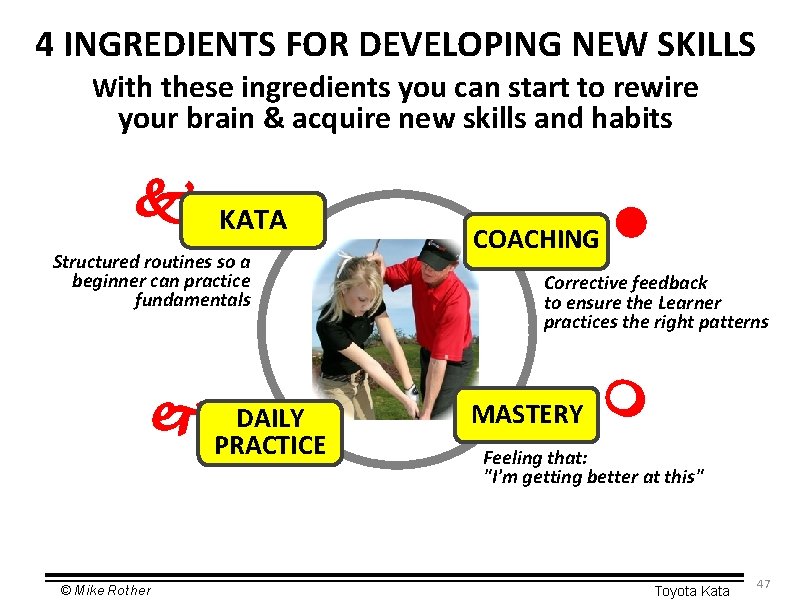
4 INGREDIENTS FOR DEVELOPING NEW SKILLS With these ingredients you can start to rewire your brain & acquire new skills and habits k KATA Structured routines so a beginner can practice fundamentals j © Mike Rother DAILY PRACTICE COACHING l Corrective feedback to ensure the Learner practices the right patterns MASTERY m Feeling that: "I'm getting better at this" Toyota Kata 47
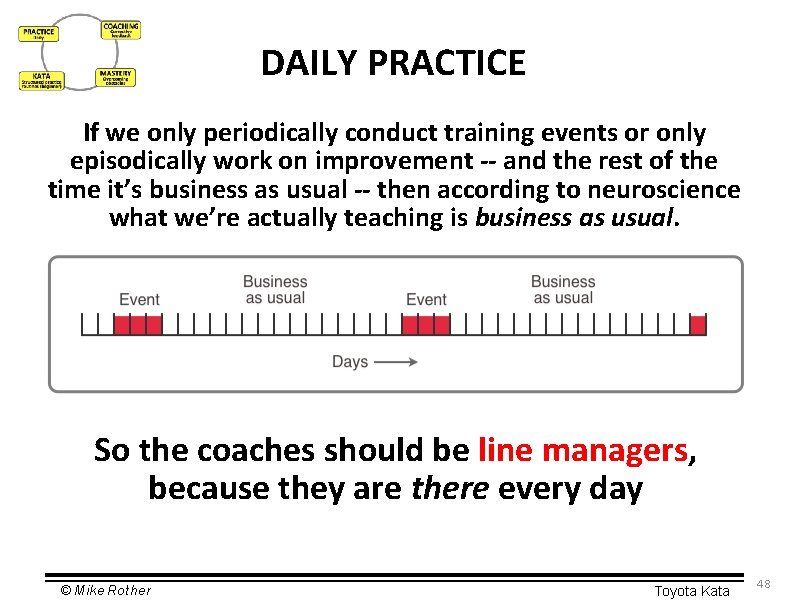
DAILY PRACTICE If we only periodically conduct training events or only episodically work on improvement -- and the rest of the time itʼs business as usual -- then according to neuroscience what weʼre actually teaching is business as usual. So the coaches should be line managers, because they are there every day © Mike Rother Toyota Kata 48
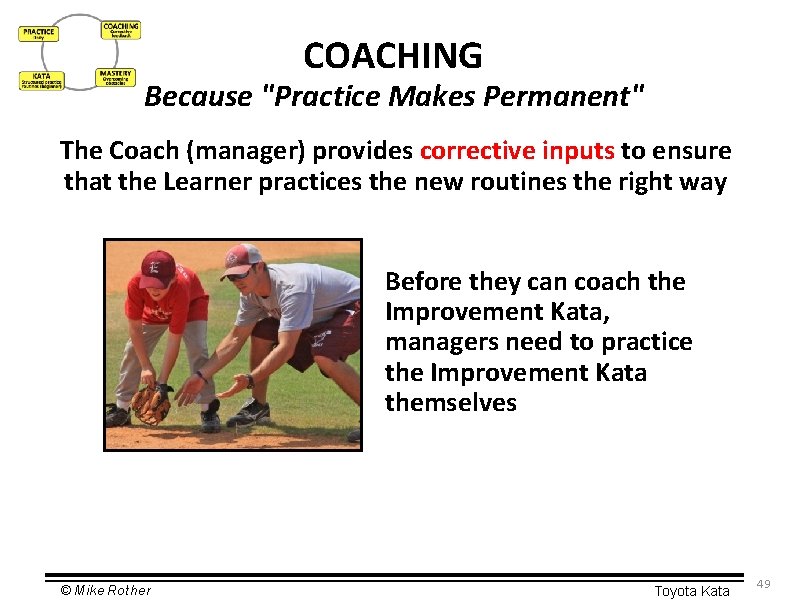
COACHING Because "Practice Makes Permanent" The Coach (manager) provides corrective inputs to ensure that the Learner practices the new routines the right way Before they can coach the Improvement Kata, managers need to practice the Improvement Kata themselves © Mike Rother Toyota Kata 49
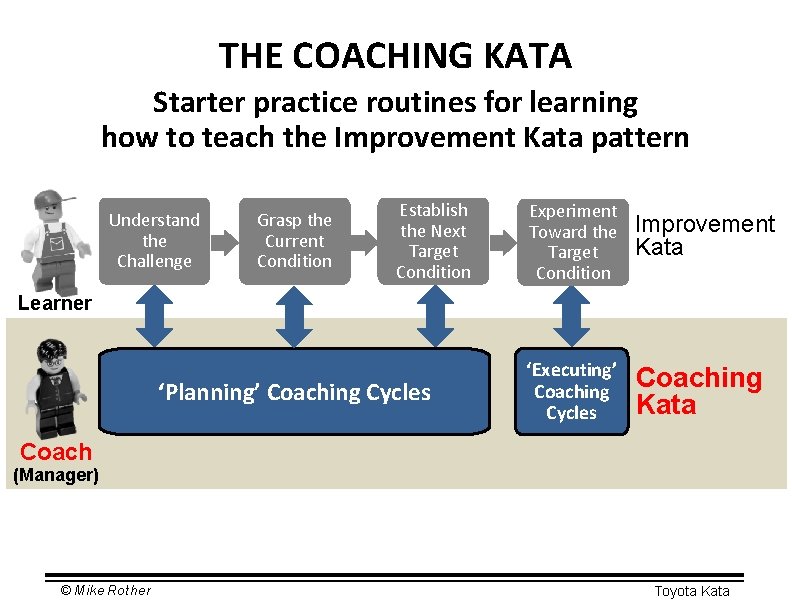
THE COACHING KATA Starter practice routines for learning how to teach the Improvement Kata pattern Understand the Challenge Grasp the Current Condition Establish the Next Target Condition Experiment Toward the Target Condition Improvement Kata ‘Executing’ Coaching Cycles Coaching Kata Learner ‘Planning’ Coaching Cycles Coach (Manager) © Mike Rother Toyota Kata
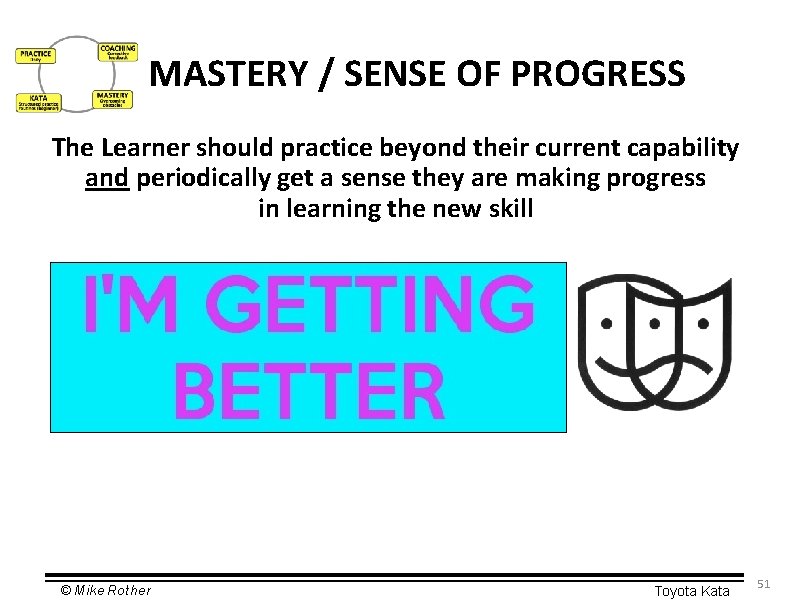
MASTERY / SENSE OF PROGRESS The Learner should practice beyond their current capability and periodically get a sense they are making progress in learning the new skill © Mike Rother Toyota Kata 51
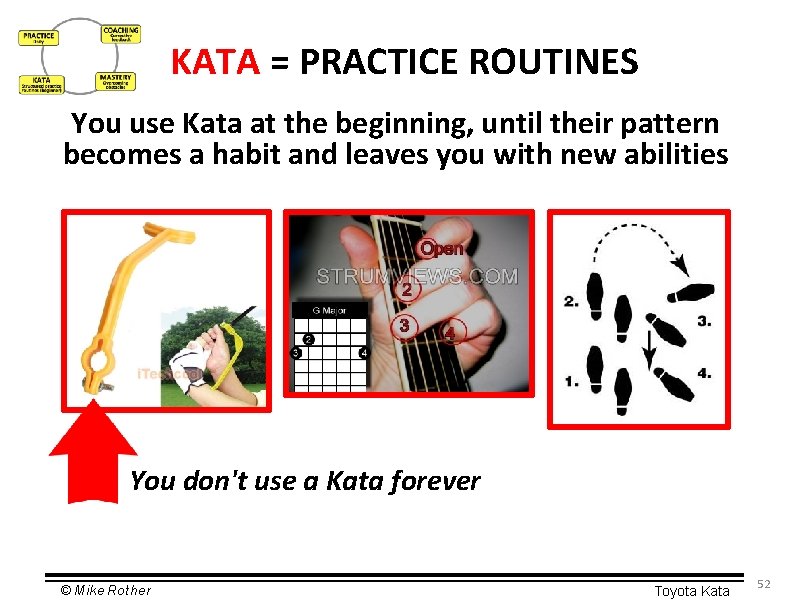
KATA = PRACTICE ROUTINES You use Kata at the beginning, until their pattern becomes a habit and leaves you with new abilities You don't use a Kata forever © Mike Rother Toyota Kata 52
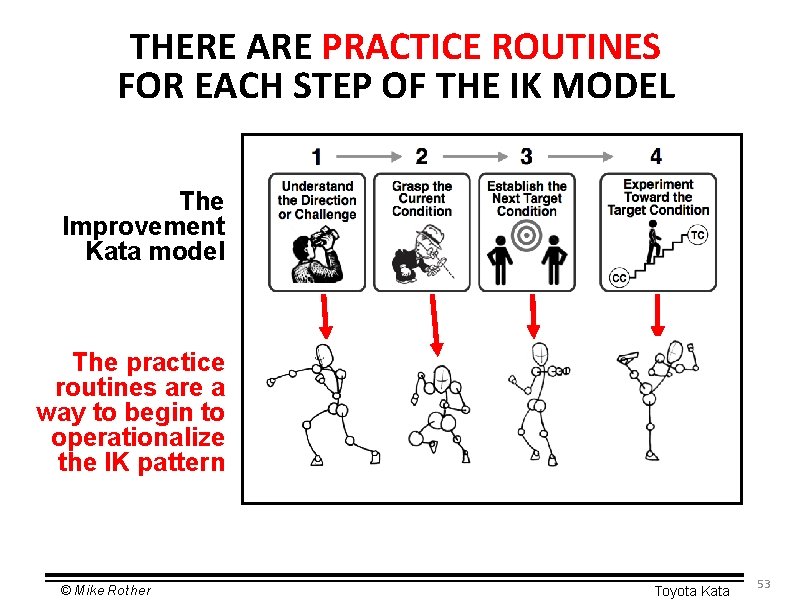
THERE ARE PRACTICE ROUTINES FOR EACH STEP OF THE IK MODEL The Improvement Kata model The practice routines are a way to begin to operationalize the IK pattern © Mike Rother Toyota Kata 53
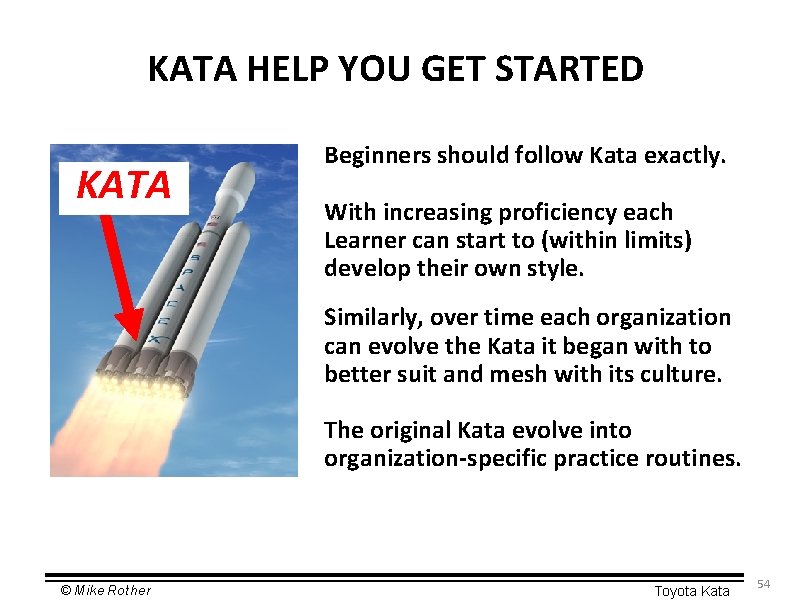
KATA HELP YOU GET STARTED KATA Beginners should follow Kata exactly. With increasing proficiency each Learner can start to (within limits) develop their own style. Similarly, over time each organization can evolve the Kata it began with to better suit and mesh with its culture. The original Kata evolve into organization-specific practice routines. © Mike Rother Toyota Kata 54
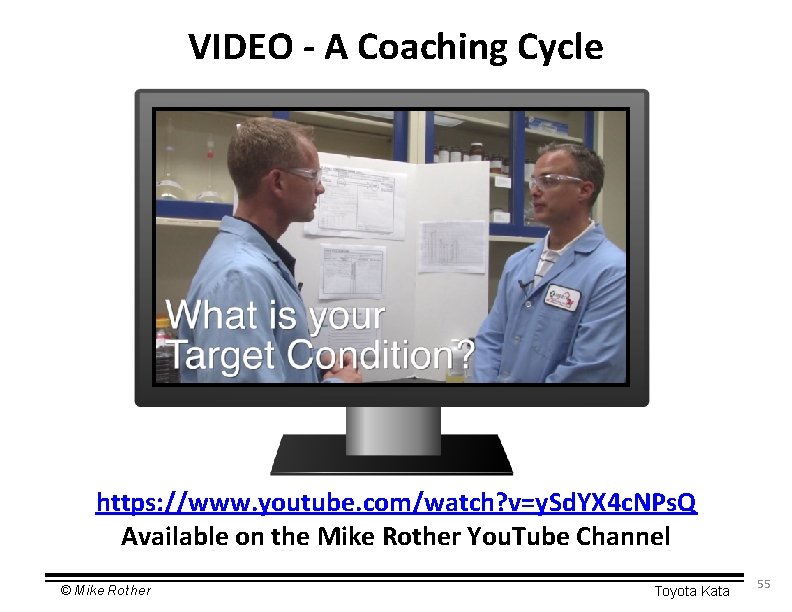
VIDEO - A Coaching Cycle https: //www. youtube. com/watch? v=y. Sd. YX 4 c. NPs. Q Available on the Mike Rother You. Tube Channel © Mike Rother Toyota Kata 55
The Challenge of Creating Lean Management The goal of this presentation is to help make us aware of what is the task The Improvement Kata and Coaching Kata help with this task! © Mike Rother Toyota Kata 56
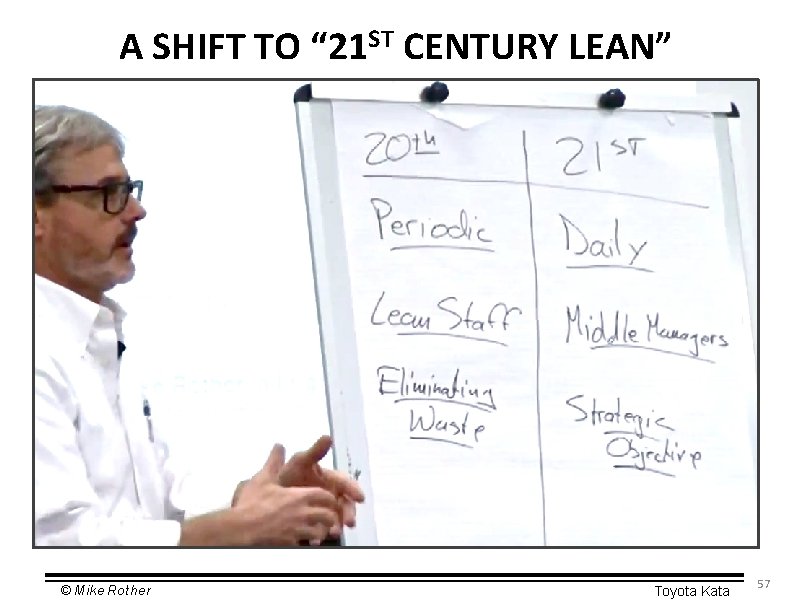
A SHIFT TO “ 21 ST CENTURY LEAN” © Mike Rother Toyota Kata 57
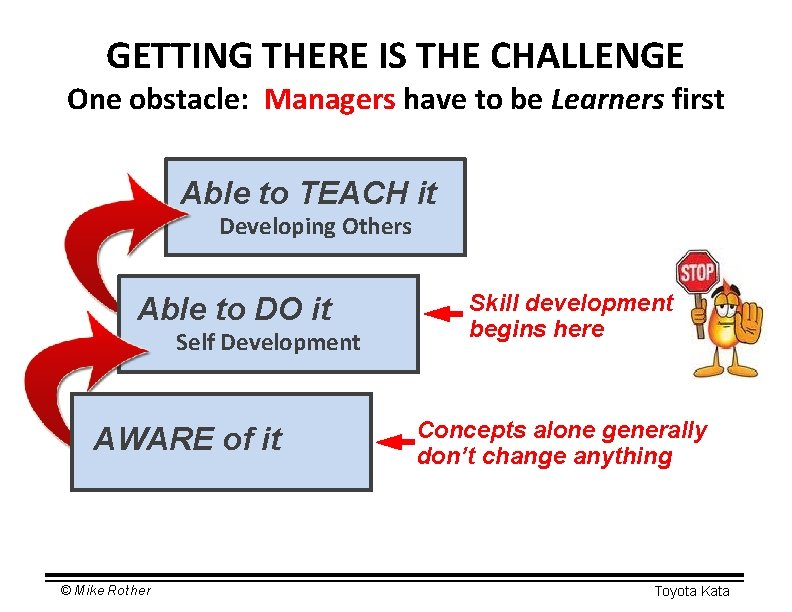
GETTING THERE IS THE CHALLENGE One obstacle: Managers have to be Learners first Able to TEACH it Developing Others Able to DO it Self Development AWARE of it © Mike Rother Skill development begins here Concepts alone generally don’t change anything Toyota Kata
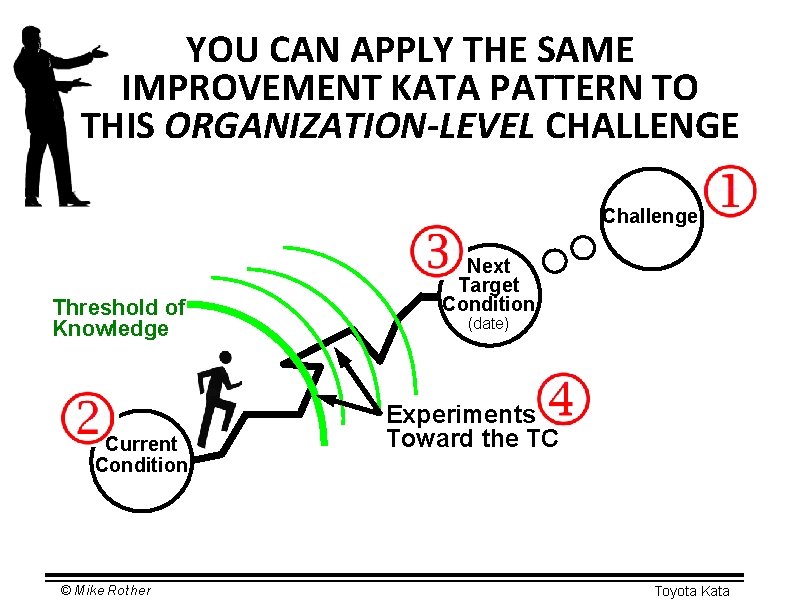
YOU CAN APPLY THE SAME IMPROVEMENT KATA PATTERN TO THIS ORGANIZATION-LEVEL CHALLENGE Challenge Threshold of Knowledge Current Condition © Mike Rother Next Target Condition (date) Experiments Toward the TC Toyota Kata
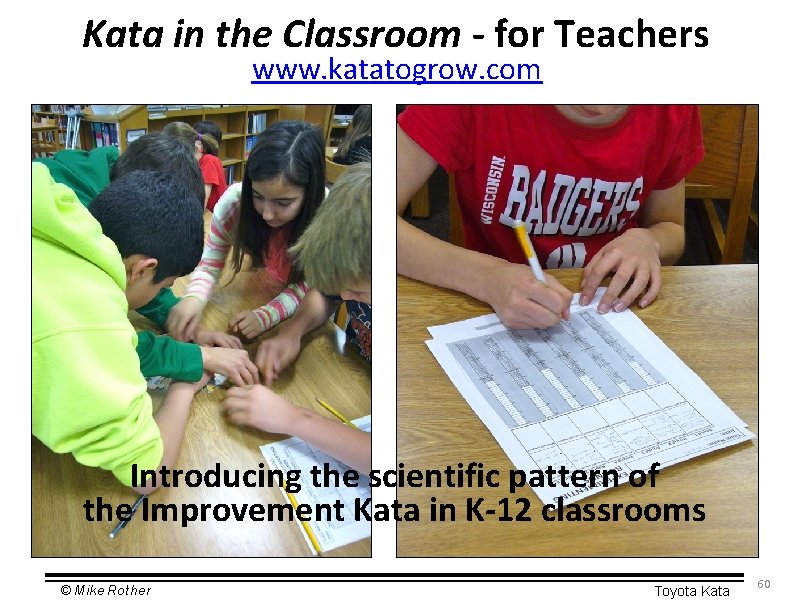
Kata in the Classroom - for Teachers www. katatogrow. com Introducing the scientific pattern of the Improvement Kata in K-12 classrooms © Mike Rother Toyota Kata 60
Best wishes for your practice Visit the Toyota Kata Website © Mike Rother Toyota Kata 61
- Slides: 61