
The Challenge of Democracy CHAPTER 2 Majoritarian or

- Slides: 27
The Challenge of Democracy CHAPTER 2 Majoritarian or Pluralist Democracy?
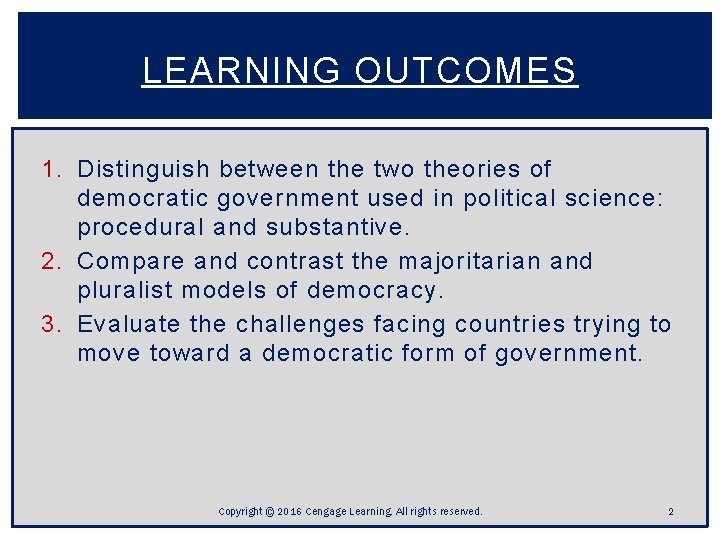
LEARNING OUTCOMES 1. Distinguish between the two theories of democratic government used in political science: procedural and substantive. 2. Compare and contrast the majoritarian and pluralist models of democracy. 3. Evaluate the challenges facing countries trying to move toward a democratic form of government. Copyright © 2016 Cengage Learning. All rights reserved. 2
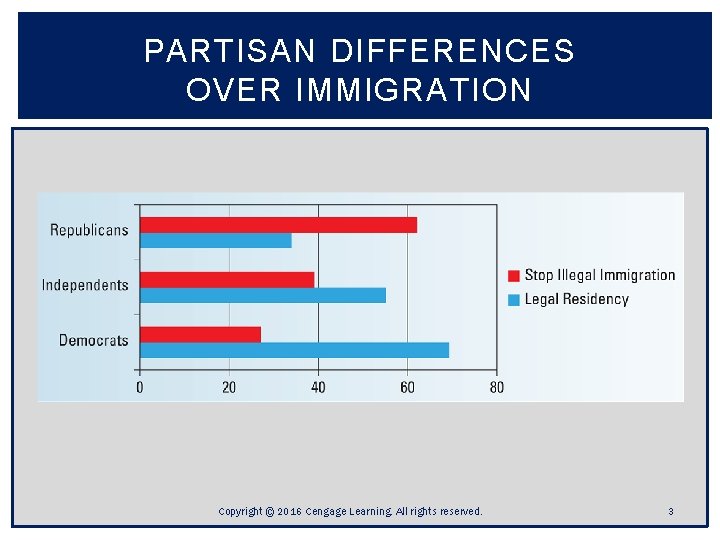
PARTISAN DIFFERENCES OVER IMMIGRATION Copyright © 2016 Cengage Learning. All rights reserved. 3
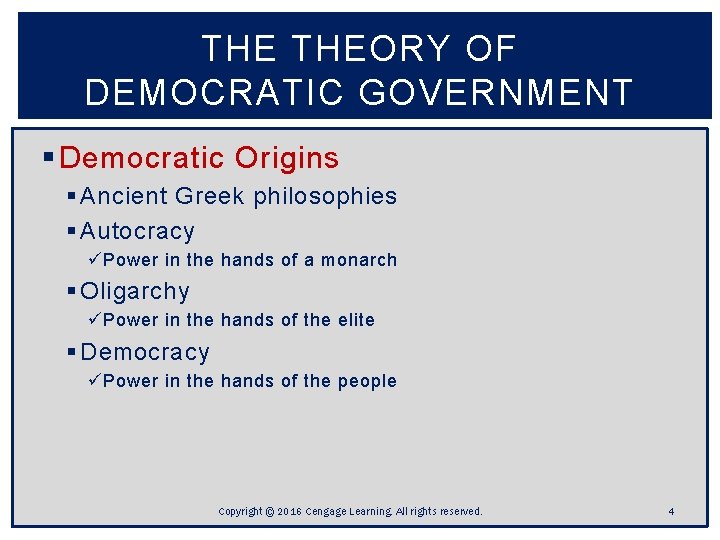
THE THEORY OF DEMOCRATIC GOVERNMENT § Democratic Origins § Ancient Greek philosophies § Autocracy ü Power in the hands of a monarch § Oligarchy ü Power in the hands of the elite § Democracy ü Power in the hands of the people Copyright © 2016 Cengage Learning. All rights reserved. 4
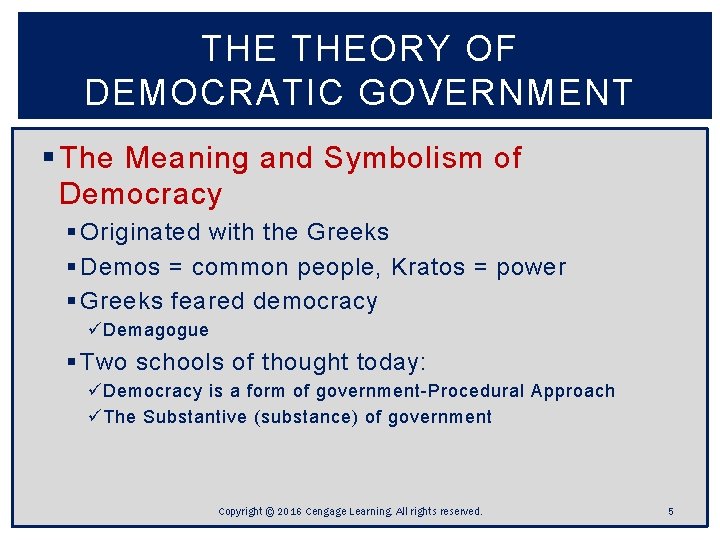
THE THEORY OF DEMOCRATIC GOVERNMENT § The Meaning and Symbolism of Democracy § Originated with the Greeks § Demos = common people, Kratos = power § Greeks feared democracy ü Demagogue § Two schools of thought today: ü Democracy is a form of government-Procedural Approach ü The Substantive (substance) of government Copyright © 2016 Cengage Learning. All rights reserved. 5
THE THEORY OF DEMOCRATIC GOVERNMENT § The Procedural View of Democracy § Universal participation ü Who should participate in decision making? § Political equality ü How much should each participant’s vote count? § Majority rule ü How many votes are needed to reach a decision? Copyright © 2016 Cengage Learning. All rights reserved. 6
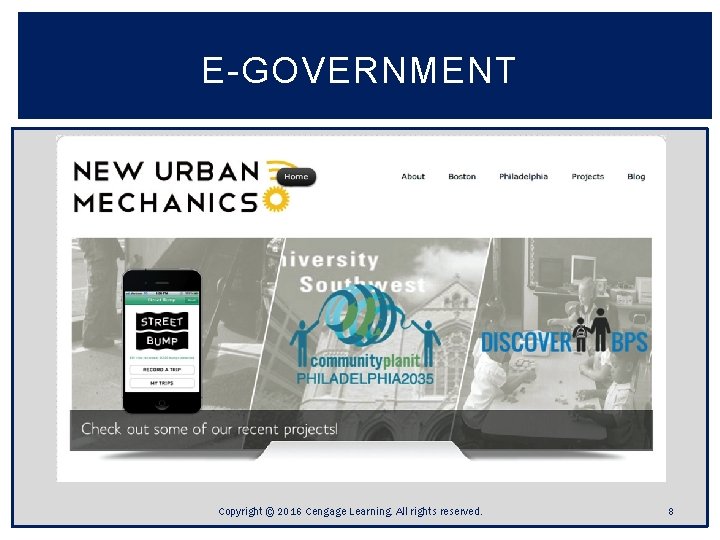
THE THEORY OF DEMOCRATIC GOVERNMENT § A Complication: Direct Versus Indirect Democracy § Participatory democracy ü Town meetings ü Rare in U. S. § E-government ü Boston’s “Street Bump” § Representative democracy ü Instituted by U. S. Constitution § Responsiveness Copyright © 2016 Cengage Learning. All rights reserved. 7
E-GOVERNMENT Copyright © 2016 Cengage Learning. All rights reserved. 8
THE THEORY OF DEMOCRATIC GOVERNMENT § A Complication: Direct Versus Indirect Democracy § Four principles of procedural democracy ü Universal participation ü Political equality ü Majority rule ü Government responsiveness to public opinion Copyright © 2016 Cengage Learning. All rights reserved. 9
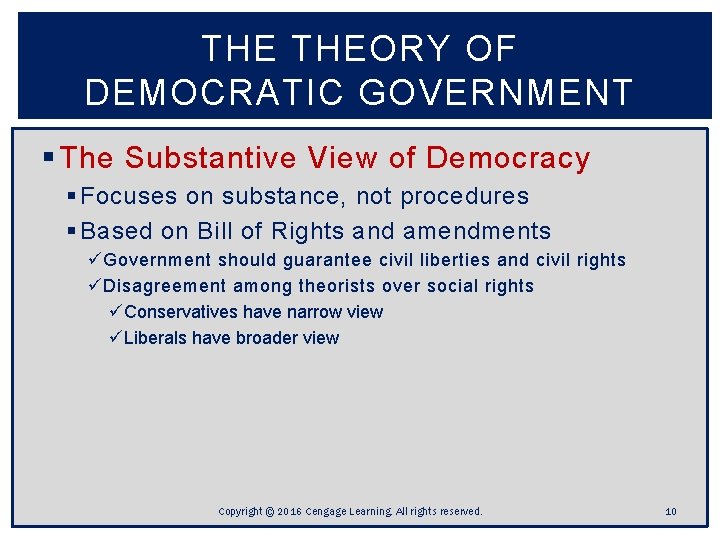
THE THEORY OF DEMOCRATIC GOVERNMENT § The Substantive View of Democracy § Focuses on substance, not procedures § Based on Bill of Rights and amendments ü Government should guarantee civil liberties and civil rights ü Disagreement among theorists over social rights üConservatives have narrow view üLiberals have broader view Copyright © 2016 Cengage Learning. All rights reserved. 10
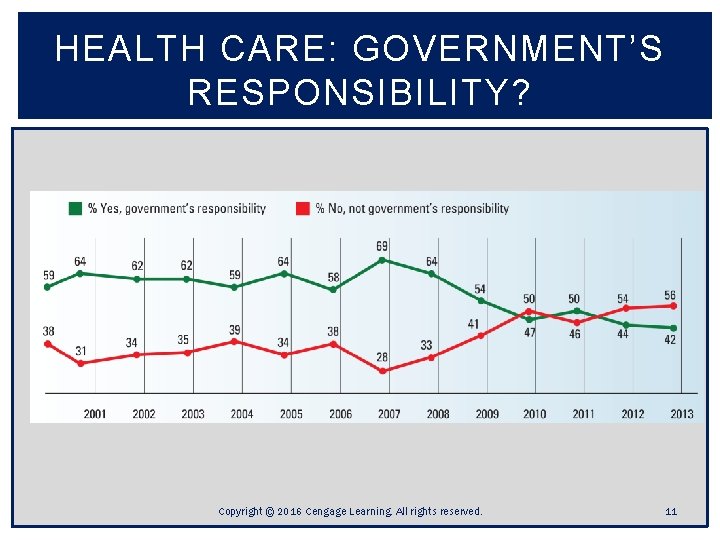
HEALTH CARE: GOVERNMENT’S RESPONSIBILITY? Copyright © 2016 Cengage Learning. All rights reserved. 11
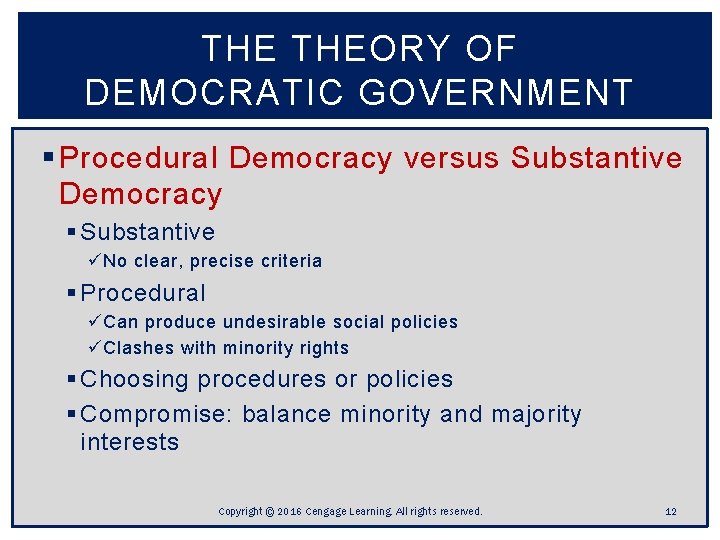
THE THEORY OF DEMOCRATIC GOVERNMENT § Procedural Democracy versus Substantive Democracy § Substantive ü No clear, precise criteria § Procedural ü Can produce undesirable social policies ü Clashes with minority rights § Choosing procedures or policies § Compromise: balance minority and majority interests Copyright © 2016 Cengage Learning. All rights reserved. 12
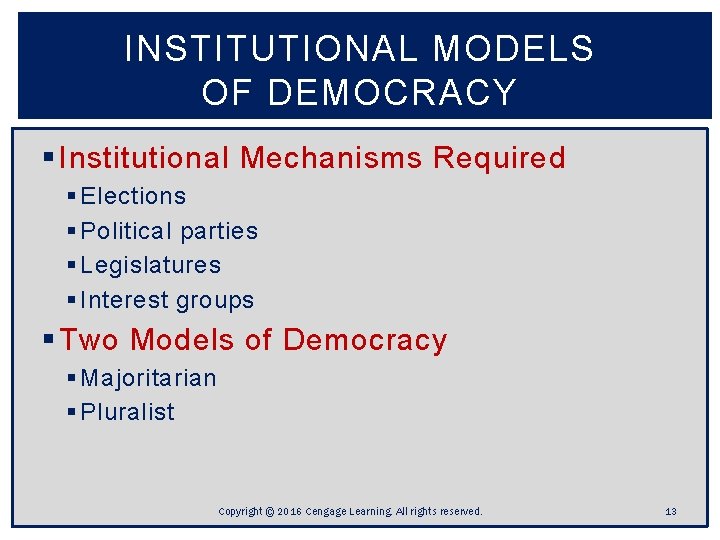
INSTITUTIONAL MODELS OF DEMOCRACY § Institutional Mechanisms Required § Elections § Political parties § Legislatures § Interest groups § Two Models of Democracy § Majoritarian § Pluralist Copyright © 2016 Cengage Learning. All rights reserved. 13
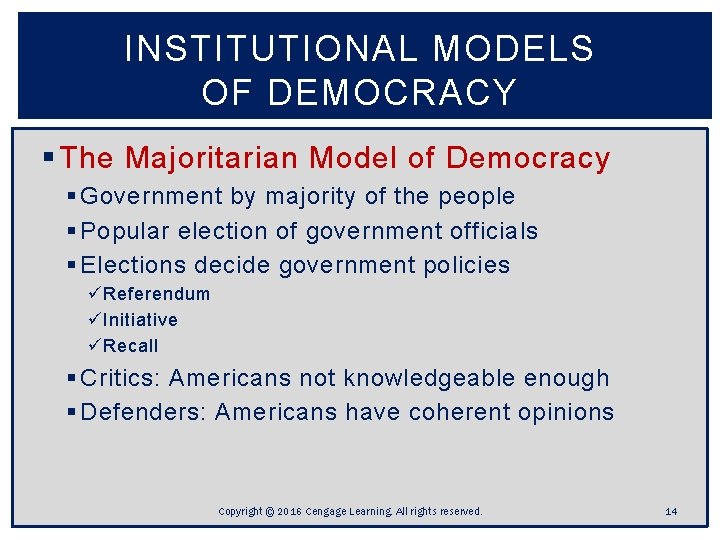
INSTITUTIONAL MODELS OF DEMOCRACY § The Majoritarian Model of Democracy § Government by majority of the people § Popular election of government officials § Elections decide government policies ü Referendum ü Initiative ü Recall § Critics: Americans not knowledgeable enough § Defenders: Americans have coherent opinions Copyright © 2016 Cengage Learning. All rights reserved. 14
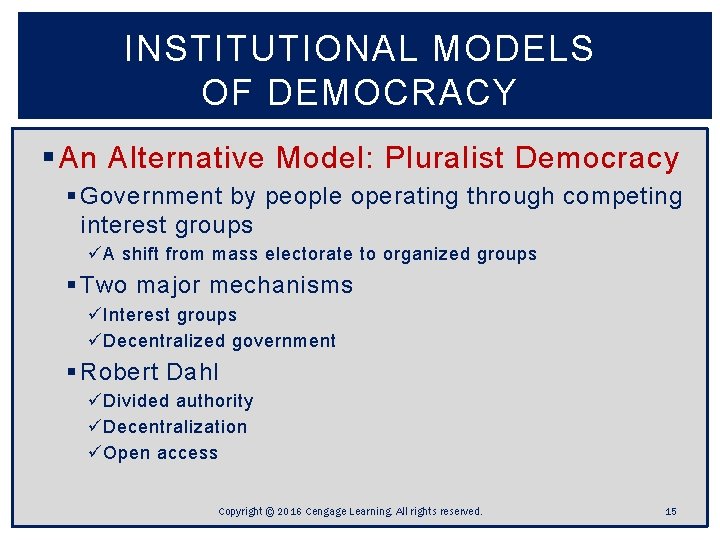
INSTITUTIONAL MODELS OF DEMOCRACY § An Alternative Model: Pluralist Democracy § Government by people operating through competing interest groups ü A shift from mass electorate to organized groups § Two major mechanisms ü Interest groups ü Decentralized government § Robert Dahl ü Divided authority ü Decentralization ü Open access Copyright © 2016 Cengage Learning. All rights reserved. 15
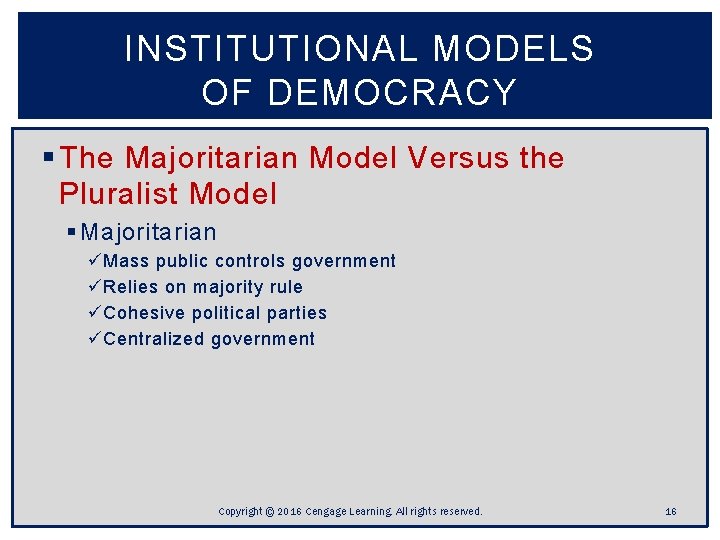
INSTITUTIONAL MODELS OF DEMOCRACY § The Majoritarian Model Versus the Pluralist Model § Majoritarian ü Mass public controls government ü Relies on majority rule ü Cohesive political parties ü Centralized government Copyright © 2016 Cengage Learning. All rights reserved. 16
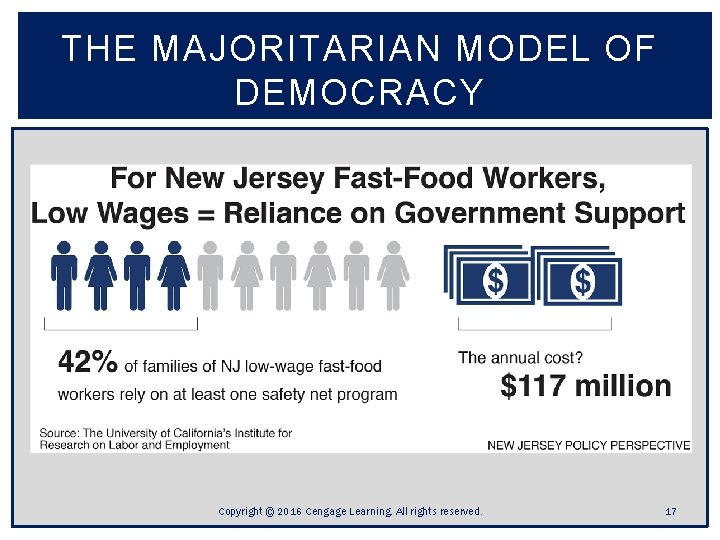
THE MAJORITARIAN MODEL OF DEMOCRACY Copyright © 2016 Cengage Learning. All rights reserved. 17
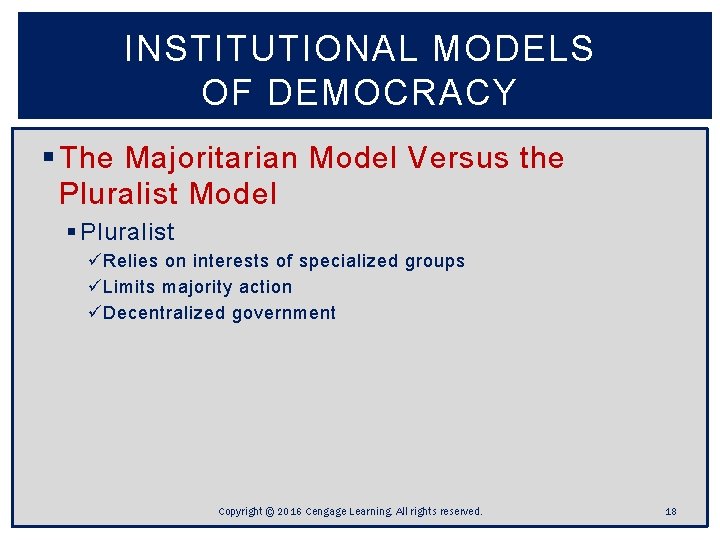
INSTITUTIONAL MODELS OF DEMOCRACY § The Majoritarian Model Versus the Pluralist Model § Pluralist ü Relies on interests of specialized groups ü Limits majority action ü Decentralized government Copyright © 2016 Cengage Learning. All rights reserved. 18
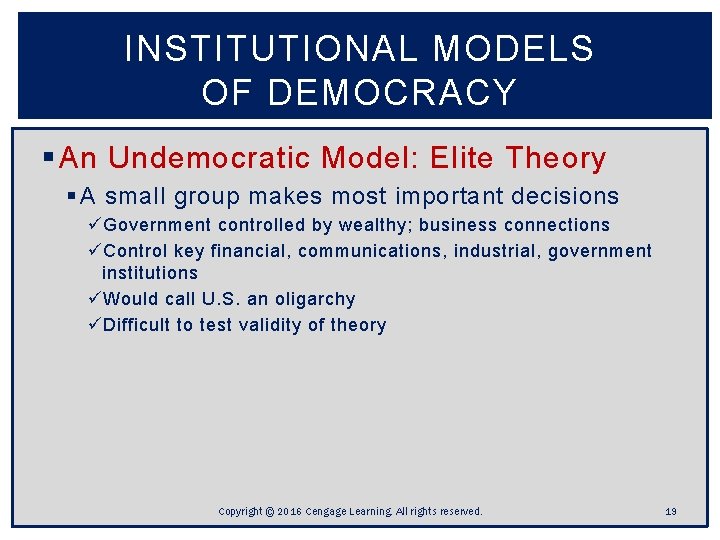
INSTITUTIONAL MODELS OF DEMOCRACY § An Undemocratic Model: Elite Theory § A small group makes most important decisions ü Government controlled by wealthy; business connections ü Control key financial, communications, industrial, government institutions ü Would call U. S. an oligarchy ü Difficult to test validity of theory Copyright © 2016 Cengage Learning. All rights reserved. 19
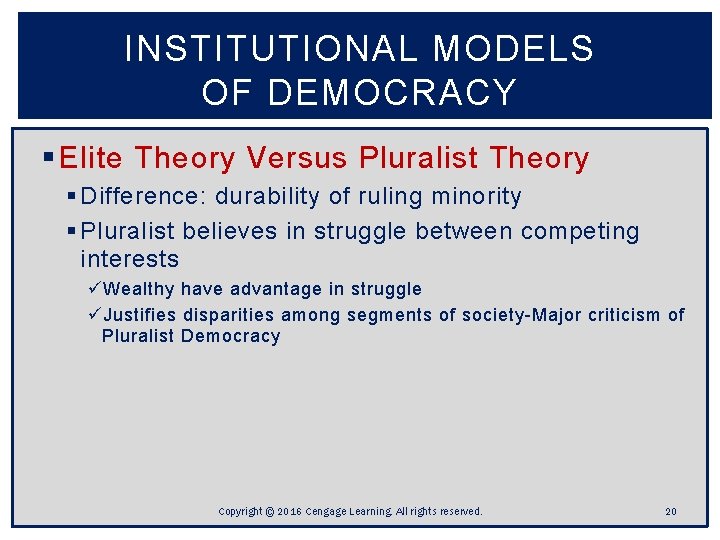
INSTITUTIONAL MODELS OF DEMOCRACY § Elite Theory Versus Pluralist Theory § Difference: durability of ruling minority § Pluralist believes in struggle between competing interests ü Wealthy have advantage in struggle ü Justifies disparities among segments of society-Major criticism of Pluralist Democracy Copyright © 2016 Cengage Learning. All rights reserved. 20
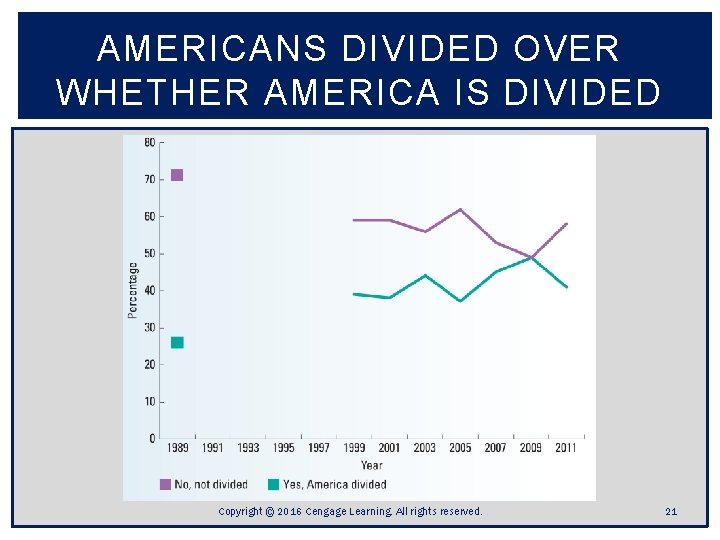
AMERICANS DIVIDED OVER WHETHER AMERICA IS DIVIDED Copyright © 2016 Cengage Learning. All rights reserved. 21
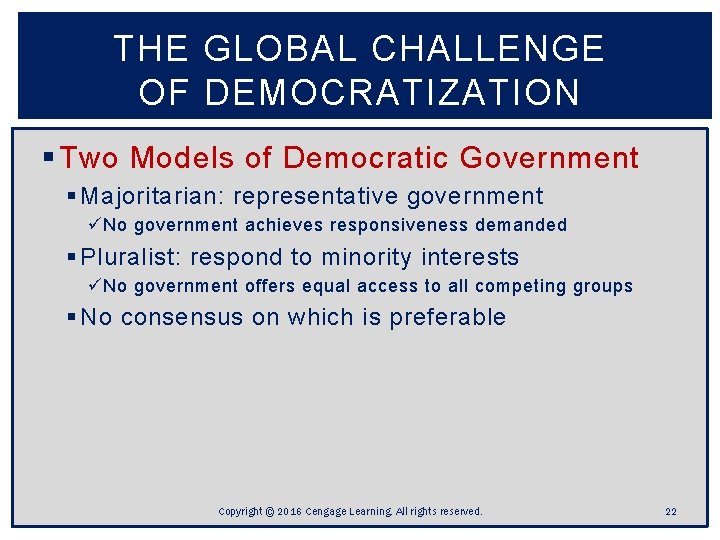
THE GLOBAL CHALLENGE OF DEMOCRATIZATION § Two Models of Democratic Government § Majoritarian: representative government ü No government achieves responsiveness demanded § Pluralist: respond to minority interests ü No government offers equal access to all competing groups § No consensus on which is preferable Copyright © 2016 Cengage Learning. All rights reserved. 22
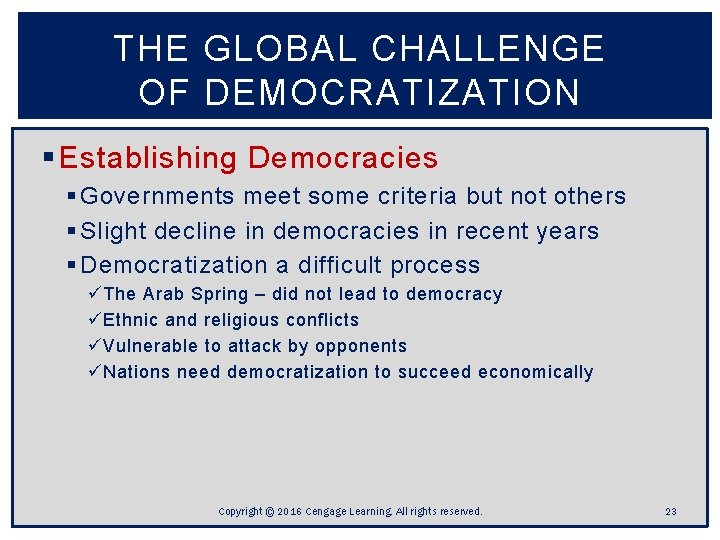
THE GLOBAL CHALLENGE OF DEMOCRATIZATION § Establishing Democracies § Governments meet some criteria but not others § Slight decline in democracies in recent years § Democratization a difficult process ü The Arab Spring – did not lead to democracy ü Ethnic and religious conflicts ü Vulnerable to attack by opponents ü Nations need democratization to succeed economically Copyright © 2016 Cengage Learning. All rights reserved. 23
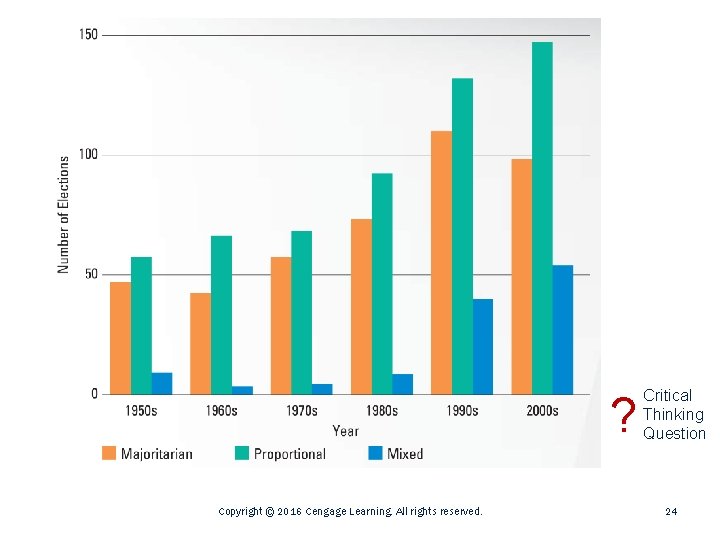
? Copyright © 2016 Cengage Learning. All rights reserved. Critical Thinking Question 24
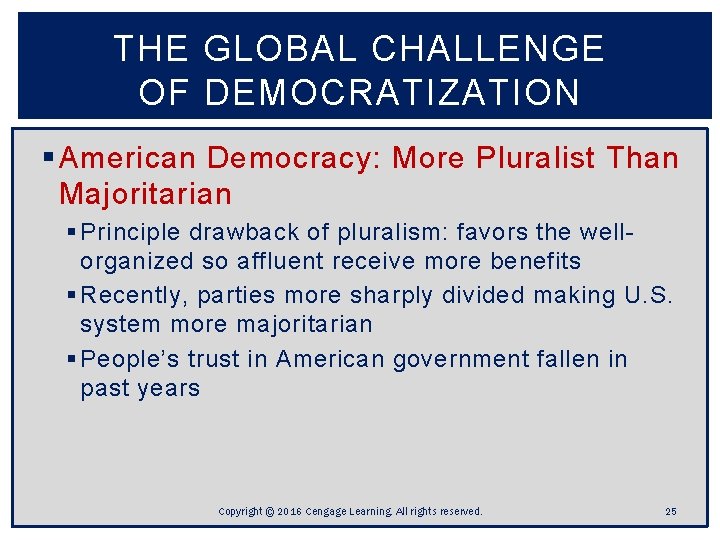
THE GLOBAL CHALLENGE OF DEMOCRATIZATION § American Democracy: More Pluralist Than Majoritarian § Principle drawback of pluralism: favors the wellorganized so affluent receive more benefits § Recently, parties more sharply divided making U. S. system more majoritarian § People’s trust in American government fallen in past years Copyright © 2016 Cengage Learning. All rights reserved. 25
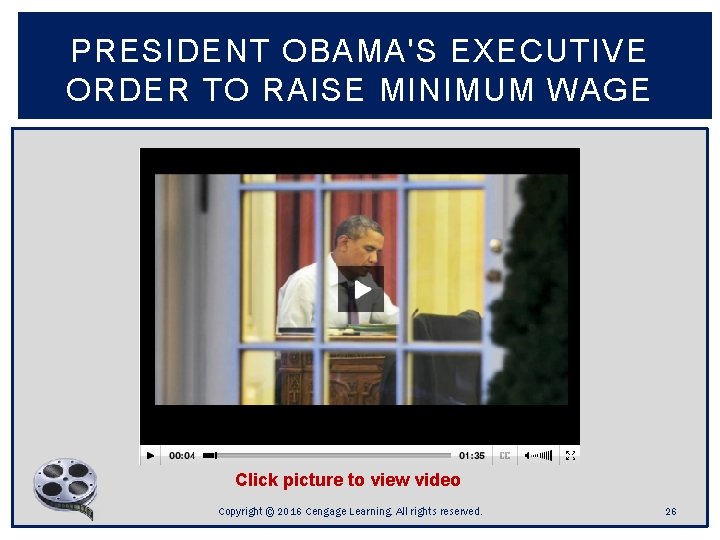
PRESIDENT OBAMA'S EXECUTIVE ORDER TO RAISE MINIMUM WAGE Click picture to view video Copyright © 2016 Cengage Learning. All rights reserved. 26
VIDEO DISCUSSION QUESTIONS 1. Why is a minimum wage increase a controversial issue? 2. Are we a nation of “haves” and “have nots”? Is this executive order a step toward economic equality? 3. Should special interests control the federal minimum wage discussion? Copyright © 2016 Cengage Learning. All rights reserved. 27