
The CGE Training Activities on National Greenhouse Gas
- Slides: 10
The CGE Training Activities on National Greenhouse Gas Inventories Bonn, Germany, 18 May 2006 Mr. Dominique Revet Financial and Technical Support (FTS) Programme UNFCCC secretariat (DRevet@unfccc. int) 1
CGE Mandate n Decision 3/CP. 8 n Paragraph 9 of the Terms of Reference of the CGE 2
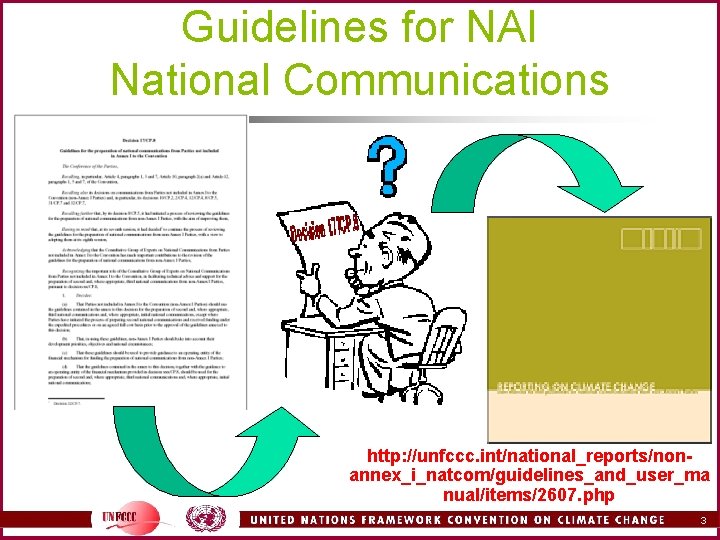
Guidelines for NAI National Communications http: //unfccc. int/national_reports/nonannex_i_natcom/guidelines_and_user_ma nual/items/2607. php 3
Disclaimer n n n The materials contained in this CGE training package, on national greenhouse gas (GHG) inventories, intends to provide the reader with the best possible synthesis of all the Intergovernmental Panel on Climate Change (IPCC) methodologies and tools available which could be of use for non-Annex I Parties and experts in the process of preparation of their national GHG inventories. The present training package is directly designed to address the UNFCCC guidelines for the preparation of national communications from Parties not included in Annex I to the Convention (decision 17/CP. 8), and is in no case intended to replace any of the IPCC methodologies or tools it is referring to in its various modules. For further detail and explanation, the reader is therefore always encouraged to go back to the original IPCC documents or tools referred to. 4
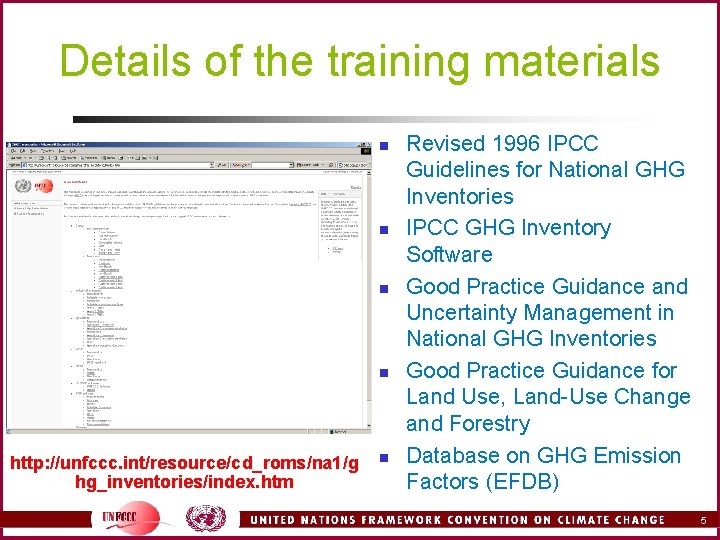
Details of the training materials n n http: //unfccc. int/resource/cd_roms/na 1/g hg_inventories/index. htm n Revised 1996 IPCC Guidelines for National GHG Inventories IPCC GHG Inventory Software Good Practice Guidance and Uncertainty Management in National GHG Inventories Good Practice Guidance for Land Use, Land-Use Change and Forestry Database on GHG Emission Factors (EFDB) 5
Regional Workshops n LAC Region: Panama City, Panama (25 – 29 Oct. 2004); 38 Participants from 22 Countries http: //unfccc. int/meetings/workshops/other_meetings/items/3402. php n n Comments from the participants were taken into account and the training materials slightly revised Asian Region: Shanghai, China (8 – 12 Feb. 2005); 26 Participants from 19 Countries http: //unfccc. int/meetings/workshops/other_meetings/items/3406. php n African Region: Wittbank, South Africa (18 – 22 Sept. 2006) 6
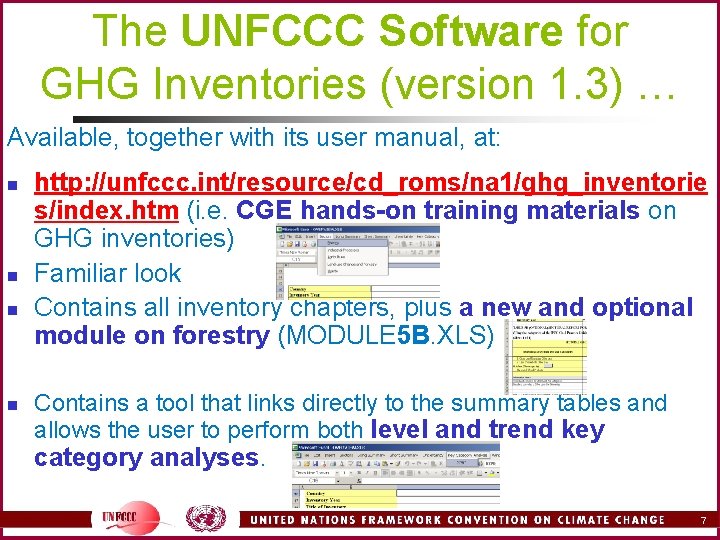
The UNFCCC Software for GHG Inventories (version 1. 3) … Available, together with its user manual, at: n n http: //unfccc. int/resource/cd_roms/na 1/ghg_inventorie s/index. htm (i. e. CGE hands-on training materials on GHG inventories) Familiar look Contains all inventory chapters, plus a new and optional module on forestry (MODULE 5 B. XLS) Contains a tool that links directly to the summary tables and allows the user to perform both level and trend key category analyses. 7
… developed to address the needs arising from Decision 17/CP. 8 n Decision 17/CP. 8, states that NAI Parties: n n n (para. 8) “…should use the Revised 1996 IPCC Guidelines…” Could be done with the IPCC software (1997); but problematic! (para. 11) “…are encouraged to apply to IPCC-GPG…” Only addressed by the new software! (para. 12) “… are encouraged… to undertake any key source analysis…” Only addressed by the new software! (para. 22) “…are encouraged to use table 1 and 2 of these guidelines…” Only addressed by the new software! (para. 23) “…are encouraged to include … inventory tables of the IPCC, in both electronic and hard copy format” Better addressed by the new software! 8
The benefits The UNFCCC software offers multiple benefits: n n n It guides the user in a simple step-by-step approach through the emission/removal calculations It helps to avoid potential mistakes/inconsistencies in the inventory preparation and enhances transparency It helps to save resources, in particular time It facilitates the reporting to the UNFCCC, as well as the management of data It offers a uniform data management system for inventories from more than one year It provides boxes in each worksheet for documenting data sources and individual steps in the inventory preparation 9
THANK YOU! n … But please, do not forget to disseminate this information as widely as possible once you return to your country, otherwise all these efforts will never be successful ! 10