
The Central Nervous System Chapter 12 Marieb Copyright
The Central Nervous System Chapter 12 Marieb Copyright © 2004 Pearson Education, Inc. , publishing as Benjamin Cummings
Central Nervous System (CNS) § Composed of the brain and spinal cord § Spinal Cord - Central cavity surrounded by a gray matter core - External to which is white matter composed of myelinated fiber tracts § Brain - Similar to spinal cord but with additional areas of gray matter and outer cortex of gray matter - Cerebellum has gray matter in nuclei and cortex Copyright © 2004 Pearson Education, Inc. , publishing as Benjamin Cummings
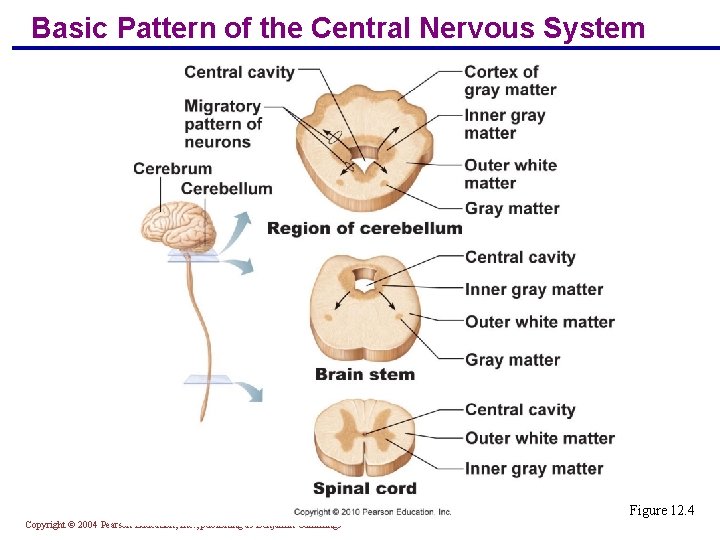
Basic Pattern of the Central Nervous System Figure 12. 4 Copyright © 2004 Pearson Education, Inc. , publishing as Benjamin Cummings
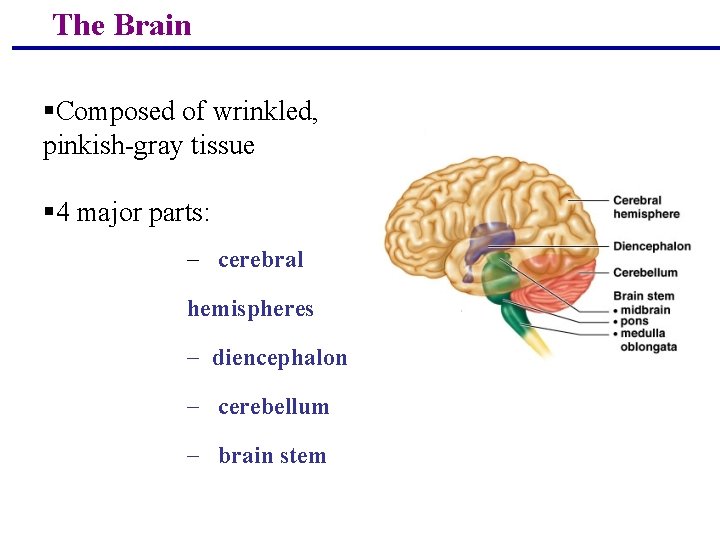
The Brain §Composed of wrinkled, pinkish-gray tissue § 4 major parts: - cerebral hemispheres - diencephalon - cerebellum - brain stem Copyright © 2004 Pearson Education, Inc. , publishing as Benjamin Cummings Figure 12. 3
Cerebral Hemispheres (Cerebrum) § Form the superior part of the brain and make up 83% of its mass § Contain ridges (gyri) and shallow grooves (sulci) § Contain deep grooves called fissures (large sulcus). § Are separated by the longitudinal fissure § Have three basic regions: cortex, white matter, and basal nuclei. Copyright © 2004 Pearson Education, Inc. , publishing as Benjamin Cummings
Cerebral Cortex § The cortex – superficial gray matter; accounts for 40% of the mass of the brain § It enables sensation, communication, memory, understanding, and voluntary movements § Each hemisphere acts contralaterally (controls the opposite side of the body) § Hemispheres are not equal in function § No functional area acts alone; conscious behavior involves the entire cortex Copyright © 2004 Pearson Education, Inc. , publishing as Benjamin Cummings
Functional Areas of the Cerebral Cortex § The three types of functional areas are: - Motor areas – control voluntary movement - Sensory areas – conscious awareness of sensation - Association areas – integrate diverse information Copyright © 2004 Pearson Education, Inc. , publishing as Benjamin Cummings
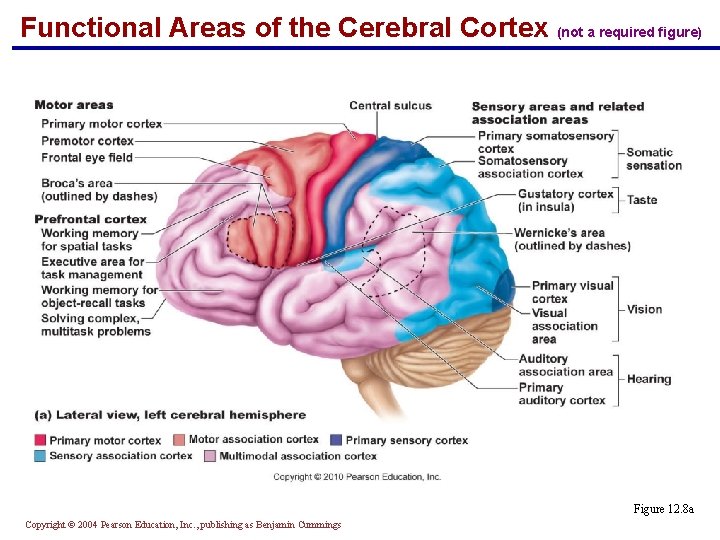
Functional Areas of the Cerebral Cortex (not a required figure) Figure 12. 8 a Copyright © 2004 Pearson Education, Inc. , publishing as Benjamin Cummings
Lateralization of Cortical Function § Lateralization – each hemisphere has abilities not shared with its partner § Cerebral dominance – designates the hemisphere dominant for language § Left hemisphere – controls language, math, and logic § Right hemisphere – controls visual-spatial skills, emotion, and artistic skills Copyright © 2004 Pearson Education, Inc. , publishing as Benjamin Cummings
Cerebral White Matter § Consists of myelinated fibers and their tracts § It is responsible for communication between: § The cerebral cortex and lower CNS center, and between areas of the cortex § Types include: § Commissures – connect corresponding gray areas of the two hemispheres § Association fibers – connect different parts of the same hemisphere § Projection fibers – enter the hemispheres from lower brain or cord centers Copyright © 2004 Pearson Education, Inc. , publishing as Benjamin Cummings
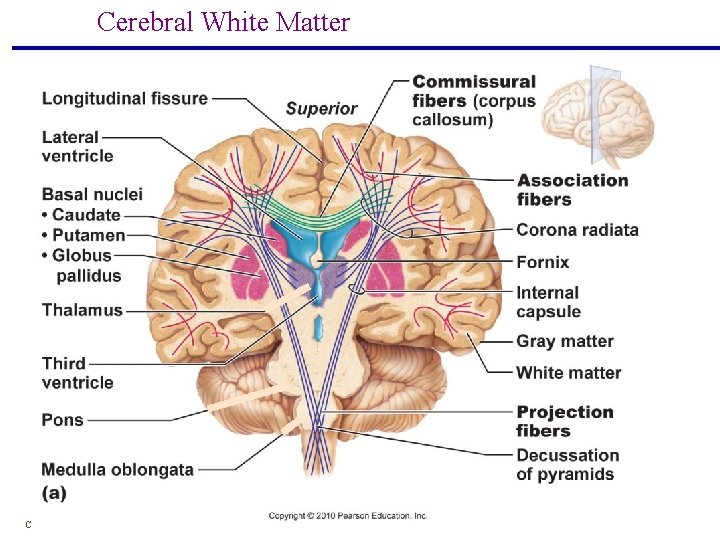
Cerebral White Matter Copyright © 2004 Pearson Education, Inc. , publishing as Benjamin Cummings
Basal Nuclei § Masses of gray matter found deep within the cortical white matter of the cerebral hemispheres - caudate nucleus - lentiform nucleus (putamen and globus pallidus) § Proposed functions of basal nuclei - Motor control -influence muscular activity - Regulate attention and cognition § Disorders of basal nuclei: - Huntington’s disease - Parkinson’s disease Copyright © 2004 Pearson Education, Inc. , publishing as Benjamin Cummings
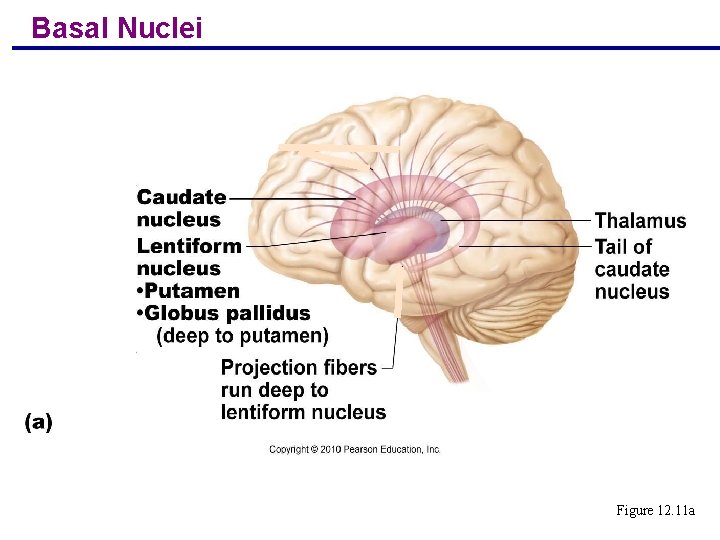
Basal Nuclei Figure 12. 11 a Copyright © 2004 Pearson Education, Inc. , publishing as Benjamin Cummings
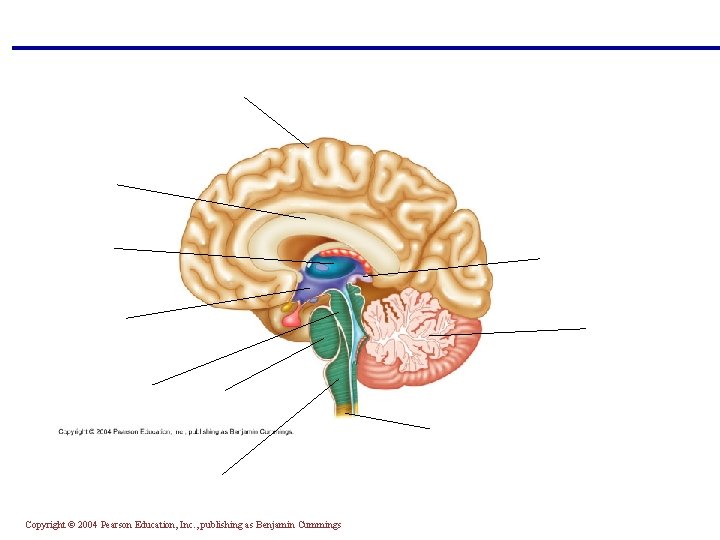
Diencephalon § Consists of three paired structures - - thalamus - - hypothalamus - - epithalamus § Encloses the third ventricle Copyright © 2004 Pearson Education, Inc. , publishing as Benjamin Cummings
Copyright © 2004 Pearson Education, Inc. , publishing as Benjamin Cummings
Thalamus § Paired, egg-shaped masses containing four groups of nuclei that project to and receive fibers from the cerebral cortex § Acts as a “relay station” for information entering the brain - Afferent impulses from all senses converge and synapse in the thalamus - All inputs ascending to the cerebral cortex pass through the thalamus - Impulses of similar function are sorted out, edited, and relayed as a group § Plays a key role in mediating sensation, motor activities, cortical arousal, learning, and memory Copyright © 2004 Pearson Education, Inc. , publishing as Benjamin Cummings
Hypothalamus § Located below the thalamus, it ‘caps’ the brainstem § Infundibulum – stalk of the hypothalamus; connects to the pituitary gland § Functions: § Regulates blood pressure, rate and force of heartbeat, digestive tract motility, rate and depth of breathing, and many other visceral activities § Is involved with perception of pleasure, fear, and rage § Controls mechanisms needed to maintain normal body temperature § Regulates feelings of hunger and satiety § Regulates sleep and the sleep cycle Copyright © 2004 Pearson Education, Inc. , publishing as Benjamin Cummings
Epithalamus § Most dorsal portion of the diencephalon § Pineal gland – extends from the posterior border and secretes melatonin - hormone involved with sleep regulation, sleep-wake cycles, and mood Copyright © 2004 Pearson Education, Inc. , publishing as Benjamin Cummings
Brain Stem § Consists of three regions - midbrain - pons - Medulla oblongata § Similar to spinal cord but contains embedded nuclei § Controls automatic behaviors necessary for survival Exs. Heart rate, respiratory rate § Provides the pathway for tracts between higher and lower brain centers Copyright © 2004 Pearson Education, Inc. , publishing as Benjamin Cummings
The Cerebellum § Located dorsal to the pons and medulla § Makes up 11% of the brain’s mass § Provides precise timing and appropriate patterns of skeletal muscle contraction, ie. coordinates movements § Cerebellar activity occurs subconsciously Copyright © 2004 Pearson Education, Inc. , publishing as Benjamin Cummings
Ventricles of the Brain § Contain cerebrospinal fluid § Continuous with the central canal of the spinal chord § The ventricles are: - The two C-shaped lateral ventricles - The third ventricle found in the diencephalon - The fourth ventricle dorsal to the pons Copyright © 2004 Pearson Education, Inc. , publishing as Benjamin Cummings
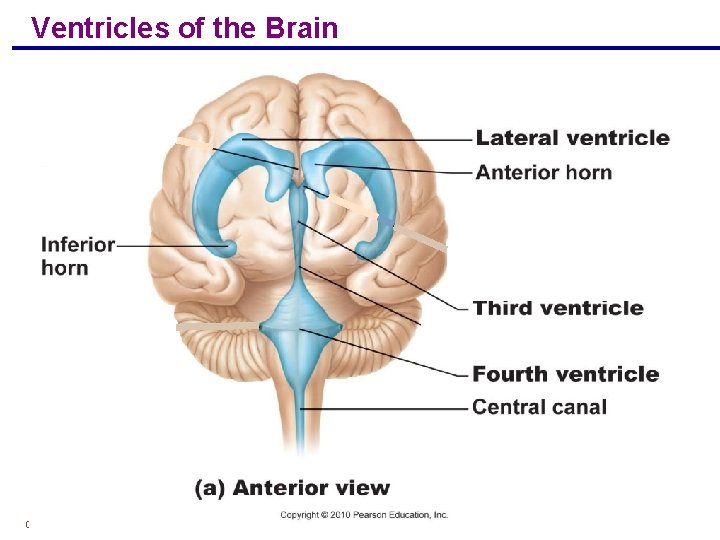
Ventricles of the Brain Figure 12. 5 Copyright © 2004 Pearson Education, Inc. , publishing as Benjamin Cummings
Protection of the Brain § The brain is protected by bone, meninges, and cerebrospinal fluid § Harmful substances are shielded from the brain by the blood-brain barrier Copyright © 2004 Pearson Education, Inc. , publishing as Benjamin Cummings
Meninges § Three connective tissue membranes lie external to the CNS – dura mater, arachnoid mater, and pia mater § Major functions of the meninges - Cover and protect the CNS - Protect blood vessels - Contain cerebrospinal fluid (CSF) Copyright © 2004 Pearson Education, Inc. , publishing as Benjamin Cummings
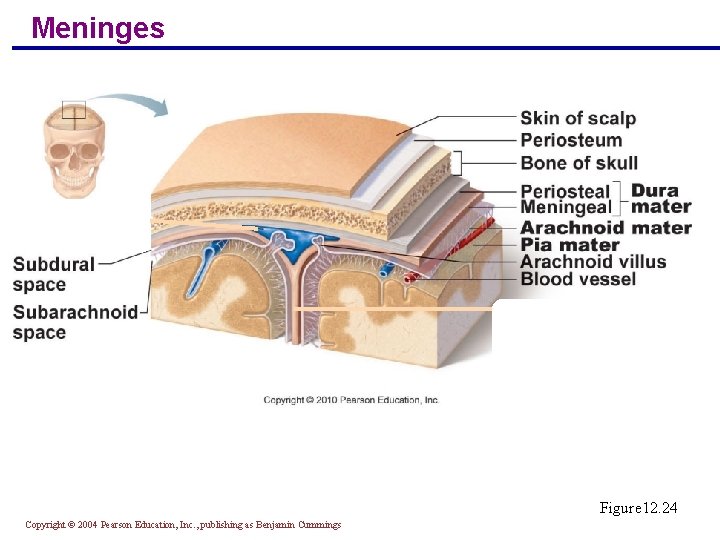
Meninges Figure 12. 24 Figure 12. 23 a Copyright © 2004 Pearson Education, Inc. , publishing as Benjamin Cummings
Cerebrospinal Fluid (CSF) § Watery solution similar in composition to blood plasma except it contains less protein and different ion concentrations § Nourishes the brain and carries chemical signals throughout it § Forms a liquid cushion that gives buoyancy to the CNS organs - prevents the brain from crushing under its own weight - protects from trauma Copyright © 2004 Pearson Education, Inc. , publishing as Benjamin Cummings
Blood-Brain Barrier § Protective mechanism that helps maintain a stable environment for the brain § Selective barrier that allows nutrients to pass freely § Is ineffective against substances that can diffuse through plasma membranes § Bloodborne substances are separated from neurons by: - endothelium of capillary walls - thick basal lamina - bulbous “feet” of astrocytes Copyright © 2004 Pearson Education, Inc. , publishing as Benjamin Cummings
Brain Waves § Normal brain function involves patterns of continuous electrical activity- brain waves § An electroencephalogram (EEG) records this activity-wave frequency expressed as Hertz (Hz) § Each person’s brain waves are unique § Brain waves change with age, sensory stimuli, brain disease, and the chemical state of the body § EEGs can be used to diagnose and localize brain lesions, tumors, infarcts, infections, abscesses, and epileptic lesions § A flat EEG (no electrical activity) is clinical evidence of death Copyright © 2004 Pearson Education, Inc. , publishing as Benjamin Cummings
Consciousness § Encompasses perception of sensation, voluntary initiation and control of movement, and capabilities associated with higher mental processing § Involves simultaneous activity of large areas of the cerebral cortex § Is superimposed on other types of neural activity § Is holistic and totally interconnected § Clinical consciousness is defined on a continuum that grades levels of behavior – alertness, drowsiness, stupor, coma Copyright © 2004 Pearson Education, Inc. , publishing as Benjamin Cummings
Spinal Cord § CNS tissue enclosed within the vertebral column; Provides two-way communication to and from the brain § Protected by bone, meninges, and CSF § Epidural space – space between the vertebrae and the dural sheath (dura mater) filled with fat and a network of veins § Spinal nerves – 31 pairs attach to the cord by paired roots § Cervical and lumbar enlargements – sites where nerves serving the upper and lower limbs emerge Copyright © 2004 Pearson Education, Inc. , publishing as Benjamin Cummings
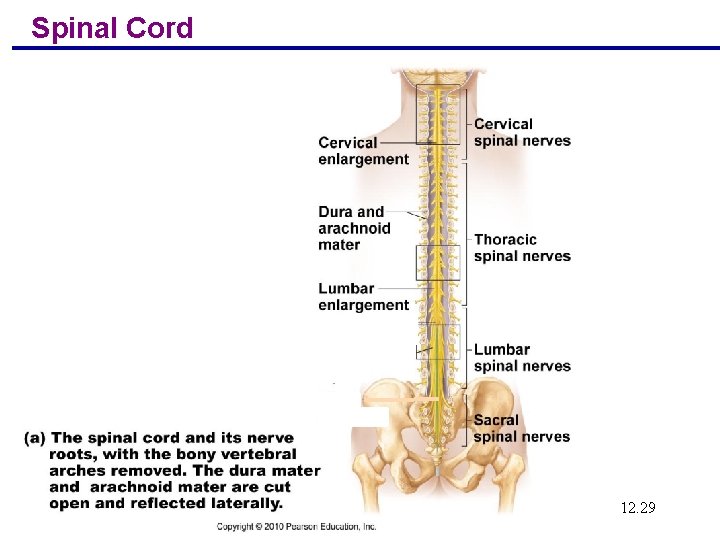
Spinal Cord 12. 29 Figure 12. 28 a Copyright © 2004 Pearson Education, Inc. , publishing as Benjamin Cummings
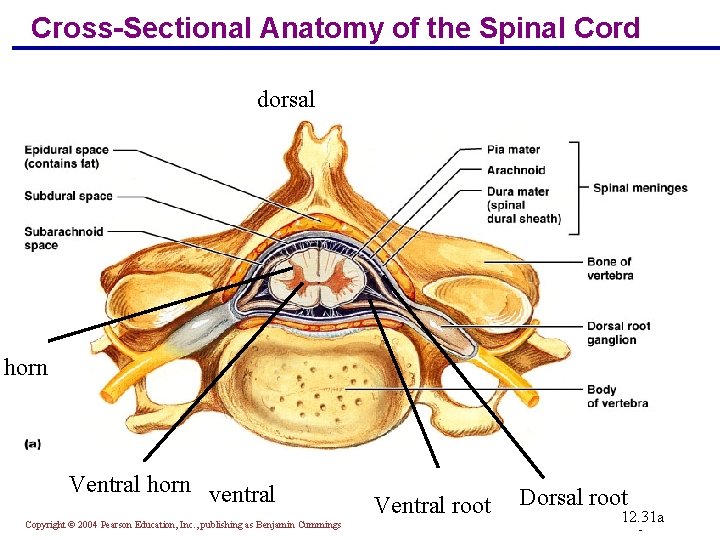
Cross-Sectional Anatomy of the Spinal Cord dorsal horn Ventral horn ventral Copyright © 2004 Pearson Education, Inc. , publishing as Benjamin Cummings Ventral root Dorsal root 12. 31 a Figure 12. 30 a
Gray Matter and Spinal Roots § Gray matter consists of somas, unmyelinated processes, and neuroglia - Dorsal segment (dorsal horns)– sensory (afferent) Afferent fibers from sensory neurons form dorsal roots Sensory neuron somas found in dorsal root ganglia (PNS) - Ventral segment (ventral horns)– motor (efferent) Axons of motor neurons leave spinal cord through ventral roots - Dorsal and ventral roots fuse laterally to form spinal nerves Copyright © 2004 Pearson Education, Inc. , publishing as Benjamin Cummings
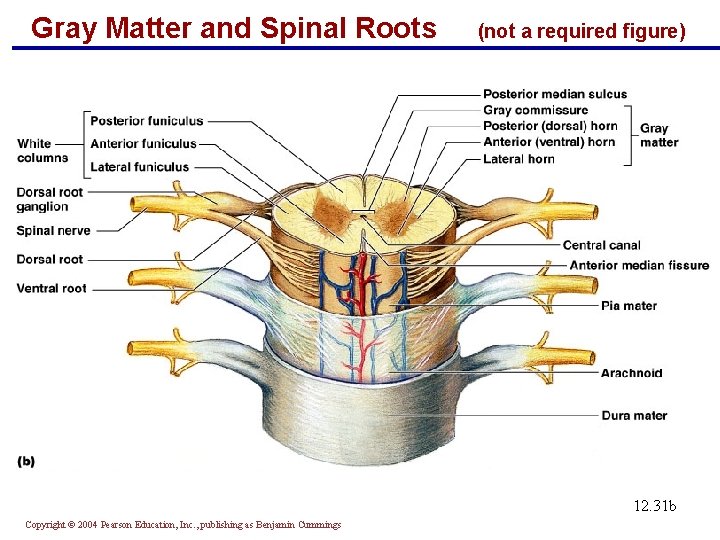
Gray Matter and Spinal Roots (not a required figure) 12. 31 b Figure 12. 30 b Copyright © 2004 Pearson Education, Inc. , publishing as Benjamin Cummings
White Matter in the Spinal Cord § Fibers (axons) run in three directions – ascending, descending, and transversely § Fiber tracts are composed of axons with similar functions § Ascending tracts send impulses to the sensory cortex § Descending tracts send impulses that ultimately control muscles and visceral organs Copyright © 2004 Pearson Education, Inc. , publishing as Benjamin Cummings
- Slides: 35