
The Central Islamic Lands Submitted by Ms Anupam
The Central Islamic Lands Submitted by Ms. Anupam. Handa PGT-History Air Force School Ambala Cantt
Introduction • As we enter the twenty-first century, there are over 1 billion Muslims living in all parts of the world. They are citizens of different nations, speak different languages, and dress differently. • The term Islamic is used here not only in its purely religious sense but also for the overall society and culture historically associated with Islam. In this society not everything that was happening originated directly from religion, but it took place in a society where Muslims and their faith were recognized as socially dominant. Non-Muslims always formed an integral, if subordinate, part of this society as did Jews in Christendom.
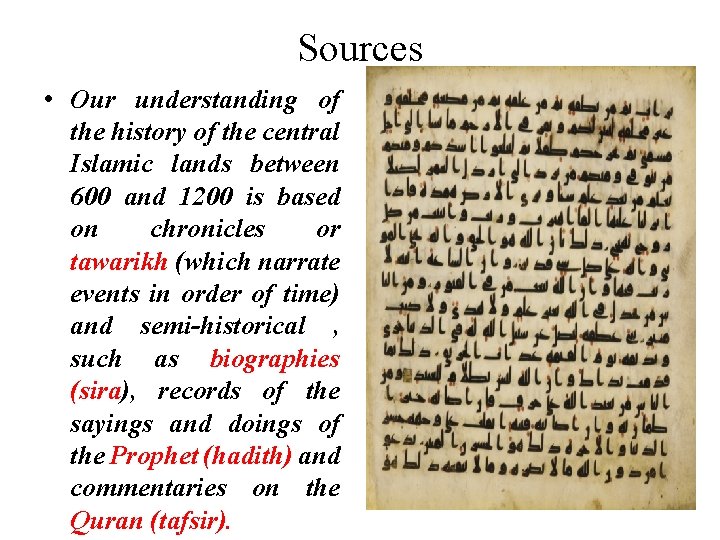
Sources • Our understanding of the history of the central Islamic lands between 600 and 1200 is based on chronicles or tawarikh (which narrate events in order of time) and semi-historical , such as biographies (sira), records of the sayings and doings of the Prophet (hadith) and commentaries on the Quran (tafsir).
• The authenticity of each report (khabar) was tested by a critical method which traced the chain of transmission (isnad)and established the reliability of the narrator. • Most of the chronicles and semi-historical works are in Arabic, the best being the Tarikh of Tabari (d. 923)has been they aretranslated into English in 38 volumes. Persian chronicles are few but quite detailed in their of Iran and Central Asia. Christian chronicles, written Syriac (a dialect of Aramaic*), are fewer but they thro interesting light on the history of early Islam. • Documentary evidence (fragmentary pieces of writing, such as official orders or private correspondence) is
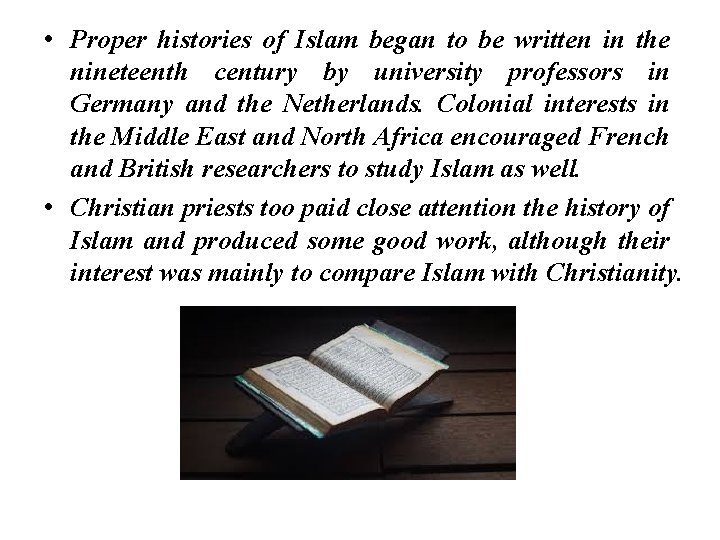
• Proper histories of Islam began to be written in the nineteenth century by university professors in Germany and the Netherlands. Colonial interests in the Middle East and North Africa encouraged French and British researchers to study Islam as well. • Christian priests too paid close attention the history of Islam and produced some good work, although their interest was mainly to compare Islam with Christianity.
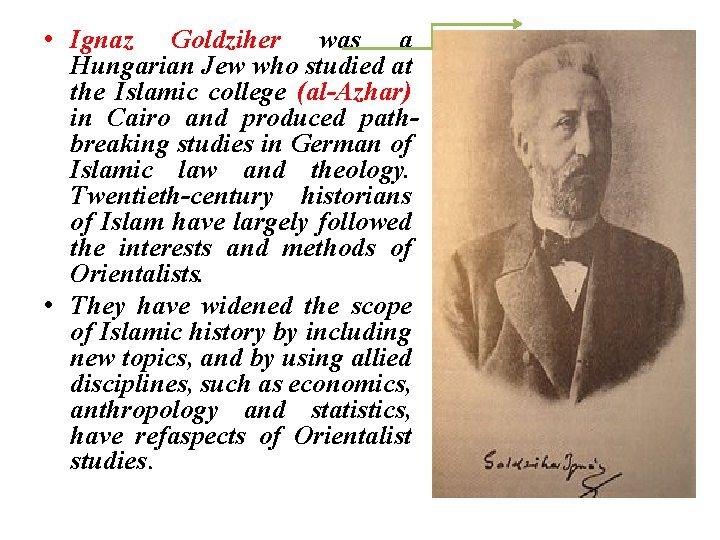
• Ignaz Goldziher was a Hungarian Jew who studied at the Islamic college (al-Azhar) in Cairo and produced pathbreaking studies in German of Islamic law and theology. Twentieth-century historians of Islam have largely followed the interests and methods of Orientalists. • They have widened the scope of Islamic history by including new topics, and by using allied disciplines, such as economics, anthropology and statistics, have refaspects of Orientalist studies.
The Rise of Islam in Arabia • During 612 -32, the Prophet Muhammad preached the worship of a single God, Allah, and the membership of a single community of believers (umma). This was the origin of Islam. Muhammad was an Arab by language and culture and a merchant by profession. • The Arabs were divided into tribes (qabila), each led by a chief wh was chosen partly on the basis of his family connections Each tribe had its own god or goddess, who was worshipped as an idol (sanam) in a shrine. Many Arab tribes were nomadic (Bedouins), moving from dry to green areas (oases) of the desert in search of food (mainly dates) and fodder for their camels.
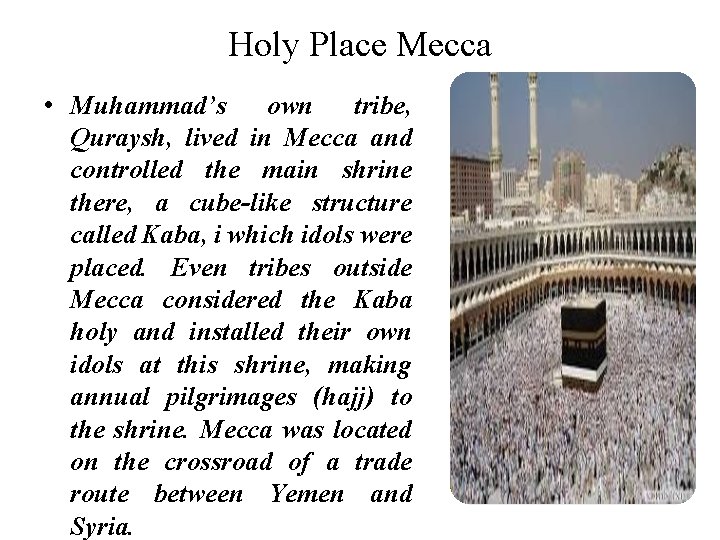
Holy Place Mecca • Muhammad’s own tribe, Quraysh, lived in Mecca and controlled the main shrine there, a cube-like structure called Kaba, i which idols were placed. Even tribes outside Mecca considered the Kaba holy and installed their own idols at this shrine, making annual pilgrimages (hajj) to the shrine. Mecca was located on the crossroad of a trade route between Yemen and Syria.
• They were promised salvation on the Day of Judgement (qiyama) and a share of the resources of the community while on earth. • In 622, Muhammad was to migrate with his followers to Medina. Muhammad’s journey from Mecca (hijra) was a turning point in the history of Islam, with the year of his arrival in Medina marking the beginning of the Muslim Calendar.
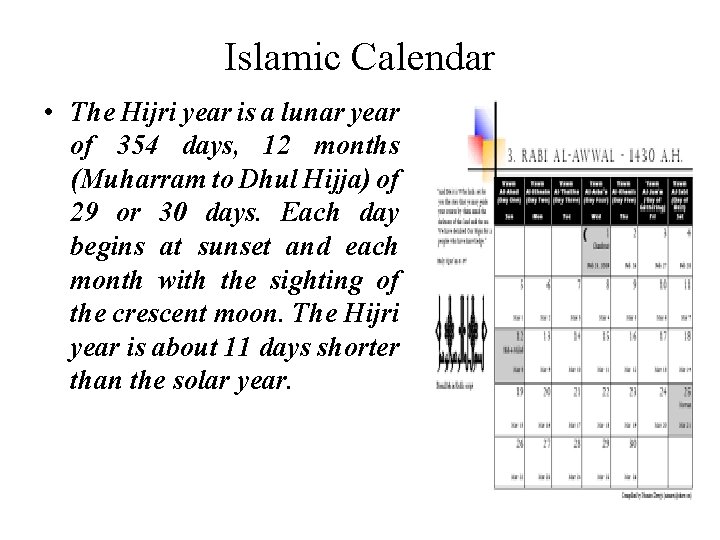
Islamic Calendar • The Hijri year is a lunar year of 354 days, 12 months (Muharram to Dhul Hijja) of 29 or 30 days. Each day begins at sunset and each month with the sighting of the crescent moon. The Hijri year is about 11 days shorter than the solar year.
• Therefore, none of the Islamic religious festivals, including the Ramazan fast, Id and hajj, corresponds in any way to seasons. There is no easy way to match the dates in the Hijri calendar with the dates in the Gregorian calendar (established by Pope Gregory XIII in 1582 CE). • The Hijri era was established during the caliphate of Umar, with the first year falling in 622 CE. A date in the Hijri calendar is followed by the letters AH.
The Caliphate: Expansion, Civil Wars and Sect Formation • After Muhammad’s death in 632, no one could legitimately to be the next prophet of Islam. As a result, his political authority was transferred to the umma with no established principal succession. This created opportunities for innovations but also caused deep divisions among the Muslims. • The biggest innovation was the creation of the institution of caliphate, in which the leader of the community (amir al-muminin) became the deputy (khalifa) of the Prophet.
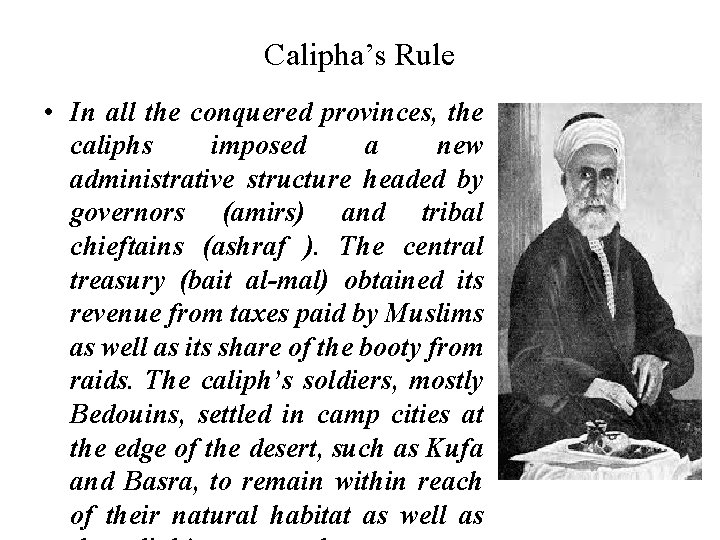
Calipha’s Rule • In all the conquered provinces, the caliphs imposed a new administrative structure headed by governors (amirs) and tribal chieftains (ashraf ). The central treasury (bait al-mal) obtained its revenue from taxes paid by Muslims as well as its share of the booty from raids. The caliph’s soldiers, mostly Bedouins, settled in camp cities at the edge of the desert, such as Kufa and Basra, to remain within reach of their natural habitat as well as
The Umayyads and the Centralisation of Polity • The first Umayyad caliph, Muawiya, moved his capital to Damascus and adopted the court ceremonies and administrative institutions of the Byzantine Empire. • The Umayyad state was now an imperial power, no longer based directly on Islam but on statecraft and the loyalty of Syrian troappealed ops. • The Umayyads always for unity and suppressed rebellions in the name of Islam. They also retained their Arab social identity.
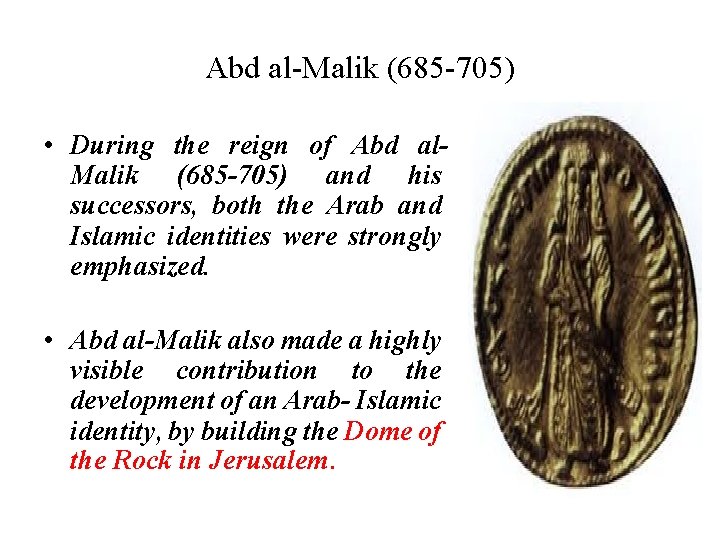
Abd al-Malik (685 -705) • During the reign of Abd al. Malik (685 -705) and his successors, both the Arab and Islamic identities were strongly emphasized. • Abd al-Malik also made a highly visible contribution to the development of an Arab- Islamic identity, by building the Dome of the Rock in Jerusalem.
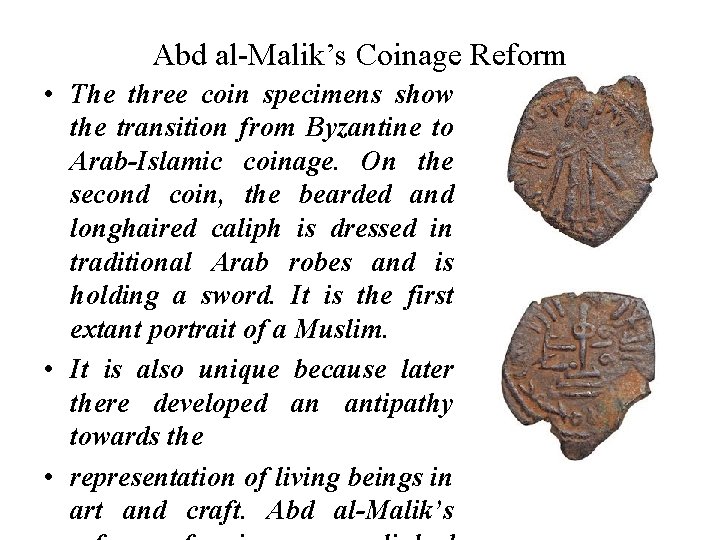
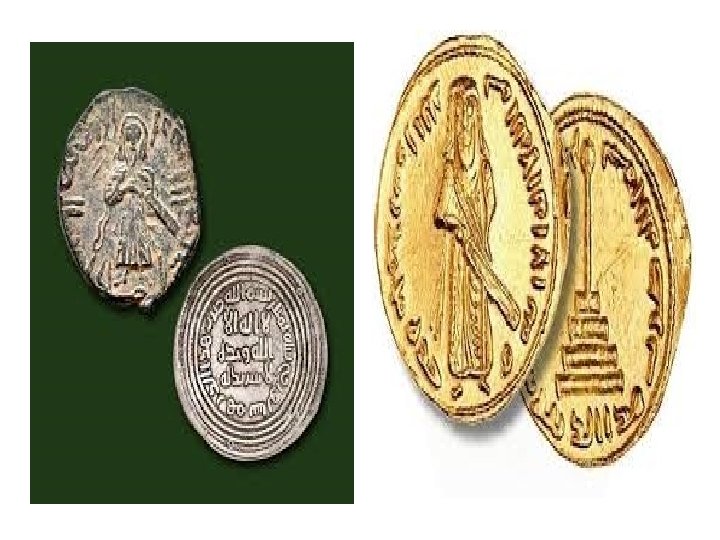
Abd al-Malik’s Coinage Reform • The three coin specimens show the transition from Byzantine to Arab-Islamic coinage. On the second coin, the bearded and longhaired caliph is dressed in traditional Arab robes and is holding a sword. It is the first extant portrait of a Muslim. • It is also unique because later there developed an antipathy towards the • representation of living beings in art and craft. Abd al-Malik’s
The Abbasid Revolution • A well-organised movement, called dawa, brought down the Umayyads and replaced them with another family of Meccan origin, the Abbasids, in 750. The Abbasids portrayed the Umayyad regime as evil and promised a restoration of the original Islam of the Prophet. • The Abbasids, descendants of Abbas, the Prophet’s uncle, mustered the support of the various dissident groups. • Under Abbasid rule, Arab influence declined, While the importance of Iranian culture increased.
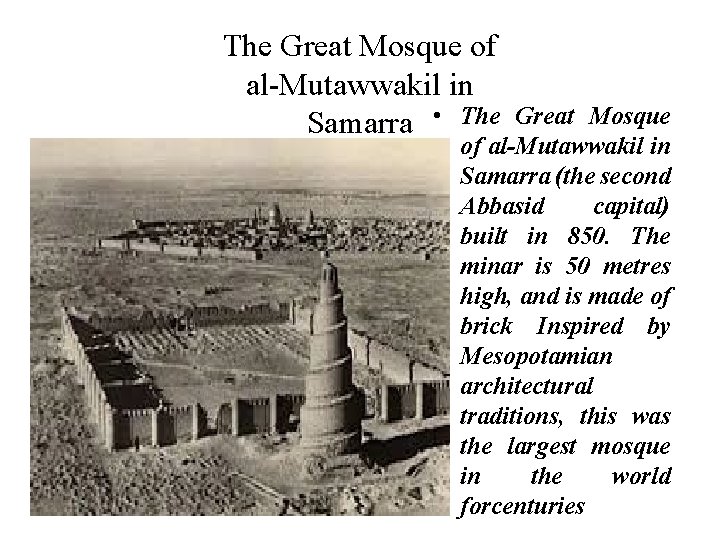
The Great Mosque of al-Mutawwakil in Samarra • The Great Mosque of al-Mutawwakil in Samarra (the second Abbasid capital) built in 850. The minar is 50 metres high, and is made of brick Inspired by Mesopotamian architectural traditions, this was the largest mosque in the world forcenturies
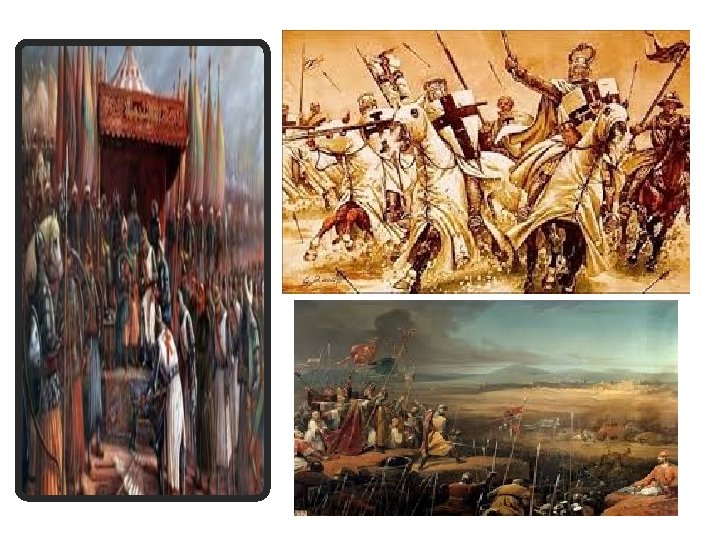
The Crusades • Between 1095 and 1291, western European Christians planned and fought wars against Muslim cities on the coastal plains of the eastern Mediterranean (Levant). These wars were later designated as Crusades*. • In the first crusade (1098 -99), soldiers from France and Italy captured Antioch in Syria, and claimed Jerusalem. Their victory was accompanied by the slaughter of Muslims and Jews in the city. • The Crusades left a lasting impact on two aspects of Christian & Muslim relations. One was the harsher attitude of the Muslim state towards its Christian subjects
Economy: Agriculture, Urbanisation and Commerce • Agriculture was the principal occupation of the settled populations in the newly conquered territories. The state had overall control of agricultural lands, deriving the bulk of its income from land revenue once the conquests were over. • Many new cities were founded, mainly to settle Arab soldiers (jund) who formed the backbone of the local administration. Among this class of garrison-cities, called misr (the Arabic. Egypt), were Kufa and Basra in Iraq, and Fustat and Cairo in Egypt.
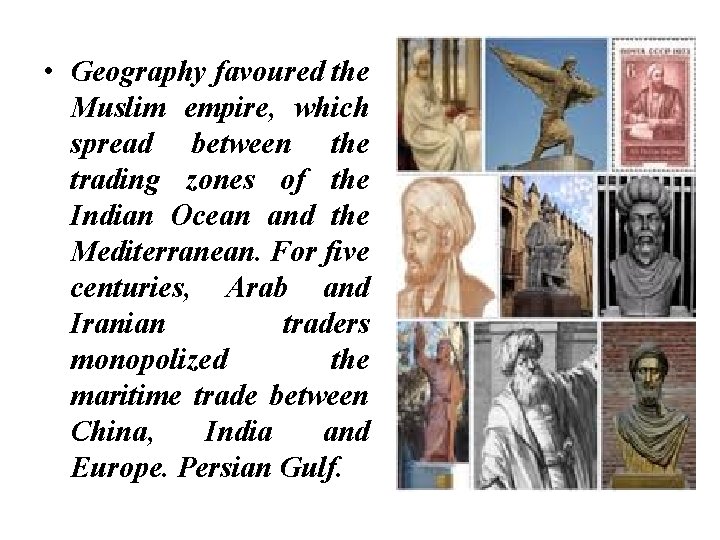
• Geography favoured the Muslim empire, which spread between the trading zones of the Indian Ocean and the Mediterranean. For five centuries, Arab and Iranian traders monopolized the maritime trade between China, India and Europe. Persian Gulf.
Learning and Culture • For religious scholars (ulama), knowledge (ilm) derived from the Quran and the model behaviour of the Prophet (sunna) was the only way to know the will of God and provide guidance in this world. The ulama in medieval times devoted themselves to writing tafsir and documenting Muhammad’s authentic hadith. Some went on to prepare a body of laws or sharia (the straight path) to govern the relationship of Muslims with God through rituals (ibadat) and with the rest of the humanity through social affairs (muamalat).
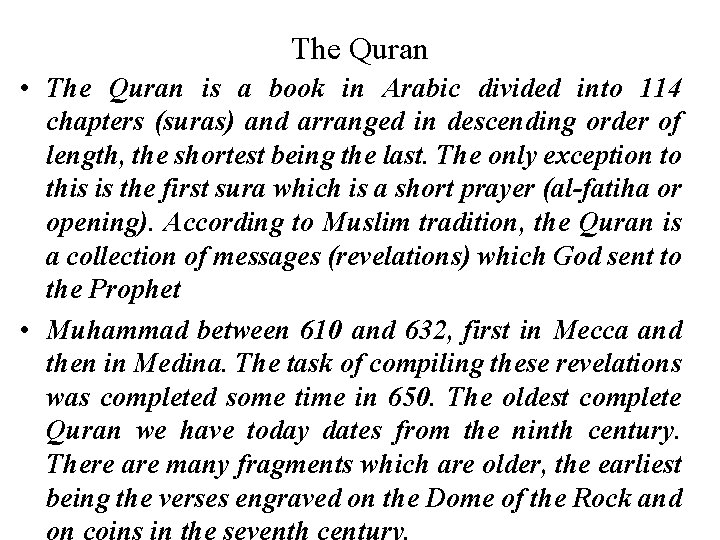
The Quran • The Quran is a book in Arabic divided into 114 chapters (suras) and arranged in descending order of length, the shortest being the last. The only exception to this is the first sura which is a short prayer (al-fatiha or opening). According to Muslim tradition, the Quran is a collection of messages (revelations) which God sent to the Prophet • Muhammad between 610 and 632, first in Mecca and then in Medina. The task of compiling these revelations was completed some time in 650. The oldest complete Quran we have today dates from the ninth century. There are many fragments which are older, the earliest being the verses engraved on the Dome of the Rock and
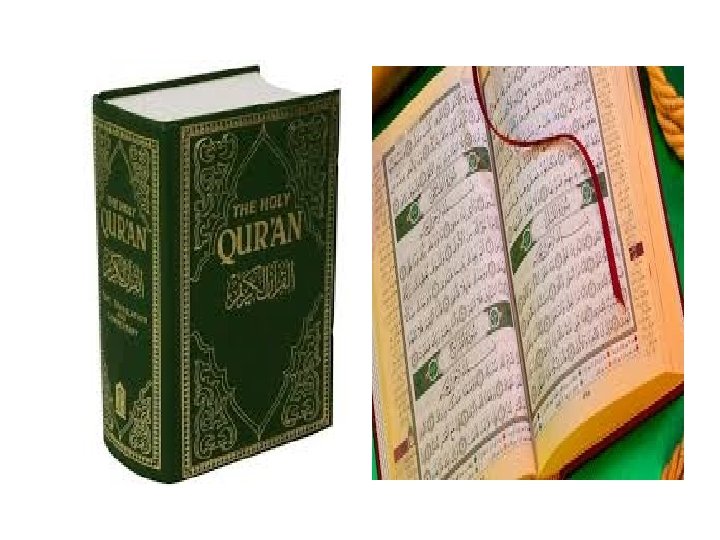
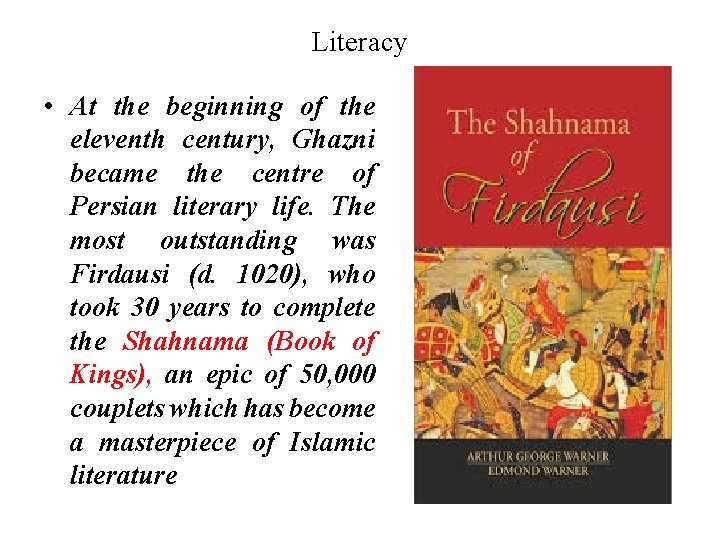
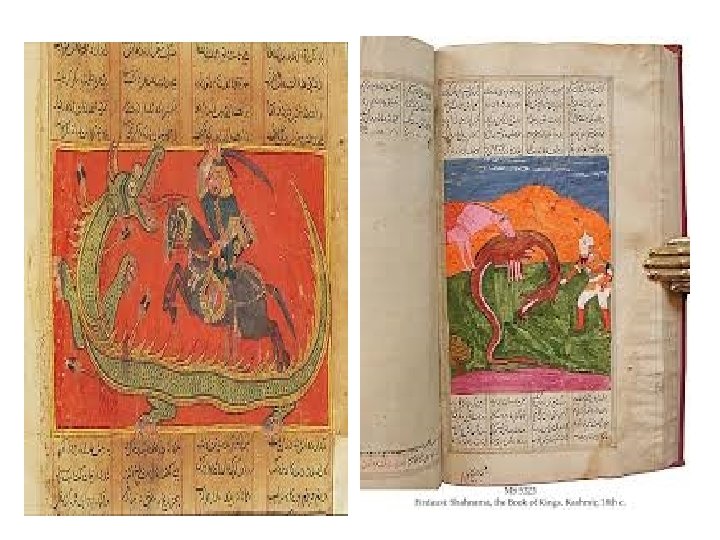
Literacy • At the beginning of the eleventh century, Ghazni became the centre of Persian literary life. The most outstanding was Firdausi (d. 1020), who took 30 years to complete the Shahnama (Book of Kings), an epic of 50, 000 couplets which has become a masterpiece of Islamic literature
• The tradition of history writing was well established in literate Muslim societies. History books were read by scholars and students as well as by the broader literate public. For rulers and officials, history provided a good record of the glories and achievements of a dynasty as well as examples of the techniques of administration. • In the two major historical works, Ansab al-Ashraf (Genealogies of the Nobles) of Baladhuri (d. 892) and Tarikh al-Rusul wal Muluk (History of Prophets and Kings) of Tabari, the whole of human history was treated with the Islamic period as the focal point

THANKS
- Slides: 30