
The Central Dogma Transcription Translation The Central Dogma
- Slides: 25
The Central Dogma Transcription & Translation
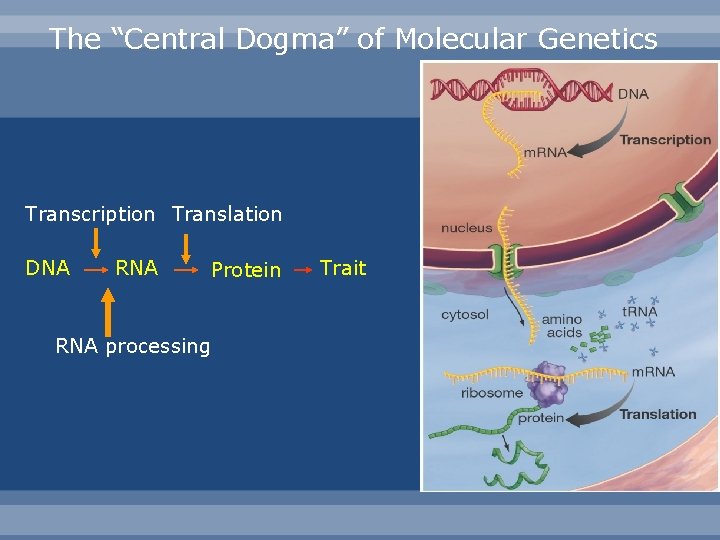
The “Central Dogma” of Molecular Genetics Transcription Translation DNA RNA Protein RNA processing Trait
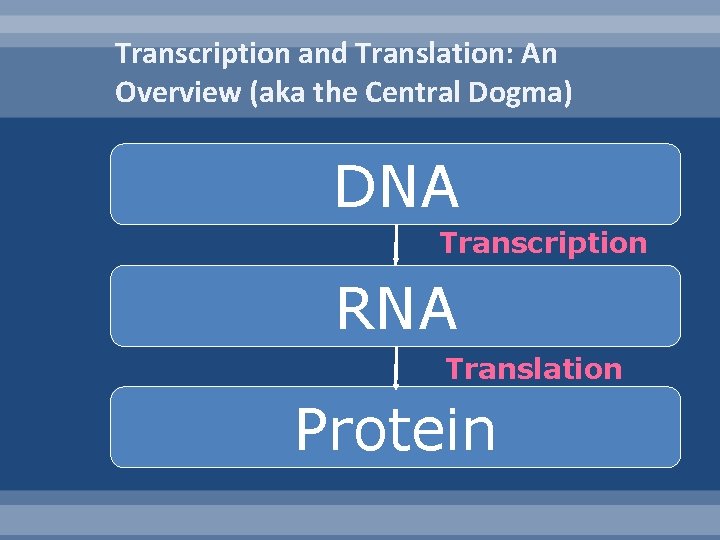
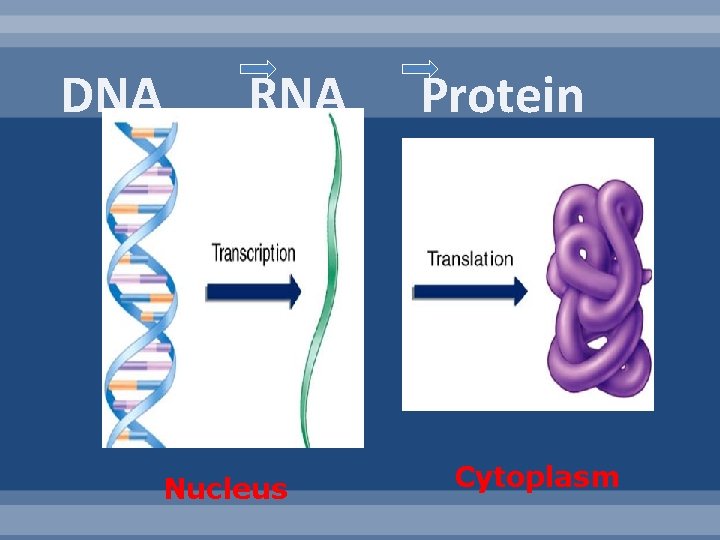
Transcription and Translation: An Overview (aka the Central Dogma) DNA Transcription RNA Translation Protein
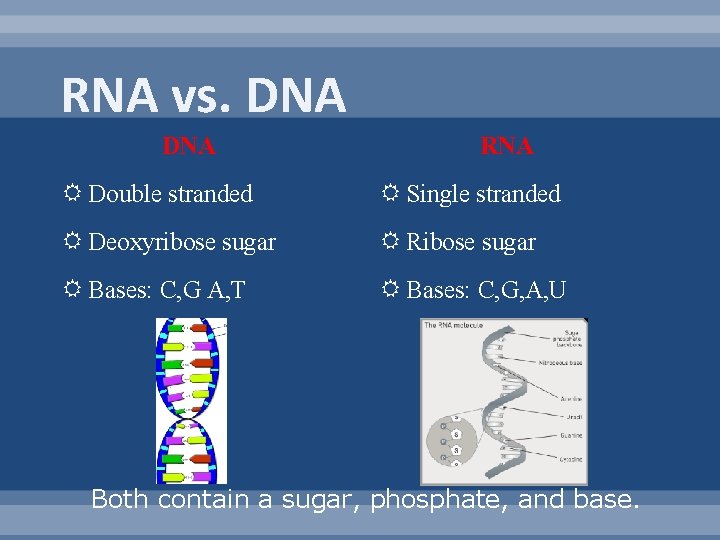
Transcription DNA RNA What is the difference between DNA and RNA? Ribose Sugar Uracil not thymine
RNA vs. DNA RNA Double stranded Single stranded Deoxyribose sugar Ribose sugar Bases: C, G A, T Bases: C, G, A, U Both contain a sugar, phosphate, and base.
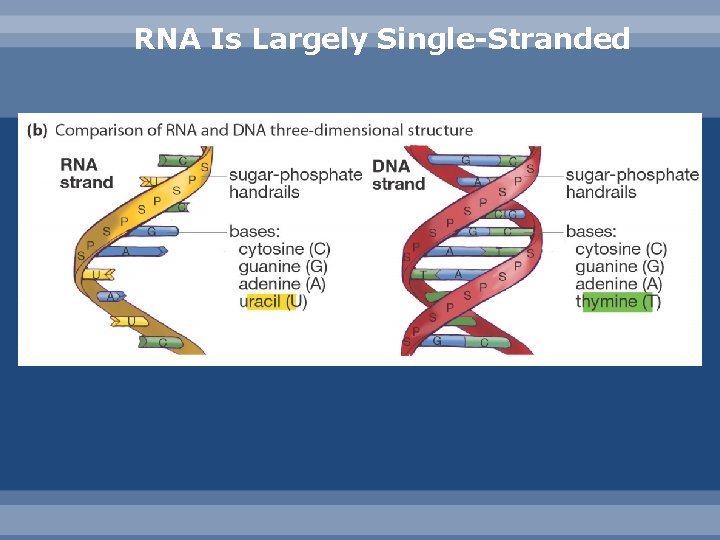
RNA Is Largely Single-Stranded
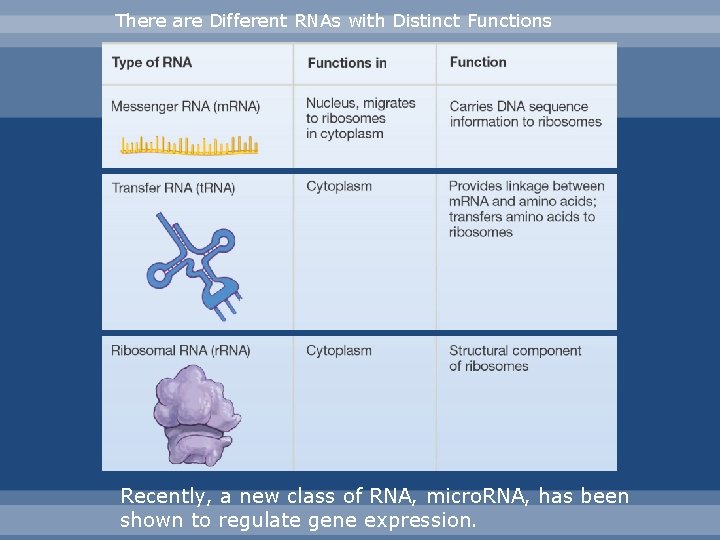
There are Different RNAs with Distinct Functions Recently, a new class of RNA, micro. RNA, has been shown to regulate gene expression.
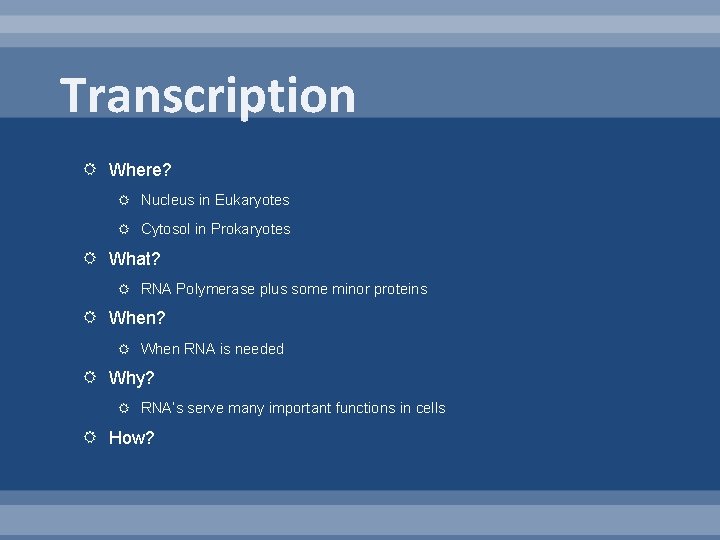
Transcription Where? Nucleus in Eukaryotes Cytosol in Prokaryotes What? RNA Polymerase plus some minor proteins When? When RNA is needed Why? RNA’s serve many important functions in cells How?
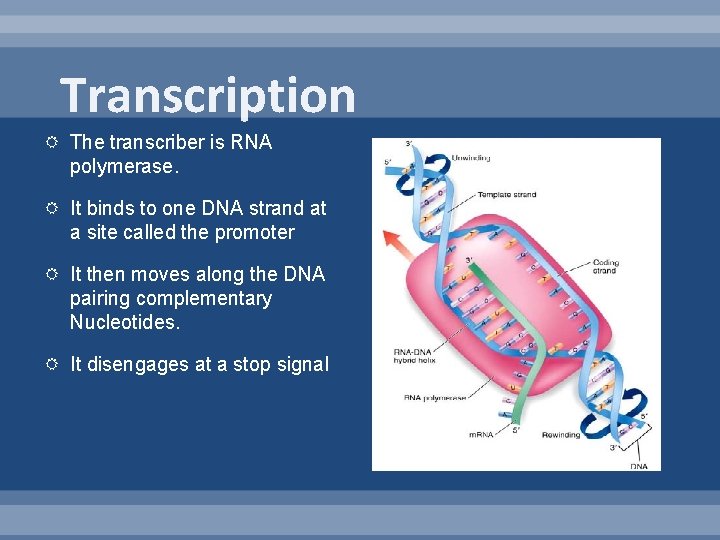
Transcription The transcriber is RNA polymerase. It binds to one DNA strand at a site called the promoter It then moves along the DNA pairing complementary Nucleotides. It disengages at a stop signal
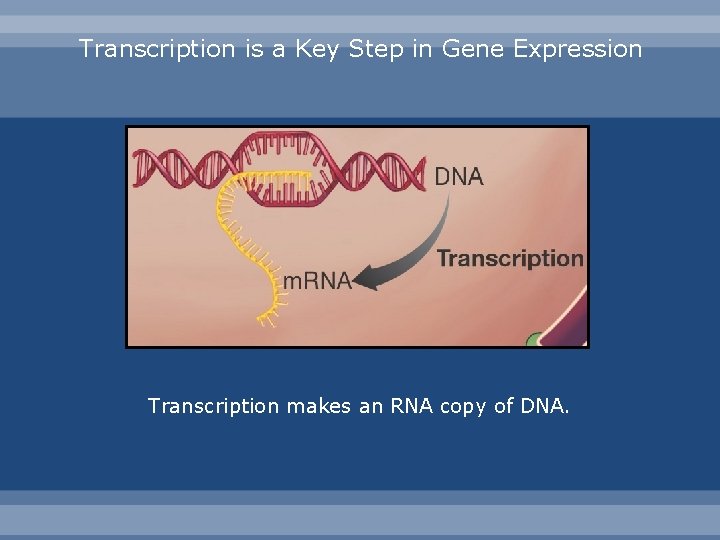
Transcription is a Key Step in Gene Expression Transcription makes an RNA copy of DNA.
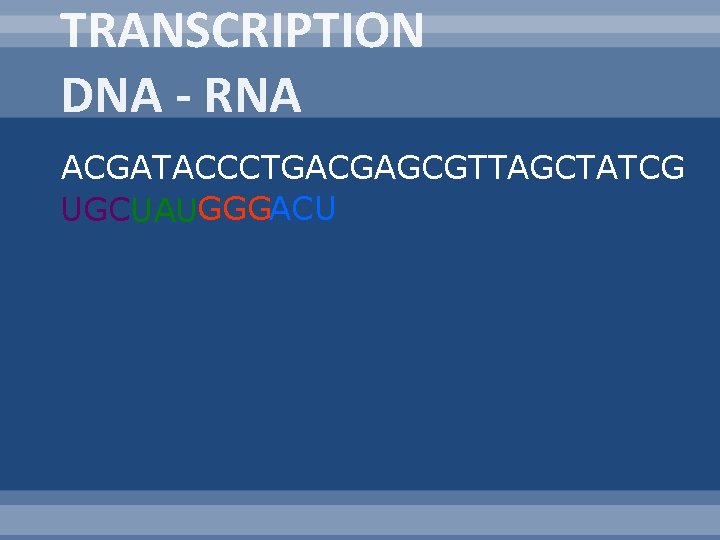
TRANSCRIPTION DNA - RNA ACGATACCCTGACGAGCGTTAGCTATCG UGCUAUGGGACU
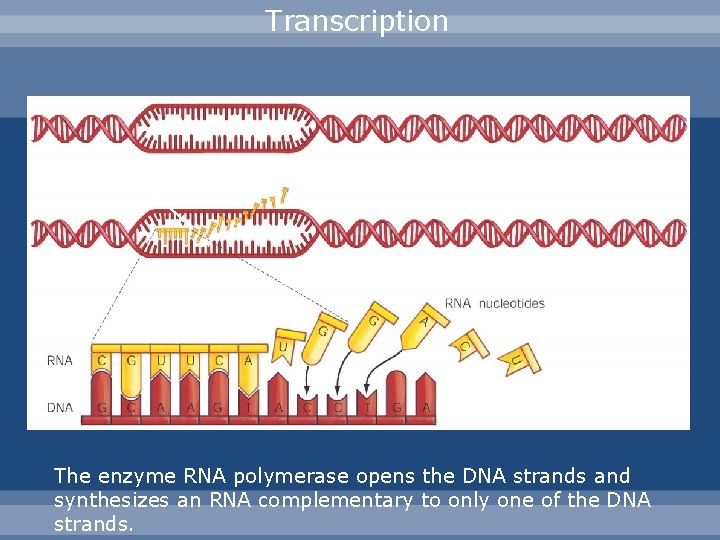
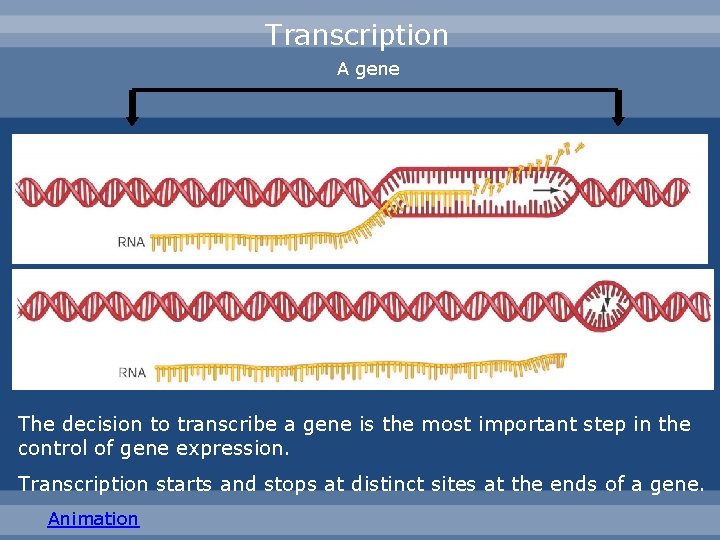
Transcription RNA polymerase acts here The enzyme RNA polymerase opens the DNA strands and synthesizes an RNA complementary to only one of the DNA strands.
Transcription A gene The decision to transcribe a gene is the most important step in the control of gene expression. Transcription starts and stops at distinct sites at the ends of a gene. Animation
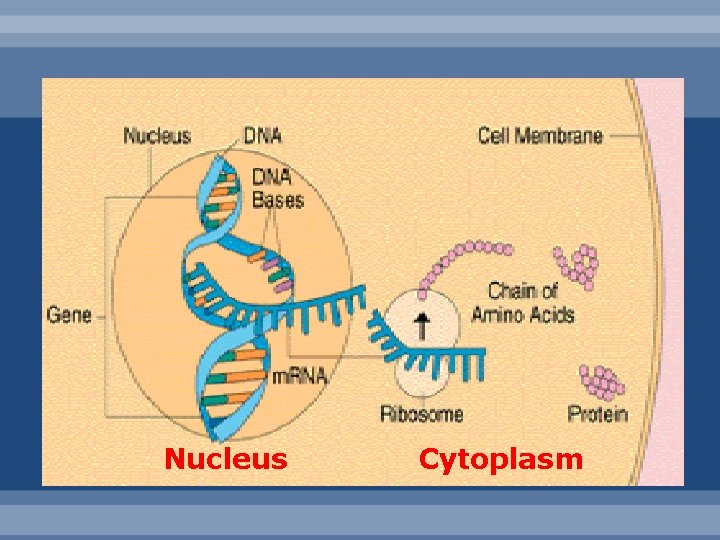
Transcription is done…what now? Now we have mature m. RNA transcribed from the cell’s DNA. It is leaving the nucleus through a nuclear pore. Once in the cytoplasm, it finds a ribosome so that translation can begin. We know how m. RNA is made, but how do we “read” the code?
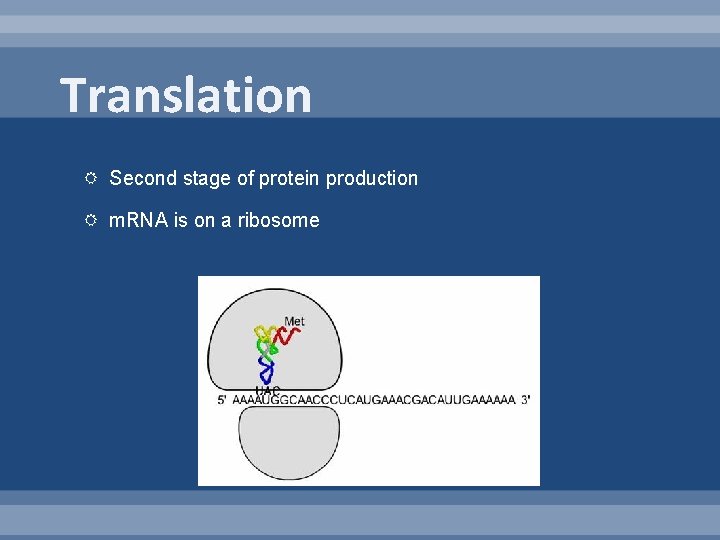
Translation Second stage of protein production m. RNA is on a ribosome
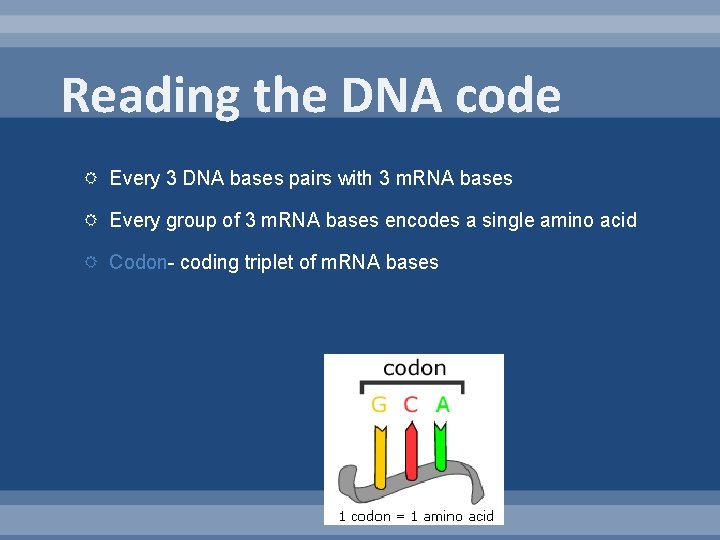
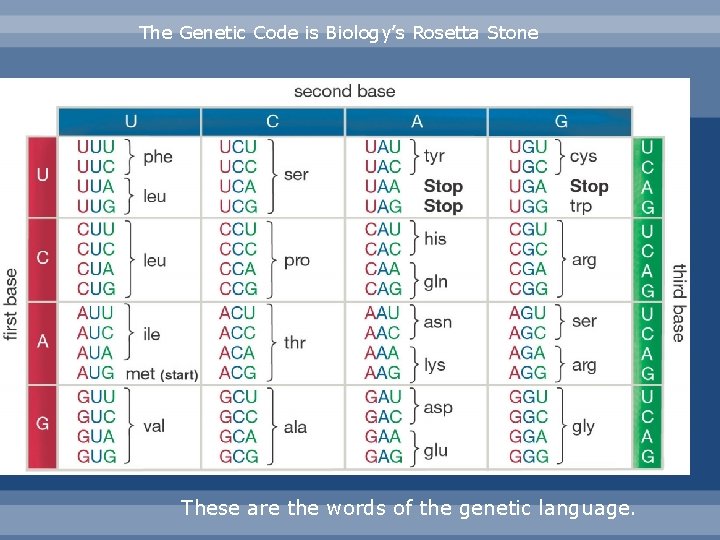
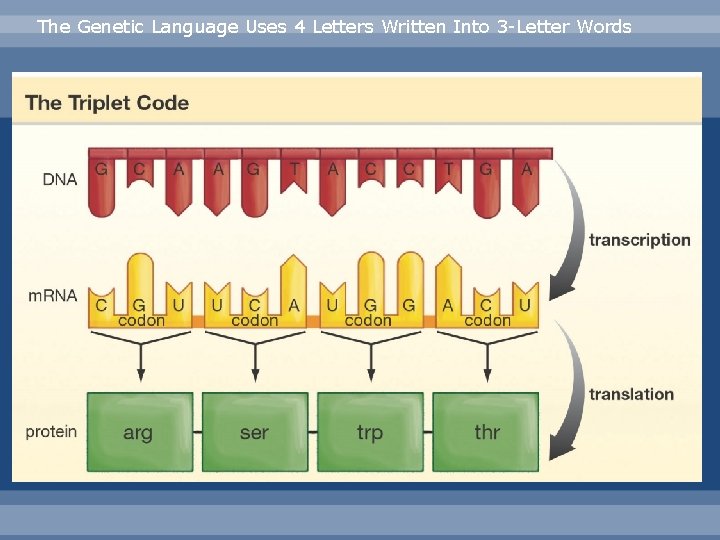
Reading the DNA code Every 3 DNA bases pairs with 3 m. RNA bases Every group of 3 m. RNA bases encodes a single amino acid Codon- coding triplet of m. RNA bases
The Genetic Code is Biology’s Rosetta Stone These are the words of the genetic language.
The Genetic Language Uses 4 Letters Written Into 3 -Letter Words
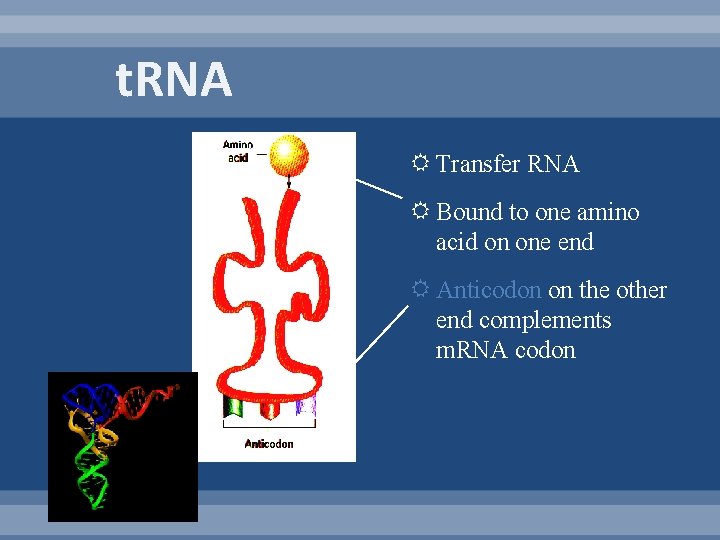
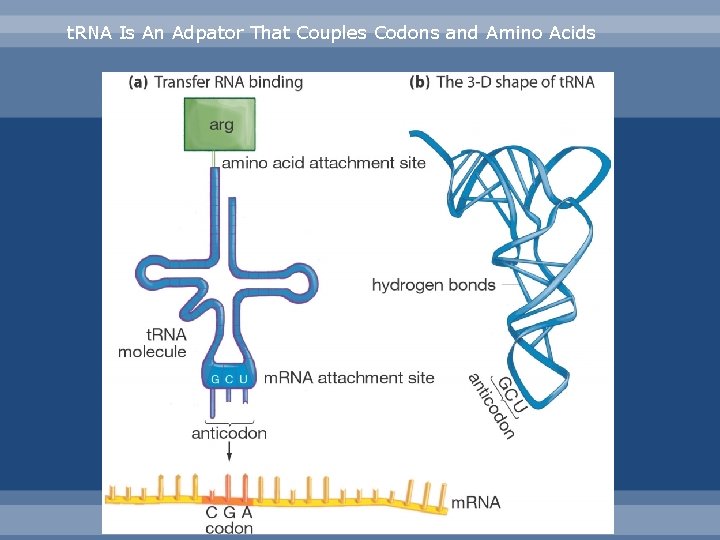
t. RNA Transfer RNA Bound to one amino acid on one end Anticodon on the other end complements m. RNA codon
t. RNA Is An Adpator That Couples Codons and Amino Acids
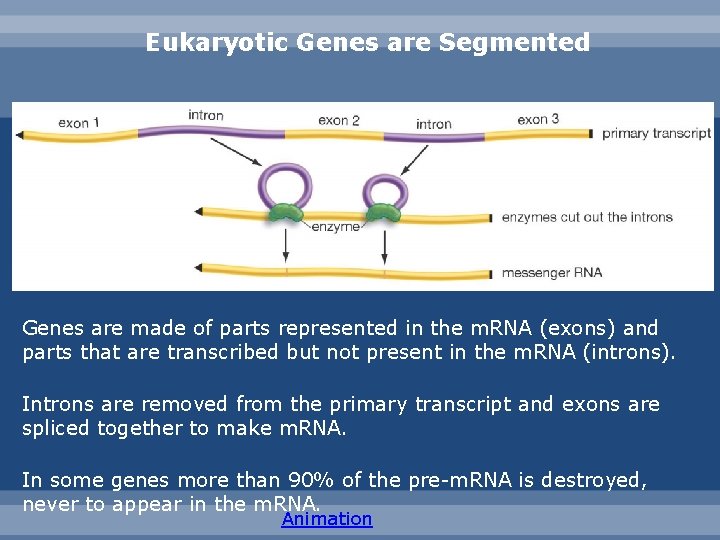
Eukaryotic Genes are Segmented Genes are made of parts represented in the m. RNA (exons) and parts that are transcribed but not present in the m. RNA (introns). Introns are removed from the primary transcript and exons are spliced together to make m. RNA. In some genes more than 90% of the pre-m. RNA is destroyed, never to appear in the m. RNA. Animation
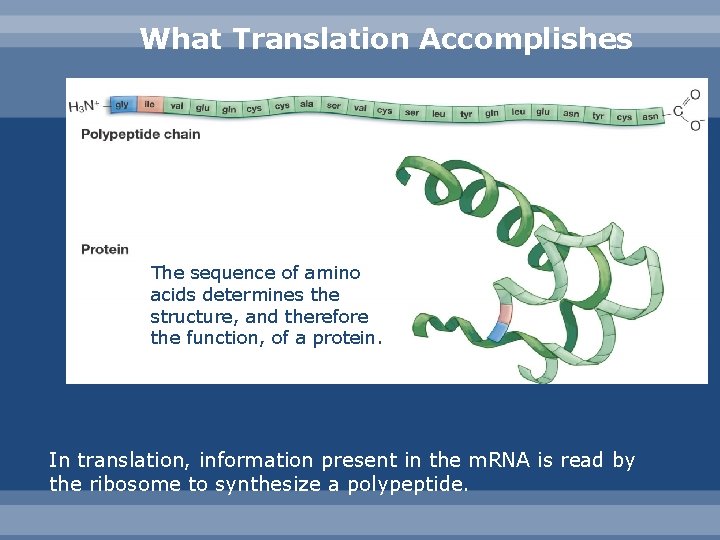
What Translation Accomplishes The sequence of amino acids determines the structure, and therefore the function, of a protein. In translation, information present in the m. RNA is read by the ribosome to synthesize a polypeptide.
DNA RNA Nucleus Protein Cytoplasm
Nucleus Cytoplasm
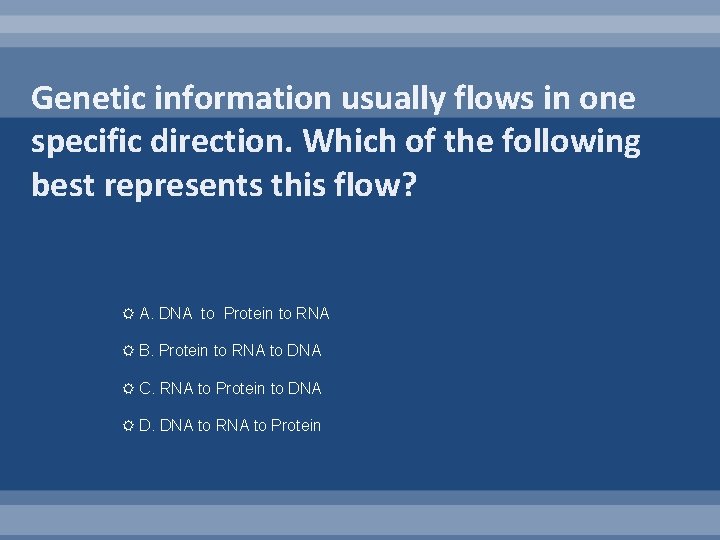
Genetic information usually flows in one specific direction. Which of the following best represents this flow? A. DNA to Protein to RNA B. Protein to RNA to DNA C. RNA to Protein to DNA D. DNA to RNA to Protein