
The Center of Government Using the center of


- Slides: 60
The Center of Government Using the center of government to maximize policy execution
The governing challenge • Governing is a complex task- significant interaction and integration of different people, processes, and structures is necessary to get things done • The Center of Government includes the entities and relationships closest to the president that: • • Cross the many silos of government • Should be used to effectively implement and advance his/her policy priorities • Deal with other critical issues as they arise This high level report: • Outlines the core principles and components of the Center of Government • Identifies how the Center of Government enables effective policy execution • Recommends ways the transition teams can incorporate the Center of Government now in their approach to agency review and policy implementation in order to hit the ground running 2
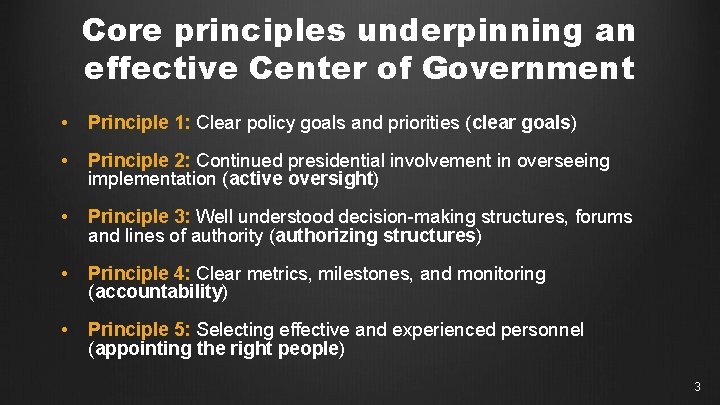
Core principles underpinning an effective Center of Government • Principle 1: Clear policy goals and priorities (clear goals) • Principle 2: Continued presidential involvement in overseeing implementation (active oversight) • Principle 3: Well understood decision-making structures, forums and lines of authority (authorizing structures) • Principle 4: Clear metrics, milestones, and monitoring (accountability) • Principle 5: Selecting effective and experienced personnel (appointing the right people) 3
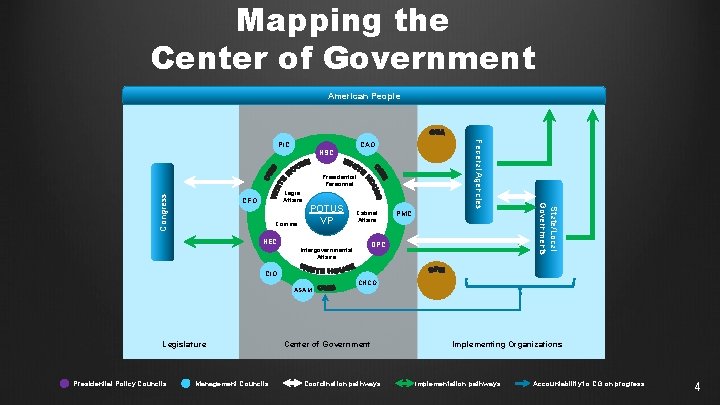
Mapping the Center of Government American People CAO NSC Congress Presidential Personnel Legis. Affairs CFO Comms POTUS VP Cabinet Affairs NEC PMC DPC Intergovernmental Affairs State/Local Governments Federal Agencies PIC CIO CHCO ASAM Legislature Presidential Policy Councils Management Councils Center of Government Coordination pathways Implementing Organizations Implementation pathways Accountability to CG on progress 4
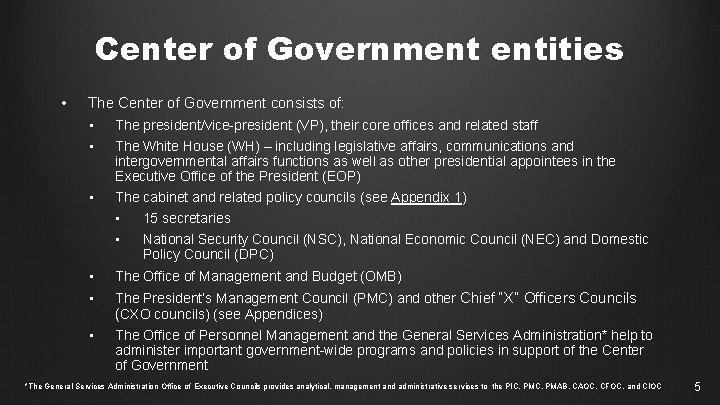
Center of Government entities • The Center of Government consists of: • The president/vice-president (VP), their core offices and related staff • The White House (WH) – including legislative affairs, communications and intergovernmental affairs functions as well as other presidential appointees in the Executive Office of the President (EOP) • The cabinet and related policy councils (see Appendix 1) • • 15 secretaries National Security Council (NSC), National Economic Council (NEC) and Domestic Policy Council (DPC) • The Office of Management and Budget (OMB) • The President’s Management Council (PMC) and other Chief “X” Officers Councils (CXO councils) (see Appendices) • The Office of Personnel Management and the General Services Administration* help to administer important government-wide programs and policies in support of the Center of Government *The General Services Administration Office of Executive Councils provides analytical, management and administrative services to the PIC, PMAB, CAOC, CFOC, and CIOC 5
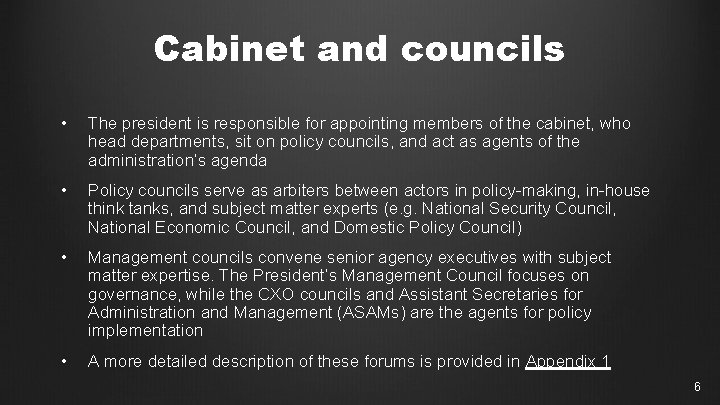
Cabinet and councils • The president is responsible for appointing members of the cabinet, who head departments, sit on policy councils, and act as agents of the administration’s agenda • Policy councils serve as arbiters between actors in policy-making, in-house think tanks, and subject matter experts (e. g. National Security Council, National Economic Council, and Domestic Policy Council) • Management councils convene senior agency executives with subject matter expertise. The President’s Management Council focuses on governance, while the CXO councils and Assistant Secretaries for Administration and Management (ASAMs) are the agents for policy implementation • A more detailed description of these forums is provided in Appendix 1 6
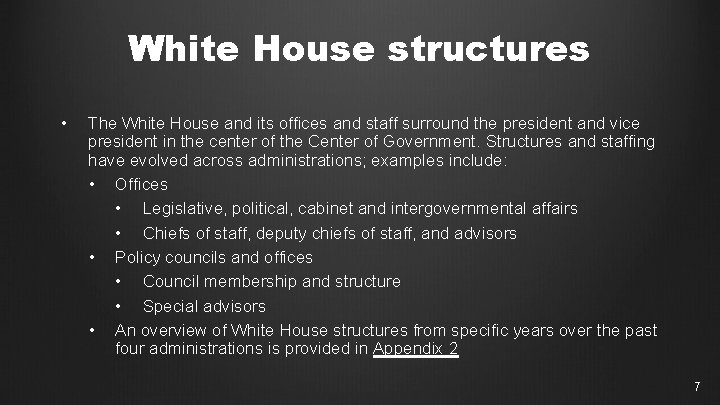
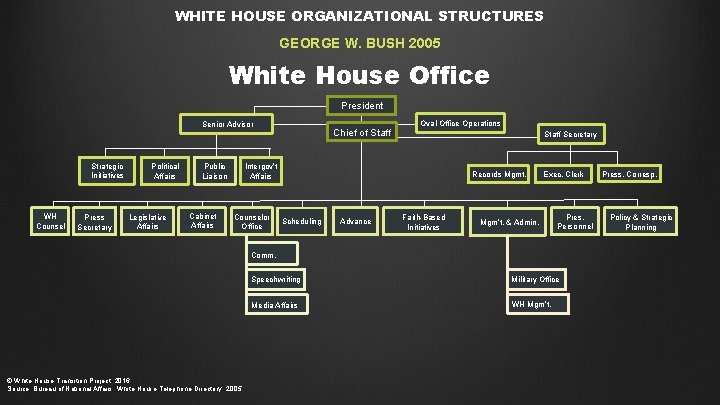
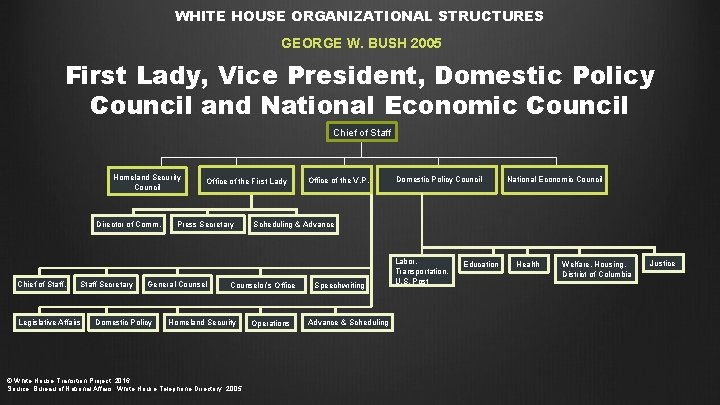
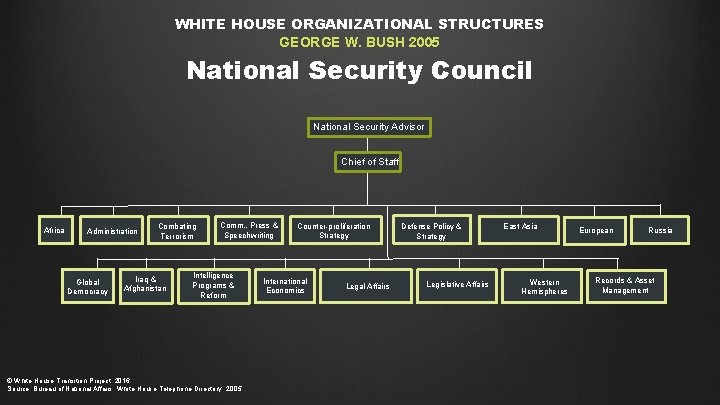
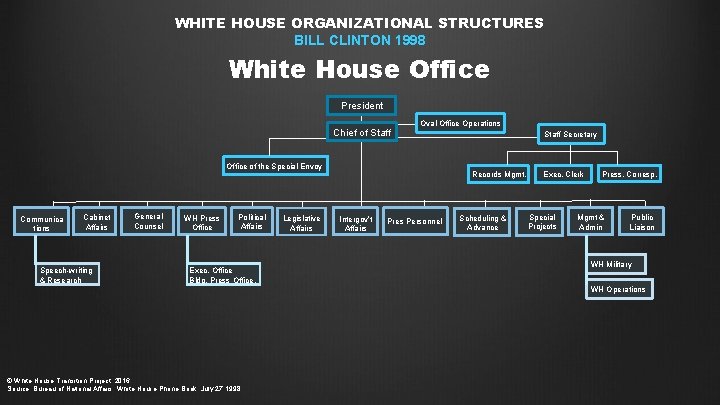
White House structures • The White House and its offices and staff surround the president and vice president in the center of the Center of Government. Structures and staffing have evolved across administrations; examples include: • Offices • Legislative, political, cabinet and intergovernmental affairs • Chiefs of staff, deputy chiefs of staff, and advisors • Policy councils and offices • Council membership and structure • Special advisors • An overview of White House structures from specific years over the past four administrations is provided in Appendix 2 7
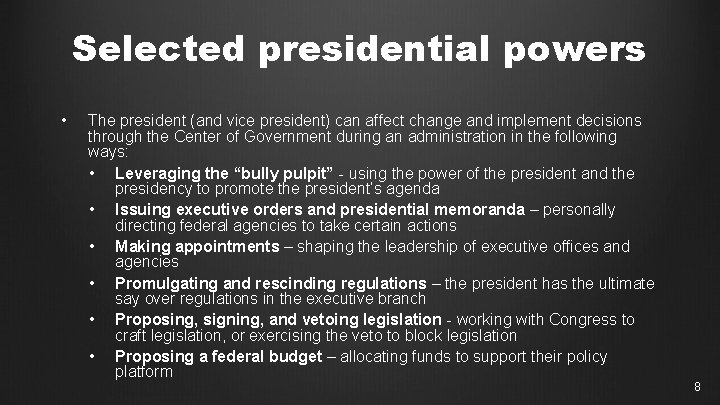
Selected presidential powers • The president (and vice president) can affect change and implement decisions through the Center of Government during an administration in the following ways: • Leveraging the “bully pulpit” - using the power of the president and the presidency to promote the president’s agenda • Issuing executive orders and presidential memoranda – personally directing federal agencies to take certain actions • Making appointments – shaping the leadership of executive offices and agencies • Promulgating and rescinding regulations – the president has the ultimate say over regulations in the executive branch • Proposing, signing, and vetoing legislation - working with Congress to craft legislation, or exercising the veto to block legislation • Proposing a federal budget – allocating funds to support their policy platform 8
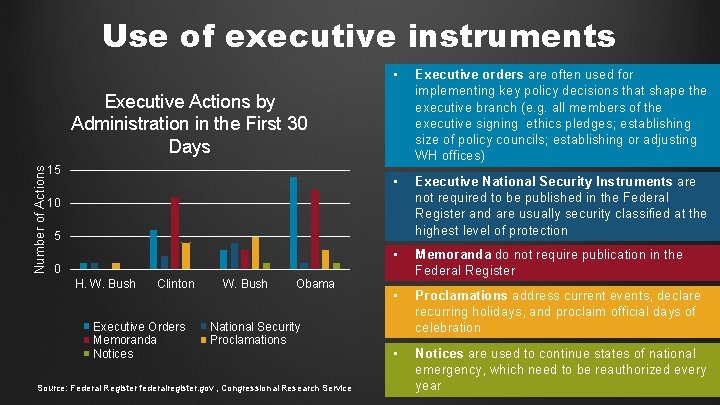
Use of executive instruments • Executive orders are often used for implementing key policy decisions that shape the executive branch (e. g. all members of the executive signing ethics pledges; establishing size of policy councils; establishing or adjusting WH offices) • Executive National Security Instruments are not required to be published in the Federal Register and are usually security classified at the highest level of protection • Memoranda do not require publication in the Federal Register • Proclamations address current events, declare recurring holidays, and proclaim official days of celebration • Notices are used to continue states of national emergency, which need to be reauthorized every 9 year Number of Actions Executive Actions by Administration in the First 30 Days 15 10 5 0 H. W. Bush Clinton Executive Orders Memoranda Notices W. Bush Obama National Security Proclamations Source: Federal Register federalregister. gov , Congressional Research Service
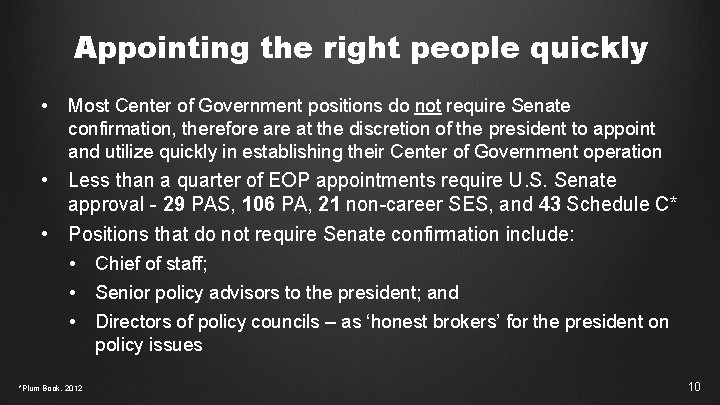
Appointing the right people quickly • Most Center of Government positions do not require Senate confirmation, therefore at the discretion of the president to appoint and utilize quickly in establishing their Center of Government operation • Less than a quarter of EOP appointments require U. S. Senate approval - 29 PAS, 106 PA, 21 non-career SES, and 43 Schedule C* • Positions that do not require Senate confirmation include: • Chief of staff; • Senior policy advisors to the president; and • Directors of policy councils – as ‘honest brokers’ for the president on policy issues *Plum Book, 2012 10
CENTER OF GOVERNMENT CASE STUDY – POLICY ENABLERS The American Recovery and Reinvestment Act of 2009 • President Obama signed the American Recovery and Reinvestment Act (ARRA) less than a month after taking the oath of office • The administration leveraged the tools of an effective Center of Government to implement the $787 billion mandate within aggressive statutory deadlines, while minimizing waste, fraud, and abuse 11
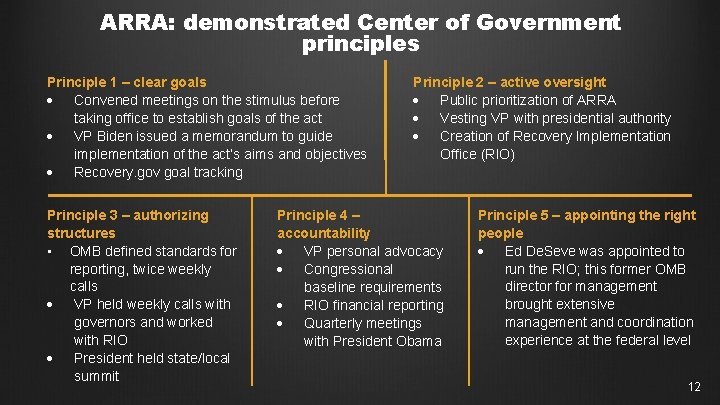
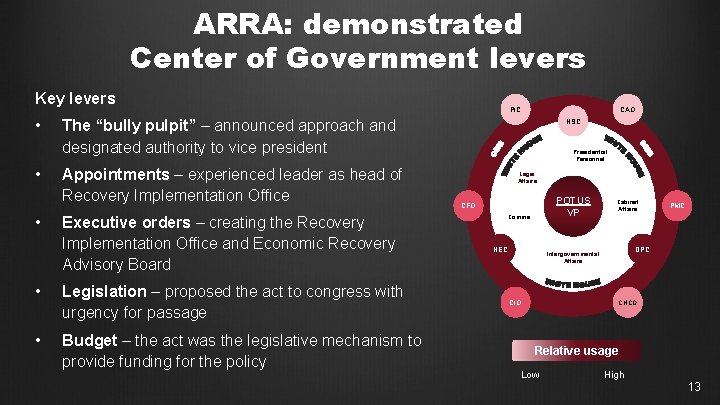
ARRA: demonstrated Center of Government principles Principle 1 – clear goals Convened meetings on the stimulus before taking office to establish goals of the act VP Biden issued a memorandum to guide implementation of the act’s aims and objectives Recovery. gov goal tracking Principle 3 – authorizing structures • OMB defined standards for reporting, twice weekly calls VP held weekly calls with governors and worked with RIO President held state/local summit Principle 2 – active oversight Public prioritization of ARRA Vesting VP with presidential authority Creation of Recovery Implementation Office (RIO) Principle 4 – accountability VP personal advocacy Congressional baseline requirements RIO financial reporting Quarterly meetings with President Obama Principle 5 – appointing the right people Ed De. Seve was appointed to run the RIO; this former OMB director for management brought extensive management and coordination experience at the federal level 12
ARRA: demonstrated Center of Government levers Key levers • • • PIC CAO The “bully pulpit” – announced approach and designated authority to vice president Appointments – experienced leader as head of Recovery Implementation Office Executive orders – creating the Recovery Implementation Office and Economic Recovery Advisory Board • Legislation – proposed the act to congress with urgency for passage • Budget – the act was the legislative mechanism to provide funding for the policy NSC Presidential Personnel Legis. Affairs POTUS VP CFO Comms NEC Cabinet Affairs DPC Intergovernmental Affairs CIO PMC CHCO Relative usage Low High 13
CENTER OF GOVERNMENT CASE STUDY – POLICY ENABLERS The E-Government initiative • The 2001 E-Government initiative during the Bush Administration sought to modernize the government and how it engages citizens • The initiative aimed to: • Focus on citizen and business communication with the federal government, expanding the use of the internet as an avenue to deliver government services • Enact the E-Government Act of 2002 to: • • Authorize the OMB E-Government Office • Codify the existence of the president’s CIO council • Standardize IT training, practices and information indexing across agencies Save taxpayer dollars and streamline citizen participation 14
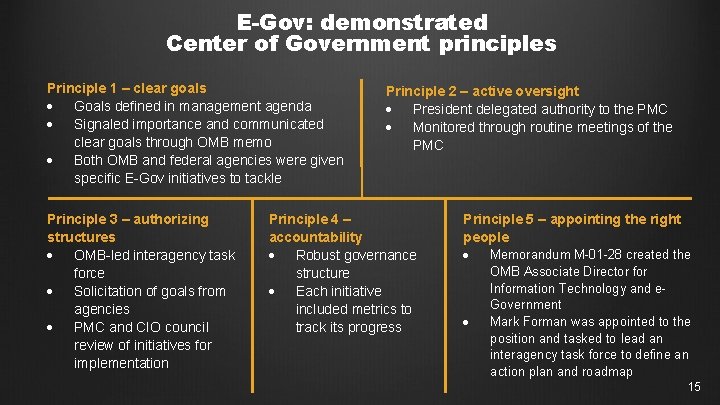
E-Gov: demonstrated Center of Government principles Principle 1 – clear goals Goals defined in management agenda Signaled importance and communicated clear goals through OMB memo Both OMB and federal agencies were given specific E-Gov initiatives to tackle Principle 3 – authorizing structures OMB-led interagency task force Solicitation of goals from agencies PMC and CIO council review of initiatives for implementation Principle 2 – active oversight President delegated authority to the PMC Monitored through routine meetings of the PMC Principle 4 – accountability Robust governance structure Each initiative included metrics to track its progress Principle 5 – appointing the right people Memorandum M-01 -28 created the OMB Associate Director for Information Technology and e. Government Mark Forman was appointed to the position and tasked to lead an interagency task force to define an action plan and roadmap 15
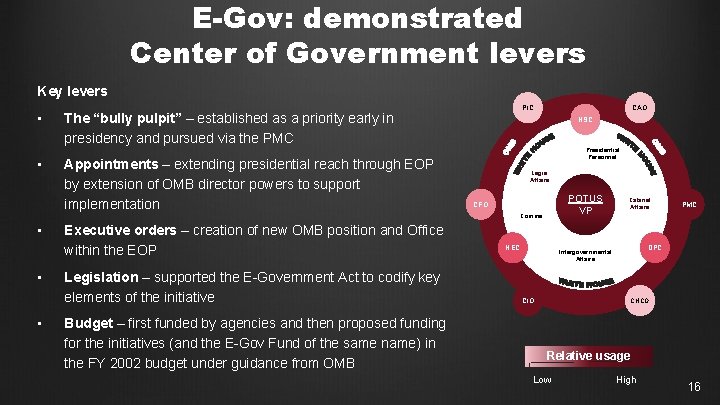
E-Gov: demonstrated Center of Government levers Key levers • • PIC The “bully pulpit” – established as a priority early in presidency and pursued via the PMC Appointments – extending presidential reach through EOP by extension of OMB director powers to support implementation CAO NSC Presidential Personnel Legis. Affairs POTUS VP CFO Comms • • • Executive orders – creation of new OMB position and Office within the EOP Legislation – supported the E-Government Act to codify key elements of the initiative Budget – first funded by agencies and then proposed funding for the initiatives (and the E-Gov Fund of the same name) in the FY 2002 budget under guidance from OMB NEC Cabinet Affairs DPC Intergovernmental Affairs CIO PMC CHCO Relative usage Low High 16
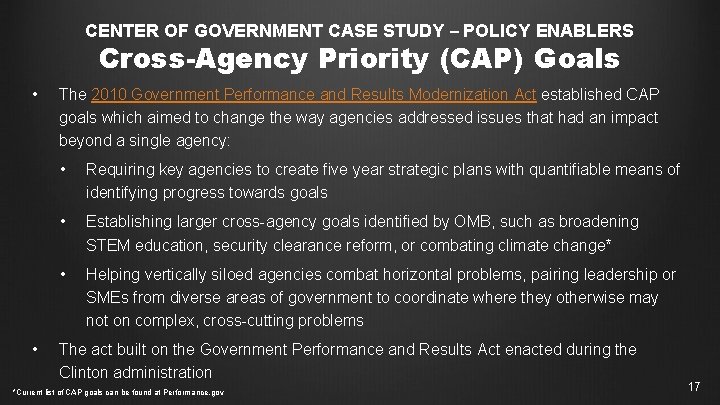
CENTER OF GOVERNMENT CASE STUDY – POLICY ENABLERS Cross-Agency Priority (CAP) Goals • • The 2010 Government Performance and Results Modernization Act established CAP goals which aimed to change the way agencies addressed issues that had an impact beyond a single agency: • Requiring key agencies to create five year strategic plans with quantifiable means of identifying progress towards goals • Establishing larger cross-agency goals identified by OMB, such as broadening STEM education, security clearance reform, or combating climate change* • Helping vertically siloed agencies combat horizontal problems, pairing leadership or SMEs from diverse areas of government to coordinate where they otherwise may not on complex, cross-cutting problems The act built on the Government Performance and Results Act enacted during the Clinton administration *Current list of CAP goals can be found at Performance. gov 17
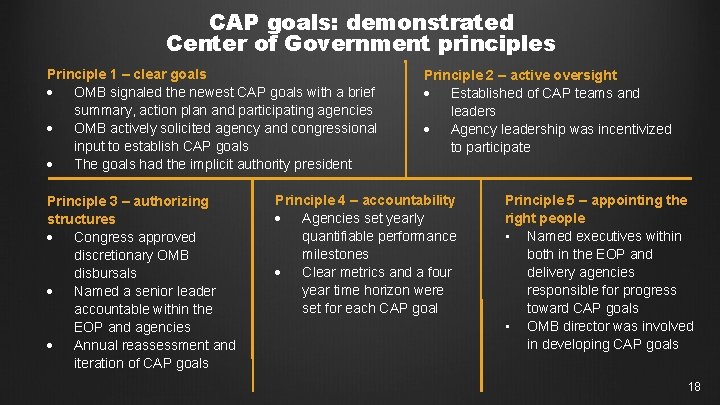
CAP goals: demonstrated Center of Government principles Principle 1 – clear goals OMB signaled the newest CAP goals with a brief summary, action plan and participating agencies OMB actively solicited agency and congressional input to establish CAP goals The goals had the implicit authority president Principle 3 – authorizing structures Congress approved discretionary OMB disbursals Named a senior leader accountable within the EOP and agencies Annual reassessment and iteration of CAP goals Principle 2 – active oversight Established of CAP teams and leaders Agency leadership was incentivized to participate Principle 4 – accountability Agencies set yearly quantifiable performance milestones Clear metrics and a four year time horizon were set for each CAP goal Principle 5 – appointing the right people • Named executives within both in the EOP and delivery agencies responsible for progress toward CAP goals • OMB director was involved in developing CAP goals 18
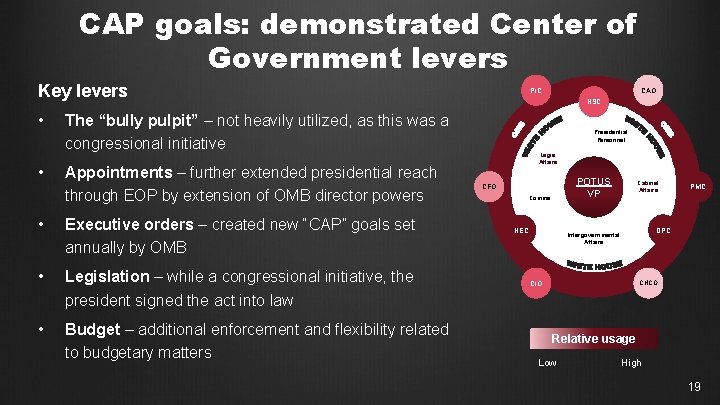
CAP goals: demonstrated Center of Government levers Key levers • • PIC The “bully pulpit” – not heavily utilized, as this was a congressional initiative Appointments – further extended presidential reach through EOP by extension of OMB director powers • Executive orders – created new “CAP” goals set annually by OMB • Legislation – while a congressional initiative, the president signed the act into law • Budget – additional enforcement and flexibility related to budgetary matters CAO NSC Presidential Personnel Legis. Affairs POTUS VP CFO Comms NEC Cabinet Affairs PMC DPC Intergovernmental Affairs CIO CHCO Relative usage Low High 19
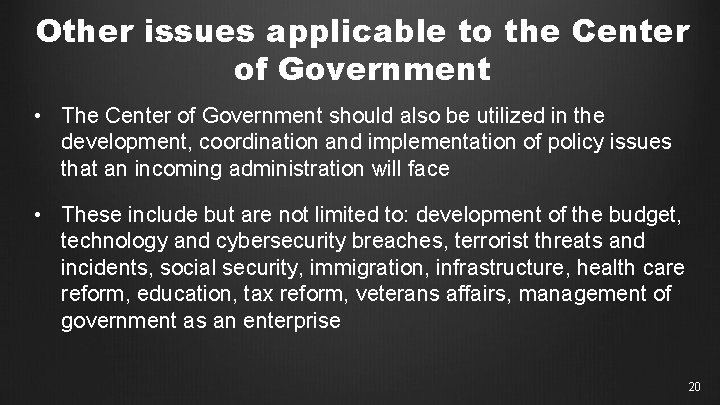
Other issues applicable to the Center of Government • The Center of Government should also be utilized in the development, coordination and implementation of policy issues that an incoming administration will face • These include but are not limited to: development of the budget, technology and cybersecurity breaches, terrorist threats and incidents, social security, immigration, infrastructure, health care reform, education, tax reform, veterans affairs, management of government as an enterprise 20
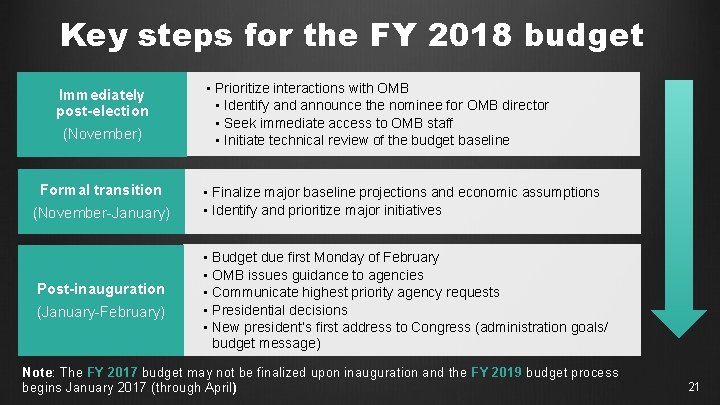
Key steps for the FY 2018 budget Immediately post-election (November) • Prioritize interactions with OMB • Identify and announce the nominee for OMB director • Seek immediate access to OMB staff • Initiate technical review of the budget baseline Formal transition (November-January) • Finalize major baseline projections and economic assumptions • Identify and prioritize major initiatives Post-inauguration (January-February) • Budget due first Monday of February • OMB issues guidance to agencies • Communicate highest priority agency requests • Presidential decisions • New president’s first address to Congress (administration goals/ budget message) Note: The FY 2017 budget may not be finalized upon inauguration and the FY 2019 budget process begins January 2017 (through April) 21
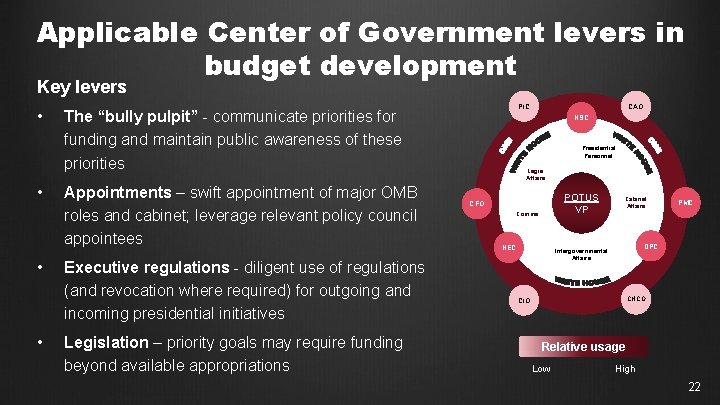
Applicable Center of Government levers in budget development Key levers • • PIC The “bully pulpit” - communicate priorities for funding and maintain public awareness of these priorities Appointments – swift appointment of major OMB roles and cabinet; leverage relevant policy council appointees Executive regulations - diligent use of regulations (and revocation where required) for outgoing and incoming presidential initiatives Legislation – priority goals may require funding beyond available appropriations CAO NSC Presidential Personnel Legis. Affairs POTUS VP CFO Comms NEC Cabinet Affairs PMC DPC Intergovernmental Affairs CHCO CIO Relative usage Low High 22
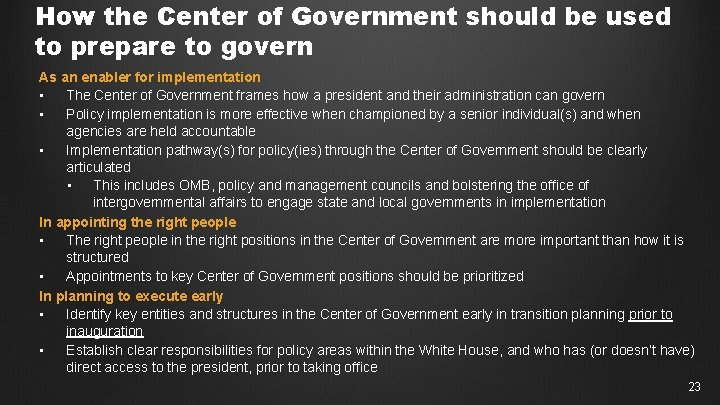
How the Center of Government should be used to prepare to govern As an enabler for implementation • The Center of Government frames how a president and their administration can govern • Policy implementation is more effective when championed by a senior individual(s) and when agencies are held accountable • Implementation pathway(s) for policy(ies) through the Center of Government should be clearly articulated • This includes OMB, policy and management councils and bolstering the office of intergovernmental affairs to engage state and local governments in implementation In appointing the right people • The right people in the right positions in the Center of Government are more important than how it is structured • Appointments to key Center of Government positions should be prioritized In planning to execute early • Identify key entities and structures in the Center of Government early in transition planning prior to inauguration • Establish clear responsibilities for policy areas within the White House, and who has (or doesn’t have) direct access to the president, prior to taking office 23
Appendix 1 24
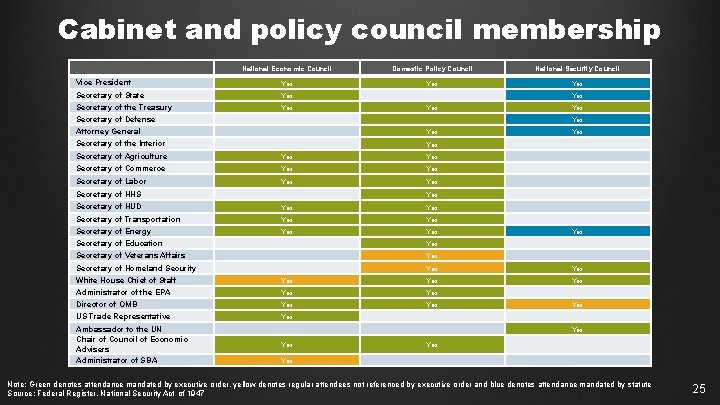
Cabinet and policy council membership National Economic Council Domestic Policy Council National Security Council Vice President Yes Yes Secretary of State Yes Secretary of the Treasury Yes Yes Secretary of Defense Yes Attorney General Yes Secretary of the Interior Yes Secretary of Agriculture Yes Secretary of Commerce Yes Secretary of Labor Yes Secretary of HHS Yes Secretary of HUD Yes Secretary of Transportation Yes Secretary of Energy Yes Secretary of Education Yes Secretary of Veterans Affairs Yes Secretary of Homeland Security Yes Yes White House Chief of Staff Yes Yes Administrator of the EPA Yes Director of OMB Yes US Trade Representative Yes Ambassador to the UN Chair of Council of Economic Advisers Administrator of SBA Yes Yes Yes Note: Green denotes attendance mandated by executive order, yellow denotes regular attendees not referenced by executive order and blue denotes attendance mandated by statute Source: Federal Register, National Security Act of 1947 25
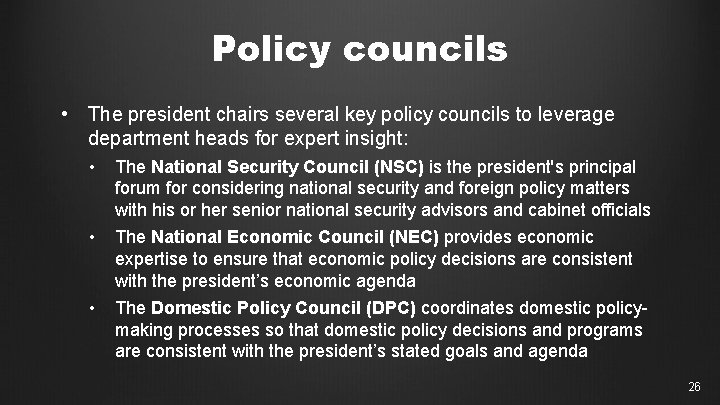
Policy councils • The president chairs several key policy councils to leverage department heads for expert insight: • The National Security Council (NSC) is the president's principal forum for considering national security and foreign policy matters with his or her senior national security advisors and cabinet officials • The National Economic Council (NEC) provides economic expertise to ensure that economic policy decisions are consistent with the president’s economic agenda • The Domestic Policy Council (DPC) coordinates domestic policymaking processes so that domestic policy decisions and programs are consistent with the president’s stated goals and agenda 26
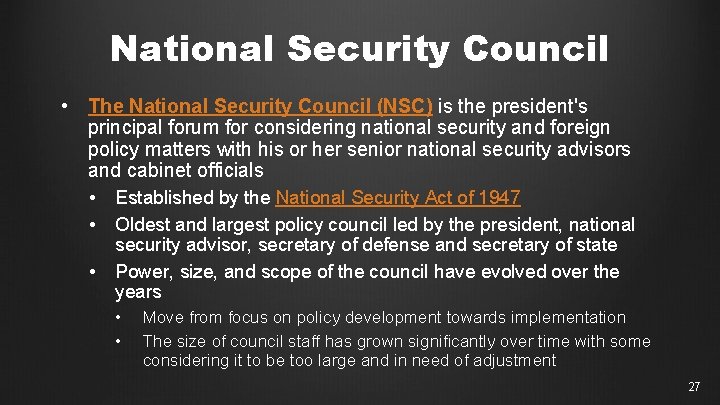
National Security Council • The National Security Council (NSC) is the president's principal forum for considering national security and foreign policy matters with his or her senior national security advisors and cabinet officials • Established by the National Security Act of 1947 • Oldest and largest policy council led by the president, national • security advisor, secretary of defense and secretary of state Power, size, and scope of the council have evolved over the years • • Move from focus on policy development towards implementation The size of council staff has grown significantly over time with some considering it to be too large and in need of adjustment 27
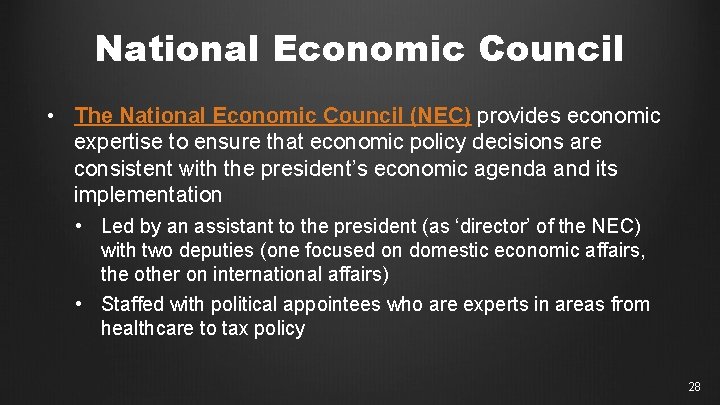
National Economic Council • The National Economic Council (NEC) provides economic expertise to ensure that economic policy decisions are consistent with the president’s economic agenda and its implementation • Led by an assistant to the president (as ‘director’ of the NEC) with two deputies (one focused on domestic economic affairs, the other on international affairs) • Staffed with political appointees who are experts in areas from healthcare to tax policy 28
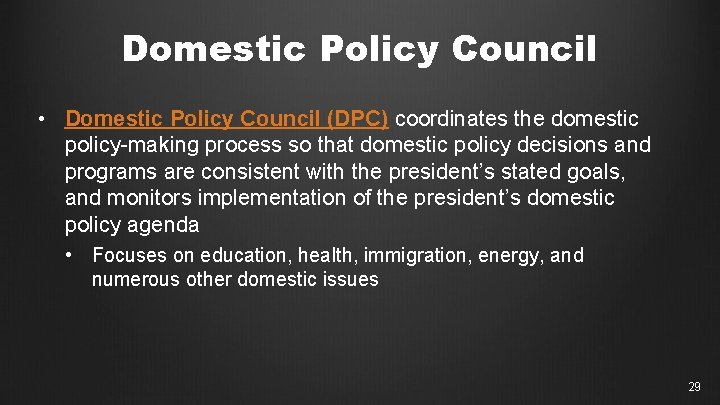
Domestic Policy Council • Domestic Policy Council (DPC) coordinates the domestic policy-making process so that domestic policy decisions and programs are consistent with the president’s stated goals, and monitors implementation of the president’s domestic policy agenda • Focuses on education, health, immigration, energy, and numerous other domestic issues 29
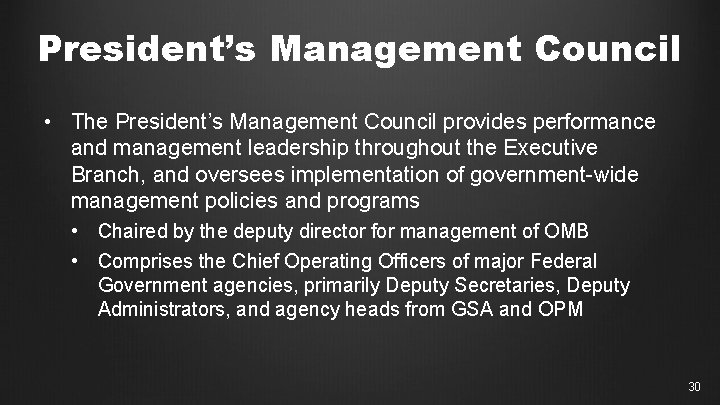
President’s Management Council • The President’s Management Council provides performance and management leadership throughout the Executive Branch, and oversees implementation of government-wide management policies and programs • Chaired by the deputy director for management of OMB • Comprises the Chief Operating Officers of major Federal Government agencies, primarily Deputy Secretaries, Deputy Administrators, and agency heads from GSA and OPM 30
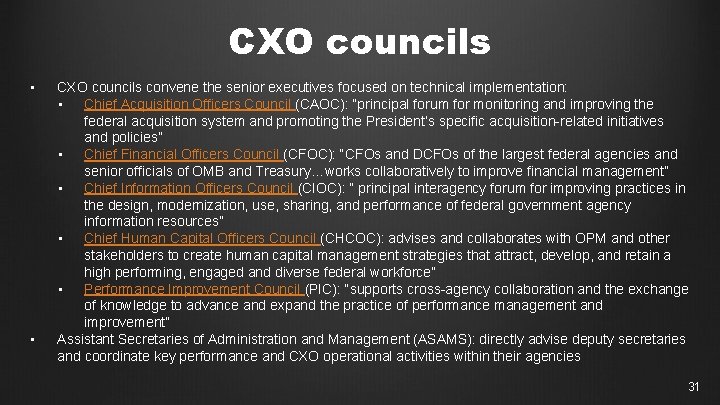
CXO councils • • CXO councils convene the senior executives focused on technical implementation: • Chief Acquisition Officers Council (CAOC): “principal forum for monitoring and improving the federal acquisition system and promoting the President’s specific acquisition-related initiatives and policies” • Chief Financial Officers Council (CFOC): “CFOs and DCFOs of the largest federal agencies and senior officials of OMB and Treasury…works collaboratively to improve financial management” • Chief Information Officers Council (CIOC): “ principal interagency forum for improving practices in the design, modernization, use, sharing, and performance of federal government agency information resources” • Chief Human Capital Officers Council (CHCOC): advises and collaborates with OPM and other stakeholders to create human capital management strategies that attract, develop, and retain a high performing, engaged and diverse federal workforce” • Performance Improvement Council (PIC): “supports cross-agency collaboration and the exchange of knowledge to advance and expand the practice of performance management and improvement” Assistant Secretaries of Administration and Management (ASAMS): directly advise deputy secretaries and coordinate key performance and CXO operational activities within their agencies 31
Appendix 2 32
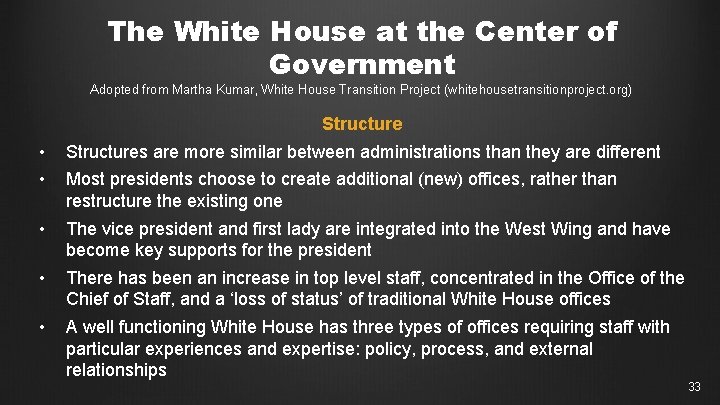
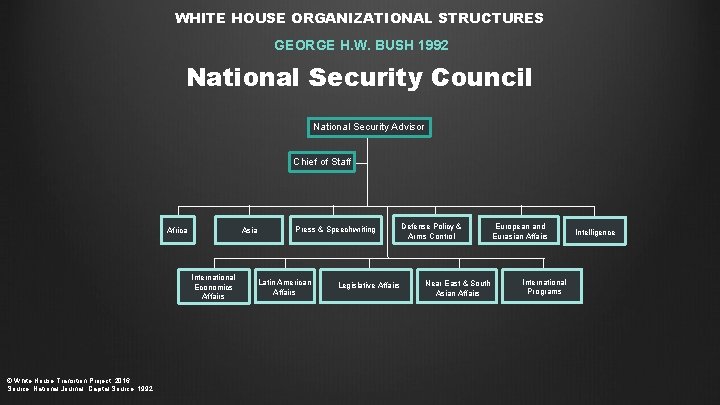
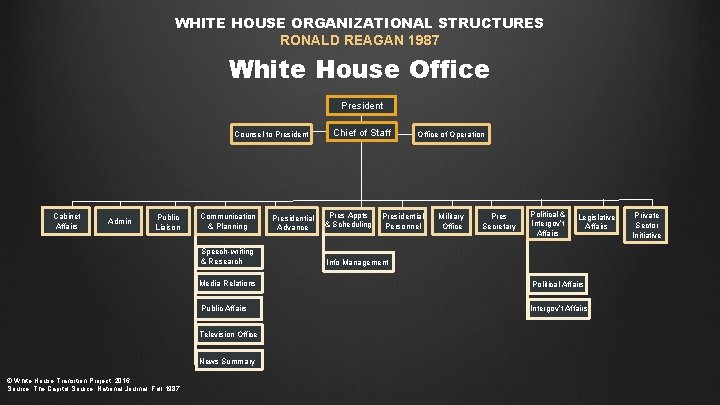
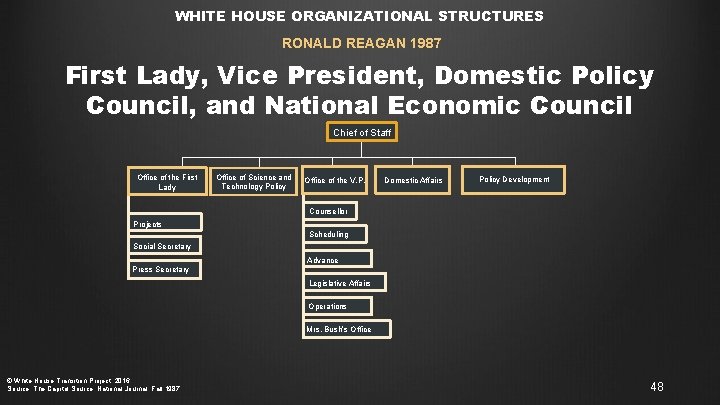
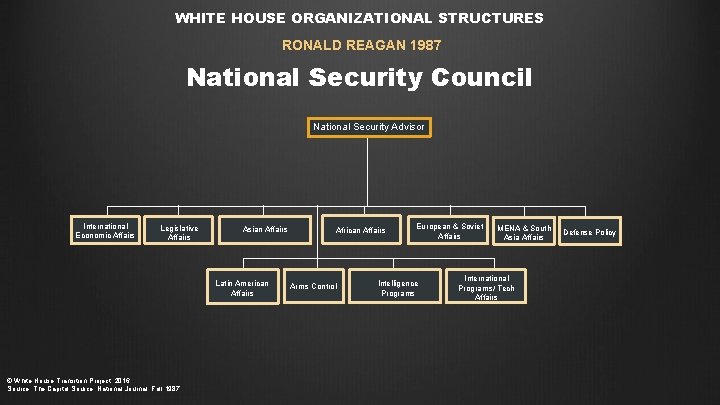
The White House at the Center of Government Adopted from Martha Kumar, White House Transition Project (whitehousetransitionproject. org) Structure • • Structures are more similar between administrations than they are different • The vice president and first lady are integrated into the West Wing and have become key supports for the president • There has been an increase in top level staff, concentrated in the Office of the Chief of Staff, and a ‘loss of status’ of traditional White House offices • A well functioning White House has three types of offices requiring staff with particular experiences and expertise: policy, process, and external relationships Most presidents choose to create additional (new) offices, rather than restructure the existing one 33
The White House at the Center of Government Adopted from Martha Kumar, White House Transition Project (whitehousetransitionproject. org) Staff • How and where to place campaign aides represents a challenge to every president setting up White House staffing system • The most effective White House staffing systems blend knowledge of the president, the campaign, day-to-day operation of the White House, substantive policy expertise, and the broader Washington community • Organization of the White House has varied according to the party holding office. A republican White House has had a more hierarchical staffing structure with clear lines of reporting, while a democratic White House has had a more horizontal staffing structure. The president • White House staffs most often mirror the strengths of a president (as opposed to providing a complementary skill set) 34
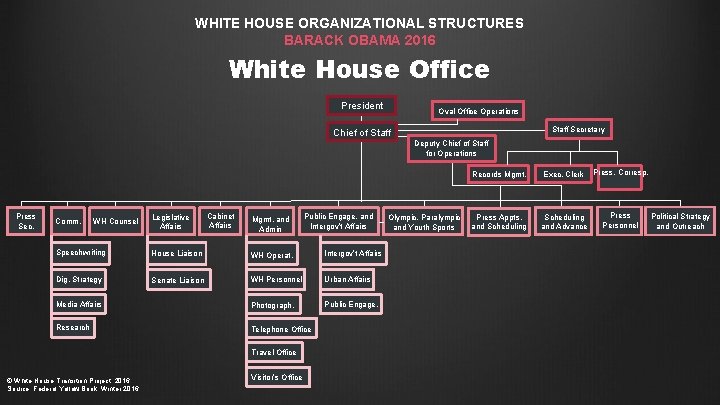
WHITE HOUSE ORGANIZATIONAL STRUCTURES BARACK OBAMA 2016 White House Office President Oval Office Operations Staff Secretary Chief of Staff Deputy Chief of Staff for Operations Press Sec. Comm. WH Counsel Legislative Affairs Cabinet Affairs Mgmt. and Admin Public Engage. and Intergov’t Affairs Speechwriting House Liaison WH Operat. Intergov’t Affairs Dig. Strategy Senate Liaison WH Personnel Urban Affairs Media Affairs Photograph. Public Engage. Research Telephone Office Travel Office © White House Transition Project, 2016. Source: Federal Yellow Book, Winter 2016 Visitor’s Office Olympic, Paralympic and Youth Sports Records Mgmt. Exec. Clerk Press. Corresp. Press Appts. and Scheduling and Advance Press Personnel Political Strategy and Outreach
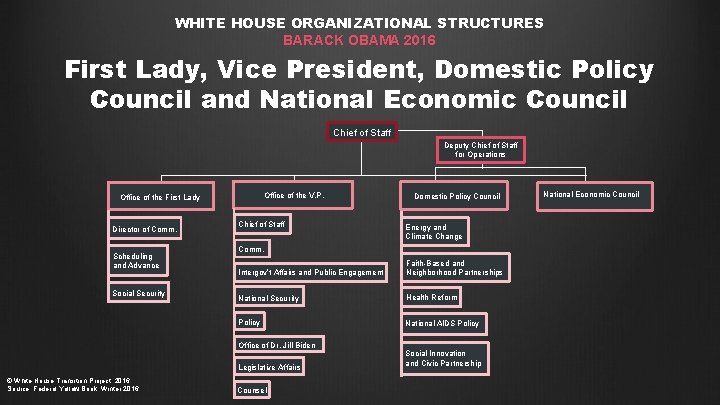
WHITE HOUSE ORGANIZATIONAL STRUCTURES BARACK OBAMA 2016 First Lady, Vice President, Domestic Policy Council and National Economic Council Chief of Staff Deputy Chief of Staff for Operations Office of the V. P. Office of the First Lady Director of Comm. Scheduling and Advance Social Security Chief of Staff Energy and Climate Change Comm. Intergov’t Affairs and Public Engagement Faith-Based and Neighborhood Partnerships National Security Health Reform Policy National AIDS Policy Office of Dr. Jill Biden Legislative Affairs © White House Transition Project, 2016. Source: Federal Yellow Book, Winter 2016 Domestic Policy Council Counsel Social Innovation and Civic Partnership National Economic Council
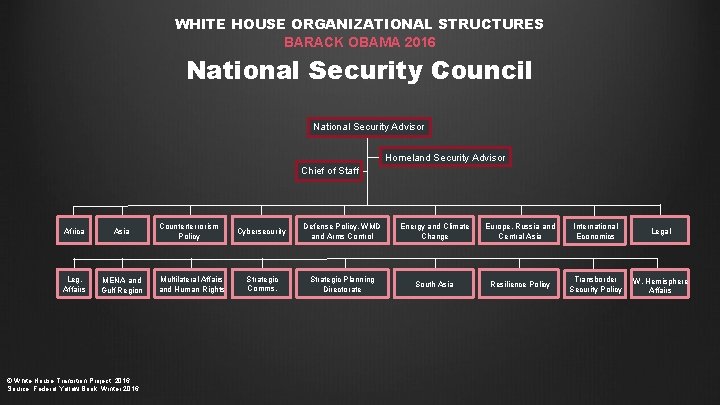
WHITE HOUSE ORGANIZATIONAL STRUCTURES BARACK OBAMA 2016 National Security Council National Security Advisor Homeland Security Advisor Chief of Staff Africa Asia Leg. Affairs MENA and Gulf Region © White House Transition Project, 2016. Source: Federal Yellow Book, Winter 2016 Counterterrorism Policy Multilateral Affairs and Human Rights Cybersecurity Defense Policy, WMD and Arms Control Energy and Climate Change Europe, Russia and Central Asia International Economics Legal Strategic Comms. Strategic Planning Directorate South Asia Resilience Policy Transborder Security Policy W. Hemisphere Affairs
WHITE HOUSE ORGANIZATIONAL STRUCTURES GEORGE W. BUSH 2005 White House Office President Senior Advisor Strategic Initiatives WH Counsel Press Secretary Political Affairs Legislative Affairs Oval Office Operations Staff Secretary Intergov’t Affairs Public Liaison Cabinet Affairs Chief of Staff Counselor Office Records Mgmt. Scheduling Advance Faith-Based Initiatives Exec. Clerk Mgm’t. & Admin. Pres. Personnel Comm. © White House Transition Project, 2016. Source: Bureau of National Affairs, White House Telephone Directory, 2005 Speechwriting Military Office Media Affairs WH Mgm’t. Press. Corresp. Policy & Strategic Planning
WHITE HOUSE ORGANIZATIONAL STRUCTURES GEORGE W. BUSH 2005 First Lady, Vice President, Domestic Policy Council and National Economic Council Chief of Staff Homeland Security Council Director of Comm. Chief of Staff Secretary Legislative Affairs Office of the First Lady Press Secretary General Counsel Domestic Policy © White House Transition Project, 2016. Source: Bureau of National Affairs, White House Telephone Directory, 2005 Domestic Policy Council National Economic Council Scheduling & Advance Counselor’s Office Homeland Security Office of the V. P. Operations Speechwriting Advance & Scheduling Labor, Transportation, U. S. Post Education Health Welfare, Housing, District of Columbia Justice
WHITE HOUSE ORGANIZATIONAL STRUCTURES GEORGE W. BUSH 2005 National Security Council National Security Advisor Chief of Staff Africa Administration Global Democracy Combating Terrorism Iraq & Afghanistan Comm. , Press & Speechwriting Intelligence Programs & Reform © White House Transition Project, 2016. Source: Bureau of National Affairs, White House Telephone Directory, 2005 Counter-proliferation Strategy International Economics Legal Affairs Defense Policy & Strategy Legislative Affairs East Asia Western Hemispheres European Russia Records & Asset Management
WHITE HOUSE ORGANIZATIONAL STRUCTURES BILL CLINTON 1998 White House Office President Chief of Staff Oval Office Operations Office of the Special Envoy Communica tions Cabinet Affairs Speech-writing & Research General Counsel WH Press Office Political Affairs Exec. Office Bldg. Press Office. Legislative Affairs Staff Secretary Records Mgmt. Intergov’t Affairs Pres Personnel Scheduling & Advance Exec. Clerk Special Projects Press. Corresp. Mgmt & Admin Public Liaison WH Military WH Operations © White House Transition Project, 2016. Source: Bureau of National Affairs, White House Phone Book, July 27 1998
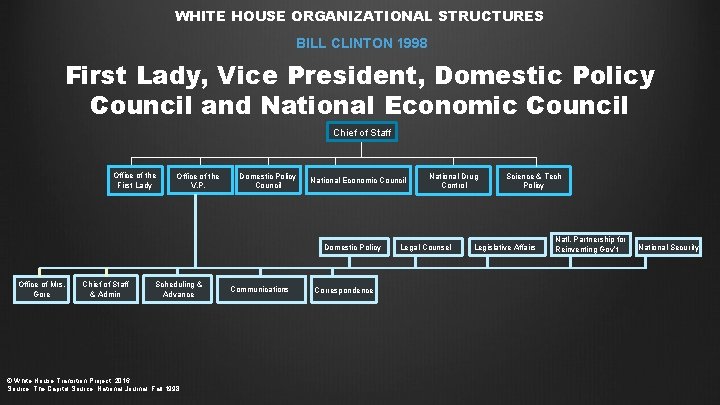
WHITE HOUSE ORGANIZATIONAL STRUCTURES BILL CLINTON 1998 First Lady, Vice President, Domestic Policy Council and National Economic Council Chief of Staff Office of the First Lady Office of the V. P. Domestic Policy Council National Economic Council Domestic Policy Office of Mrs. Gore Chief of Staff & Admin Scheduling & Advance © White House Transition Project, 2016. Source: The Capital Source, National Journal, Fall 1998 Communications Correspondence National Drug Control Legal Counsel Science & Tech Policy Legislative Affairs Natl. Partnership for Reinventing Gov’t National Security
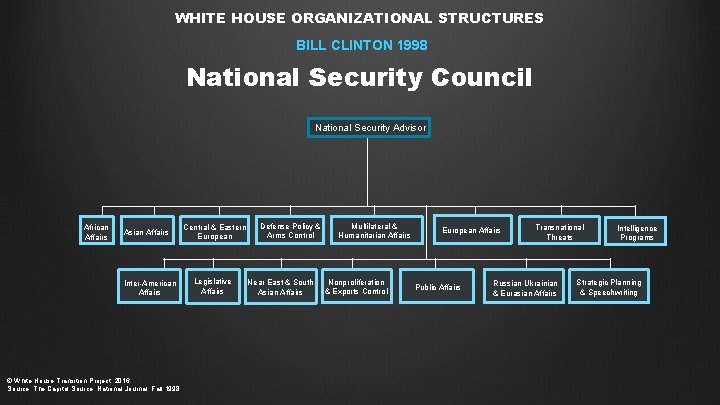
WHITE HOUSE ORGANIZATIONAL STRUCTURES BILL CLINTON 1998 National Security Council National Security Advisor African Affairs Asian Affairs Inter-American Affairs © White House Transition Project, 2016. Source: The Capital Source, National Journal, Fall 1998 Central & Eastern European Legislative Affairs Defense Policy & Arms Control Near East & South Asian Affairs Multilateral & Humanitarian Affairs Nonproliferation & Exports Control European Affairs Public Affairs Transnational Threats Russian Ukrainian & Eurasian Affairs Intelligence Programs Strategic Planning & Speechwriting
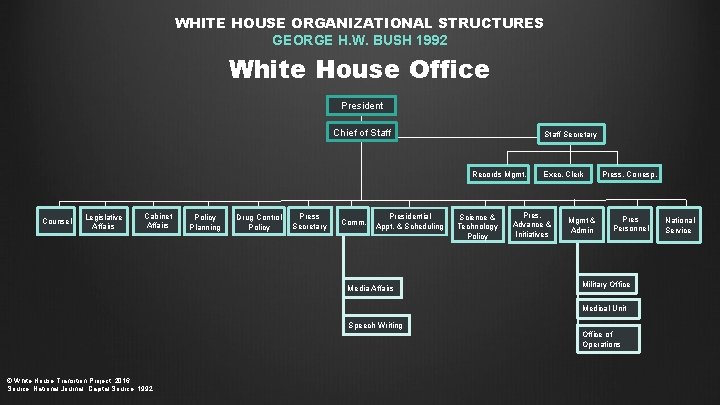
WHITE HOUSE ORGANIZATIONAL STRUCTURES GEORGE H. W. BUSH 1992 White House Office President Chief of Staff Secretary Records Mgmt. Counsel Legislative Affairs Cabinet Affairs Policy Planning Drug Control Policy Press Secretary Comm. Presidential Appt. & Scheduling Media Affairs Science & Technology Policy Exec. Clerk Pres. Advance & Initiatives Mgmt & Admin Press. Corresp. Pres Personnel Military Office Medical Unit Speech Writing Office of Operations © White House Transition Project, 2016. Source: National Journal, Capital Source, 1992 National Service
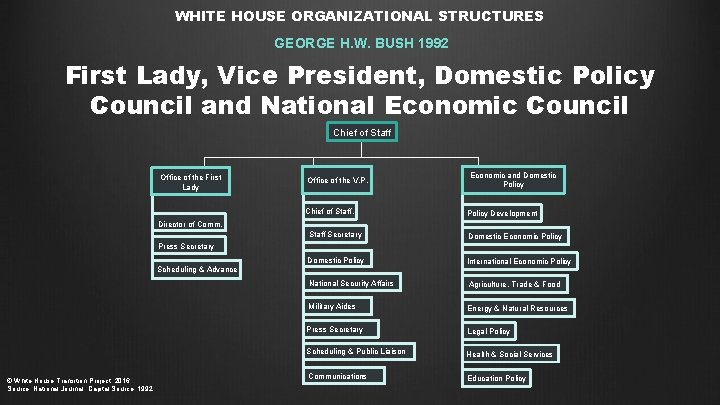
WHITE HOUSE ORGANIZATIONAL STRUCTURES GEORGE H. W. BUSH 1992 First Lady, Vice President, Domestic Policy Council and National Economic Council Chief of Staff Office of the First Lady Office of the V. P. Chief of Staff. Economic and Domestic Policy Development Director of Comm. Staff Secretary Domestic Economic Policy Domestic Policy International Economic Policy National Security Affairs Agriculture, Trade & Food Military Aides Energy & Natural Resources Press Secretary Legal Policy Scheduling & Public Liaison Health & Social Services Communications Education Policy Press Secretary Scheduling & Advance © White House Transition Project, 2016. Source: National Journal, Capital Source, 1992
WHITE HOUSE ORGANIZATIONAL STRUCTURES GEORGE H. W. BUSH 1992 National Security Council National Security Advisor Chief of Staff Asia Africa International Economics Affairs © White House Transition Project, 2016. Source: National Journal, Capital Source, 1992 Press & Speechwriting Latin American Affairs Legislative Affairs Defense Policy & Arms Control Near East & South Asian Affairs European and Eurasian Affairs International Programs Intelligence
WHITE HOUSE ORGANIZATIONAL STRUCTURES RONALD REAGAN 1987 White House Office President Counsel to President Cabinet Affairs Admin Public Liaison Communication & Planning Speech-writing & Research Pres Appts & Scheduling Office of Operation Presidential Personnel Military Office Pres Secretary Political & Intergov’t Affairs Legislative Affairs Info Management Media Relations Political Affairs Public Affairs Intergov’t Affairs Television Office News Summary © White House Transition Project, 2016. Source: The Capital Source, National Journal, Fall 1987 Presidential Advance Chief of Staff Private Sector Initiative
WHITE HOUSE ORGANIZATIONAL STRUCTURES RONALD REAGAN 1987 First Lady, Vice President, Domestic Policy Council, and National Economic Council Chief of Staff Office of the First Lady Office of Science and Technology Policy Office of the V. P. Domestic Affairs Policy Development Counsellor Projects Scheduling Social Secretary Advance Press Secretary Legislative Affairs Operations Mrs. Bush’s Office © White House Transition Project, 2016. Source: The Capital Source, National Journal, Fall 1987 48
WHITE HOUSE ORGANIZATIONAL STRUCTURES RONALD REAGAN 1987 National Security Council National Security Advisor International Economic Affairs Legislative Affairs Asian Affairs Latin American Affairs © White House Transition Project, 2016. Source: The Capital Source, National Journal, Fall 1987 African Affairs Arms Control European & Soviet Affairs Intelligence Programs MENA & South Asia Affairs International Programs/ Tech Affairs Defense Policy
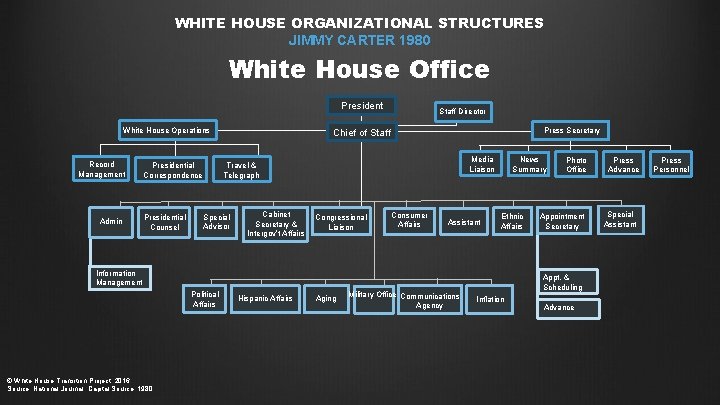
WHITE HOUSE ORGANIZATIONAL STRUCTURES JIMMY CARTER 1980 White House Office President White House Operations Record Management Admin Press Secretary Chief of Staff Special Advisor Cabinet Secretary & Intergov’t Affairs News Summary Media Liaison Travel & Telegraph Presidential Correspondence Presidential Counsel Staff Director Congressional Liaison Consumer Affairs Assistant Ethnic Affairs Information Management Political Affairs © White House Transition Project, 2016. Source: National Journal, Capital Source, 1980 Hispanic Affairs Aging Military Office Communications Agency Photo Office Appointment Secretary Appt. & Scheduling Inflation Advance Press Advance Special Assistant Press Personnel
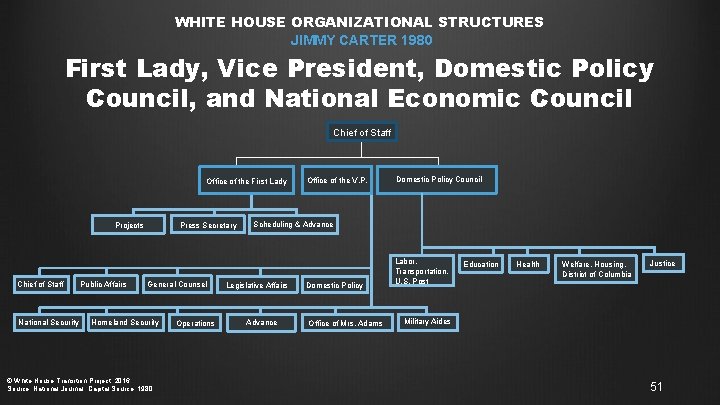
WHITE HOUSE ORGANIZATIONAL STRUCTURES JIMMY CARTER 1980 First Lady, Vice President, Domestic Policy Council, and National Economic Council Chief of Staff Office of the First Lady Projects Chief of Staff National Security Public Affairs Press Secretary General Counsel Homeland Security © White House Transition Project, 2016. Source: National Journal, Capital Source, 1980 Operations Office of the V. P. Domestic Policy Council Scheduling & Advance Legislative Affairs Advance Domestic Policy Office of Mrs. Adams Labor, Transportation, U. S. Post Education Health Welfare, Housing, District of Columbia Justice Military Aides 51
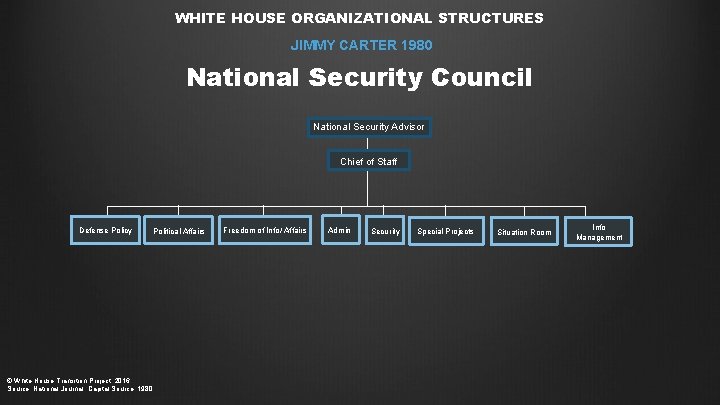
WHITE HOUSE ORGANIZATIONAL STRUCTURES JIMMY CARTER 1980 National Security Council National Security Advisor Chief of Staff Defense Policy Political Affairs © White House Transition Project, 2016. Source: National Journal, Capital Source, 1980 Freedom of Info/ Affairs Admin Security Special Projects Situation Room Info Management
Appendix 3 53
The role of the Office of Management and Budget (OMB) • • As one of the major parts of the Center of Government, OMB has a number of key roles: • Develops and executes the budget • Oversees key management areas: performance, procurement, financial management and information technology • Coordinates and reviews all significant agency regulations, and coordinates agencies’ information collection • Reviews and clears agency testimonies and legislative proposals • Issues executive orders and presidential memoranda on behalf of the president Additionally, OMB houses the intellectual property program coordinator and the United States Digital Service 54
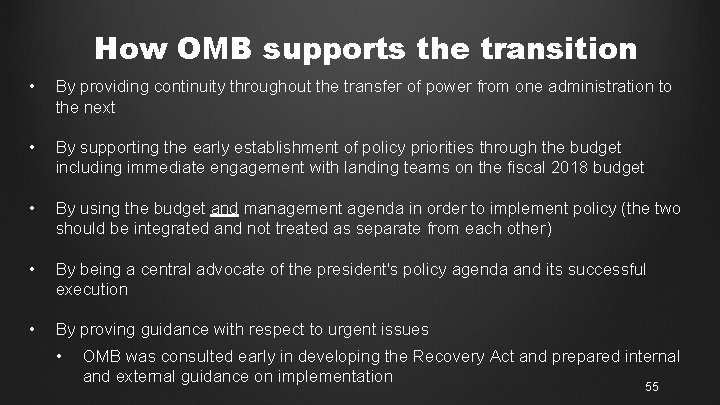
How OMB supports the transition • By providing continuity throughout the transfer of power from one administration to the next • By supporting the early establishment of policy priorities through the budget including immediate engagement with landing teams on the fiscal 2018 budget • By using the budget and management agenda in order to implement policy (the two should be integrated and not treated as separate from each other) • By being a central advocate of the president's policy agenda and its successful execution • By proving guidance with respect to urgent issues • OMB was consulted early in developing the Recovery Act and prepared internal and external guidance on implementation 55
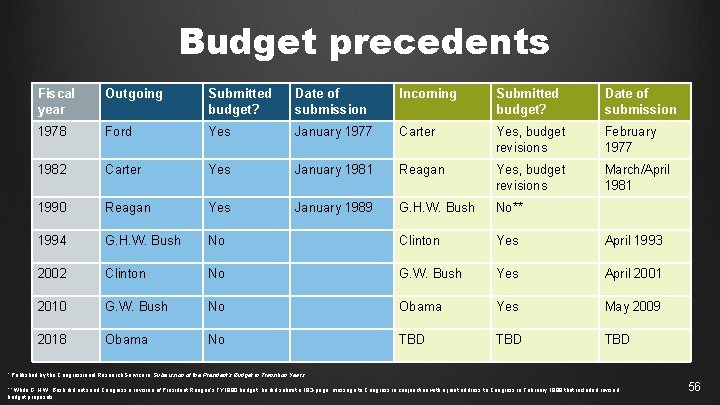
Budget precedents Fiscal year Outgoing Submitted budget? Date of submission Incoming Submitted budget? Date of submission 1978 Ford Yes January 1977 Carter Yes, budget revisions February 1977 1982 Carter Yes January 1981 Reagan Yes, budget revisions March/April 1981 1990 Reagan Yes January 1989 G. H. W. Bush No** 1994 G. H. W. Bush No Clinton Yes April 1993 2002 Clinton No G. W. Bush Yes April 2001 2010 G. W. Bush No Obama Yes May 2009 2018 Obama No TBD TBD * Published by the Congressional Research Service in Submission of the President’s Budget in Transition Years. ** While G. H. W. Bush did not send Congress a revision of President Reagan’s FY 1990 budget, he did submit a 193 -page message to Congress in conjunction with a joint address to Congress in February 1989 that included revised budget proposals. 56
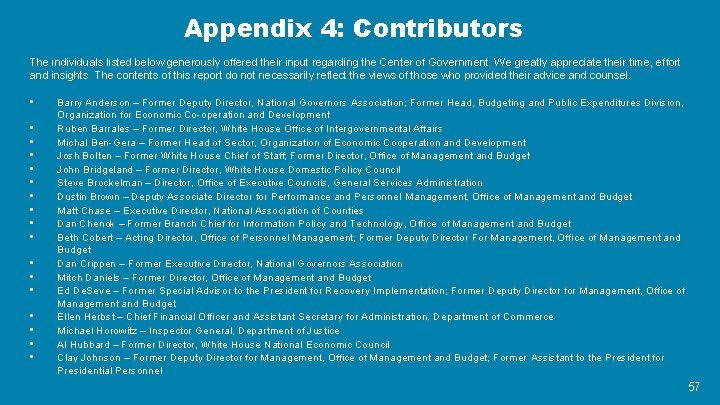
Appendix 4: Contributors The individuals listed below generously offered their input regarding the Center of Government. We greatly appreciate their time, effort and insights. The contents of this report do not necessarily reflect the views of those who provided their advice and counsel. • • • • • Barry Anderson – Former Deputy Director, National Governors Association; Former Head, Budgeting and Public Expenditures Division, Organization for Economic Co-operation and Development Ruben Barrales – Former Director, White House Office of Intergovernmental Affairs Michal Ben-Gera – Former Head of Sector, Organization of Economic Cooperation and Development Josh Bolten – Former White House Chief of Staff; Former Director, Office of Management and Budget John Bridgeland – Former Director, White House Domestic Policy Council Steve Brockelman – Director, Office of Executive Councils, General Services Administration Dustin Brown – Deputy Associate Director for Performance and Personnel Management, Office of Management and Budget Matt Chase – Executive Director, National Association of Counties Dan Chenok – Former Branch Chief for Information Policy and Technology, Office of Management and Budget Beth Cobert – Acting Director, Office of Personnel Management; Former Deputy Director For Management, Office of Management and Budget Dan Crippen – Former Executive Director, National Governors Association Mitch Daniels – Former Director, Office of Management and Budget Ed De. Seve – Former Special Advisor to the President for Recovery Implementation; Former Deputy Director for Management, Office of Management and Budget Ellen Herbst – Chief Financial Officer and Assistant Secretary for Administration, Department of Commerce Michael Horowitz – Inspector General, Department of Justice Al Hubbard – Former Director, White House National Economic Council Clay Johnson – Former Deputy Director for Management, Office of Management and Budget; Former Assistant to the President for Presidential Personnel 57
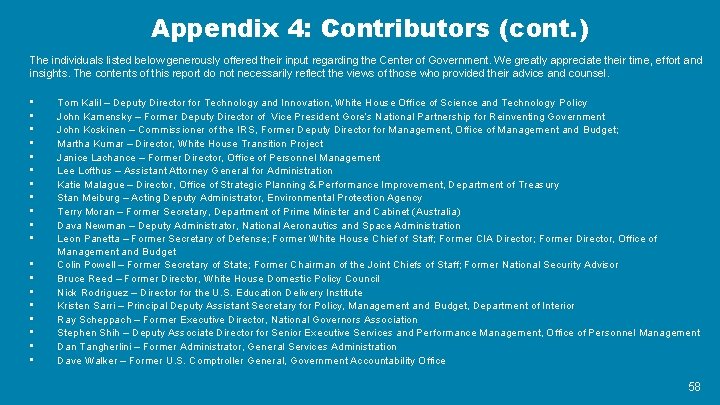
Appendix 4: Contributors (cont. ) The individuals listed below generously offered their input regarding the Center of Government. We greatly appreciate their time, effort and insights. The contents of this report do not necessarily reflect the views of those who provided their advice and counsel. • • • • • Tom Kalil – Deputy Director for Technology and Innovation, White House Office of Science and Technology Policy John Kamensky – Former Deputy Director of Vice President Gore’s National Partnership for Reinventing Government John Koskinen – Commissioner of the IRS, Former Deputy Director for Management, Office of Management and Budget; Martha Kumar – Director, White House Transition Project Janice Lachance – Former Director, Office of Personnel Management Lee Lofthus – Assistant Attorney General for Administration Katie Malague – Director, Office of Strategic Planning & Performance Improvement, Department of Treasury Stan Meiburg – Acting Deputy Administrator, Environmental Protection Agency Terry Moran – Former Secretary, Department of Prime Minister and Cabinet (Australia) Dava Newman – Deputy Administrator, National Aeronautics and Space Administration Leon Panetta – Former Secretary of Defense; Former White House Chief of Staff; Former CIA Director; Former Director, Office of Management and Budget Colin Powell – Former Secretary of State; Former Chairman of the Joint Chiefs of Staff; Former National Security Advisor Bruce Reed – Former Director, White House Domestic Policy Council Nick Rodriguez – Director for the U. S. Education Delivery Institute Kristen Sarri – Principal Deputy Assistant Secretary for Policy, Management and Budget, Department of Interior Ray Scheppach – Former Executive Director, National Governors Association Stephen Shih – Deputy Associate Director for Senior Executive Services and Performance Management, Office of Personnel Management Dan Tangherlini – Former Administrator, General Services Administration Dave Walker – Former U. S. Comptroller General, Government Accountability Office 58
Appendix 5: Project team Associate Designer Partnership for Public Service • Amanda Patarino, Research Associate • Chantelle Renn, Manager • • • • Joseph Carr, Fellow Margot Conrad, Education and Outreach Director David Eagles, Center for Presidential Transition Director Brad Golson, Senior Advisor – Detailee Peter Kamocsai, Research Associate Eric Keller, Senior Research Manager Courtney Liss, Communications Associate Aakash Pattabi, Fellow Audrey Pfund, Associate Design Manager Camilo Vergara, Associate Designer Kristine Simmons, Vice President of Government Affairs Max Stier, President and CEO Tina Sung, Vice President of Government Transformation and Agency Partnerships Pricewaterhouse. Coopers • Dave Walker, Senior Strategic Advisor • Scott Flood, Manager • Alec Kirkman, Associate 59
This report and other transition materials can be accessed at presidentialtransition. org