
The Center for Astrophysical Thermonuclear Flashes Simulating Everything
- Slides: 25
The Center for Astrophysical Thermonuclear Flashes Simulating Everything: Galaxy Cluster Mergers in a Supercomputer John Zu. Hone Department of Astronomy and Astrophysics University of Chicago An Advanced Simulation and Computing (ASC) Academic Strategic Alliances Program (ASAP) Center at The University of Chicago
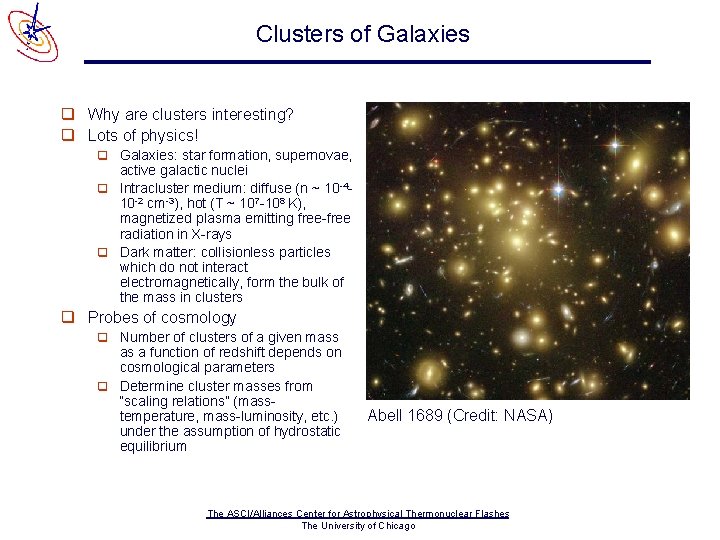
Clusters of Galaxies q Why are clusters interesting? q Lots of physics! q Galaxies: star formation, supernovae, active galactic nuclei q Intracluster medium: diffuse (n ~ 10 -410 -2 cm-3), hot (T ~ 107 -108 K), magnetized plasma emitting free-free radiation in X-rays q Dark matter: collisionless particles which do not interact electromagnetically, form the bulk of the mass in clusters q Probes of cosmology q Number of clusters of a given mass as a function of redshift depends on cosmological parameters q Determine cluster masses from “scaling relations” (masstemperature, mass-luminosity, etc. ) under the assumption of hydrostatic equilibrium Abell 1689 (Credit: NASA) The ASCI/Alliances Center for Astrophysical Thermonuclear Flashes The University of Chicago
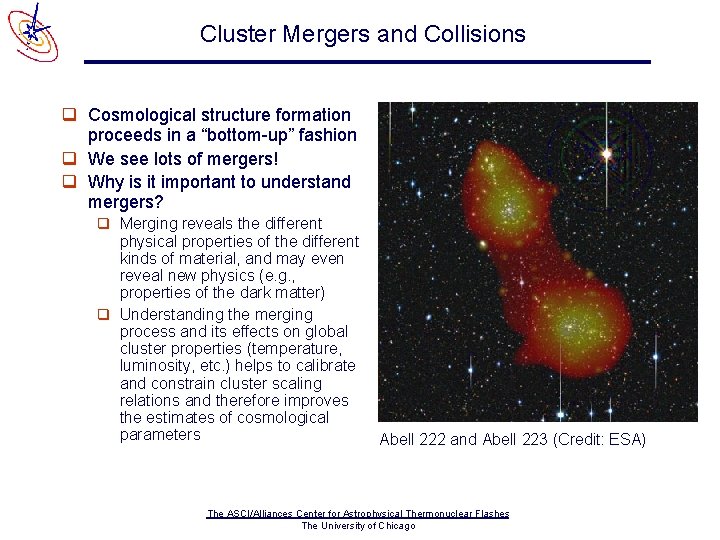
Cluster Mergers and Collisions q Cosmological structure formation proceeds in a “bottom-up” fashion q We see lots of mergers! q Why is it important to understand mergers? q Merging reveals the different physical properties of the different kinds of material, and may even reveal new physics (e. g. , properties of the dark matter) q Understanding the merging process and its effects on global cluster properties (temperature, luminosity, etc. ) helps to calibrate and constrain cluster scaling relations and therefore improves the estimates of cosmological parameters Abell 222 and Abell 223 (Credit: ESA) The ASCI/Alliances Center for Astrophysical Thermonuclear Flashes The University of Chicago
Cluster Mergers and Collisions 1 E 0657 -56, “The Bullet Cluster” (Credit: Chandra X-Ray Center) The ASCI/Alliances Center for Astrophysical Thermonuclear Flashes The University of Chicago
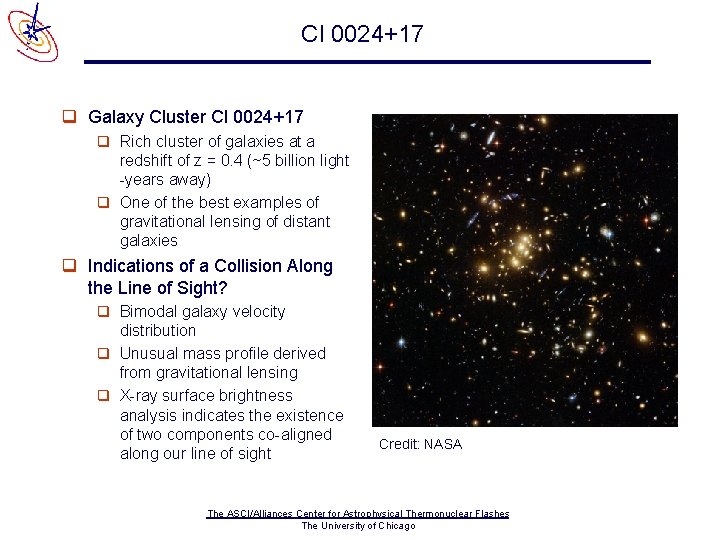
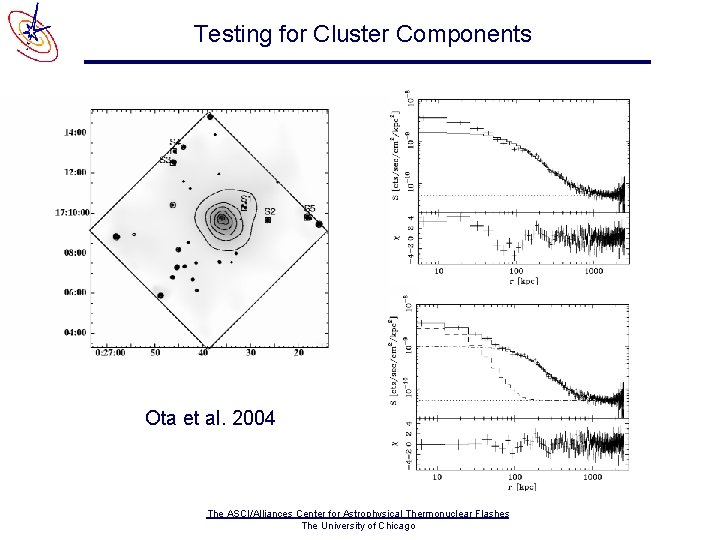
Cl 0024+17 q Galaxy Cluster Cl 0024+17 q Rich cluster of galaxies at a redshift of z = 0. 4 (~5 billion light -years away) q One of the best examples of gravitational lensing of distant galaxies q Indications of a Collision Along the Line of Sight? q Bimodal galaxy velocity distribution q Unusual mass profile derived from gravitational lensing q X-ray surface brightness analysis indicates the existence of two components co-aligned along our line of sight Credit: NASA The ASCI/Alliances Center for Astrophysical Thermonuclear Flashes The University of Chicago
Testing for Cluster Components Ota et al. 2004 The ASCI/Alliances Center for Astrophysical Thermonuclear Flashes The University of Chicago
Scientific questions concerning Cl 0024+17 q Can we distinguish the existence of two cluster components aligned along our line of sight from just one? q Assuming hydrostatic equilibrium, how accurate a mass estimate can we get assuming one cluster? Two clusters? q What does this system tell us about the possibilities of discerning cluster components projected along the line of sight for other systems? The ASCI/Alliances Center for Astrophysical Thermonuclear Flashes The University of Chicago
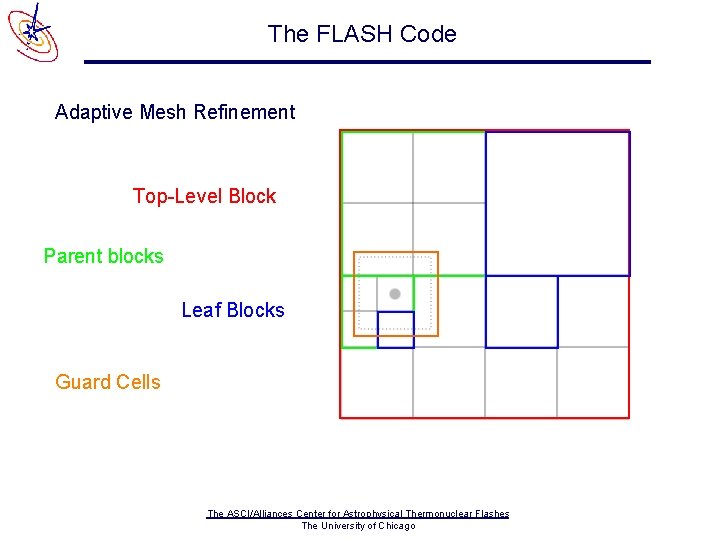
The FLASH Code q FLASH: A multiphysics, modular, parallel astrophysical simulation code q Essential components: q Block-Structured Adaptive Mesh Refinement (PARAMESH library) q Octree(s) of blocks make up the mesh q Refine the mesh on built-in or user-specified criteria q Can go to higher resolution using less memory and less time q Eulerian Hydrodynamics q Piecewise-Parabolic Method (PPM, Woodward & Colella 1984) q Higher-order Godunov method q Well-suited to capture sharp features like shocks and contact discontinuities q N-body q Particle-based systems, e. g. dark matter, stars, cosmic rays q Map particles to mesh (particle mass to grid density) q Map mesh to particles (grid forces to particle accelerations) The ASCI/Alliances Center for Astrophysical Thermonuclear Flashes The University of Chicago
The FLASH Code Adaptive Mesh Refinement Top-Level Block Parent blocks Leaf Blocks Guard Cells The ASCI/Alliances Center for Astrophysical Thermonuclear Flashes The University of Chicago
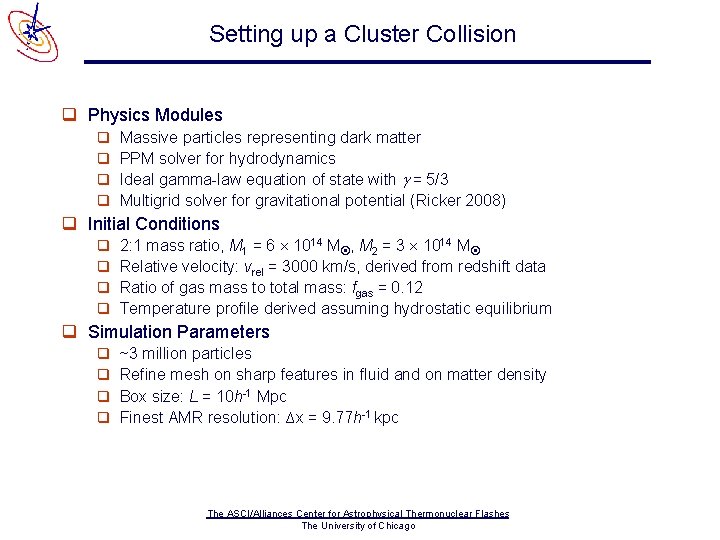
Setting up a Cluster Collision q Physics Modules q q Massive particles representing dark matter PPM solver for hydrodynamics Ideal gamma-law equation of state with = 5/3 Multigrid solver for gravitational potential (Ricker 2008) q Initial Conditions q q 2: 1 mass ratio, M 1 = 6 1014 M , M 2 = 3 1014 M Relative velocity: vrel = 3000 km/s, derived from redshift data Ratio of gas mass to total mass: fgas = 0. 12 Temperature profile derived assuming hydrostatic equilibrium q Simulation Parameters q q ~3 million particles Refine mesh on sharp features in fluid and on matter density Box size: L = 10 h-1 Mpc Finest AMR resolution: ∆x = 9. 77 h-1 kpc The ASCI/Alliances Center for Astrophysical Thermonuclear Flashes The University of Chicago
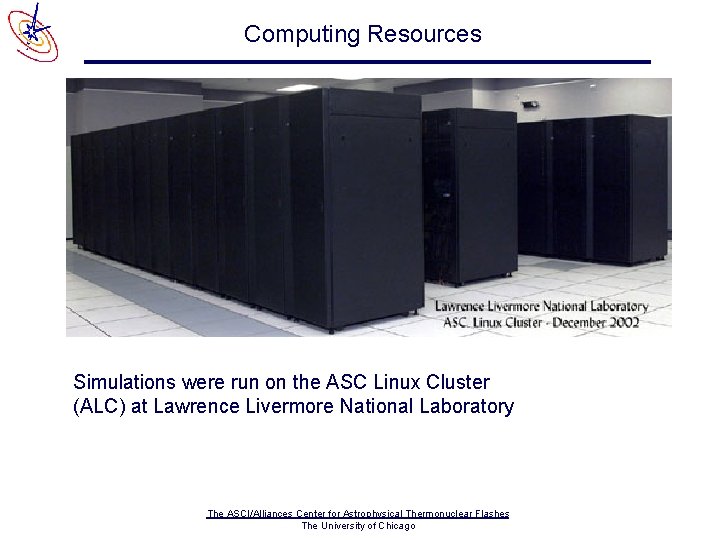
Computing Resources Simulations were run on the ASC Linux Cluster (ALC) at Lawrence Livermore National Laboratory The ASCI/Alliances Center for Astrophysical Thermonuclear Flashes The University of Chicago
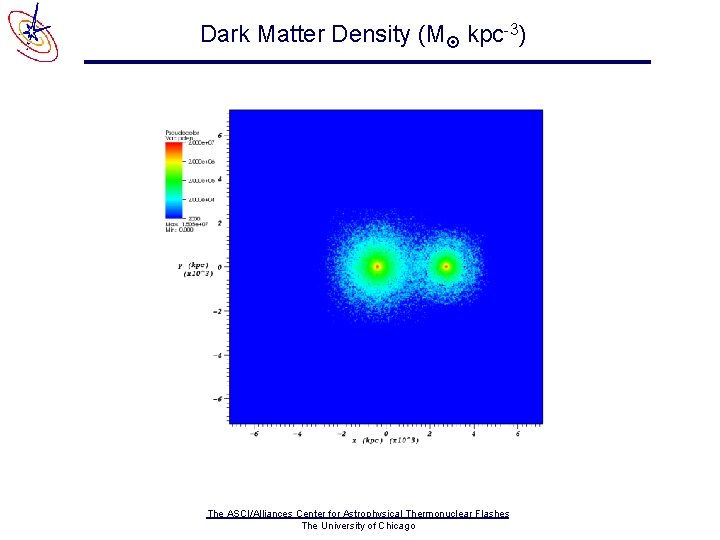
Dark Matter Density (M kpc-3) The ASCI/Alliances Center for Astrophysical Thermonuclear Flashes The University of Chicago
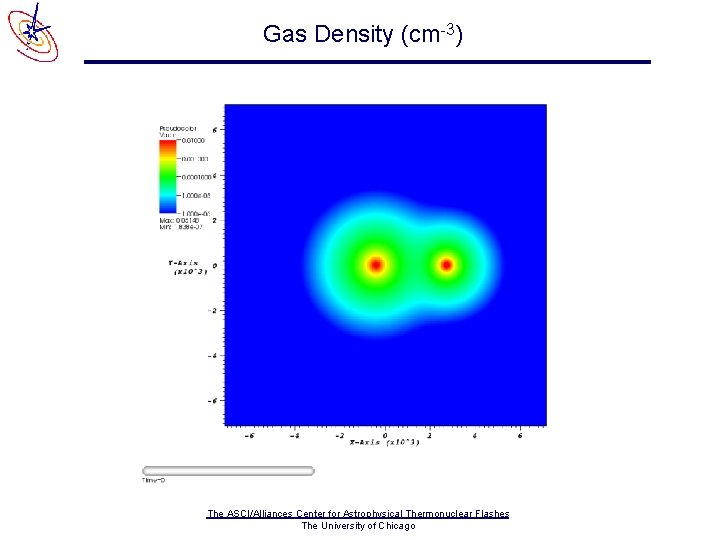
Gas Density (cm-3) The ASCI/Alliances Center for Astrophysical Thermonuclear Flashes The University of Chicago
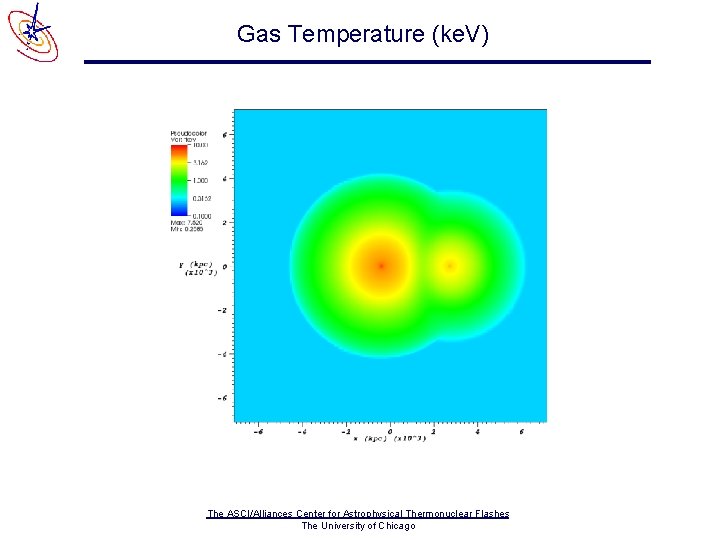
Gas Temperature (ke. V) The ASCI/Alliances Center for Astrophysical Thermonuclear Flashes The University of Chicago
Connecting Simulations to Observations q However, in real clusters we don’t get to know physical quantities directly as in simulations: we get all our information from photons q Such quantities (density, temperature, metallicity) must be derived from fitting spatial and energy distributions of photons to physically motivated models q The questions we will be able to answer from observations depend heavily on what we’re capable of doing with our instrument: q Resolution of the detector(s) (both in position and energy space) q Exposure time (how long can we observe? ) q Ability to account for and model extraneous influences (point source contamination, backgrounds, foregrounds, etc. ) q Creating simulated observations of our simulated systems help us to determine what scientific questions will be able to be clearly posed answered in real systems The ASCI/Alliances Center for Astrophysical Thermonuclear Flashes The University of Chicago
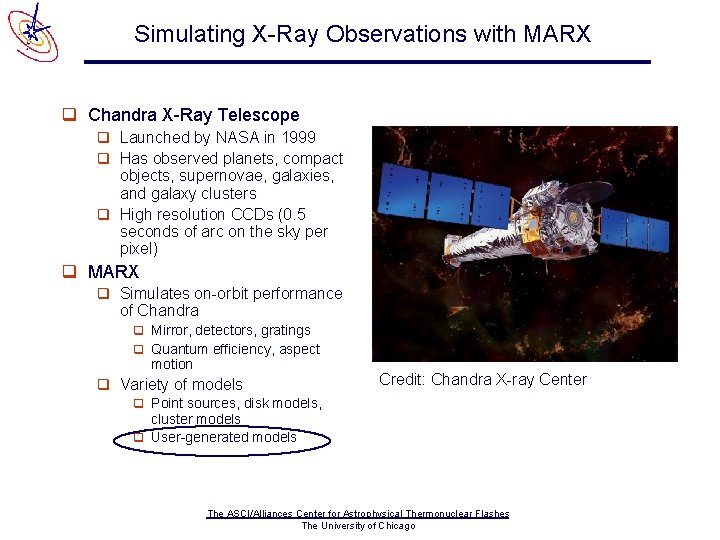
Simulating X-Ray Observations with MARX q Chandra X-Ray Telescope q Launched by NASA in 1999 q Has observed planets, compact objects, supernovae, galaxies, and galaxy clusters q High resolution CCDs (0. 5 seconds of arc on the sky per pixel) q MARX q Simulates on-orbit performance of Chandra q Mirror, detectors, gratings q Quantum efficiency, aspect motion q Variety of models Credit: Chandra X-ray Center q Point sources, disk models, cluster models q User-generated models The ASCI/Alliances Center for Astrophysical Thermonuclear Flashes The University of Chicago
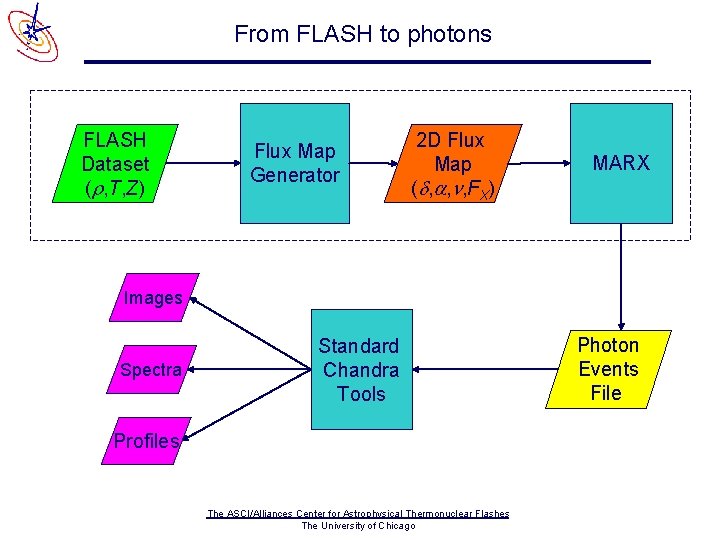
From FLASH to photons FLASH Dataset ( , T, Z) Flux Map Generator 2 D Flux Map ( , , , FX) MARX Images Spectra Standard Chandra Tools Profiles The ASCI/Alliances Center for Astrophysical Thermonuclear Flashes The University of Chicago Photon Events File
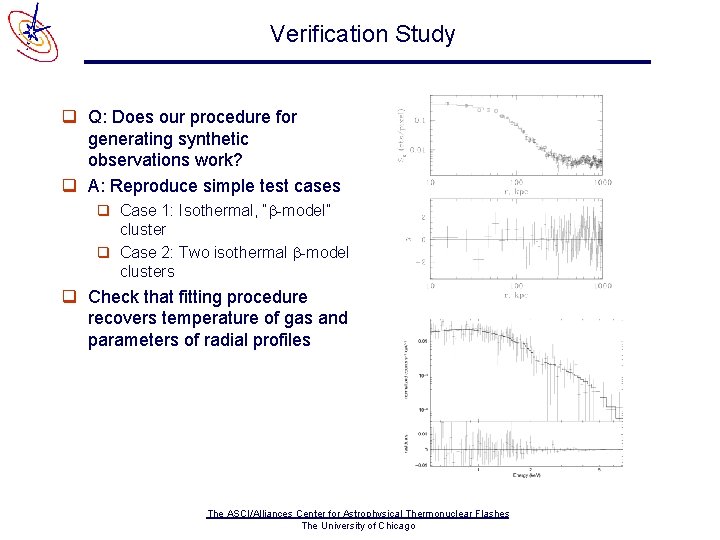
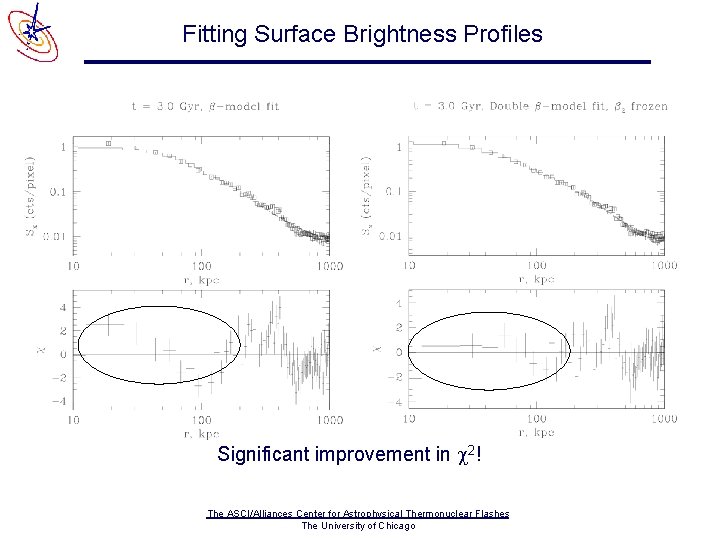
Verification Study q Q: Does our procedure for generating synthetic observations work? q A: Reproduce simple test cases q Case 1: Isothermal, “ -model” cluster q Case 2: Two isothermal -model clusters q Check that fitting procedure recovers temperature of gas and parameters of radial profiles The ASCI/Alliances Center for Astrophysical Thermonuclear Flashes The University of Chicago
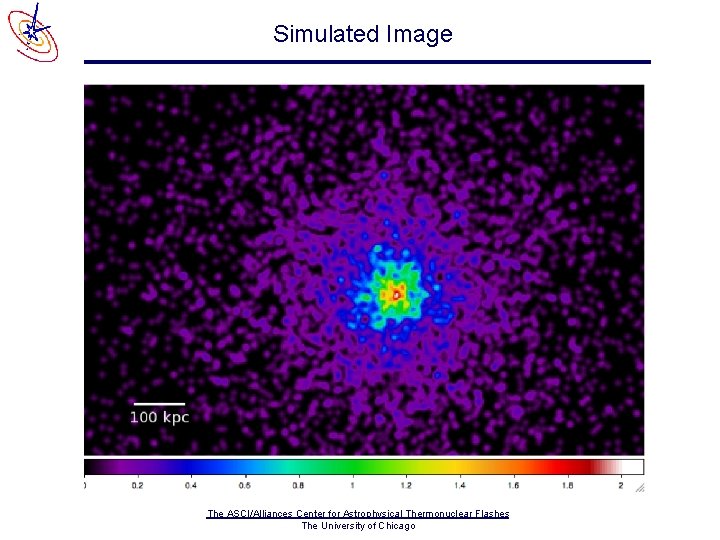
Simulated Image The ASCI/Alliances Center for Astrophysical Thermonuclear Flashes The University of Chicago
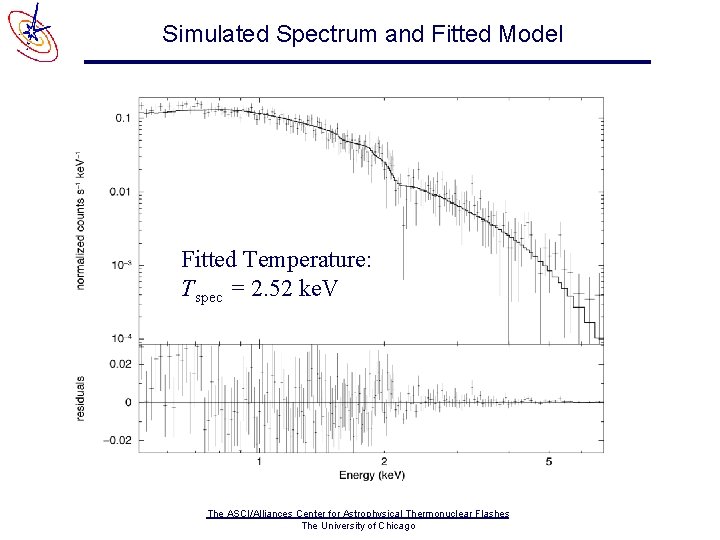
Simulated Spectrum and Fitted Model Fitted Temperature: Tspec = 2. 52 ke. V The ASCI/Alliances Center for Astrophysical Thermonuclear Flashes The University of Chicago
Fitting Surface Brightness Profiles Significant improvement in 2! The ASCI/Alliances Center for Astrophysical Thermonuclear Flashes The University of Chicago
Mass Estimates q From the surface brightness profile and temperature information we can derive a mass estimate assuming hydrostatic equilibrium: q Estimated masses t ~ 1 -2 Gyr after the collision come within 10% of the true projected mass! The ASCI/Alliances Center for Astrophysical Thermonuclear Flashes The University of Chicago
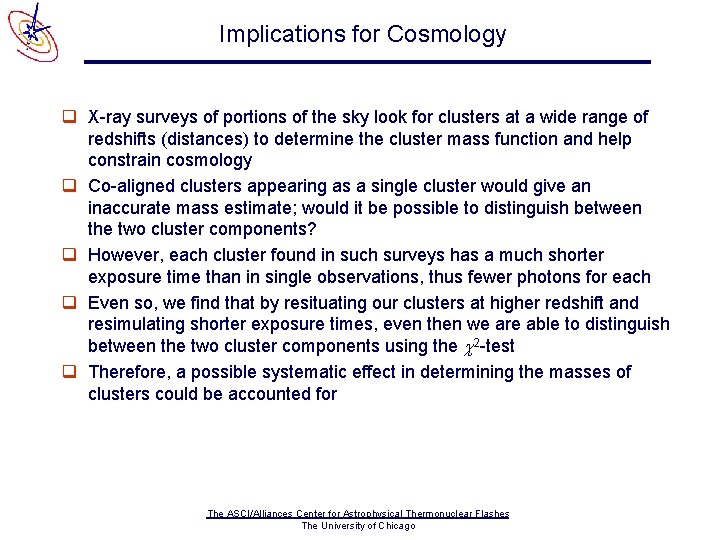
Implications for Cosmology q X-ray surveys of portions of the sky look for clusters at a wide range of redshifts (distances) to determine the cluster mass function and help constrain cosmology q Co-aligned clusters appearing as a single cluster would give an inaccurate mass estimate; would it be possible to distinguish between the two cluster components? q However, each cluster found in such surveys has a much shorter exposure time than in single observations, thus fewer photons for each q Even so, we find that by resituating our clusters at higher redshift and resimulating shorter exposure times, even then we are able to distinguish between the two cluster components using the 2 -test q Therefore, a possible systematic effect in determining the masses of clusters could be accounted for The ASCI/Alliances Center for Astrophysical Thermonuclear Flashes The University of Chicago
Conclusions q Making an accurate connection between simulations and observations is essential to true understanding of astrophysical systems q Bridging the gap: simulated X-ray observations of a simulated galaxy cluster collision q Implications for Cl 0024+17: q Statistical analysis of the surface brightness profile indicates the existence of two cluster components q Shortly after the collision, an estimate of the mass based on the assumption of hydrostatic equilibrium can be made to within ~10%, but only if the existence of both components is assumed q Even at low exposure times and high redshifts, it may be possible to determine the existence of co-aligned components, which aids the use of X-ray surveys of clusters to constrain cosmology The ASCI/Alliances Center for Astrophysical Thermonuclear Flashes The University of Chicago
Acknowledgements q Don Lamb (advisor) q ASC FLASH Center team q http: //flash. uchicago. edu/ q Collaborators at the University of Illinois at Urbana-Champaign: q Paul Ricker q Karen Yang (developed synthetic X-ray pipeline) q http: //www. astro. uiuc. edu/~pmricker/research/codes/flashcosmo/ q Practicum Advisor: Bronson Messer q Krell Institute and DOE THANKS! The ASCI/Alliances Center for Astrophysical Thermonuclear Flashes The University of Chicago