
The Cell Membrane Maintaining Homeostasis Cell Membrane Function
The Cell Membrane Maintaining Homeostasis
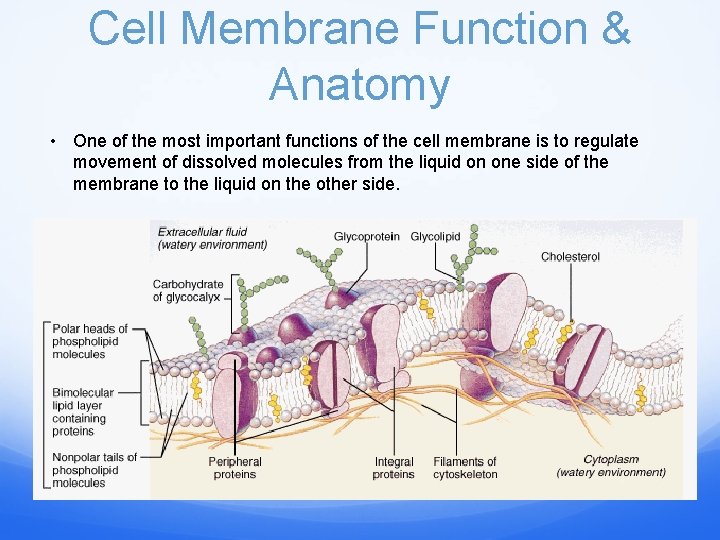
Cell Membrane Function & Anatomy • One of the most important functions of the cell membrane is to regulate movement of dissolved molecules from the liquid on one side of the membrane to the liquid on the other side.
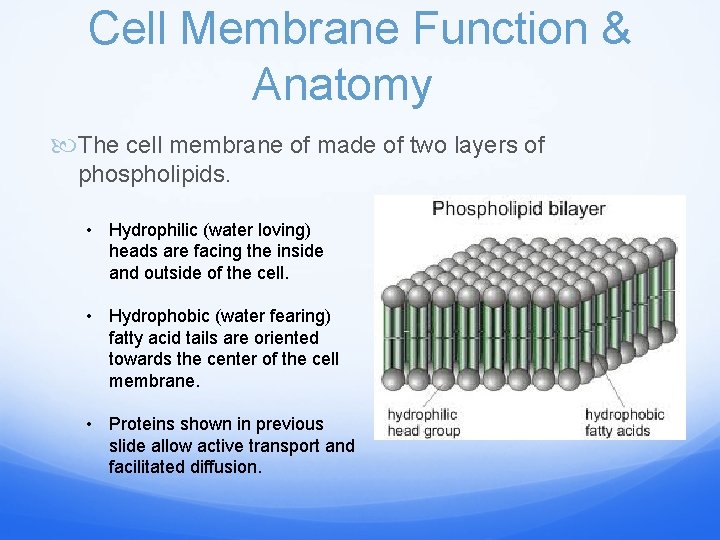
Cell Membrane Function & Anatomy The cell membrane of made of two layers of phospholipids. • Hydrophilic (water loving) heads are facing the inside and outside of the cell. • Hydrophobic (water fearing) fatty acid tails are oriented towards the center of the cell membrane. • Proteins shown in previous slide allow active transport and facilitated diffusion.
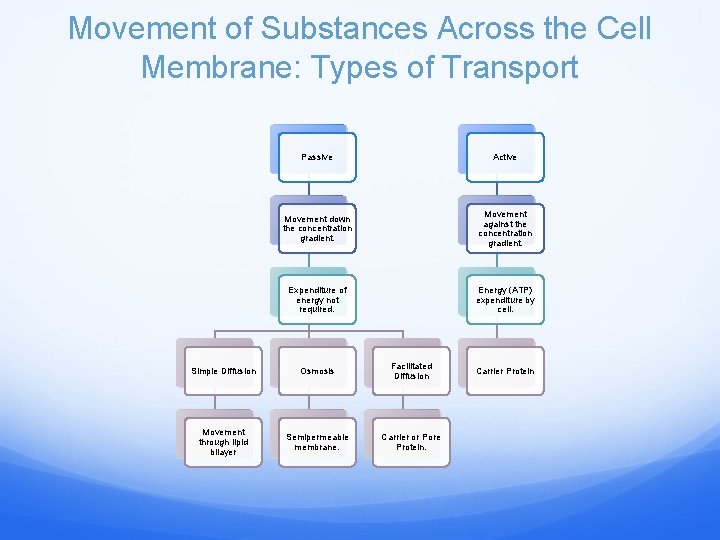
Movement of Substances Across the Cell Membrane: Types of Transport Passive Active Movement down the concentration gradient. Movement against the concentration gradient. Expenditure of energy not required. Energy (ATP) expenditure by cell. Simple Diffusion Osmosis Facilitated Diffusion Movement through lipid bilayer Semipermeable membrane. Carrier or Pore Protein. Carrier Protein
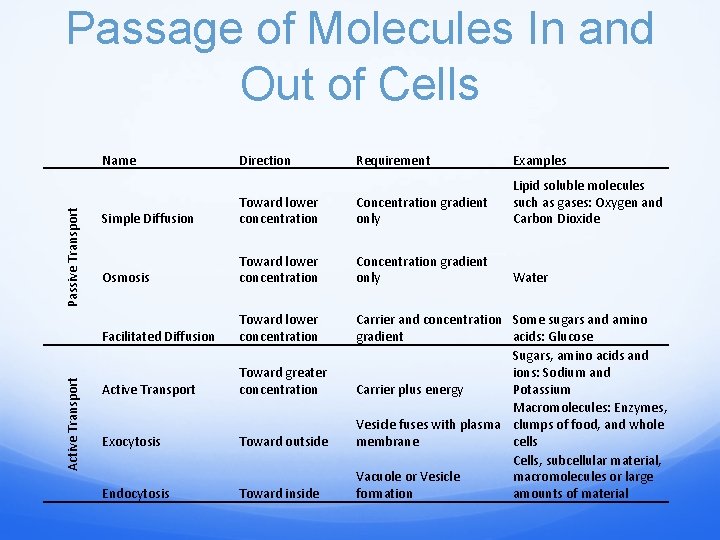
Passage of Molecules In and Out of Cells Active Transport Passive Transport Name Direction Requirement Examples Simple Diffusion Toward lower concentration Concentration gradient only Lipid soluble molecules such as gases: Oxygen and Carbon Dioxide Osmosis Toward lower concentration Concentration gradient only Water Facilitated Diffusion Toward lower concentration Active Transport Toward greater concentration Exocytosis Toward outside Endocytosis Toward inside Carrier and concentration Some sugars and amino gradient acids: Glucose Sugars, amino acids and ions: Sodium and Carrier plus energy Potassium Macromolecules: Enzymes, Vesicle fuses with plasma clumps of food, and whole membrane cells Cells, subcellular material, Vacuole or Vesicle macromolecules or large formation amounts of material
Let’s Permeate 1 2 3 4
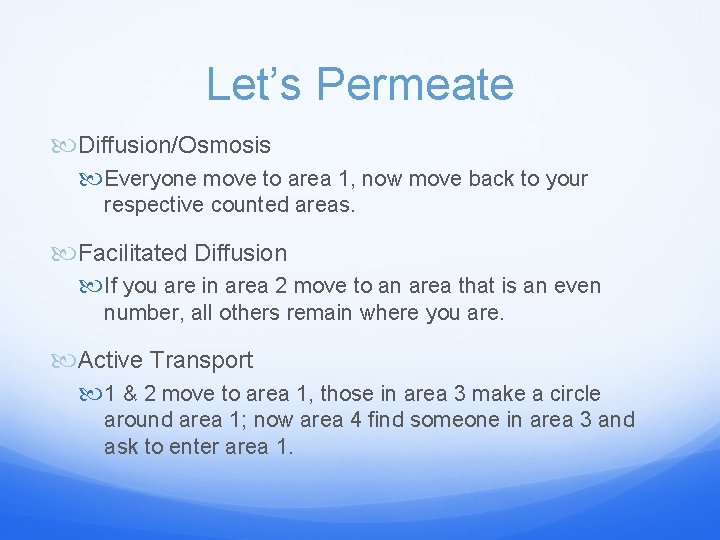
Let’s Permeate Diffusion/Osmosis Everyone move to area 1, now move back to your respective counted areas. Facilitated Diffusion If you are in area 2 move to an area that is an even number, all others remain where you are. Active Transport 1 & 2 move to area 1, those in area 3 make a circle around area 1; now area 4 find someone in area 3 and ask to enter area 1.
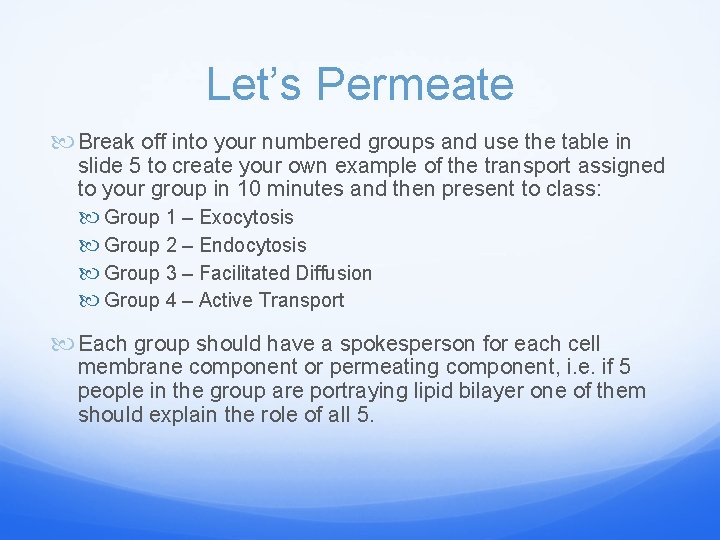
Let’s Permeate Break off into your numbered groups and use the table in slide 5 to create your own example of the transport assigned to your group in 10 minutes and then present to class: Group 1 – Exocytosis Group 2 – Endocytosis Group 3 – Facilitated Diffusion Group 4 – Active Transport Each group should have a spokesperson for each cell membrane component or permeating component, i. e. if 5 people in the group are portraying lipid bilayer one of them should explain the role of all 5.

What is Homeostasis? Definition: The process by which organisms keep internal conditions relatively constant despite changes in the external environment. The average temperate of a human is 98. 6°F regardless of the outside temperature. How does this golfer play in the frigid winter weather and still maintain a body temperature of 98. 6°F?
Homeostasis at the Cellular Level The cell membrane regulates what enters and exits the cell by: Only allowing certain gases to pass through the lipid bilayer. Requiring selective proteins for small molecules. Requiring proteins and expenditure of energy for small molecules against the concentration gradient.
- Slides: 10