
The Cell Membrane Cell Transport Packet 12 Thursday

The Cell Membrane & Cell Transport Packet #12 Thursday, January 13, 2022 1
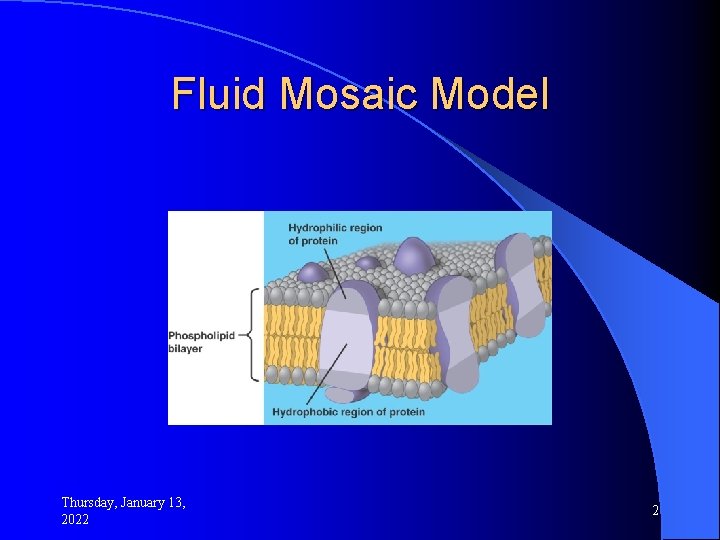
Fluid Mosaic Model Thursday, January 13, 2022 2

Thursday, January 13, 2022 3
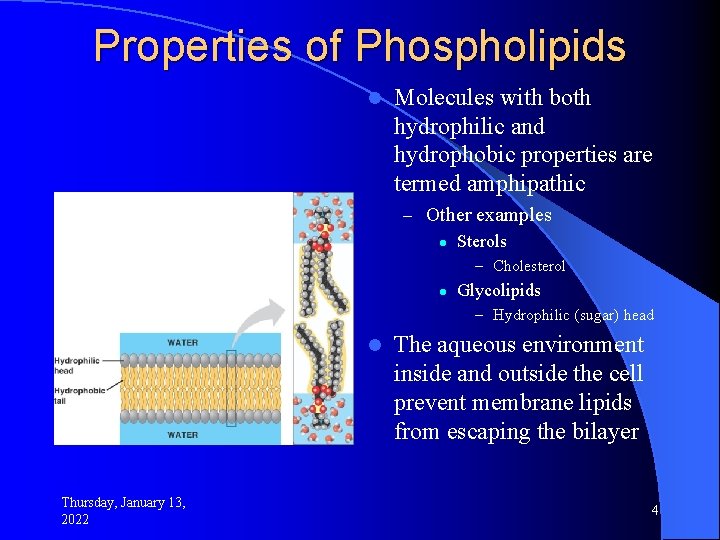
Properties of Phospholipids l Molecules with both hydrophilic and hydrophobic properties are termed amphipathic – Other examples l Sterols – Cholesterol l Glycolipids – Hydrophilic (sugar) head l Thursday, January 13, 2022 The aqueous environment inside and outside the cell prevent membrane lipids from escaping the bilayer 4
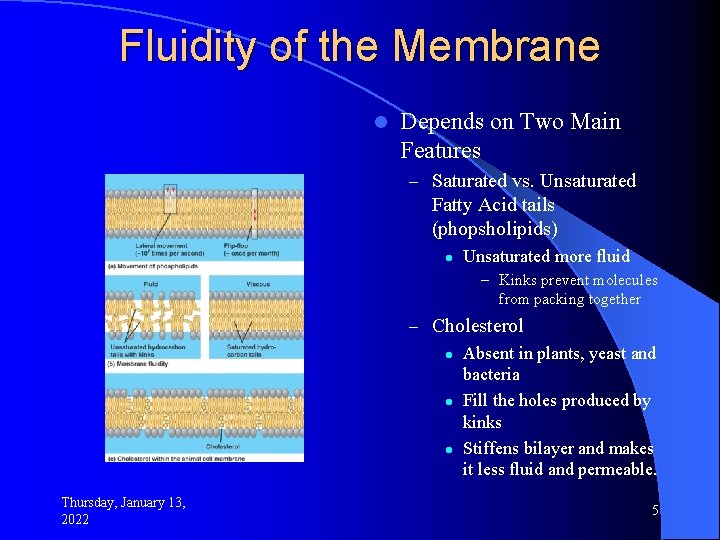
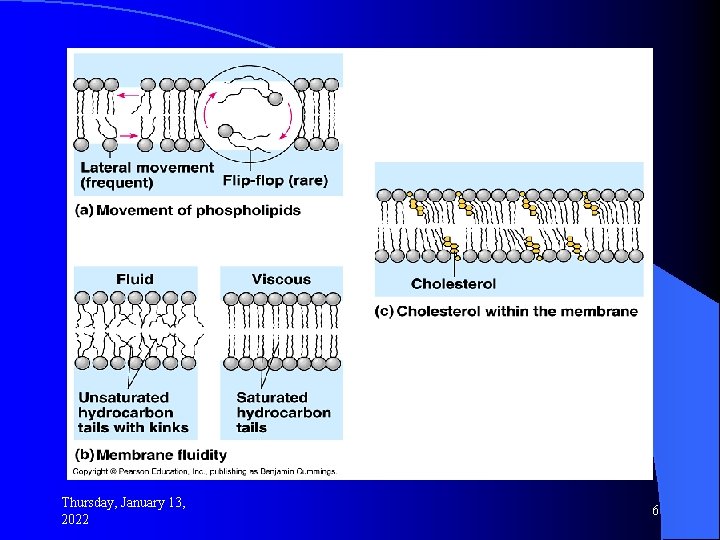
Fluidity of the Membrane l Depends on Two Main Features – Saturated vs. Unsaturated Fatty Acid tails (phopsholipids) l Unsaturated more fluid – Kinks prevent molecules from packing together – Cholesterol l Absent in plants, yeast and bacteria l Fill the holes produced by kinks l Stiffens bilayer and makes it less fluid and permeable. Thursday, January 13, 2022 5
Thursday, January 13, 2022 6
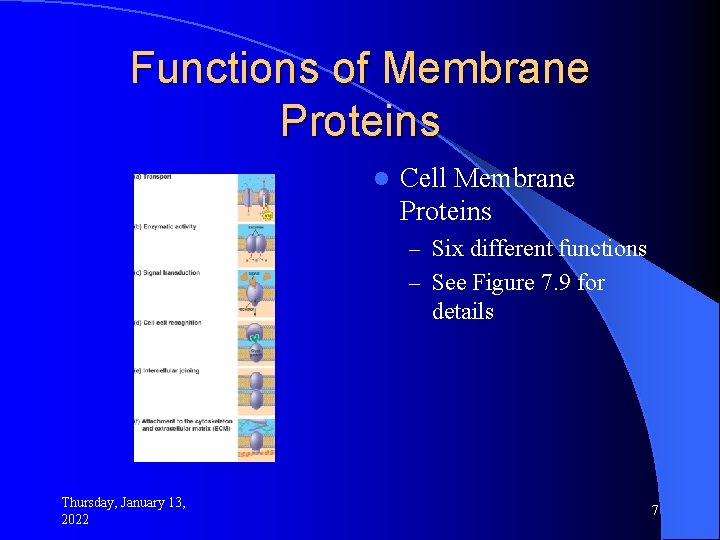
Functions of Membrane Proteins l Cell Membrane Proteins – Six different functions – See Figure 7. 9 for details Thursday, January 13, 2022 7

Integral vs. Peripheral Proteins l Integral Proteins l Peripheral Proteins – A protein that is firmly – Not embedded in the anchored in the plasma membrane via interactions between its hydrophobic domains and the membrane phospholipids – Directly attached to the membrane lipid bilayer – Can be released from the membrane by relatively gentle extraction procedures Thursday, January 13, 2022 8
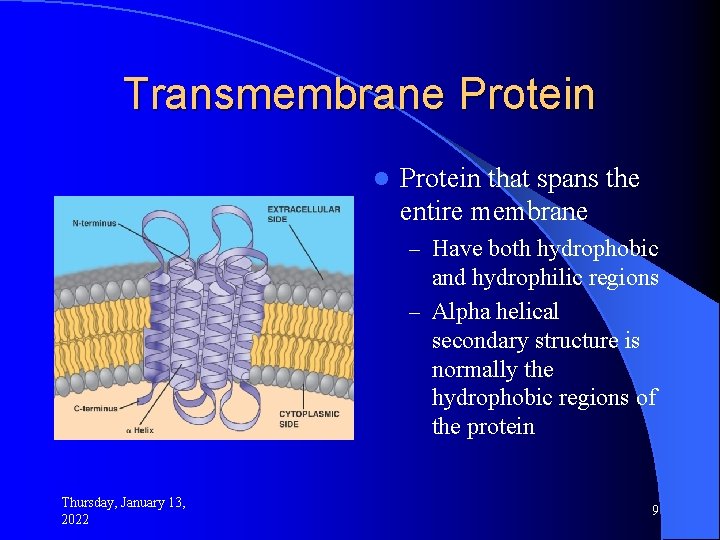
Transmembrane Protein l Protein that spans the entire membrane – Have both hydrophobic and hydrophilic regions – Alpha helical secondary structure is normally the hydrophobic regions of the protein Thursday, January 13, 2022 9
Transport of Materials Into and Out of Cells Thursday, January 13, 2022 10

Permeability of the Lipid Bilayer Permeable l Small hydrophobic molecules Non-Permeable l – Amino Acids – O 2 – Glucose – CO 2 – N 2 – Benzene l Small Uncharged Polar Molecules – H 2 O – Glycerol – Ethanol Thursday, January 13, 2022 Larger Uncharged Polar Molecules – Nucleotides l Ions – H+ – Na+ – HCO 3– K+ – Ca 2+ – Cl– Mg 2+ 11

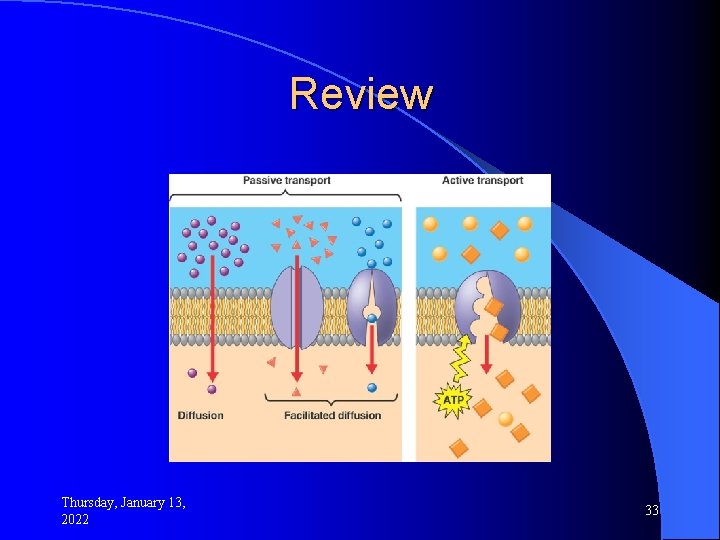
Introduction l There are 5 ways of transporting materials across the cell membrane – Diffusion l Regular & Facilitated – Passive Transport – Active transport – Osmosis – Phagocytosis – Pinocytosis Thursday, January 13, 2022 12
Diffusion l The movement of a substance from an area of high concentration to an area of low concentration – The difference in concentration between the two regions is known as the concentration gradient Thursday, January 13, 2022 13
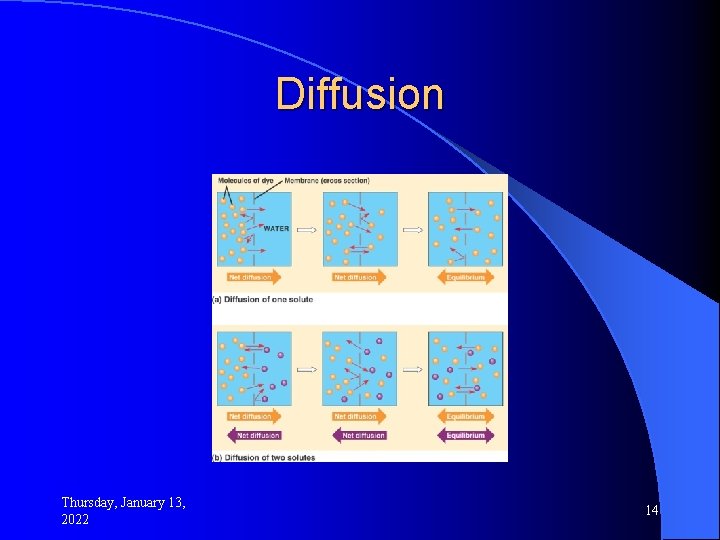
Diffusion Thursday, January 13, 2022 14
Rate of Diffusion l The rate of diffusion depends on – The difference in concentration l The greater the concentration gradient, the faster the process – The distance between the two regions l Smaller distance means faster process – The area l If the total “area” is increased, the faster the process – The size of the molecules l Small and fat-soluble molecules will diffuse faster Thursday, January 13, 2022 15
Regular vs Facilitated Diffusion l “Regular” Diffusion – Movement of molecules is from high concentration to low concentration – No proteins are used – No energy (ATP) is required l Facilitated Diffusion – Movement of molecules is from high concentration to low concentration – Proteins are used – No energy (ATP) is required Thursday, January 13, 2022 16
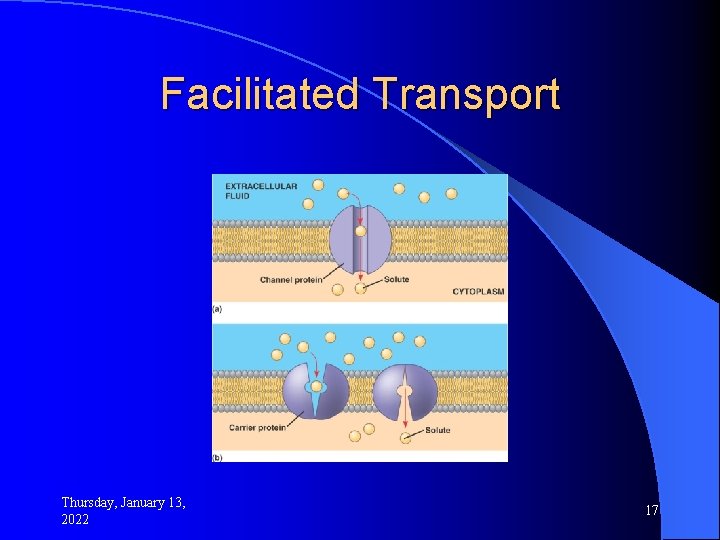
Facilitated Transport Thursday, January 13, 2022 17
Glucose Carrier l l l Carrier protein Found in the plasma membrane of liver cells Glucose, an uncharged molecule, is plentiful, outside the cell, after a meal Glucose is moved from a high concentration to an area of low concentration Which form of glucose can cells only use in Glycolysis? – D-glucose and not the mirror image L-glucose Thursday, January 13, 2022 18
Glucose Carrier II l Hungry? l Blood glucose is low l Hormone Glucagon glycogen to glucose l Glucose concentration higher inside the liver cell than outside l Glucose moves from high concentration to low concentration Thursday, January 13, 2022 19
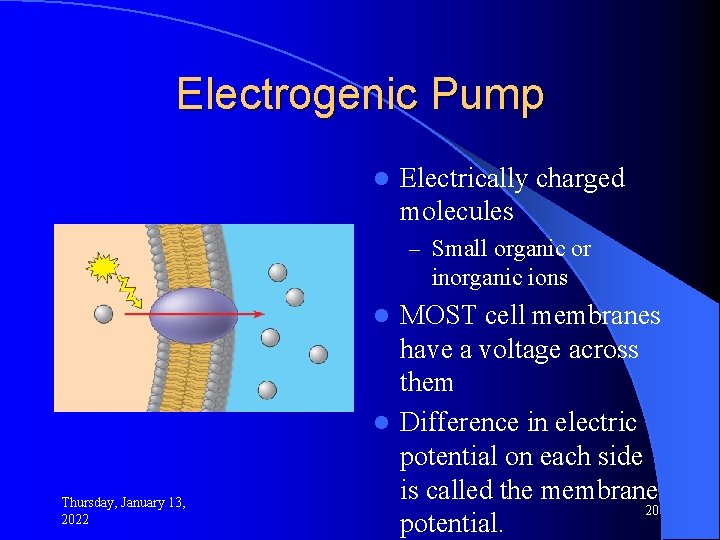
Electrogenic Pump l Electrically charged molecules – Small organic or inorganic ions MOST cell membranes have a voltage across them l Difference in electric potential on each side is called the membrane 20 potential. l Thursday, January 13, 2022
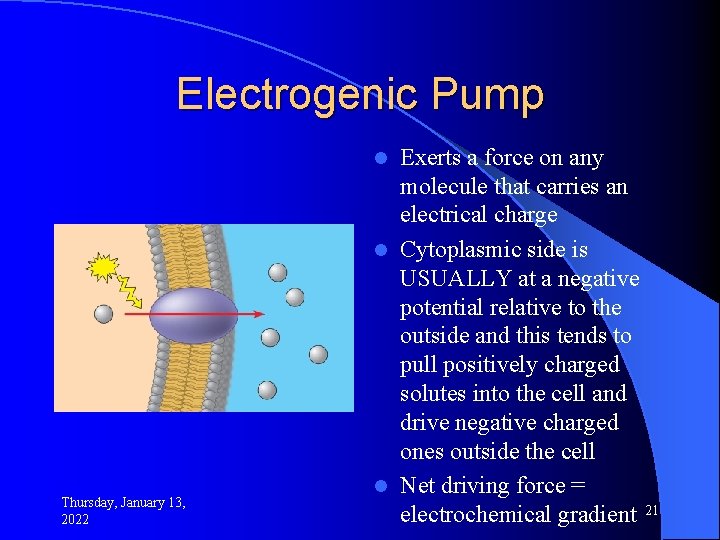
Electrogenic Pump Exerts a force on any molecule that carries an electrical charge l Cytoplasmic side is USUALLY at a negative potential relative to the outside and this tends to pull positively charged solutes into the cell and drive negative charged ones outside the cell l Net driving force = electrochemical gradient 21 l Thursday, January 13, 2022
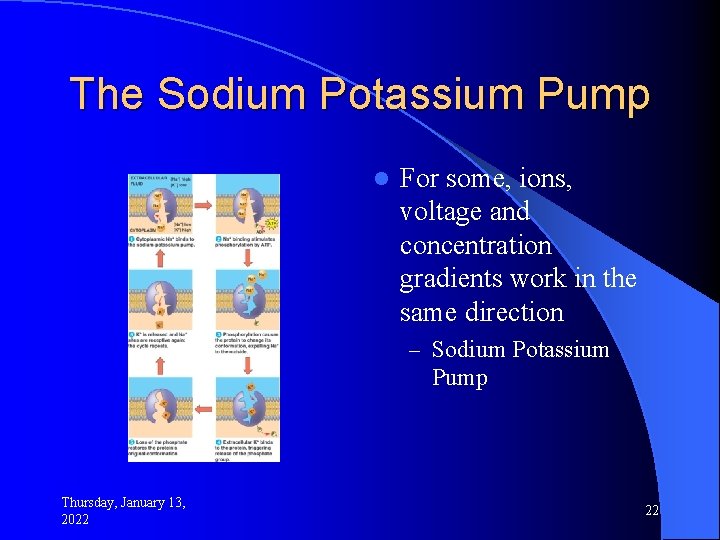
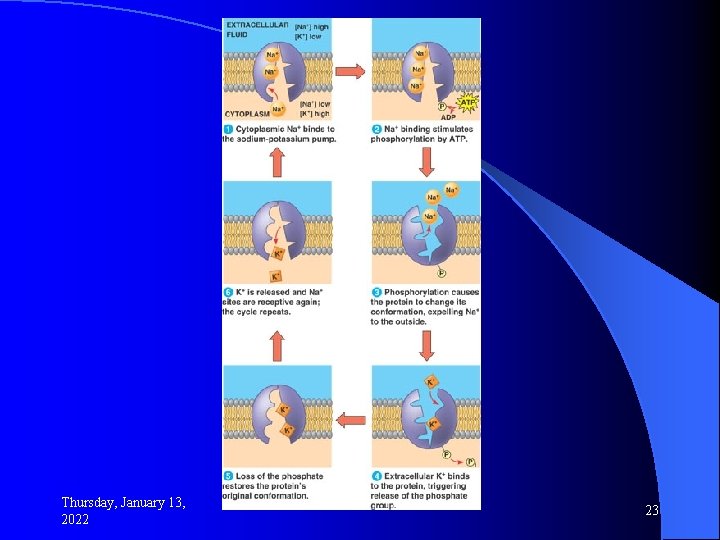
The Sodium Potassium Pump l For some, ions, voltage and concentration gradients work in the same direction – Sodium Potassium Pump Thursday, January 13, 2022 22
Thursday, January 13, 2022 23
Active Transport l Materials are moved against the concentration gradient – Molecules move from an area of low concentration to an area of high concentration l Proteins are used to move materials across the membrane Thursday, January 13, 2022 24
Active Transport II l Energy is used – Because energy is used, cells carrying out active transport have A high respiratory rate l Many mitochondria l A high concentration/reserve of ATP l – Any factor which reduces or stops cell respiration will stop active transport l Cyanide Thursday, January 13, 2022 25
Active Transport III l Cells carry our active transport in three ways – Coupled transport (co-transport) – ATP driven pumps l Couple uphill transport with hydrolysis of ATP – Light driven pumps Found mainly in bacterial cells l Input of energy from light l – Bacteriohodopsin Thursday, January 13, 2022 26
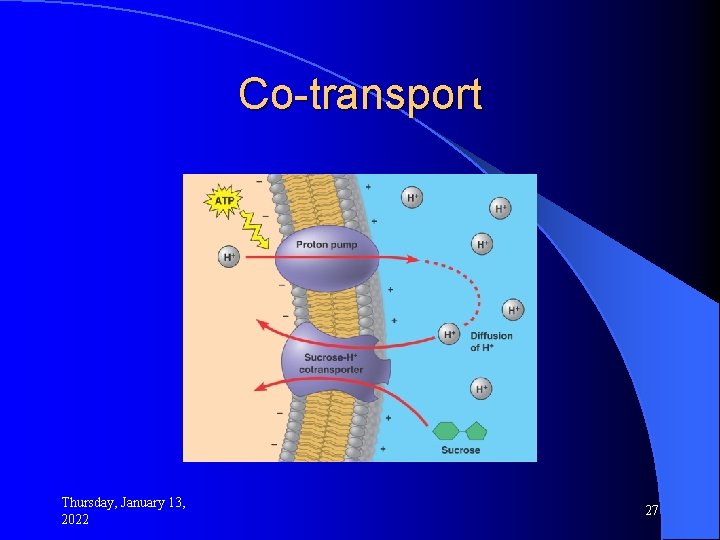
Co-transport Thursday, January 13, 2022 27
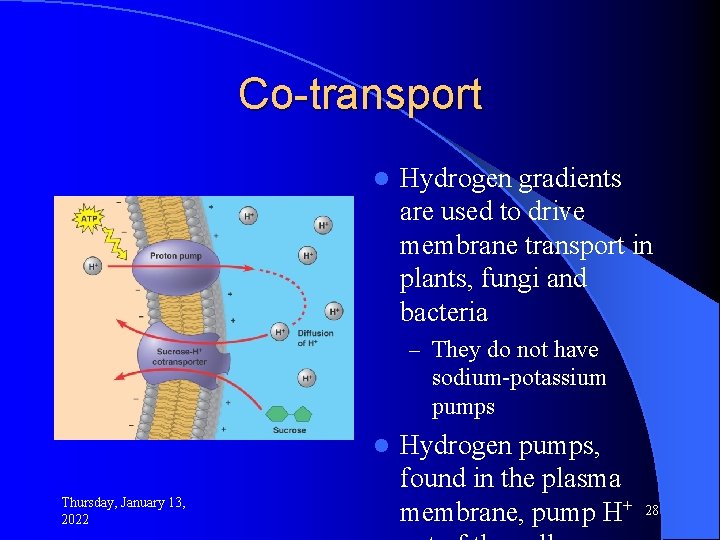
Co-transport l Hydrogen gradients are used to drive membrane transport in plants, fungi and bacteria – They do not have sodium-potassium pumps l Thursday, January 13, 2022 Hydrogen pumps, found in the plasma membrane, pump H+ 28
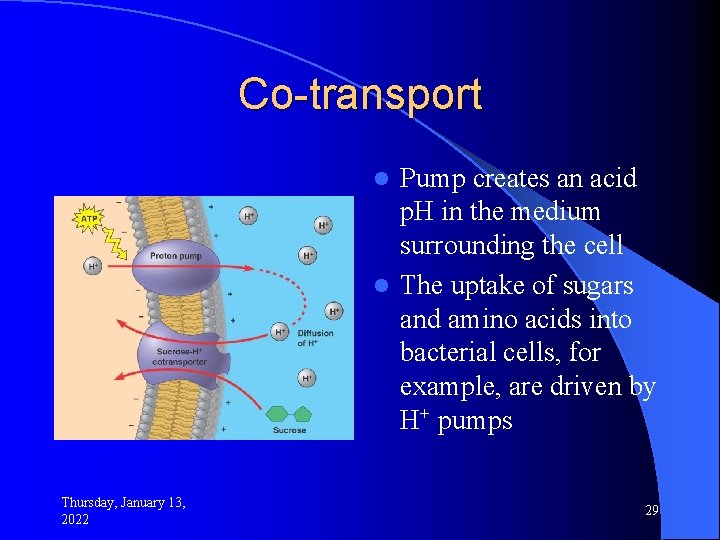
Co-transport Pump creates an acid p. H in the medium surrounding the cell l The uptake of sugars and amino acids into bacterial cells, for example, are driven by H+ pumps l Thursday, January 13, 2022 29
H+ Pumps in Bacteria l In some photosynthetic bacteria, the H+ gradient is created by the activity of light driven H+ pumps such as bacteriorhodopsin. l In plants and fungi and many other bacteria, the gradient is set up by ATPases in their plasma membrane Thursday, January 13, 2022 30

Co-transport The Na+ gradient generated by the sodiumpotassium pump can be used to drive active transport of a 2 nd molecule. l The downhill movement of the first solute down provides the energy to drive the uphill transport of the second. l Thursday, January 13, 2022 31
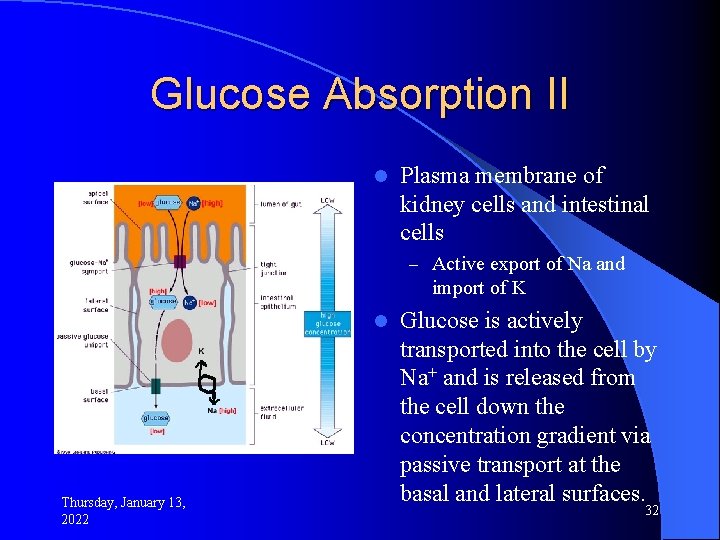
Glucose Absorption II l Plasma membrane of kidney cells and intestinal cells – Active export of Na and import of K l Thursday, January 13, 2022 Glucose is actively transported into the cell by Na+ and is released from the cell down the concentration gradient via passive transport at the basal and lateral surfaces. 32
Review Thursday, January 13, 2022 33
Osmosis l Transfer of a liquid solvent through a semi permeable membrane, that does not allow dissolved solids (solutes) to pass from an area of high concentration to an area of low concentration – Review of solvents vs solutes Thursday, January 13, 2022 34
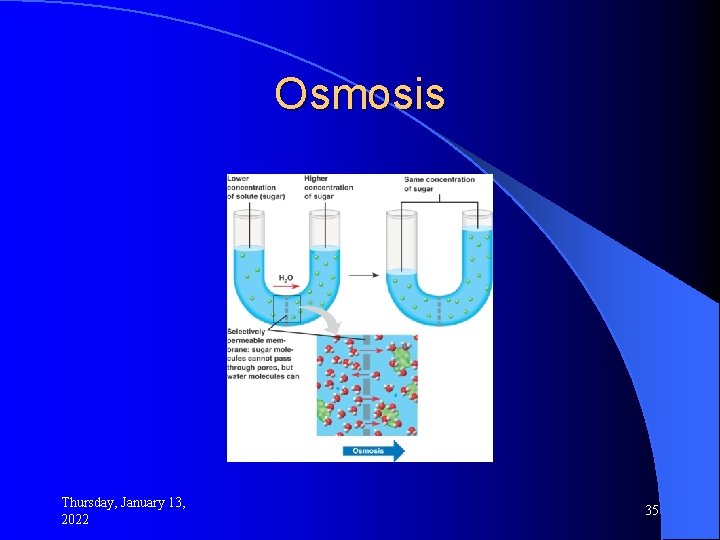
Osmosis Thursday, January 13, 2022 35
Osmosis and Animal Cells l Osmotic Pressure – The driving force for the water is the difference in water pressure l Osmotic pressure – The pressure exerted by the flow of water through a semi-permeable membrane separating two solutions with different concentrations of solute If a solution is separated from pure water by a semipermeable membrane, the pressure which must be applied to prevent osmosis is called the osmotic Thursday, January 13, 36 2022 pressure l
Osmosis and Animal Cells II l Osmotic Potential – Difference in osmotic pressure that draws water from an area of less osmotic pressure to an area of greater osmotic pressure. – The potential of a solution to pull in water – Value is always negative – The more concentrated the solution, the more negative its osmotic potential Thursday, January 13, 2022 37
Osmosis and Animal Cells III l Isotonic – When two solutions have the same osmotic potential l Hypertonic vs. Hypotonic – Hypertonic l When one solution has a greater osmotic potential than another – Contains a higher concentration of solute • More concentrated – Hypotonic l When one solution has a lower osmotic potential than the other – Contains a lower concentration of solute in comparison to the other • Less concentrated Thursday, January 13, 2022 38
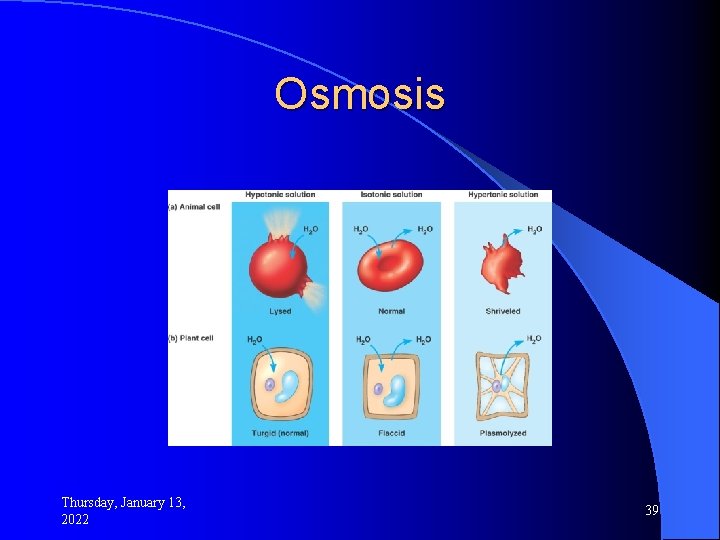
Osmosis Thursday, January 13, 2022 39
Osmosis and Plant Cells I l Although the osmotic principles apply equally to plant and animal cells, a different set of terms is currently applied to the osmotic relationship of plant cells Thursday, January 13, 2022 40
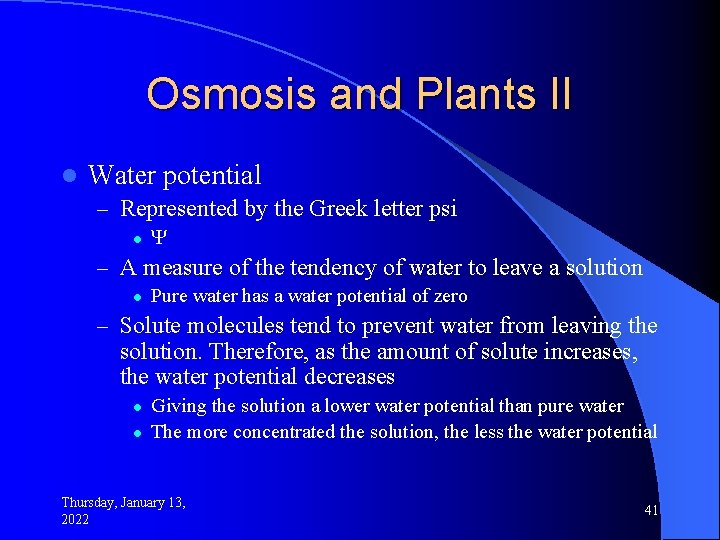
Osmosis and Plants II l Water potential – Represented by the Greek letter psi l – A measure of the tendency of water to leave a solution l Pure water has a water potential of zero – Solute molecules tend to prevent water from leaving the solution. Therefore, as the amount of solute increases, the water potential decreases l l Giving the solution a lower water potential than pure water The more concentrated the solution, the less the water potential Thursday, January 13, 2022 41
Osmosis & Plant Cells III l Plant cell – Can be considered as a solution of salts and sugars in the vacuole surrounded by a semi-permeable membrane l l l Tonoplast Cytoplasm Plasma membrane – And a slightly elastic but completely permeable cell wall. – A plant cell therefore has more water potential than pure water and will draw in water when surrounded by it Thursday, January 13, 2022 42
Osmosis and Plants IV This entry of water forces the living part of the cell, known as the protoplast, against the cell wall. l This pressure is known as pressure potential l – p In a turgid plant cell that has a positive value, although the xylem of a transpiring plant(which is under tension) it is negative l The water potential of a cell is changed by the presence of the solute. The change in water potential, as a result of the solute, is referred to as Thursday, 13, potential the. January solute 43 l 2022
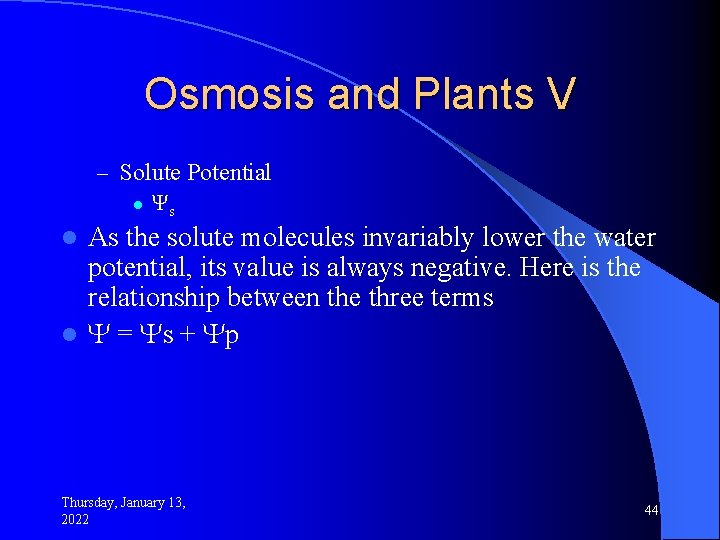
Osmosis and Plants V – Solute Potential l s As the solute molecules invariably lower the water potential, its value is always negative. Here is the relationship between the three terms l = s + p l Thursday, January 13, 2022 44
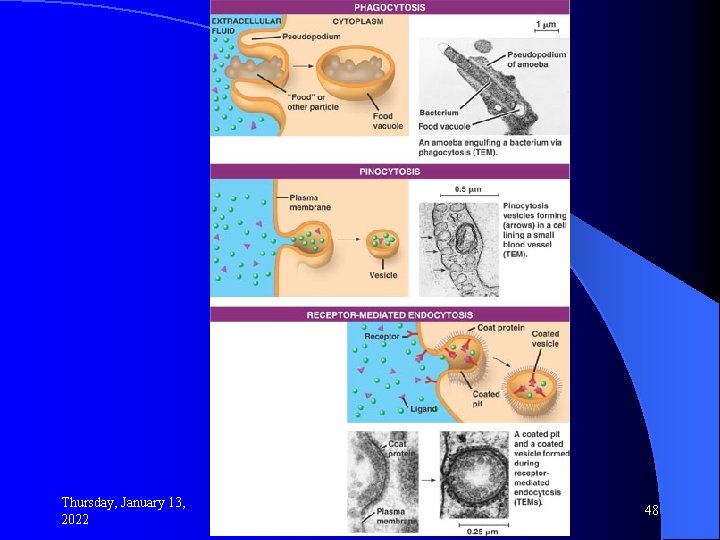
Phagocytosis l The take up of large particles by cells via vesicles formed in the plasma membrane l The cell invaginates to form a depression in which particles are contained l This then pinches off to form a vacuole – White blood cells Neutrophils l Monocytes l Thursday, January 13, 2022 45
Pinocytosis l The take up of liquids rather than solids – Vacuoles are smaller than those used during phagocytosis Thursday, January 13, 2022 46
Endocytosis vs. Exocytosis l Both phagocytosis and pinocytosis involve the taking of materials into the cell in bulk. – These are examples of endocytosis l The removal of materials from the cell in bulk is called exocytosis. Thursday, January 13, 2022 47
Thursday, January 13, 2022 48
- Slides: 48