
The Cell Living things are different than nonliving


- Slides: 14
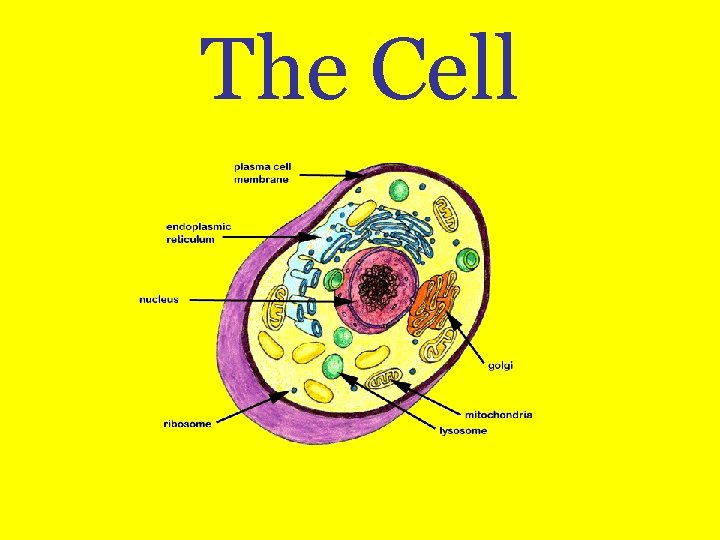
The Cell
Living things are different than nonliving things Organism – any individual form of life that is capable of growing and reproducing Characteristics of life: -all living things have these characteristics 1) must be organized 2) can grow and develop 3) respond to its environment 4) be able to reproduce
Needs of life All organisms need basic things 1) a steady supply of energy 2) materials like carbon dioxide, oxygen nitrogen and water 3) a space to live and grow * Characteristics and needs of a living thing are the same for a single celled organism or a multi-celled organism
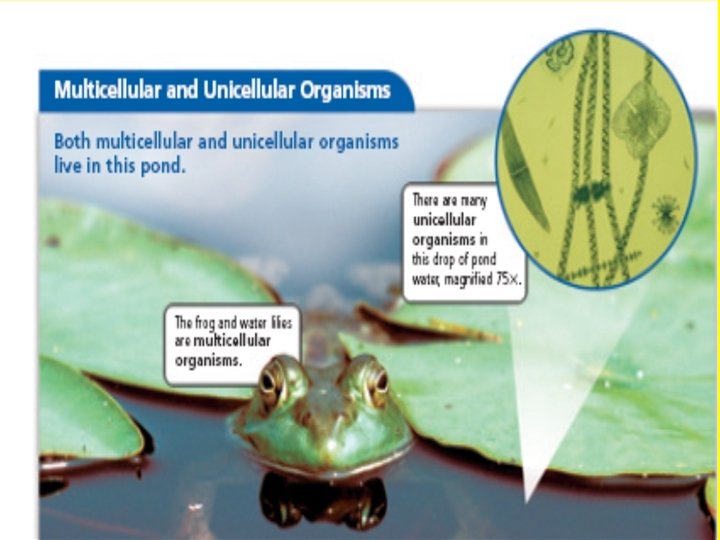
All living things are made of cells: cell – the smallest unit of a living thing unicellular organism - an organism made of a single cell -most are too small to see directly example: organisms found in a drop of pond water
All living things are made of cells (continued) multicellular organisms – organisms made of many cells • much more complex than unicellular organisms • different cells perform different functions • many cells work together to carry out the activities of life example: frog, bird, lily pad, grass, etc.
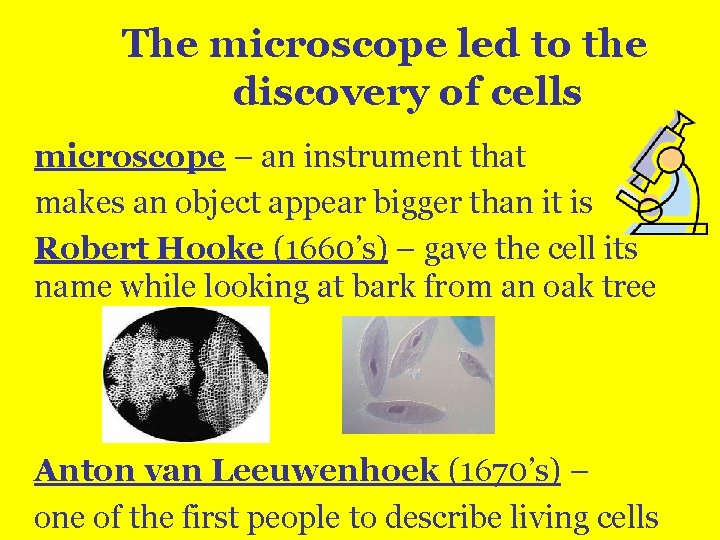
The microscope led to the discovery of cells microscope – an instrument that makes an object appear bigger than it is Robert Hooke (1660’s) – gave the cell its name while looking at bark from an oak tree Anton van Leeuwenhoek (1670’s) – one of the first people to describe living cells
Cell theory is important to the study of biology Scientific theory –is a widely accepted explanation of things observed in nature A theory must be – 1) supported by evidence 2) widely accepted 3) explain observations in nature *serves as a foundation for further research*
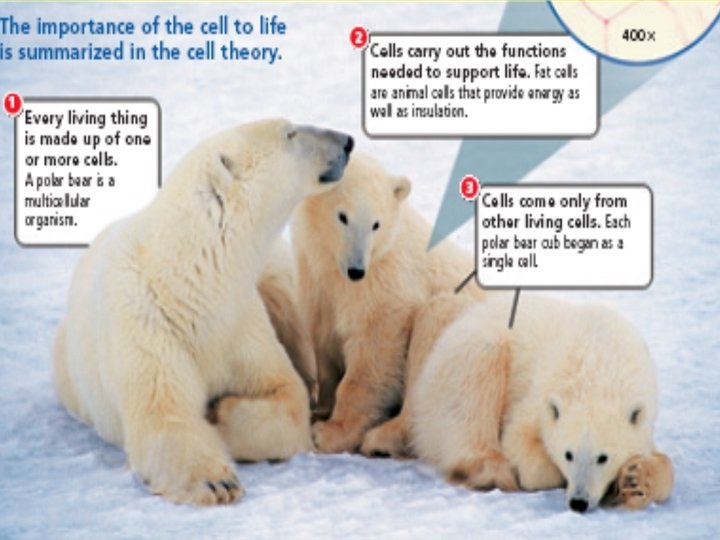
Cells come from other cells *Although often times cells look different from one another, all living matter is made of cells Cell Theory summarized– 1) every living thing is made of one or more cells 2) cells carry out the functions needed to support life 3) cells come only from other living things
H. Louis Pasteur and Spontaneous Generation: Louis Pasteur was a French scientist who showed the practical uses of the cell theory • Lived in the 1800’s – a time when there was not refrigeration and many people died from diseases caused by microscopic organism • His work showed that microscopic organisms were involved in both food spoilage AND disease
Louis Pasteur • Observed sour milk and discovered a large number of single-celled organisms he called “germs” now know as bacteria • Developed pasteurization, a process that uses heat to kill bacteria and keep milk fresher, longer • Pasteur began to look for bacteria and other microorganisms everywhere • His work led to the first animal vaccinations for cholera and anthrax and the first rabies treatment for humans
Louis Pasteur and Spontaneous Generation • At the time Pasteur was conducting his research, scientists thought that bacteria came from and grew from non-living organisms; an idea known as spontaneous generation • Pasteur conducted an experiment that did not support the idea of spontaneous generation • His experiment, instead, confirmed the cell theory