
THE CELL Key Points 1 Structure and importance

- Slides: 32
THE CELL
Key Points: 1. Structure (and importance) of cell membrane 2. Structure (and function) of organelles 3. Interconnections between cells to maintain structural stability in body tissues.
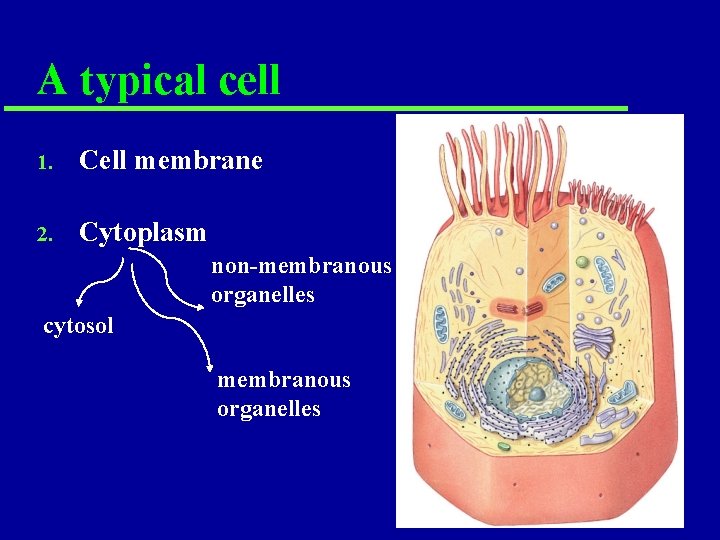
A typical cell 1. Cell membrane 2. Cytoplasm non-membranous organelles cytosol membranous organelles
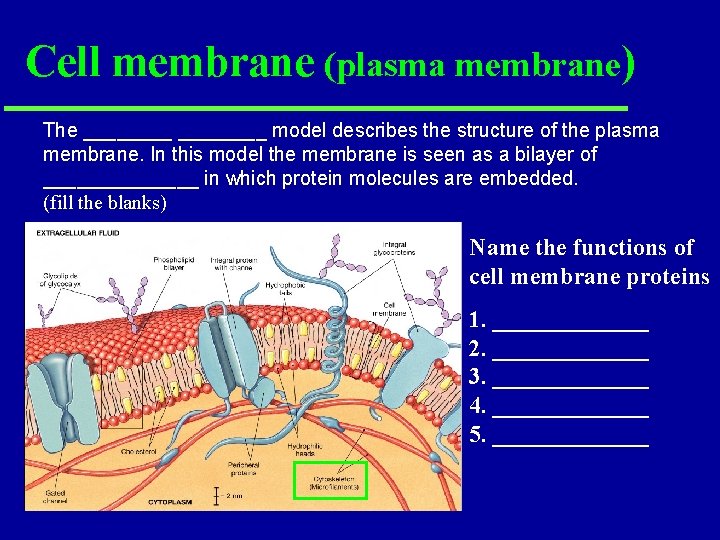
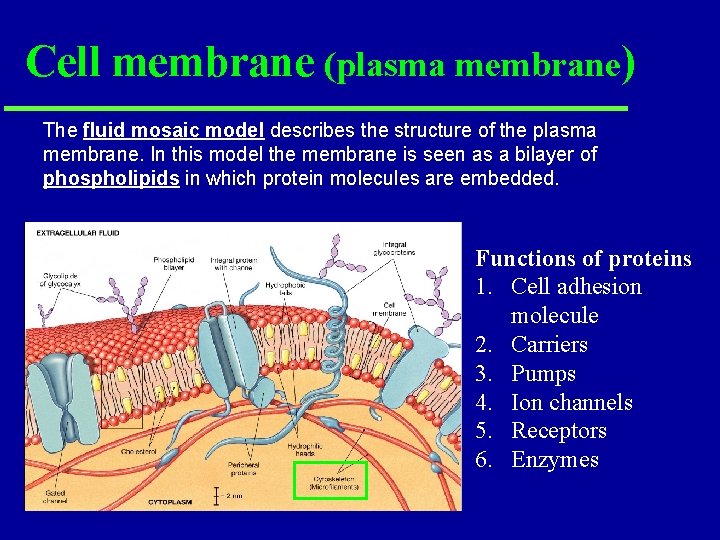
Cell membrane (plasma membrane) The ________ model describes the structure of the plasma membrane. In this model the membrane is seen as a bilayer of _______ in which protein molecules are embedded. (fill the blanks) Name the functions of cell membrane proteins 1. _______ 2. _______ 3. _______ 4. _______ 5. _______
Cell membrane (plasma membrane) The fluid mosaic model describes the structure of the plasma membrane. In this model the membrane is seen as a bilayer of phospholipids in which protein molecules are embedded. Functions of proteins 1. Cell adhesion molecule 2. Carriers 3. Pumps 4. Ion channels 5. Receptors 6. Enzymes
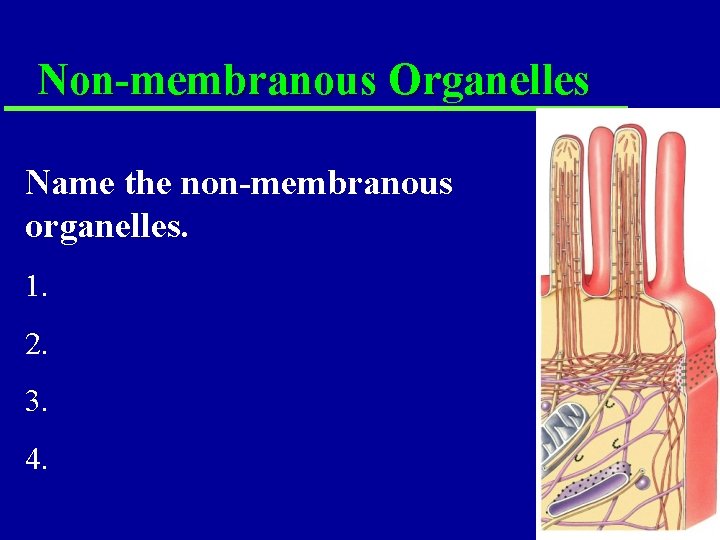
Non-membranous Organelles Name the non-membranous organelles. 1. 2. 3. 4.
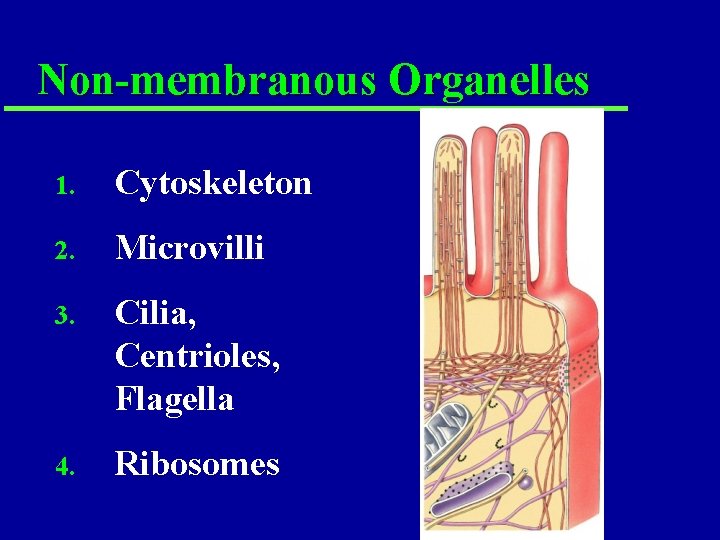
Non-membranous Organelles 1. Cytoskeleton 2. Microvilli 3. Cilia, Centrioles, Flagella 4. Ribosomes
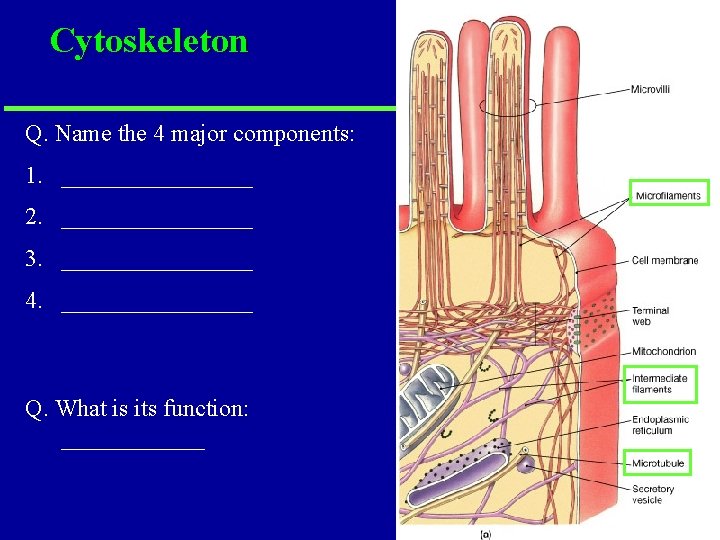
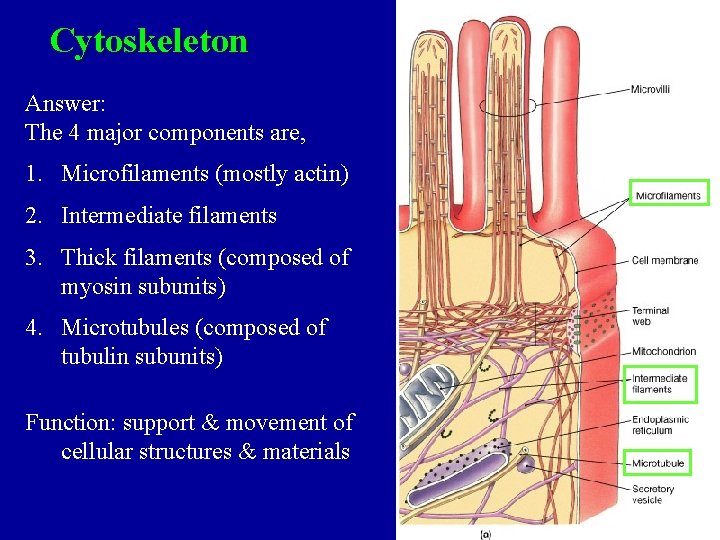
Cytoskeleton Q. Name the 4 major components: 1. ________ 2. ________ 3. ________ 4. ________ Q. What is its function: ______
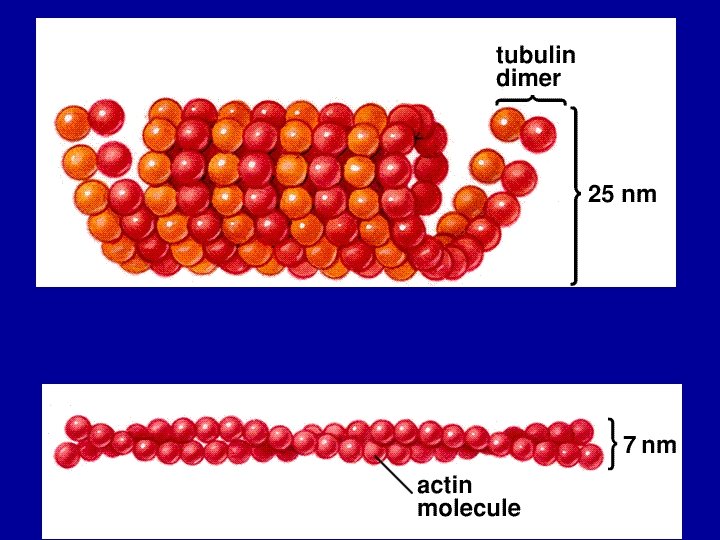
Cytoskeleton Answer: The 4 major components are, 1. Microfilaments (mostly actin) 2. Intermediate filaments 3. Thick filaments (composed of myosin subunits) 4. Microtubules (composed of tubulin subunits) Function: support & movement of cellular structures & materials
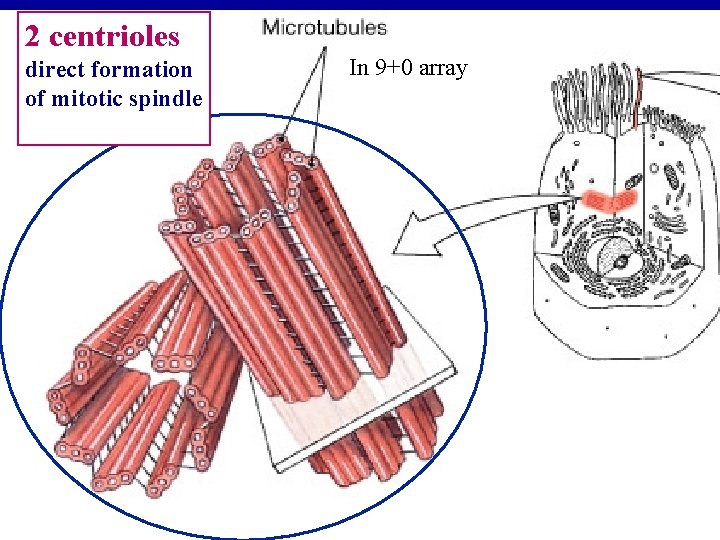
2 centrioles direct formation of mitotic spindle In 9+0 array
The centrosome, also called the "microtubule organizing center", is an area in the cell where microtubles are produced. Within an animal cell centrosome there is a pair of small organelles, the centrioles, each made up of a ring of nine groups of microtubules. There are three fused microtubules in each group. The two centrioles are arranged such that one is perpendicular to the other. During animal cell division, the centrosome divides and the centrioles replicate (make new copies). The result is two centrosomes, each with its own pair of centrioles. The two centrosomes move to opposite ends of the nucleus, and from each centrosome, microtubules grow into a "spindle" which is responsible for separating replicated chromosomes into the two daughter cells.
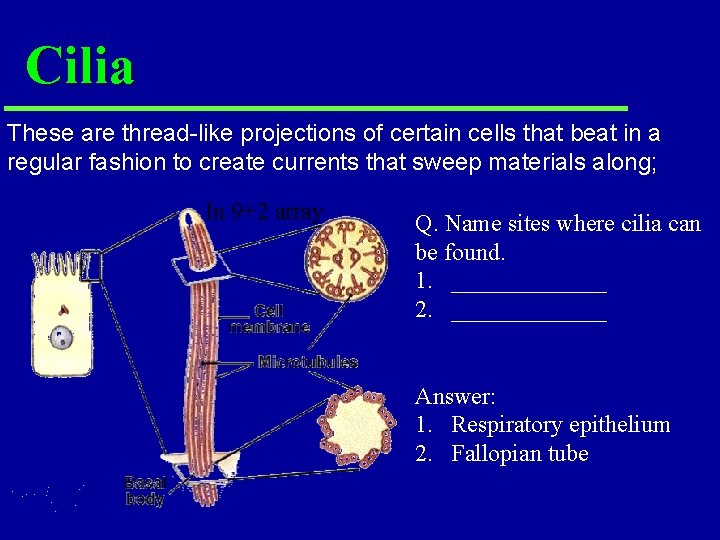
Cilia These are thread-like projections of certain cells that beat in a regular fashion to create currents that sweep materials along; In 9+2 array Q. Name sites where cilia can be found. 1. _______ 2. _______ Answer: 1. Respiratory epithelium 2. Fallopian tube
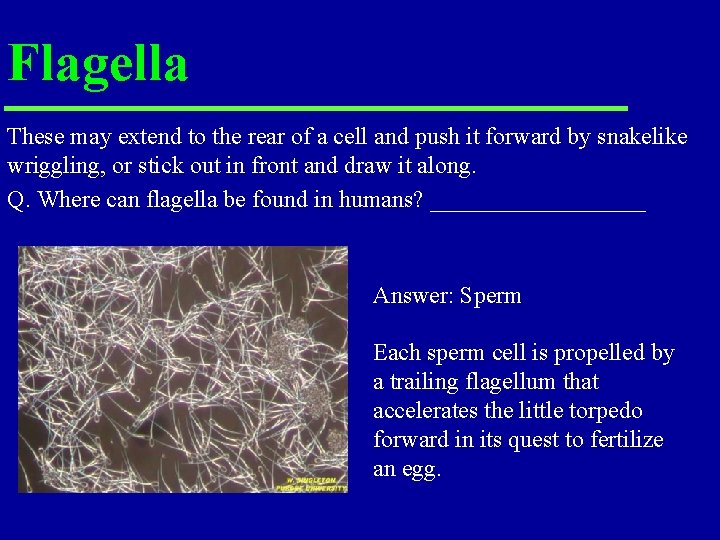
Flagella These may extend to the rear of a cell and push it forward by snakelike wriggling, or stick out in front and draw it along. Q. Where can flagella be found in humans? _________ Answer: Sperm Each sperm cell is propelled by a trailing flagellum that accelerates the little torpedo forward in its quest to fertilize an egg.
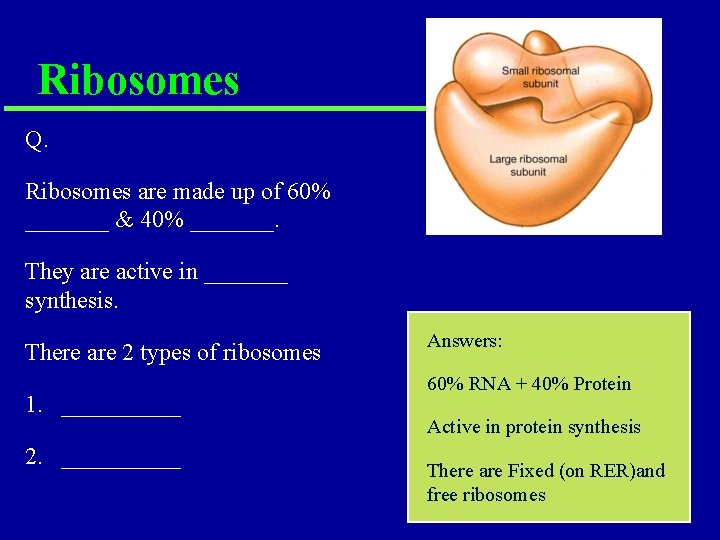
Ribosomes Q. Ribosomes are made up of 60% _______ & 40% _______. They are active in _______ synthesis. There are 2 types of ribosomes 1. _____ 2. _____ Answers: 60% RNA + 40% Protein Active in protein synthesis There are Fixed (on RER)and free ribosomes
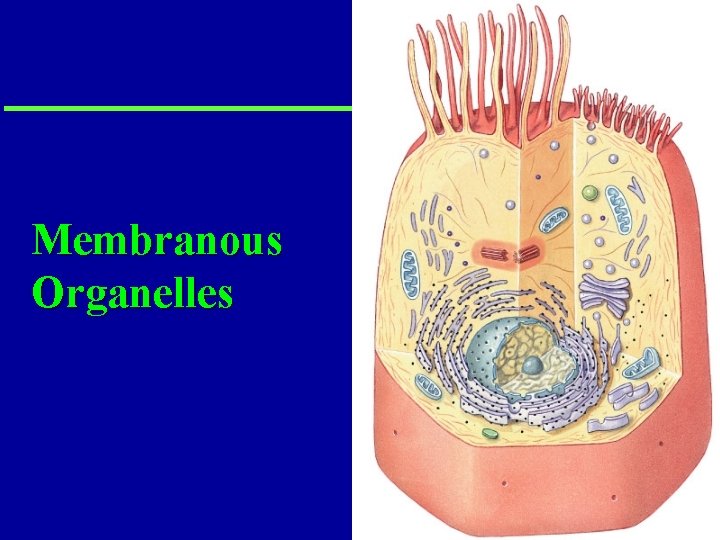
Membranous Organelles
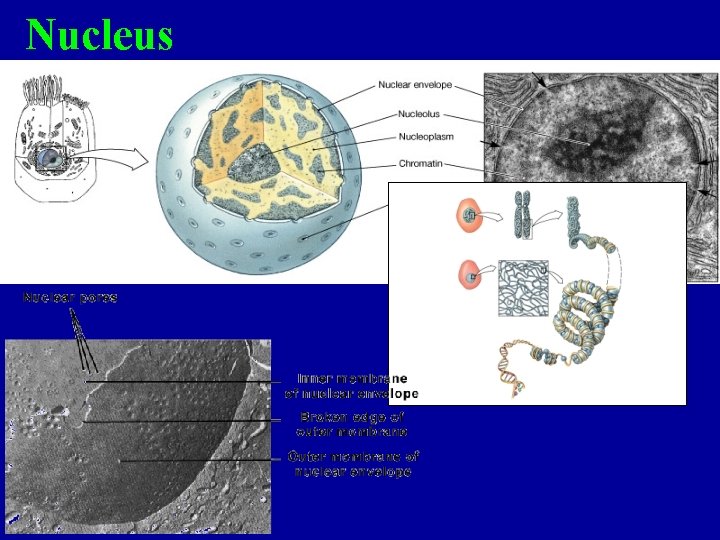
Nucleus
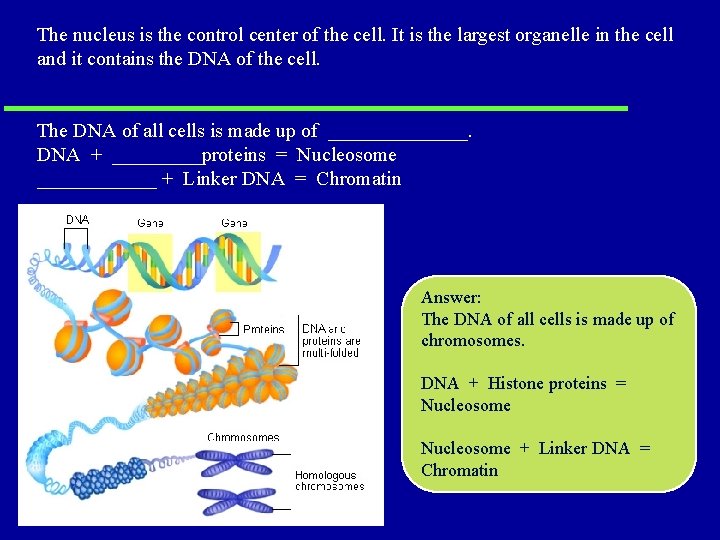
The nucleus is the control center of the cell. It is the largest organelle in the cell and it contains the DNA of the cell. The DNA of all cells is made up of _______. DNA + _____proteins = Nucleosome ______ + Linker DNA = Chromatin Answer: The DNA of all cells is made up of chromosomes. DNA + Histone proteins = Nucleosome + Linker DNA = Chromatin
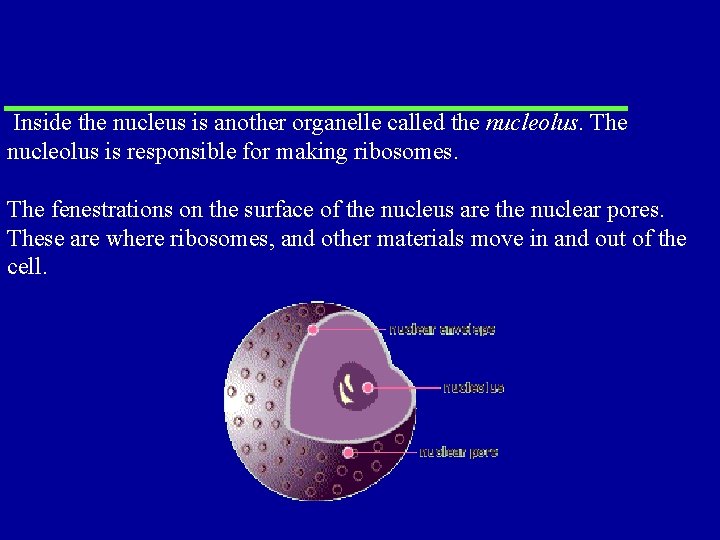
Inside the nucleus is another organelle called the nucleolus. The nucleolus is responsible for making ribosomes. The fenestrations on the surface of the nucleus are the nuclear pores. These are where ribosomes, and other materials move in and out of the cell.
Mitochondria
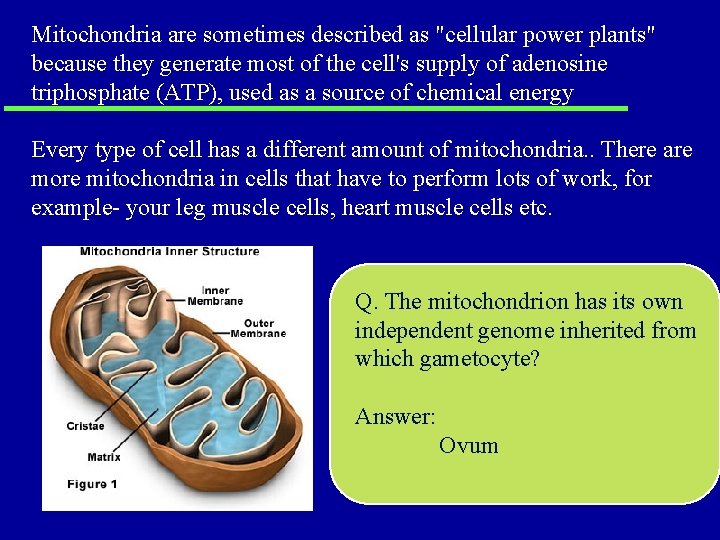
Mitochondria are sometimes described as "cellular power plants" because they generate most of the cell's supply of adenosine triphosphate (ATP), used as a source of chemical energy Every type of cell has a different amount of mitochondria. . There are more mitochondria in cells that have to perform lots of work, for example- your leg muscle cells, heart muscle cells etc. Q. The mitochondrion has its own independent genome inherited from which gametocyte? Answer: Ovum
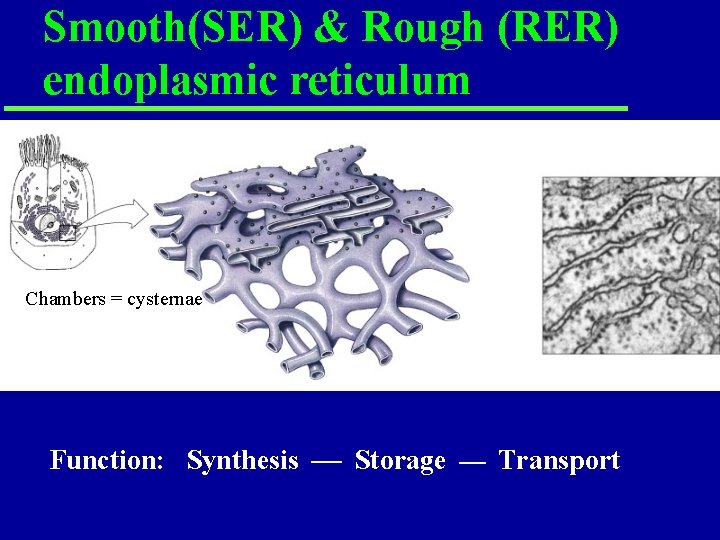
Smooth(SER) & Rough (RER) endoplasmic reticulum Chambers = cysternae Function: Synthesis Storage Transport
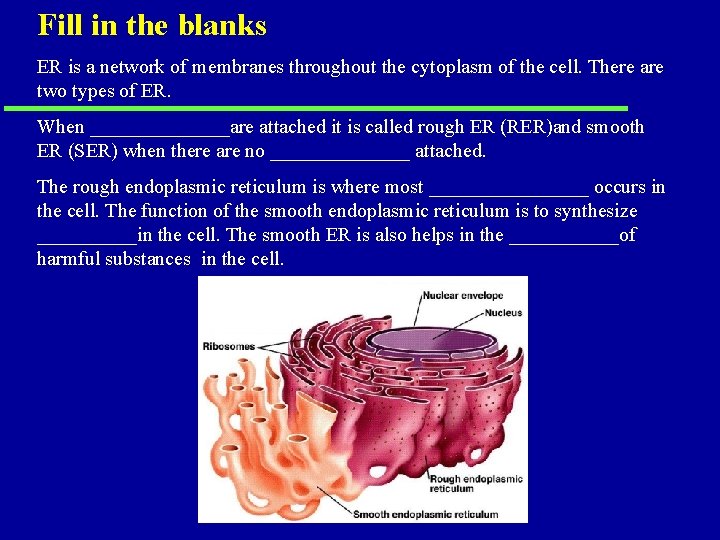
Fill in the blanks ER is a network of membranes throughout the cytoplasm of the cell. There are two types of ER. When _______are attached it is called rough ER (RER)and smooth ER (SER) when there are no _______ attached. The rough endoplasmic reticulum is where most ________ occurs in the cell. The function of the smooth endoplasmic reticulum is to synthesize _____in the cell. The smooth ER is also helps in the ______of harmful substances in the cell.
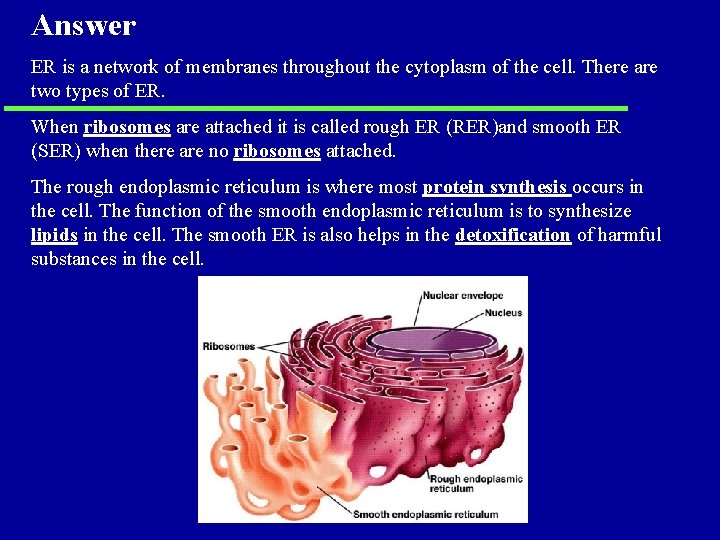
Answer ER is a network of membranes throughout the cytoplasm of the cell. There are two types of ER. When ribosomes are attached it is called rough ER (RER)and smooth ER (SER) when there are no ribosomes attached. The rough endoplasmic reticulum is where most protein synthesis occurs in the cell. The function of the smooth endoplasmic reticulum is to synthesize lipids in the cell. The smooth ER is also helps in the detoxification of harmful substances in the cell.
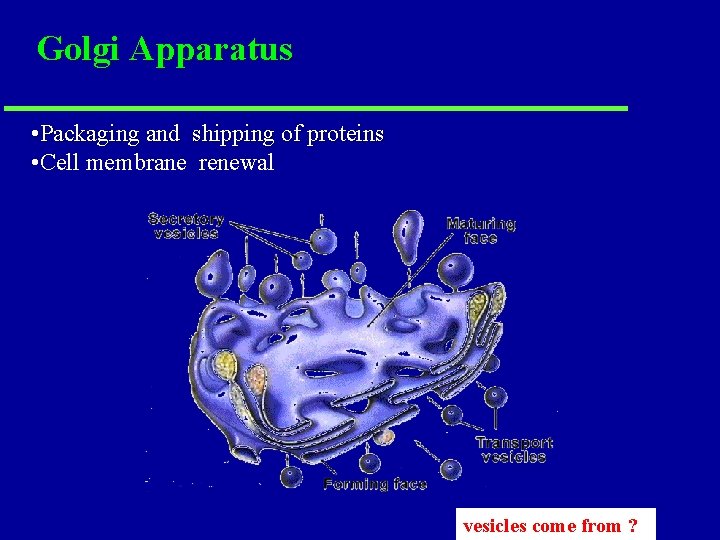
Golgi Apparatus • Packaging and shipping of proteins • Cell membrane renewal vesicles come from ?
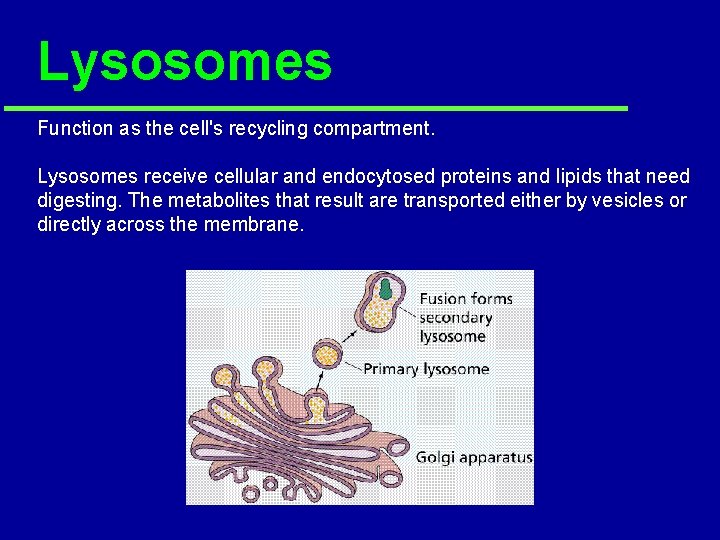
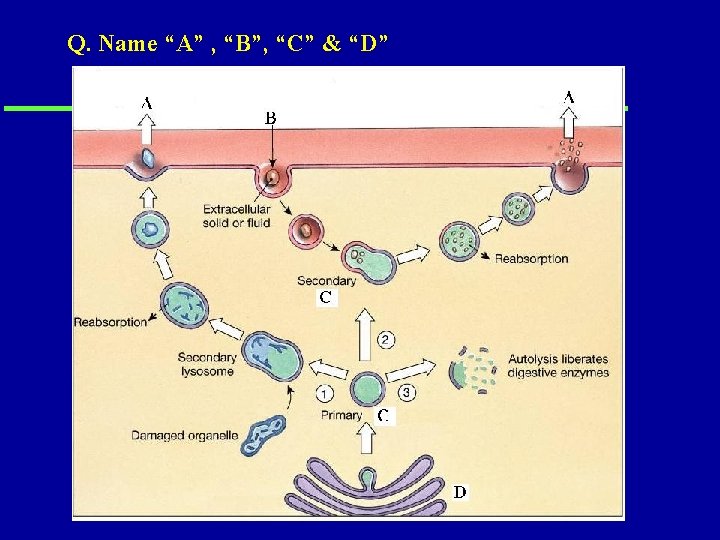
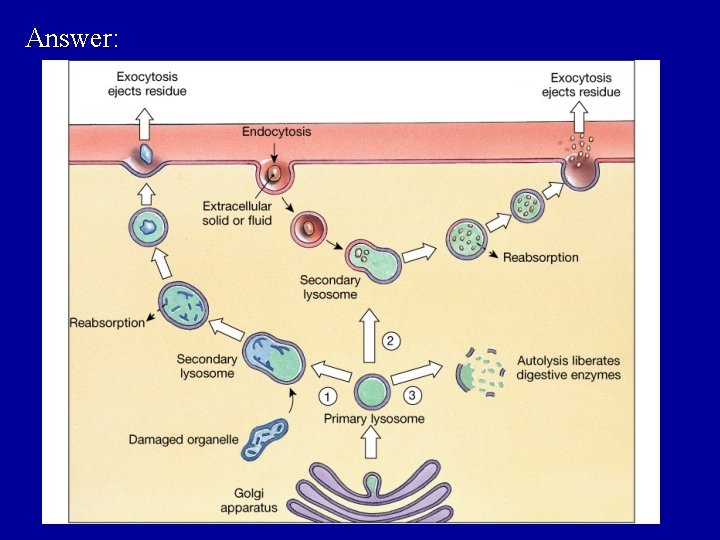
Lysosomes Function as the cell's recycling compartment. Lysosomes receive cellular and endocytosed proteins and lipids that need digesting. The metabolites that result are transported either by vesicles or directly across the membrane.
Answer:
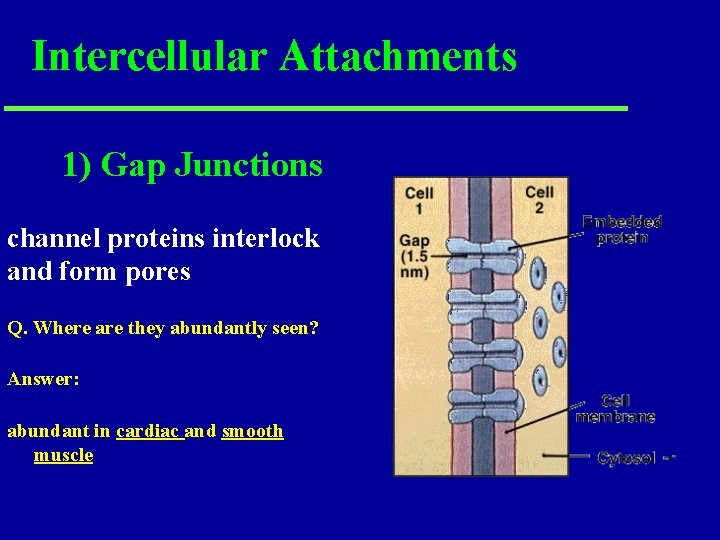
Intercellular Attachments 1) Gap Junctions channel proteins interlock and form pores Q. Where are they abundantly seen? Answer: abundant in cardiac and smooth muscle
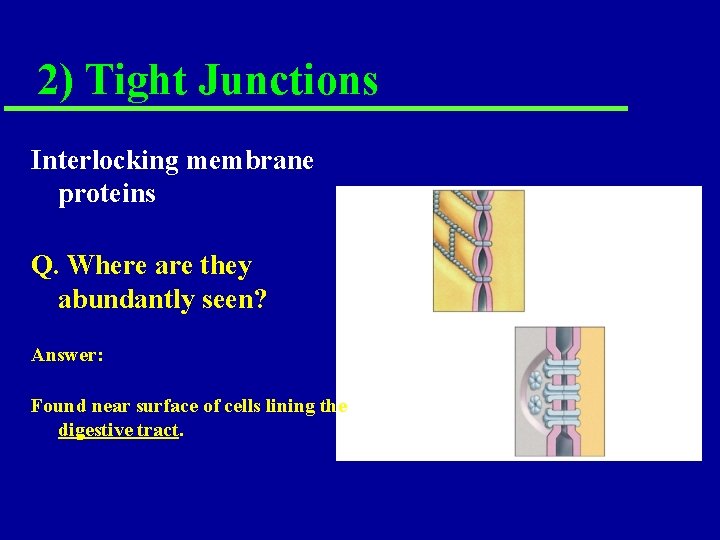
2) Tight Junctions Interlocking membrane proteins Q. Where are they abundantly seen? Answer: Found near surface of cells lining the digestive tract.
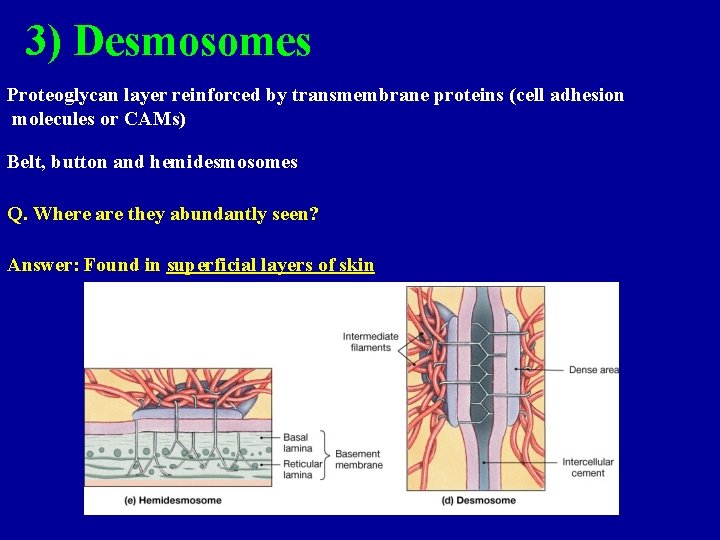
3) Desmosomes Proteoglycan layer reinforced by transmembrane proteins (cell adhesion molecules or CAMs) Belt, button and hemidesmosomes Q. Where are they abundantly seen? Answer: Found in superficial layers of skin