
The Cell Cycle Life cycle of cells Begins
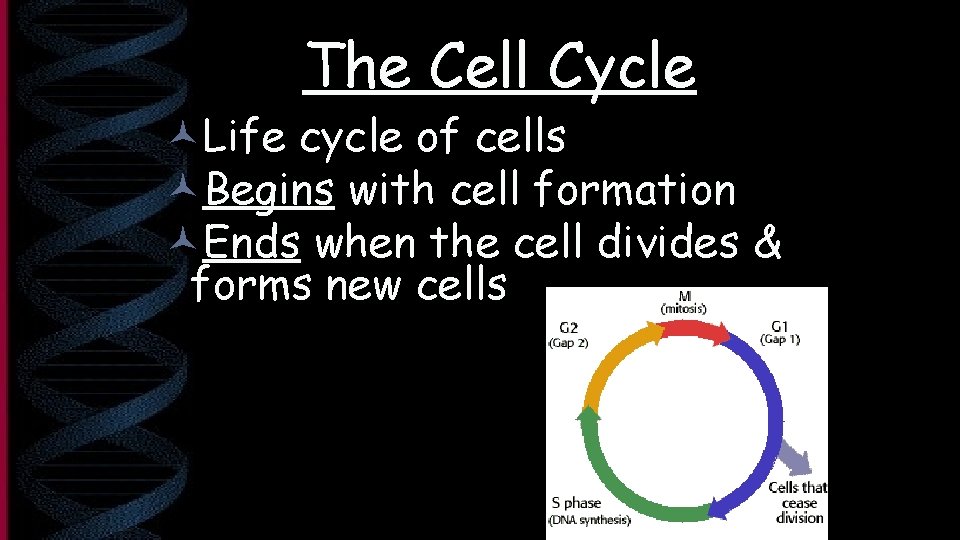
The Cell Cycle ©Life cycle of cells ©Begins with cell formation ©Ends when the cell divides & forms new cells

Why Cells Divide © Growth © Repair & Replace (maintain) © Reproduce © Mitosis (asexual = makes clones) like binary fission of bacteria © Meiosis (forms gametes for sexual reproduction)

Cell Size Limitations • The cells that make up a multicellular organism come in a wide variety of sizes & shapes. • Considering this wide range of cell sizes, why then can’t most organisms be just one giant cell? Diffusion limits cell size • Although diffusion is a fast & efficient process over short distances, it becomes slow & inefficient as the distances become larger. • Because of the slow rate of diffusion, organisms can’t be just one giant-sized cell.

Surface area-to-volume ratio If cell size doubled in size, the cell volume would require 8 times more nutrients & would have 8 times more waste to excrete. 4 mm 1 mm 2 mm 1 mm mm 2 Surface area = 6 Volume = 1 mm 3 4 mm 2 mm 4 mm Surface area = 24 mm 2 Volume = 8 mm 3 The surface area, however, would increase by a factor of only 4. The cell would either starve to death or be poisoned from the buildup of waste products.

Eukaryotic Reproduction: • Before eukaryotic cell division, DNA (chromatin) coils tightly around proteins & forms chromosomes. • At cell division, each chromosome consists of 2 sister chromatids attached at the centromere. • The chromatids separate during cell division into each new cell.

CHROMOSOMES Sister Chromatids are the two Parts of the chromosome and Are connected by the centromere

Chromosomes • Sets of Chromosomes • Each organism has a characteristic number of chromosomes. • Human somatic (body) cells are diploid (2 N) with 23 pairs (46 in total) of homologous chromosomes – contain genes that code for the same traits • Human gametes are haploid (N), with 23 chromosomes. Gametes are sex cells (sperm and egg) used in sexual reproduction • Sex Chromosomes- the 23 rd pair • These carry information that determines an organism’s sex. XX= female. XY= male

This is the cell cycle Interphase (most of the time) Consists of G 1, G 0, S and G 2 Interphase is sometimes known as the resting phase, but it is also when DNA is replicated by the cell (in the S phase) Study this!!! Mitosis: replicated chromosomes are split into two new daughter cells. See your notes and the workshops to learn about the phases of mitosis: Prophase, Metaphase, Anaphase and Telophase. Cytokinesis: the division of one cell into two daughter cells When cancer happens, the cell can’t reach G 0, it repeats the process of replication and division over and over. G 0: the cell stops dividing

The Cell Cycle Eukaryotic Cell • Interphase: A cell spends 90% of its time in interphase Interphase consists of 4 phases • G 1 - Growth • G 0 - Division stops • S - DNA synthesis-replication • G 2 - Preparation for cell division • Mitosis- division of the nucleus (chromosomes) • Cytokinesis- division of the cytoplasm S G 1 G 2

Before cell division: ©DNA replicates ©Remember, DNA has info that tells a cell how to make proteins

DNA Replication happens in the S phase G 0

Now we will look at the steps of DNA replication. Pay attention to the order and the enzymes involved.

Step 1 An enzyme called helicase “unzips” the DNA by breaking the hydrogen bonds apart and creating a replication fork. Each strand from the original molecule of DNA is called the “parent” strand.

Step 2 Enzymes called DNA polymerases add nucleotides one at a time to each parent strand. Each new strand is called a “daughter” strand

Step 3 The enzyme DNA ligase joins the backbone of each nucleotide together What is the backbone of DNA made of?

©With a partner, see how many of these questions you can answer… ©Helicase and polymerase are what kind of biomolecule? ©What does DNA Polymerase do? ©What does helicase do? ©What does ligase do? © 5’ to 3’ and 3’ to 5’ means that DNA replication is anti-_____.

The Ameoba Sisters ©https: //www. youtube. com/watch? v=5 q. Srmei. Ws uc#action=share
- Slides: 17