
The Cell Cycle and Mitosis Lesson 4 September
The Cell Cycle and Mitosis Lesson 4 September 27 th, 2010
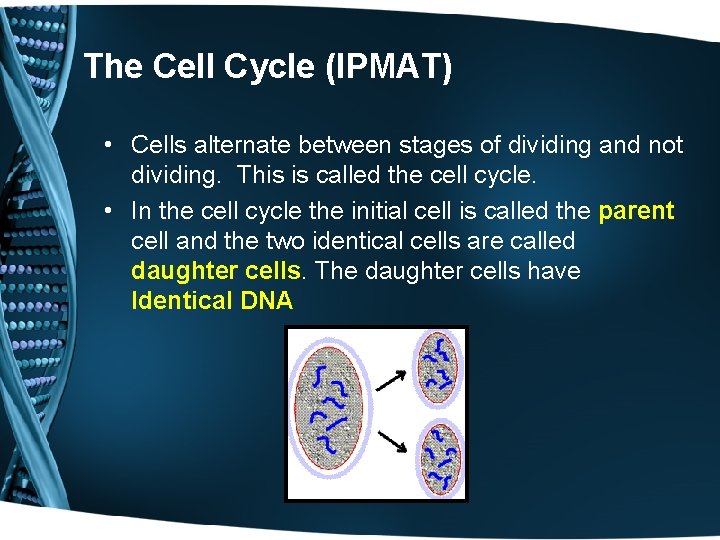
The Cell Cycle (IPMAT) • Cells alternate between stages of dividing and not dividing. This is called the cell cycle. • In the cell cycle the initial cell is called the parent cell and the two identical cells are called daughter cells. The daughter cells have Identical DNA

Functions of Cell Division Healing and tissue repair • Dead cells are replaced by new ones
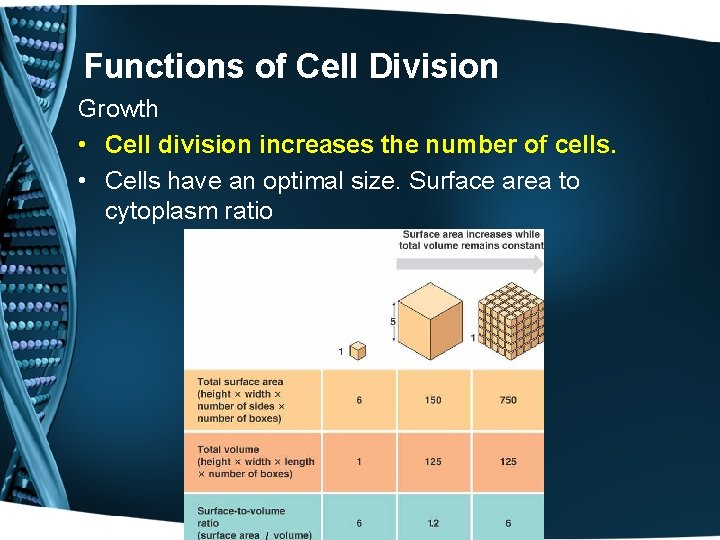
Functions of Cell Division Growth • Cell division increases the number of cells. • Cells have an optimal size. Surface area to cytoplasm ratio

Functions of Cell Division Reproduction of organisms • Perpetuates life • Fundamental to unicellular and multicellular organisms.
Chromosomes • Every cell contains chromosomes. • Each chromosome is a long piece of coiled DNA and proteins. The number of chromosomes in each cell differs between organisms. – Humans 46 – 23 matching pairs – Hermit crabs 254
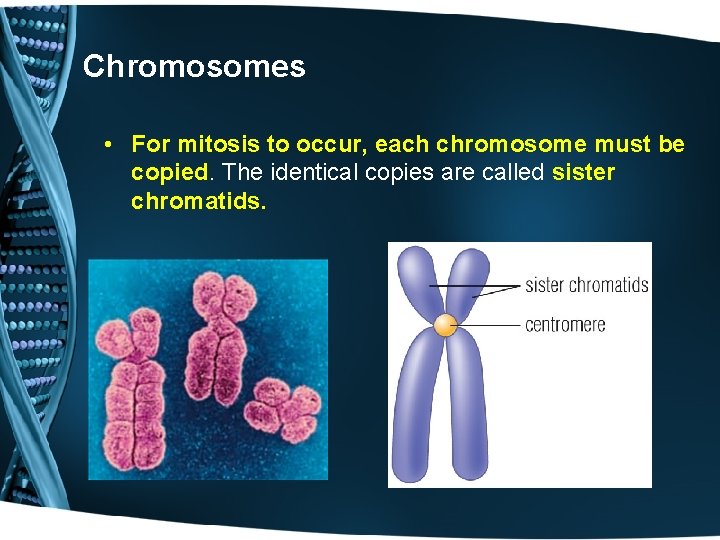
Chromosomes • For mitosis to occur, each chromosome must be copied. The identical copies are called sister chromatids.
Mitosis Movie
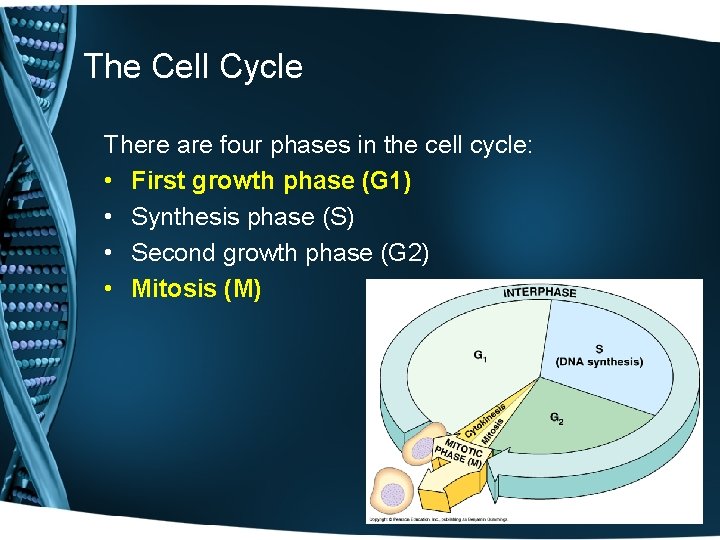
The Cell Cycle There are four phases in the cell cycle: • First growth phase (G 1) • Synthesis phase (S) • Second growth phase (G 2) • Mitosis (M)
The Three Phases of Interphase (IPMAT) • -A cell spends 90 percent of its time in interphase. 1. First Growth Phase (G 1) • Period of growth • Produces new proteins and organelles 2. Synthesis Phase (S) • Makes (synthesizes) an entire copy of the DNA of the cell. • Key proteins associated with chromosomes also copied
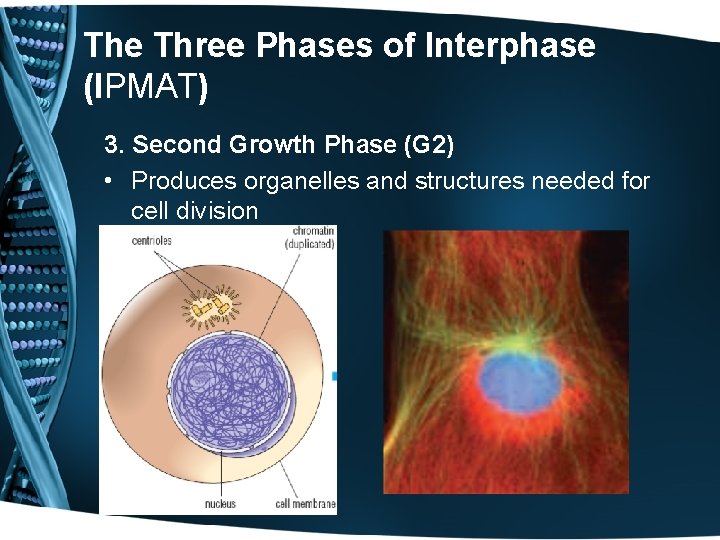
The Three Phases of Interphase (IPMAT) 3. Second Growth Phase (G 2) • Produces organelles and structures needed for cell division
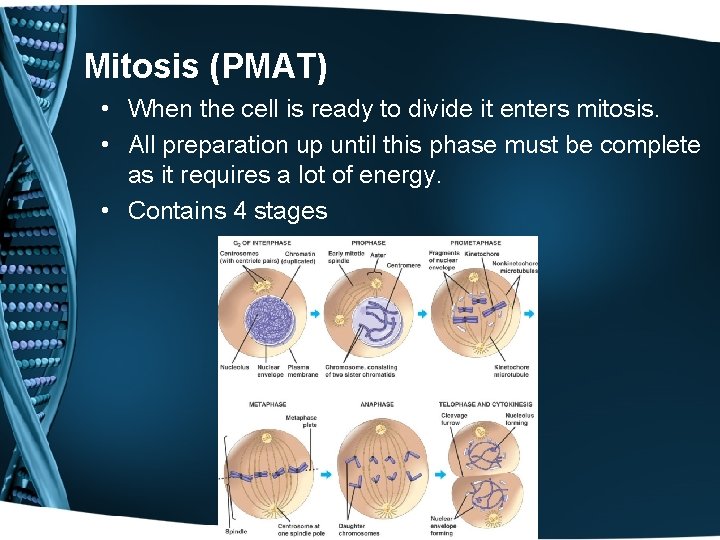
Mitosis (PMAT) • When the cell is ready to divide it enters mitosis. • All preparation up until this phase must be complete as it requires a lot of energy. • Contains 4 stages
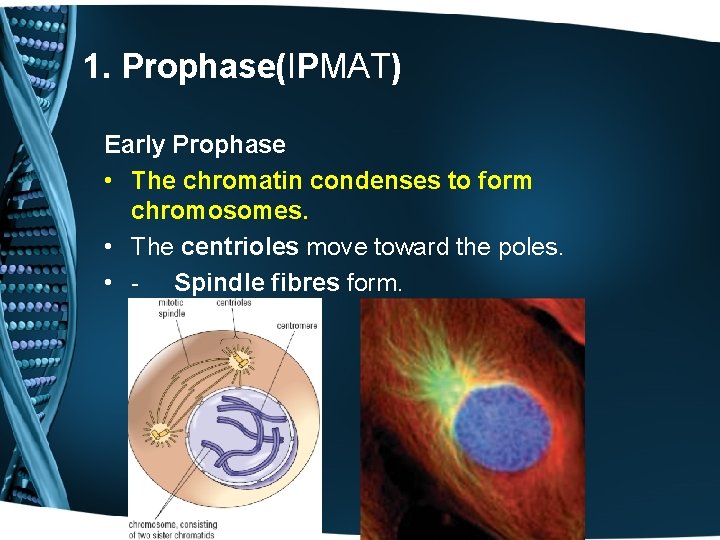
1. Prophase(IPMAT) Early Prophase • The chromatin condenses to form chromosomes. • The centrioles move toward the poles. • - Spindle fibres form.
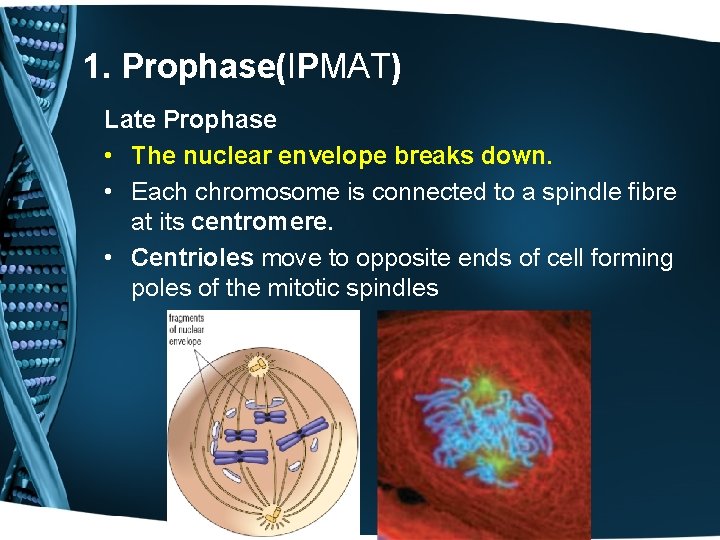
1. Prophase(IPMAT) Late Prophase • The nuclear envelope breaks down. • Each chromosome is connected to a spindle fibre at its centromere. • Centrioles move to opposite ends of cell forming poles of the mitotic spindles
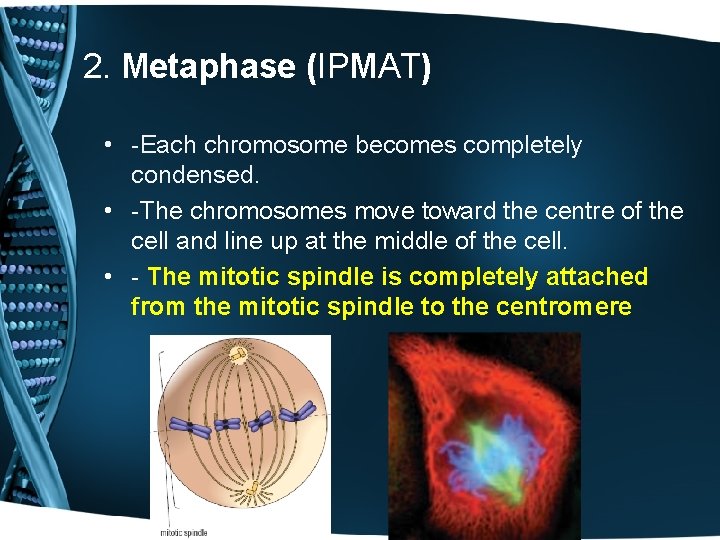
2. Metaphase (IPMAT) • -Each chromosome becomes completely condensed. • -The chromosomes move toward the centre of the cell and line up at the middle of the cell. • - The mitotic spindle is completely attached from the mitotic spindle to the centromere
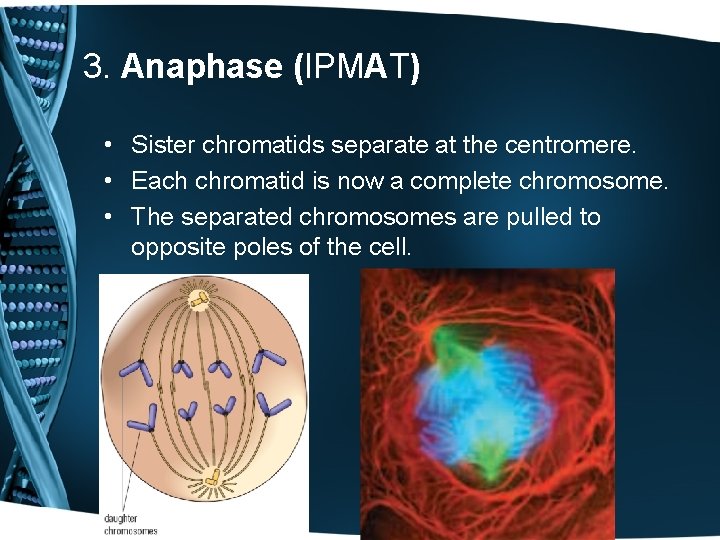
3. Anaphase (IPMAT) • Sister chromatids separate at the centromere. • Each chromatid is now a complete chromosome. • The separated chromosomes are pulled to opposite poles of the cell.
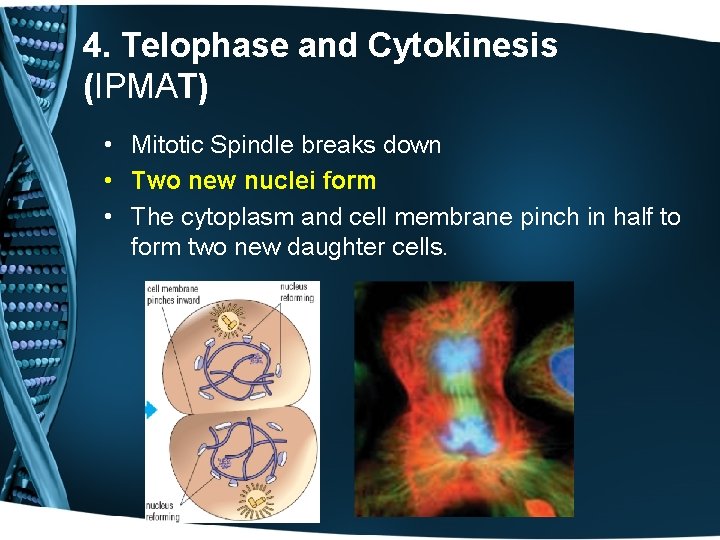
4. Telophase and Cytokinesis (IPMAT) • Mitotic Spindle breaks down • Two new nuclei form • The cytoplasm and cell membrane pinch in half to form two new daughter cells.
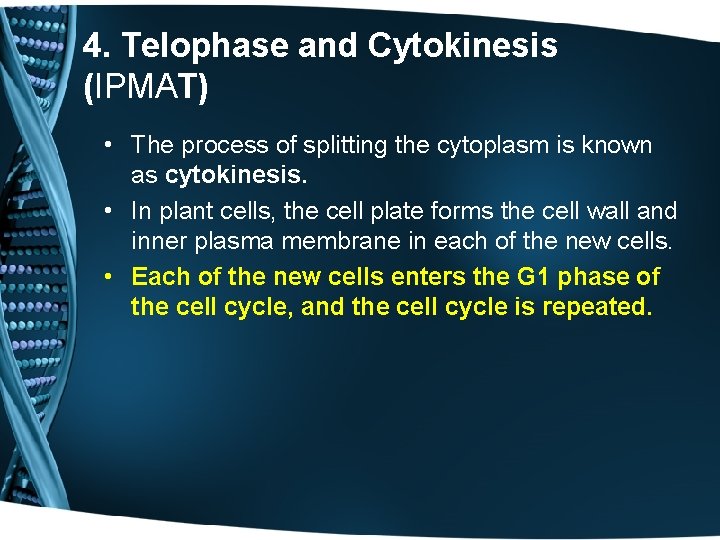
4. Telophase and Cytokinesis (IPMAT) • The process of splitting the cytoplasm is known as cytokinesis. • In plant cells, the cell plate forms the cell wall and inner plasma membrane in each of the new cells. • Each of the new cells enters the G 1 phase of the cell cycle, and the cell cycle is repeated.
Questions • 1. What is the purpose of the cell cycle? • 2. Define the term “interphase” and describe its purpose. • 3. (a) What is mitosis? • (b) Why is mitosis important to the cell? • 4. Define and distinguish between the following terms: chromosome, centromere, and sister chromatids. • 5. Explain the meaning and importance of the term “cytokinesis. ”
Micro viewer 55 • Do the questions and hand them in
- Slides: 20