
The CEFR and the MFL classroom PDST seminar
- Slides: 39
The CEFR and the MFL classroom PDST seminar Maynooth University 7 Nov 2015 Frédérique. rantz@languagesinitiative. ie
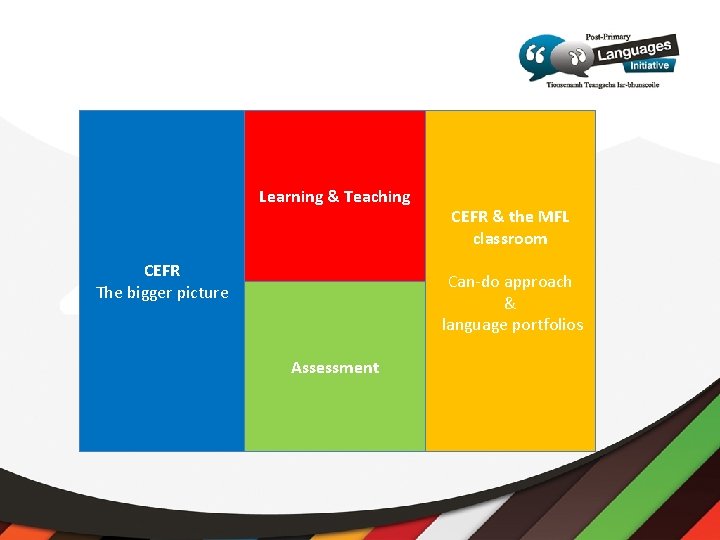
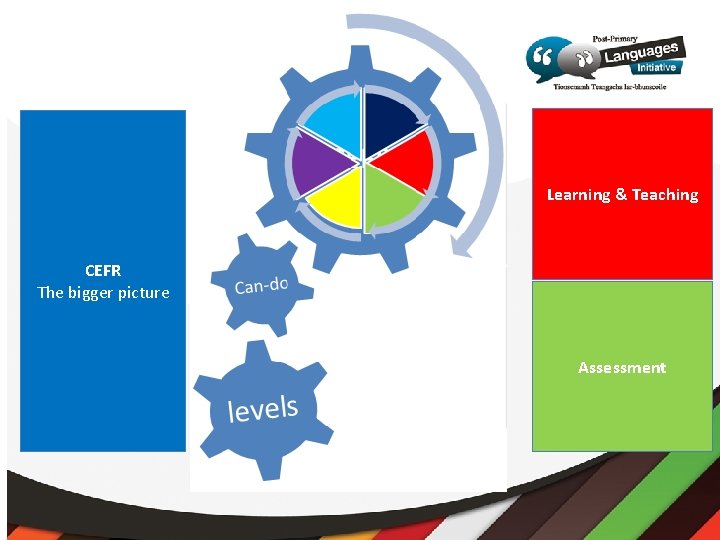
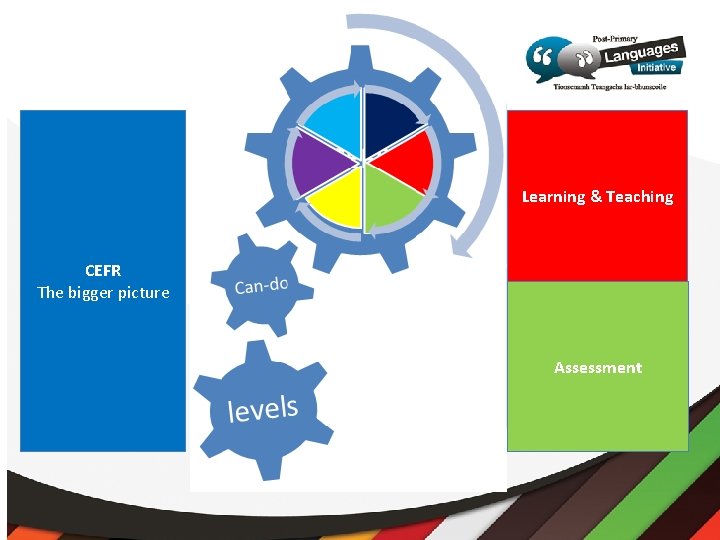
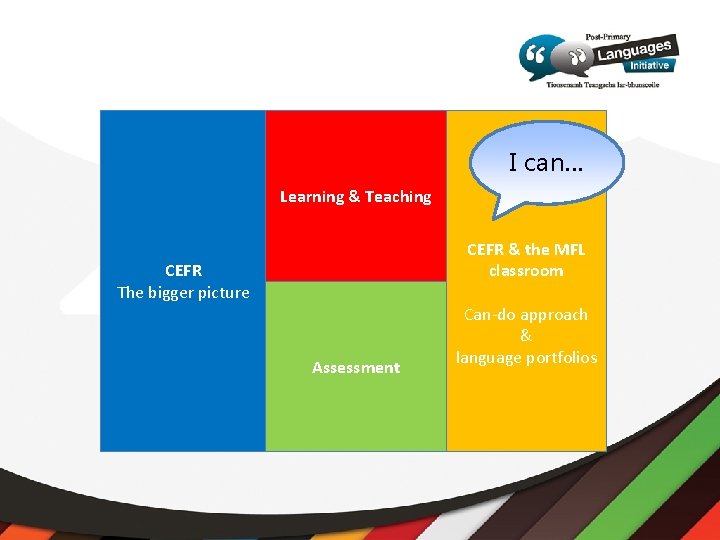
Learning & Teaching CEFR The bigger picture CEFR & the MFL classroom Can-do approach & language portfolios Assessment
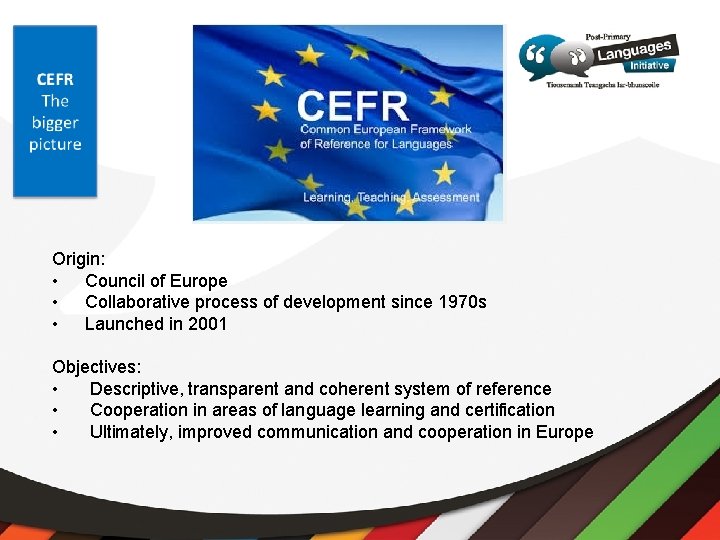
Origin: • Council of Europe • Collaborative process of development since 1970 s • Launched in 2001 Objectives: • Descriptive, transparent and coherent system of reference • Cooperation in areas of language learning and certification • Ultimately, improved communication and cooperation in Europe
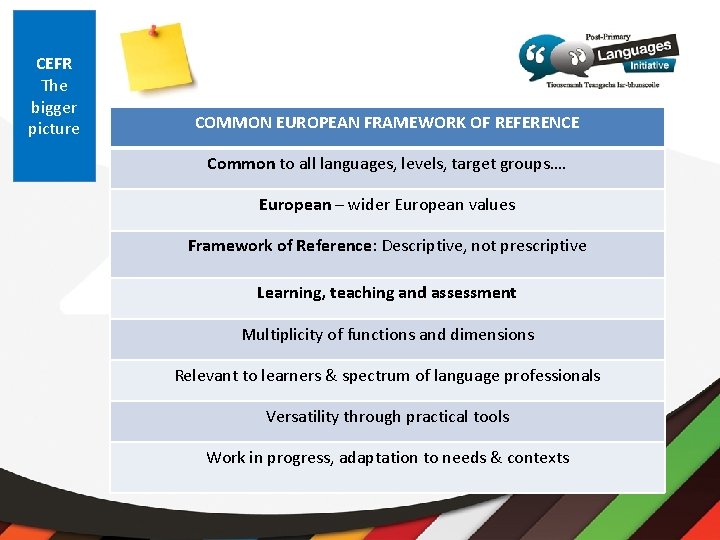
CEFR The bigger picture COMMON EUROPEAN FRAMEWORK OF REFERENCE Common to all languages, levels, target groups…. European – wider European values Framework of Reference: Descriptive, not prescriptive Learning, teaching and assessment Multiplicity of functions and dimensions Relevant to learners & spectrum of language professionals Versatility through practical tools Work in progress, adaptation to needs & contexts
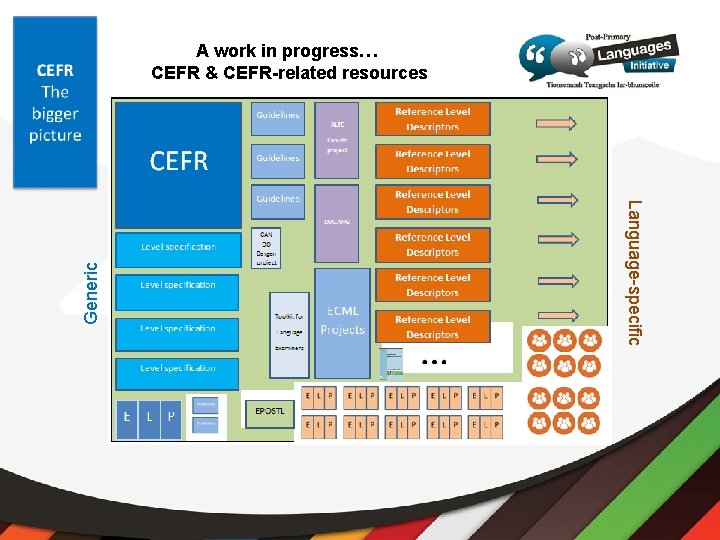
Language-specific Generic A work in progress… CEFR & CEFR-related resources
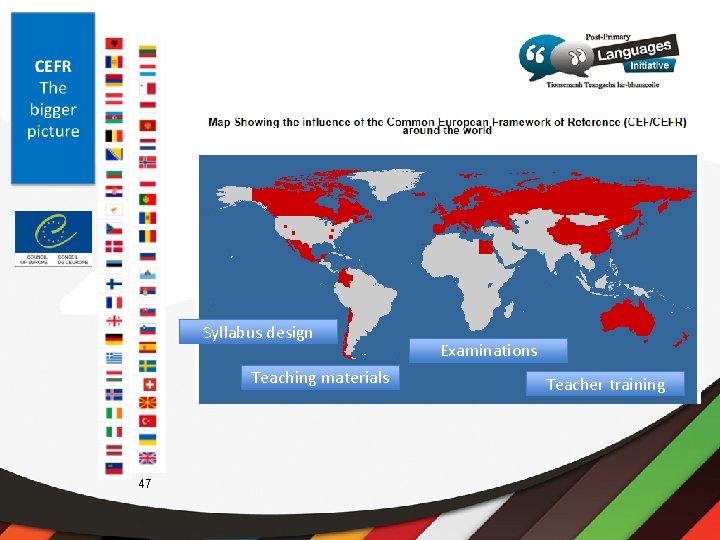
Syllabus design Teaching materials 47 Examinations Teacher training
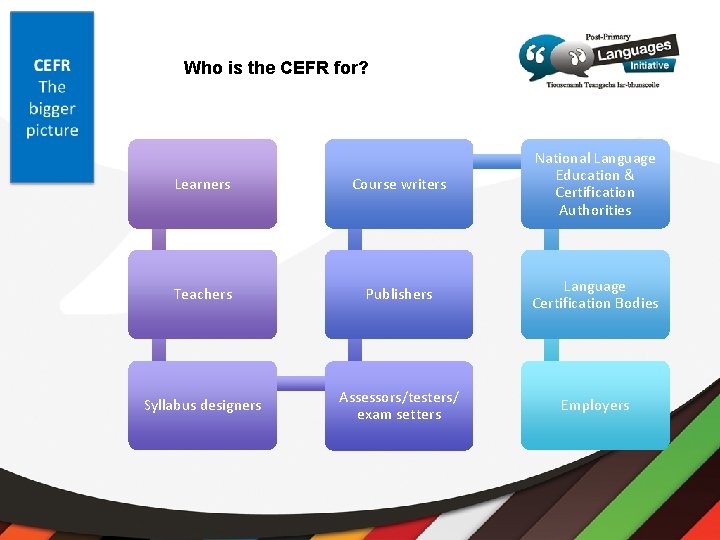
Who is the CEFR for? Learners Course writers National Language Education & Certification Authorities Teachers Publishers Language Certification Bodies Syllabus designers Assessors/testers/ exam setters Employers
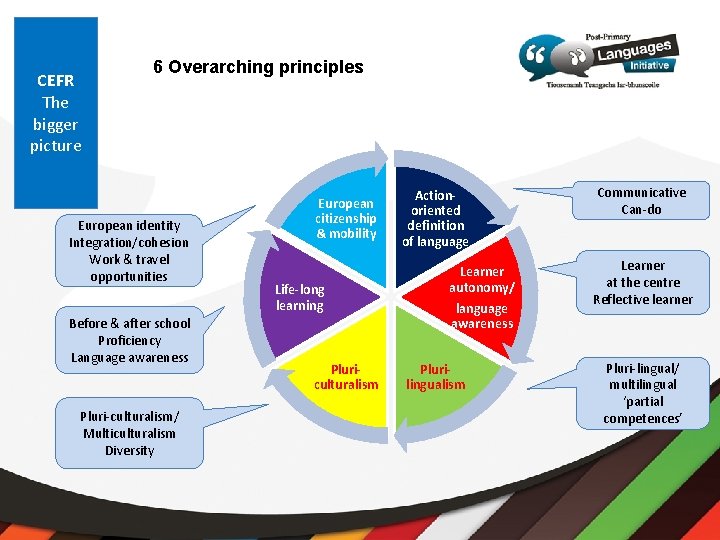
CEFR The bigger picture 6 Overarching principles European identity Integration/cohesion Work & travel opportunities Before & after school Proficiency Language awareness Pluri-culturalism/ Multiculturalism Diversity European citizenship & mobility Life-long learning Pluriculturalism Actionoriented definition of language Learner autonomy/ language awareness Plurilingualism Communicative Can-do Learner at the centre Reflective learner Pluri-lingual/ multilingual ‘partial competences’
My languages My level in each language 3 statements max. per partner Take note of: the languages + language levels of both partners
Learning & Teaching CEFR The bigger picture Assessment
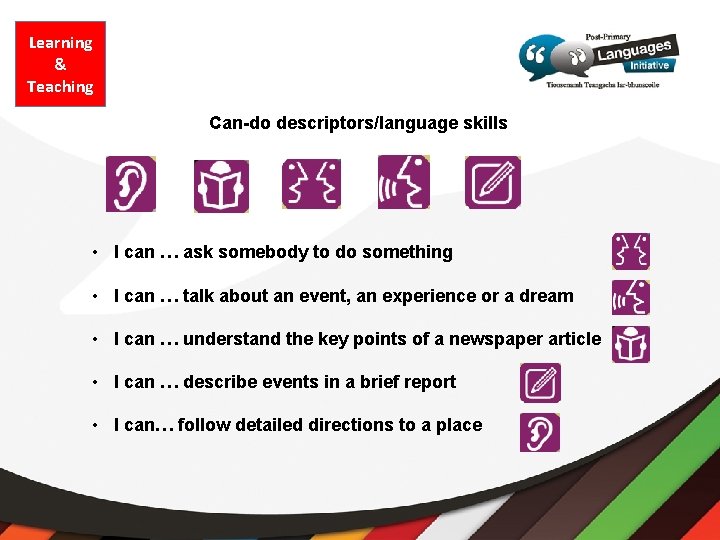
Learning & Teaching Can-do descriptors/language skills • I can … ask somebody to do something • I can … talk about an event, an experience or a dream • I can … understand the key points of a newspaper article • I can … describe events in a brief report • I can… follow detailed directions to a place
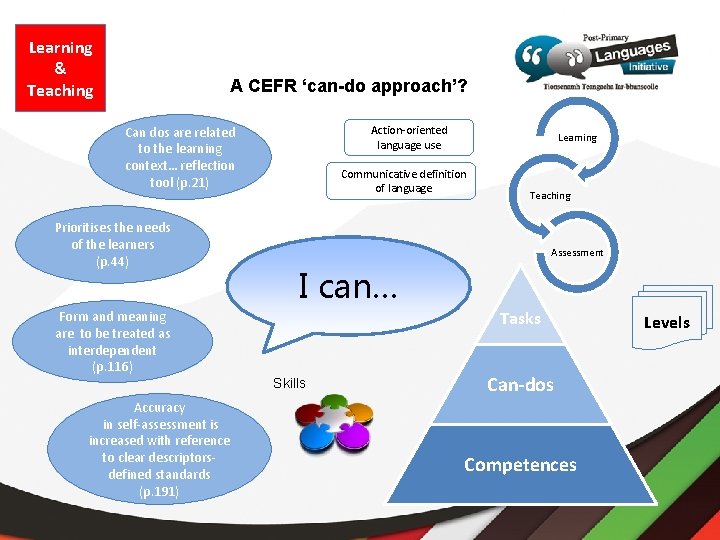
Learning & Teaching A CEFR ‘can-do approach’? Action-oriented language use Can dos are related to the learning context… reflection tool (p. 21) Prioritises the needs of the learners (p. 44) Form and meaning are to be treated as interdependent (p. 116) Accuracy in self-assessment is increased with reference to clear descriptorsdefined standards (p. 191) Learning Communicative definition of language Teaching Assessment I can… Tasks Skills Can-dos Competences Levels
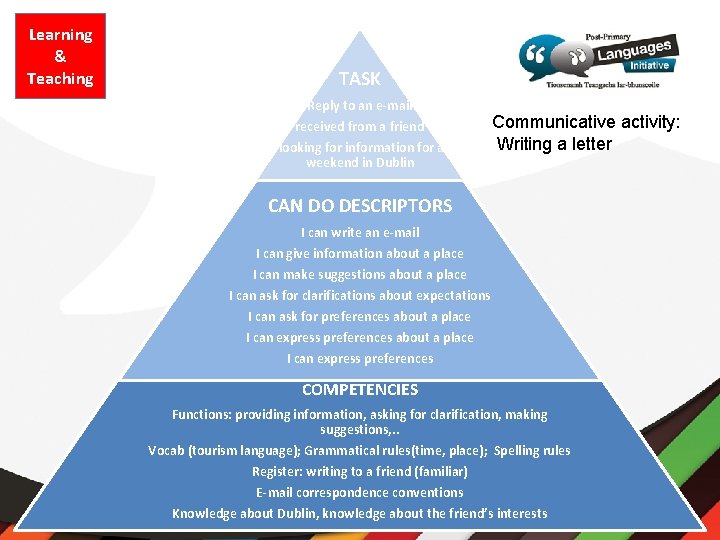
Learning & Teaching TASK Reply to an e-mail received from a friend looking for information for a weekend in Dublin Communicative activity: Writing a letter CAN DO DESCRIPTORS I can write an e-mail I can give information about a place I can make suggestions about a place I can ask for clarifications about expectations I can ask for preferences about a place I can express preferences COMPETENCIES Functions: providing information, asking for clarification, making suggestions, . . Vocab (tourism language); Grammatical rules(time, place); Spelling rules Register: writing to a friend (familiar) E-mail correspondence conventions Knowledge about Dublin, knowledge about the friend’s interests
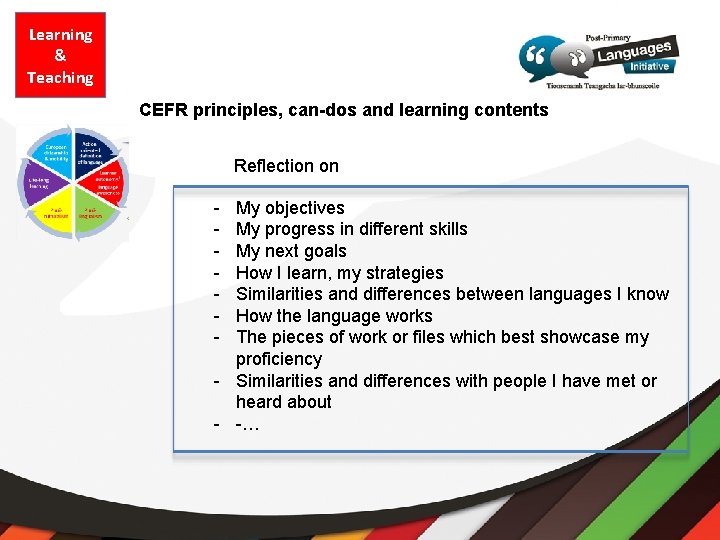
Learning & Teaching CEFR principles, can-dos and learning contents Reflection on - My objectives My progress in different skills My next goals How I learn, my strategies Similarities and differences between languages I know How the language works The pieces of work or files which best showcase my proficiency - Similarities and differences with people I have met or heard about - -…
Learning & Teaching 5 benefits of a ‘can-do’ approach - for students? 5 benefits of a ‘can-do’ approach - for teachers ?
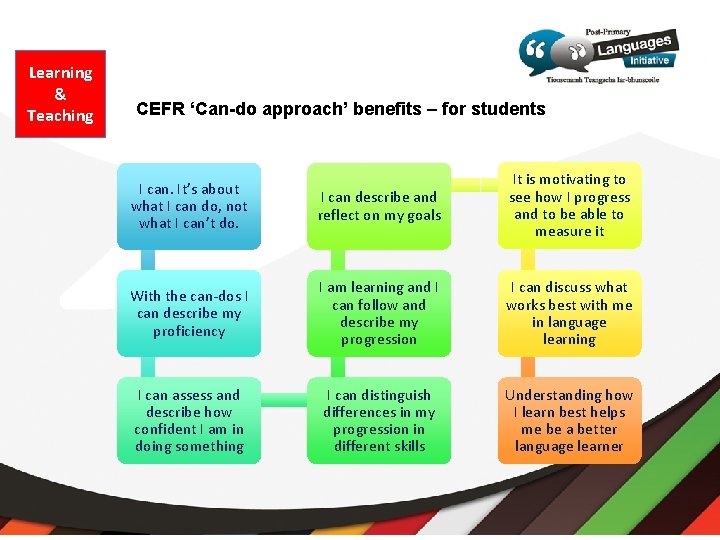
Learning & Teaching CEFR ‘Can-do approach’ benefits – for students I can. It’s about what I can do, not what I can’t do. I can describe and reflect on my goals It is motivating to see how I progress and to be able to measure it With the can-dos I can describe my proficiency I am learning and I can follow and describe my progression I can discuss what works best with me in language learning I can assess and describe how confident I am in doing something I can distinguish differences in my progression in different skills Understanding how I learn best helps me be a better language learner
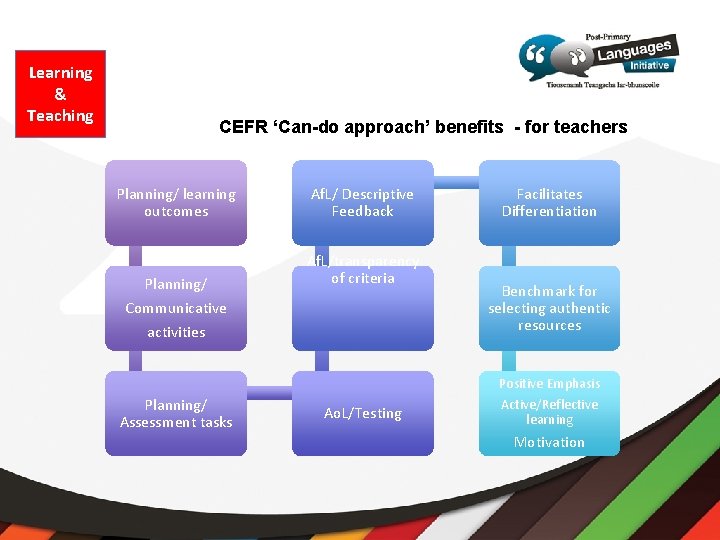
Learning & Teaching CEFR ‘Can-do approach’ benefits - for teachers Planning/ learning outcomes Planning/ Communicative Af. L/ Descriptive Feedback Af. L/transparency of criteria activities Facilitates Differentiation Benchmark for selecting authentic resources Positive Emphasis Planning/ Assessment tasks Ao. L/Testing Active/Reflective learning Motivation
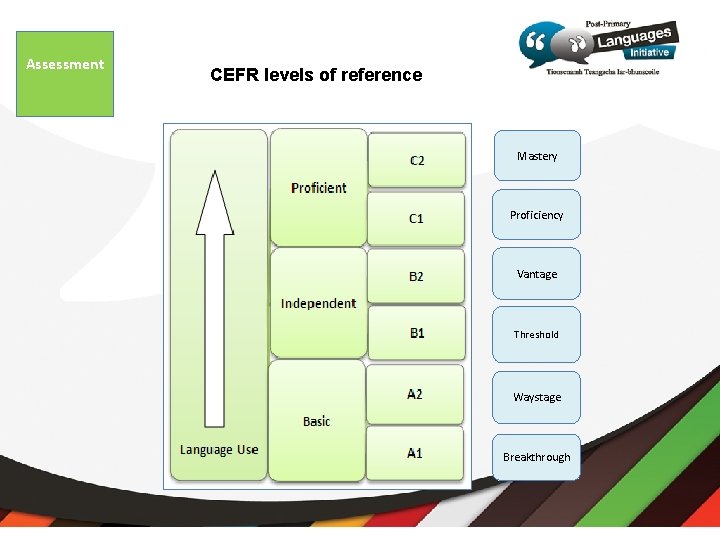
Assessment CEFR levels of reference Mastery Proficiency Vantage Threshold Waystage Breakthrough
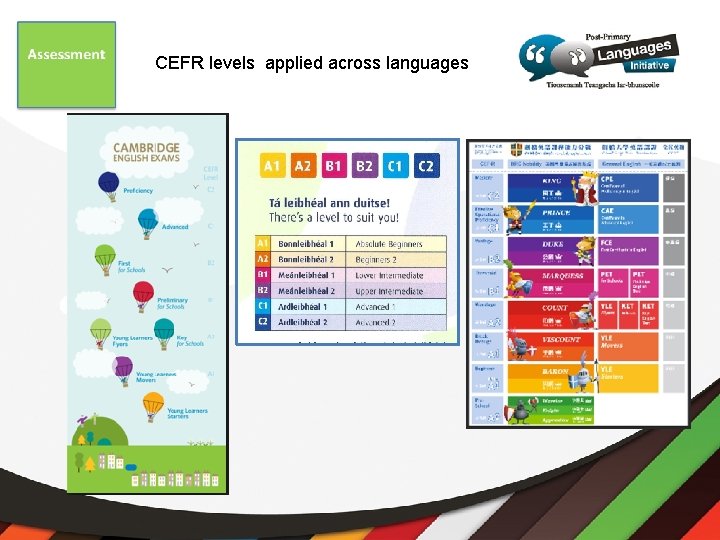
CEFR levels applied across languages
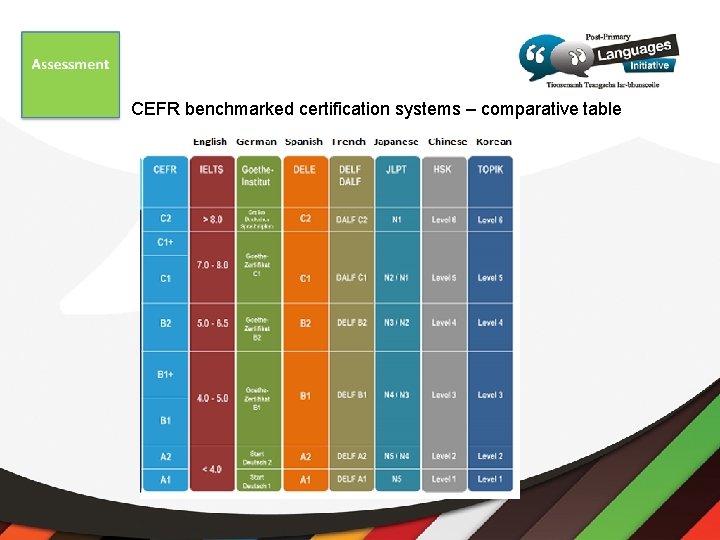
CEFR benchmarked certification systems – comparative table
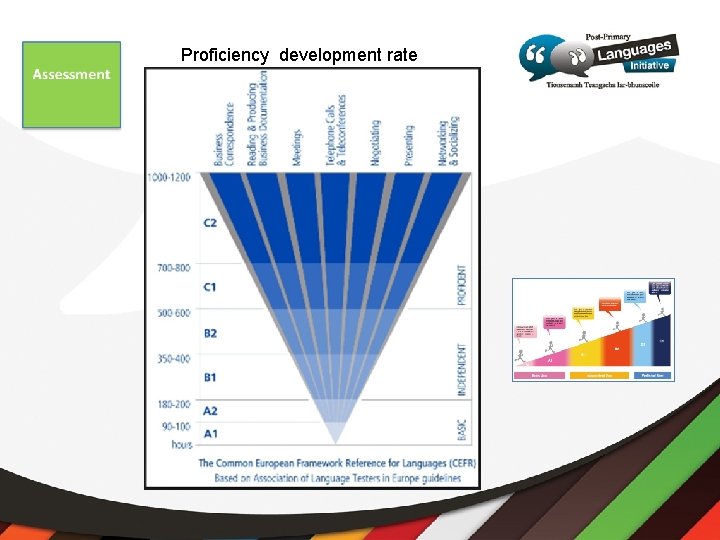
Proficiency development rate Levels funnel
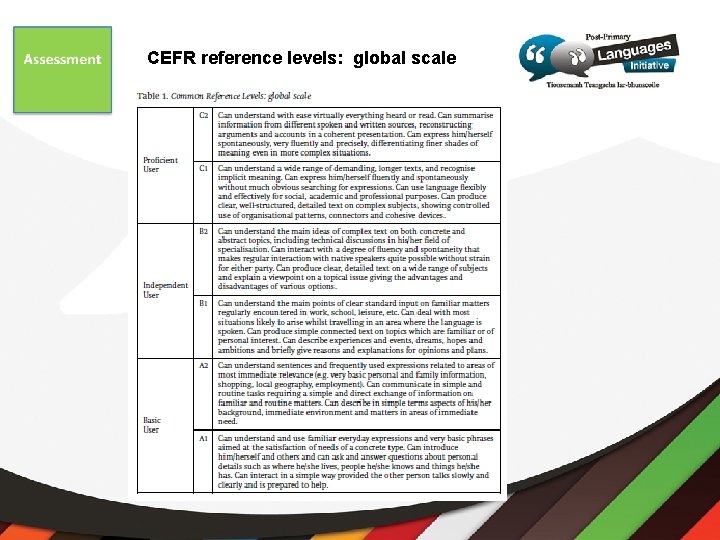
CEFR reference levels: global scale
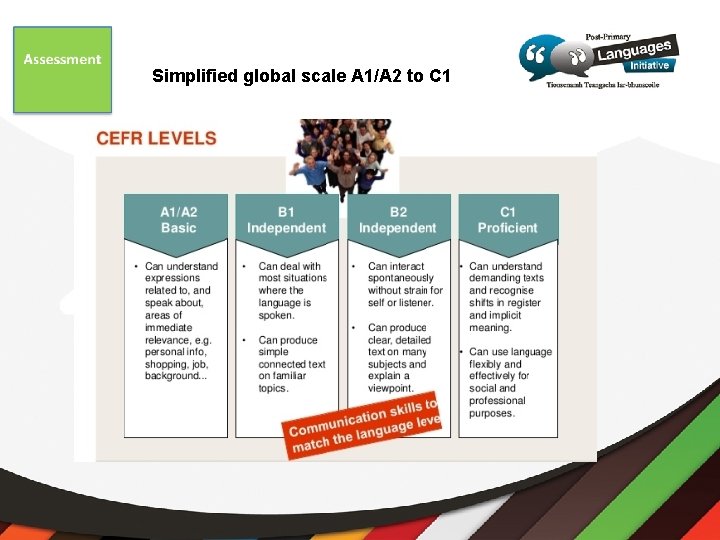
Simplified global scale A 1/A 2 to C 1 Global scale
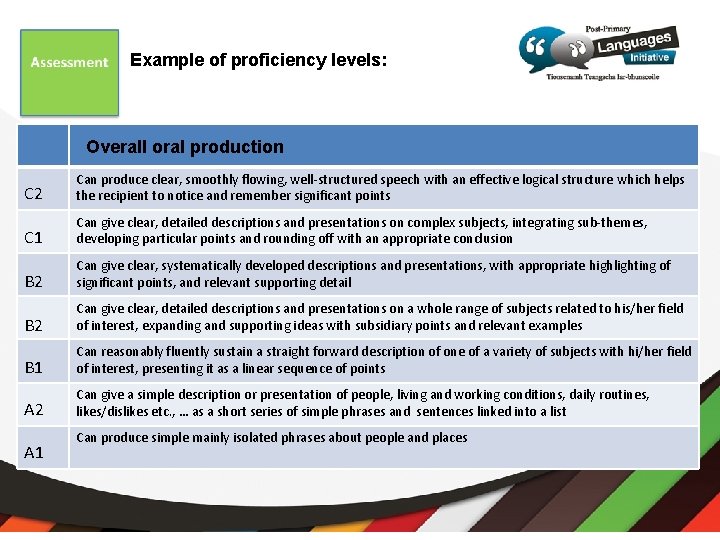
Example of proficiency levels: Overall oral production C 2 Can produce clear, smoothly flowing, well-structured speech with an effective logical structure which helps the recipient to notice and remember significant points C 1 Can give clear, detailed descriptions and presentations on complex subjects, integrating sub-themes, developing particular points and rounding off with an appropriate conclusion B 2 Can give clear, systematically developed descriptions and presentations, with appropriate highlighting of significant points, and relevant supporting detail B 2 Can give clear, detailed descriptions and presentations on a whole range of subjects related to his/her field of interest, expanding and supporting ideas with subsidiary points and relevant examples B 1 Can reasonably fluently sustain a straight forward description of one of a variety of subjects with hi/her field of interest, presenting it as a linear sequence of points A 2 Can give a simple description or presentation of people, living and working conditions, daily routines, likes/dislikes etc. , … as a short series of simple phrases and sentences linked into a list A 1 Can produce simple mainly isolated phrases about people and places
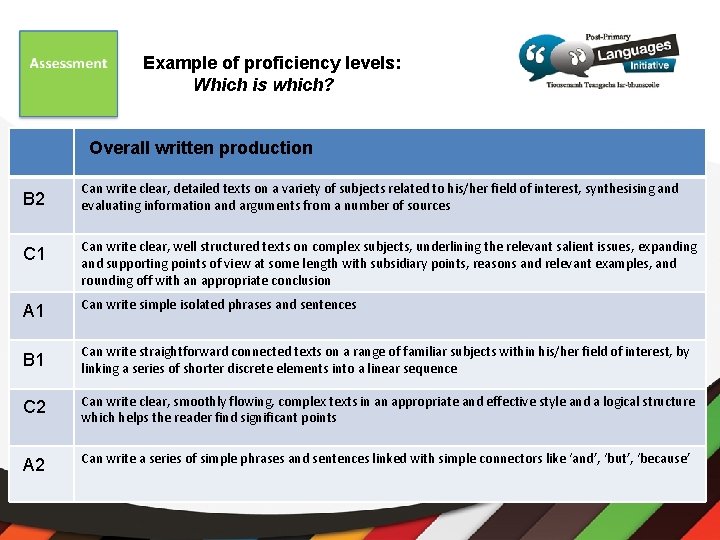
Example of proficiency levels: Which is which? Overall written production B 2 Can write clear, detailed texts on a variety of subjects related to his/her field of interest, synthesising and evaluating information and arguments from a number of sources C 1 Can write clear, well structured texts on complex subjects, underlining the relevant salient issues, expanding and supporting points of view at some length with subsidiary points, reasons and relevant examples, and rounding off with an appropriate conclusion A 1 Can write simple isolated phrases and sentences B 1 Can write straightforward connected texts on a range of familiar subjects within his/her field of interest, by linking a series of shorter discrete elements into a linear sequence C 2 Can write clear, smoothly flowing, complex texts in an appropriate and effective style and a logical structure which helps the reader find significant points A 2 Can write a series of simple phrases and sentences linked with simple connectors like ‘and’, ‘but’, ‘because’
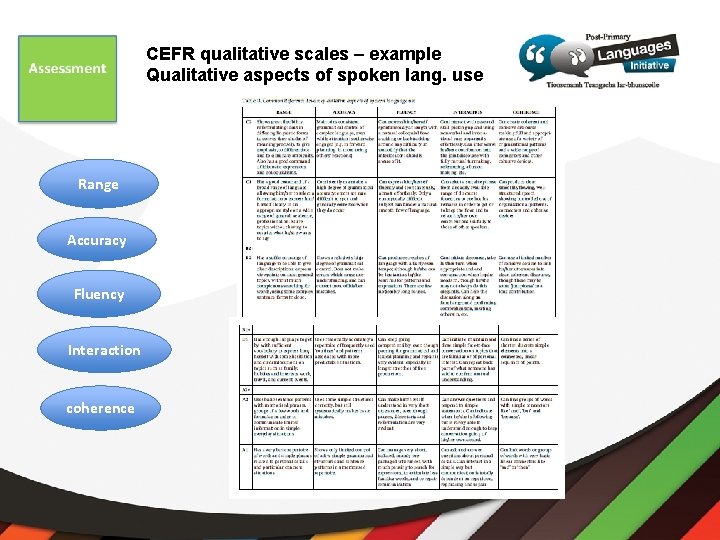
CEFR qualitative scales – example Qualitative aspects of spoken lang. use Range Accuracy Fluency Interaction coherence
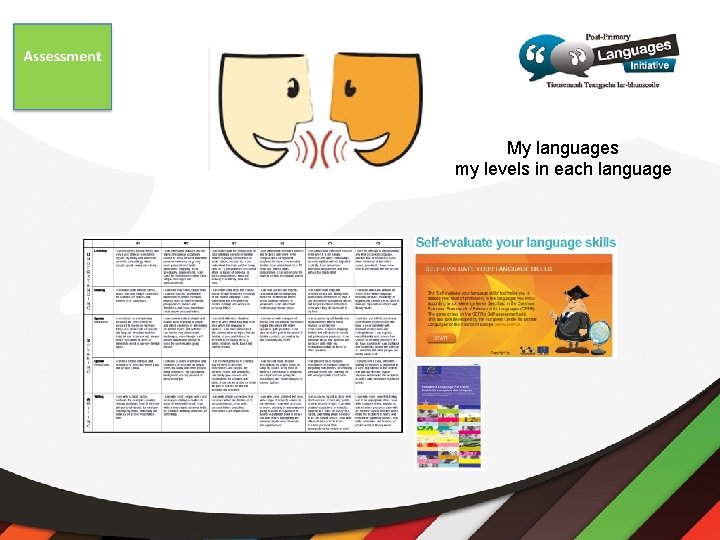
My languages my levels in each language
Learning & Teaching CEFR The bigger picture Assessment
I can… Learning & Teaching CEFR & the MFL classroom CEFR The bigger picture Assessment Can-do approach & language portfolios
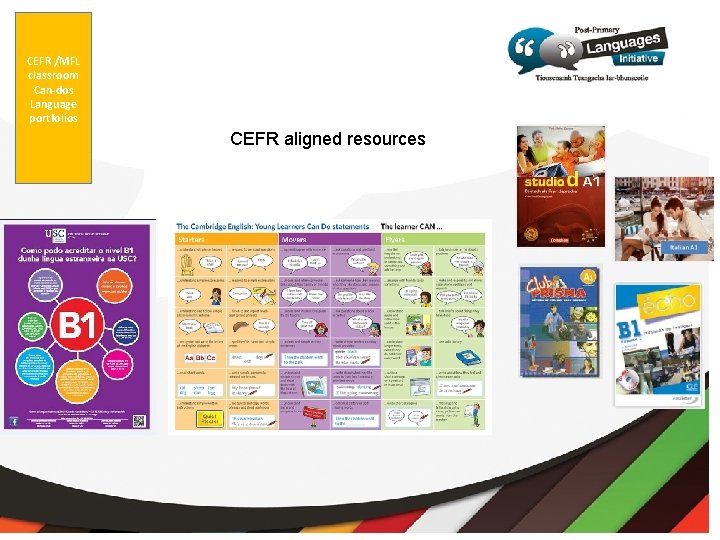
CEFR /MFL classroom Can-dos Language portfolios CEFR aligned resources
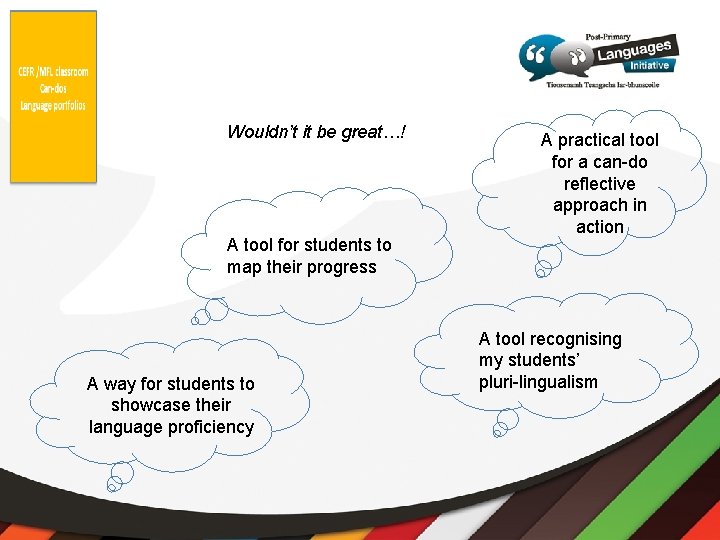
Wouldn’t it be great…! A tool for students to map their progress A way for students to showcase their language proficiency A practical tool for a can-do reflective approach in action A tool recognising my students’ pluri-lingualism
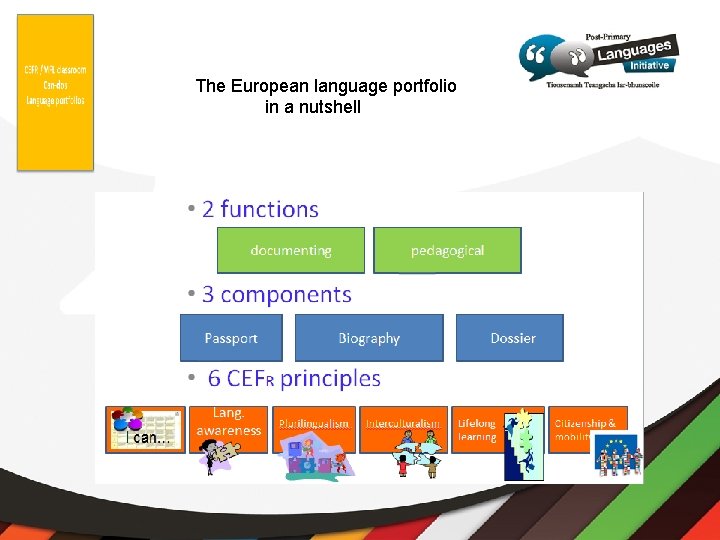
The European language portfolio in a nutshell
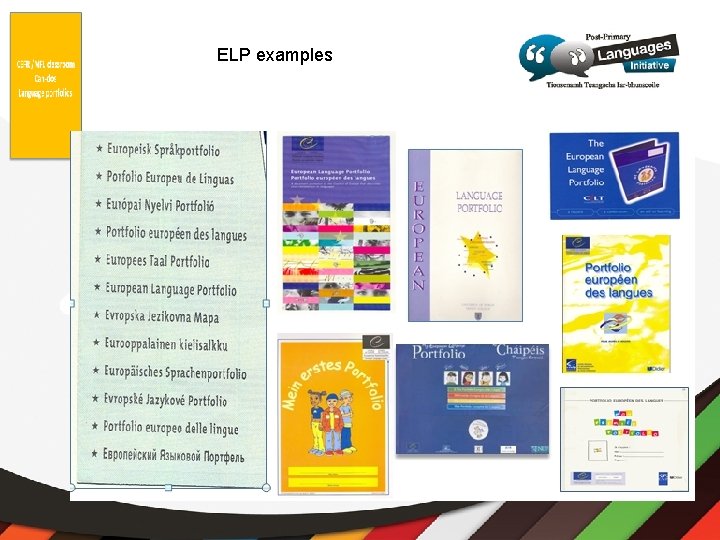
ELP examples
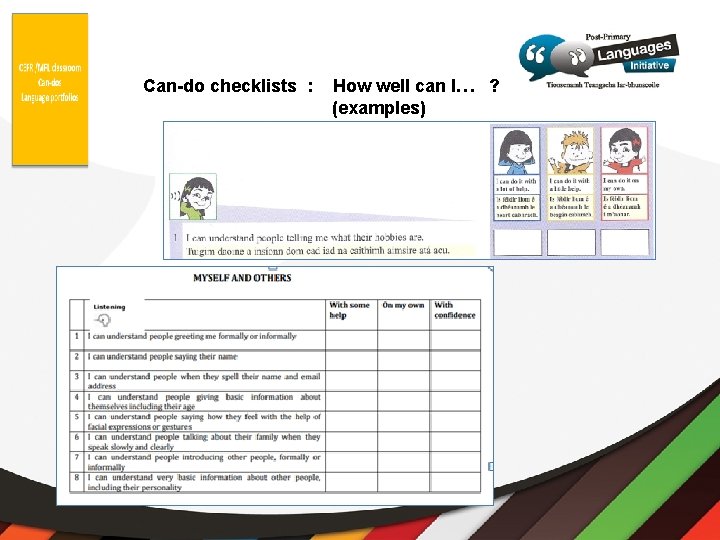
Can-do checklists : How well can I… ? (examples)
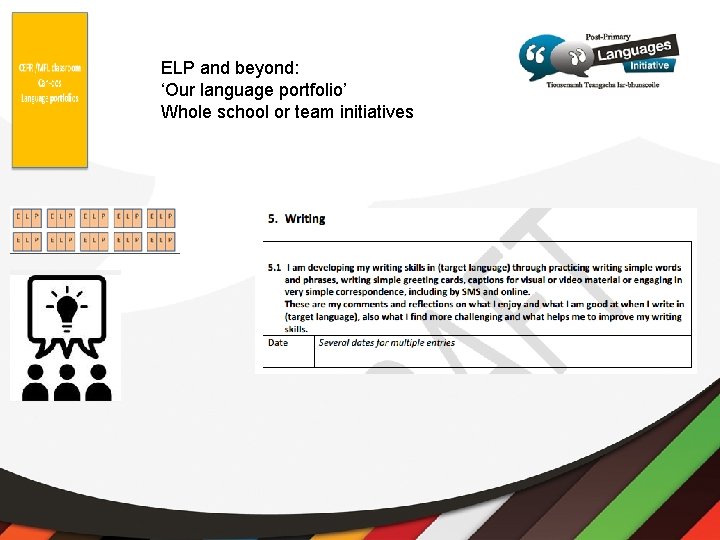
ELP and beyond: ‘Our language portfolio’ Whole school or team initiatives
Conclusion: A question and an invitation Questio n Parallels between the CEFR can-do approach to learning and the Junior Cycle key skills framework?
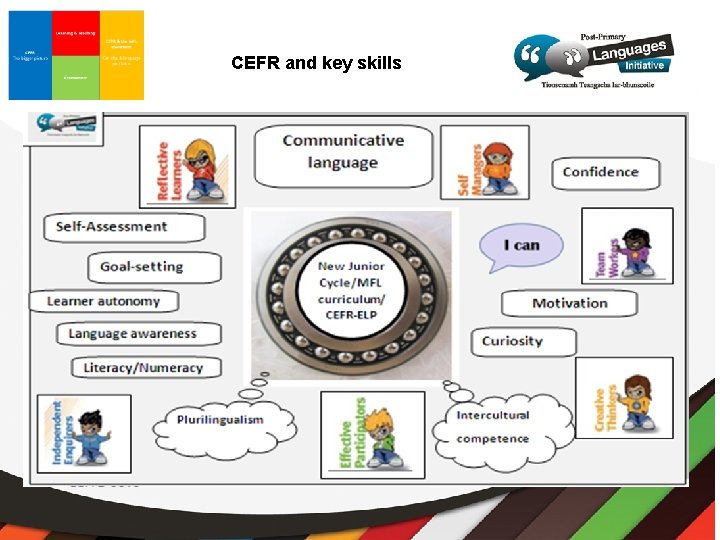
CEFR and key skills
CEFR and the MFL classroom An invitation CEFR + ELP-based language portfolio = Toolkit for innovation and change in MFL classroom Students mapping their own language learning journey