
The Causes of The Industrial Revolution ic History


- Slides: 11
The Causes of The Industrial Revolution ic. History. com
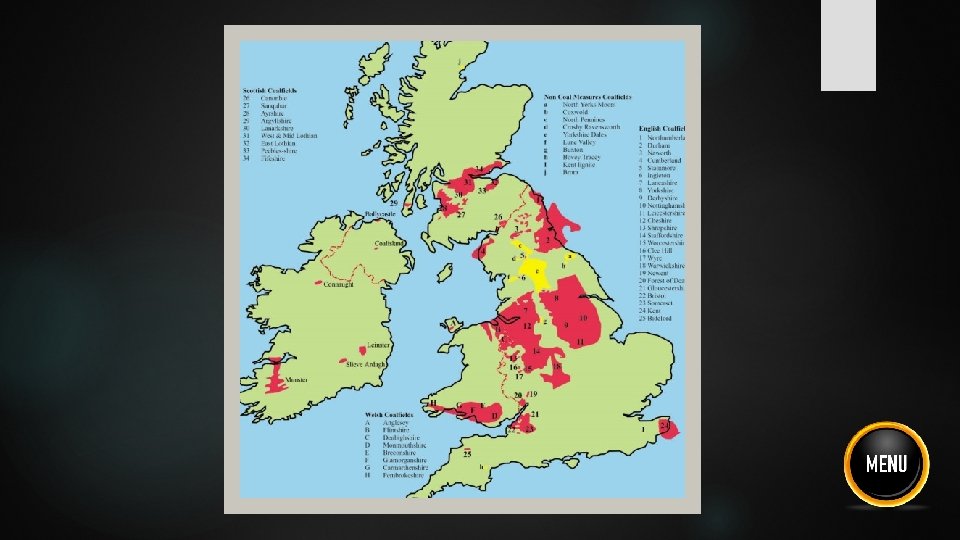
Enter causes menu here … Download FREE supporting resources here … Enlarged Map of UK Coal Deposits … Denotes relevant video links ‘How to operate a steam engine’ here …
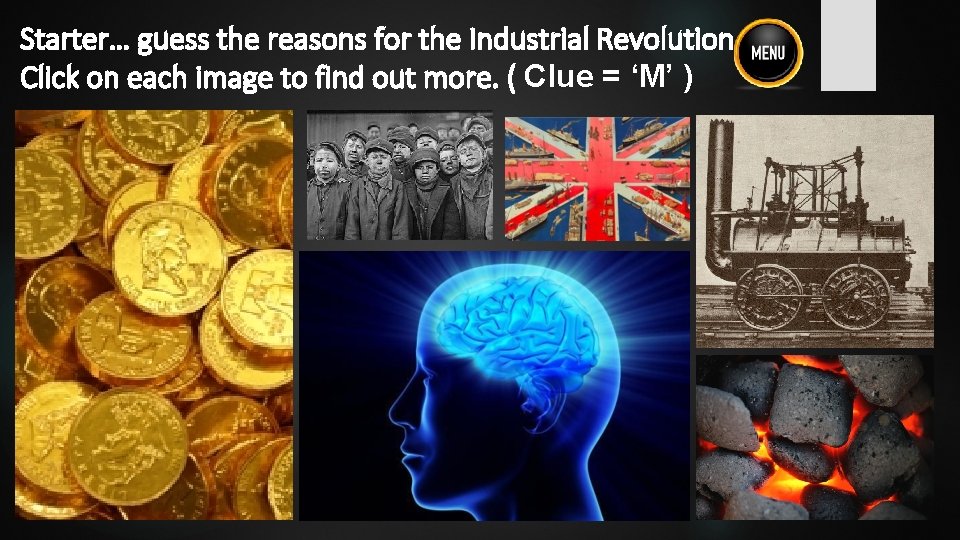
Starter… guess the reasons for the Industrial Revolution Click on each image to find out more. ( Clue = ‘M’ )
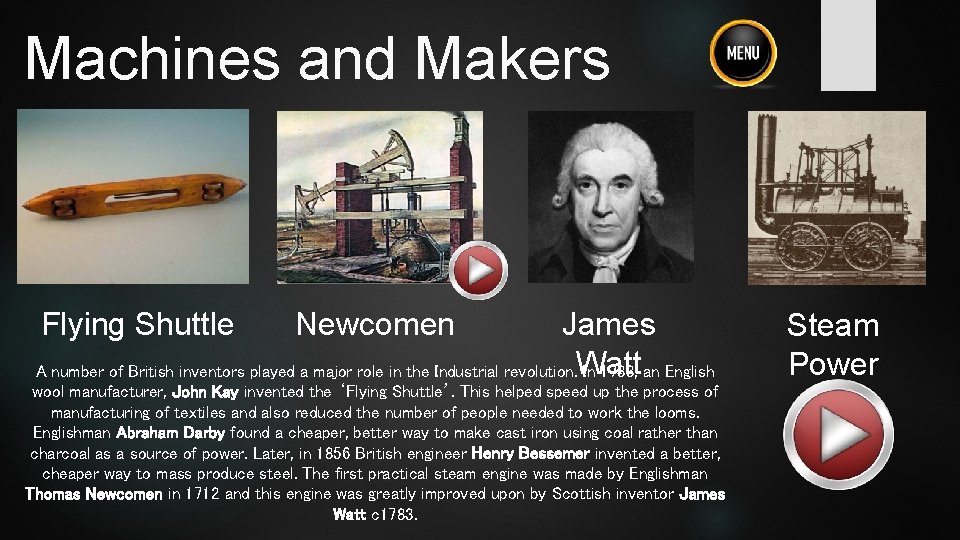
Machines and Makers James A number of British inventors played a major role in the Industrial revolution. Watt In 1733, an English Flying Shuttle Newcomen wool manufacturer, John Kay invented the ‘Flying Shuttle’. This helped speed up the process of manufacturing of textiles and also reduced the number of people needed to work the looms. Englishman Abraham Darby found a cheaper, better way to make cast iron using coal rather than charcoal as a source of power. Later, in 1856 British engineer Henry Bessemer invented a better, cheaper way to mass produce steel. The first practical steam engine was made by Englishman Thomas Newcomen in 1712 and this engine was greatly improved upon by Scottish inventor James Watt c 1783. Steam Power
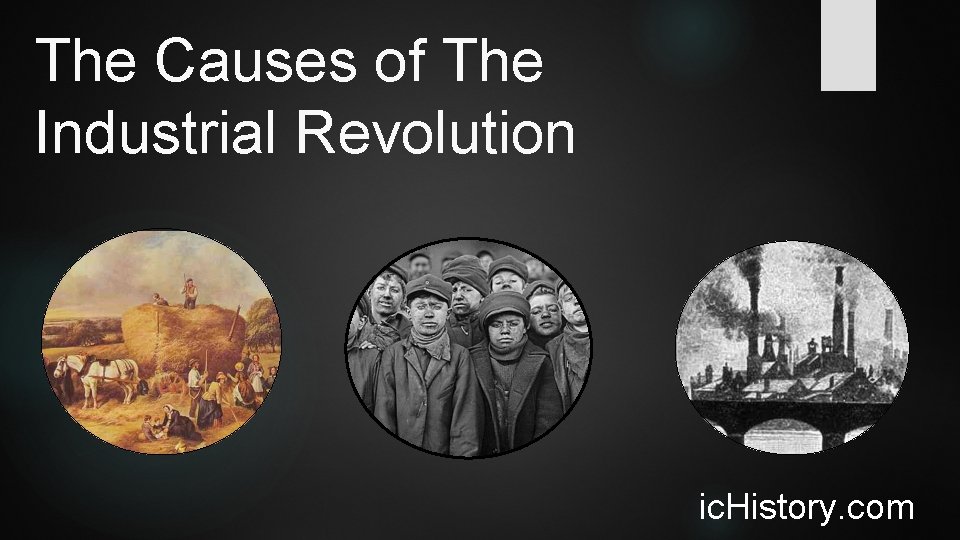
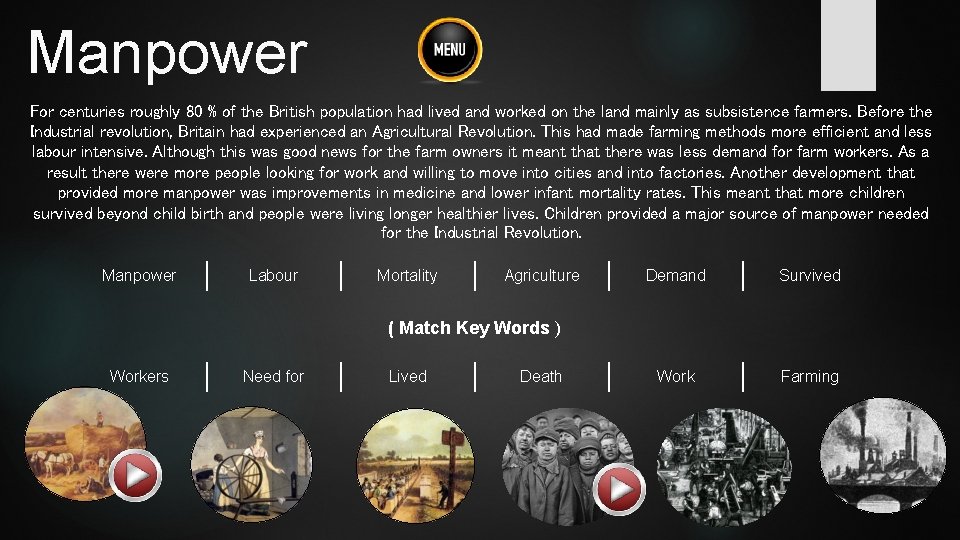
Manpower For centuries roughly 80 % of the British population had lived and worked on the land mainly as subsistence farmers. Before the Industrial revolution, Britain had experienced an Agricultural Revolution. This had made farming methods more efficient and less labour intensive. Although this was good news for the farm owners it meant that there was less demand for farm workers. As a result there were more people looking for work and willing to move into cities and into factories. Another development that provided more manpower was improvements in medicine and lower infant mortality rates. This meant that more children survived beyond child birth and people were living longer healthier lives. Children provided a major source of manpower needed for the Industrial Revolution. Manpower Labour Mortality Agriculture Demand Survived Work Farming ( Match Key Words ) Workers Need for Lived Death
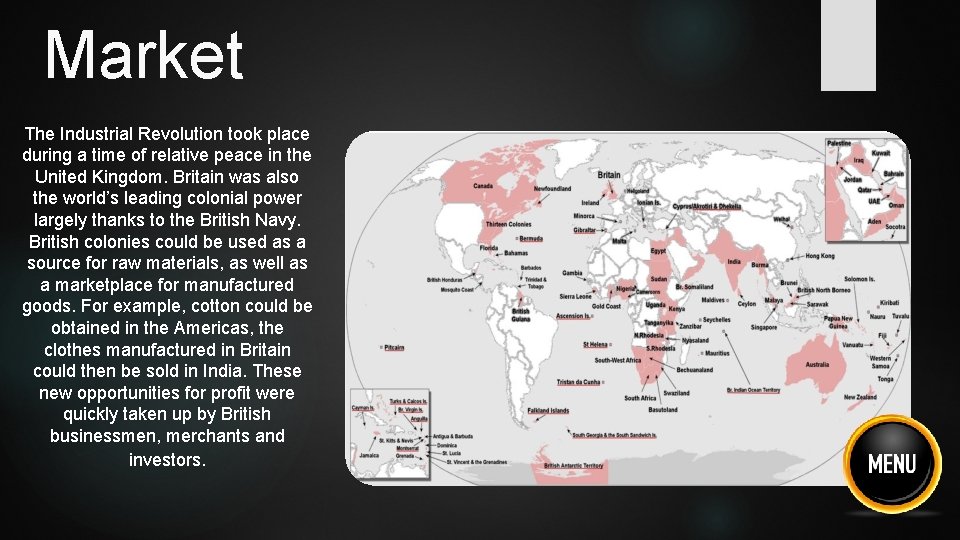
Market The Industrial Revolution took place during a time of relative peace in the United Kingdom. Britain was also the world’s leading colonial power largely thanks to the British Navy. British colonies could be used as a source for raw materials, as well as a marketplace for manufactured goods. For example, cotton could be obtained in the Americas, the clothes manufactured in Britain could then be sold in India. These new opportunities for profit were quickly taken up by British businessmen, merchants and investors.
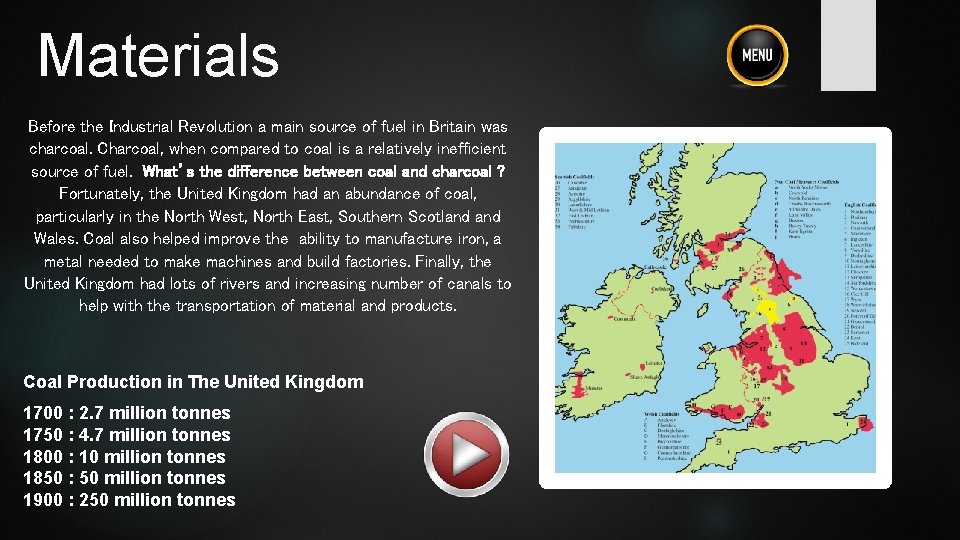
Materials Before the Industrial Revolution a main source of fuel in Britain was charcoal. Charcoal, when compared to coal is a relatively inefficient source of fuel. What’s the difference between coal and charcoal ? Fortunately, the United Kingdom had an abundance of coal, particularly in the North West, North East, Southern Scotland Wales. Coal also helped improve the ability to manufacture iron, a metal needed to make machines and build factories. Finally, the United Kingdom had lots of rivers and increasing number of canals to help with the transportation of material and products. Coal Production in The United Kingdom 1700 : 2. 7 million tonnes 1750 : 4. 7 million tonnes 1800 : 10 million tonnes 1850 : 50 million tonnes 1900 : 250 million tonnes
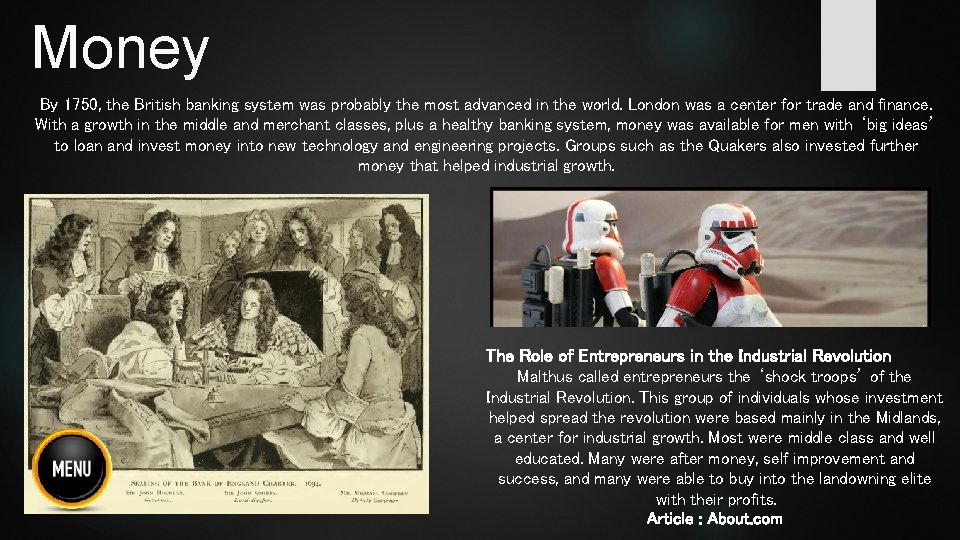
Money By 1750, the British banking system was probably the most advanced in the world. London was a center for trade and finance. With a growth in the middle and merchant classes, plus a healthy banking system, money was available for men with ‘big ideas’ to loan and invest money into new technology and engineering projects. Groups such as the Quakers also invested further money that helped industrial growth. The Role of Entrepreneurs in the Industrial Revolution Malthus called entrepreneurs the ‘shock troops’ of the Industrial Revolution. This group of individuals whose investment helped spread the revolution were based mainly in the Midlands, a center for industrial growth. Most were middle class and well educated. Many were after money, self improvement and success, and many were able to buy into the landowning elite with their profits. Article : About. com
Mindset Another important factor behind the Industrial Revolution was that mainland Britain had enjoyed a relatively peaceful period. The English Civil war ended a century earlier and conflict with Scotland had largely been resolved with the signing of the Acts of Union in 1706 and 1707. Without worry or burden of war, physical and mental resources were freed up to work on advancements in technology needed to spark the Industrial Revolution. . In addition, a period of ‘Enlightenment’ had taken place in parts of Europe between c 1650 and 1800. This was a new level of understanding and a more modern way of thinking about many things including work, the role of government and development of technology. The British government was now modern enough to support these new ideas and wanted to support economic growth. An economist called Adam Smith had suggested a theory known a ‘Laissez faire’ – this encouraged the government to ‘leave alone’ businessmen and allow them to make money without government interference or heavy taxation.
ic. History. com