
The cause of it all What causes volcanoes






- Slides: 18
The cause of it all… • What causes volcanoes to erupt? ? ? • The shift in the Earth’s plates are what causes volcanoes to form. • As the plates join or separate some of the molten rock is exposed. • viscosity, resistance of a fluid to flow.
Where do volcanoes erupt? ? ? • Convergent plate boundaries – where two of Earth’s plates join together • Divergent plate boundaries – where two of Earth’s plates move apart RING OF FIRE!! • Hot spots – active areas below the earths crust
Structure of a Volcano • Magma – the molten, or liquid-like, rock within the Earth • Lava – magma that reaches Earth’s surface • Vent – an opening through which molten (liquid-like) rock flows onto Earth’s surface • Volcanoes always have one central vent, but can also have several smaller side vents.
Structure of a Volcano ash cloud lava central vent side vent old layers of lava magma Earth’s crust
Types of volcanoes
There are three types • Shield Volcano • Cinder Cone • Composite Volcano
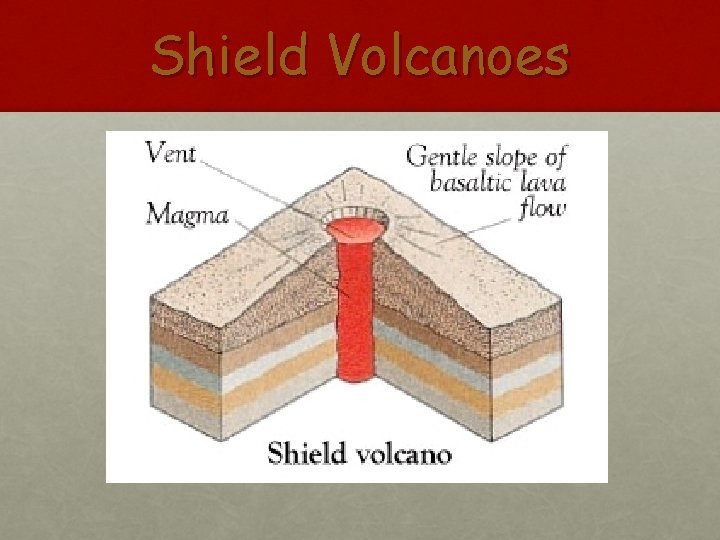
Shield Volcano • Shaped like a long, flat dome • Built up by many eruptions of lava • Sides are layers of lava • Lava flows out gently and for great distances • Hawaii is made up of this type of volcano. • One of Earth’s most active volcanoes
Shield Volcanoes • The magma inside a shield volcano is rich in iron and magnesium and is very fluid. • Since the magma is very fluid, the lava coming out of the volcano tends to flow great distances. • When shield volcanoes erupt, the flowing lava gives the volcano the shape of a gently sloping mountain.
Shield Volcanoes • Eruptions of shield volcanoes are mild and can occur several times. • Mauna Loa in Hawaii is an example of a shield volcano.
Shield Volcanoes
Cinder Cone • Steep sides • Cone-shaped hill • Formed from eruption of cinders and other rock fragments • Very explosive eruptions • Magma is thick and resists flowing • Eruptions have a lot of cinder and ash.
Cinder Cone Volcanoes • The magma inside a cinder cone volcano has large amounts of gas trapped in it. • Eruptions from cinder cone volcanoes are violent and explosive because of all the gas trapped in the magma. • The large amounts of hot ash and lava thrown out of the vent fall to the ground forming the cone shape that these volcanoes have.
Cinder Cone Volcanoes • Cinder cone volcanoes are usually only active for a short time and then become dormant (inactive). • Paricutin in Mexico is an example of a cinder cone volcano.
Cinder Cone Volcanoes
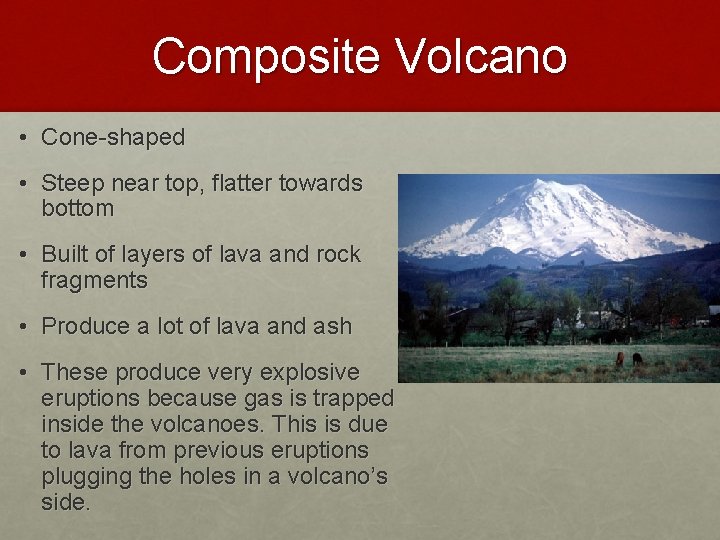
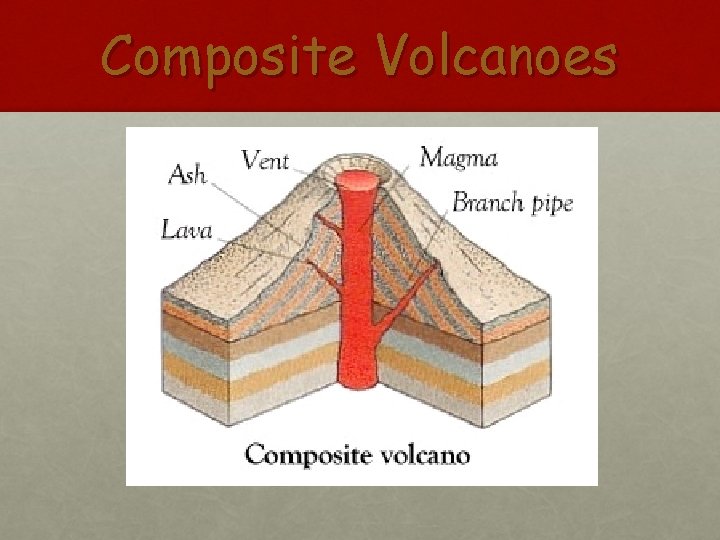
Composite Volcano • Cone-shaped • Steep near top, flatter towards bottom • Built of layers of lava and rock fragments • Produce a lot of lava and ash • These produce very explosive eruptions because gas is trapped inside the volcanoes. This is due to lava from previous eruptions plugging the holes in a volcano’s side.
Composite Volcanoes • The magma inside a composite volcano is rich in silica and much thicker than magma from a shield volcano. • Gases get trapped inside this thicker magma. • Eruptions from composite volcanoes can be flowing lava or explosions. The explosive eruptions come from the trapped gases and produce cinders and ash.
Composite Volcanoes • These different types of eruptions are what give composite volcanoes their alternating layers of lava and cinders. • Composite volcanoes have much steeper slopes than shield volcanoes. • Mount Fuji in Japan and Mount St. Helens in the USA are examples of composite volcanoes.
Composite Volcanoes