
The Cause Of An Extended Recovery Phase Of
- Slides: 1
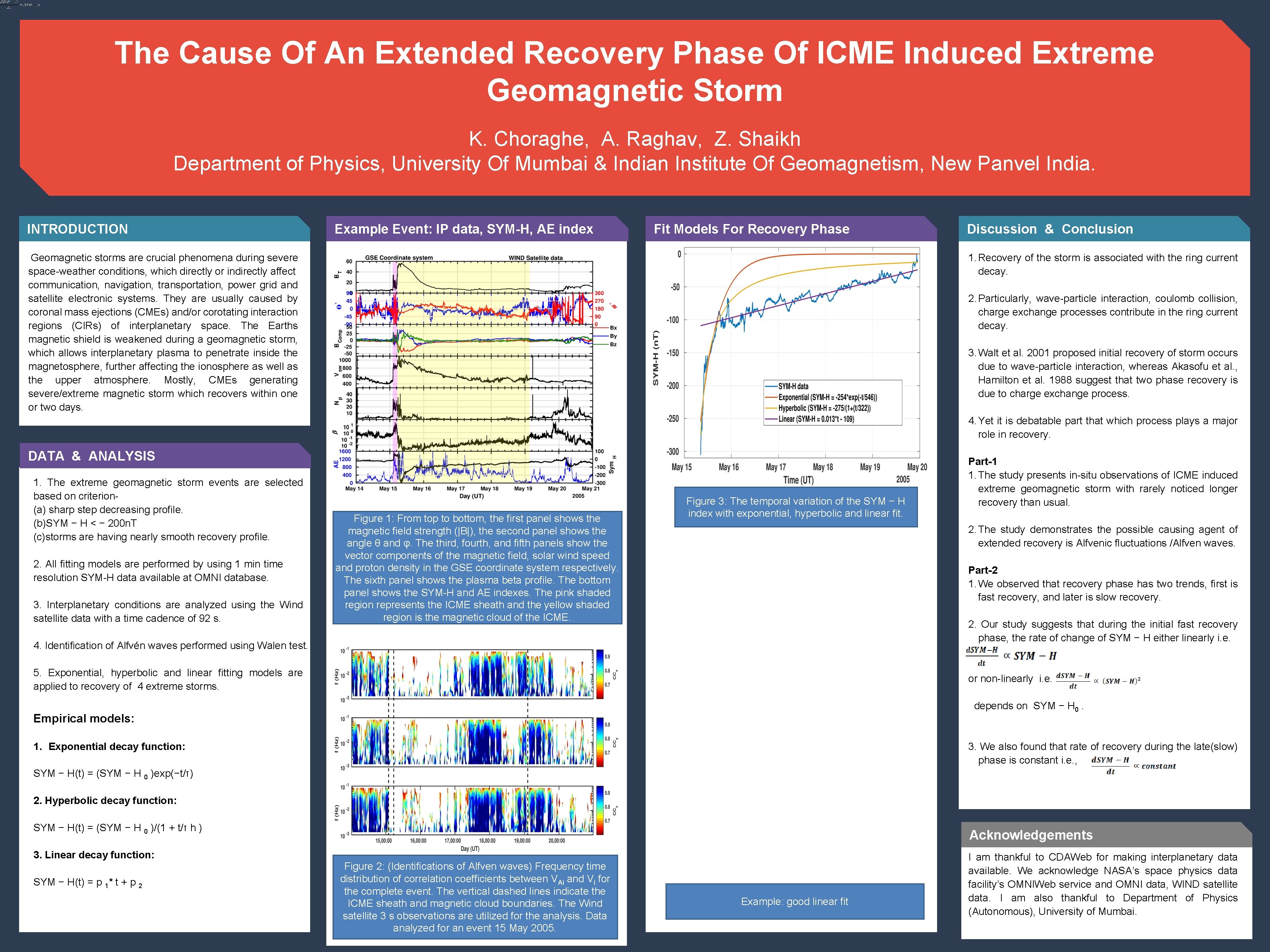
The Cause Of An Extended Recovery Phase Of ICME Induced Extreme Geomagnetic Storm K. Choraghe, A. Raghav, Z. Shaikh Department of Physics, University Of Mumbai & Indian Institute Of Geomagnetism, New Panvel India. INTRODUCTION Example Event: IP data, SYM-H, AE index Fit Models For Recovery Phase Discussion & Conclusion 1. Recovery of the storm is associated with the ring current decay. Geomagnetic storms are crucial phenomena during severe space-weather conditions, which directly or indirectly affect communication, navigation, transportation, power grid and satellite electronic systems. They are usually caused by coronal mass ejections (CMEs) and/or corotating interaction regions (CIRs) of interplanetary space. The Earths magnetic shield is weakened during a geomagnetic storm, which allows interplanetary plasma to penetrate inside the magnetosphere, further affecting the ionosphere as well as the upper atmosphere. Mostly, CMEs generating severe/extreme magnetic storm which recovers within one or two days. 2. Particularly, wave-particle interaction, coulomb collision, charge exchange processes contribute in the ring current decay. 3. Walt et al. 2001 proposed initial recovery of storm occurs due to wave-particle interaction, whereas Akasofu et al. , Hamilton et al. 1988 suggest that two phase recovery is due to charge exchange process. 4. Yet it is debatable part that which process plays a major role in recovery. DATA & ANALYSIS 1. The extreme geomagnetic storm events are selected based on criterion(a) sharp step decreasing profile. (b)SYM − H < − 200 n. T (c)storms are having nearly smooth recovery profile. 2. All fitting models are performed by using 1 min time resolution SYM-H data available at OMNI database. 3. Interplanetary conditions are analyzed using the Wind satellite data with a time cadence of 92 s. Figure 1: From top to bottom, the first panel shows the magnetic field strength (|B|), the second panel shows the angle θ and φ. The third, fourth, and fifth panels show the vector components of the magnetic field, solar wind speed and proton density in the GSE coordinate system respectively. The sixth panel shows the plasma beta profile. The bottom panel shows the SYM-H and AE indexes. The pink shaded region represents the ICME sheath and the yellow shaded region is the magnetic cloud of the ICME. Figure 3: The temporal variation of the SYM − H index with exponential, hyperbolic and linear fit. Part-1 1. The study presents in-situ observations of ICME induced extreme geomagnetic storm with rarely noticed longer recovery than usual. 2. The study demonstrates the possible causing agent of extended recovery is Alfvenic fluctuations /Alfven waves. Part-2 1. We observed that recovery phase has two trends, first is fast recovery, and later is slow recovery. 2. Our study suggests that during the initial fast recovery phase, the rate of change of SYM − H either linearly i. e. 4. Identification of Alfvén waves performed using Walen test. 5. Exponential, hyperbolic and linear fitting models are applied to recovery of 4 extreme storms. or non-linearly i. e. depends on SYM − H 0. Empirical models: 1. Exponential decay function: 3. We also found that rate of recovery during the late(slow) phase is constant i. e. , SYM − H(t) = (SYM − H 0 )exp(−t/τ) jdjdjdj 2. Hyperbolic decay function: SYM − H(t) = (SYM − H 0 )/(1 + t/τ h ) 3. Linear decay function: SYM − H(t) = p 1* t + p 2 Acknowledgements Figure 2: (Identifications of Alfven waves) Frequency time distribution of correlation coefficients between VAi and Vi for the complete event. The vertical dashed lines indicate the ICME sheath and magnetic cloud boundaries. The Wind satellite 3 s observations are utilized for the analysis. Data analyzed for an event 15 May 2005. Example: good linear fit I am thankful to CDAWeb for making interplanetary data available. We acknowledge NASA’s space physics data facility’s OMNIWeb service and OMNI data, WIND satellite data. I am also thankful to Department of Physics (Autonomous), University of Mumbai.