
The Case for Unencumbering Interest Rates at the
The Case for Unencumbering Interest Rates at the Zero Bound Author: Marvin Goodfriend Presenter: Shen Wang Professor: Philip Dybvig 9/19/2019
Agenda 1. Background 2. Economic Model 3. Reasons 4. Solutions 5. Personal View 1
1 A Background: the Author and the Paper Marvin Goodfriend Education • Brown University - Ph. D - 1980 • Union College - BS - 1972 Career • Professor of Economics at Carnegie Mellon's Tepper School of Business • Board of Governors of the Federal Reserve System in Washington, D. C. from 1993 to 2005 Policy Positions • Conservative (freshwater) • Critic of an actively regulating role of the Fed • Repeatedly argues against quantitative easing • Supports monetary policy based rule • Willing to consider unusual monetary instruments in times of crisis, i. e. negative rates Source: Wikipedia Paper Introduction Main idea • Make the case for unencumbering interest rate policy so that negative nominal interest rates can be made freely available and fully effective as a realistic policy option in a future crisis. Situation • “Designing Resilient Monetary Policy Frameworks for the Future” in Jackson Hole Economic Policy Symposium Solutions • Abolish paper currency • Introduce a market-determined flexible deposit price of paper currency • Provide electronic currency (to pay or charge interest) at par with deposits 2
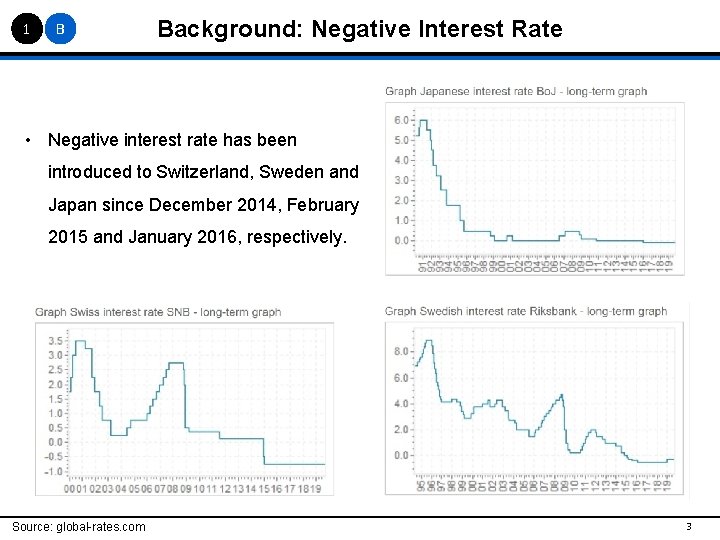
1 B Background: Negative Interest Rate • Negative interest rate has been introduced to Switzerland, Sweden and Japan since December 2014, February 2015 and January 2016, respectively. Source: global-rates. com 3
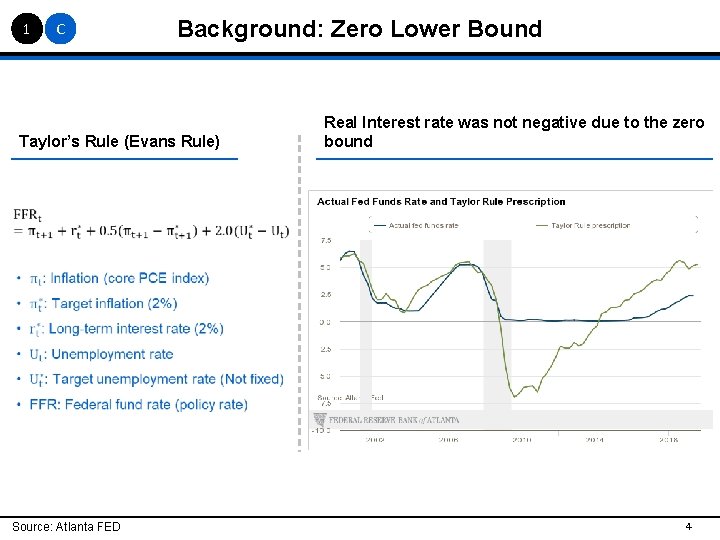
1 C Background: Zero Lower Bound Taylor’s Rule (Evans Rule) Source: Atlanta FED Real Interest rate was not negative due to the zero bound 4
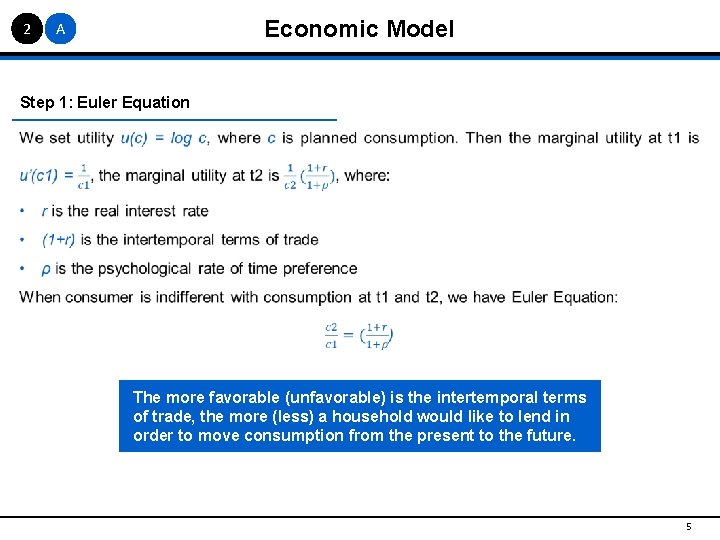
2 Economic Model A Step 1: Euler Equation The more favorable (unfavorable) is the intertemporal terms of trade, the more (less) a household would like to lend in order to move consumption from the present to the future. 5
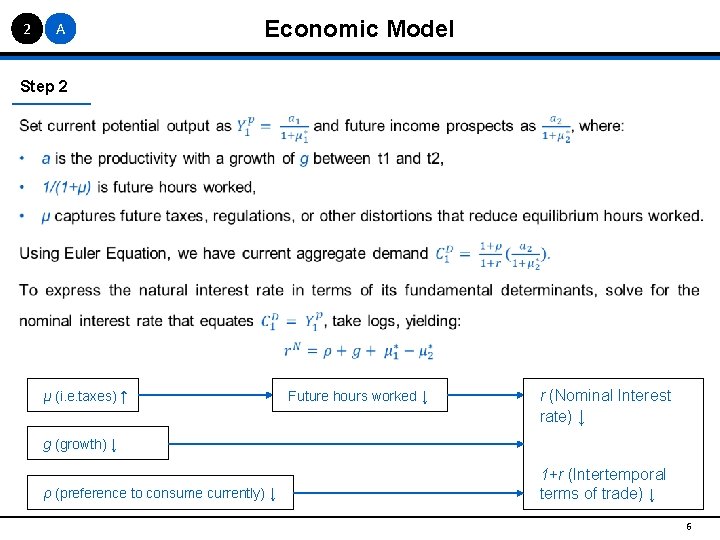
2 A Economic Model Step 2 μ (i. e. taxes) ↑ Future hours worked ↓ r (Nominal Interest rate) ↓ g (growth) ↓ ρ (preference to consume currently) ↓ 1+r (Intertemporal terms of trade) ↓ 6
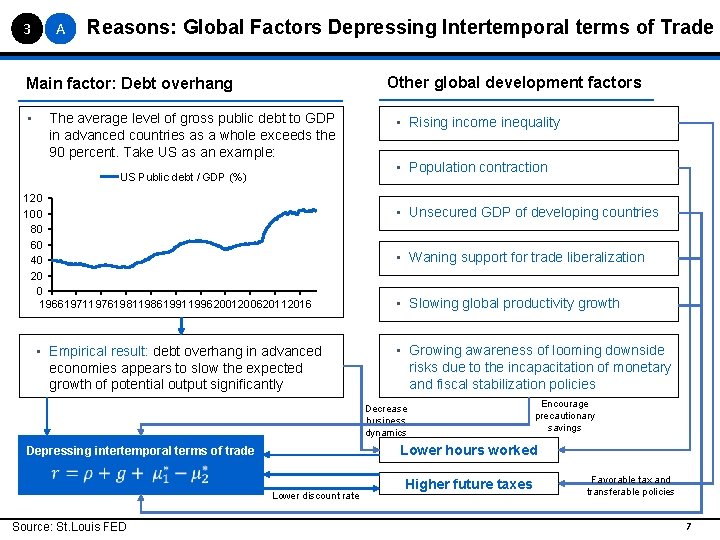
3 A Reasons: Global Factors Depressing Intertemporal terms of Trade Other global development factors Main factor: Debt overhang • The average level of gross public debt to GDP in advanced countries as a whole exceeds the 90 percent. Take US as an example: US Public debt / GDP (%) 120 100 80 60 40 20 0 19661971197619811986199119962001200620112016 • Empirical result: debt overhang in advanced economies appears to slow the expected growth of potential output significantly • Rising income inequality • Population contraction • Unsecured GDP of developing countries • Waning support for trade liberalization • Slowing global productivity growth • Growing awareness of looming downside risks due to the incapacitation of monetary and fiscal stabilization policies Decrease business dynamics Lower hours worked Depressing intertemporal terms of trade Lower discount rate Source: St. Louis FED Encourage precautionary savings Higher future taxes Favorable tax and transferable policies 7
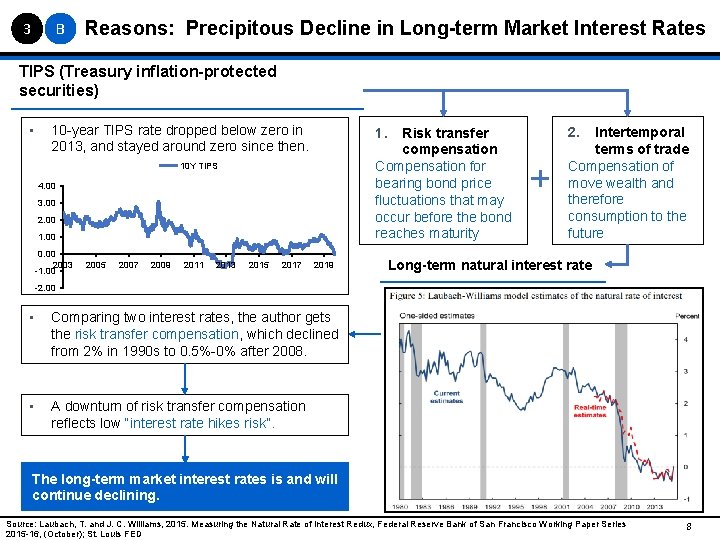
3 B Reasons: Precipitous Decline in Long-term Market Interest Rates TIPS (Treasury inflation-protected securities) • 10 -year TIPS rate dropped below zero in 2013, and stayed around zero since then. 1. Risk transfer compensation Compensation for bearing bond price fluctuations that may occur before the bond reaches maturity 10 Y TIPS 4. 00 3. 00 2. 00 1. 00 0. 00 2003 -1. 00 2005 2007 2009 2011 2013 2015 2017 2019 2. Intertemporal terms of trade Compensation of move wealth and therefore consumption to the future Long-term natural interest rate -2. 00 • Comparing two interest rates, the author gets the risk transfer compensation, which declined from 2% in 1990 s to 0. 5%-0% after 2008. • A downturn of risk transfer compensation reflects low “interest rate hikes risk”. The long-term market interest rates is and will continue declining. Source: Laubach, T. and J. C. Williams, 2015. Measuring the Natural Rate of Interest Redux, Federal Reserve Bank of San Francisco Working Paper Series 2015 -16, (October); St. Louis FED 8
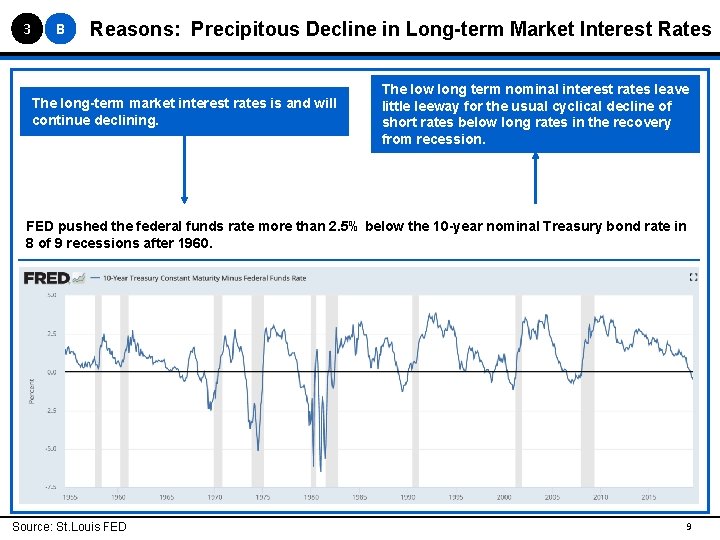
3 B Reasons: Precipitous Decline in Long-term Market Interest Rates The long-term market interest rates is and will continue declining. The low long term nominal interest rates leave little leeway for the usual cyclical decline of short rates below long rates in the recovery from recession. FED pushed the federal funds rate more than 2. 5% below the 10 -year nominal Treasury bond rate in 8 of 9 recessions after 1960. Source: St. Louis FED 9
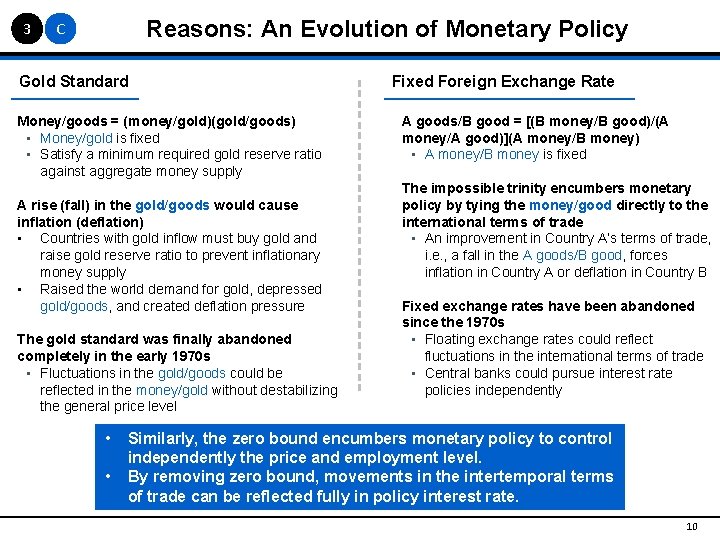
3 Reasons: An Evolution of Monetary Policy C Gold Standard Money/goods = (money/gold)(gold/goods) • Money/gold is fixed • Satisfy a minimum required gold reserve ratio against aggregate money supply A rise (fall) in the gold/goods would cause inflation (deflation) • Countries with gold inflow must buy gold and raise gold reserve ratio to prevent inflationary money supply • Raised the world demand for gold, depressed gold/goods, and created deflation pressure The gold standard was finally abandoned completely in the early 1970 s • Fluctuations in the gold/goods could be reflected in the money/gold without destabilizing the general price level • • Fixed Foreign Exchange Rate A goods/B good = [(B money/B good)/(A money/A good)](A money/B money) • A money/B money is fixed The impossible trinity encumbers monetary policy by tying the money/good directly to the international terms of trade • An improvement in Country A’s terms of trade, i. e. , a fall in the A goods/B good, forces inflation in Country A or deflation in Country B Fixed exchange rates have been abandoned since the 1970 s • Floating exchange rates could reflect fluctuations in the international terms of trade • Central banks could pursue interest rate policies independently Similarly, the zero bound encumbers monetary policy to control independently the price and employment level. By removing zero bound, movements in the intertemporal terms of trade can be reflected fully in policy interest rate. 10
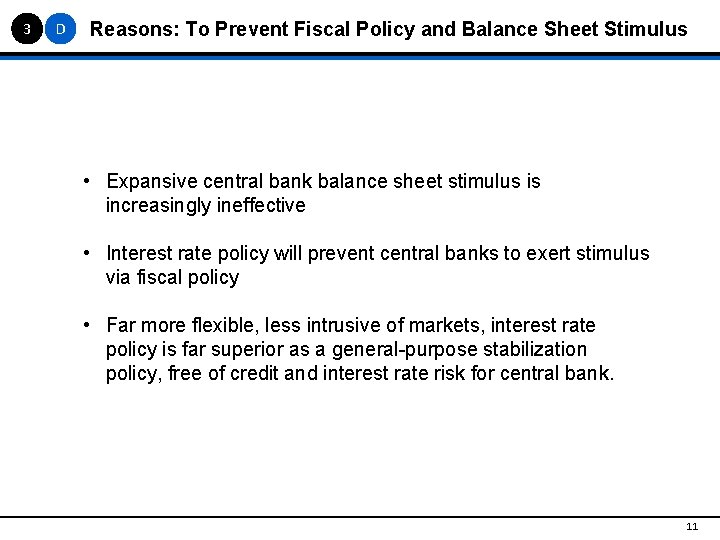
3 D Reasons: To Prevent Fiscal Policy and Balance Sheet Stimulus • Expansive central bank balance sheet stimulus is increasingly ineffective • Interest rate policy will prevent central banks to exert stimulus via fiscal policy • Far more flexible, less intrusive of markets, interest rate policy is far superior as a general-purpose stabilization policy, free of credit and interest rate risk for central bank. 11
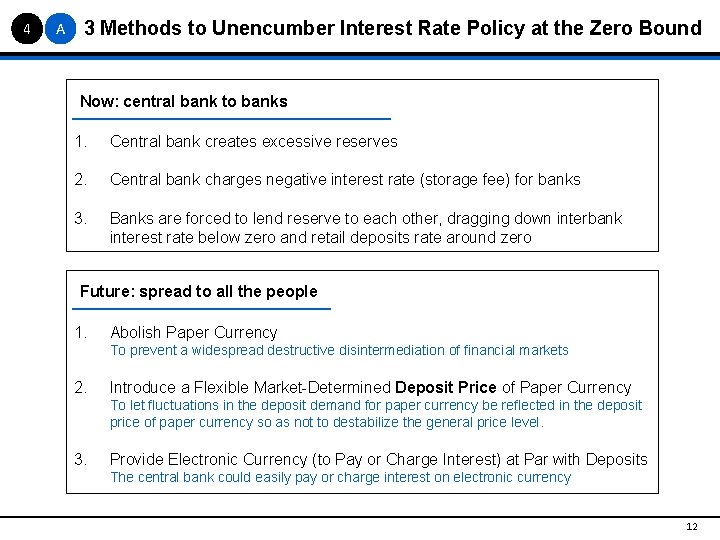
4 A 3 Methods to Unencumber Interest Rate Policy at the Zero Bound Now: central bank to banks 1. Central bank creates excessive reserves 2. Central bank charges negative interest rate (storage fee) for banks 3. Banks are forced to lend reserve to each other, dragging down interbank interest rate below zero and retail deposits rate around zero Future: spread to all the people 1. Abolish Paper Currency To prevent a widespread destructive disintermediation of financial markets 2. Introduce a Flexible Market-Determined Deposit Price of Paper Currency To let fluctuations in the deposit demand for paper currency be reflected in the deposit price of paper currency so as not to destabilize the general price level. 3. Provide Electronic Currency (to Pay or Charge Interest) at Par with Deposits The central bank could easily pay or charge interest on electronic currency 12
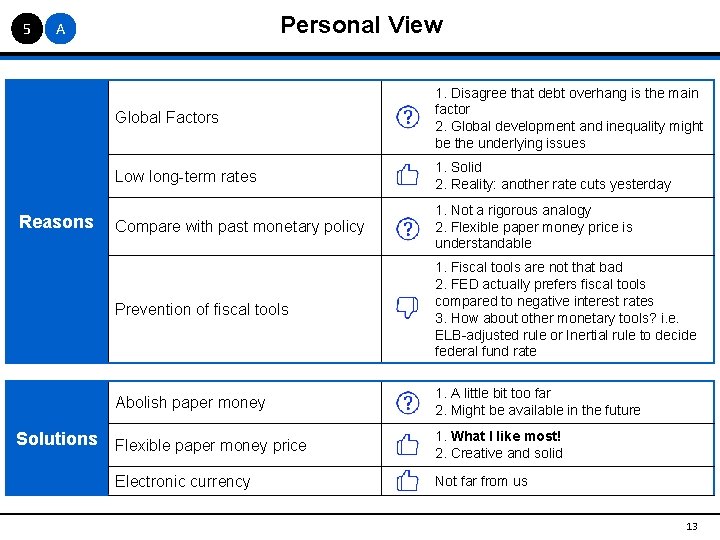
5 Personal View A Reasons Global Factors 1. Disagree that debt overhang is the main factor 2. Global development and inequality might be the underlying issues Low long-term rates 1. Solid 2. Reality: another rate cuts yesterday Compare with past monetary policy 1. Not a rigorous analogy 2. Flexible paper money price is understandable Prevention of fiscal tools 1. Fiscal tools are not that bad 2. FED actually prefers fiscal tools compared to negative interest rates 3. How about other monetary tools? i. e. ELB-adjusted rule or Inertial rule to decide federal fund rate Abolish paper money 1. A little bit too far 2. Might be available in the future Solutions Flexible paper money price Electronic currency 1. What I like most! 2. Creative and solid Not far from us 13
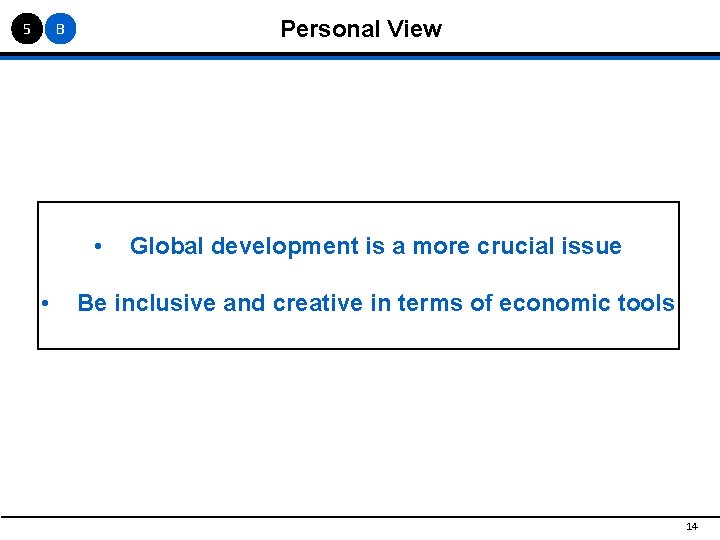
5 Personal View B • • Global development is a more crucial issue Be inclusive and creative in terms of economic tools 14

THANKS!
- Slides: 16