
The Caribbean Low Level Jet variability during August
The Caribbean Low Level Jet variability during August and September and its relation with the regional hydroclimate Ernesto Muñoz
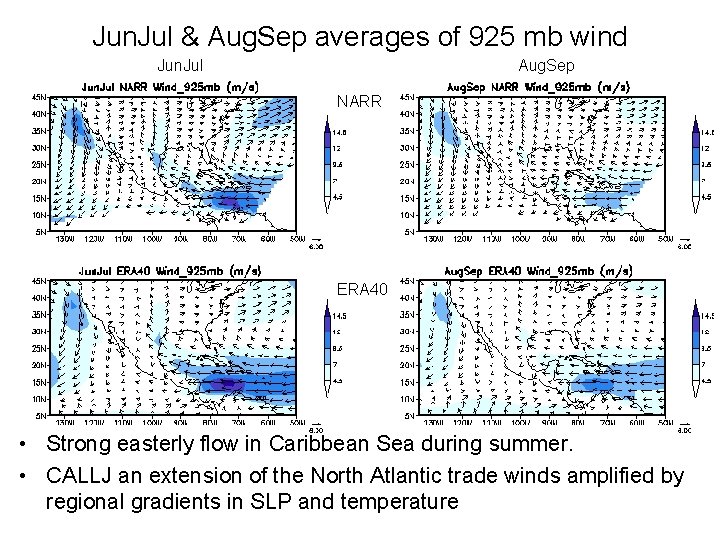
Jun. Jul & Aug. Sep averages of 925 mb wind Jun. Jul Aug. Sep NARR ERA 40 • Strong easterly flow in Caribbean Sea during summer. • CALLJ an extension of the North Atlantic trade winds amplified by regional gradients in SLP and temperature
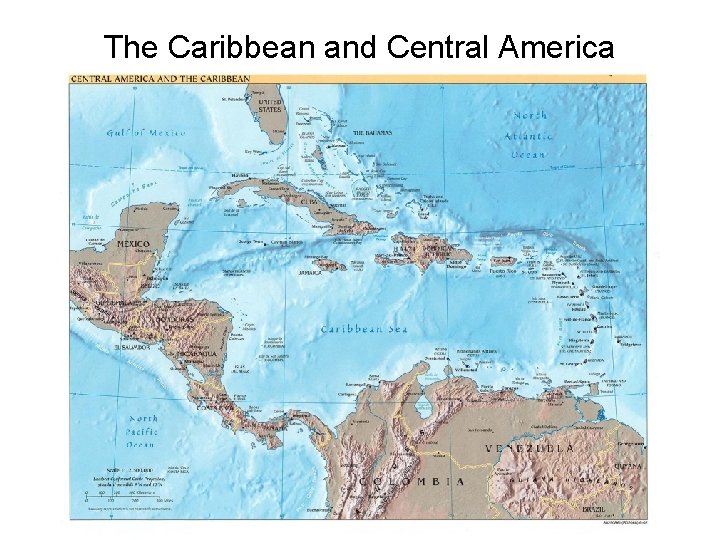
The Caribbean and Central America
Motivation • Previous studies of Caribbean hydroclimate mostly on precipitation from land stations. • Lack of knowledge of role of Caribbean Low Level Jet on regional hydroclimate. • Other LLJs are associated with moisture transport and downwind convection.
Background (Giannini et al 2000, 2001) • Giannini et al (2000, 2001) observe anomalous tropical inter-basin SLP gradient and SST gradient. • Associated with less precip over Caribbean and Central America are warm Pacific and low SLPA vs cool Atlantic and high SLPA. • Make association with drier Carib’n and divergence over region (except east of Costa Rica). • Positive NAO in winter cools TNA SSTs that when followed by onset of ENSO in summer combines effect on less precip over Carib’n (4/6 for 19791999).
Background (Taylor et al 2002) • Taylor et al (2002) partitioned summer rainy season in a early rainy season (MJJ) and a late rainy season (ASO). • Indicate that late rainfall season not affected so much by SSTA but by vertical wind shear (VWS). • VWS inhibits convection.
Data and Methods • • NARR and ERA 40 reanalyses GPCP precipitation Had. SST and ERSST sea surface temperature August and September anomalies from 19792001 climatology • Calculated Caribbean Low Level Jet index as area average 12 N-16 N, 80 W-70 W. • Calculated regressions and correlations
Summer climatological conditions
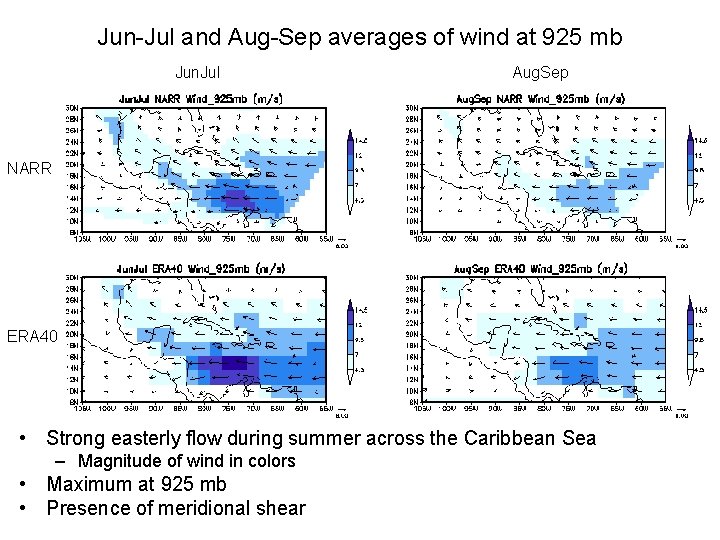
Jun-Jul and Aug-Sep averages of wind at 925 mb Jun. Jul Aug. Sep NARR ERA 40 • Strong easterly flow during summer across the Caribbean Sea – Magnitude of wind in colors • Maximum at 925 mb • Presence of meridional shear
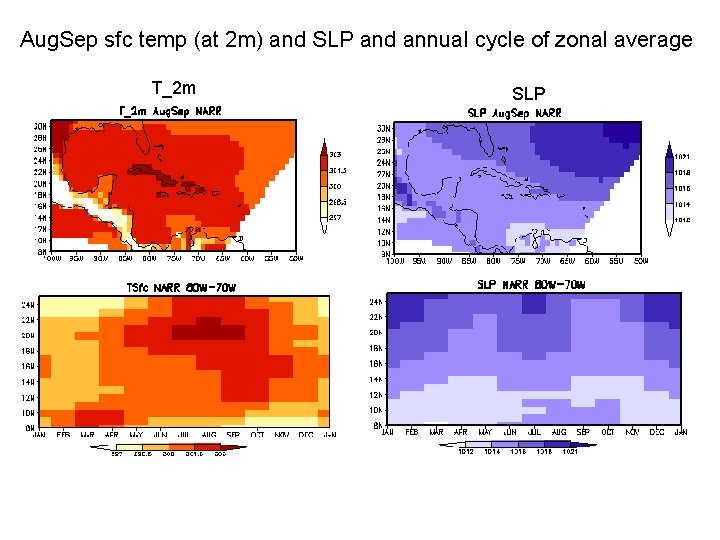
Aug. Sep sfc temp (at 2 m) and SLP and annual cycle of zonal average T_2 m SLP
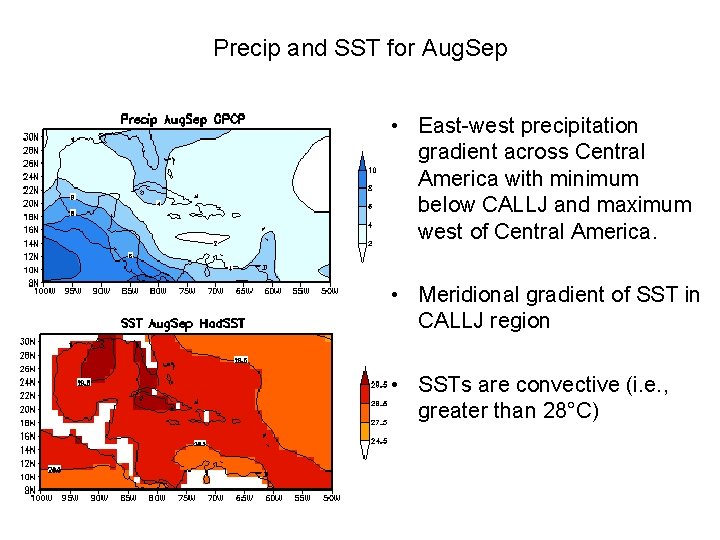
Precip and SST for Aug. Sep • East-west precipitation gradient across Central America with minimum below CALLJ and maximum west of Central America. • Meridional gradient of SST in CALLJ region • SSTs are convective (i. e. , greater than 28°C)
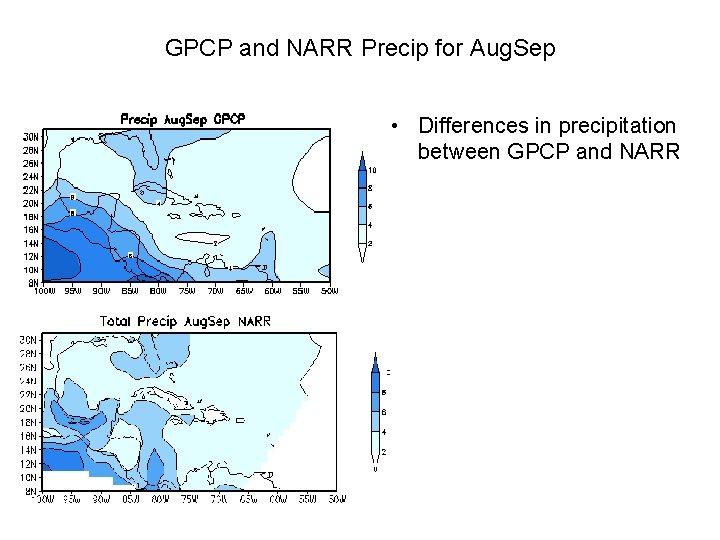
GPCP and NARR Precip for Aug. Sep • Differences in precipitation between GPCP and NARR
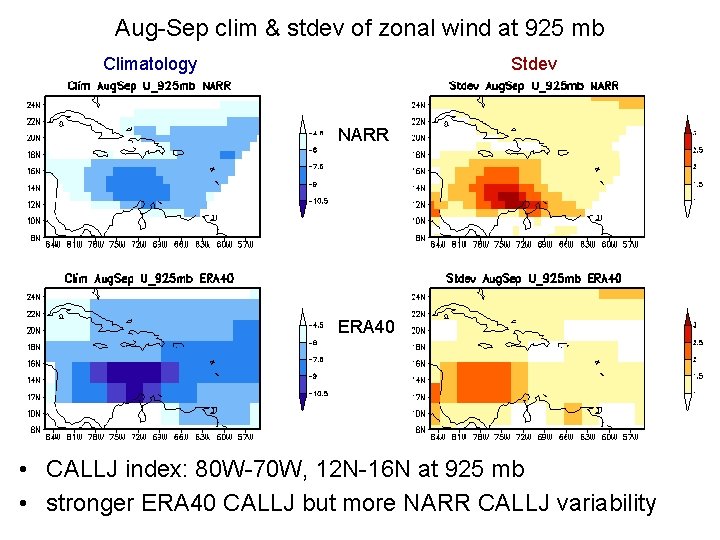
Aug-Sep clim & stdev of zonal wind at 925 mb Climatology Stdev NARR ERA 40 • CALLJ index: 80 W-70 W, 12 N-16 N at 925 mb • stronger ERA 40 CALLJ but more NARR CALLJ variability
Interannual variability • NARR and ERA 40 CALLJ show similar variability throughout the 1979 -2001 period. • Correlation of 0. 93 between NARR and ERA 40 from 1979 to 2001.
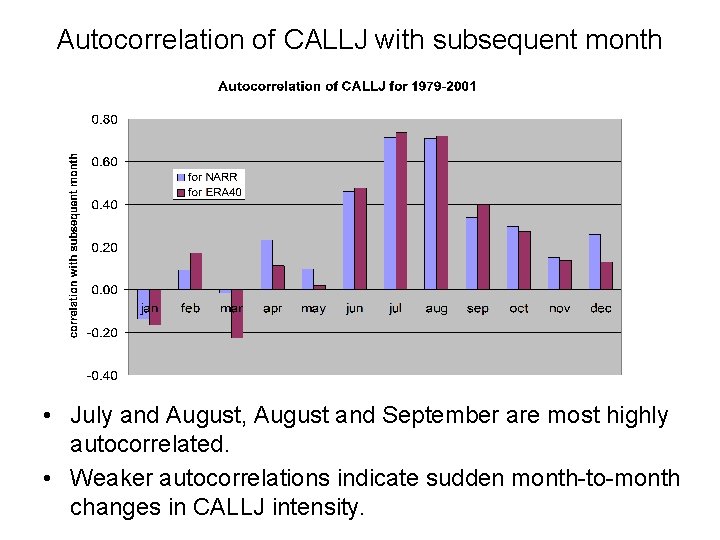
Autocorrelation of CALLJ with subsequent month • July and August, August and September are most highly autocorrelated. • Weaker autocorrelations indicate sudden month-to-month changes in CALLJ intensity.
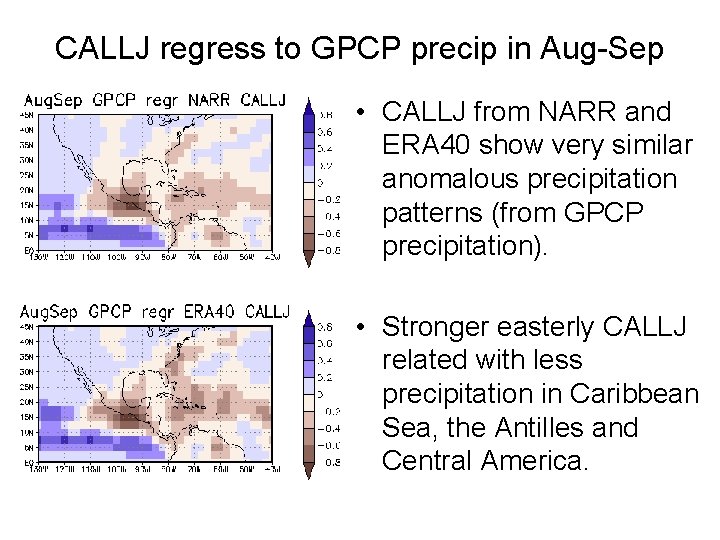
CALLJ regress to GPCP precip in Aug-Sep • CALLJ from NARR and ERA 40 show very similar anomalous precipitation patterns (from GPCP precipitation). • Stronger easterly CALLJ related with less precipitation in Caribbean Sea, the Antilles and Central America.
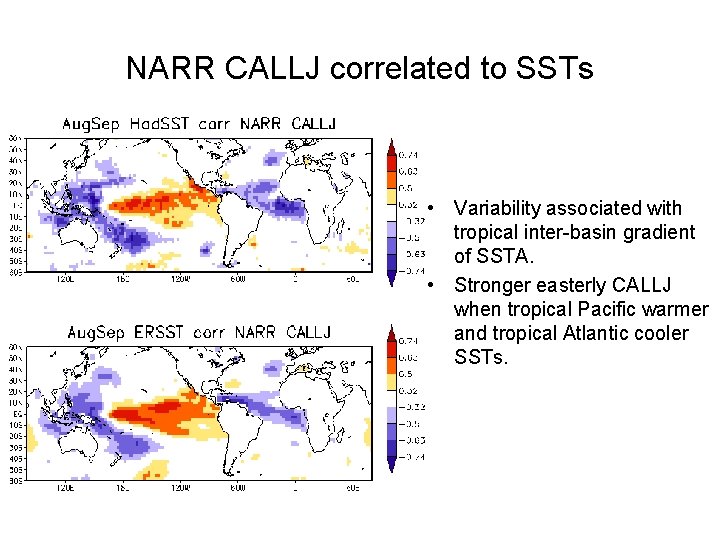
NARR CALLJ correlated to SSTs • Variability associated with tropical inter-basin gradient of SSTA. • Stronger easterly CALLJ when tropical Pacific warmer and tropical Atlantic cooler SSTs.
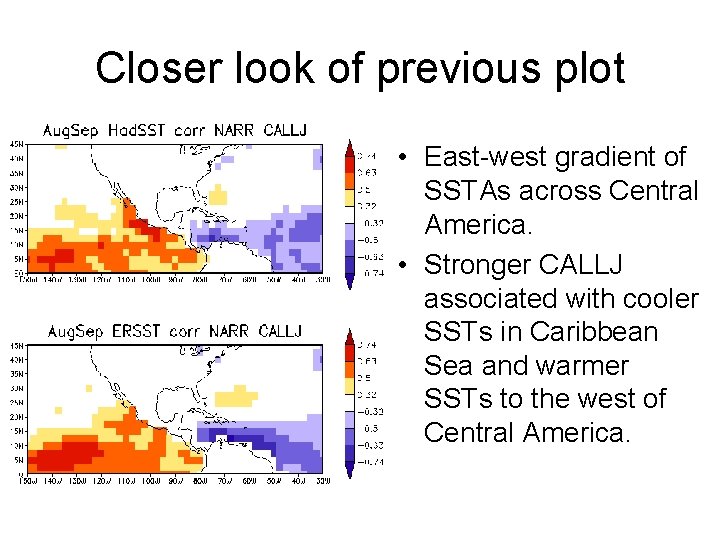
Closer look of previous plot • East-west gradient of SSTAs across Central America. • Stronger CALLJ associated with cooler SSTs in Caribbean Sea and warmer SSTs to the west of Central America.
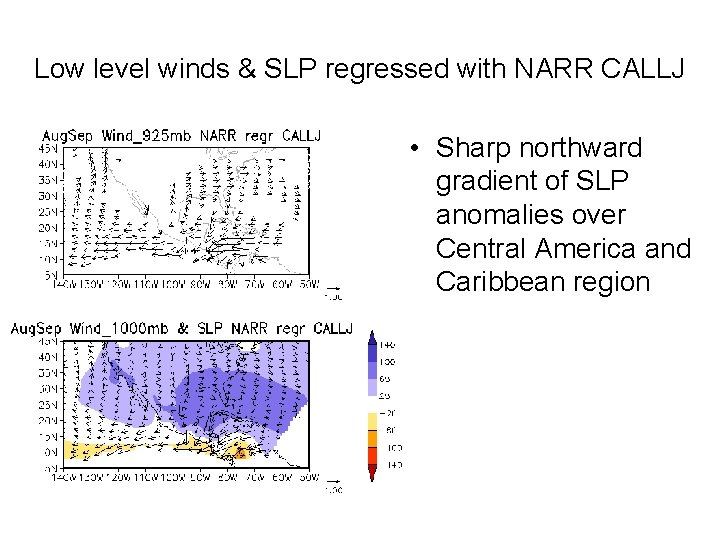
Low level winds & SLP regressed with NARR CALLJ • Sharp northward gradient of SLP anomalies over Central America and Caribbean region
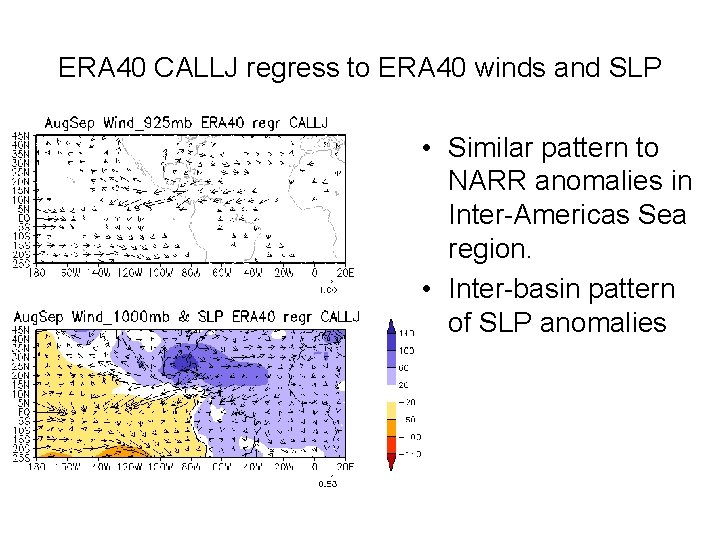
ERA 40 CALLJ regress to ERA 40 winds and SLP • Similar pattern to NARR anomalies in Inter-Americas Sea region. • Inter-basin pattern of SLP anomalies
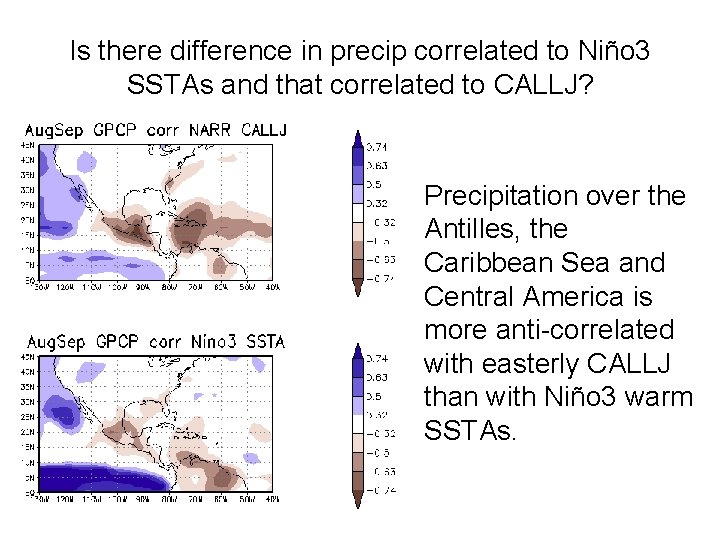
Is there difference in precip correlated to Niño 3 SSTAs and that correlated to CALLJ? • Precipitation over the Antilles, the Caribbean Sea and Central America is more anti-correlated with easterly CALLJ than with Niño 3 warm SSTAs.
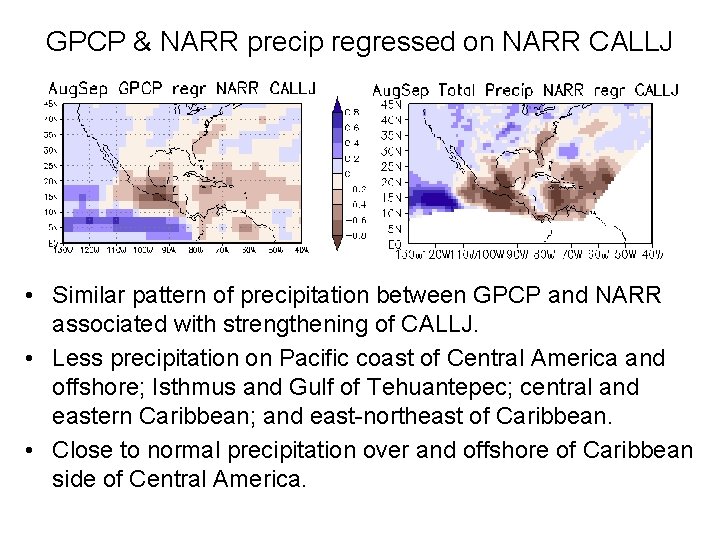
GPCP & NARR precip regressed on NARR CALLJ • Similar pattern of precipitation between GPCP and NARR associated with strengthening of CALLJ. • Less precipitation on Pacific coast of Central America and offshore; Isthmus and Gulf of Tehuantepec; central and eastern Caribbean; and east-northeast of Caribbean. • Close to normal precipitation over and offshore of Caribbean side of Central America.
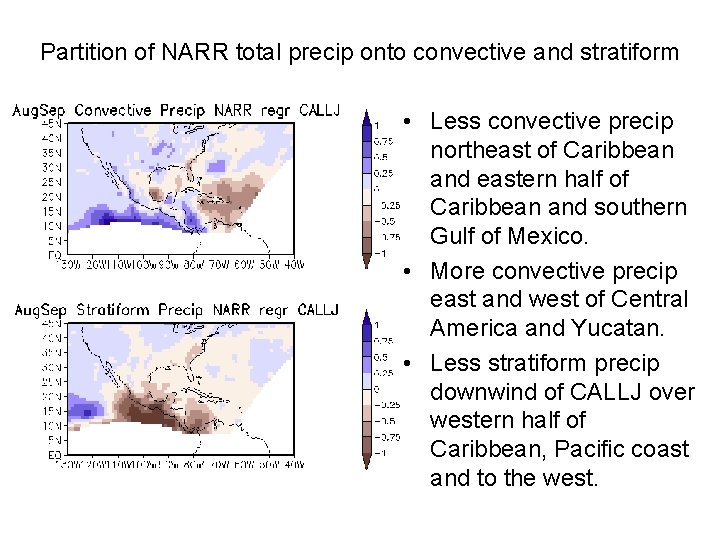
Partition of NARR total precip onto convective and stratiform • Less convective precip northeast of Caribbean and eastern half of Caribbean and southern Gulf of Mexico. • More convective precip east and west of Central America and Yucatan. • Less stratiform precip downwind of CALLJ over western half of Caribbean, Pacific coast and to the west.
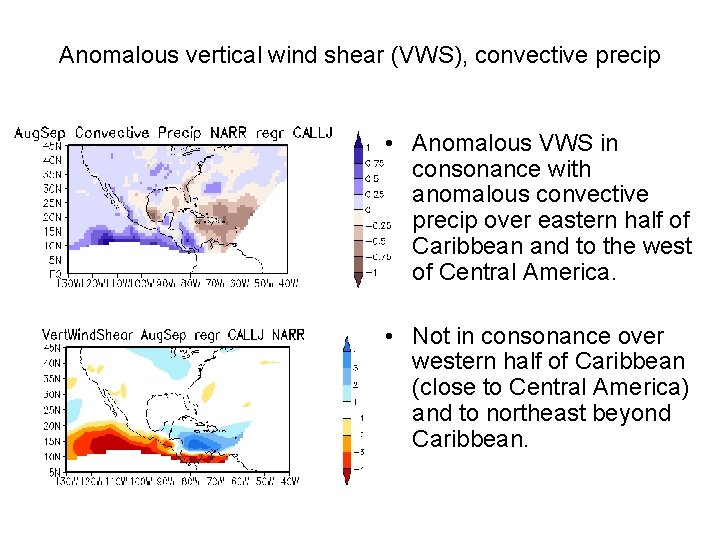
Anomalous vertical wind shear (VWS), convective precip • Anomalous VWS in consonance with anomalous convective precip over eastern half of Caribbean and to the west of Central America. • Not in consonance over western half of Caribbean (close to Central America) and to northeast beyond Caribbean.
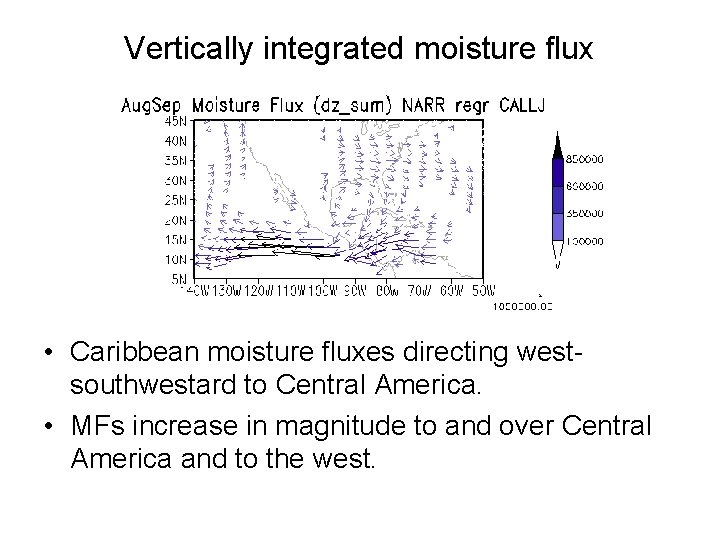
Vertically integrated moisture flux • Caribbean moisture fluxes directing westsouthwestard to Central America. • MFs increase in magnitude to and over Central America and to the west.
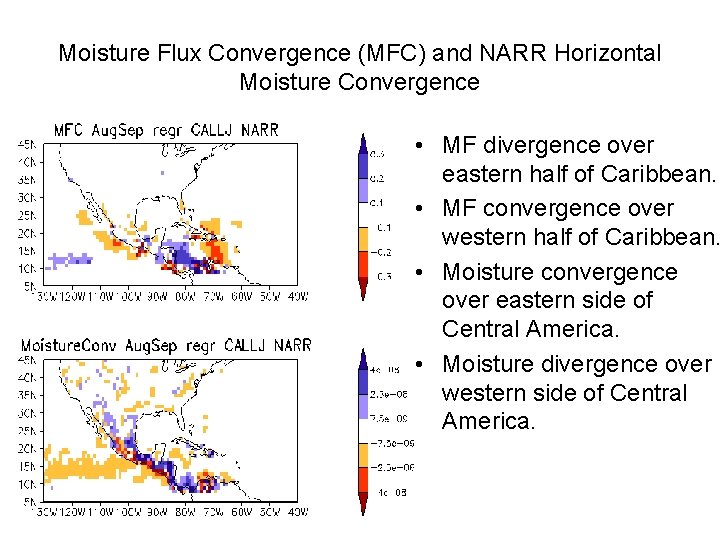
Moisture Flux Convergence (MFC) and NARR Horizontal Moisture Convergence • MF divergence over eastern half of Caribbean. • MF convergence over western half of Caribbean. • Moisture convergence over eastern side of Central America. • Moisture divergence over western side of Central America.
Summary • In August and September a strengthening of the CALLJ is associated with: – a strengthening of the meridional SLP gradient in Caribbean region, – an interbasin SST gradient, – less precipitation over western Central America and eastern Caribbean, – MFDiv over eastern Caribbean and MFConv over western Caribbean. – An increase of vertical wind shear over Caribbean and a decrease to the west of Central America. • The CALLJ seems to be a principal atmospheric modulator of Caribbean and Central American precipitation from year to year.
- Slides: 27