
The care of adults with a Learning Disability

The care of adults with a Learning Disability at St George’s Hospital A presentation to the Merton Patient Engagement Group Padraic Costello, Learning Disability CNS St Georges University Hospitals NHS Foundation Trust 19 th September 2018
An Overview of the past present and future • Exploring recent history in acute settings • Reflecting on services at St George’s today • Highlighting Challenges and Successes • Looking forward
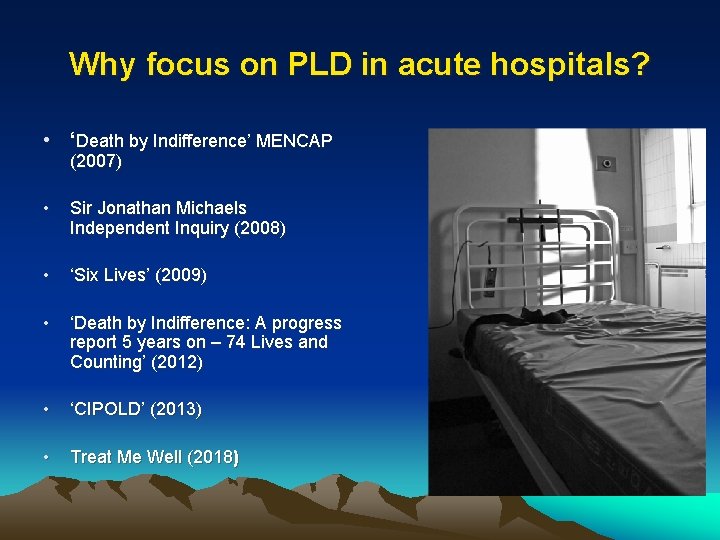
Why focus on PLD in acute hospitals? • ‘Death by Indifference’ MENCAP (2007) • Sir Jonathan Michaels Independent Inquiry (2008) • ‘Six Lives’ (2009) • ‘Death by Indifference: A progress report 5 years on – 74 Lives and Counting’ (2012) • ‘CIPOLD’ (2013) • Treat Me Well (2018)
Findings from National Reports and Investigations • Lack of appropriate admission planning • Omissions in delivery of care • Poor information sharing • Failure to understand the law • Inadequate discharge planning • Premature death in hospital
Criteria for seeing patients A Learning Disability is defined as: • A reduced ability to understand new or complex information, to learn new skills (impaired intelligence, usually associated with an IQ below 70) • A reduced ability to cope independently (impaired social functioning) • Which started before adulthood, with a lasting effect on development Do. H 2001 – Valuing People
What happens at St George’s • Employment of two learning disability nurses • Posts commissioned by Wandsworth CCG • Under the umbrella of Safeguarding Service • Accessible to all SGH adult wards and departments • Available Monday to Friday 8 am to 5 pm
Core Elements of Service • To ensure a safe pathway of care for PLD • To facilitate reasonable adjustments • To liaise with internal and external services • To coordinate best interest decision making meetings • To raise awareness of the needs of PLD in a hospital setting
Referral System • Referrals accepted by telephone/email • Accepted from any source • Majority referrals are internal (A and E, OPDs, wards) • Other referrals from London and beyond (CLDTs, other hospitals) • 26% referrals relate to Merton residents • Occasional inappropriate referrals
Responding to Referrals • Contact with the local CLDT • Request for Hospital Passport/Care Plans • Review of risks with suggested interventions • Initial screening if patient is not known • Planning with MDT
Examples of a Reasonable Adjustment • Providing Accessible Information • Securing a Side Room • Offering a First or double OPD appointment • Coordinating multiple treatments • Promoting flexible visiting hours • Organising an overnight stay for carers • Facilitating pre planned visit to ward/department
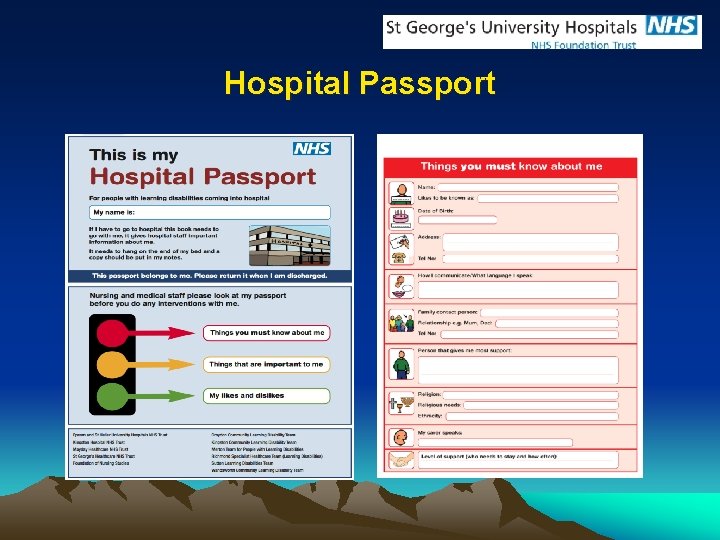
Hospital Passport
Working with Families, Carers and Partners • Facilitating Effective Communication • Obtaining collateral to inform care plan • Providing emotional support • Supporting the patient in making decisions • Assisting clinicians in making BI decisions
How are concerns being addressed now? • Patients seen at the point of admission • Direct Link to Pre Op Care Centre • Obtaining collateral from other sources • Emphasis on the Mental Capacity Act • Early contact with Discharge Facilitators • Requesting the deferral of discharge
Elements of Success • Very low readmission rates for PLD • One formal complaint about patient care in 5 years • No serious untoward incidents • No known avoidable deaths • Many expressions of gratitude
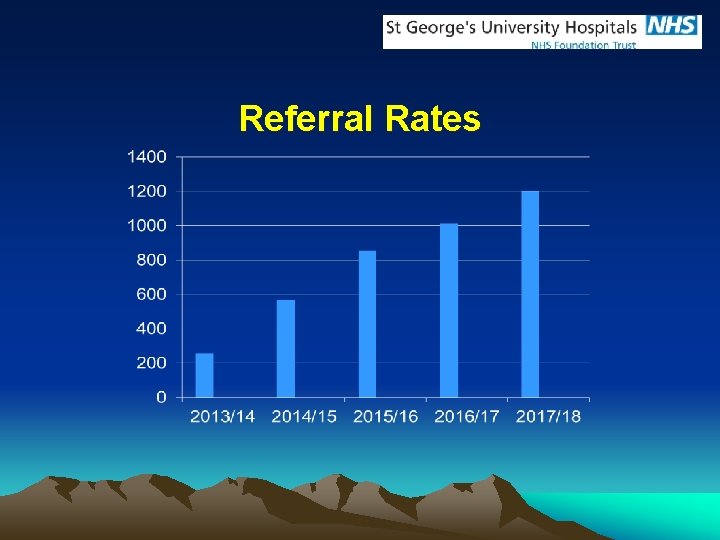
Referral Rates
Potential Challenges Ahead • Managing PLD with complex health needs • Devising a Meaningful Flagging System • Meeting RCN recommendations by 2020 • Sustaining a developing Liaison Service (321% increase in referrals in 4 years)
Planning for the Future • Placing more responsibility on clinical staff • Adapting the Friends and Family Test • Participating in Clinical Audit • Accessible Complaints Procedure • Conversations with commissioners
Patient Story • • • 19 Year old female with autism and humeral fracture Reviewed with parents by Orthopaedic Consultant Surgical intervention proposed Parents oppositional for many reasons Patient was not in any apparent distress Best Interest discussions and conservation agreed X Rays and orthopaedic reviews every 2 months Fast tracking through each department Full healing after 8 months without need for surgery
References and Further Reading • • • Abraham, A. (2009) Six Lives: the provision of public services to people with learning disabilities London: The Stationery Office Heslop, P; Blair, P; Fleming, P; Hoghton, M ; Marriott, A; Russ, L. (2013) Confidential Inquiry into premature deaths of people with learning disabilities (CIPOLD) Final Report. University of Bristol Department of Health (2010 a) Making written information easier to understand for people with learning disabilities Guidance for people who commission or produce Easy Read information – Revised Edition. London. Department of Health Disability Rights Commission (2006) Equal Treatment: Closing the Gap A formal investigation into the physical Health Inequalities experienced by People with Learning Disabilities and/or Mental Health Problems. Stratford upon Avon: Disability Rights Commission Emerson, E. and Baines, S. (2010) Health Inequalities and People with Learning Disabilities: Improving Health and Lives. London Learning Disabilities Observatory Emerson, E. and Baines, S. (2010) Health Inequalities and People with Learning Disabilities in the UK: Tizard Learning Disability Review, 16: 1 pp 42 - 48 Gaskell, S. , Nightingale, S. (2010) Supporting people with learning disabilities in acute care. Nursing Standard. 24 (18) 42 – 48 Mencap (2007) Death by Indifference. London: Mencap (2012) Death by Indifference: 74 deaths and counting: A progress report 5 years on. London: Mencap Michael, J. , (2008) Healthcare for All: Report of the Independent Inquiry into access to Healthcare for People with Learning Disabilities. Do. H: London Mencap (2018) Treat Me Well; Simple Adjustments make a Big Difference. London: Mencap
Please feel free to ask a question

Contact Details • Padraic Costello Clinical Nurse Specialist, Learning Disabilities • Email: Padraic. Costello@stgeorges. nhs. uk • Tel: 020 87252217
- Slides: 22