
The Care Act Assessment and eligibility Paul Woods
The Care Act: Assessment and eligibility Paul Woods Social Care Group June 2014
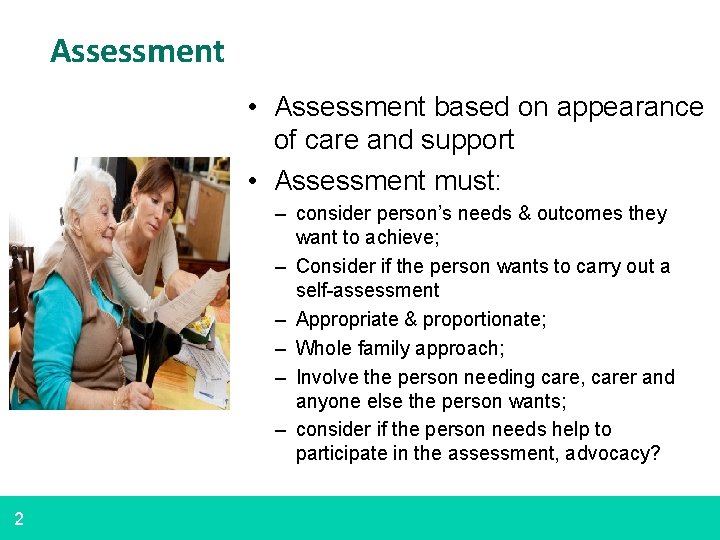
Assessment • Assessment based on appearance of care and support • Assessment must: – consider person’s needs & outcomes they want to achieve; – Consider if the person wants to carry out a self-assessment – Appropriate & proportionate; – Whole family approach; – Involve the person needing care, carer and anyone else the person wants; – consider if the person needs help to participate in the assessment, advocacy? 2
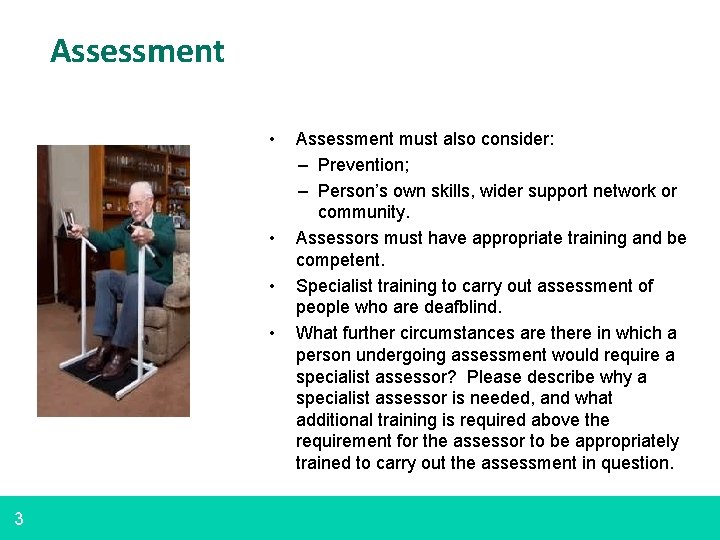
Assessment • • 3 Assessment must also consider: – Prevention; – Person’s own skills, wider support network or community. Assessors must have appropriate training and be competent. Specialist training to carry out assessment of people who are deafblind. What further circumstances are there in which a person undergoing assessment would require a specialist assessor? Please describe why a specialist assessor is needed, and what additional training is required above the requirement for the assessor to be appropriately trained to carry out the assessment in question.
Eligibility • National minimum eligibility threshold has been set through the Spending Review for 2015/16. • This will allow current practice continue in the vast majority of local authorities. • Eligibility threshold set in regulations. Engagement on first version of the draft regulations started last June: 1. 2. 3. 4 DH held engagement workshops; – Eight workshops held: three in London, Birmingham, Taunton, Derby, Preston, Gateshead. Around 250 people, representing over 100 local authorities The Care and Support Alliance engaged with people who use services and their carer’s; and – Nearly 400 users of care services and carers took part in the survey. Comments received through the eligibility mailbox – 68 submissions from 63 respondents (34 third sector organisations, 24 local authorities, 5 individuals)
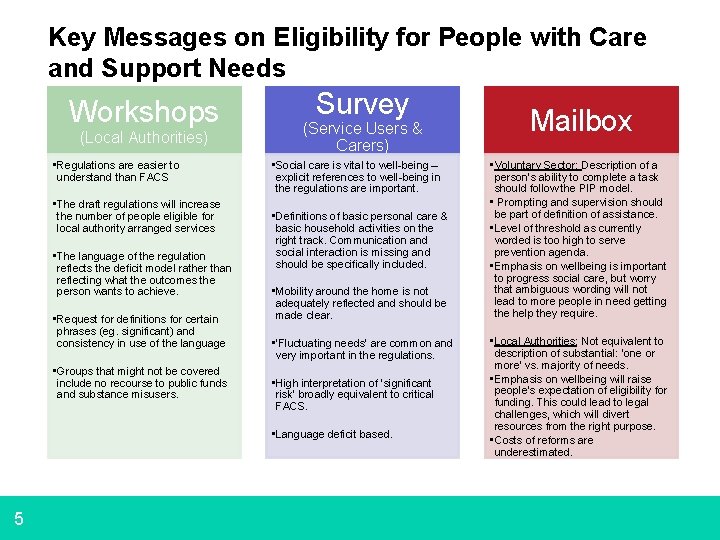
Key Messages on Eligibility for People with Care and Support Needs Workshops (Local Authorities) • Regulations are easier to understand than FACS • The draft regulations will increase the number of people eligible for local authority arranged services • The language of the regulation reflects the deficit model rather than reflecting what the outcomes the person wants to achieve. • Request for definitions for certain phrases (eg. significant) and consistency in use of the language • Groups that might not be covered include no recourse to public funds and substance misusers. Survey (Service Users & Carers) • Social care is vital to well-being – explicit references to well-being in the regulations are important. • Definitions of basic personal care & basic household activities on the right track. Communication and social interaction is missing and should be specifically included. • Mobility around the home is not adequately reflected and should be made clear. • ‘Fluctuating needs’ are common and very important in the regulations. • High interpretation of ‘significant risk’ broadly equivalent to critical FACS. • Language deficit based. 5 Mailbox • Voluntary Sector: Description of a person’s ability to complete a task should follow the PIP model. • Prompting and supervision should be part of definition of assistance. • Level of threshold as currently worded is too high to serve prevention agenda. • Emphasis on wellbeing is important to progress social care, but worry that ambiguous wording will not lead to more people in need getting the help they require. • Local Authorities: Not equivalent to description of substantial: ‘one or more’ vs. majority of needs. • Emphasis on wellbeing will raise people’s expectation of eligibility for funding. This could lead to legal challenges, which will divert resources from the right purpose. • Costs of reforms are underestimated.
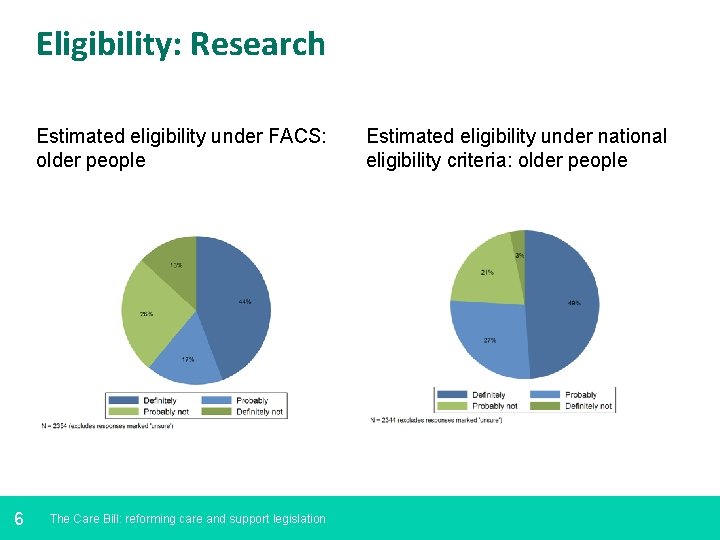
Eligibility: Research Estimated eligibility under FACS: older people 6 The Care Bill: reforming care and support legislation Estimated eligibility under national eligibility criteria: older people
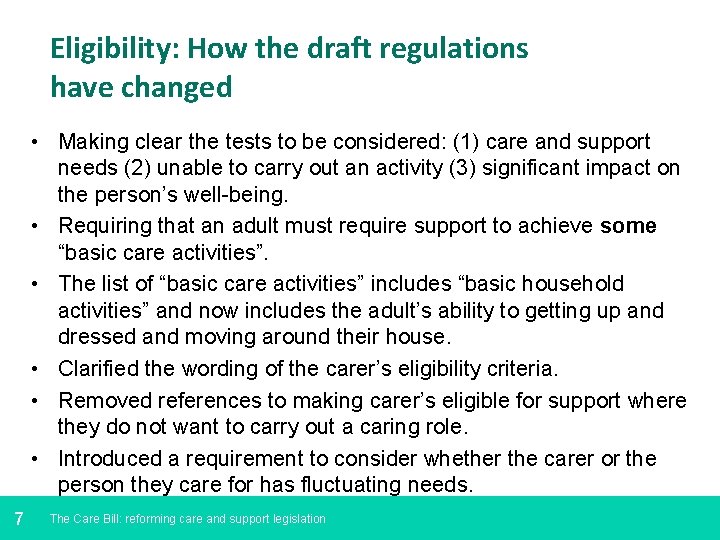
Eligibility: How the draft regulations have changed • Making clear the tests to be considered: (1) care and support needs (2) unable to carry out an activity (3) significant impact on the person’s well-being. • Requiring that an adult must require support to achieve some “basic care activities”. • The list of “basic care activities” includes “basic household activities” and now includes the adult’s ability to getting up and dressed and moving around their house. • Clarified the wording of the carer’s eligibility criteria. • Removed references to making carer’s eligible for support where they do not want to carry out a caring role. • Introduced a requirement to consider whether the carer or the person they care for has fluctuating needs. 7 The Care Bill: reforming care and support legislation
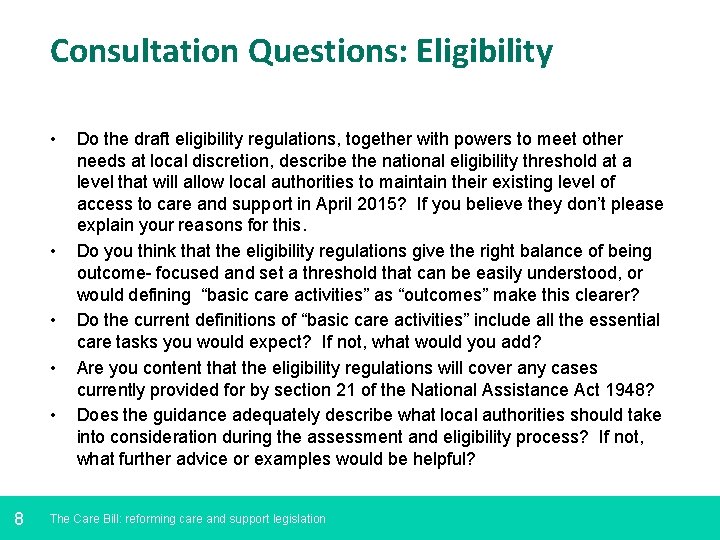
Consultation Questions: Eligibility • • • 8 Do the draft eligibility regulations, together with powers to meet other needs at local discretion, describe the national eligibility threshold at a level that will allow local authorities to maintain their existing level of access to care and support in April 2015? If you believe they don’t please explain your reasons for this. Do you think that the eligibility regulations give the right balance of being outcome- focused and set a threshold that can be easily understood, or would defining “basic care activities” as “outcomes” make this clearer? Do the current definitions of “basic care activities” include all the essential care tasks you would expect? If not, what would you add? Are you content that the eligibility regulations will cover any cases currently provided for by section 21 of the National Assistance Act 1948? Does the guidance adequately describe what local authorities should take into consideration during the assessment and eligibility process? If not, what further advice or examples would be helpful? The Care Bill: reforming care and support legislation
- Slides: 8