
The Cardiovascular System Heart Anatomy and the Function



- Slides: 42
The Cardiovascular System Heart Anatomy and the Function of the Cardiovascular System Regulation of the Heart Blood Vessels and Circulation Heart Disease
The Cardiovascular System Pg. Heart Anatomy and the Function of the Cardiovascular System
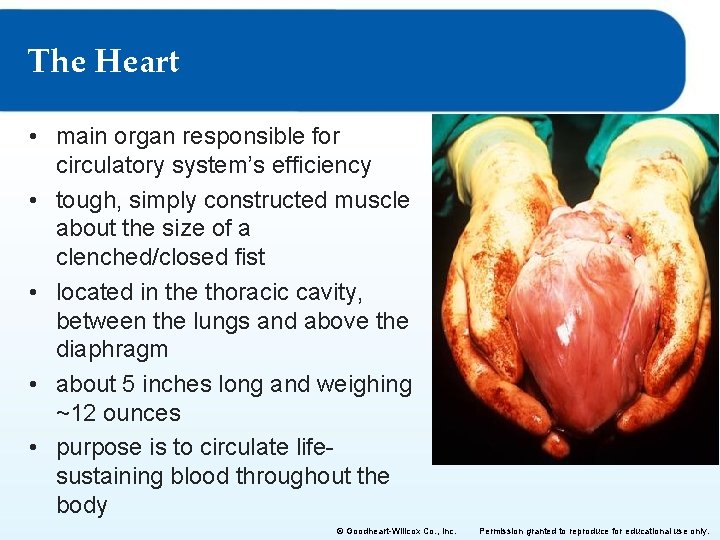
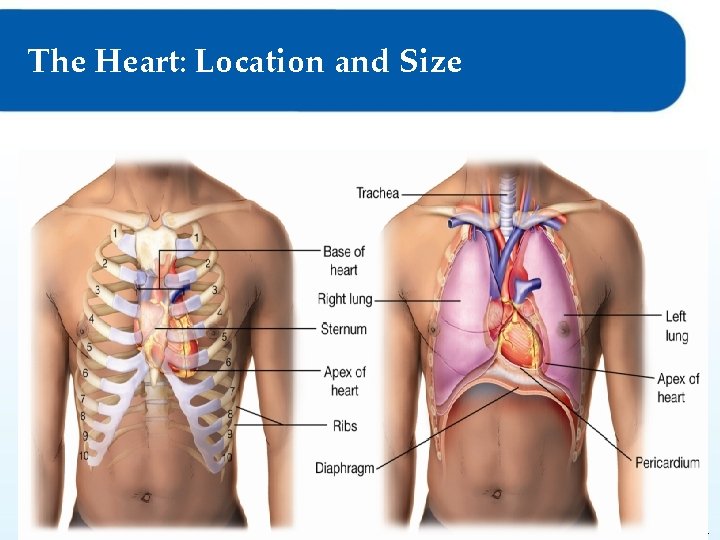
The Heart • main organ responsible for circulatory system’s efficiency • tough, simply constructed muscle about the size of a clenched/closed fist • located in the thoracic cavity, between the lungs and above the diaphragm • about 5 inches long and weighing ~12 ounces • purpose is to circulate lifesustaining blood throughout the body © Goodheart-Willcox Co. , Inc. Permission granted to reproduce for educational use only.
The Heart: Location and Size © Goodheart-Willcox Co. , Inc. Permission granted to reproduce for educational use only.
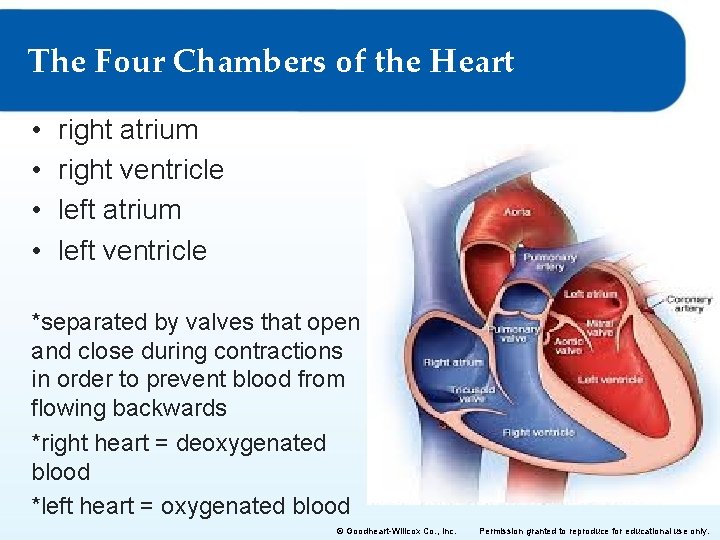
The Four Chambers of the Heart • • right atrium right ventricle left atrium left ventricle *separated by valves that open and close during contractions in order to prevent blood from flowing backwards *right heart = deoxygenated blood *left heart = oxygenated blood © Goodheart-Willcox Co. , Inc. Permission granted to reproduce for educational use only.
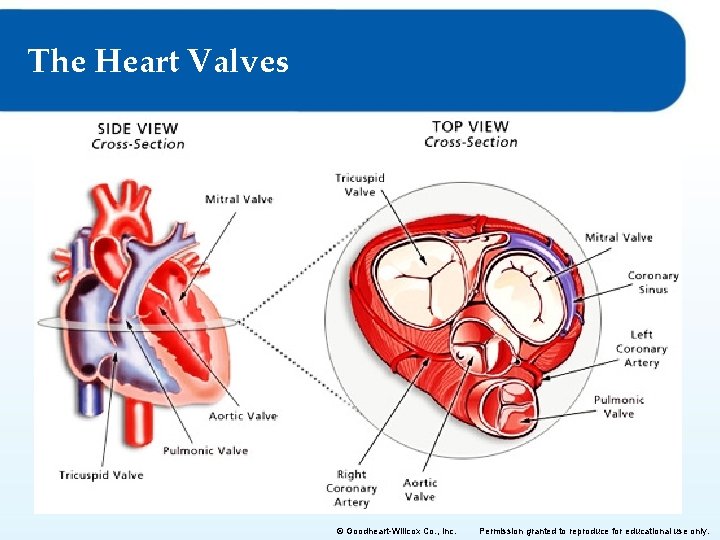
The Heart Valves • atrioventricular (AV) valves~ located between atria and ventricles – tricuspid: positioned between the right atrium and right ventricle – bicuspid (mitral): located between the left atrium and left ventricle • semilunar valves~ located where blood will leave heart – Pulmonary: found at orifice of pulmonary artery; blood travels from right ventricle into pulmonary artery and then into lungs – Aortic: found at orifice of aorta; blood passes from left ventricle into aorta, but NOT back into ventricle © Goodheart-Willcox Co. , Inc. Permission granted to reproduce for educational use only.
The Heart Valves © Goodheart-Willcox Co. , Inc. Permission granted to reproduce for educational use only.
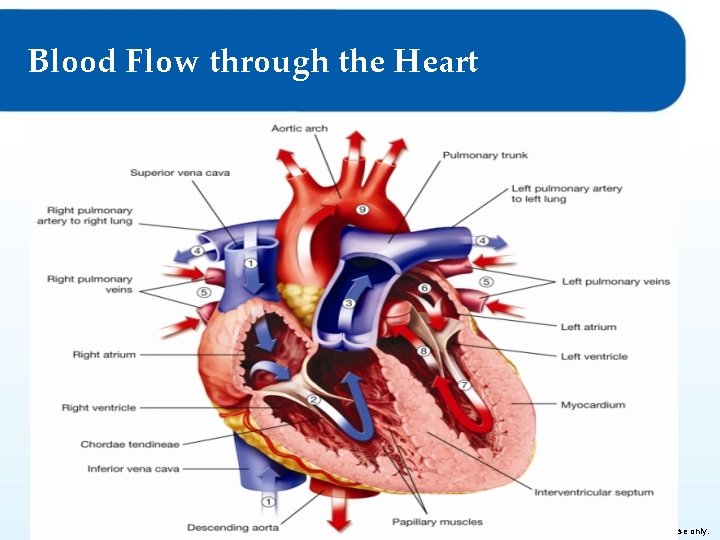
Blood Flow through the Heart 1) deoxygenated blood flows from the body to the inferior and superior vena cavae to right atrium 2) right atrium contracts, forcing blood through the tricuspid valve to right ventricle 3) right ventricle contracts, forcing blood through the pulmonary valve, to the pulmonary artery 4) blood exits to the lungs (receives O 2) © Goodheart-Willcox Co. , Inc. Permission granted to reproduce for educational use only.
Blood Flow through the Heart (continued) 5) oxygenated blood from lungs travels through the pulmonary veins to the left atrium 6) left atrium contracts, forcing blood through the mitral (bicuspid) valve to the left ventricle 7) left ventricle contracts, forcing blood through the aortic valve (semilunar veins) 8) blood passes to the aorta 9) oxygenated blood travels out to all cells of the body © Goodheart-Willcox Co. , Inc. Permission granted to reproduce for educational use only.
Blood Flow through the Heart © Goodheart-Willcox Co. , Inc. Permission granted to reproduce for educational use only.
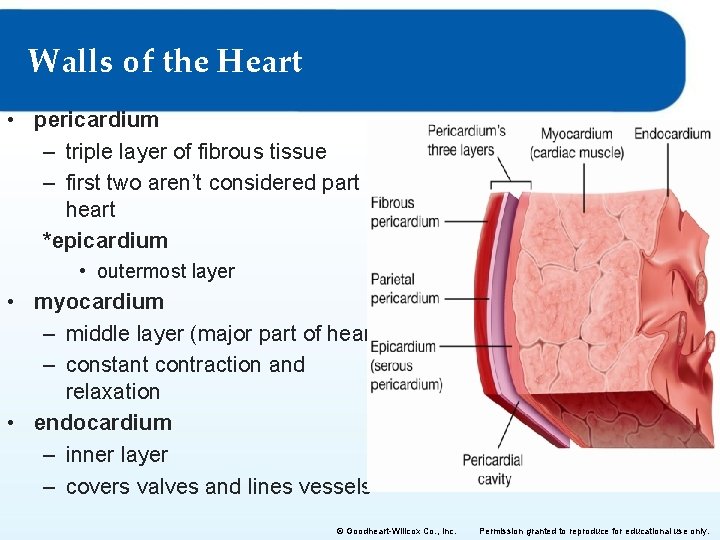
Walls of the Heart • pericardium – triple layer of fibrous tissue – first two aren’t considered part of heart *epicardium • outermost layer • myocardium – middle layer (major part of heart) – constant contraction and relaxation • endocardium – inner layer – covers valves and lines vessels © Goodheart-Willcox Co. , Inc. Permission granted to reproduce for educational use only.
Chapter 11: The Cardiovascular System Pg. Regulation of the Heart
Internal Control of the Heart • sinoatrial (SA) node – pacemaker – sends electrical impulse – tells heart to beat 60– 100 bpm © Goodheart-Willcox Co. , Inc. Permission granted to reproduce for educational use only.
External Control of the Heart • the nervous system – sympathetic nervous system speeds up – parasympathetic nervous system slows down • the endocrine system – some hormones speed up © Goodheart-Willcox Co. , Inc. Permission granted to reproduce for educational use only.
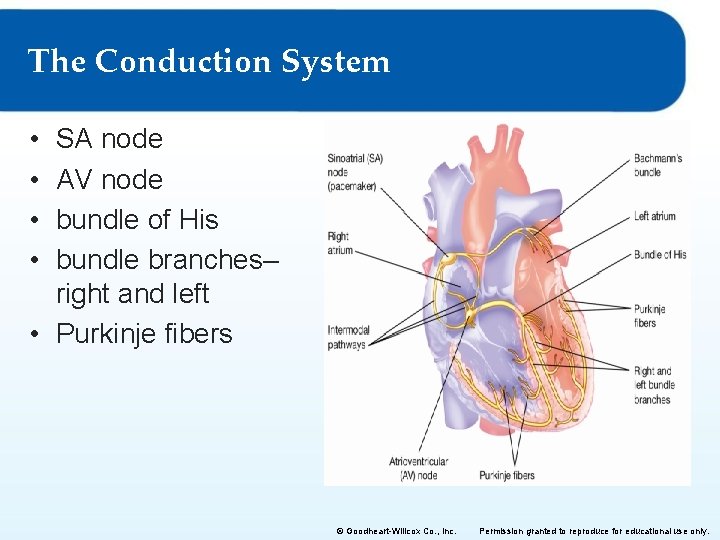
The Conduction System • • SA node AV node bundle of His bundle branches– right and left • Purkinje fibers © Goodheart-Willcox Co. , Inc. Permission granted to reproduce for educational use only.
Cardiac Cycle 1. SA node stimulates contraction of both atria. Blood flows from atria into ventricles through tricuspid and mitral valves. At this time, ventricles are relaxed, and filling with blood. 2. AV node stimulates contraction of both ventricles so that blood in ventricles is pumped to pulmonary artery and aorta through semilunar valves. Atria are relaxed and tricuspid and mitral valves are closed. 3. Ventricles relax. Semilunar valves are closed to prevent blood flow back into ventricles. Heart rests briefly (repolarization). *each cycle takes 0. 8 seconds; average person’s heart rate is between 72 and 80 beats per minute © Goodheart-Willcox Co. , Inc. Permission granted to reproduce for educational use only.
Electrocardiogram (ECG/EKG) © Goodheart-Willcox Co. , Inc. Permission granted to reproduce for educational use only.
Cardiac Output • cardiac output – Total volume of blood ejected from the heart per minute – stroke volume X heart rate = cardiac output – 60 m. L X 80 = 4800 m. L/per minute • stroke volume – amount of blood pumped in 1 beat • heart rate – number of beats per minute © Goodheart-Willcox Co. , Inc. Permission granted to reproduce for educational use only.
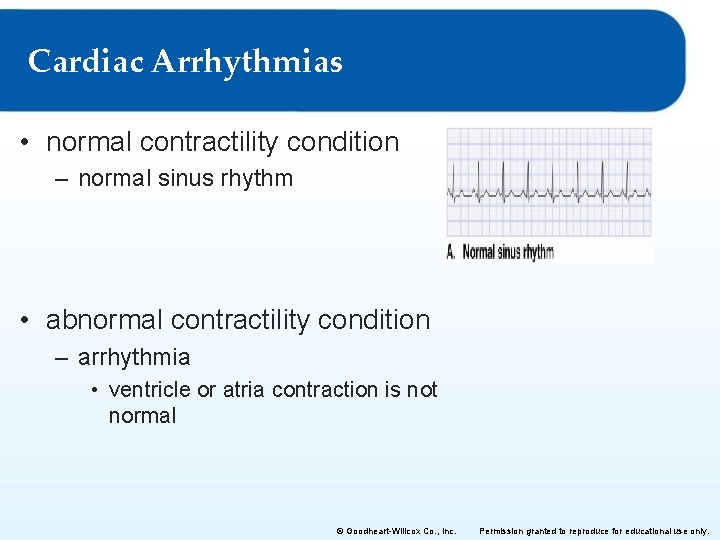
Cardiac Arrhythmias • normal contractility condition – normal sinus rhythm • abnormal contractility condition – arrhythmia • ventricle or atria contraction is not normal © Goodheart-Willcox Co. , Inc. Permission granted to reproduce for educational use only.
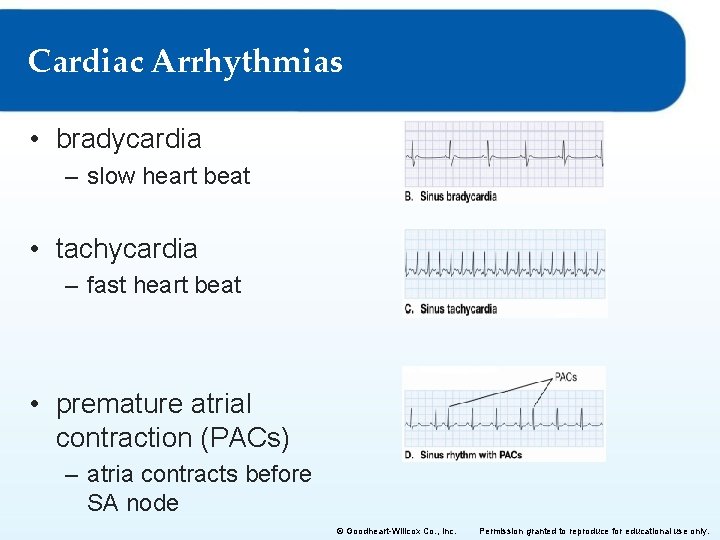
Cardiac Arrhythmias • bradycardia – slow heart beat • tachycardia – fast heart beat • premature atrial contraction (PACs) – atria contracts before SA node © Goodheart-Willcox Co. , Inc. Permission granted to reproduce for educational use only.
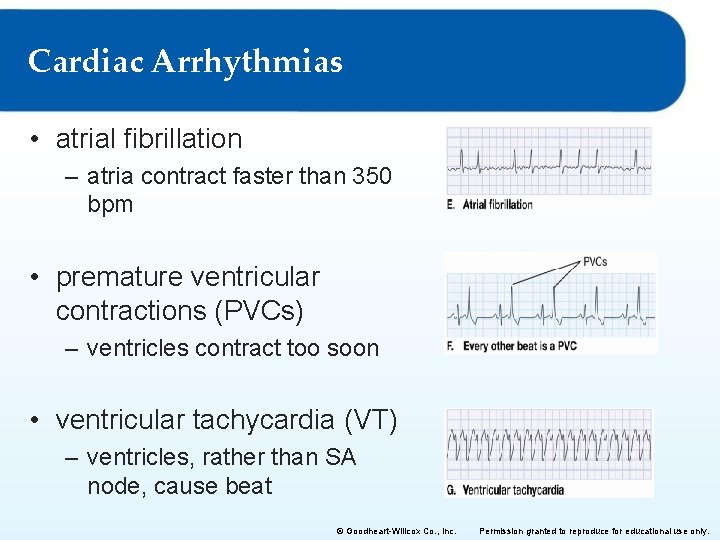
Cardiac Arrhythmias • atrial fibrillation – atria contract faster than 350 bpm • premature ventricular contractions (PVCs) – ventricles contract too soon • ventricular tachycardia (VT) – ventricles, rather than SA node, cause beat © Goodheart-Willcox Co. , Inc. Permission granted to reproduce for educational use only.
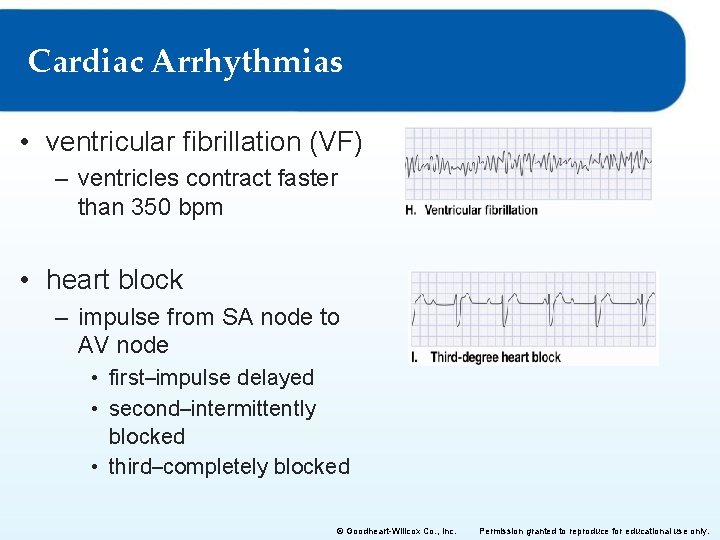
Cardiac Arrhythmias • ventricular fibrillation (VF) – ventricles contract faster than 350 bpm • heart block – impulse from SA node to AV node • first–impulse delayed • second–intermittently blocked • third–completely blocked © Goodheart-Willcox Co. , Inc. Permission granted to reproduce for educational use only.
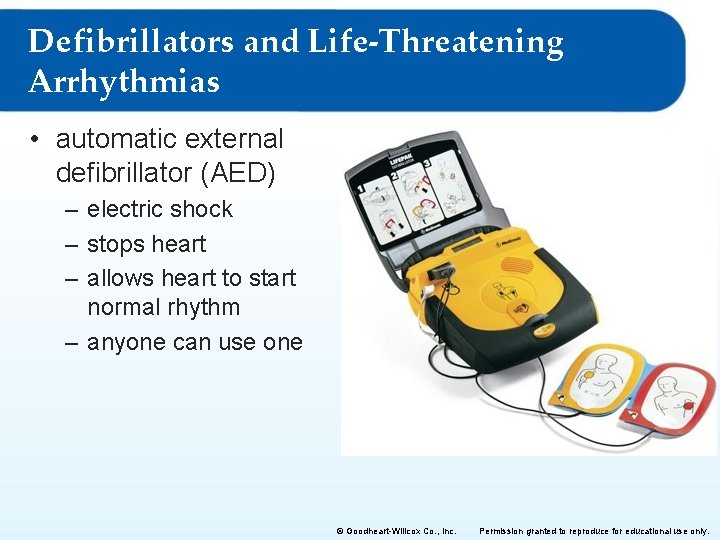
Defibrillators and Life-Threatening Arrhythmias • automatic external defibrillator (AED) – electric shock – stops heart – allows heart to start normal rhythm – anyone can use one © Goodheart-Willcox Co. , Inc. Permission granted to reproduce for educational use only.
Chapter 11: The Cardiovascular System Pg. Blood Vessels and Circulation
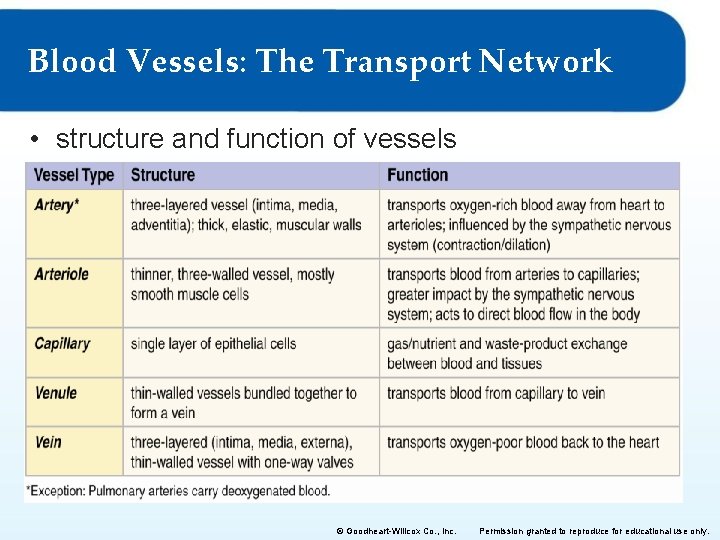
Blood Vessels: The Transport Network • structure and function of vessels © Goodheart-Willcox Co. , Inc. Permission granted to reproduce for educational use only.
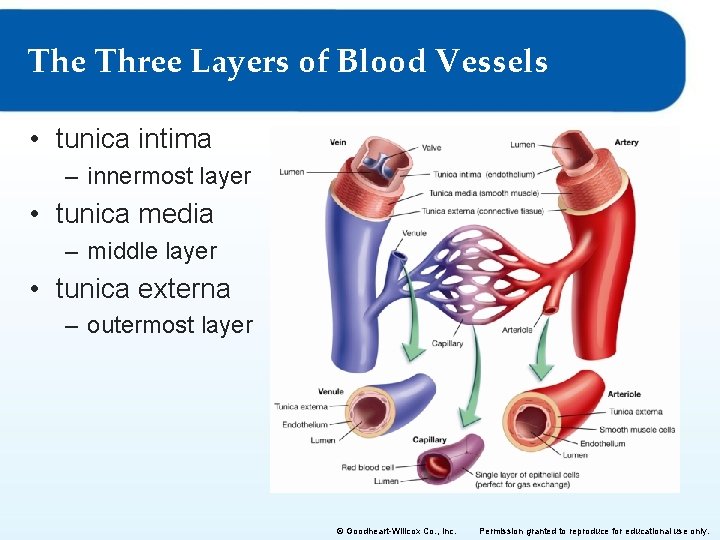
The Three Layers of Blood Vessels • tunica intima – innermost layer • tunica media – middle layer • tunica externa – outermost layer © Goodheart-Willcox Co. , Inc. Permission granted to reproduce for educational use only.
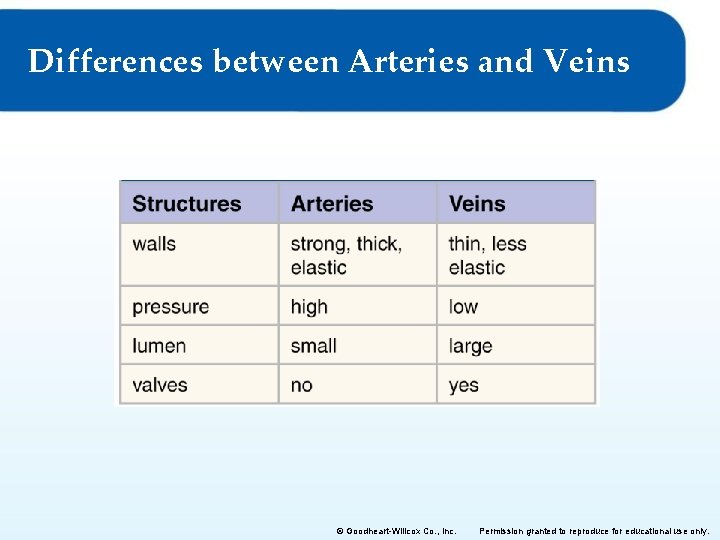
Differences between Arteries and Veins © Goodheart-Willcox Co. , Inc. Permission granted to reproduce for educational use only.
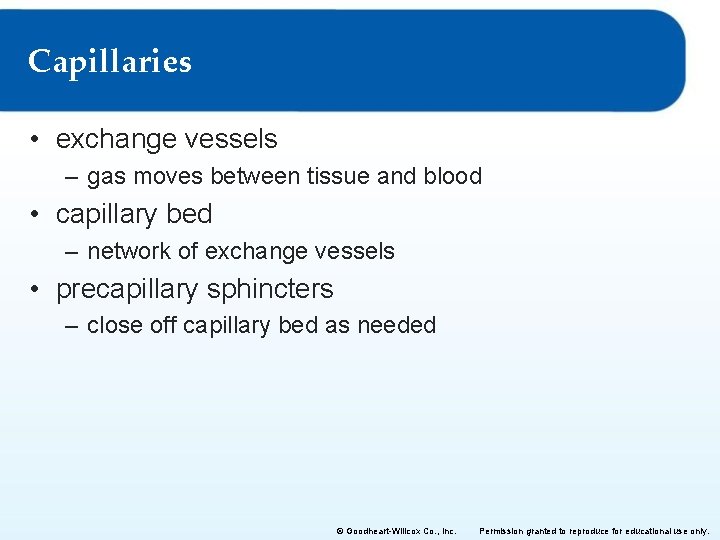
Capillaries • exchange vessels – gas moves between tissue and blood • capillary bed – network of exchange vessels • precapillary sphincters – close off capillary bed as needed © Goodheart-Willcox Co. , Inc. Permission granted to reproduce for educational use only.
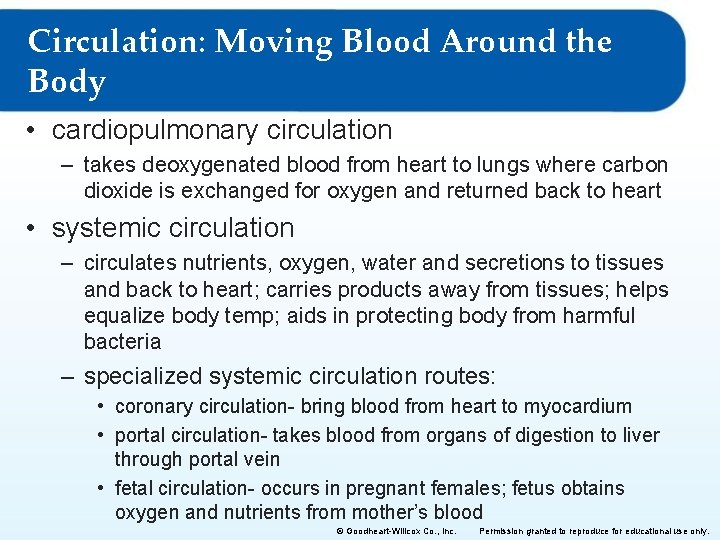
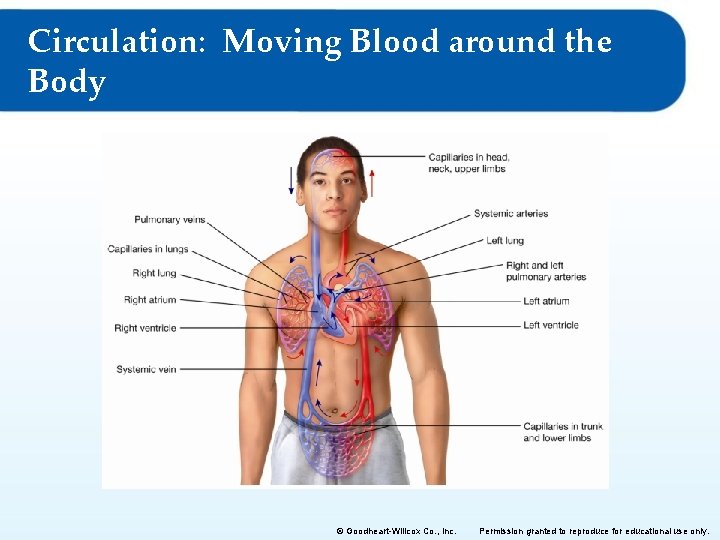
Circulation: Moving Blood Around the Body • cardiopulmonary circulation – takes deoxygenated blood from heart to lungs where carbon dioxide is exchanged for oxygen and returned back to heart • systemic circulation – circulates nutrients, oxygen, water and secretions to tissues and back to heart; carries products away from tissues; helps equalize body temp; aids in protecting body from harmful bacteria – specialized systemic circulation routes: • coronary circulation- bring blood from heart to myocardium • portal circulation- takes blood from organs of digestion to liver through portal vein • fetal circulation- occurs in pregnant females; fetus obtains oxygen and nutrients from mother’s blood © Goodheart-Willcox Co. , Inc. Permission granted to reproduce for educational use only.
Circulation: Moving Blood around the Body © Goodheart-Willcox Co. , Inc. Permission granted to reproduce for educational use only.
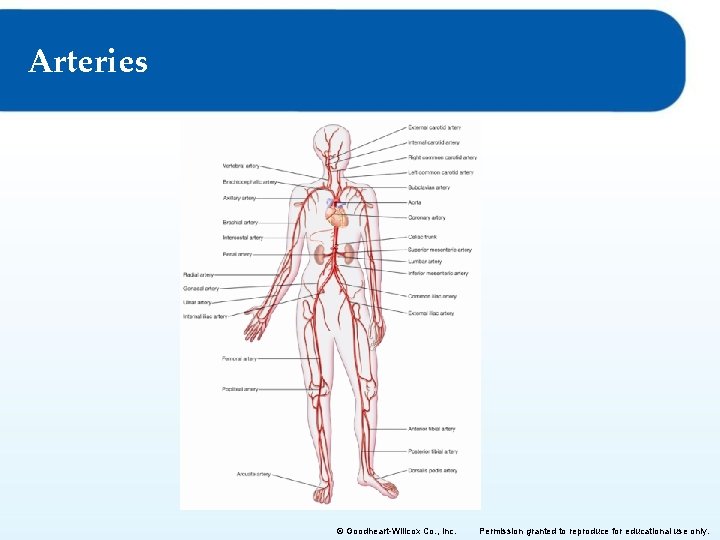
Arteries © Goodheart-Willcox Co. , Inc. Permission granted to reproduce for educational use only.
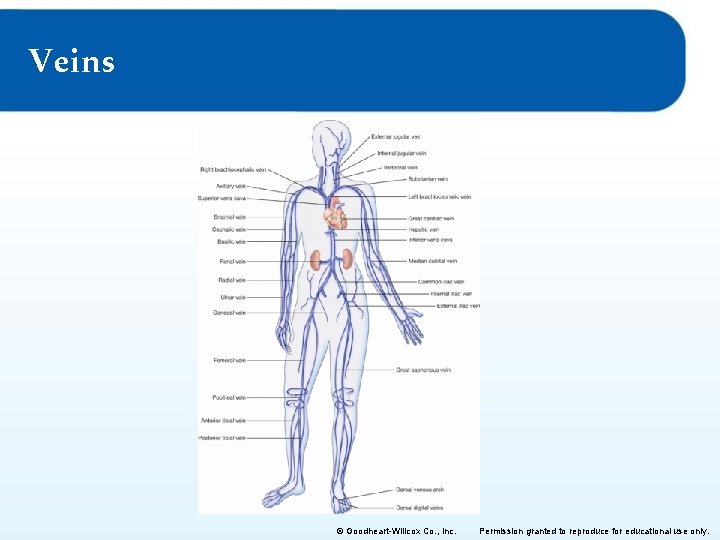
Veins © Goodheart-Willcox Co. , Inc. Permission granted to reproduce for educational use only.
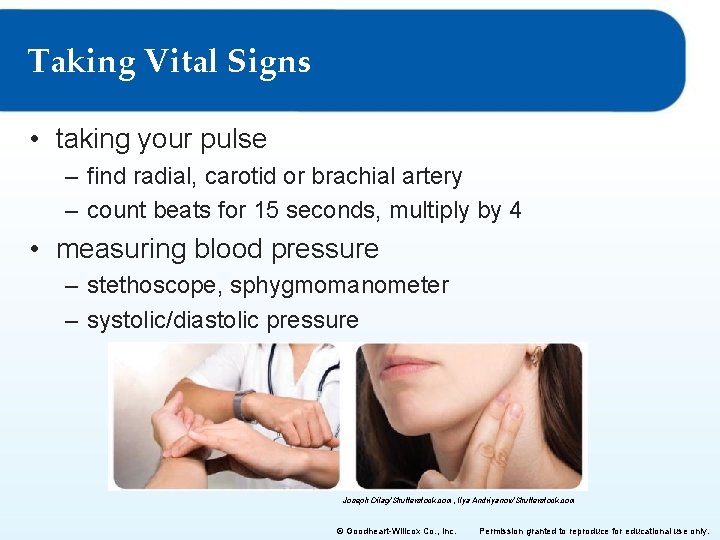
Taking Vital Signs • taking your pulse – find radial, carotid or brachial artery – count beats for 15 seconds, multiply by 4 • measuring blood pressure – stethoscope, sphygmomanometer – systolic/diastolic pressure Joseph Dilag/Shutterstock. com, Ilya Andriyanov/Shutterstock. com © Goodheart-Willcox Co. , Inc. Permission granted to reproduce for educational use only.
Know Your Numbers • weight – body mass index–weight to height • blood pressure – systolic/diastolic– 110/70 mm. Hg • cholesterol – LDLs and HDLs © Goodheart-Willcox Co. , Inc. Permission granted to reproduce for educational use only.
Chapter 11: The Cardiovascular System Pg. Heart Disease
Valve Abnormalities • heart murmurs – valves do not close properly • valvular stenosis – narrowed, stiff heart valve • mitral valve prolapse – mitral valve does not fully close • palpitations © Goodheart-Willcox Co. , Inc. Permission granted to reproduce for educational use only.
Diseases Ending in -itis • pericarditis – inflammation of heart sac • myocarditis – inflammation of heart muscle • endocarditis – inflammation of heart lining and valves © Goodheart-Willcox Co. , Inc. Permission granted to reproduce for educational use only.
Heart Failure • heart cannot pump blood • fluid backs up in – – lungs liver limbs gastrointestinal tract © Goodheart-Willcox Co. , Inc. Permission granted to reproduce for educational use only.
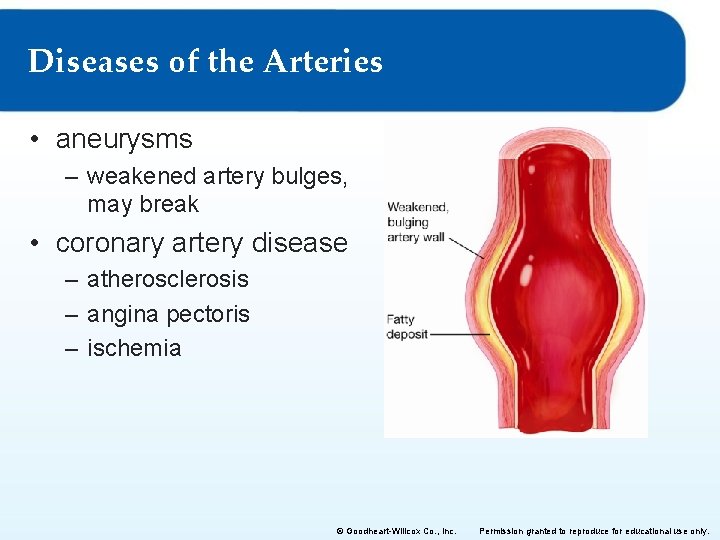
Diseases of the Arteries • aneurysms – weakened artery bulges, may break • coronary artery disease – atherosclerosis – angina pectoris – ischemia © Goodheart-Willcox Co. , Inc. Permission granted to reproduce for educational use only.
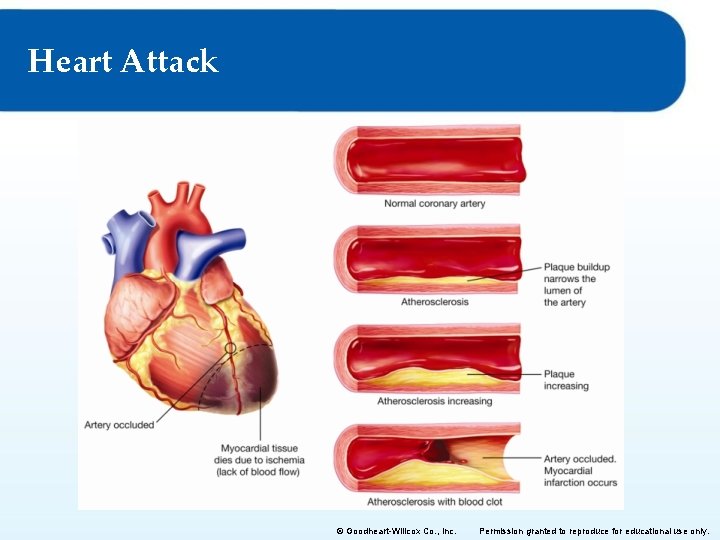
Heart Attack • myocardial infarction – plaque blocks a cardiac artery – treatment • aspirin as soon as symptoms appear (20– 60 minute window for treatment) © Goodheart-Willcox Co. , Inc. Permission granted to reproduce for educational use only.
Heart Attack © Goodheart-Willcox Co. , Inc. Permission granted to reproduce for educational use only.
Heart Disease • hypertension – blood pressure above 140/90 mm. Hg • peripheral vascular disease – lack of circulation in legs • stroke – blockage of brain blood flow • ischemic stroke • hemorrhagic stroke • transient ischemic attack (TIA) © Goodheart-Willcox Co. , Inc. Permission granted to reproduce for educational use only.