
The Cardiology Training Needs of General Practice Based
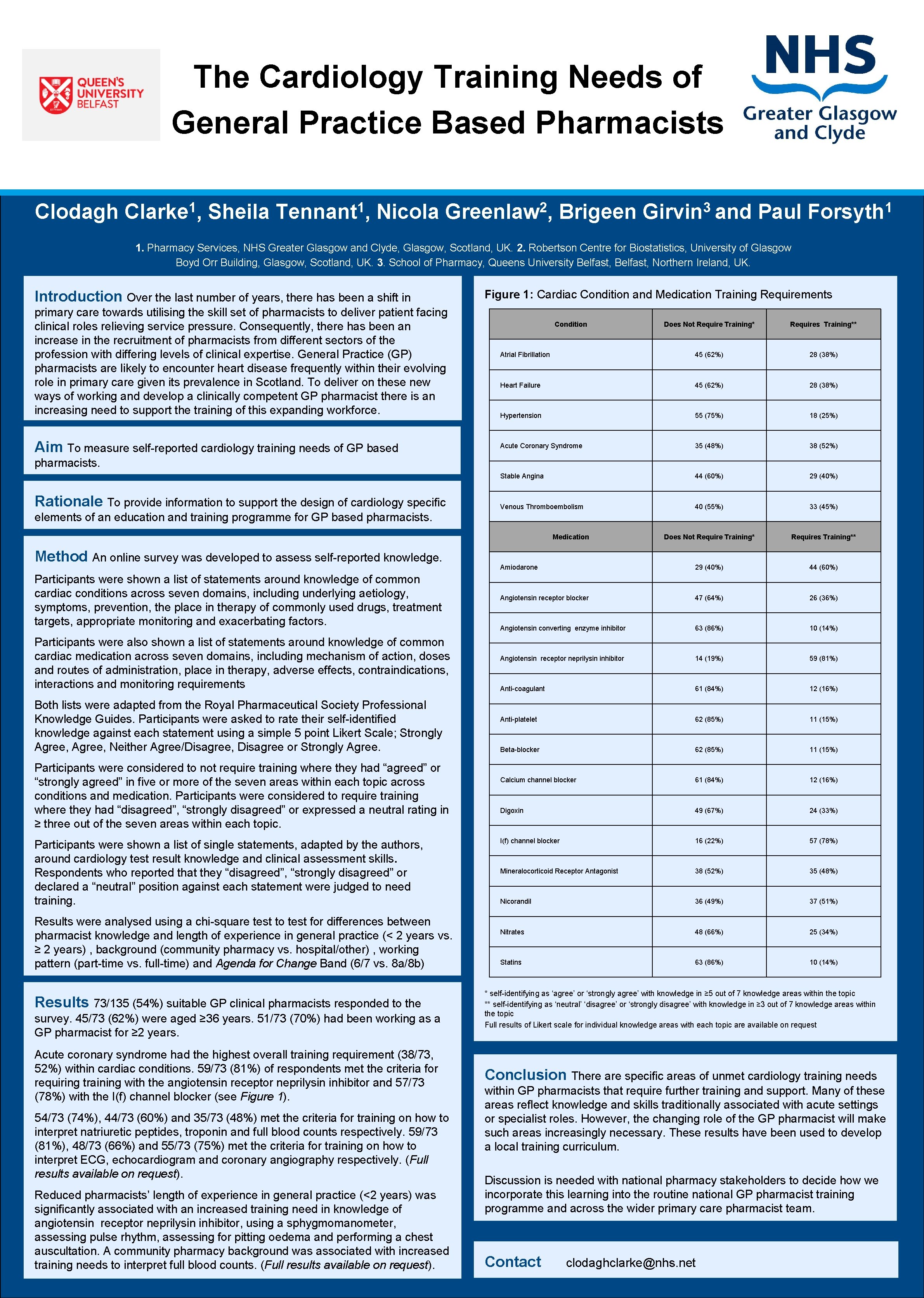
The Cardiology Training Needs of General Practice Based Pharmacists Clodagh 1 Clarke , Sheila 1 Tennant , Nicola 2 Greenlaw , Brigeen 3 Girvin and Paul 1 Forsyth 1. Pharmacy Services, NHS Greater Glasgow and Clyde, Glasgow, Scotland, UK. 2. Robertson Centre for Biostatistics, University of Glasgow Boyd Orr Building, Glasgow, Scotland, UK. 3. School of Pharmacy, Queens University Belfast, Northern Ireland, UK. Introduction Over the last number of years, there has been a shift in primary care towards utilising the skill set of pharmacists to deliver patient facing clinical roles relieving service pressure. Consequently, there has been an increase in the recruitment of pharmacists from different sectors of the profession with differing levels of clinical expertise. General Practice (GP) pharmacists are likely to encounter heart disease frequently within their evolving role in primary care given its prevalence in Scotland. To deliver on these new ways of working and develop a clinically competent GP pharmacist there is an increasing need to support the training of this expanding workforce. Aim To measure self-reported cardiology training needs of GP based Figure 1: Cardiac Condition and Medication Training Requirements Condition Does Not Require Training* Requires Training** Atrial Fibrillation 45 (62%) 28 (38%) Heart Failure 45 (62%) 28 (38%) Hypertension 55 (75%) 18 (25%) Acute Coronary Syndrome 35 (48%) 38 (52%) Stable Angina 44 (60%) 29 (40%) Venous Thromboembolism 40 (55%) 33 (45%) Does Not Require Training* Requires Training** Amiodarone 29 (40%) 44 (60%) Angiotensin receptor blocker 47 (64%) 26 (36%) Angiotensin converting enzyme inhibitor 63 (86%) 10 (14%) Angiotensin receptor neprilysin inhibitor 14 (19%) 59 (81%) Anti-coagulant 61 (84%) 12 (16%) Anti-platelet 62 (85%) 11 (15%) Beta-blocker 62 (85%) 11 (15%) Calcium channel blocker 61 (84%) 12 (16%) Digoxin 49 (67%) 24 (33%) I(f) channel blocker 16 (22%) 57 (78%) Mineralocorticoid Receptor Antagonist 38 (52%) 35 (48%) Nicorandil 36 (49%) 37 (51%) Nitrates 48 (66%) 25 (34%) Statins 63 (86%) 10 (14%) pharmacists. Rationale To provide information to support the design of cardiology specific elements of an education and training programme for GP based pharmacists. Medication Method An online survey was developed to assess self-reported knowledge. Participants were shown a list of statements around knowledge of common cardiac conditions across seven domains, including underlying aetiology, symptoms, prevention, the place in therapy of commonly used drugs, treatment targets, appropriate monitoring and exacerbating factors. Participants were also shown a list of statements around knowledge of common cardiac medication across seven domains, including mechanism of action, doses and routes of administration, place in therapy, adverse effects, contraindications, interactions and monitoring requirements Both lists were adapted from the Royal Pharmaceutical Society Professional Knowledge Guides. Participants were asked to rate their self-identified knowledge against each statement using a simple 5 point Likert Scale; Strongly Agree, Neither Agree/Disagree, Disagree or Strongly Agree. Participants were considered to not require training where they had “agreed” or “strongly agreed” in five or more of the seven areas within each topic across conditions and medication. Participants were considered to require training where they had “disagreed”, “strongly disagreed” or expressed a neutral rating in ≥ three out of the seven areas within each topic. Participants were shown a list of single statements, adapted by the authors, around cardiology test result knowledge and clinical assessment skills. Respondents who reported that they “disagreed”, “strongly disagreed” or declared a “neutral” position against each statement were judged to need training. Results were analysed using a chi-square test to test for differences between pharmacist knowledge and length of experience in general practice (< 2 years vs. ≥ 2 years) , background (community pharmacy vs. hospital/other) , working pattern (part-time vs. full-time) and Agenda for Change Band (6/7 vs. 8 a/8 b) Results 73/135 (54%) suitable GP clinical pharmacists responded to the survey. 45/73 (62%) were aged ≥ 36 years. 51/73 (70%) had been working as a GP pharmacist for ≥ 2 years. Acute coronary syndrome had the highest overall training requirement (38/73, 52%) within cardiac conditions. 59/73 (81%) of respondents met the criteria for requiring training with the angiotensin receptor neprilysin inhibitor and 57/73 (78%) with the I(f) channel blocker (see Figure 1). 54/73 (74%), 44/73 (60%) and 35/73 (48%) met the criteria for training on how to interpret natriuretic peptides, troponin and full blood counts respectively. 59/73 (81%), 48/73 (66%) and 55/73 (75%) met the criteria for training on how to interpret ECG, echocardiogram and coronary angiography respectively. (Full results available on request). Reduced pharmacists’ length of experience in general practice (<2 years) was significantly associated with an increased training need in knowledge of angiotensin receptor neprilysin inhibitor, using a sphygmomanometer, assessing pulse rhythm, assessing for pitting oedema and performing a chest auscultation. A community pharmacy background was associated with increased training needs to interpret full blood counts. (Full results available on request). * self-identifying as ‘agree’ or ‘strongly agree’ with knowledge in ≥ 5 out of 7 knowledge areas within the topic ** self-identifying as ‘neutral’ ‘disagree’ or ‘strongly disagree’ with knowledge in ≥ 3 out of 7 knowledge areas within the topic Full results of Likert scale for individual knowledge areas with each topic are available on request Conclusion There are specific areas of unmet cardiology training needs within GP pharmacists that require further training and support. Many of these areas reflect knowledge and skills traditionally associated with acute settings or specialist roles. However, the changing role of the GP pharmacist will make such areas increasingly necessary. These results have been used to develop a local training curriculum. Discussion is needed with national pharmacy stakeholders to decide how we incorporate this learning into the routine national GP pharmacist training programme and across the wider primary care pharmacist team. Contact clodaghclarke@nhs. net
- Slides: 1