
The Carbon Cycle Workshop on the Strategic Plan
The Carbon Cycle Workshop on the Strategic Plan for the Climate Change Science Program Steven Japar Research Laboratory, Ford Motor Company December 3, 2002 Washington, D. C.
General Comments • Overview is comprehensive, but … • Key Questions have considerable overlap – Curtails discussion of specific issues in the available space • A different break-out scheme? – Desired end points/products – Needs to achieve goals • Scientific understanding – experiments; data mining • Confirming global data – satellites, in situ remote sensing • Interactions with other areas of the Climate Change Science Program • Model improvement/development, as appropriate
US Carbon Cycle Science Program AIMS • How large/variable are the dynamic reservoirs/ fluxes of carbon in the Earth system? – Carbon cycling changes: years decades centuries? – Interactions with climate, water, nitrogen cycles • What are our options for managing carbon sources/sinks to achieve balance of risk/cost/ benefit to society? – Science of CO 2/CH 4 mitigation (sequestration)
What Is Needed? • IDENTIFY, QUANTIFY all sources and sinks – Understand biogeochemistry • Interactions of carbon, nitrogen, water cycles • Interactions with climate, ecosystem disturbances, air quality • Impacts of land use alternatives – Science of CO 2, CH 4 mitigation • GLOBAL MAP of land use – Satellite platforms; in situ ecosystem monitoring • MODEL the carbon cycle – Couple land water, especially interfaces – Regional resolution or parameterization – Sources/sinks Land use
What Is Needed? • IDENTIFY, QUANTIFY all sources and sinks – Understand the biogeochemistry – interactions of carbon, nitrogen, water cycles; climate • Above and below ground h t • Terrestrial, ocean waters y r e – Surface layer, deep water v E • Science of CO , CH tmitigation u o GLOBAL MAP b of land use A in situ ecosystem monitoring – Satellite platforms; t s u MODEL J the carbon cycle – Flora and Fauna 2 • • ! g in 4 – Couple land water, especially interfaces – Regional resolution or parameterization – Sources/sinks Land use
Ford Motor Co. ’s Research Interests • Science underlying CO 2/CH 4 mitigation/ sequestration – Princeton University sequestration program – University of Michigan – sponsored Ameriflux work • Black Carbon – Impact on radiative forcing of climate • University of Michigan – model development • In-house: optical properties of vehicle particle emissions • Air quality and CO 2/CH 4 sources/sinks – Nitrogen fertilization, ozone and biomass, etc.
Cautions • Mapping, remote sensing, modeling are nice, but to look into the future we must have the underlying science. • There is no point in collecting data if we have to way to manage it and use it. It looks good, but vigilance is required
Q 1: Magnitudes/distributions of N. A. carbon sources/sinks; dynamicscontrolling processes? • Research Needs – Micrometeorological estimates of net land, ocean CO 2/CH 4 fluxes at ecosystem, landscape scales – Biomass, soil inventories of carbon in all managed and unmanaged ecosystems – Processes in coastal zones, ecosystem margins • Products – – Quantify regional estimates of C fluxes Identify processes controlling C sources/sinks Carbon cycle models State of N. American Carbon Report
Q 2: Magnitudes/distributions of ocean C sources/sinks; dynamics- controlling processes; timescales? • Research Needs – Quantify ocean capacity to absorb fossil fuel CO 2 through export to the deep sea • Regional/seasonal variation in nutrients, C uptake – Characterization of coastal margins • Products – Role of nutrients, primary productivity on deep-sea C storage; linkage of carbon, nitrogen cycles – Global air/sea fluxes of CO 2; delivery of C from land to oceans – Ocean sequestration models: biogeochemistry, ocean circulation, ecosystem feedback
Q 3: Magnitudes/distributions of global terrestrial, oceanic, atmospheric C; timescales? • Research needs – Collection, analysis, integration of global C monitoring and inventory data – Development of coupled, interactive carbon-climate, and Earth system models • Products – Identification/quantification of processes controlling soil C storage, global CO 2 exchange among land/ocean/air – Regional estimates of C flux strength – Remote sensing: changes in primary productivity, biomass, land cover – Potential for changes in C storage, fluxes due to changes in climate, ecosystem disturbance, climate; climate feedbacks?
Q 4: Effects of past future land use change/resource management on C sources/sinks? • Research needs – Continued monitoring of C storage/flux (soil, litter, vegetation, etc. ); response to land use changes/ management practices – Continued satellite land use data; new remote sensing data of biomass – Process studies linking observations and long-term experiments to identify cause-and-effect relationships. • Products – Effects of land use (then and now) on C storage/release under all environmental conditions – Agricultural management effects on US C emissions/storage – Linked ecosystem, resource management, human dimensions models to evaluate policy options
Q 5: Future CO 2, CH 4 concentrations; how will C sources/ sinks change in the future? • Research needs – Potential land use/climate/carbon cycle interactions/ feedbacks; anomalous responses • Incorporate improved processes into C cycle models – Response of C sources/sinks to increased CO 2, climate change, inherent natural variability – Process studies linking observations and long-term experiments to identify cause-and-effect relationships. • Products – Effects of land use (then and now) on C storage/release under all environmental conditions – Agricultural management effects on US C emissions/storage – Linked ecosystem, resource management, human dimensions models to evaluate policy options
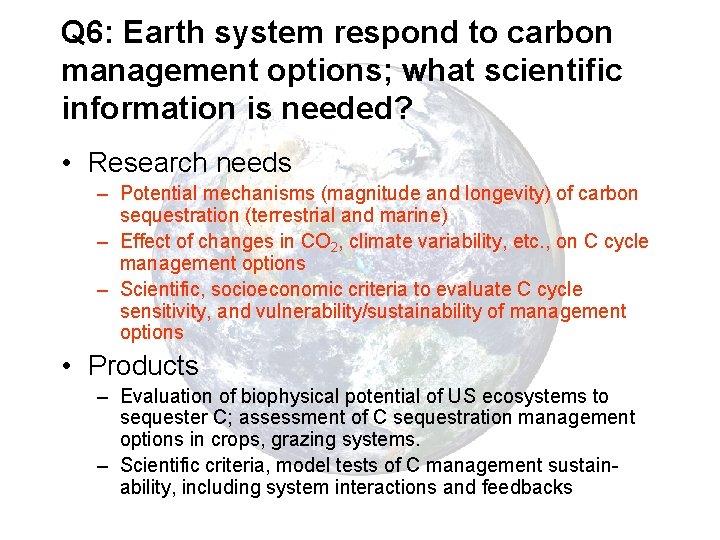
Q 6: Earth system respond to carbon management options; what scientific information is needed? • Research needs – Potential mechanisms (magnitude and longevity) of carbon sequestration (terrestrial and marine) – Effect of changes in CO 2, climate variability, etc. , on C cycle management options – Scientific, socioeconomic criteria to evaluate C cycle sensitivity, and vulnerability/sustainability of management options • Products – Evaluation of biophysical potential of US ecosystems to sequester C; assessment of C sequestration management options in crops, grazing systems. – Scientific criteria, model tests of C management sustainability, including system interactions and feedbacks
- Slides: 13