
The capability approach an introduction Wednesday 7 th
The capability approach: an introduction Wednesday 7 th June, 2017 Rosie Peppin Vaughan rosie. peppinvaughan@ucl. ac. uk
The Capability Approach • Developed by the economist Amartya Sen and the philosopher Martha Nussbaum • Context: • ‘Crisis of development’ • Ongoing questions about equality and social justice; limitations of i) resource-based or ii) utility-based approaches. • Key question: ‘equality of what? ’ • A theoretical and evaluative framework for thinking about equality and development
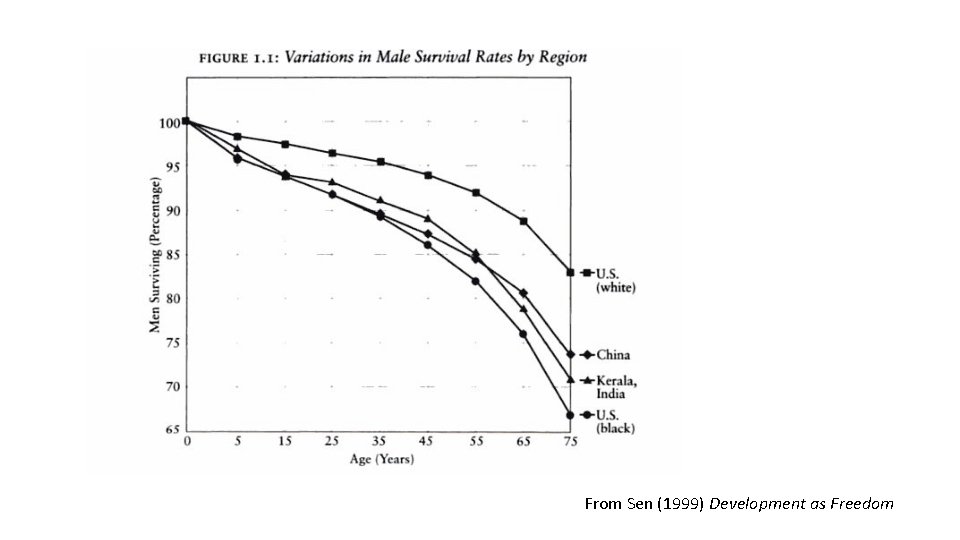
From Sen (1999) Development as Freedom
Central proposition • When thinking about development and equality, we need to look at… The extent of freedom people have to achieve the functionings that they value • Functionings: ‘beings and doings’, e. g. working, resting, being nourished • The freedom to achieve a functioning = capability • Functionings that they value: Sen distinguished between wellbeing and agency, important to acknowledge ‘other-regarding’ values as well. Example of two starving men.
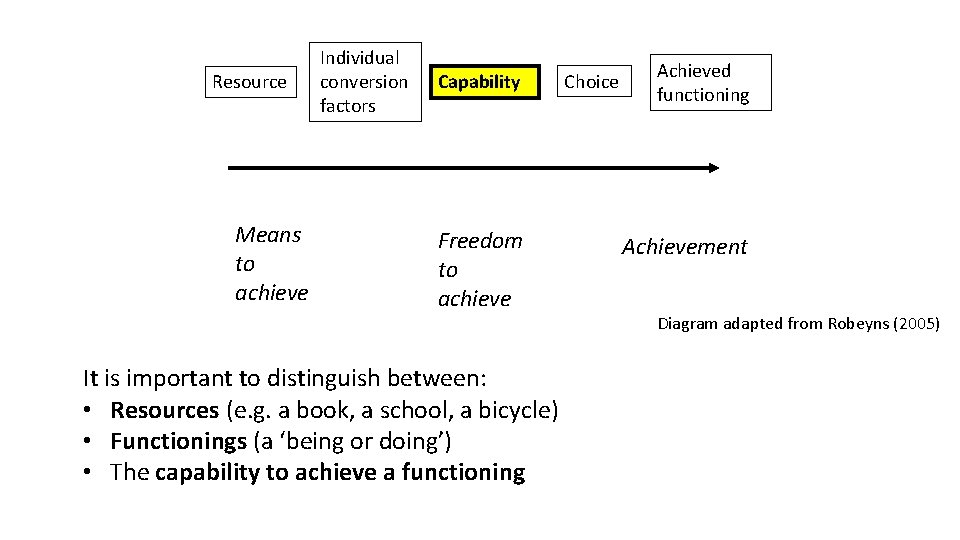
Resource Means to achieve Individual conversion factors Capability Freedom to achieve It is important to distinguish between: • Resources (e. g. a book, a school, a bicycle) • Functionings (a ‘being or doing’) • The capability to achieve a functioning Choice Achieved functioning Achievement Diagram adapted from Robeyns (2005)
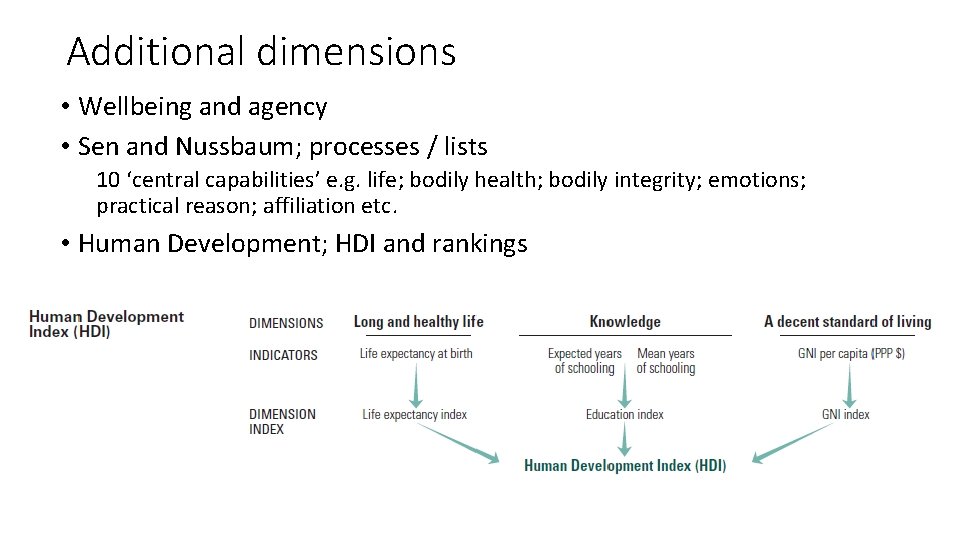
Additional dimensions • Wellbeing and agency • Sen and Nussbaum; processes / lists 10 ‘central capabilities’ e. g. life; bodily health; bodily integrity; emotions; practical reason; affiliation etc. • Human Development; HDI and rankings
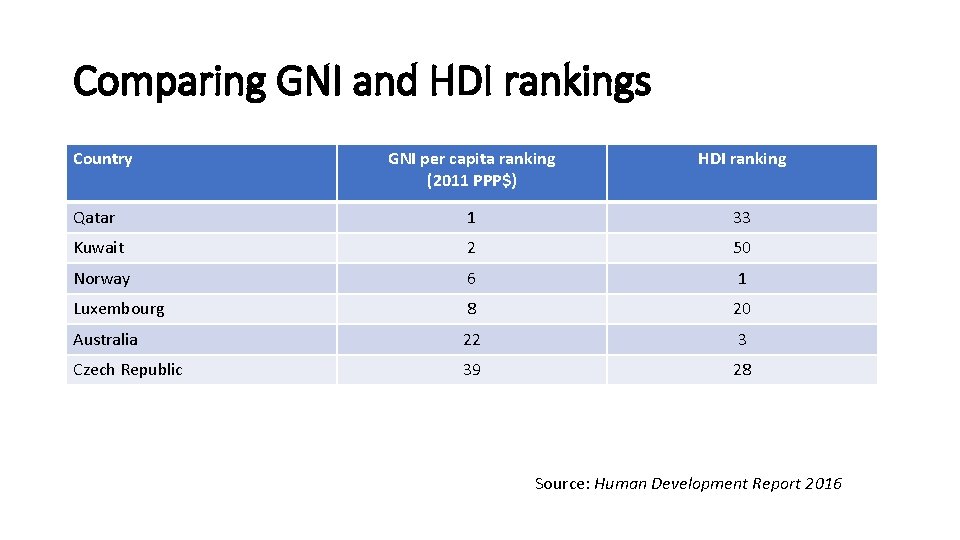
Comparing GNI and HDI rankings Country GNI per capita ranking (2011 PPP$) HDI ranking Qatar 1 33 Kuwait 2 50 Norway 6 1 Luxembourg 8 20 Australia 22 3 Czech Republic 39 28 Source: Human Development Report 2016
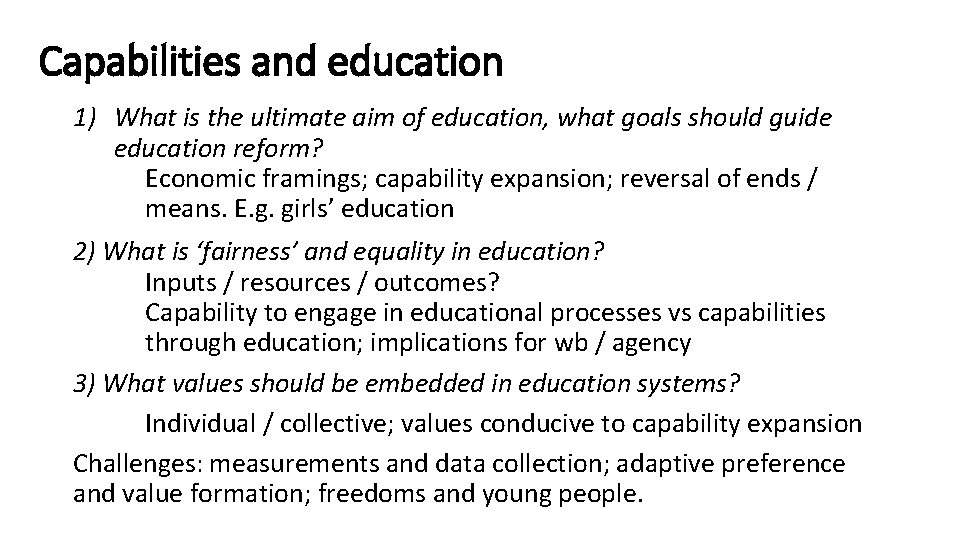
Capabilities and education 1) What is the ultimate aim of education, what goals should guide education reform? Economic framings; capability expansion; reversal of ends / means. E. g. girls’ education 2) What is ‘fairness’ and equality in education? Inputs / resources / outcomes? Capability to engage in educational processes vs capabilities through education; implications for wb / agency 3) What values should be embedded in education systems? Individual / collective; values conducive to capability expansion Challenges: measurements and data collection; adaptive preference and value formation; freedoms and young people.
Some areas of work so far • Theoretical work around rights, entitlements, capabilities and justice (e. g. Mc. Cowan, Unterhalter, Brighouse, Robeyns) • Value formation and aspirations (e. g. Hart, Walker, Robeyns) • Diversity and different values in education (e. g. Terzi, Walker) • Impact of education on other capabilities e. g. labour market (e. g. Otto, Hinchliffe) • Teachers’ capabilities (e. g. Tao, Buckler, Cin) • Children’s capabilities (e. g. Biggeri, Comim) • Higher Education (e. g. Walker, Mc. Lean, Hart, Mc. Cowan) Cross-cutting themes: gender; critical perspectives on education; measurement; capabilities and education policy.
Conclusion • Theoretical and practical challenges but advantages for thinking about social justice in education • Justification for education – and definition. • Defines equality while taking diversity into account Upcoming talks: • Thursday 8 th June: Melanie Walker, 10 am, London International Development Centre • Thursday 15 th June: Amartya Sen, 5 pm, UCL Institute of Education • 2017 -18 Seminars on capabilities and education at UCL Institute of Education (email rosie. peppinvaughan@ucl. ac. uk to sign up) • HDCA Thematic Group on Education – see website.
- Slides: 10