
The Canadian Model of Occupational Performance and Engagement


- Slides: 16
The Canadian Model of Occupational Performance and Engagement Polatajko, Townsend & Craik 2007. Occupational Therapy Division University of Cape Town ‘Matumo Ramafikeng’
Background Developed from the Canadian Model of Occupational Performance (CMOP) Captures the occupational perspective of human occupation Positions profession beyond the medical model Envisions health, well-being and justice as attainable through occupation Introduces engagement as an important construct in understanding human occupation
Assumptions Based on shared assumptions of the profession Client-centredness is key
Theories that inform CMOP-E Humanistic theories- client centred principles Developmental theories- adaptation and development of occupational roles Environmental theories- the influence of environment on occupation and the person
Focus of model Occupational performance Occupational Engagement Both are a result of a dynamic interaction between components of the model. Presents a transverse view of model that situates occupation as the core focus of the profession.
Engagement Refers to all that people do to become occupied Speaks to occupying self or others Relates to having occupations and not only performing them Presents a broader view of human occupation
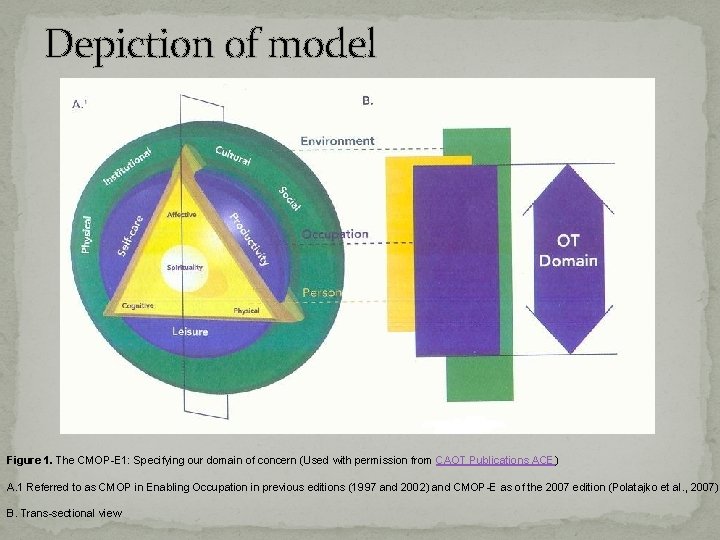
Depiction of model Figure 1. The CMOP-E 1: Specifying our domain of concern (Used with permission from CAOT Publications ACE) A. 1 Referred to as CMOP in Enabling Occupation in previous editions (1997 and 2002) and CMOP-E as of the 2007 edition (Polatajko et al. , 2007) B. Trans-sectional view
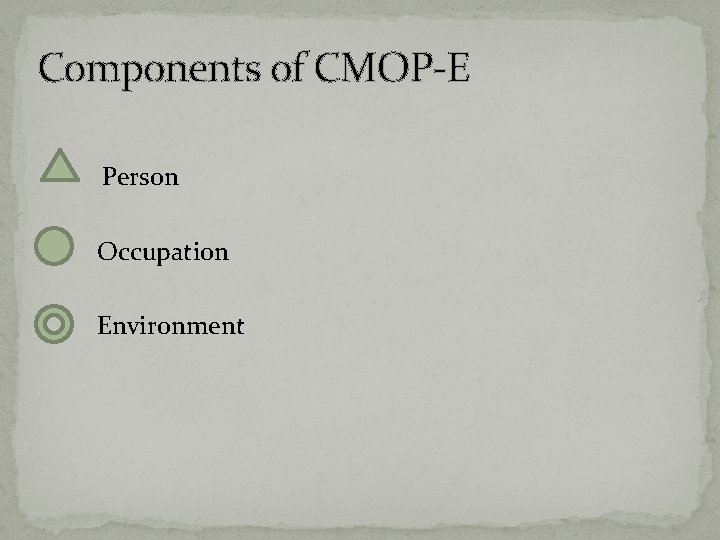
Components of CMOP-E Person Occupation Environment
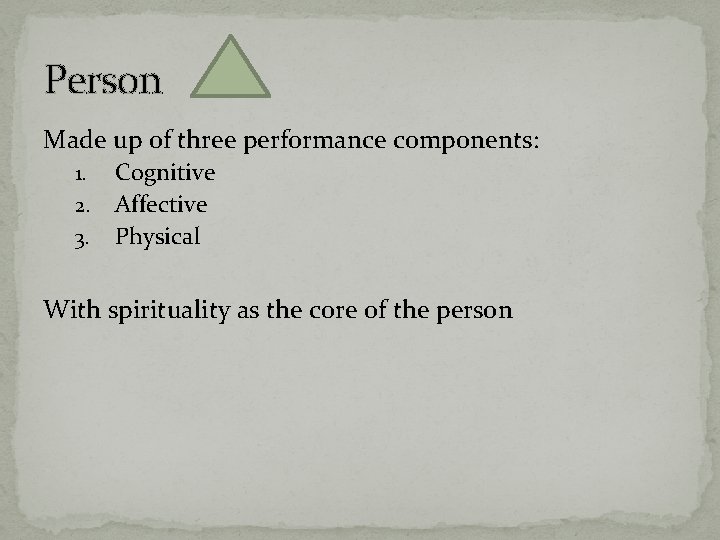
Person Made up of three performance components: 1. 2. 3. Cognitive Affective Physical With spirituality as the core of the person
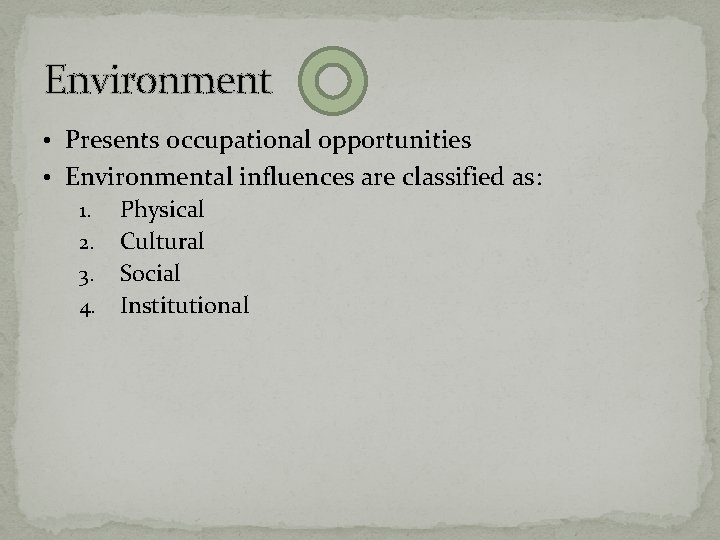
Environment • Presents occupational opportunities • Environmental influences are classified as: 1. 2. 3. 4. Physical Cultural Social Institutional
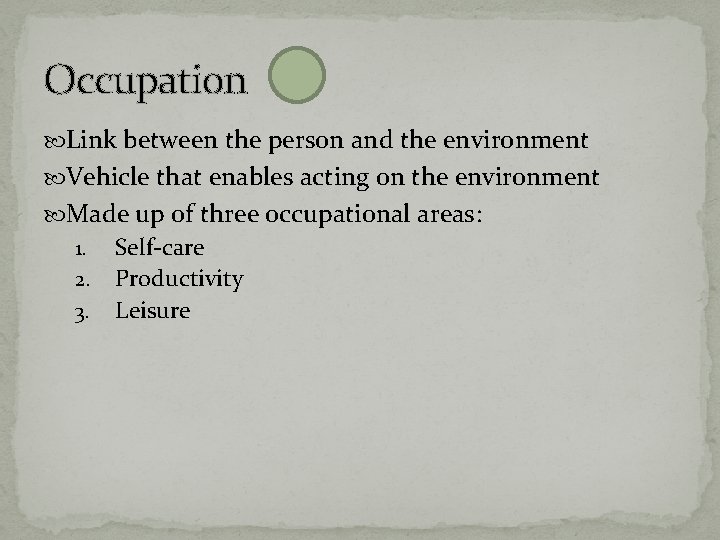
Occupation Link between the person and the environment Vehicle that enables acting on the environment Made up of three occupational areas: 1. 2. 3. Self-care Productivity Leisure
Function- dysfunction continuum Change in one component= change in another component Limitations within the person= decreased performance An unsupportive environment= decreased performance and engagement Limited occupational opportunities= limited occupational engagement Harmonious relationship between components= optimal performance and engagement
Implications for practice Allows for use with other frameworks. Can be used across age groups. Can be applied to various diagnoses. Promotes client-centredness. Can be used in multicultural settings. Congruent with the International Classification of Functioning, Disability and Health (ICF).
Implications for practice Directs focus of practice on creating environments that are occupationally supportive Means through which health and well-being may be attained.
References: Clarke, C. 2003. Clinical application of the Canadian Model of Occupational Performance in a forensic rehabilitation hostel. British Journal of Occupational Therapy. 66(4)171 -174. Grant, D. D. & Lundon, K. 1998. The Canadian Model of Occupational Performance applied to females with osteoporosis. Canadian Journal of Occupational Therapy. 66(4)3 -12. Polatajko, H. J. , Townsend, E. A. & Craik, J. 2007. Canadian Model of Occupational Performance and Engagement (CMOP-E). In Enabling Occupation II: Advancing an Occupational Therapy Vision of Health, Well-being, & Justice through Occupation. E. A. Townsend & H. J. Polatajko, Eds. Ottawa, ON: CAOT Publications ACE. 22 -36. World Health Organization. 2001. International Classification of Functioning, Disability and Health. Geneva: WHO.
This work is licensed under the Creative Commons Attribution-Non Commercial. Share Alike 2. 5 South Africa License. To view a copy of this license, visit http: //creativecommons. org/licenses/bysa/2. 5/za/