
The California Department of Education and The California
- Slides: 66
The California Department of Education and The California Community of Practice on Secondary Transition Presents A Webinar Series Triangulating Postsecondary Goals Incorporating Industry Standards and Common Core Standards in Postsecondary and Annual Goal Statements Hosted by California Department of Education March 20, 2012 3: 00 – 4: 30 p. m.
Welcome Jill Larson, Consultant Policy and Program Services Unit Special Education Division California Department of Education jlarson@cde. ca. gov Sue Sawyer Sharen Bertrando Research Associate Comprehensive President California Transition Alliance Center @ West. Ed www. catransitionalliance. org sbertra@wested. org This presentation was developed by the California Community of Practice on Secondary Transition which is a statewide, multi-agency, stakeholder group.
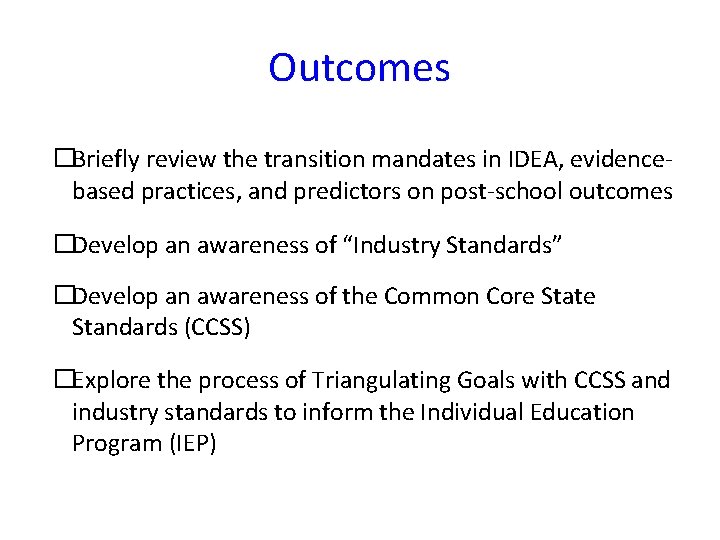
Outcomes �Briefly review the transition mandates in IDEA, evidencebased practices, and predictors on post-school outcomes �Develop an awareness of “Industry Standards” �Develop an awareness of the Common Core State Standards (CCSS) �Explore the process of Triangulating Goals with CCSS and industry standards to inform the Individual Education Program (IEP)
Transition Mandates • IDEA • Evidence-based practices • Predictors
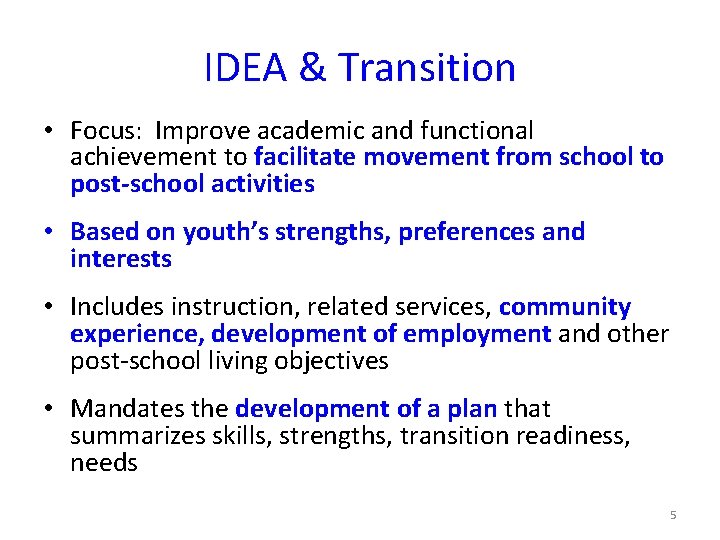
IDEA & Transition • Focus: Improve academic and functional achievement to facilitate movement from school to post-school activities • Based on youth’s strengths, preferences and interests • Includes instruction, related services, community experience, development of employment and other post-school living objectives • Mandates the development of a plan that summarizes skills, strengths, transition readiness, needs 5
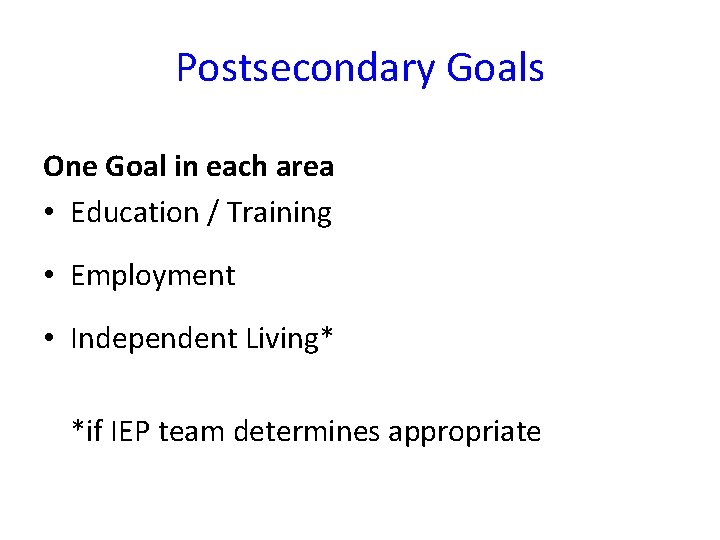
Postsecondary Goals One Goal in each area • Education / Training • Employment • Independent Living* *if IEP team determines appropriate
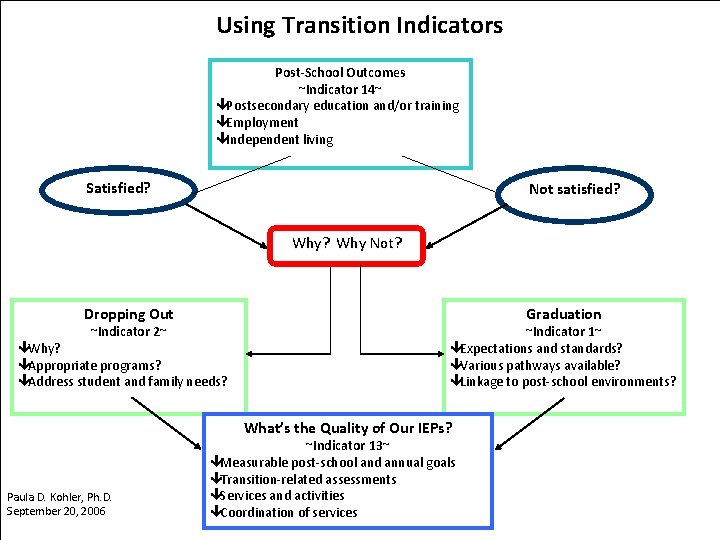
Using Transition Indicators Post-School Outcomes ~Indicator 14~ êPostsecondary education and/or training êEmployment êIndependent living Satisfied? Not satisfied? Why Not? Dropping Out ~Indicator 2~ Graduation êWhy? êAppropriate programs? êAddress student and family needs? ~Indicator 1~ êExpectations and standards? êVarious pathways available? êLinkage to post-school environments? What’s the Quality of Our IEPs? Paula D. Kohler, Ph. D. September 20, 2006 ~Indicator 13~ êMeasurable post-school and annual goals êTransition-related assessments êServices and activities êCoordination of services 7
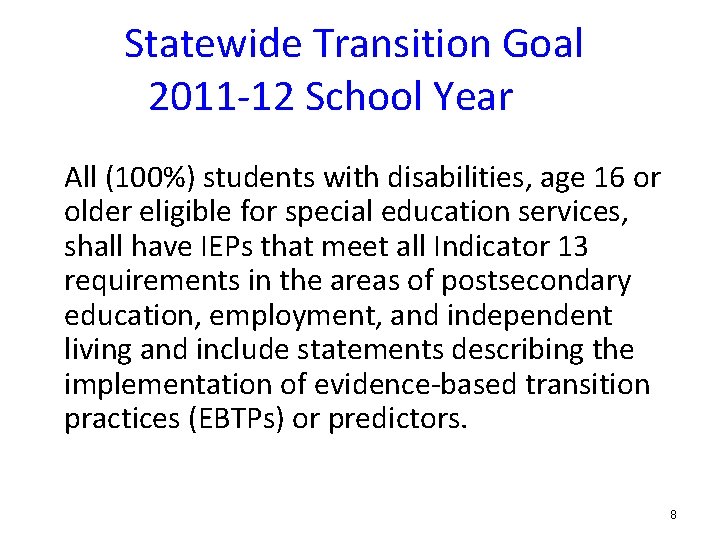
Statewide Transition Goal 2011 -12 School Year All (100%) students with disabilities, age 16 or older eligible for special education services, shall have IEPs that meet all Indicator 13 requirements in the areas of postsecondary education, employment, and independent living and include statements describing the implementation of evidence-based transition practices (EBTPs) or predictors. 8
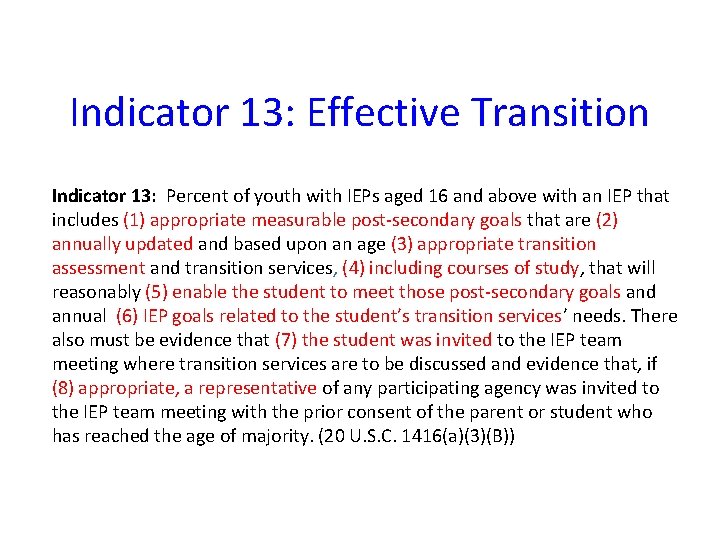
Indicator 13: Effective Transition Indicator 13: Percent of youth with IEPs aged 16 and above with an IEP that includes (1) appropriate measurable post-secondary goals that are (2) annually updated and based upon an age (3) appropriate transition assessment and transition services, (4) including courses of study, that will reasonably (5) enable the student to meet those post-secondary goals and annual (6) IEP goals related to the student’s transition services’ needs. There also must be evidence that (7) the student was invited to the IEP team meeting where transition services are to be discussed and evidence that, if (8) appropriate, a representative of any participating agency was invited to the IEP team meeting with the prior consent of the parent or student who has reached the age of majority. (20 U. S. C. 1416(a)(3)(B))
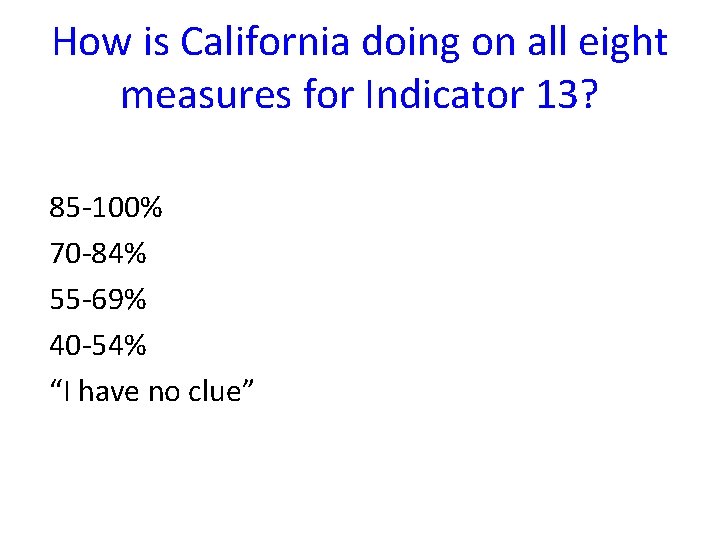
How is California doing on all eight measures for Indicator 13? 85 -100% 70 -84% 55 -69% 40 -54% “I have no clue”
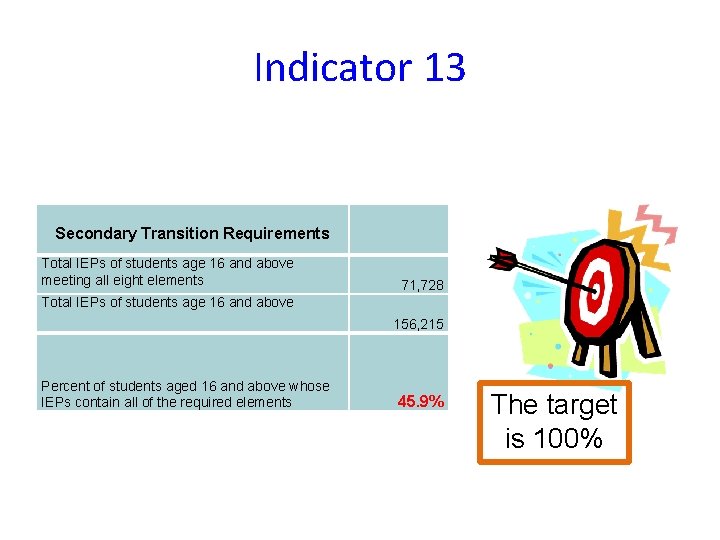
Indicator 13 Secondary Transition Requirements Total IEPs of students age 16 and above meeting all eight elements 71, 728 Total IEPs of students age 16 and above 156, 215 Percent of students aged 16 and above whose IEPs contain all of the required elements 45. 9% The target is 100%
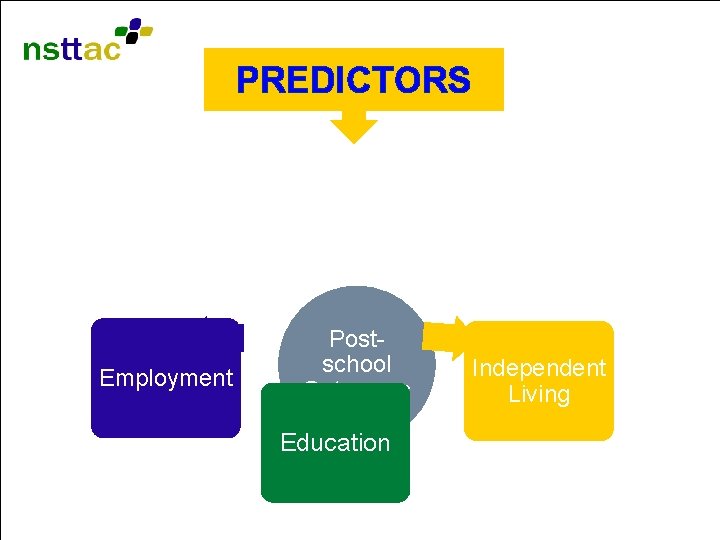
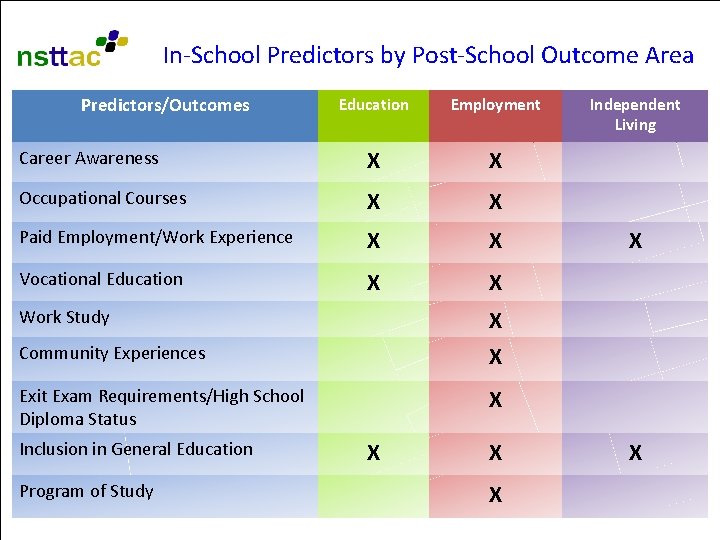
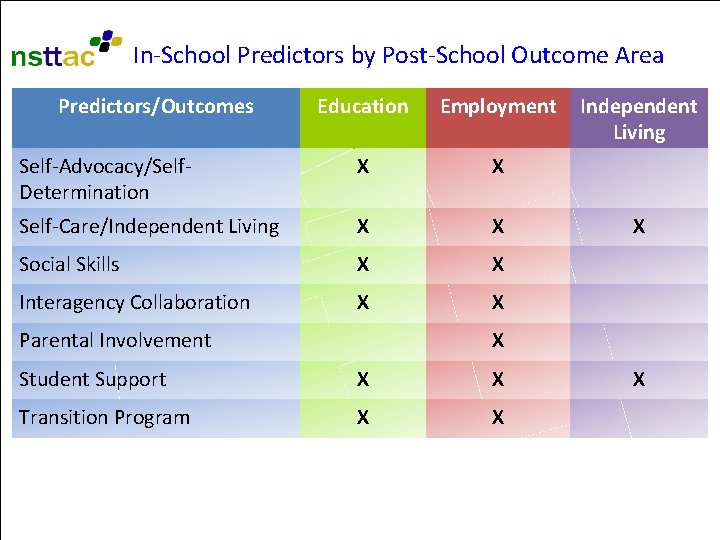
PREDICTORS Employment Postschool Outcomes Independent Living Education 12
In-School Predictors by Post-School Outcome Area Predictors/Outcomes Education Employment Career Awareness X X Occupational Courses X X Paid Employment/Work Experience X X Vocational Education X X Community Experiences X Exit Exam Requirements/High School Diploma Status Program of Study X X X Work Study Inclusion in General Education Independent Living X X 13
In-School Predictors by Post-School Outcome Area Predictors/Outcomes Education Employment Self-Advocacy/Self. Determination X X Self-Care/Independent Living X X Social Skills X X Interagency Collaboration X X Parental Involvement Independent Living X X Student Support X X Transition Program X X X 15
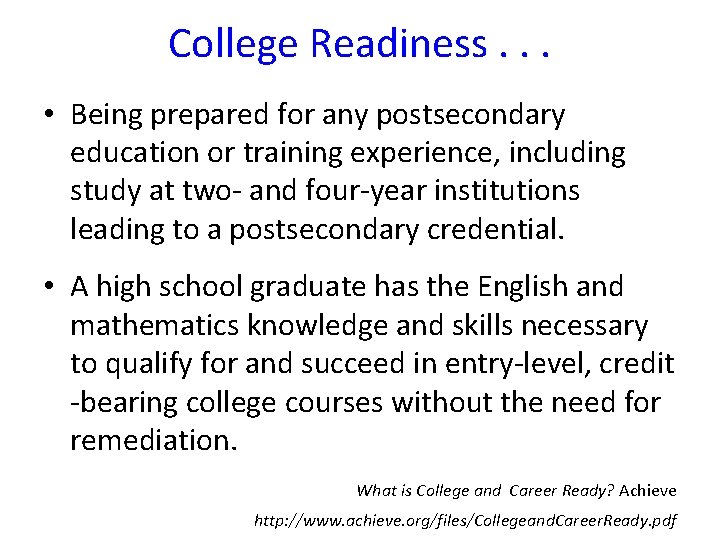
College Readiness. . . • Being prepared for any postsecondary education or training experience, including study at two- and four-year institutions leading to a postsecondary credential. • A high school graduate has the English and mathematics knowledge and skills necessary to qualify for and succeed in entry-level, credit -bearing college courses without the need for remediation. What is College and Career Ready? Achieve http: //www. achieve. org/files/Collegeand. Career. Ready. pdf
Career Readiness. . . A high school graduate has the English and mathematics knowledge and skills needed to qualify for and succeed in the postsecondary job training and/or education necessary for their chosen career (i. e. , technical/vocational program, community college, apprenticeship or significant on-the-job training). What is College and Career Ready? Achieve http: //www. achieve. org/files/Collegeand. Career. Ready. pdf
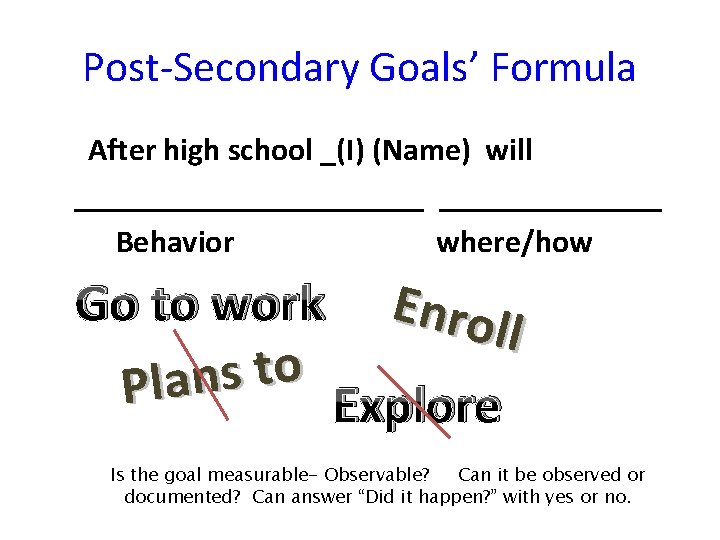
Post-Secondary Goals’ Formula After high school _(I) (Name) will ___________ Behavior where/how Go to work Enrol l o t s n Pla Explore Is the goal measurable- Observable? Can it be observed or documented? Can answer “Did it happen? ” with yes or no.
Measurable Postsecondary Goals • Appropriate measurable postsecondary goals – Appropriate is based on the child’s chronological age rather than developmental age • Refers to goals a child hopes to achieve after leaving secondary school • Postsecondary goal is not the process of moving toward a desire outcome. • Post secondary goal is related to training, education, employment, independent living skills IDEA 2004: Part B: Section 614 (d)(1)(A)(aa)
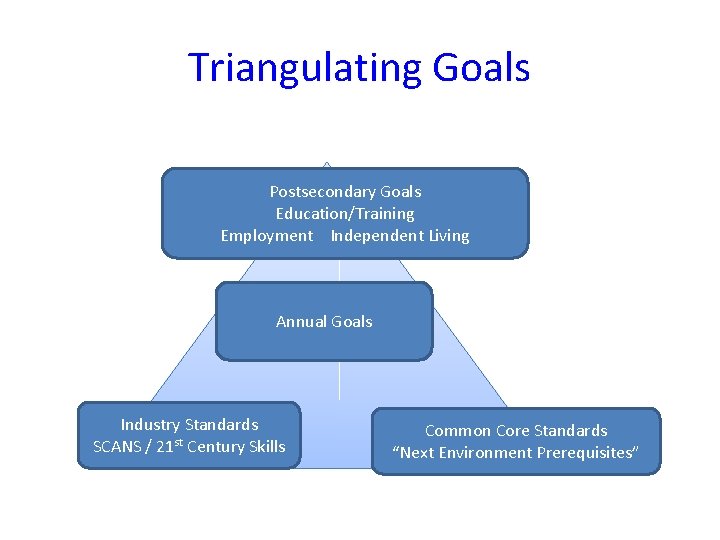
Annual Goals • Prepare annually for postsecondary goals • Directly relate to education, employment, and independent living goal statements • How do we know the goals are reasonable and relevant? We will explore integrating industry standards in the IEP through a process defined as “Triangulation”.
Triangulating Goals Postsecondary Goal Education/Training Employment Independent Living Annual. Goals Annual Industry Standards SCANS / 21 st Century Skills Common Core Standards “Next Environment Prerequisites”
Industry Standards Inform the IEP • Have you ever wondered what students need to know and do in various career areas? • O’NET is the Occupation Information Network that is the national database for jobs in the U. S • It lists the industry standards required for success in the student’s stated career interest area. It can be aligned with student assessments. • We will explore how Industry Standards language can be integrated into the annual goal statement.
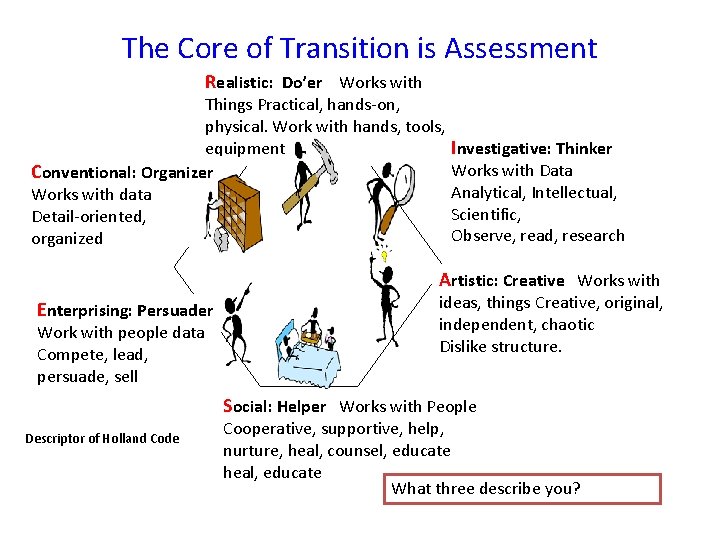
The Core of Transition is Assessment Realistic: Do’er Works with Things Practical, hands-on, physical. Work with hands, tools, equipment Investigative: Thinker Works with Data Conventional: Organizer Analytical, Intellectual, Works with data Scientific, Detail-oriented, Observe, read, research organized Artistic: Creative Works with Enterprising: Persuader Work with people data Compete, lead, persuade, sell ideas, things Creative, original, independent, chaotic Dislike structure. Social: Helper Works with People Descriptor of Holland Code Cooperative, supportive, help, nurture, heal, counsel, educate heal, educate What three describe you?
Let’s Explore Industry Standards California Career Resource Network www. californiacareer s. info O*Net Online http: //www. onetonline. or g/
Industry ~ Informing the IEP • Industry standards are the level of skills required for success in the student’s stated career interest area • Generates discussion about goals being realistic, attainable • An annual goal statement
Realistic Goal Issue • Sometimes students state goals that are inconsistent with their assessment information • Sometimes students state goals that appear to be unrealistic • Industry standards, Labor Market Information, and postsecondary program prerequisites can be researched and explored by the students who are preparing for competitive employment http: //www. edd. ca. gov
A Message from President Obama A National Goal. . . “Every student should graduate from high school ready for college and a career, regardless of their income, race, ethnic or language background, or disability status. ”
Why college and career ready? • Increased competition for employment • Employers’ expectations • Poverty is linked to level of education http: //www. achieve. org/files/Collegeand. Career. Ready. pdf Douglas-Hall, A. & Chau M. (2007). Parents’ Low Education Leads to Low Income, Despite Full-Time Employment. National Center for Children in Poverty, Columbia University Mailman School of Public Health. http: //www. nccp. org/publications/pub_786. html
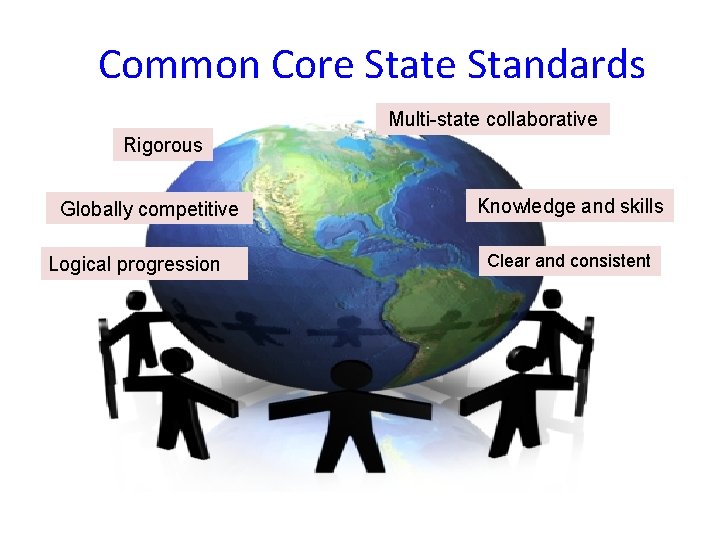
Common Core State Standards Multi-state collaborative Rigorous Globally competitive Logical progression Knowledge and skills Clear and consistent
CCSS Foundations • Aligned with college and work expectations • Prepare students for success in entry-level, credit bearing, academic college courses (2 - and 4 -year postsecondary institutions) • Prepare students for success in careers that offer competitive livable salaries above the poverty line, opportunities for career advancement, and are in growing or sustainable industries
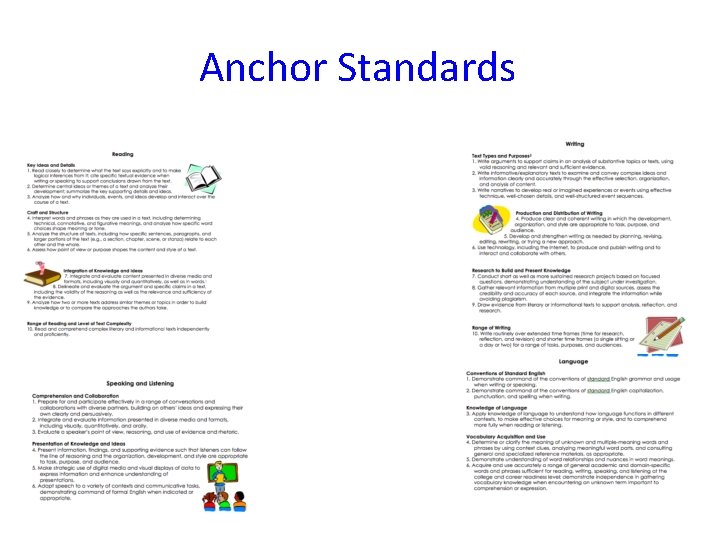
Anchor Standards
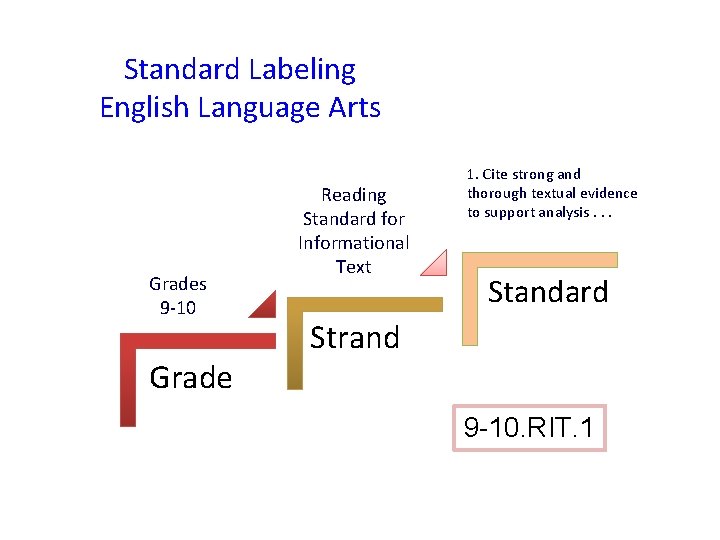
Standard Labeling English Language Arts Grades 9 -10 Grade Reading Standard for Informational Text 1. Cite strong and thorough textual evidence to support analysis. . . Standard Strand 9 -10. RIT. 1
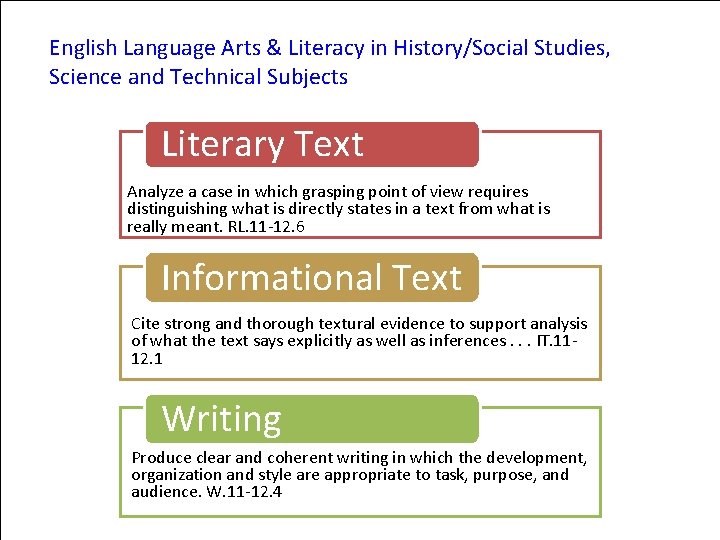
English Language Arts & Literacy in History/Social Studies, Science and Technical Subjects Literary Text Analyze a case in which grasping point of view requires distinguishing what is directly states in a text from what is really meant. RL. 11 -12. 6 Informational Text Cite strong and thorough textural evidence to support analysis of what the text says explicitly as well as inferences. . . IT. 1112. 1 Writing Produce clear and coherent writing in which the development, organization and style are appropriate to task, purpose, and audience. W. 11 -12. 4 California Department of Education 33
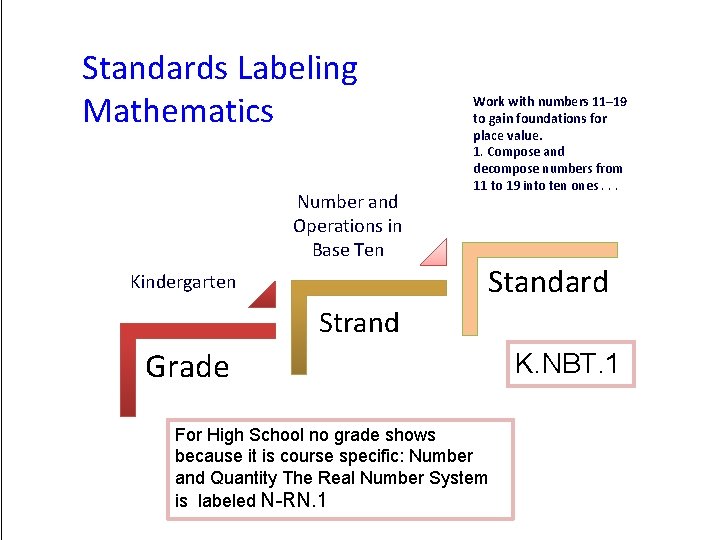
Standards Labeling Mathematics Number and Operations in Base Ten Kindergarten Work with numbers 11– 19 to gain foundations for place value. 1. Compose and decompose numbers from 11 to 19 into ten ones. . . Standard Strand Grade For High School no grade shows because it is course specific: Number and Quantity The Real Number System is labeled N-RN. 1 California Department of Education K. NBT. 1 34
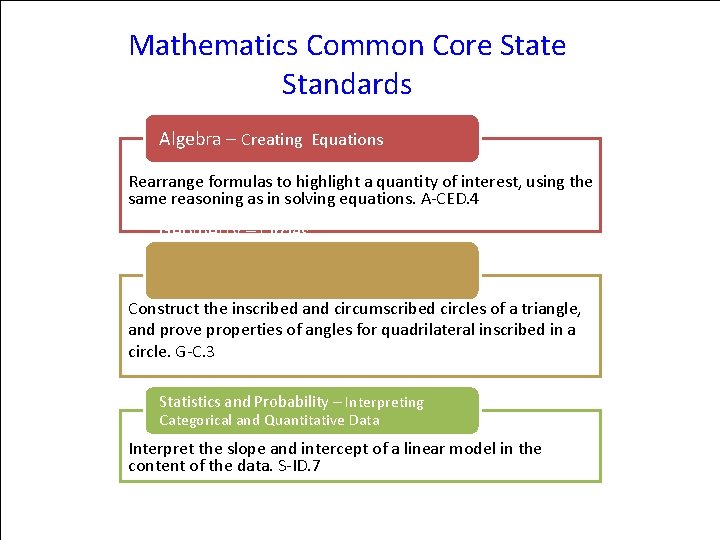
Mathematics Common Core State Standards Algebra – Creating Equations Rearrange formulas to highlight a quantity of interest, using the same reasoning as in solving equations. A-CED. 4 Geometry – Circles Construct the inscribed and circumscribed circles of a triangle, and prove properties of angles for quadrilateral inscribed in a circle. G-C. 3 Statistics and Probability – Interpreting Categorical and Quantitative Data Interpret the slope and intercept of a linear model in the content of the data. S-ID. 7 California Department of Education 35
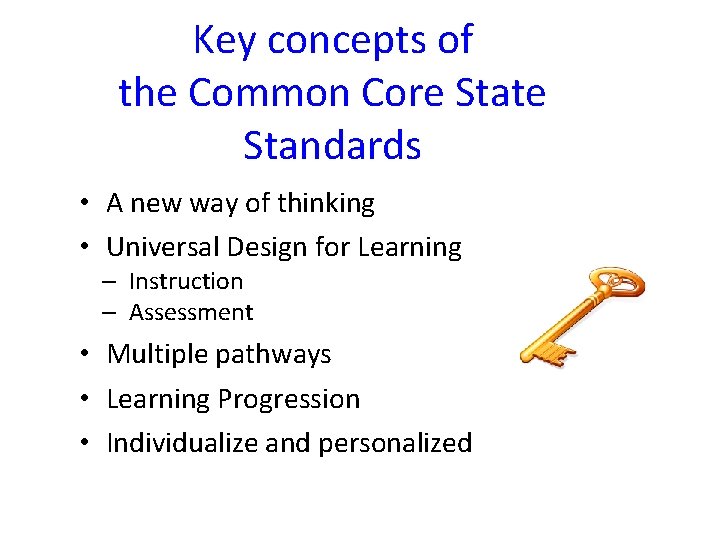
Key concepts of the Common Core State Standards • A new way of thinking • Universal Design for Learning – Instruction – Assessment • Multiple pathways • Learning Progression • Individualize and personalized
A New Way of Thinking. . . “This is a change in spirit. It’s a change in how we think about kids and practice every day; of moving from a world where we’re trying to protect them from the things we think are hard, to helping them embrace and encounter those things that are hard to practice them, as an aid to them. . . so it is a moral an ethical move. ” ~ David Coleman 2011
Triangulating Goals
Transition A coordinated set of activities for a child with a disability. . . • Designed to facilitate the child’s movement from school to post-school activities • Based on the individual child’s needs, taking into account the child’s strengths, preferences, and interests IDEA Partnership, June, 2011
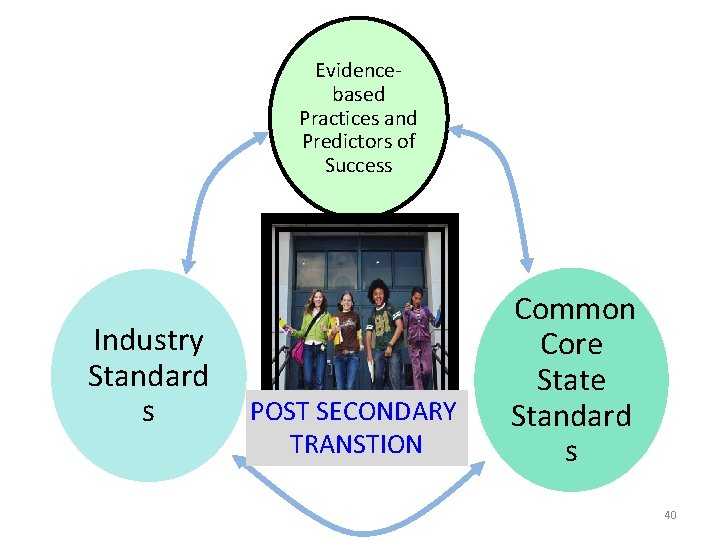
Evidencebased Practices and Predictors of Success Industry Standard s POST SECONDARY TRANSTION Common Core State Standard s 40
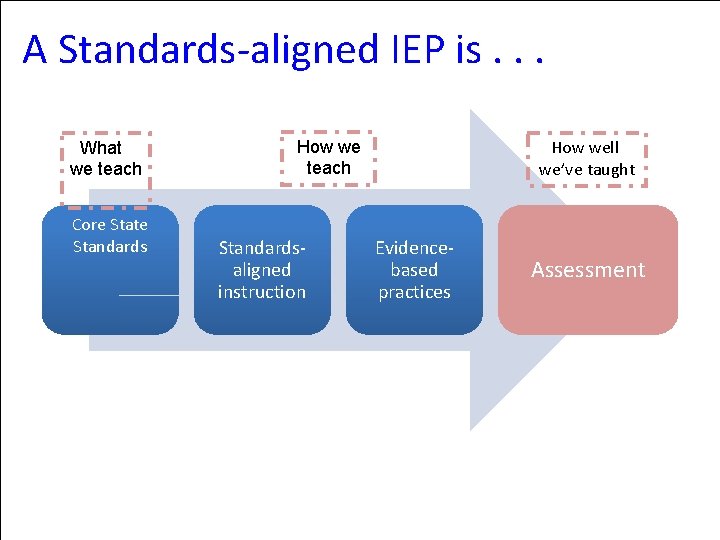
A Standards-aligned IEP is. . . What we teach Core State Standards How well we’ve taught How we teach Standardsaligned instruction Evidencebased practices Assessment
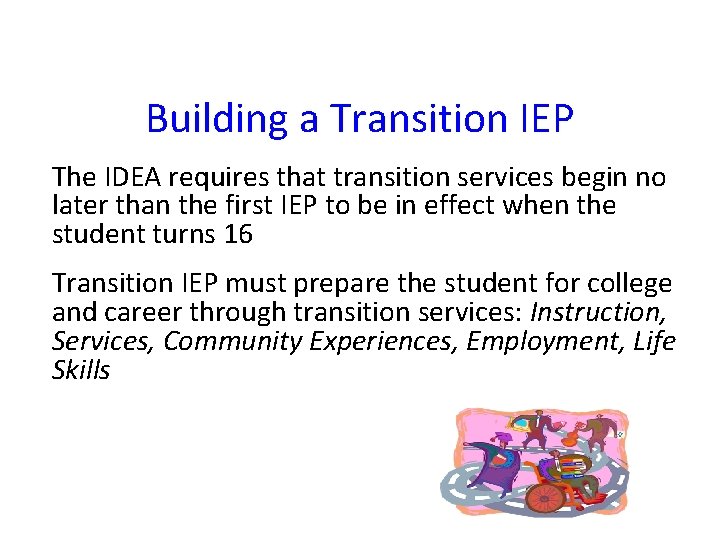
Building a Transition IEP The IDEA requires that transition services begin no later than the first IEP to be in effect when the student turns 16 Transition IEP must prepare the student for college and career through transition services: Instruction, Services, Community Experiences, Employment, Life Skills
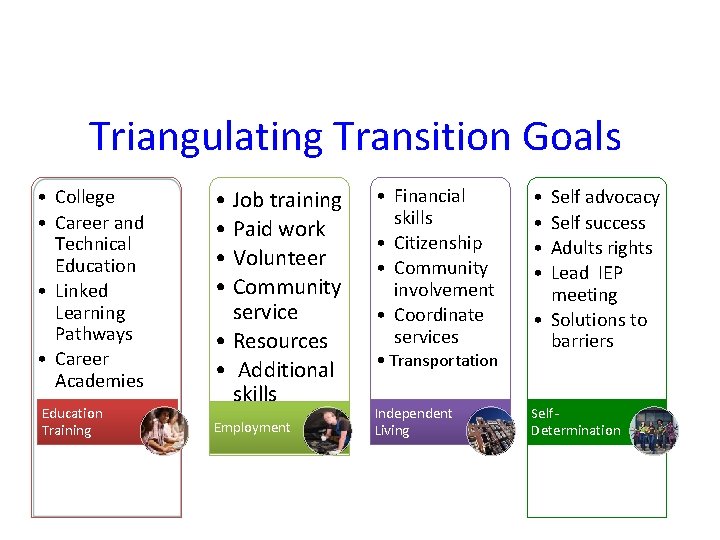
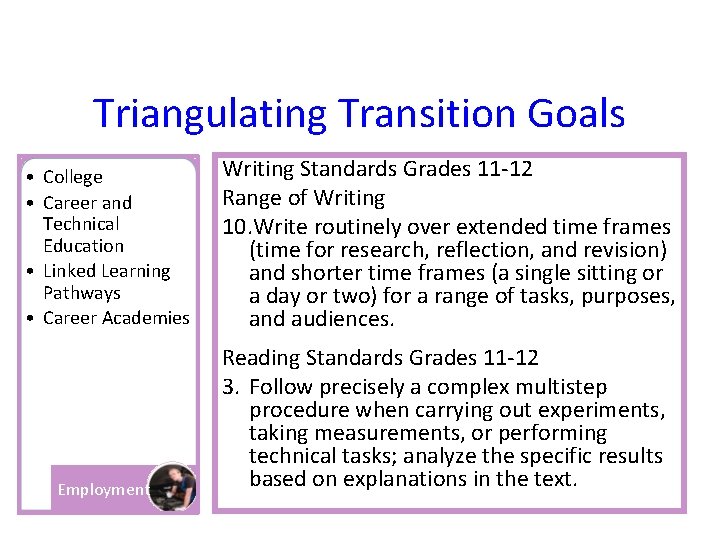
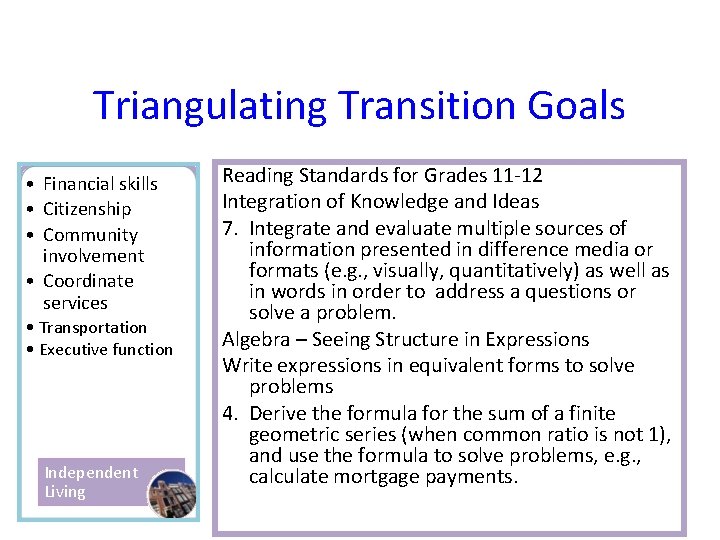
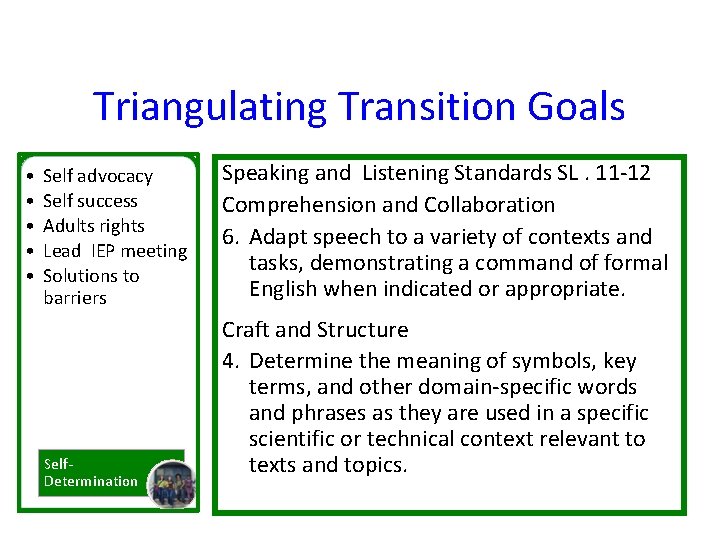
Triangulating Transition Goals • College • Career and Technical Education • Linked Learning Pathways • Career Academies Education Training • Job training • Paid work • Volunteer • Community service • Resources • Additional skills Employment • Financial skills • Citizenship • Community involvement • Coordinate services • Transportation Independent Living • • Self advocacy Self success Adults rights Lead IEP meeting • Solutions to barriers Self. Determination
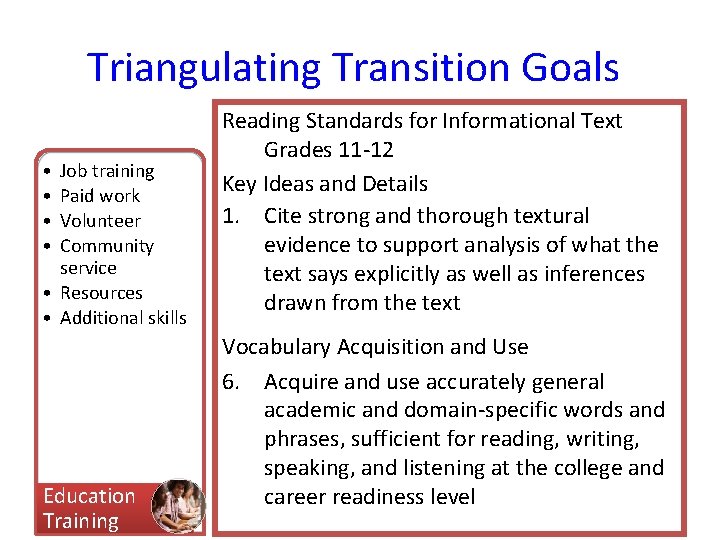
Triangulating Transition Goals • • Job training Paid work Volunteer Community service • Resources • Additional skills Education Training Reading Standards for Informational Text Grades 11 -12 Key Ideas and Details 1. Cite strong and thorough textural evidence to support analysis of what the text says explicitly as well as inferences drawn from the text Vocabulary Acquisition and Use 6. Acquire and use accurately general academic and domain-specific words and phrases, sufficient for reading, writing, speaking, and listening at the college and career readiness level
Triangulating Transition Goals • College • Career and Technical Education • Linked Learning Pathways • Career Academies Writing Standards Grades 11 -12 Range of Writing 10. Write routinely over extended time frames (time for research, reflection, and revision) and shorter time frames (a single sitting or a day or two) for a range of tasks, purposes, and audiences. Employment Reading Standards Grades 11 -12 3. Follow precisely a complex multistep procedure when carrying out experiments, taking measurements, or performing technical tasks; analyze the specific results based on explanations in the text.
Triangulating Transition Goals • Financial skills • Citizenship • Community involvement • Coordinate services • Transportation • Executive function Independent Living Reading Standards for Grades 11 -12 Integration of Knowledge and Ideas 7. Integrate and evaluate multiple sources of information presented in difference media or formats (e. g. , visually, quantitatively) as well as in words in order to address a questions or solve a problem. Algebra – Seeing Structure in Expressions Write expressions in equivalent forms to solve problems 4. Derive the formula for the sum of a finite geometric series (when common ratio is not 1), and use the formula to solve problems, e. g. , calculate mortgage payments.
Triangulating Transition Goals • • • Self advocacy Self success Adults rights Lead IEP meeting Solutions to barriers Self. Determination Speaking and Listening Standards SL. 11 -12 Comprehension and Collaboration 6. Adapt speech to a variety of contexts and tasks, demonstrating a command of formal English when indicated or appropriate. Craft and Structure 4. Determine the meaning of symbols, key terms, and other domain-specific words and phrases as they are used in a specific scientific or technical context relevant to texts and topics.
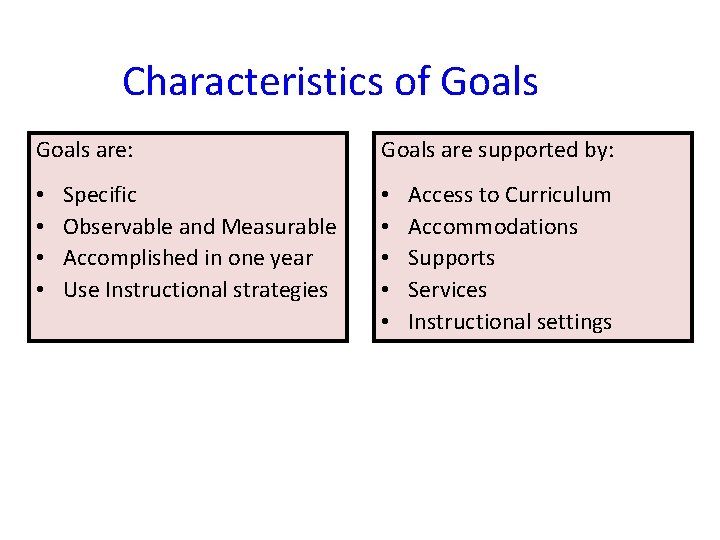
/2020 Characteristics of Goals are: • • Specific Observable and Measurable Accomplished in one year Use Instructional strategies Goals are supported by: • • • Access to Curriculum Accommodations Supports Services Instructional settings
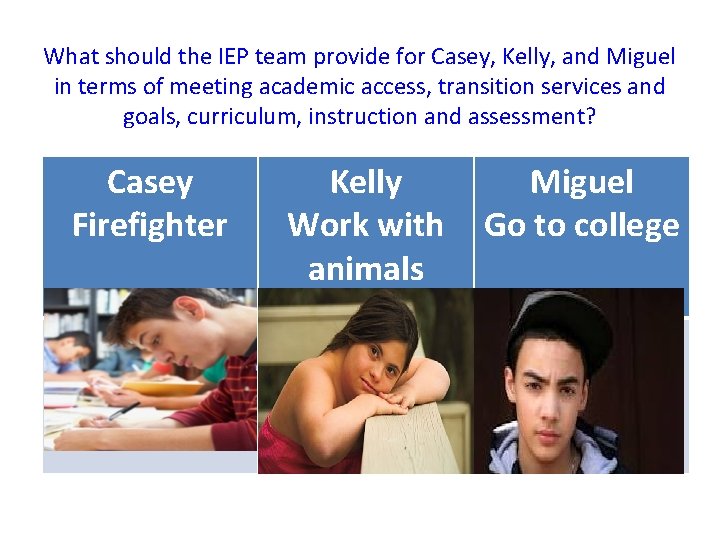
What should the IEP team provide for Casey, Kelly, and Miguel in terms of meeting academic access, transition services and goals, curriculum, instruction and assessment? Casey Firefighter Kelly Work with animals Miguel Go to college
Think about Casey. . . Casey is a very social 16 -year-old sophomore. He is eligible for special education under specific learning disability. He maintains a “B” average, taking courses this block semester in Art, Algebra, World Studies, and co-taught English with a lot of special education support. He would like to become a fire fighter. Analyze: Which skills will have the greatest academic impact on future growth, success and transition to post secondary life?
Casey’s Strengths and Needs Strengths • Good time management and strong work ethic • Using appropriate tools strategically • Social skills with adults and peers • Strong auditory recall and comprehension • Hands-on learner • Prefers work-based learning • Passed CAHSEE Math, Reading, Writing • Excellent coordination and physical strength Needs • Written composition • Reading comprehension • Vocabulary o dt e e n e h es er? o d t h at g h i W ef r i f be a
California’s Common Core State Standards for English Language Arts & Literacy in History /Social Studies, Science and Technical Subjects Reading Standards for Informational Text 6 -12: Grades 11 -12: Key Ideas and Details 1. Cite strong and thorough textural evidence to support analysis of what the text says explicitly as well as inferences drawn from the text. Linking the annual goal to the CCSS
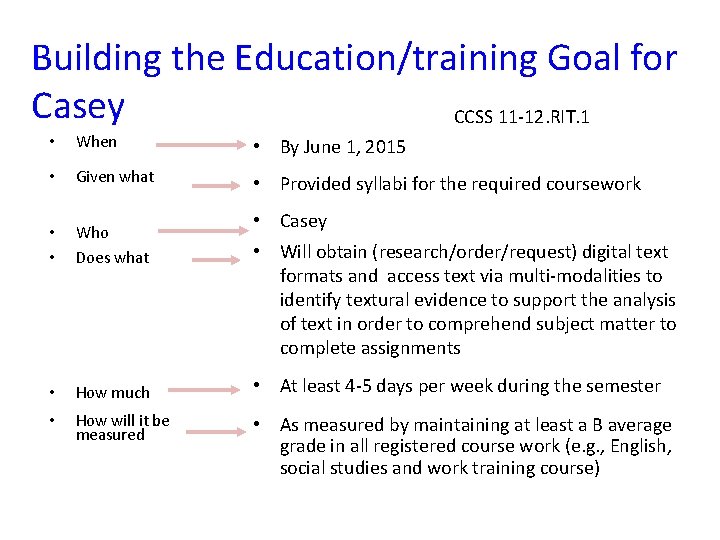
Building the Education/training Goal for Casey CCSS 11 -12. RIT. 1 • When • By June 1, 2015 • Given what • Provided syllabi for the required coursework • • Who Does what • How much • At least 4 -5 days per week during the semester • How will it be measured • As measured by maintaining at least a B average grade in all registered course work (e. g. , English, social studies and work training course) • Casey • Will obtain (research/order/request) digital text formats and access text via multi-modalities to identify textural evidence to support the analysis of text in order to comprehend subject matter to complete assignments
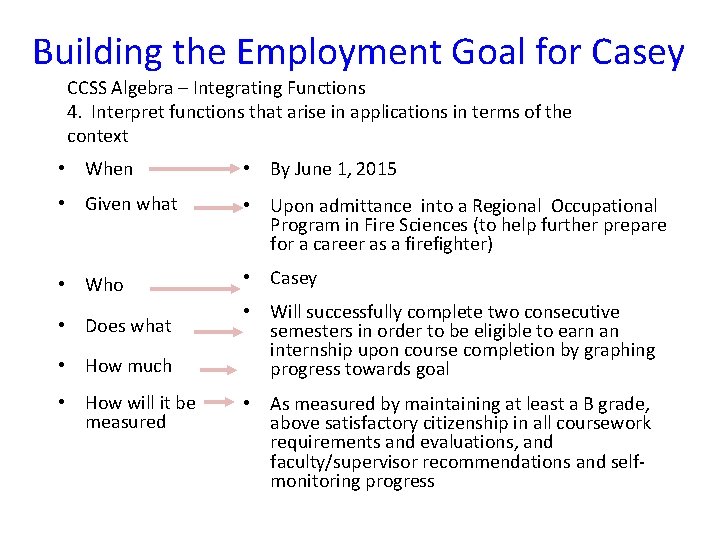
Building the Employment Goal for Casey CCSS Algebra – Integrating Functions 4. Interpret functions that arise in applications in terms of the context • When • By June 1, 2015 • Given what • Upon admittance into a Regional Occupational Program in Fire Sciences (to help further prepare for a career as a firefighter) • Who • Casey • Does what • How much • How will it be measured • Will successfully complete two consecutive semesters in order to be eligible to earn an internship upon course completion by graphing progress towards goal • As measured by maintaining at least a B grade, above satisfactory citizenship in all coursework requirements and evaluations, and faculty/supervisor recommendations and selfmonitoring progress
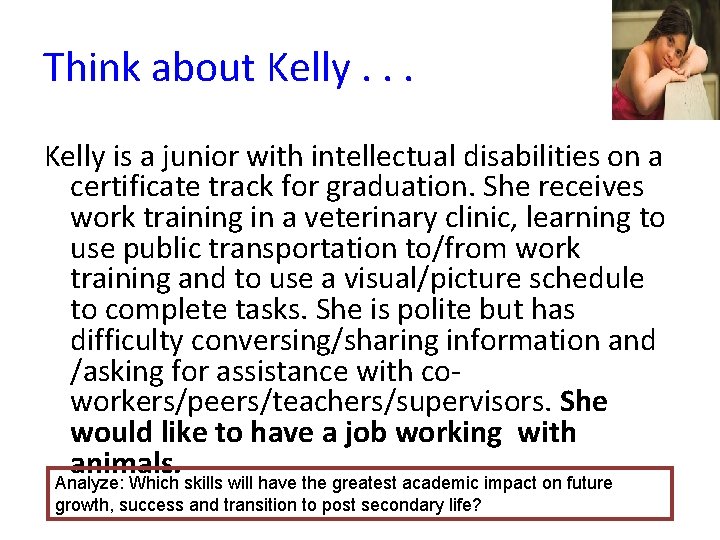
Think about Kelly. . . Kelly is a junior with intellectual disabilities on a certificate track for graduation. She receives work training in a veterinary clinic, learning to use public transportation to/from work training and to use a visual/picture schedule to complete tasks. She is polite but has difficulty conversing/sharing information and /asking for assistance with coworkers/peers/teachers/supervisors. She would like to have a job working with animals. Analyze: Which skills will have the greatest academic impact on future growth, success and transition to post secondary life?
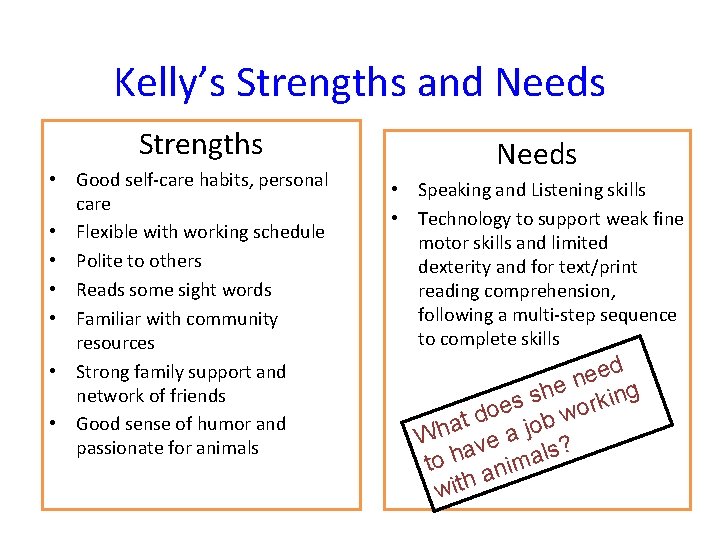
Kelly’s Strengths and Needs Strengths • Good self-care habits, personal care • Flexible with working schedule • Polite to others • Reads some sight words • Familiar with community resources • Strong family support and network of friends • Good sense of humor and passionate for animals Needs • Speaking and Listening skills • Technology to support weak fine motor skills and limited dexterity and for text/print reading comprehension, following a multi-step sequence to complete skills d e e e n ing h s rk es o o w d b at o j h a W ve als? a h to im n a with
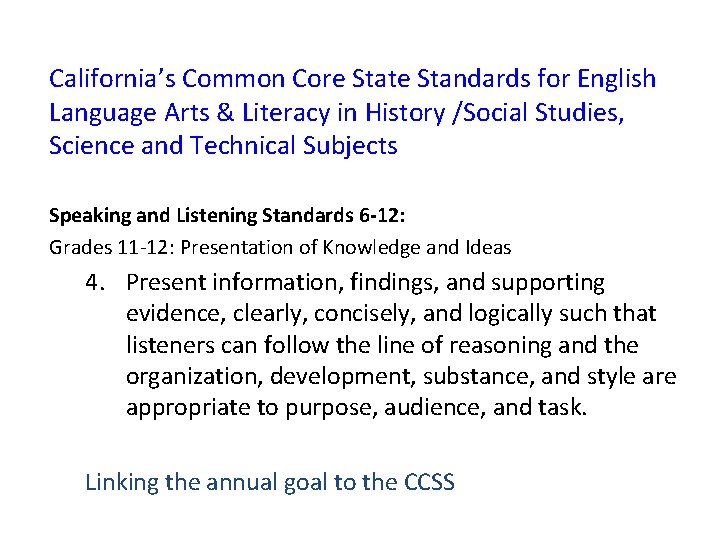
California’s Common Core State Standards for English Language Arts & Literacy in History /Social Studies, Science and Technical Subjects Speaking and Listening Standards 6 -12: Grades 11 -12: Presentation of Knowledge and Ideas 4. Present information, findings, and supporting evidence, clearly, concisely, and logically such that listeners can follow the line of reasoning and the organization, development, substance, and style are appropriate to purpose, audience, and task. Linking the annual goal to the CCSS
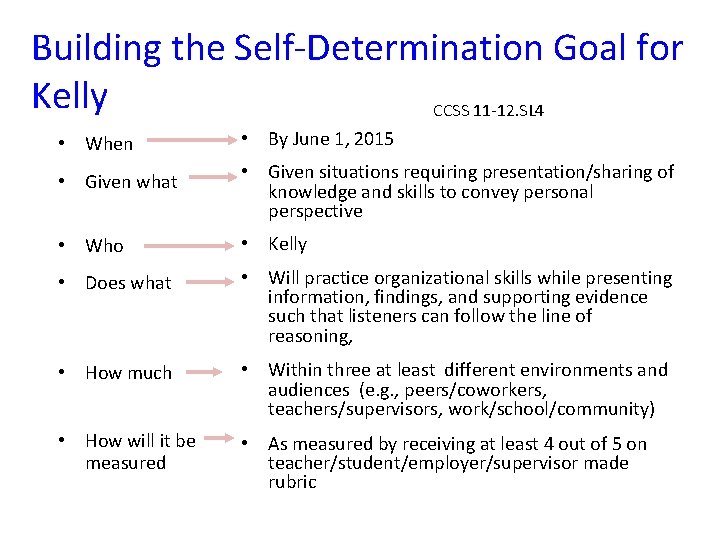
Building the Self-Determination Goal for Kelly CCSS 11 -12. SL 4 • When • By June 1, 2015 • Given what • Given situations requiring presentation/sharing of knowledge and skills to convey personal perspective • Who • Kelly • Does what • Will practice organizational skills while presenting information, findings, and supporting evidence such that listeners can follow the line of reasoning, • How much • Within three at least different environments and audiences (e. g. , peers/coworkers, teachers/supervisors, work/school/community) • How will it be measured • As measured by receiving at least 4 out of 5 on teacher/student/employer/supervisor made rubric
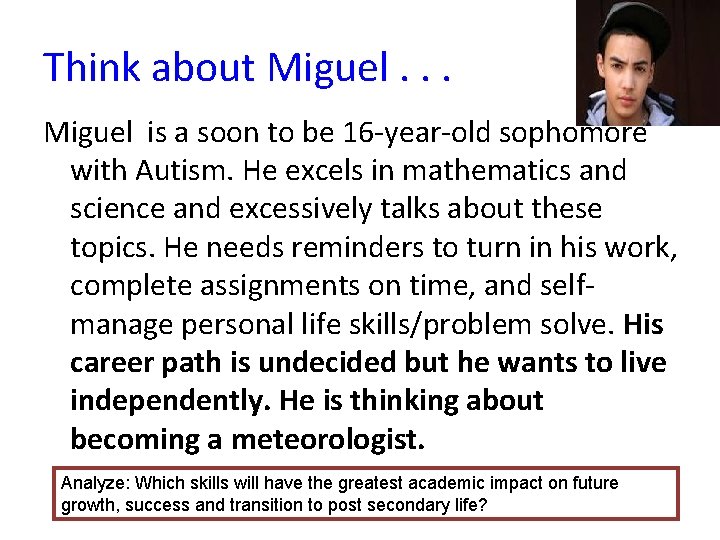
Think about Miguel. . . Miguel is a soon to be 16 -year-old sophomore with Autism. He excels in mathematics and science and excessively talks about these topics. He needs reminders to turn in his work, complete assignments on time, and selfmanage personal life skills/problem solve. His career path is undecided but he wants to live independently. He is thinking about becoming a meteorologist. Analyze: Which skills will have the greatest academic impact on future growth, success and transition to post secondary life?
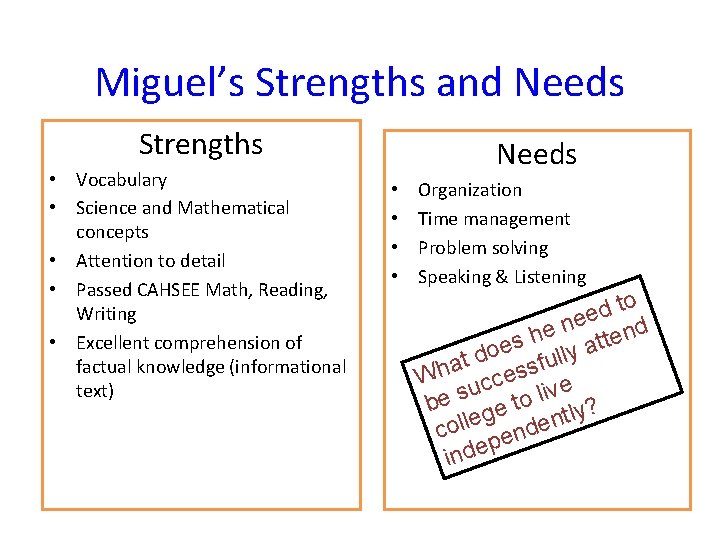
Miguel’s Strengths and Needs Strengths • Vocabulary • Science and Mathematical concepts • Attention to detail • Passed CAHSEE Math, Reading, Writing • Excellent comprehension of factual knowledge (informational text) Needs • • Organization Time management Problem solving Speaking & Listening to d e e nd h e t t s a e o y l d l at essfu h W ucc e v i s l e to b ? e y l g t e coll penden inde
California’s Common Core State Standards for English Language Arts & Literacy in History /Social Studies, Science and Technical Subjects Reading Standards for Informational Text 6 -12: Grades 11 -12: Integration of Knowledge and Ideas 7. Integrate and evaluate multiple sources of information presented in different media or formats (e. g. , visually, quantitatively) as well as in words in order to address a question or solve a problem. Linking the annual goal to the CCSS
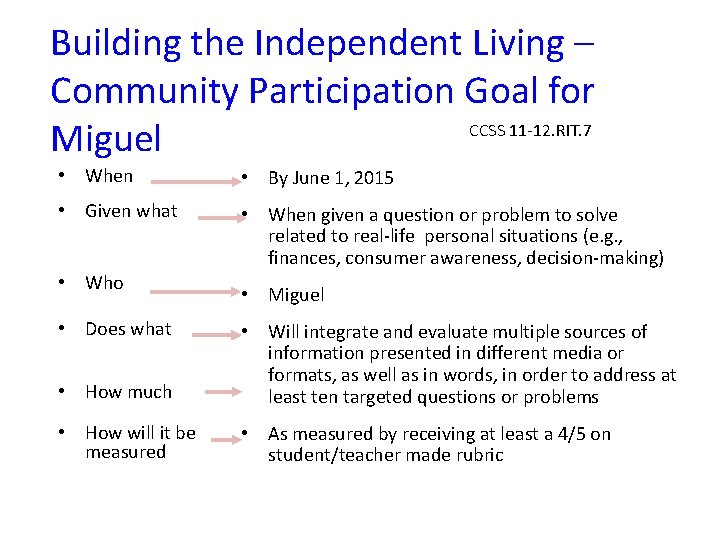
Building the Independent Living – Community Participation Goal for CCSS 11 -12. RIT. 7 Miguel • When • By June 1, 2015 • Given what • When given a question or problem to solve related to real-life personal situations (e. g. , finances, consumer awareness, decision-making) • Who • Does what • Miguel • How much • Will integrate and evaluate multiple sources of information presented in different media or formats, as well as in words, in order to address at least ten targeted questions or problems • How will it be measured • As measured by receiving at least a 4/5 on student/teacher made rubric
Triangulating Transition Goals Are Casey, Kelly, and Miguel on the right track to be College and Career ready in terms of meeting academic access, transition services and goals by the time they graduate?
A Teacher’s Perspective. . . Meet Amanda Van Kleist Putting it all together. . .
Reflection. . . • Questions • Comments Thank you!
Resources from the State of California – • http: //www. cde. state. co. us/cdesped/TK. asp • http: //www. cde. state. co. us/Transition. IEPTraining/2 Page 2 Overviewofthe. Componentsofa. Transition. IEP. asp Website-Based • Common Core State Standards Collections IDEA Partnership http: //www. ideapartnership. org/index. phpoption=co m_content&view=article&id=1522 • Common Core Curriculum Maps for English Language Arts - http: //commoncore. org/maps/index. php